Painter Victor Wang has approached the violence and energy of the volcanic alembic. He has seen the frozen surges of unreal lava rivers spilled in a splattered profusion of glow-bright oranges and reds, and poured from the fissures and craters breaking the earth’s landscape, then cooled into violent forms of encrusted black rock and smooth flows. Each ecstatic eruption raises new land from oceans, brews vast clouds of steam and smoke, throws ash and stone high into the atmosphere, turns rain into acid, and freezes liquid into stone.
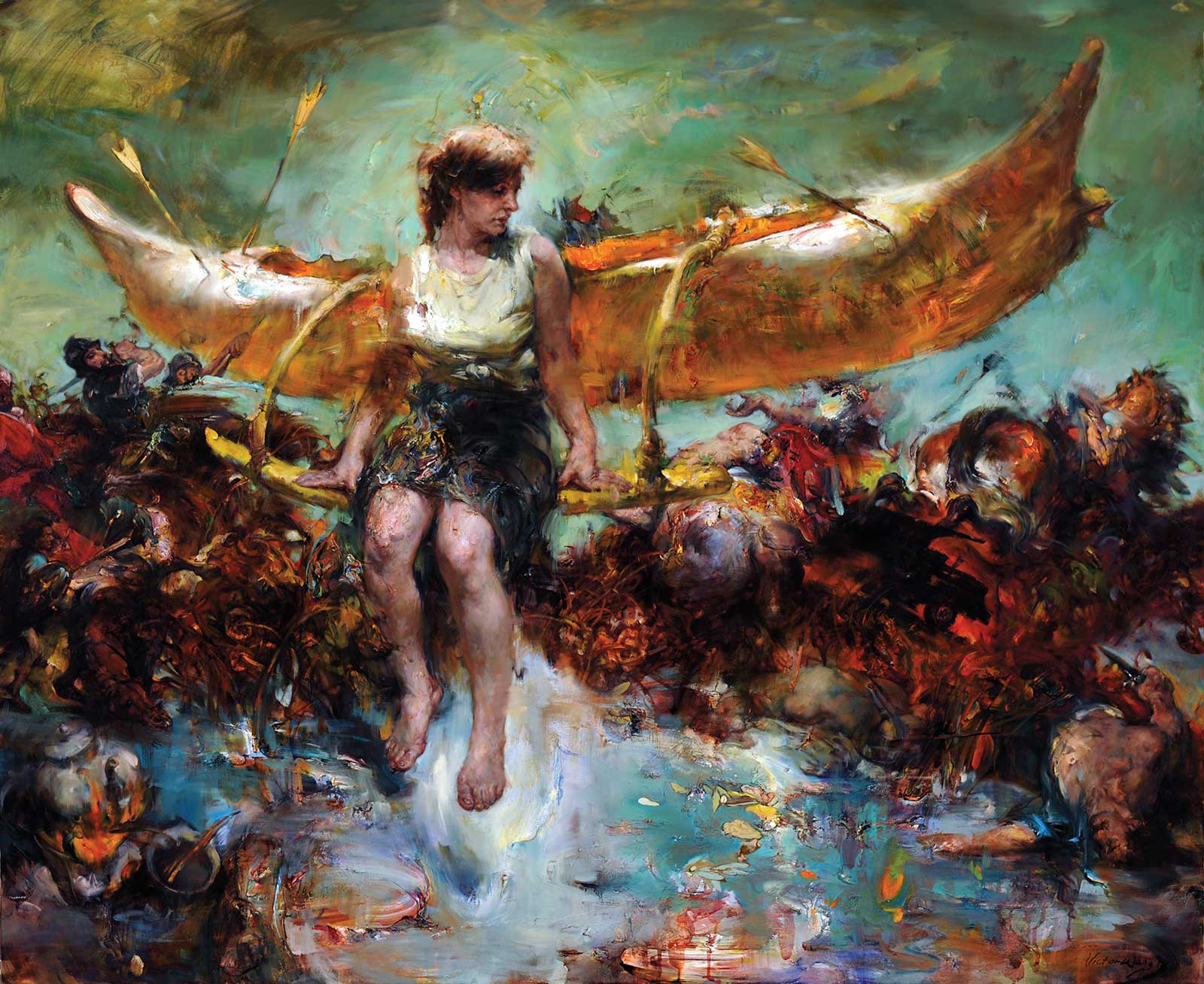 Listing the Battle, 2019, oil on canvas, 48 x 60"
“I went to Hawaii, and I felt so amazed and overwhelmed by the volcano,” says Wang, recalling his introduction to the presence of such pure power, of recognizing human frailty in the face of the primal. “It was the first time I’d seen real lava, the texture, the movement, the surface quality and the smell. I felt so excited, I never had this kind of experience—this humungous, epic feeling. This thing could easily wipe out human culture and life. It was so significant. I did a big drawing—three panels—with an opera singer in the center, and the lava flows down from the top, and on the left sunflowers start to burn up, and on the other side pillars from Pompeii.”
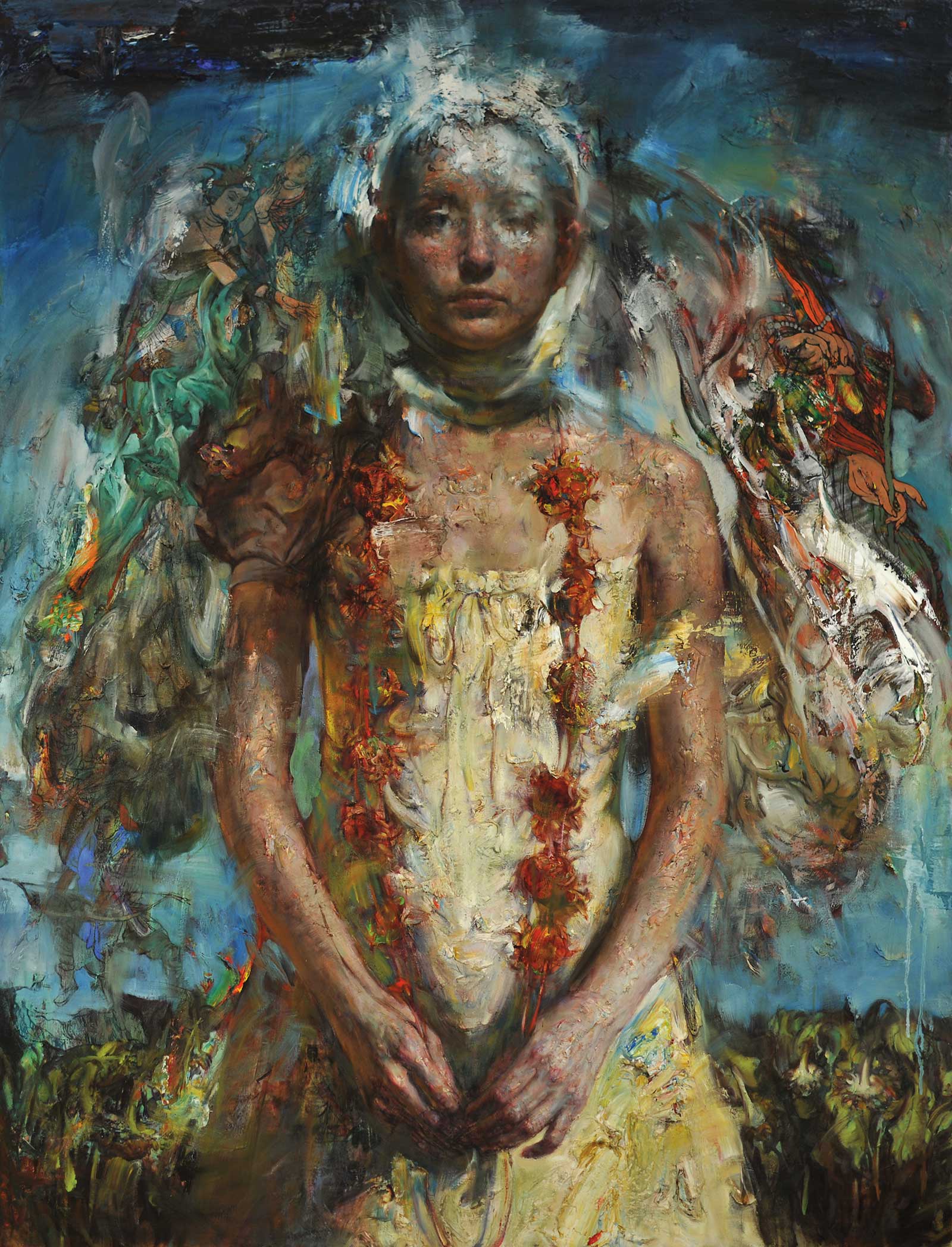
The Angel of Sunflowers, 2019, oil on canvas, 63 x 48"
The sublime power of the volcano shaped the energy of Wang’s drawing and he posted a picture of it to his social media, feeling certain that he had captured the spirit and fire of vital creativity. The lava drawing opened a hot new avenue of commercial success for him. At that time, Wang was a visiting scholar at the University of Illinois at Urbana-Champaign, and the owner of nearby Cinema Gallery saw the post and called him at once, asking to represent him. The drawing sold immediately.
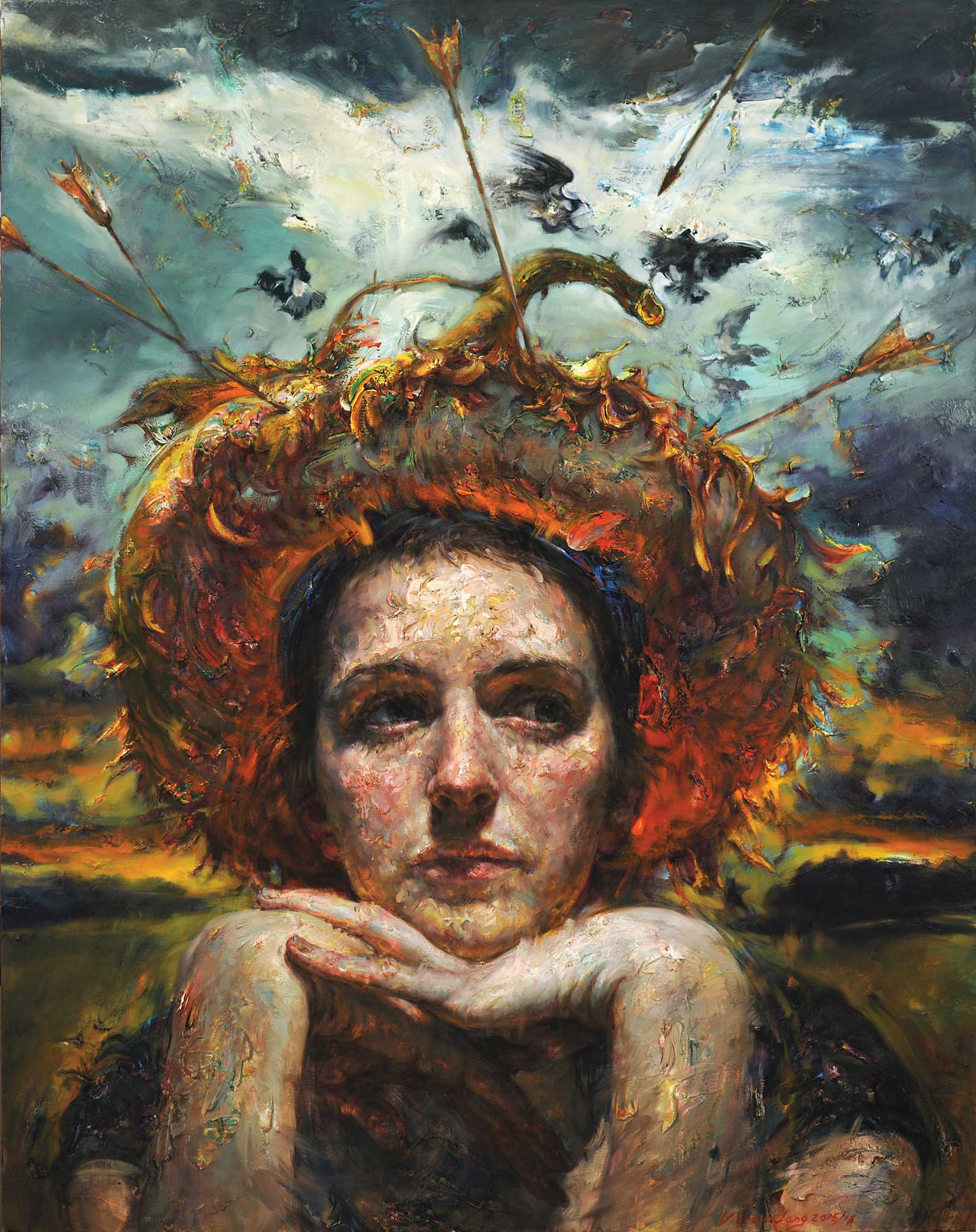
The Flushed Birds, 2016, oil on canvas, 65 x 52"
“The landscape of Hawaii was very pretty, of course,” says Wang, “but I never had strong feelings for it until I saw the lava. The lava changed the way I see nature. Before, I had heard people talking of the power of nature, but I really felt the true power with the lava. The forms, mile after mile of black, the swirling, the movement, so effective to me. I touched it here and there. It was amazing. It was warm, and soft, dynamically powerful…it felt like Rodin’s sculpture, but textured, not as smooth as your first impression. From a distance it looks like black silk, a nice flow, very lyrical, the repetition of lines, rhythm, beautiful, as you stand off you feel the power, it overcomes your body and spirit.”
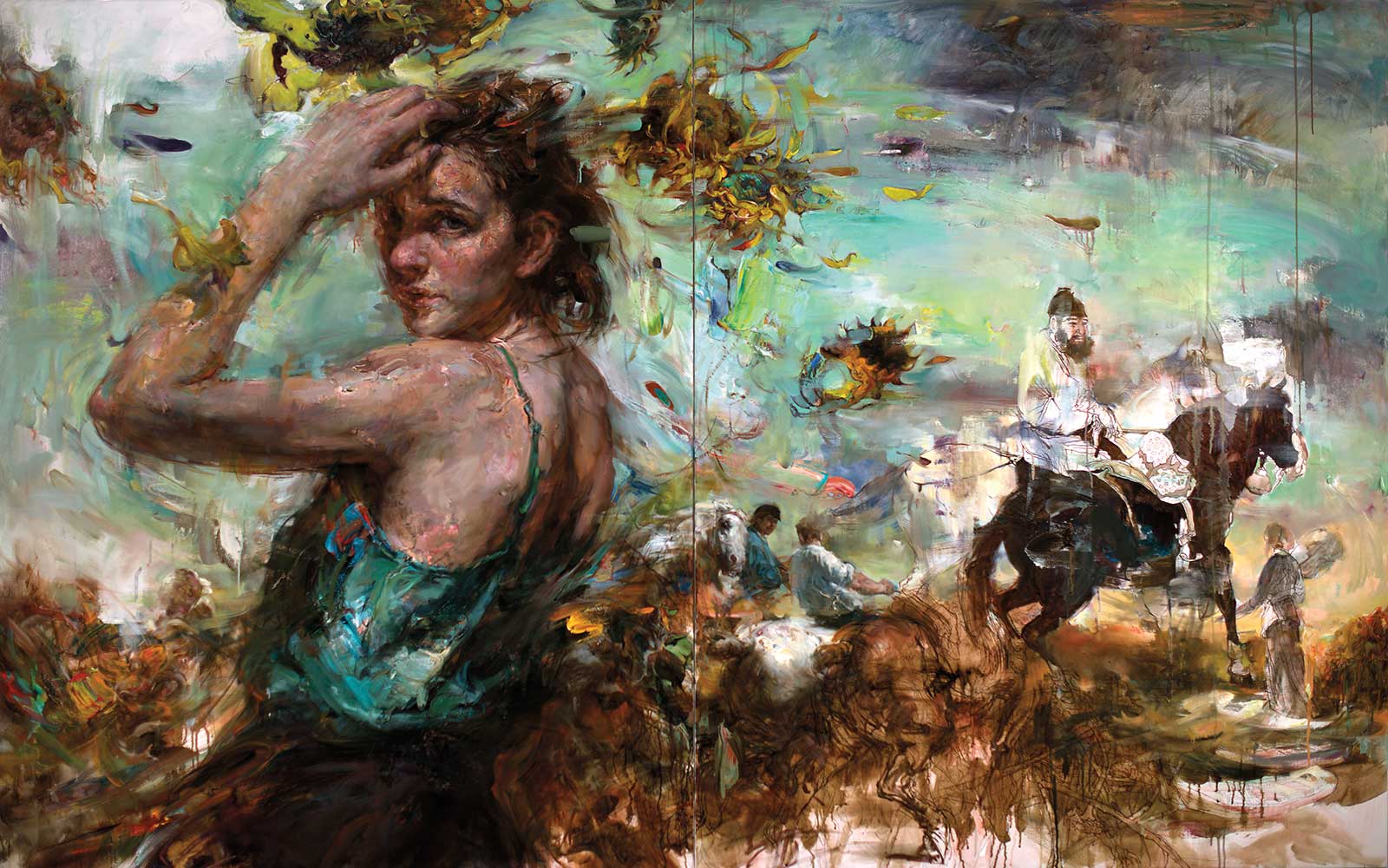
Breeze from the Orient (diptych), 2018, oil on canvas, 60 x 96"
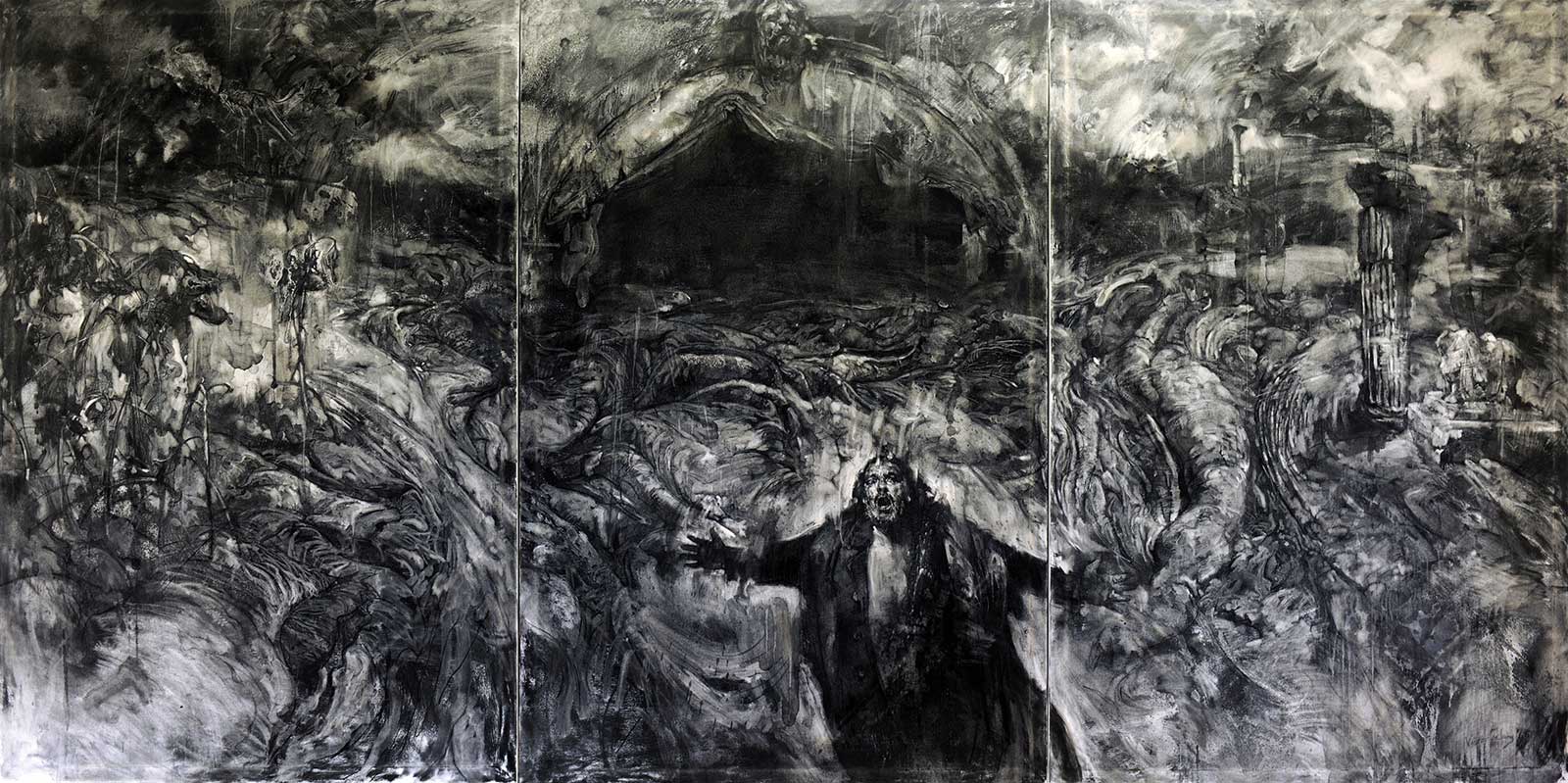
Lava - The Gate of Hell (triptych), 2017, charcoal and wash on canvas, 72 x 144"
The dry and dying sunflowers which often appear in Wang’s paintings are important emblems layered into the psychological sediments of his mind, and their symbolic destruction beneath the lava is deliberately meaningful. Wang was a child in China during the utilitarian reign of Chairman Mao and the cultural revolution. He remembers being instructed to follow Mao’s leadership in the same way the sunflower follows the sun, always turning its head to bask in the radiance of the glorious light of the heavens. Wang soon realized he was being deceived, and escaped to the freedom of the United States, where he has prospered as an individualistic artist, and the powerful image of the sunflowers continues to remind him to vigilantly guard against the dangers of totalitarian propaganda. And yet, the sunflower remains a symbol of his joy in radiant nature, too, and he has sometimes crowned his subjects in its golden halo. In The Flushed Birds the drying sunflower is his model’s crown, pierced by arrows which have frightened portentous crows from their concealment.
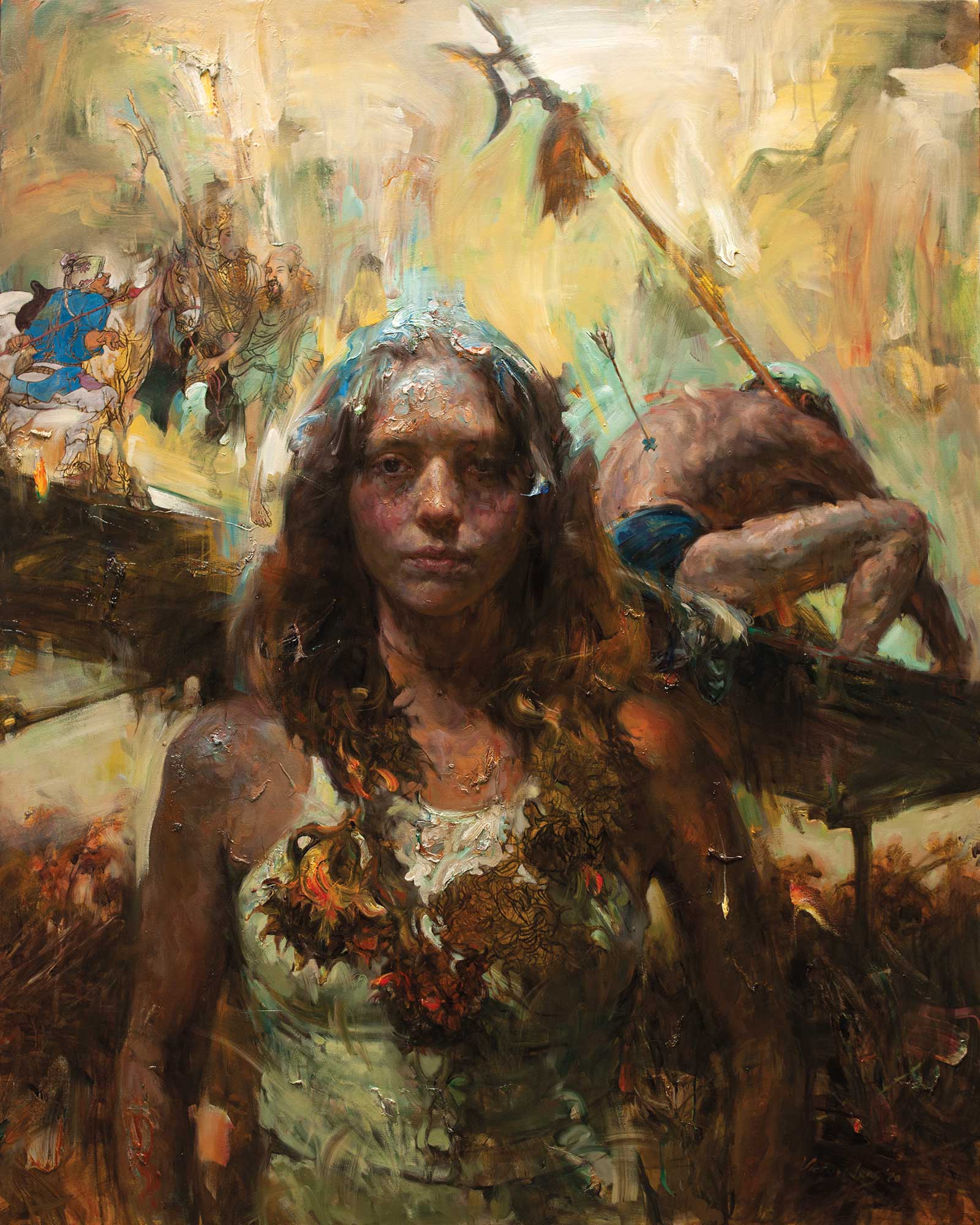
Let Her Go, 2018, oil on canvas, 60 x 48"
Like an anarchic eruption, Wang has found a fiery freedom which transforms tight paint with the molten spirit of the boiling rock. The Battle is a chimeric chaos of thick texture from which figures slowly emerge, resolving as battling cowboys and the twisted forms of tormented horses, like the massed men and beasts in Da Vinci’s Battle of Anghiari. A pretty girl dressed in the innocence and white of parlay flees the turmoil. The painting is chaos, then clarity. Wang explains, “Anselm Kiefer is my favorite contemporary artist. While you stand closer you see beautiful abstract marks, and while you stand further away, you can see spatial form, realist references.” Inspired by Kiefer’s work to bring vigor to his own, he lays panels on the floor, and pushes thick paint over the scraped surface. This vigorous abstraction defaced dead sunflowers with dark violence and settled his dissatisfaction with that youthful indoctrination.
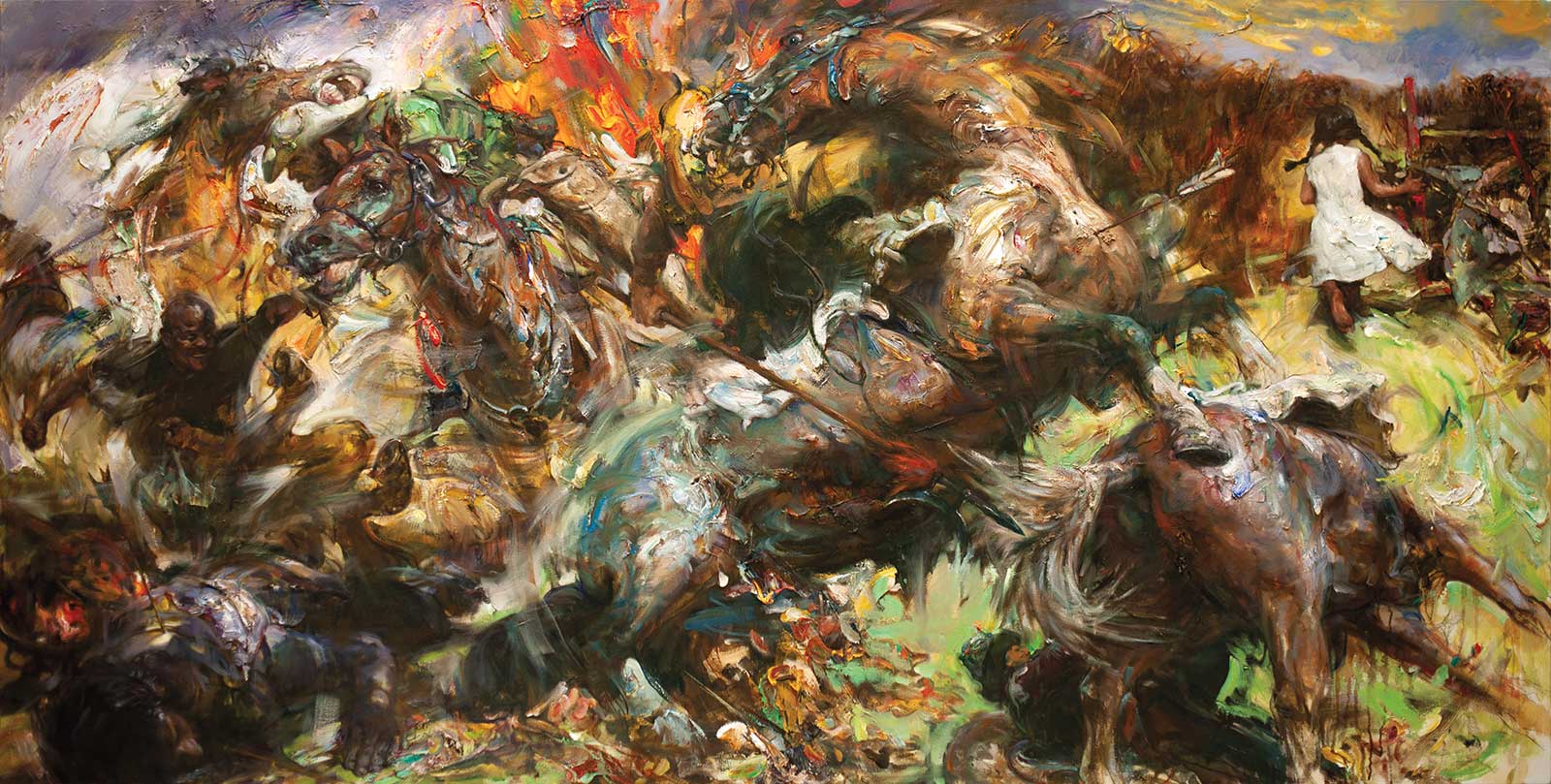
The Battle, 2022, oil on canvas, 43 x 84"
Texture is tied to his technique as much as it is his subject. As a student in the United States, he found a mentor whose background originated in the practice of sculptural discipline, not painting. While he was a graduate student, Wang took a class with his professor Rudy Torrini, a talented sculptor who created many monumental public works around St. Louis, Missouri, including the impressive Dr. Martin Luther King frozen in full oratorical flow in Fountain Park. Torrini had a lineage of impressive pedigree—he had studied under Rodin’s best friend, Ivan Meštrović, the creator of Chicago’s famed bronze The Spearman. This cross-disciplinary background helps Wang’s admirers to understand his methodology. He explained how the textured power of soft clay influenced his work, “I really liked the way I used my fingers to apply the clay. Torrini said I should become a sculpture major, but I said, ‘No, my passion is more for painting,’ but while I was doing those clay sculptures I thought ‘This is such beautiful mark-making, how can I make something cross to my painting?’”
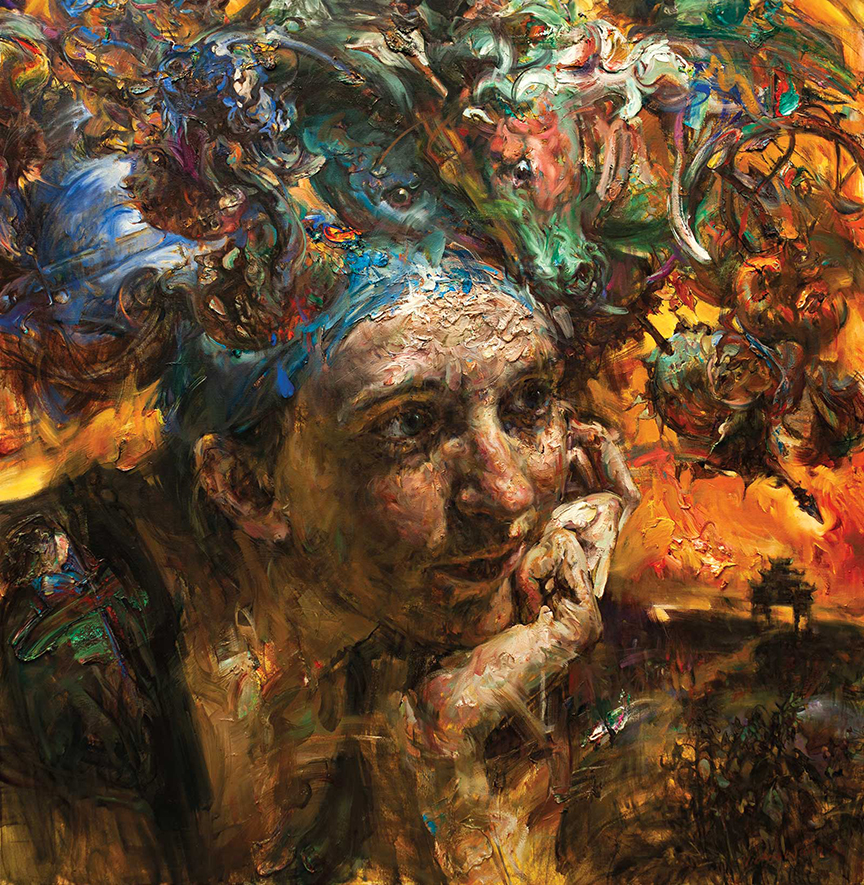
Memories of my Hometown, 2020, oil on canvas, 48 x 48"
Deep within Wang’s mind the idea of shaping paintings with the sensual surfaces of sculpture began to grow and work its way to the surface, like a thread of lava finding a path to a fissure. “I started reading some books about Titian and Rembrandt, how they ground their flake paint to make it more chunky and buttery…I put the flake onto newsprint paper for two or three days, spread it and let it sit, and the paper soaked up the oil, and the paint became more buttery, just like Rembrandt described…Then I started changing my mindset to try to think ‘This is colored clay, rather than paint.’” Like the elemental drama of lava meeting the ocean, the vigor of the volcano, of lava and molten metal, met the discipline of the studio and turned Wang’s paintings into extravaganzas of tactile experience These days war occupies his imagination, and soldiers flail in the explosive Listing the Battle as the backdrop to a woman perched on the outrigger of an arrow-shot canoe. Bright color is scraped and layered to build a geology of flesh and flame, and mysterious creatures and patterns are concealed in the thick strata of the surface. A splashed glaze and knifed scrape of primary blue drapes forehead skin tones in Memories of my Hometown,as melodious harmonies of pinks and golds and yellows fill the face, emerging from an explosion and chaos of unresolved figures and horses.
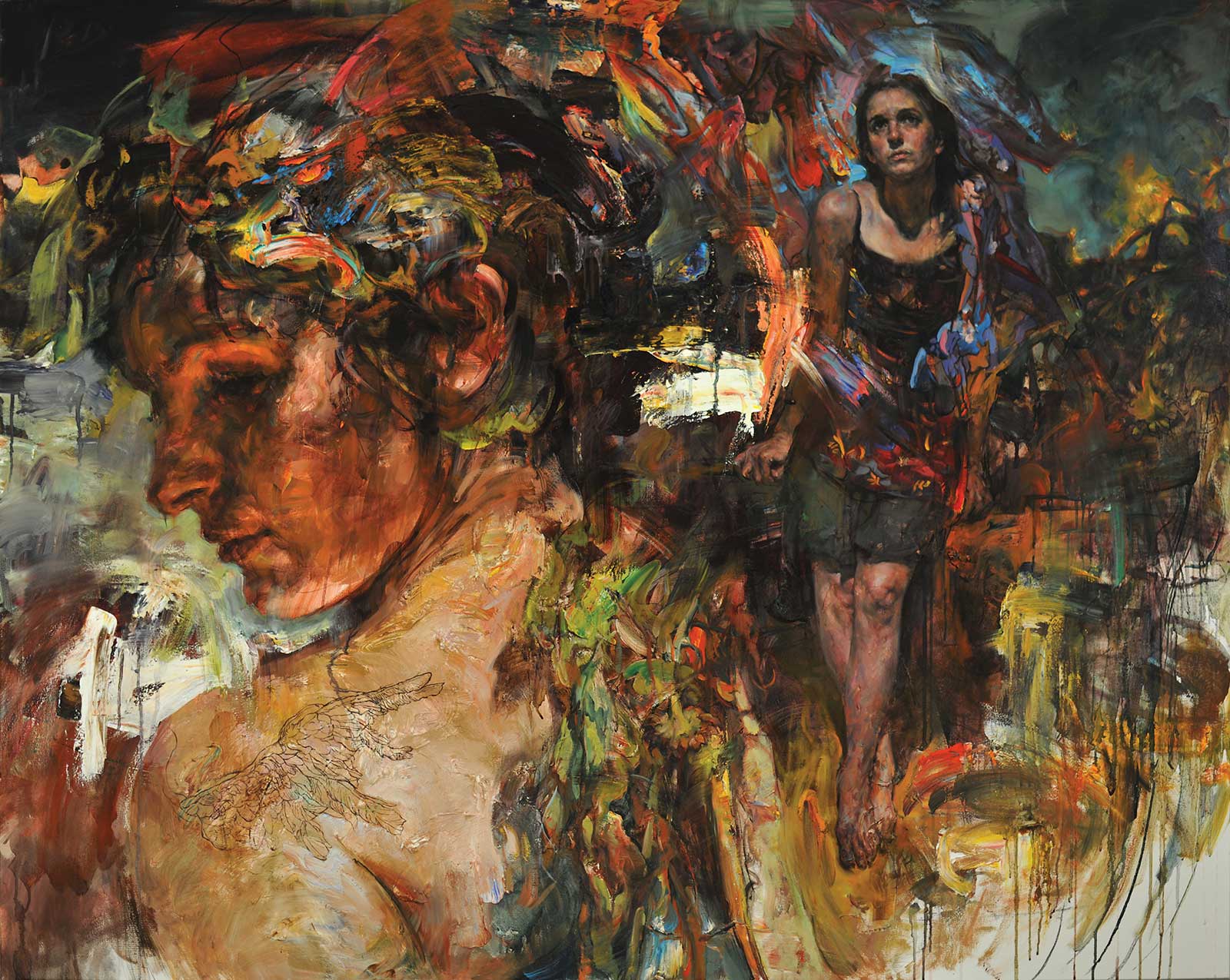
Dreamer, 2018, oil on canvas, 48 x 60"
Tang Dynasty geishas hover over the head of one girl and warriors float beside another. But Wang’s work is not all Sturm und Drang. He balances the impasto dimensionality of the knife with sensitive portraiture, creating the calm and dream of imagery which contrasts with the vitality of his tactile technique. “I feel the temperature.," he says. "When I walked close to Michelangelo’s sculptures, at the moment of standing next to them I thought I felt the warmth of the human body, but when I touched the marble it felt cold. “When I feel something is interesting, I always touch it. I like the sense of touch. To feel something. To make a connection between the heart and spirit.” The fire of life burns beneath the surface of Wang’s encrusted paintings—the volcanic fire of primordial creation. —
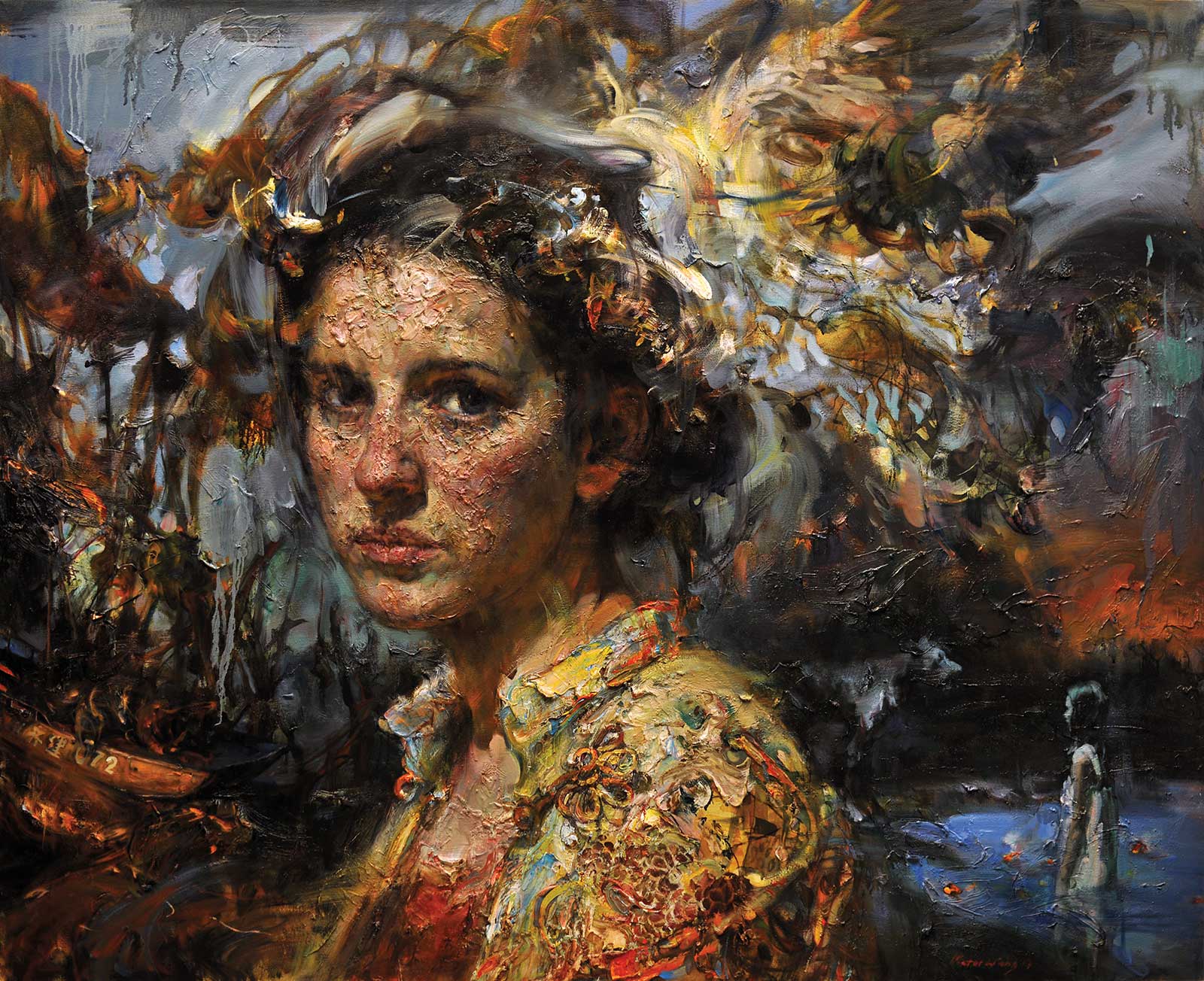
The Wishing Wings, 2019, oil on canvas, 50 x 62"
+++
Michael Pearce is a dynamic writer, curator, and critic, and a champion of art that emerges from popular culture and shapes the spirit of the age. He has published dozens of articles about art and artists, and is author of Kitsch, Propaganda, and the American Avant-Garde.
Powered by Froala Editor