In his essay for the catalog to the exhibition Big Stories,Bo Bartlett writes, “Artists have made marks to express themselves since the beginning of time. The cave paintings of Lascaux reveal the innate urge to satisfy the craving to document and express our inner and outer worlds. The narrative element in artistic renderings is as old as art itself. In the history of Western art and literature, scenes from the world around us have given way to stories created to enhance and encode human experience. From Homer to Shakespeare to Spielberg, the history of Western culture is rich with narrative storylines which excite and illuminate us.”
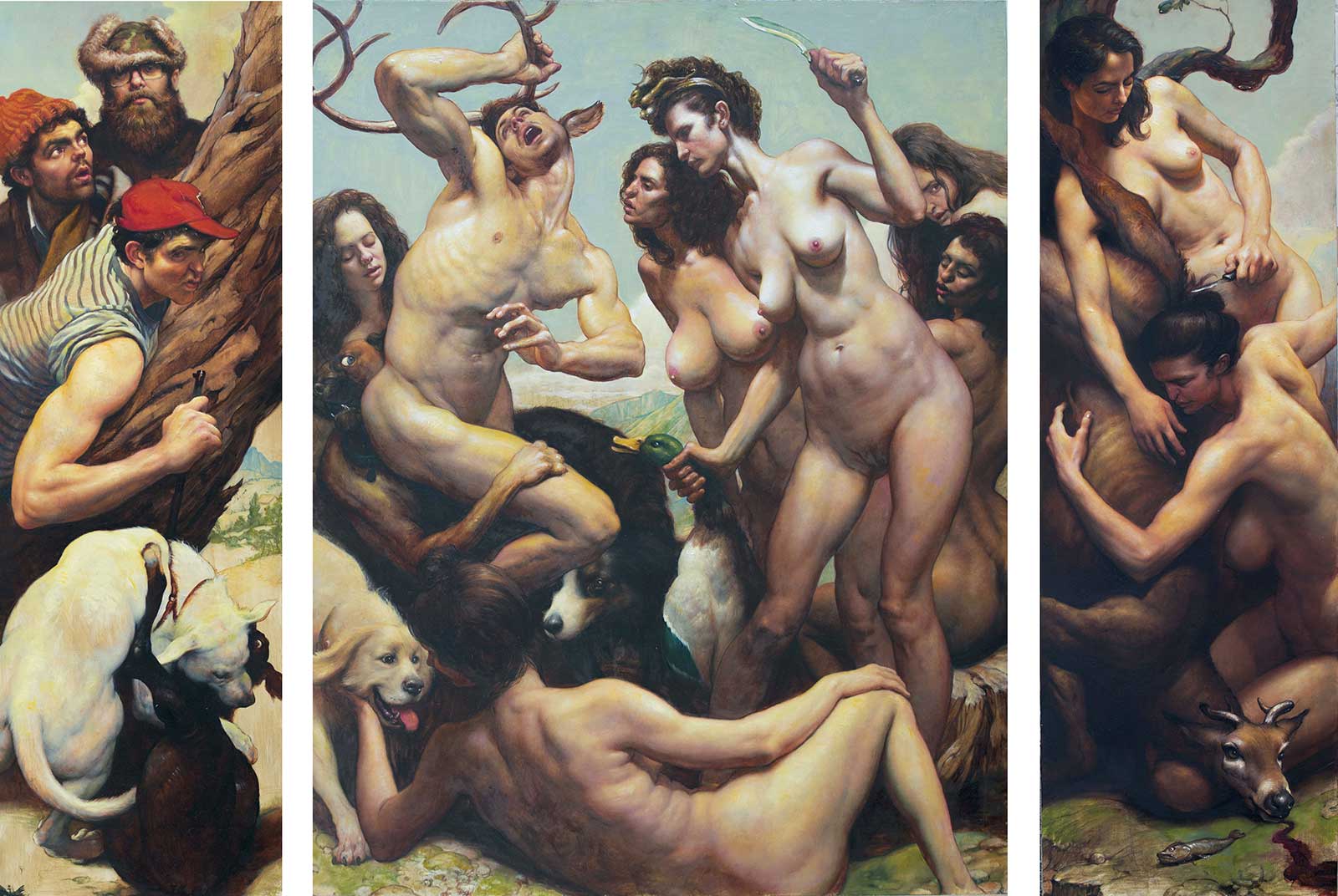
Adam Miller, Diana and Actaeon, 2018, oil on panel, 36 x 50”. Private collection.
Big Stories, which is on view at the Bo Bartlett Center at Columbus State University in Columbus, Georgia, through December 16, features 18 contemporary large-scale narrative paintings by a diverse group of artists. Some take classical stories and portray them in a contemporary way using traditional techniques. Others combine new media to create their stories. Artists in the exhibition, some of the finest figurative painters of the day, include: Steven Assael, Bo Bartlett, Margaret Bowland, Noah Buchanan, Aleah Chapin, Alfred Conteh, Vincent Desiderio, Carl Dobsky, Michelle Doll, Najee Dorsey, Paul Fenniak, Zoey Frank, Andrea Kowch, Adam Miller, Odd Nerdrum, Amy Sherald, Tim Short and Patricia Watwood. After the Bo Bartlett Center, the exhibition will be shown at the New York Academy from January 26 to March 3, 2024.
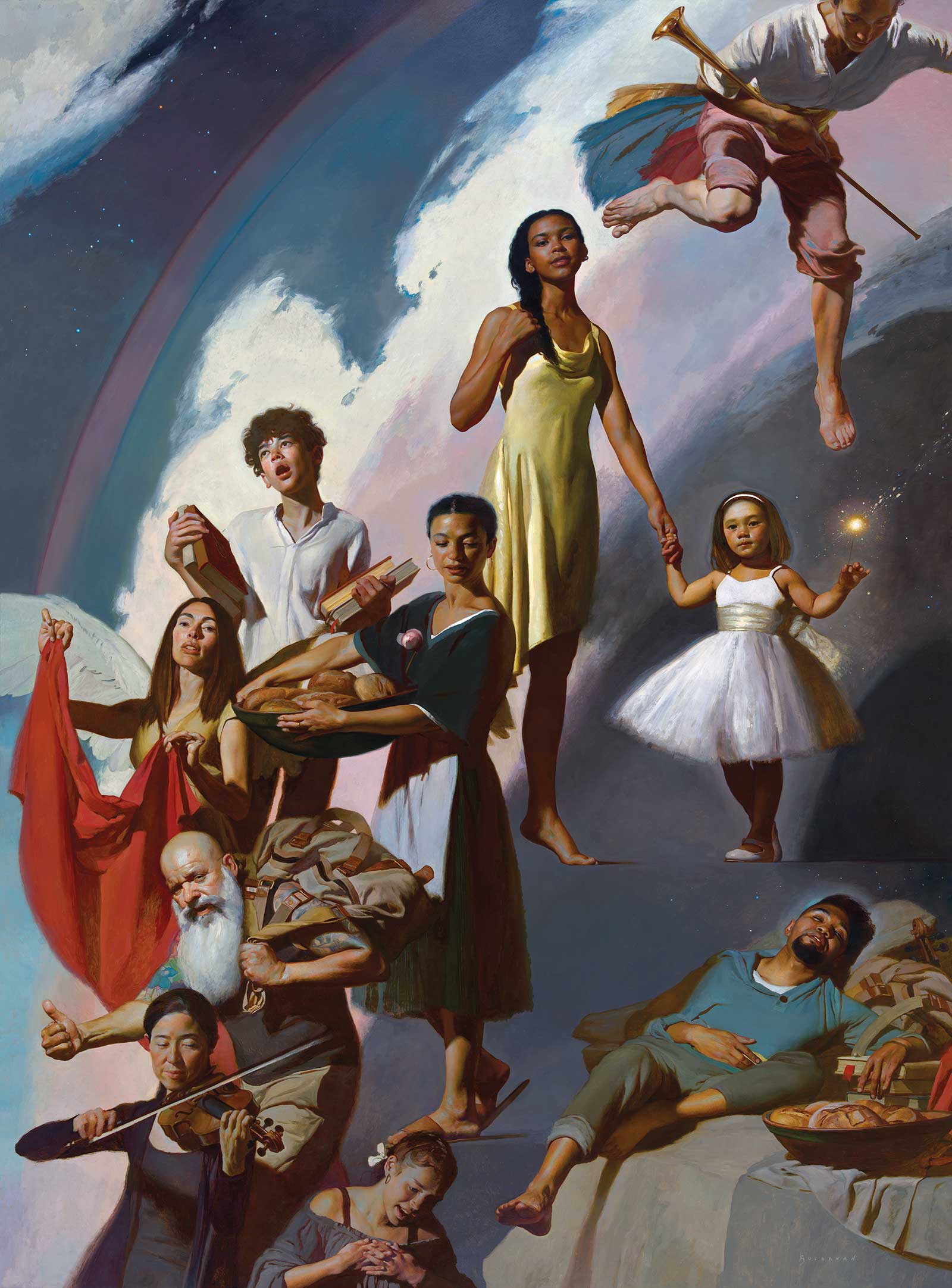
Noah Buchanan, Jacob's Ladder, 2023, oil on canvas, 108 x 80”. Courtesy of the artist.
The exhibition was curated by Noah Buchanan, Carl Dobsky and Bo Bartlett. Buchanan recalls, “As a fledgling artist, I always saw myself doing large scale multi-figure narrative paintings. In 2015, Dobsky unveiled his painting Ship of Fools at John Pence Gallery where we were both showing. It was 6 by 9 feet and crammed with figures. In 2017, there was an exhibition of paintings by the French follower of Caravaggio, Valentin de Boulogne. His huge canvases were staggering and loaded with figures. On the flight home to California I started sketching ideas that would become my 80-by-62-inch Triumph of Bacchus in 2018. Frank Galuszka was the first person I voiced my frustrations to about a lack of venues in which to show such work and he suggested that I try to arrange a group exhibition of works in this tradition. It was then that I turned to Carl Dobsky to join me in this cause. Frank also suggested that I contact Bo Bartlett about the possibility of the center staging an exhibition of large scale, multi-figured narrative works. Bo and the people at the center were enthusiastic. Everyone pitched in to bring the exhibition together.”
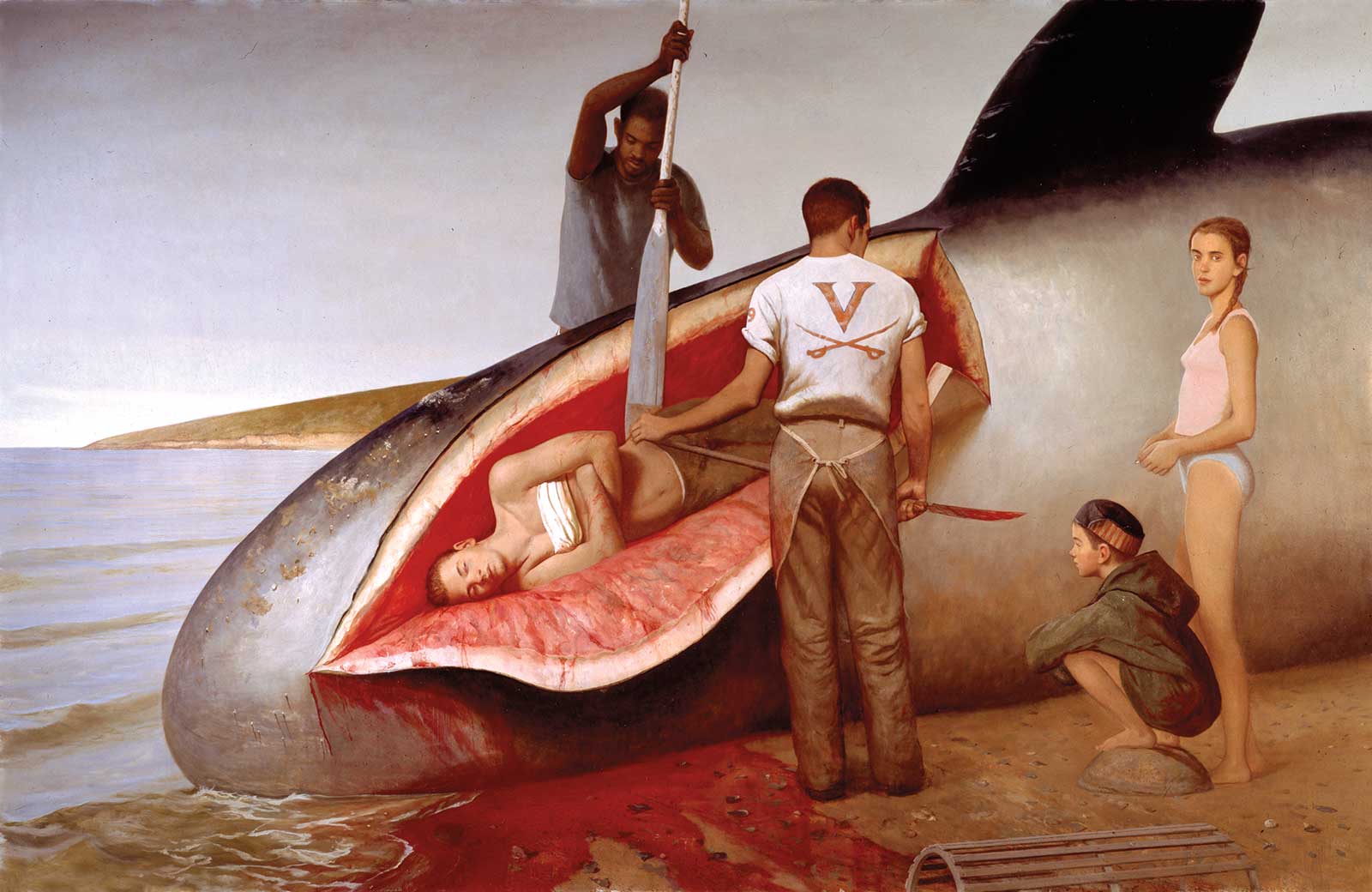
Bo Bartlett, Leviathan, 2000, oil on linen, 89 x 138”. The Scarborough Collection at the Bo Bartlett Center at Columbus State University.
Buchanan, Aleah Chapin, Michelle Doll and Carl Dobsky created new works for the exhibition. Other paintings have come from public and private collections.
Twenty years ago, I exhibited Patricia Watwood’s Music and Poetry in the sixth of the seven Re-presenting Representationexhibitions I curated at the Arnot Art Museum in Elmira, New York, beginning in 1993. It is as powerful and sensitive today as it was then. Commenting on historical paintings of nymphs and satyrs, she writes in the catalog to Big Stories, “Older artworks of this subject played on tropes of the ‘animalistic nature of dark flesh,’ and in moralizing on sexual desire, with equal parts superiority and drooling commodification…For centuries we have accepted these artistic compositions without much note of their racist and classist underpinnings. Instead, I want a new canon of language with the figures composed in balance: the beautiful nudes are found at leisure together, tenderly intimate, in a yin and yang of contrasts and harmony. This shows a tranquil ideal in which the coded hierarchies of racism and the control of the female body and sexuality do not exist.”
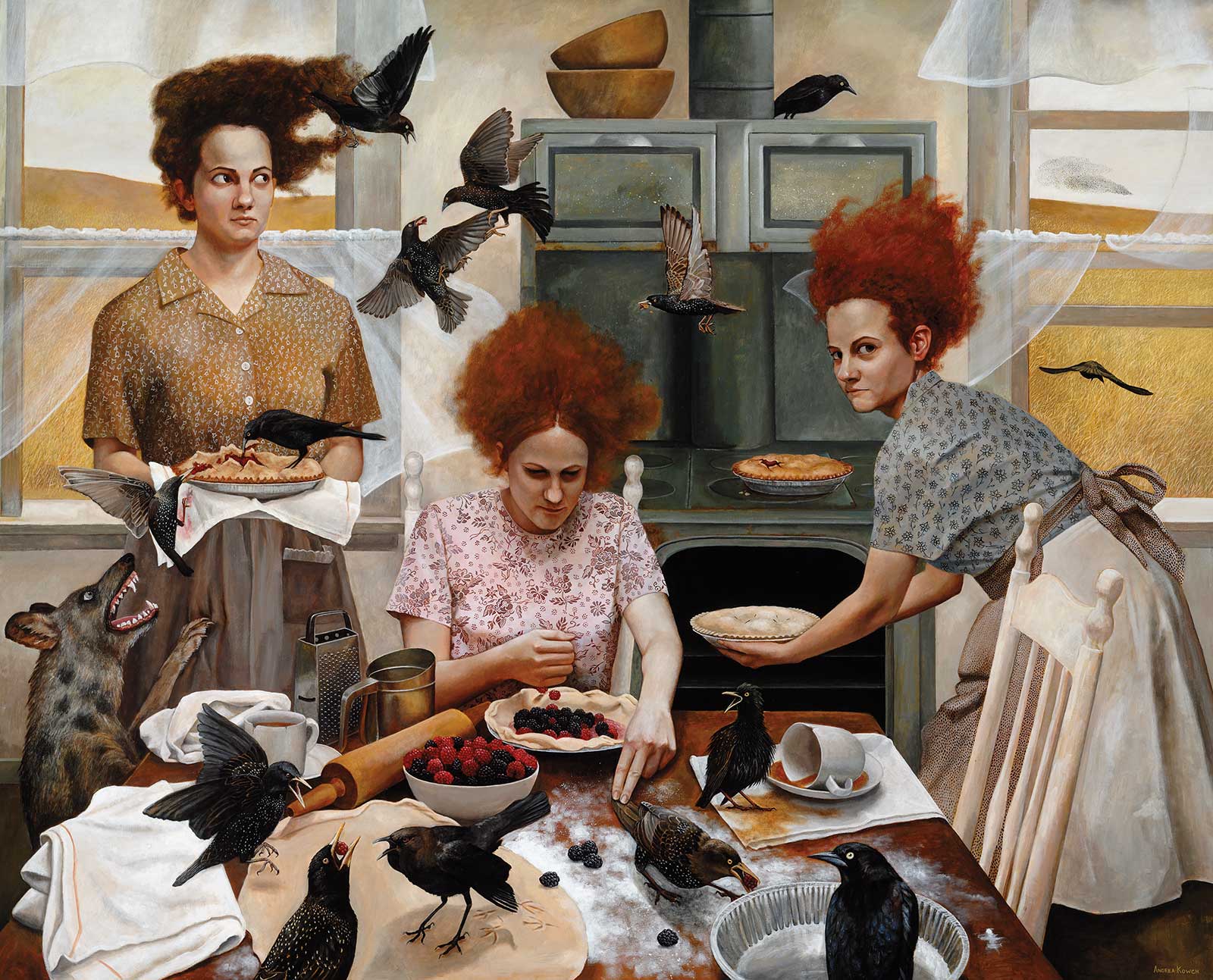
Andrea Kowch, The Visitors, 2010, acrylic on canvas, 48 x 60”. The Bennett Collection of Women Realists, San Antonio, TX
Narrative paintings can introduce us to characters and stories from other traditions, bring familiar myths and historical moments into the present, and recall details from earlier historical paintings. Adam Miller includes Diana’s maidens and Actaeon’s fellow hunters in his triptych of the central story of Diana and Actaeon. Bo Bartlett recalls figures in John Singleton Copley’s Watson and the Shark and Géricault’s The Raft of the Medusa. The classic stories become personal in several artist’s work with the figures being their families and friends. The stories being made contemporary revivifies them, connecting us to our past.
These artists are in contrast to young artists emerging from the atelier who construct competent figurative compositions devoid of content—in which the narrative is tacked on as an afterthought. These artists draw from their gut and from the archetypal roots of our culture.
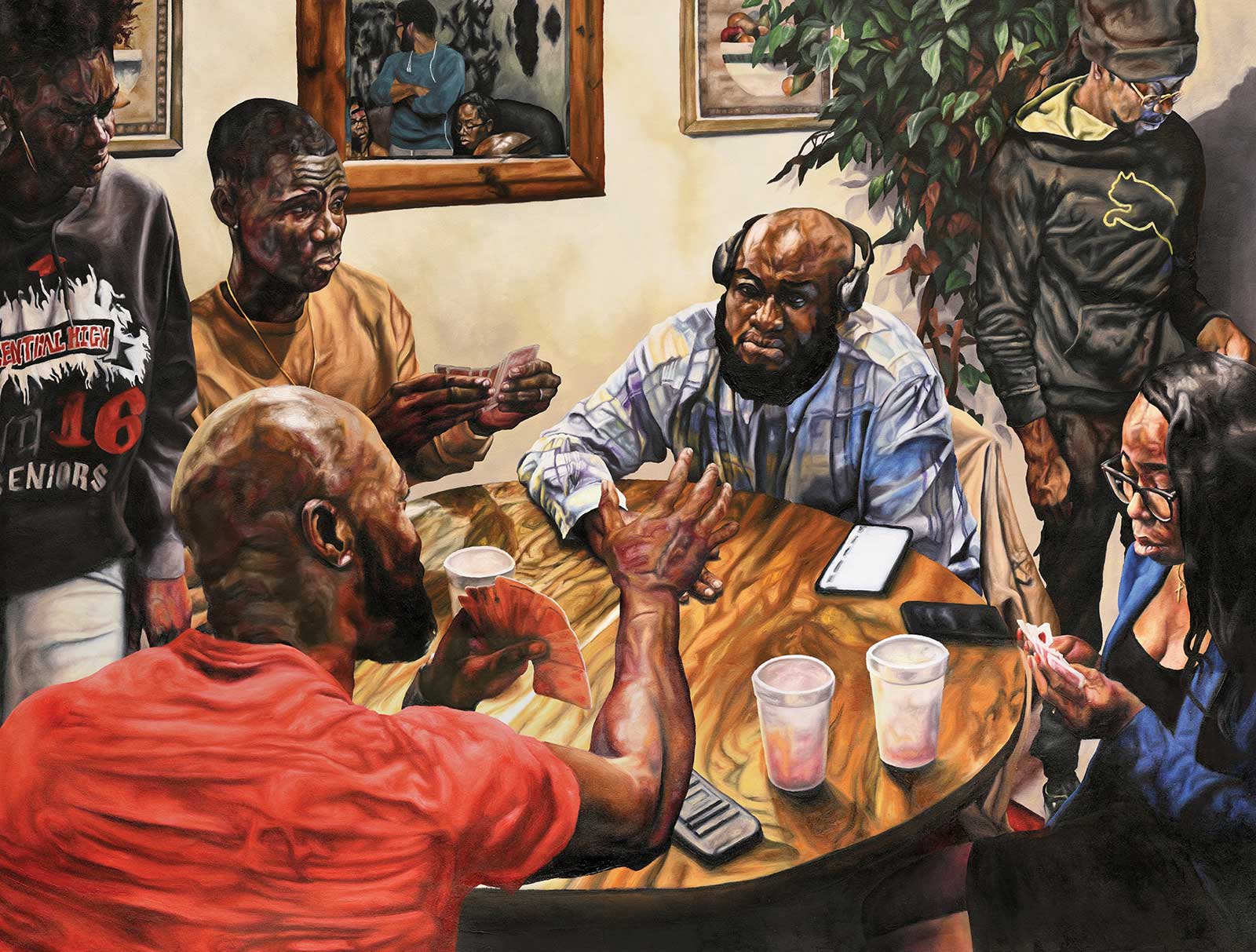
Tim Short, Talkin’ Across the Table, oil on linen, 2022, 54 x 72”. Najee & Seteria Dorsey’s Black Art In America Collection
The scene in Andrea Kowch’s The Visitors is a contemporary one in which we can imagine the hermetically-sealed routine of three older sisters being disrupted by something perhaps minor but the cause of great upset. Kowch explains, “The scene is an allegory for the struggle to create order out of chaos, the cry of suppressed emotions too long masked beneath the common routine of our lives.” We can hear the scene and smell the “traces of raspberry, blackberry and warm pie crust [that] permeate the air. A dry wind lifts the curtains to reveal a parched, unbroken skyline. Three sisters share a kitchen. The space, further occupied by pestering animals, turns into an overwhelming sense of invasion.”
Adam Miller’s Diana and Actaeon is a large triptych, “a deliberate nod to the traditions of painting in the Middle Ages and Renaissance,” he explains. It was painted in 2018 at a time when he was moving “away from naturalism while placing a greater emphasis on the manneristic possibilities of the body. The story comes from Ovid’s The Metamorphosis, Book III. Actaeon, a hunter, accidently sees the goddess Diana bathing in a grotto with her nymphs. Angered, Diana turns Actaeon into a stag which is attacked and eaten by the dogs he once commanded.
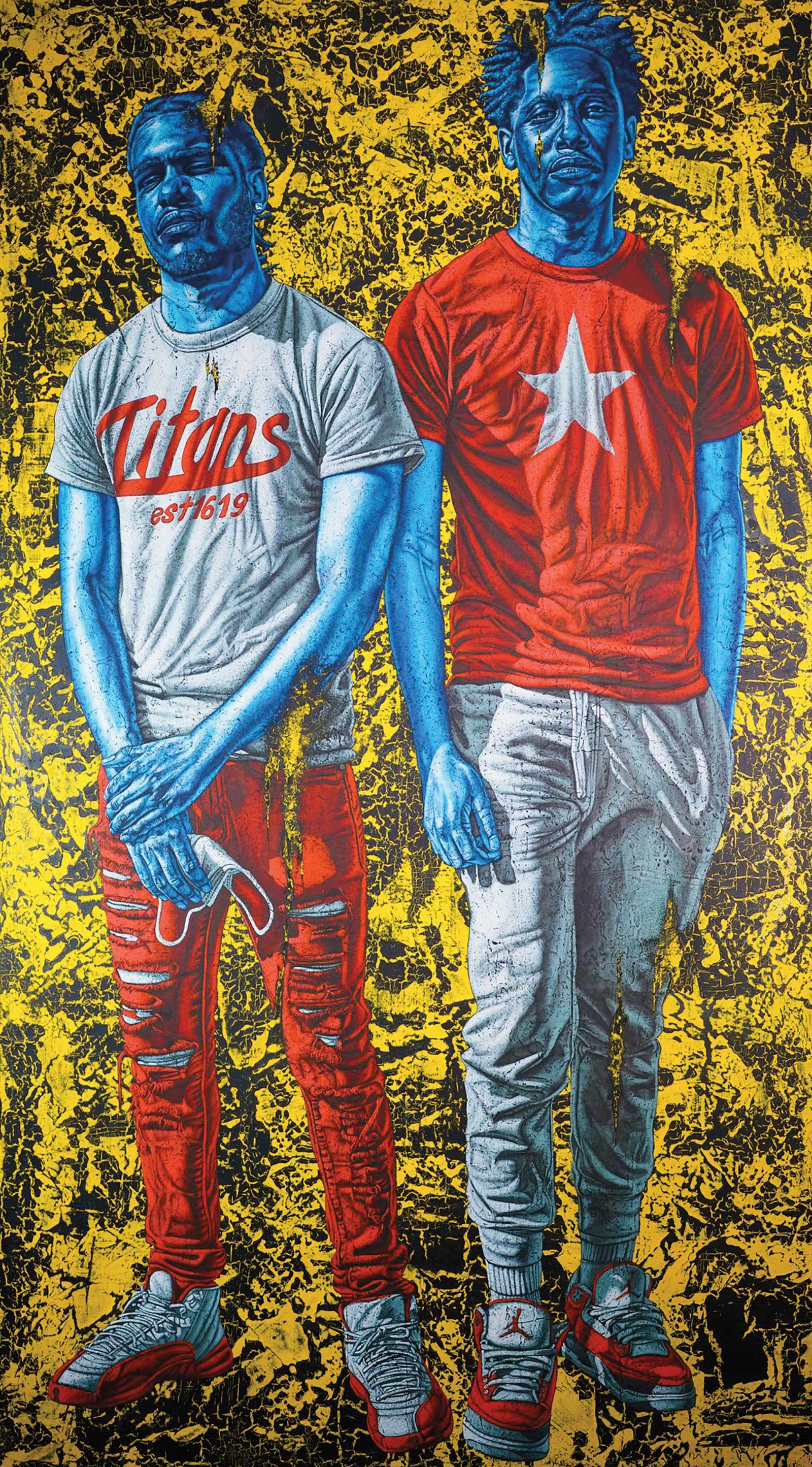
Alfred Conteh, Evan and Aaron, acrylic and urethane plastic on canvas, 2020, 84 x 48”. Najee & Seteria Dorsey’s Black Art In America Collection.
Miller comments, “It is a perfect example of the Greek view of unforgiving nature or karma in which the slightest mistake will be paid for, and mercy will not be granted by the gods even when clemency could be justified. Actaeon’s sin of discovering Diana naked at her bath was certainly accidental, and if his glance lingered for a moment on the vision of the beautiful bathing goddess, that was certainly only natural. Despite these mitigating circumstances, his punishment came swiftly and violently.”
“In the triptych,” he explains, “I have the hunter friends of Actaeon on the left hand side observing the bathing goddess. On the right her nymphs are preparing the deer they hunted that day. In the center is the focus of the action with Diana and the nymphs turning Actaeon into a stag while his dogs attack.”
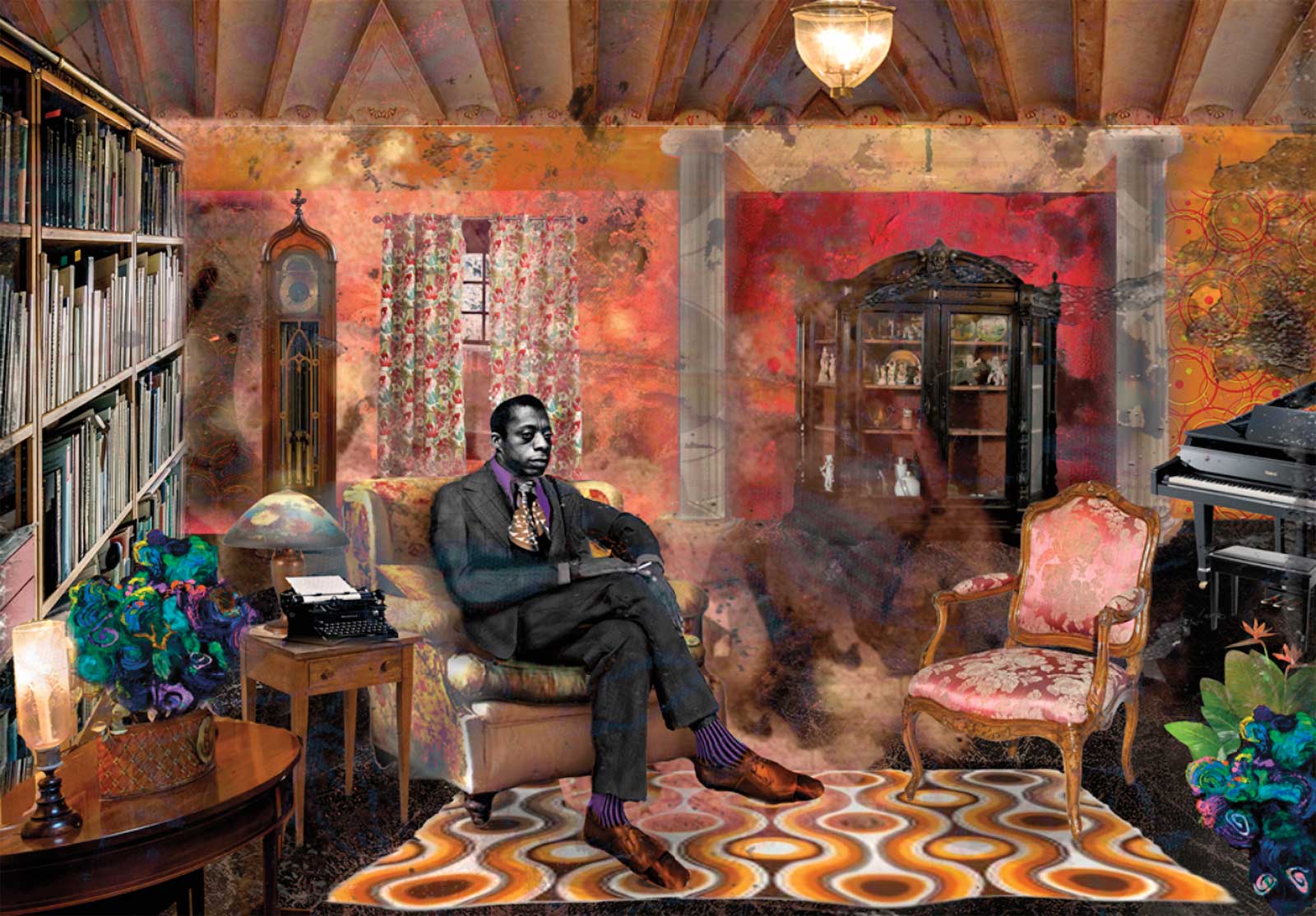
Najee Dorsey, This My Baldwin, mixed media on gallery wrap canvas, 2020, 64 x 56”. Najee & Seteria Dorsey’s Black Art In America Collection.
Bo Bartlett reimagines the Old Testament story of Jonah and the whale in his painting Leviathan as “an honest attempt to find an appropriate visual metaphor for where I am in my life. It represents a highly personal inner and outer journey.” The particularity of his using himself, his three sons and his wife as models in the painting allows for a universality in which we can participate in ancient stories as we were meant to do. Part of his making the story contemporary refers to the root of the biblical story itself. Jonah was sent by God to preach to the people of Ninevah but didn’t want to go. He ran away and boarded a ship that encountered a storm, which his shipmates blamed on him, and threw him into the sea. God sent a “big fish” to save him. The t-shirt on the central figure (the artist’s self-portrait) emblazoned with the letter “V” also has the number “9” on the sleeve. Combining the number and the letter reveals Jonah’s original destination.
Noah Buchanan brings another biblical story into the contemporary world—Jacob’s Ladder. Fleeing for his life, Jacob took refuge at night and lay down with a stone for his pillow. He dreamed of a ladder connecting the earth to heaven with angels descending. God appeared to him in the dream and offered the land he was on and recognized Jacob as the father of His chosen people—his 12 sons founding the 12 tribes of Israel.
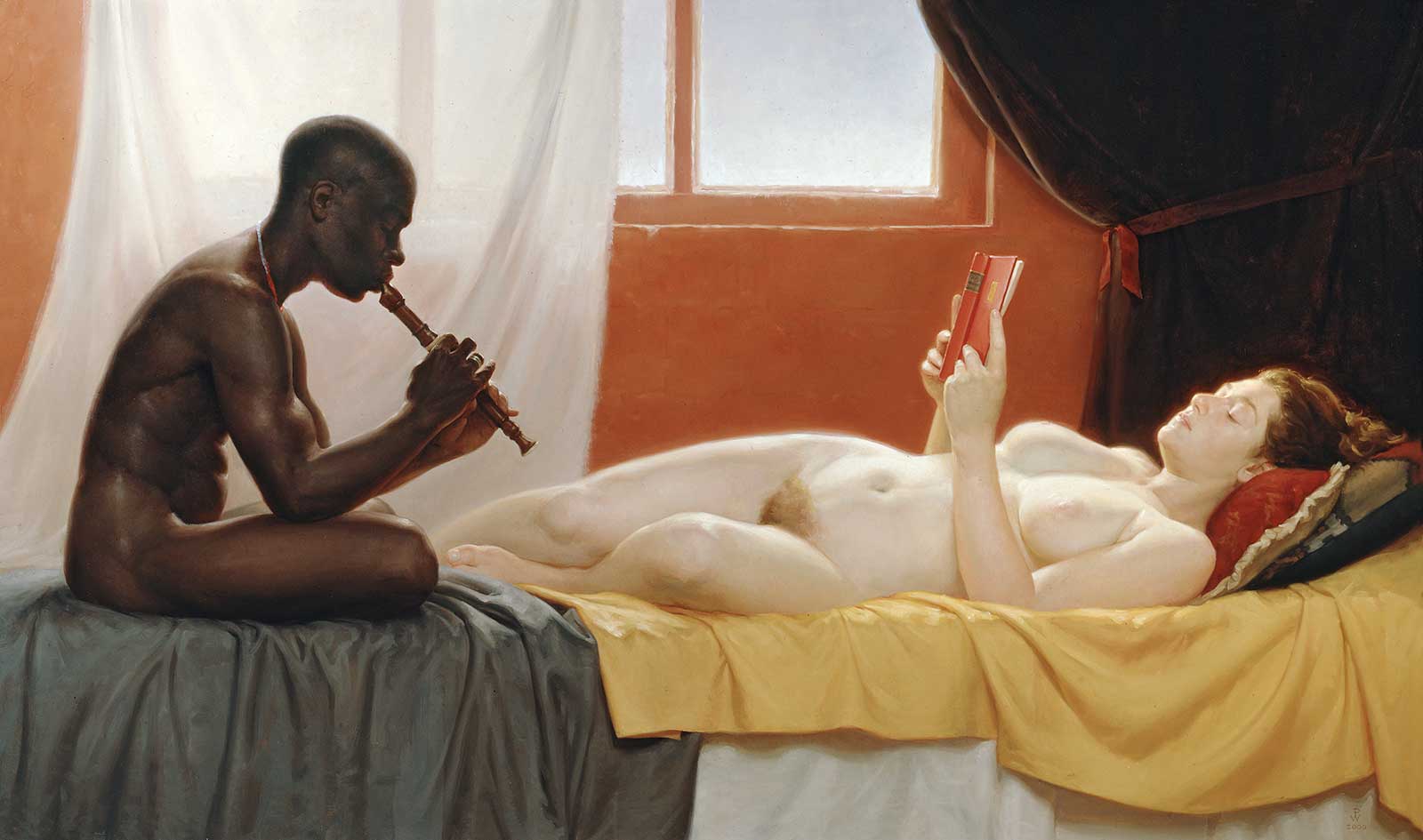
Patricia Watwood, Music and Poetry, 2000, oil on linen, 44 x 68” (framed). On loan by Margaret and Gregory Hedberg, New York, NY.
Buchanan writes, “These angels are us; they are you and I. My paintings are filled with the real people in my life: my wife, stepchildren, family members, friends, neighbors, students. They all become symbolic and allegorical figures in my work. I want the viewer to recognize themselves in the characters of my paintings, and then go out and recognize themselves in others. The figures in this painting, and their actions, remind us that amidst the challenges and uncertainties of life, there exists a connection between us all: we ourselves are the couriers of the good in life. In this painting, we enter the narrative not merely as Jacob, but as agents of the divine.”
Bartlett quotes the 20th-century French philosopher, Maurice Merleau-Ponty, who wrote, “We will arrive at the universal not by abandoning our particularity but by turning it into a way of reaching others, by virtue of that mysterious affinity which makes situations mutually understandable.” —
Big Stories
When: Through December 16, 2023
Where: Bo Bartlett Center, Columbia State University, Corn Center for the Visual Arts
921 Front Avenue, Columbus, GA 31901
Information: (706) 507-8432, bartlettcenter.columbusstate.edu
Powered by Froala Editor