Around 600 B.C., Greek kouros sculptures of nude young men began breaking free of the rigidity of their Egyptian predecessors—the left leg moved forward, they stand in full three dimensions. Devoid of symbols of status, they represent universal youth. Their symmetry and the stylized beginnings of anatomical accuracy, evolved into the brilliance of classical Greek sculpture. Animals appeared as domestic companions and as materializations and messengers of the gods.
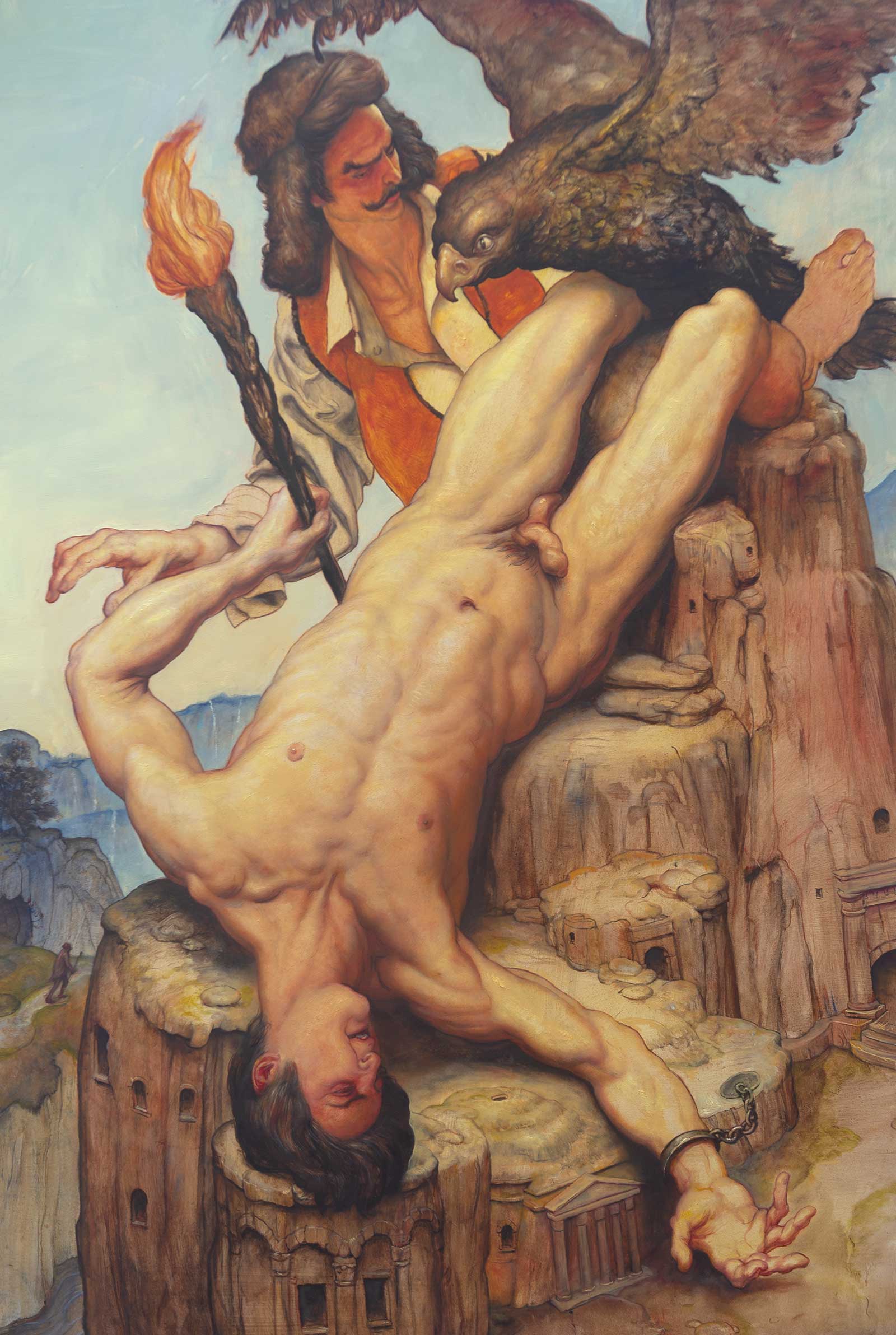 Adam Miller, Prometheus, 2021, oil on panel, 48 x 36”. Courtesy the artist and Gallery Poulsen, Copenhagen, Denmark.
In Yedidya Hershberg’s Nude with Blackbuck, a nude female adjusts her hair while she turns to regally regard the viewer. Hershberg describes the painting as “a synthesis of pictorial evocations and symbols. In the midst of a gothic Trecento setting, a classical nude melts from her stony posture. She gazes at the viewer aloof of her symbolic counterpart. The wounded Blackbuck, whose presence is frequently found in Mughal paintings, carries with it a host of Hindu mythological connotations. In some parts it is reverenced for being the vehicle of the Hindu goddess Korravai, who, as well as being the deity of war and victory, is also the mother goddess and the goddess of fertility.”
The figure may well be a goddess, transcending time and space, existing above all things. The blackbuck, is a species of antelope hunted for sport in Mughal times (early 16th-to the mid-18th century), and is often depicted in paintings of the hunting parties of Shah Jahan who built the Taj Mahal. Today, the blackbuck is revered among the Bishnoi of Rajasthan who, in 1998, pursued an Indian actor who had killed two blackbucks and was sentenced to five years in jail.
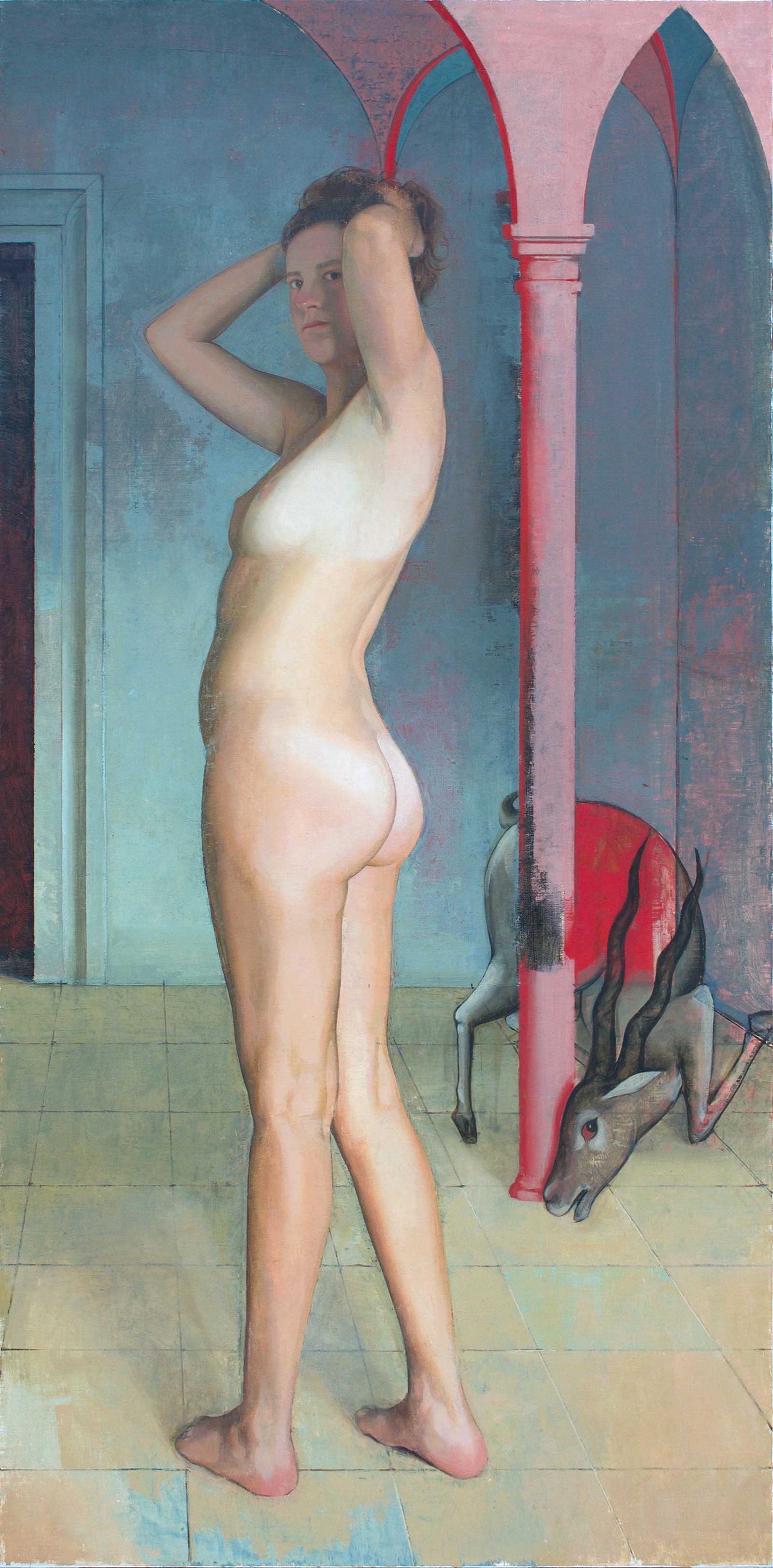
Yedidya Hershberg, Nude with Blackbuck, 2021, oil on canvas mounted on wood, 47¼ x 23²/3”. Courtesy the artist and High Line Nine Galleries, New York, NY.
Adam Miller’s figures are larger than life, exuberant, embodying archetypes and involved in moments of great drama. Unlike the stylized pose of Hershberg’s figure, Miller’s figures are inspired by mannerists like Michelangelo and Pontormo, realistic in a gutsy way rather than being photorealistic. His sinuous figures embody life and a passion that transposes to the viewer, and arouses a greater sense of being.
In his Prometheus,the young Greek, chained to a rock, awaits the arrival of an eagle sent by Zeus to eat his liver. Zeus caused the liver to regenerate and the eagle to return to feast every day for eternity. Prometheus, in some tellings, created mankind from clay and gave the people the gift of fire which he had stolen from the gods on Olympus. Zeus condemned him to torment for having defied him. In this story, Zeus employs the eagle for torture. In another story, he transforms himself into an eagle to abduct Ganymede, a beautiful Greek boy, to serve him on Mount Olympus and to be cup bearer to the gods. Years after condemning Prometheus, Zeus allowed Herakles to kill the eagle with his arrows and to release Prometheus who, he believed, had knowledge that would be useful to him and that Prometheus would share only if he was freed.
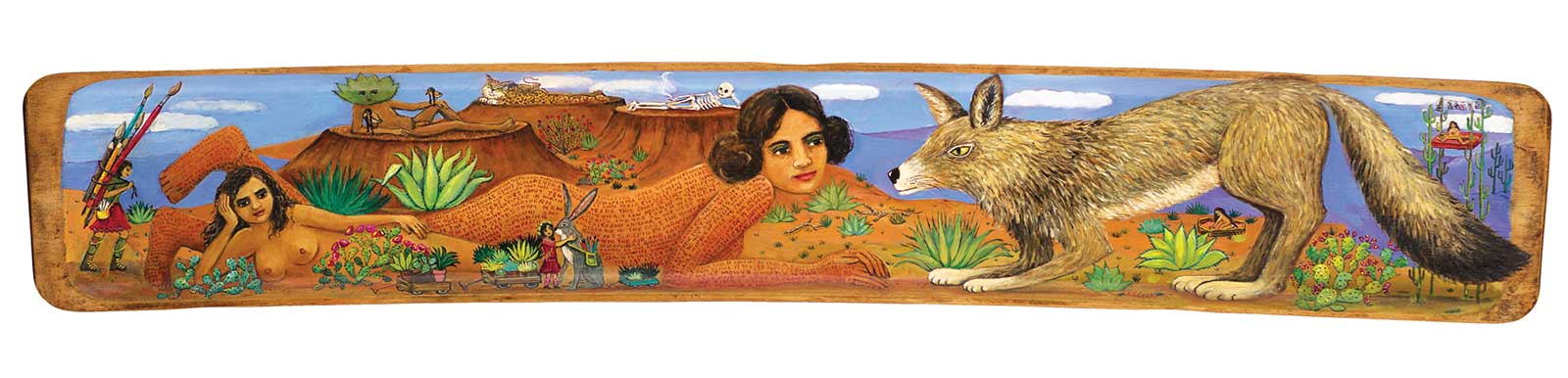
Irene Hardwicke Olivieri, The Messenger, oil on wood, 7 x 42". Courtesy Evoke Contemporary, Santa Fe, NM.
Irene Hardwicke Olivieri was brought up on a farm on the Texas/Mexico border, immersed in the land and familiar with its flora and fauna from large animals to the creatures in the earth. One of the creatures is the centipede, feared by most of us as a venomous, creepy thing to be avoided at all costs. Her research, an important aspect of her work, revealed that centipede venom causes swelling and pain at the site of a bite on a human, as well as headaches and vomiting. She also learned that the venom has been used in Chinese folk medicine to treat many ailments. Research is ongoing into the characteristics of centipede venom and its potential uses.
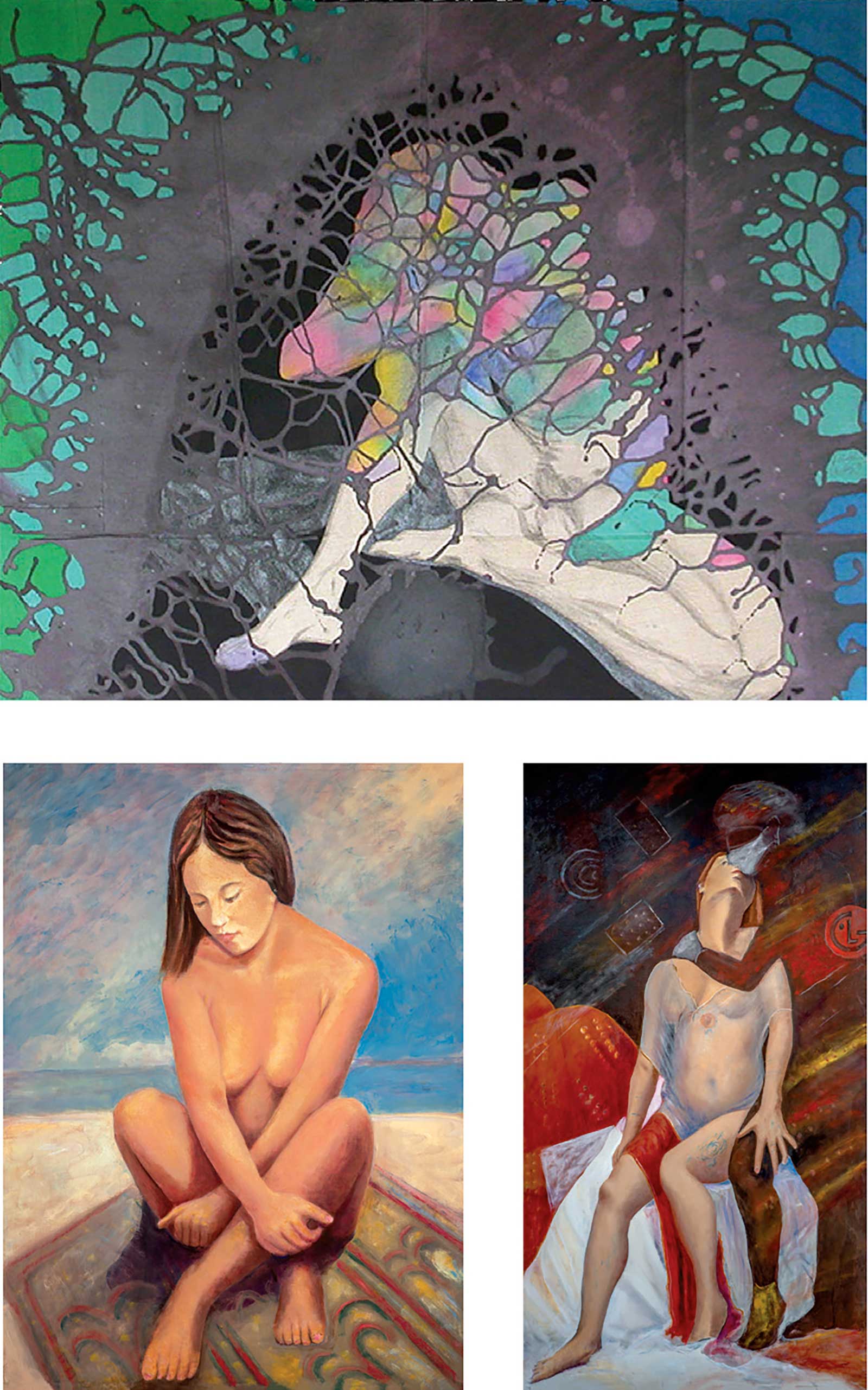
Top: Deborah Curtiss, CHRYsalis, acrylic and graphite on unprimed linen canvas, 36 x 45". Bottom: John Cutruzzola, Sunny Dreams, oil on canvas, 38 x 28"; John Cutruzzola, Seduction, oil on canvas, 64 x 36"
In her painting, The Messenger, a nude female figure lies on the ground in conversation with a coyote, often a creature of cunning and curiosity in Native American culture. The figure’s body is painted with her notes from her research into centipedes.
Speaking about her recent exhibition, Seduction by Centipede,she explained, “I am totally fascinated by things that are wild and scary, seduced by the natural world and the parts that are untamable. Often people tell me they don’t like creatures like centipedes. If you really observe and learn about any creature, how they find their food, how they find a mate, their courtship, how they use their time and how they care for their young, you can’t help but see them differently. You kind of can’t help but fall in love with them. We need all other creatures with which we share this earth.”
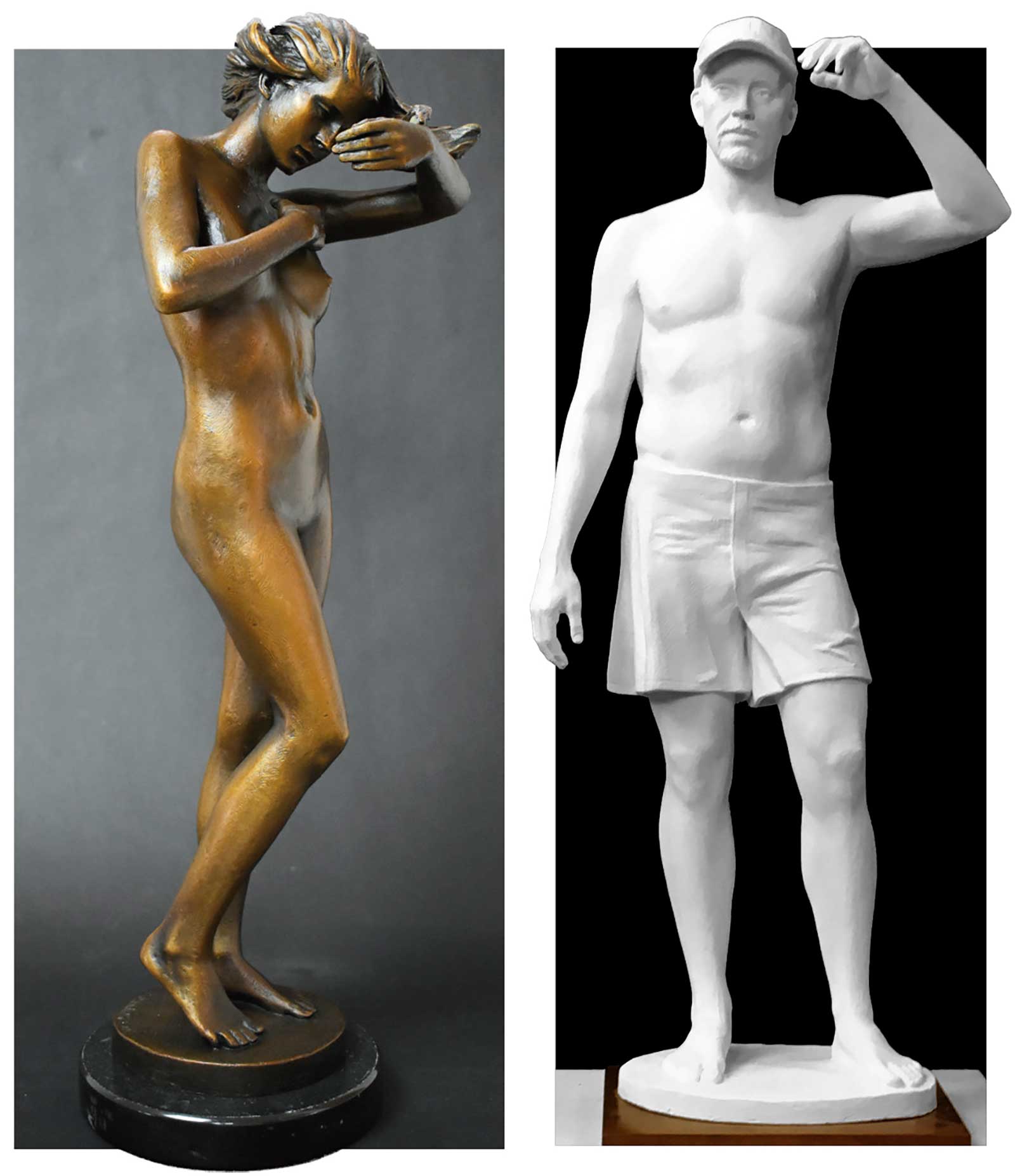
Anthony Frudakis, Forma, bronze, 22"; Anthony Frudakis, 55, plaster, 36"
In the remainder of this special section, we feature other artists working in this timeless genre and the galleries who represent them.
A lifelong sculptor, Anthony Frudakisbegan sculpting while still a child, soaking up his knowledge of the arts from his father, noted sculptor EvAngelos Frudakis and his mother, Virginia, a painter. Frudakis finds inspiration in a multitude of places. “I’ve been inspired by great lives I’ve read about, by powerful tragic moments in my life and our lives as a community, by acts of courage, kindness and love, and by beauty that I have seen and imagined,” he says. “As artists we want to be prepared through the development of our skills, sensibilities and souls to give honest and adequate expression to this gift we receive.”
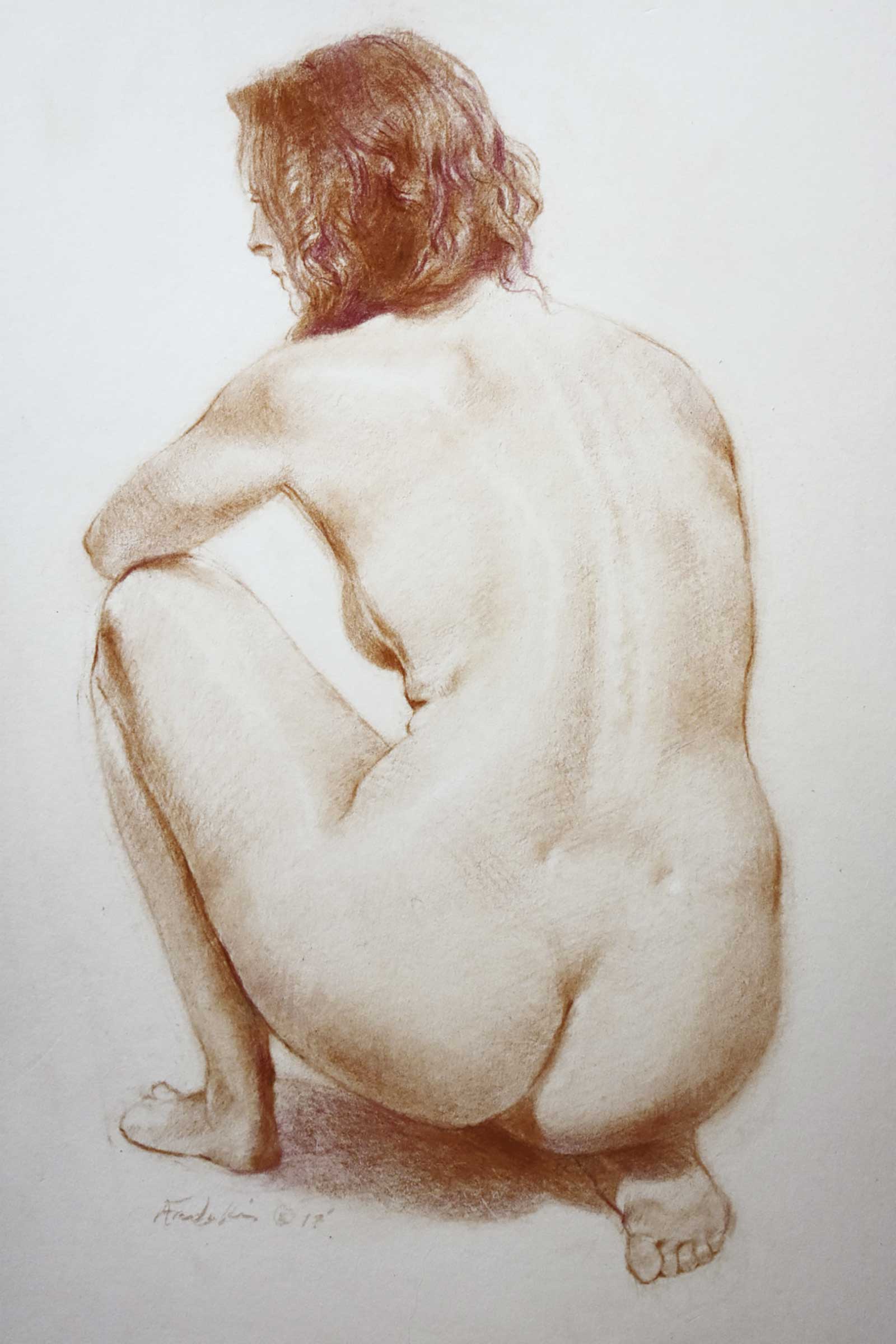
Anthony Frudakis, Crouching Female Nude, sanguine chalk, 14 x 11"
Artist Deborah Curtiss considers the fact that, historically, most nudes were created by men. “I set out to discover whether, as a female, we express a different perspective. Would my depiction of the nude figure be discernible as created by a female to others? Could the nude simultaneously be my subject and effectively express my own artistic interest in synthesizing drawing with painting?” For Curtiss, the human figure, regardless of gender, represents a metaphor for humanity. “Moreover, I chose to escape from the ‘window’ view that dominated painting for centuries,” she says. “Unlike others who departed more drastically—Frank Stella and Elizabeth Murray come to mind—I chose to take a small step to four sides of unequal length. A loop is provided in each painting for the figure to be hung at its rightful angle with no true vertical or horizontal painting edge.”
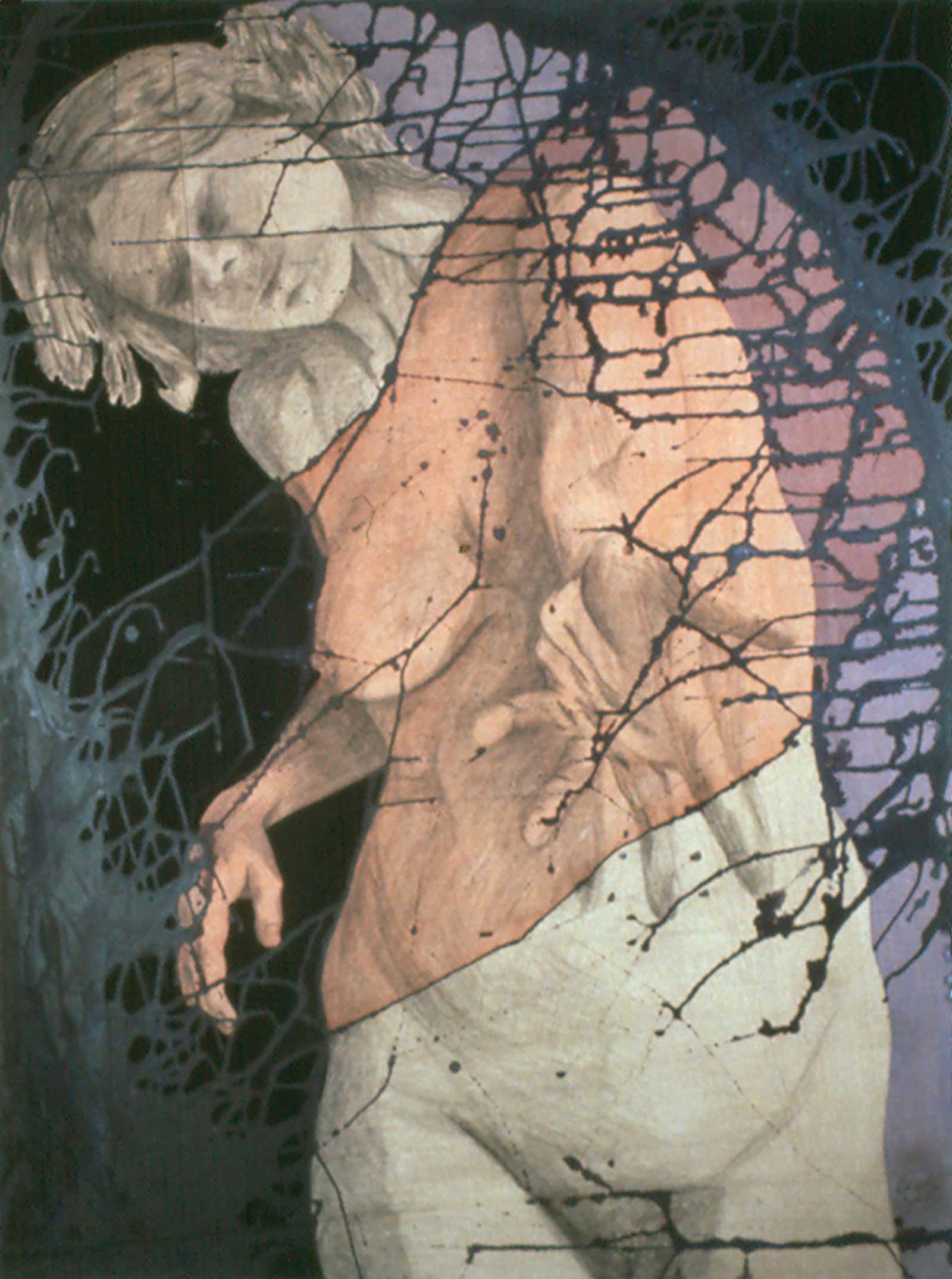
Deborah Curtiss, chRYSAlis, acrylic and graphite on unprimed linen canvas, 56 x 42"
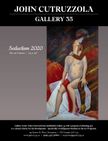
John Cutruzzola,the founder of the first private art gallery in Brampton, Ontario, has been passionate about art from his time as a young schoolboy in Italy where he would spend time gazing reverently and in wonder at the magnificent frescos on the ceilings of both the smallest churches and grandest cathedrals. It is where he first formed the thoughts that later crystallized, as an adult, into the dual philosophies of building beautiful buildings and creating works of art. “Gallery 35 was founded on the principle that art is not just for the few, but rather for everyone,” Cutruzzola says. “In addition to being a beautiful space, 35 percent of all fees associated with gallery rentals will be donated to the Indigenous Student Art Endowment managed by Algoma University-Brampton.” The gallery features Cutruzzola’s paintings and has showcased a variety of talented artists including Jaideep Mathur, Stephanie Lehouiller, Steve Wilson, Margaret Sarah Pardy, Lyden Cowan and Abiola Idowu.
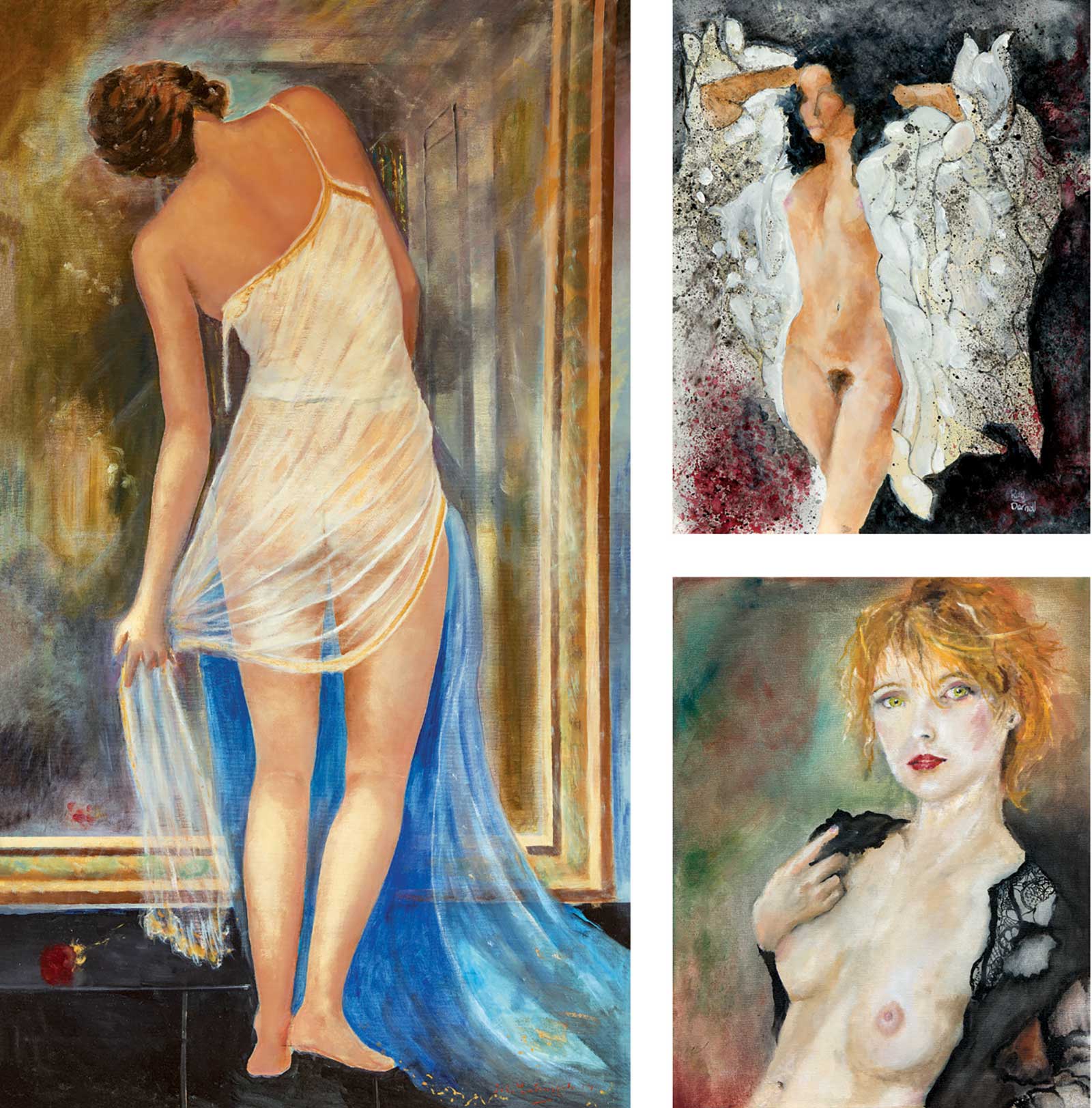
Clockwise from left: John Cutruzzola, The Mirror, 60 x 30"; Ray Darnell, Angeline, oil on canvas, 14 x 11"; Ray Darnell, Siri, oil on canvas, 20 x 16”
Ray Darnell’s motto has always been, “be creative in all that you do.” He explores various media to achieve new, and often unexpected results, which keep his creations exciting and different. “The challenge becomes recreating that ‘chance result’ in order to understand it and control it,” says Darnell. “That’s how I live and create art—sometimes wild and untamed, often with an ending that is different than the original idea.” In his paintings, Darnell’s strength is capturing natural movement in the human form. He prefers painting women because they are so varied and challenging. When asked why he prefers figurative art, Darnell says, “It’s probably because the technical demands of figurative art are tremendous, but when you get it right it’s very gratifying.” —
Featured Artists & Galleries
Anthony Frudakis
www.anthonyfrudakis.com
Deborah Curtiss
(610) 715-0129
www.deborahcurtiss.com
Evoke Contemporary
550 S. Guadalupe Street
Santa Fe, NM 87501
(505) 995-9902
www.evokecontemporary.com
Gallery Poulsen
Staldgade 32
1699 Copenhagen, Denmark
+45 3333 9396
www.gallerypoulsen.com
High Line Nine Galleries
507 W. 27th Street
New York, NY 10001
www.highlinenine.org
John Cutruzzola
Gallery 35
35 Queen Street West
Brampton, ON Canada L6Y 1L9
(905) 457-3660
inquiries@gallery35.ca
www.gallery35.ca
Ray Darnell
(505) 250-2590
applewoodmtn@gmail.com
www.maeroadartgallery.com
Powered by Froala Editor