Julie Heffernan is known for visionary self-portraits built on her hyper-visual experience of the living, vibrant women’s world and set within a series of surreal landscapes sourced from the stream of images that pours through her mind's eye when she closes her eyes. She has access to an unusually intense stream of these images—which originate from a waking dreamscape of memory, imagination and random associations thrown together by her vivid subconscious mind. It is the fundamental source and guide of her art. “The psychedelic nature of closing your eyes and what you see continues to amaze me,” says Heffernan. “Does everybody see it? I did not do psychedelics. I always thought I would throw myself off a roof, so I stayed away. But there’s all this great stuff that I look at all the time and I want to evoke that.”
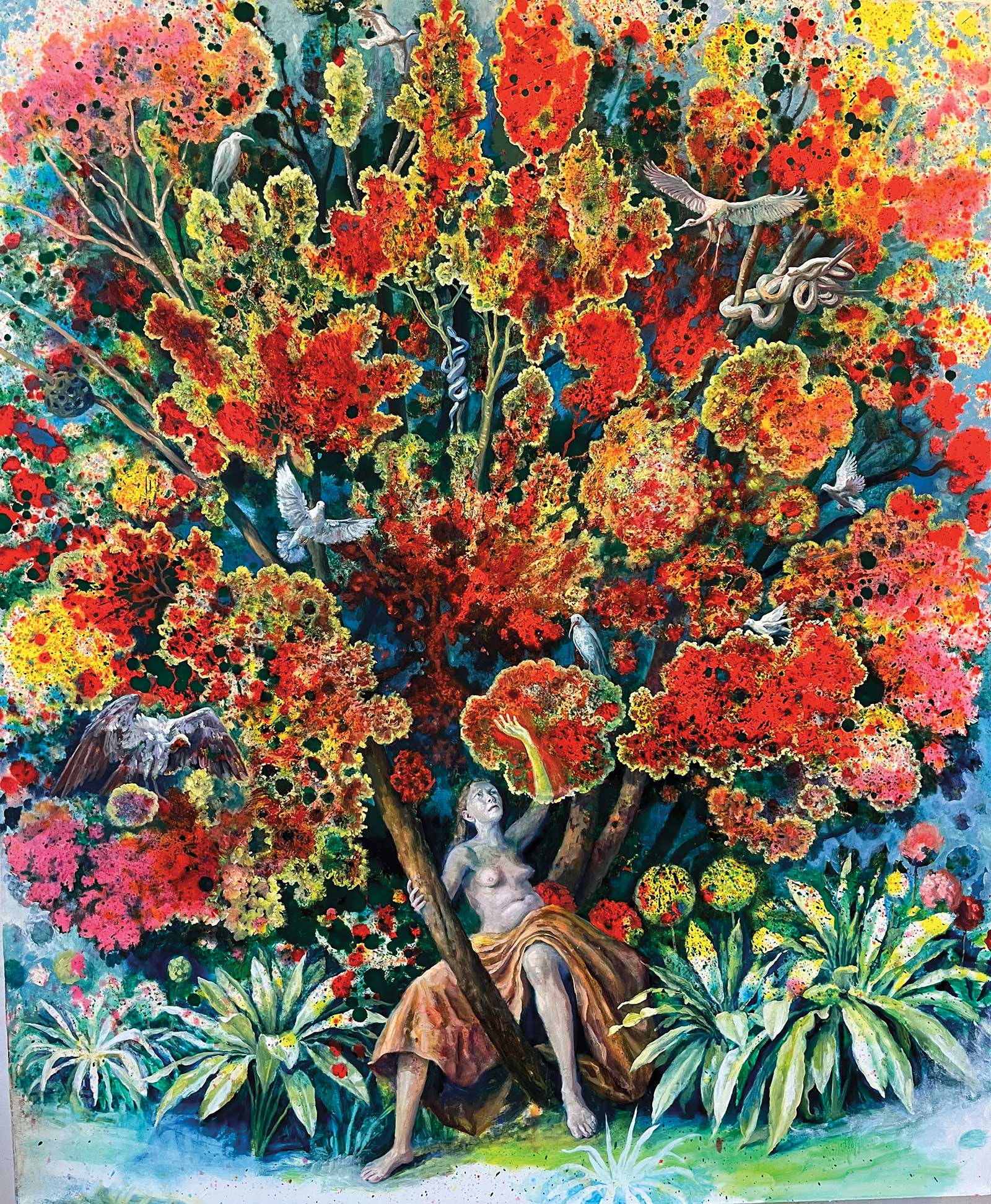 Spill (Birds), oil on canvas, 54 x 50". Courtesy of Hirschl & Adler Modern © Eric W. Baumgartner.
Her first experience of these visions came after months of painting bleak, black expressionist paintings in 1980s Berlin, then a city of grim division overshadowed by the oppression of living imprisoned behind the wall. Her work was unsatisfying and depressing, but it led to a shamanic experience that changed the course of her artistic life and turned her into a messenger of transformation. After a frustrating day of painting, she lay down to rest and suddenly experienced a flood of precise imagery, as if pictures were presenting themselves for her attention. The wall was down and for 30 years she mined the endless flow, until eventually she lost her sense of purpose in the studio. She stopped painting and produced a graphic novel, soon to be published, and found that swimming in the creative ocean of digital work had restored her hunger for the materiality of paint. She returned to the studio restored.
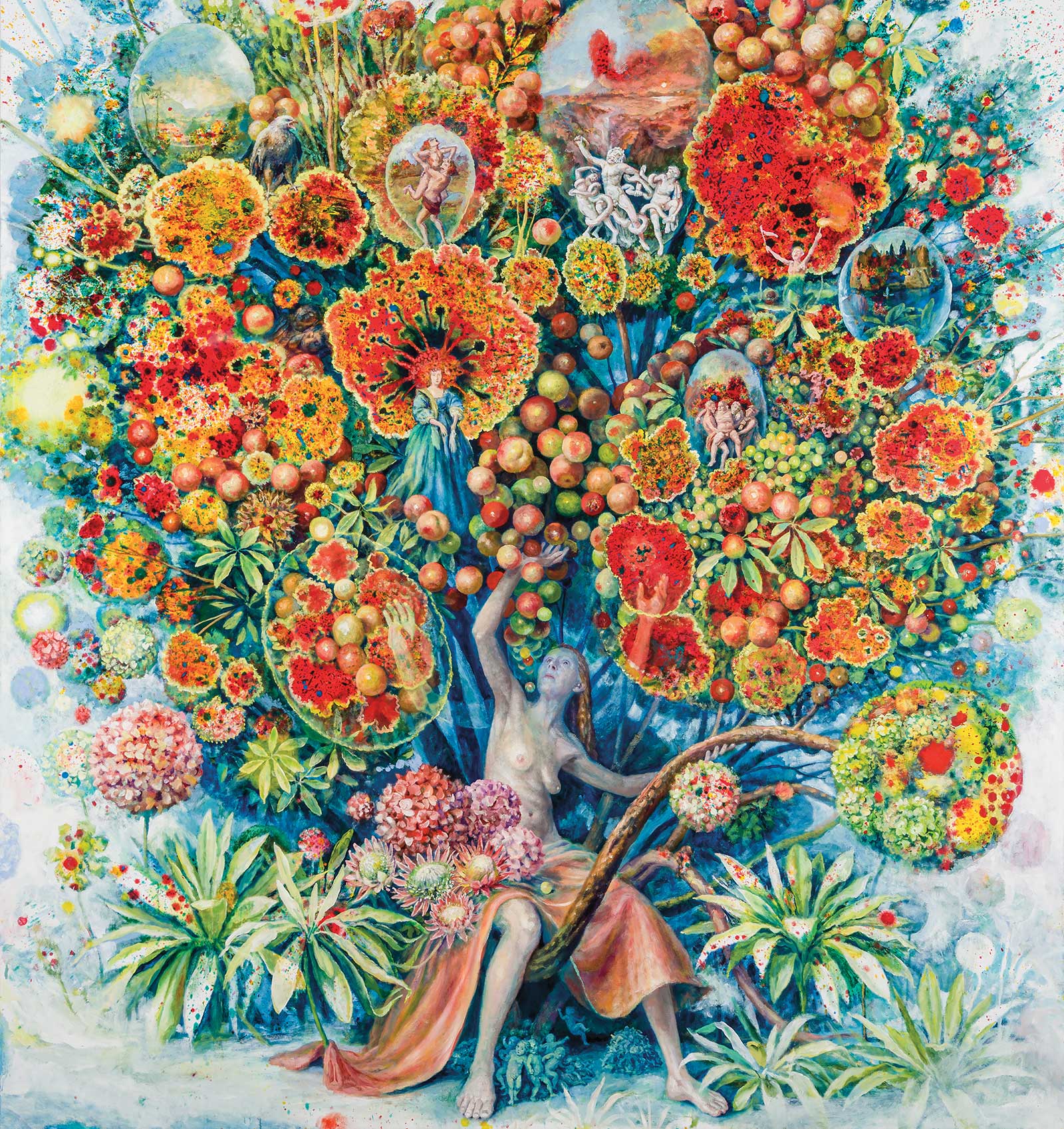
Spill (Laocoon), oil on canvas, 72 x 68". Courtesy of Hirschl & Adler Modern © Eric W. Baumgartner.
Being back in the studio led to a different kind of revelatory experience, this time about how paint itself would help her find vibrant new life in her work. Her past work was precise and she carefully planned her strategies for constructing the paintings, using her imagination as a source, picking and choosing from the abundance of imagery she envisioned. Now she began throwing paint at her panels, or pouring it over primed surfaces, and imagining what forms might emerge from the random splashes and splatters.
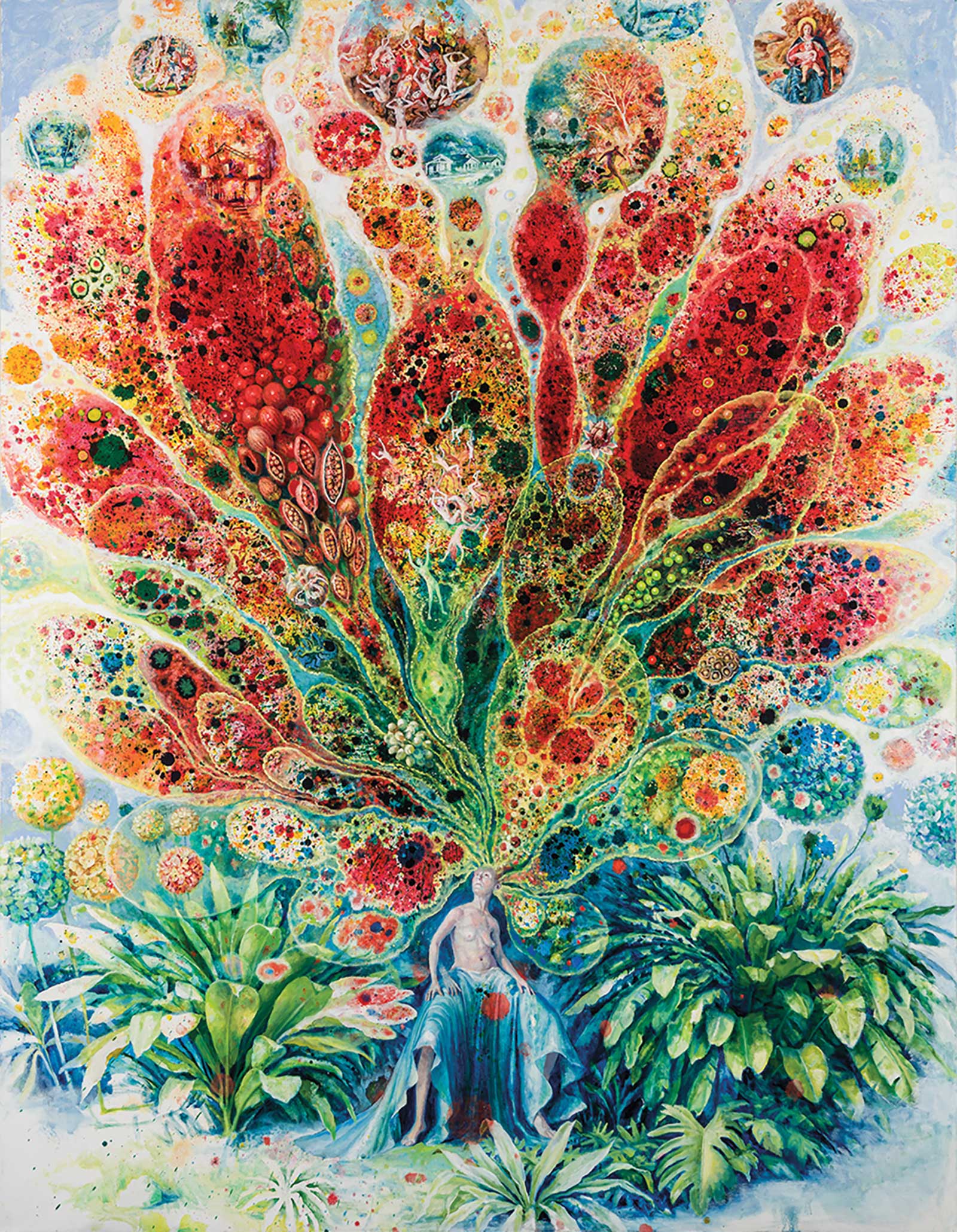
Spill (The Fall), oil on canvas, 96 x 75". Courtesy of Hirschl & Adler Modern © Eric W. Baumgartner.
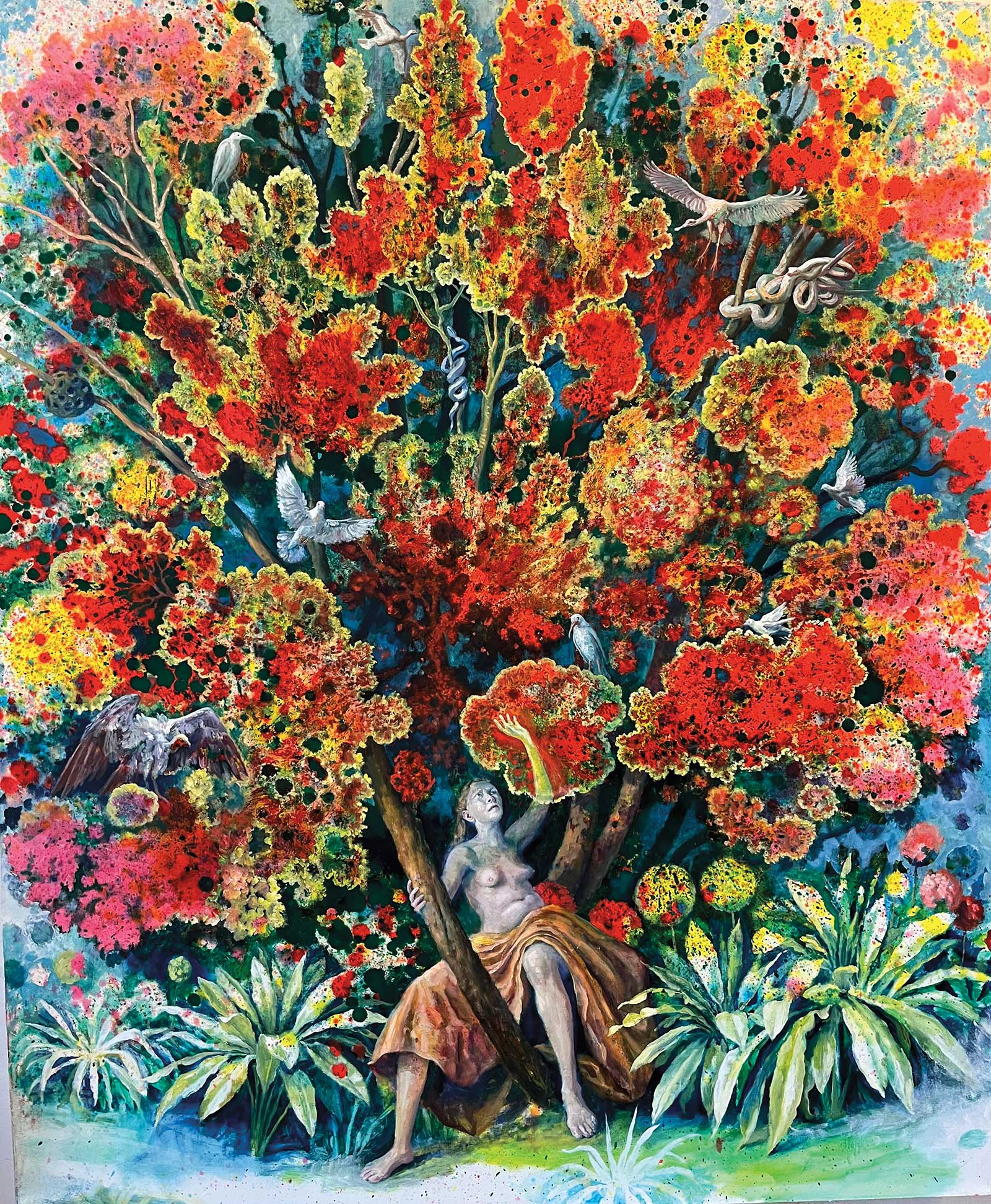
Spill (Thorn Apple), oil on canvas, 70 x 56". Courtesy of Hirschl & Adler Modern © Eric W. Baumgartner.
She shaped the chance contours and textures of the poured paint and allowed them to become her foundation, and then she opened the floodgates of her imagination to find forms that made sense of the chaos and gave it structure. “It felt really good to throw paint and go at it from an entirely different perspective,” Heffernan says. “In the past I would always start with an earth color, wanting to fill the canvas as quickly as possible with opacity, so I could start pulling out the lights and the deeper darks—it was a tonal thing so it felt so good, for the first time in my life, to really think about pure color.” She loved the brightness and chance that pouring paint brought to her work, inspiring new shapes and ideas. She found the pure chaotic nature of color exciting. “The pours suggested trees pretty quickly,” she recalls. “They turned themselves into the dapple of leaf clusters and became a place to hide things, like a little treasure chest or a Christmas tree. It allowed me to play between the rendered things, like a thought bubble.” The results were magical, ethereal images that fit within the long sequence of her body of work, which has always been mysterious and feminine, but the new works had a dreamy sensitivity and beauty born of their abstract beginnings.
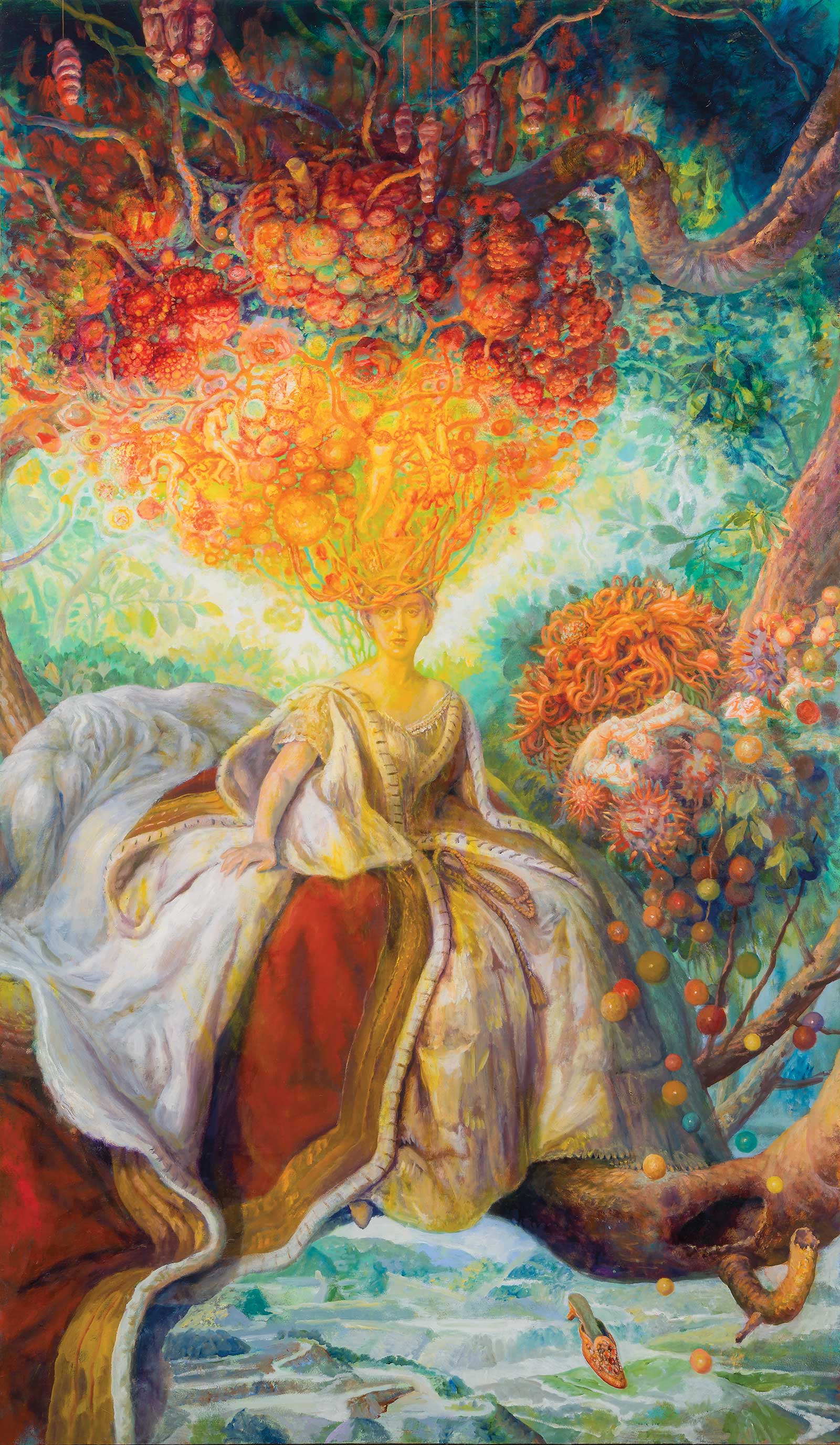
Self-Portrait as Mad Queen, oil on canvas, 96 x 75". Courtesy of Hirschl & Adler Modern © Eric W. Baumgartner.
Sometimes the poured paint dominated areas of the panel, which remained untouched by her brush, but Heffernan loves to overwhelm her audience with intense imagery, and the abstract shapes of the paint allowed her to divide her compositions into areas of passionately worked pareidolia and soft spaces where the paint does the work for her. The galactic splash above her self -portrait Spill (Throne) is the backdrop for a cascade of colorful stones held in balanced equilibrium among whimsical stars and coins, and long strings of pearls. A fantastic flower garden has emerged from lighter shapes in the lower half of the painting, with giant puffballs, pink artichoke globes and epic balls of hydrangeas.
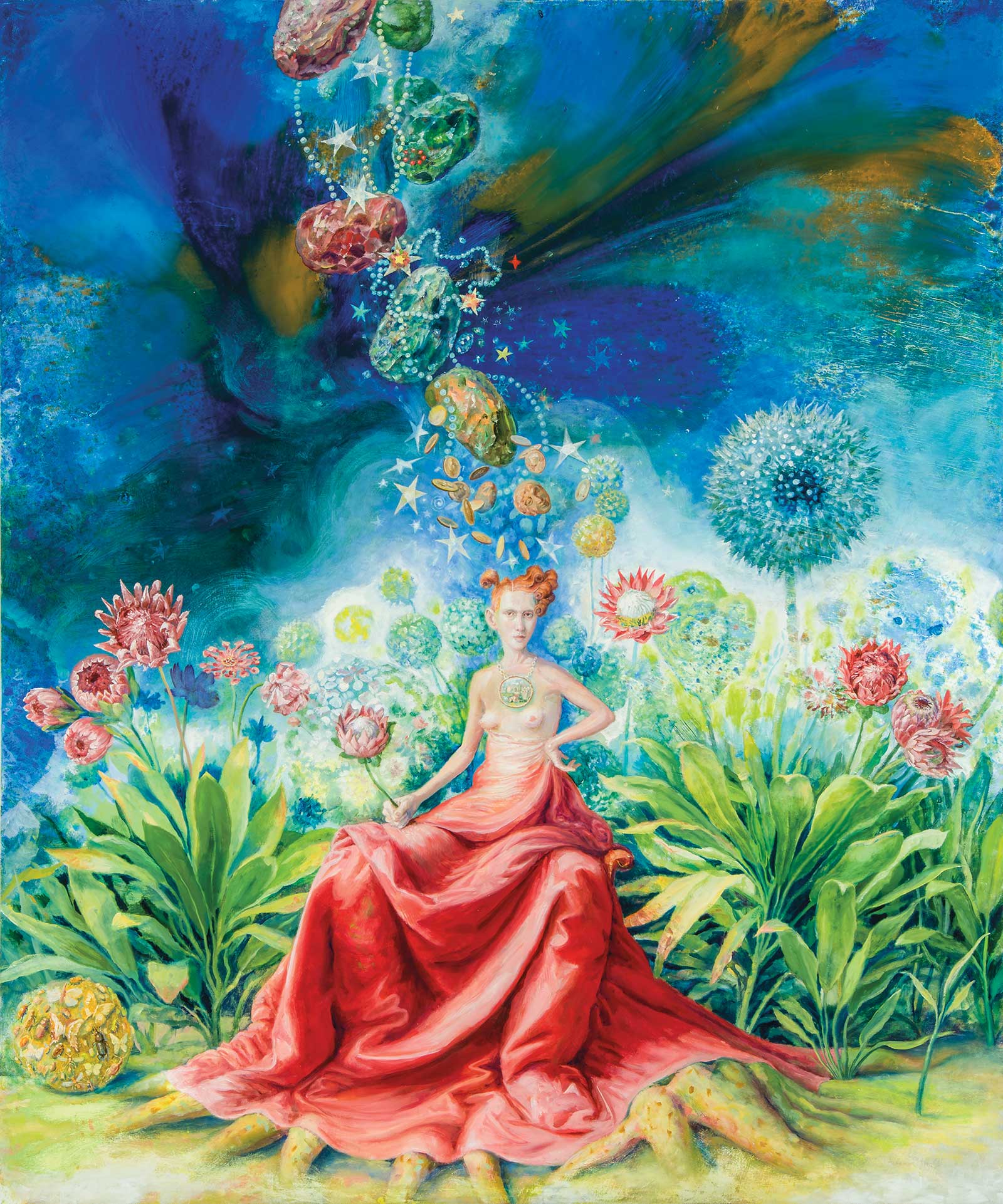
Spill (Throne), oil on canvas, 72 x 60". Courtesy of Hirschl & Adler Modern © Eric W. Baumgartner.
Looking for clear, individual meanings in each painting may be fruitless. Heffernan is critical of metaphorical approaches to painting. “Allegory is a little bit suffocating, isn’t it,” she declares. “Allegory is a bit of spoon feeding and pushing an agenda and that strikes me as really wrong for art. I’m furrowing my brow as I say that. It becomes kind of a game. It cancels out other possibilities because when you decode it, you’ve got it; you’ve solved the riddle and all the mystery’s gone. Obviously, there’s a place for it in storytelling but maybe not in the world of visual art so much.”
Instead of creating didactic images designed to persuade her audience of any specific point of view, she pursues an organic evolution of form which is ultimately thematic—consistent refrains emerge throughout her body of work, collectively providing insight into her preoccupations. The first of her self-portraits was made when she suffered an ectopic pregnancy and had to have life-changing emergency surgery. The experience launched her into a feeling of shared, lived feminism. She felt her work had to reflect her profound experience.
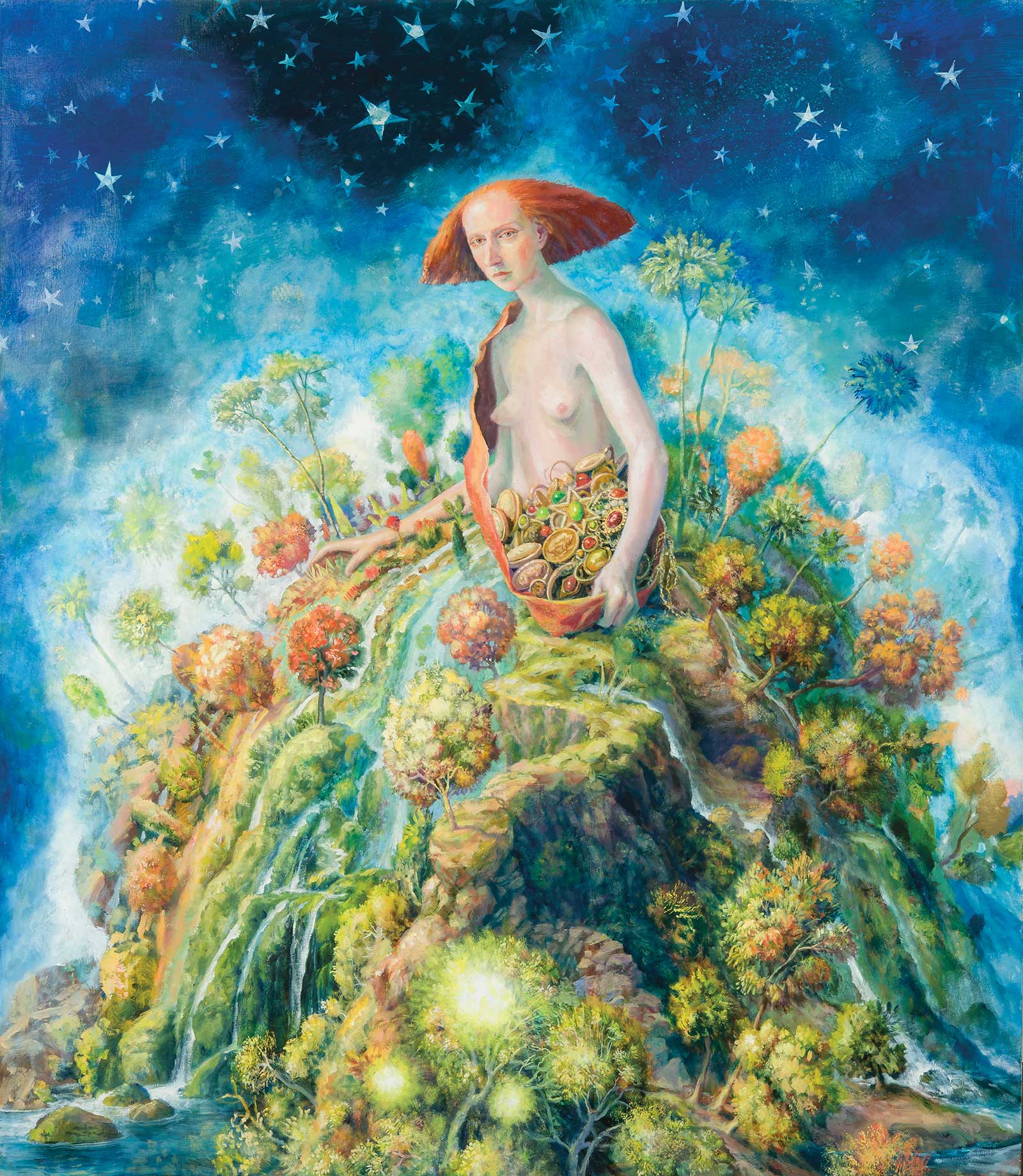
Self-Portrait (Continental Divide), oil on canvas, 60 x 52". Courtesy of Hirschl & Adler Modern © Eric W. Baumgartner.
Her paintings provoke immediate associations to archetypal and fundamental ideas of women—the Priestess, the iconography of Mother Mary, primordial Eve and the tree of knowledge of good and evil, and the hagiography of imagery dwelling in Heffernan’s mind as the remembrances of her lost faith. “The Catholic archetypes keep speaking to you,” she says. “The thing that I always paint to is the idea of some sort of metamorphosis. The thing that brings it around is when one event metamorphosizes from another event. Someone spitting becomes a torrent that puts out a fire. Birds released escape into a ceiling mural firmament. Moths coming out of leaves become birds. Some idea of metamorphosis. That definitely comes from a Catholic upbringing where every week you’re gazing at a transformation—and you believe it.”
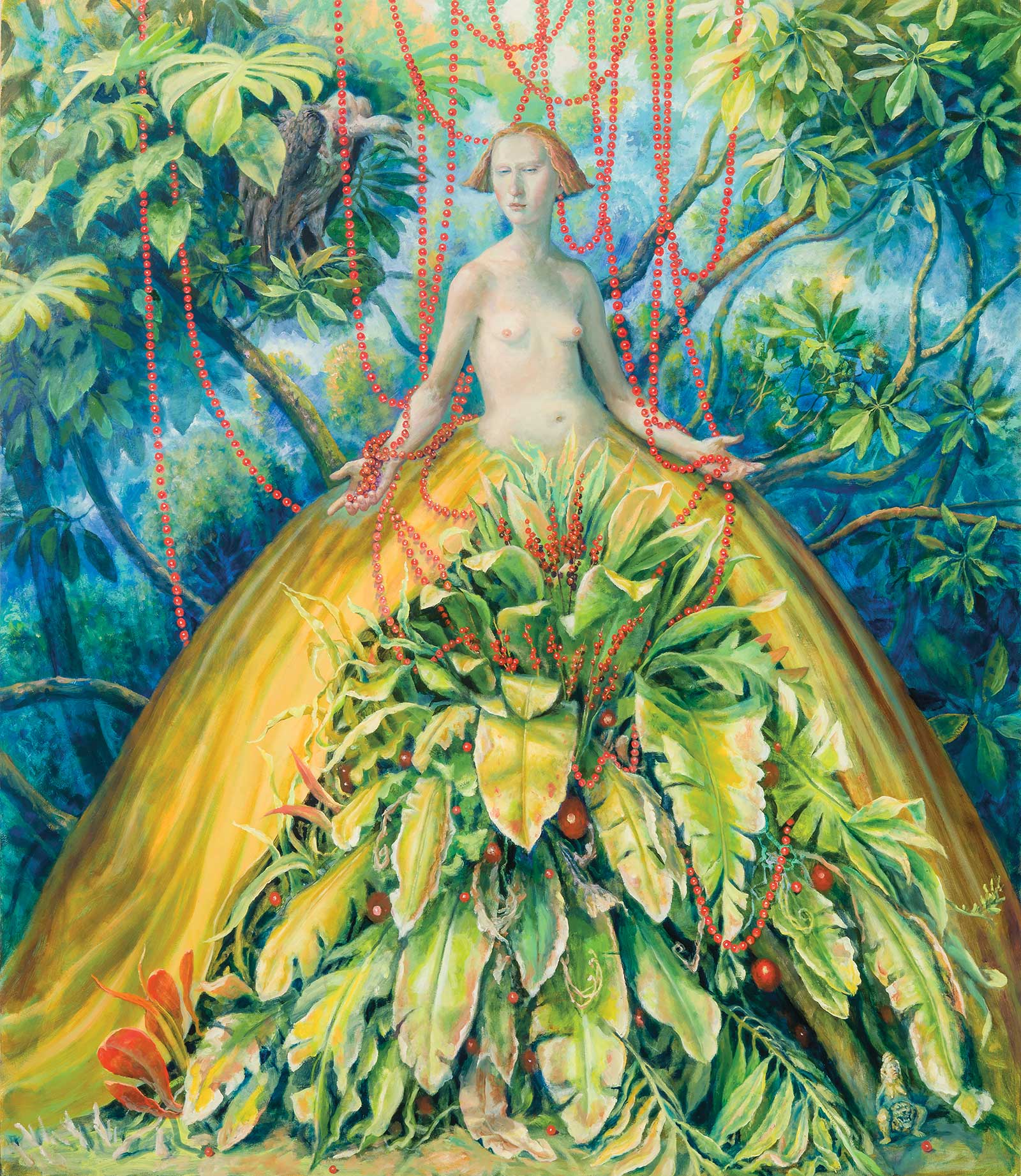
Self-Portrait (Lion Birth), oil on canvas, 60 x 52". Courtesy of Hirschl & Adler Modern. © Eric W. Baumgartner.
The iconography of the saints provided her with an inexhaustible visual lexicon. She remembers collecting pictures of them on cards, carrying them in her pockets, tucking them behind the bottles in the medicine chest—pictures created in the surreal language of Catholic narrative imagery. Saint Agnes offered her breasts on a plate. St. Lucy carried her eyeballs in her hands.
The Garden of Eden is a consistent presence in Heffernan’s work, and the archetype of Eve is tied to her youthful indoctrination to Catholic rites and dogmas. She is a world-builder, creating an environment for the feminine principle to dwell in. “I live not far from Prospect Park and spend as much time there as I can, pretty much every day,” she shares. “The park as opposed to the forest is an interesting thing because you get to love and cultivate it, and it never fails to spark my druidic, tree-worshipping ancient self.”
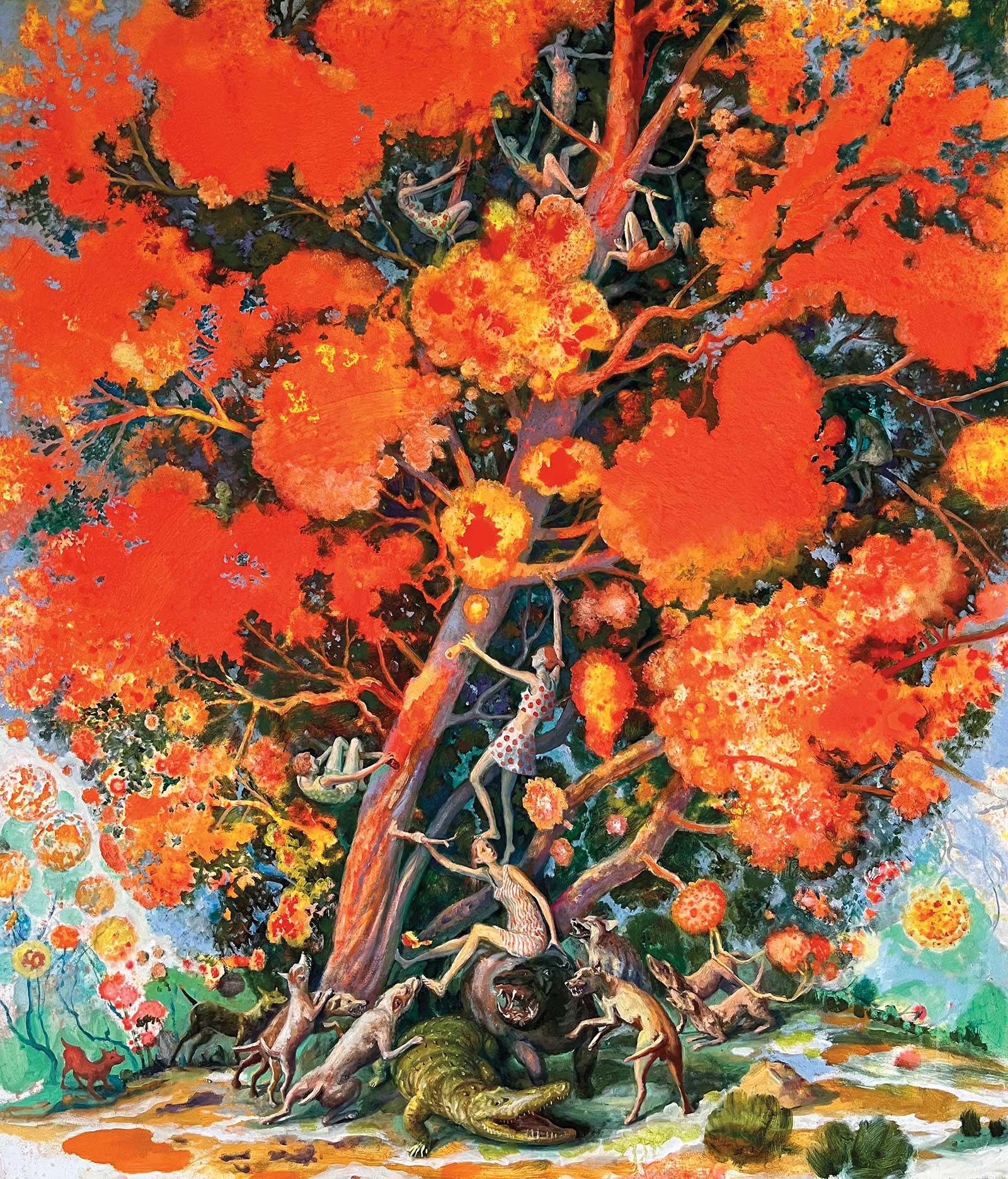
Spill (Climbers), oil on canvas, 58 x 50". Courtesy of Hirschl & Adler Modern © Eric W. Baumgartner.
Her paintings allow her to cultivate the garden of her images, to reposition and reprocess the iconography of her youth, and to visit the other world of her shamanic vision. She does it for all women, everywhere. —
+++
Michael Pearce is a dynamic writer, curator, and critic, and a champion of art that emerges from popular culture and shapes the spirit of the age. He has published dozens of articles about art and artists, and is author of Kitsch, Propaganda, and the American Avant-Garde. He is Professor of Art at California Lutheran University.
Powered by Froala Editor