If the alienated and frightened lyrics of Radiohead’s OK Computerwere paintings, perhaps they would shape themselves under the brush of Rebecca Orcutt, whose pictures are the visual songs of her generation. She says her work “…is reflective of my feeling of the world. Most of it is about waiting and expectation, and belief. The figures are in situations where they really want to believe in what they’re doing and believe that there’s a purpose to it, but there’s this insecurity and fear that they’re wrong about how they’re choosing to make meaning in their lives.” Her cast of characters—her friends and fellows—pose for her as she builds narratives about their hope that what they’re doing in life matters.
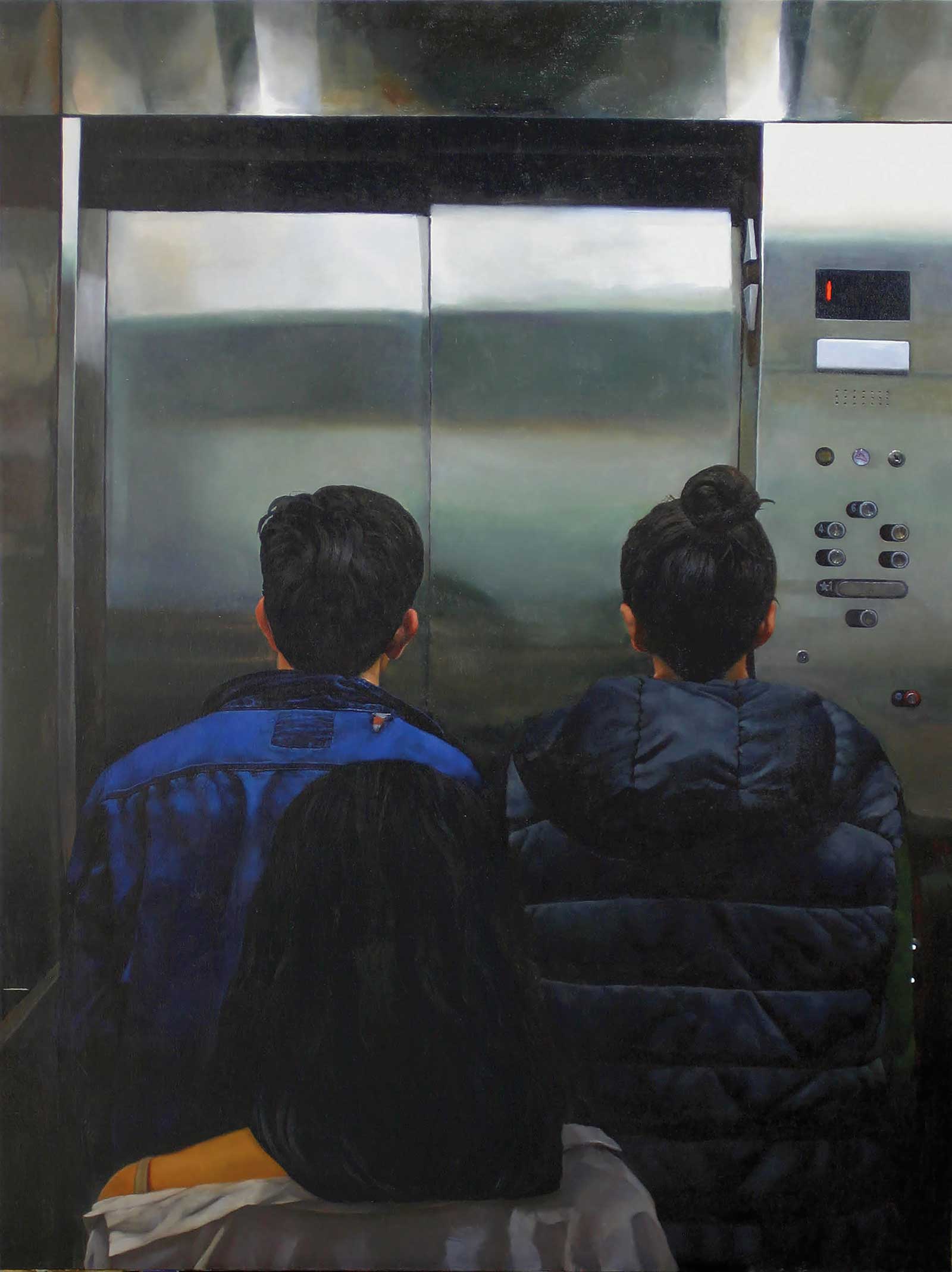
In 6 Years this Might be Worth It, 2018, oil on canvas, 48 x 36". Private collection
They seem to dwell in a world where they may be fitter, happier and more productive; living comfortably, not drinking too much and getting regular exercise at the gym three days a week, but they are constantly nagged by the feeling that their opinion is of no consequence and their actions are meaningless. Take Stop Now and it was all for Nothing. Somehow the stilled motion of a girl playing with a spinning hula hoop is connected to the frozen inaction of a jammed fan, which buzzes like a fridge. What is her purpose? Her spinning is trivial and worthless, and the fan is broken. Whatever weird relationship exists between what she does and what happens is disconnected. She is split and blanked by a faceless wall, withdrawn into a bare and private space within the windowed world of the barren and secluded frame, alone. “It was about an irrational connection between unrelated events,” Orcutt explains. “I wanted something dark and ominous about the figure being partly concealed, and maybe thinking that it’s stupid, what they’re doing, but it’s an obsession and they can’t stop because if they do, it was all a waste of time.” She is afraid that there is nothing underneath the actions of life.
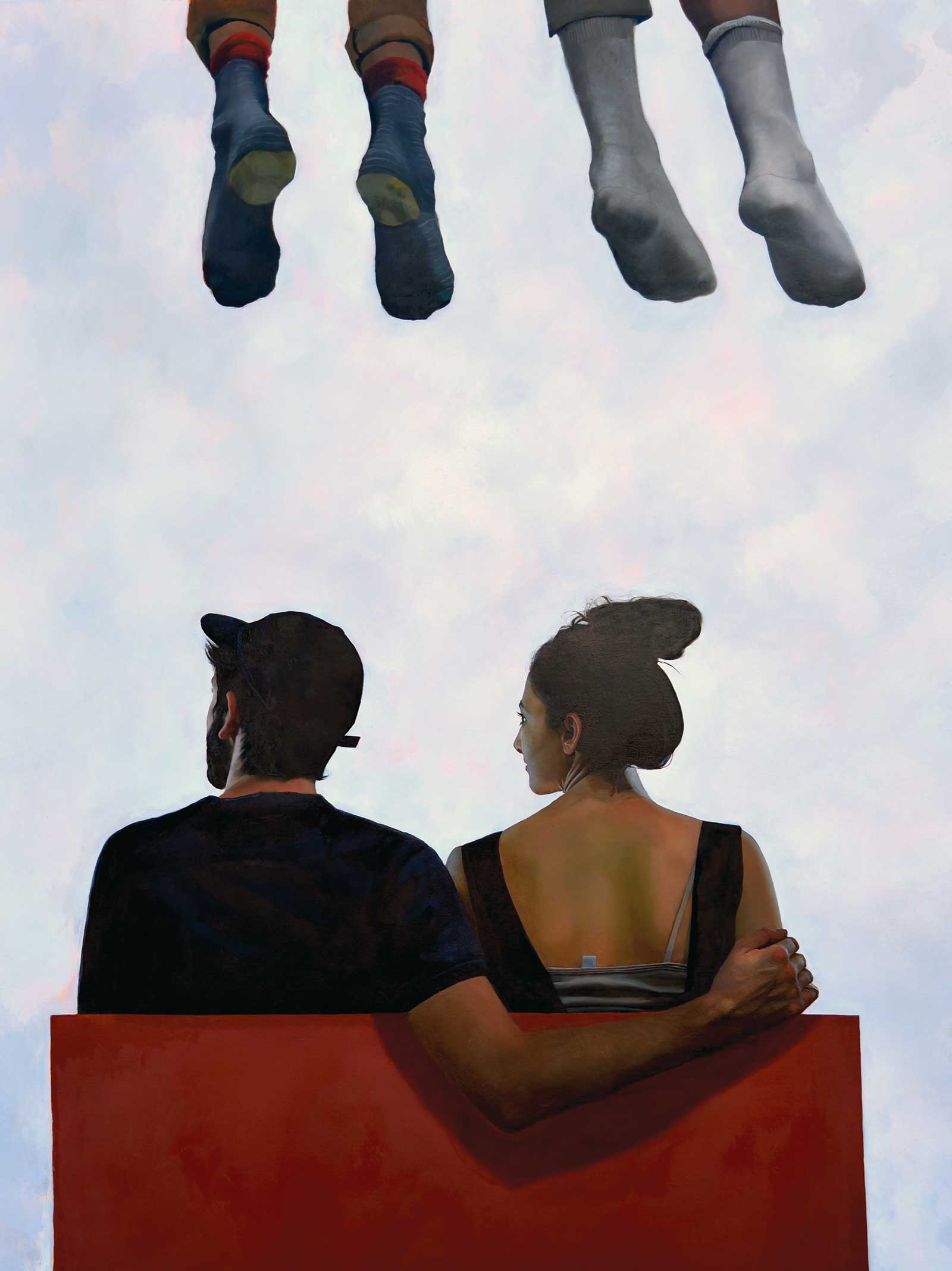
Looking at Someone Looking, oil on canvas, 60 x 48"
Her players are afraid to act. In Absolute Only Best Possible Way, the speed and action of the ball game are as frozen as the fan. “I wanted it to feel as though there are really high stakes. If it’s dodgeball it should be a split second, a natural impulse to throw it and move on. But there’s a monumental importance to which direction to throw it, staying too long in that deliberation.” Action might seem like ambition and ambition makes you look pretty ugly in a passive generation formed by fear. Ambiguity is a safer choice, being observant and docile as events unfold. “There’s always anticipation, waiting to see what’s going to happen—if anything’s going to happen,” she says. The fear that Orcutt worries about is an offscreen personality standing on the edge of the paintings and climbing up the walls just outside the frame. Fear whispers insidious darkness into the ears of Orcutt’s characters. “Either way you turn, I’ll be there,” it says, and this intimidation stifles action.
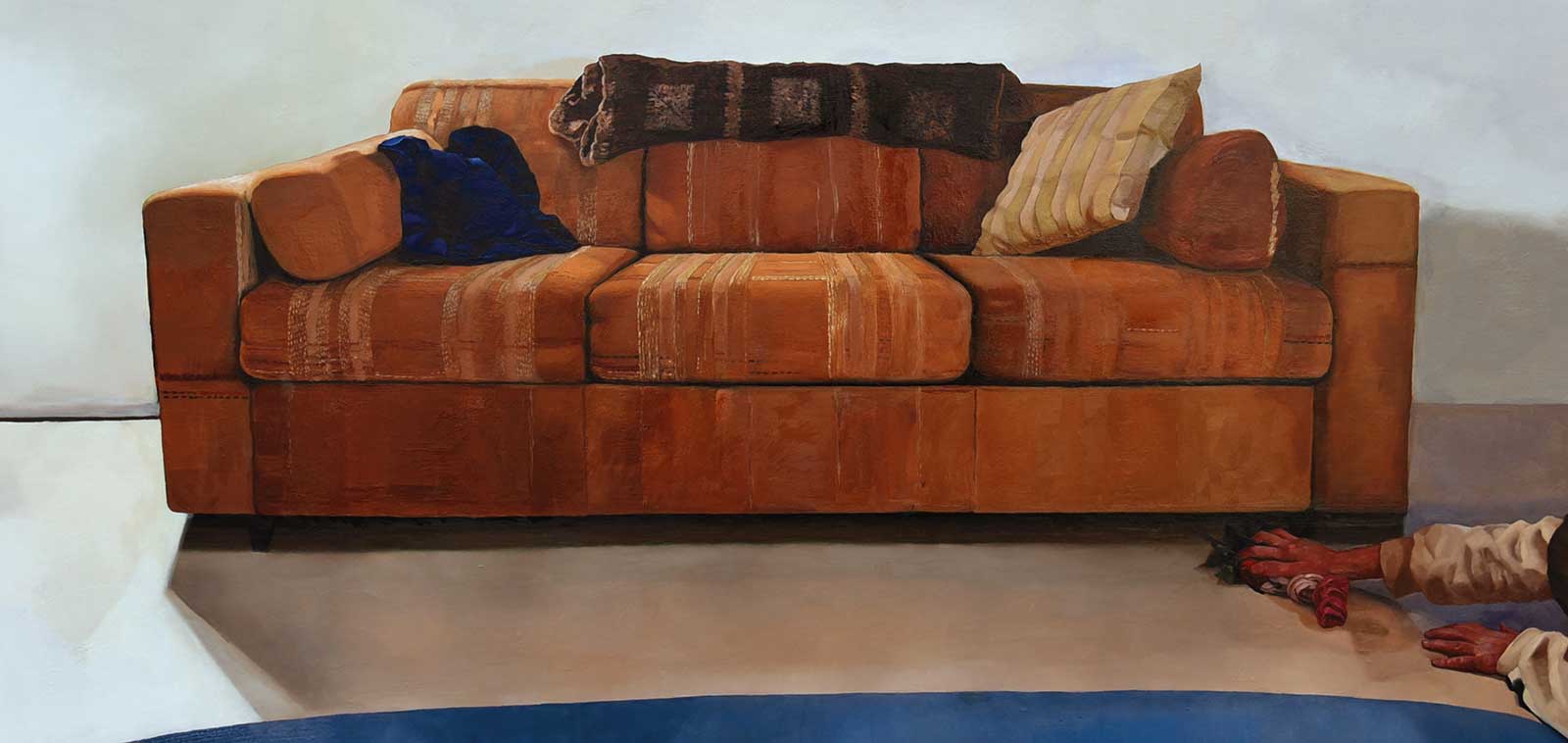
Bored When it’s Over, oil on canvas, 24 x 48"
The theme is repeated in the painting In 6 Years this Might be Worth it, where she paints resignation to existential crisis in the elevator. The elevator is going up, the passengers are beginning a day at work and Orcutt seems to comment on doing a job that slowly kills you. She says her passengers are longing for knowledge. “To feel like what they’re doing matters,” she says, “Like there’s a point to it. Having this awful suspicion that there’s not, but doing it anyway. Hoping for an outcome that seems extremely unlikely and unreasonable.” This is all there is. This is what you get.
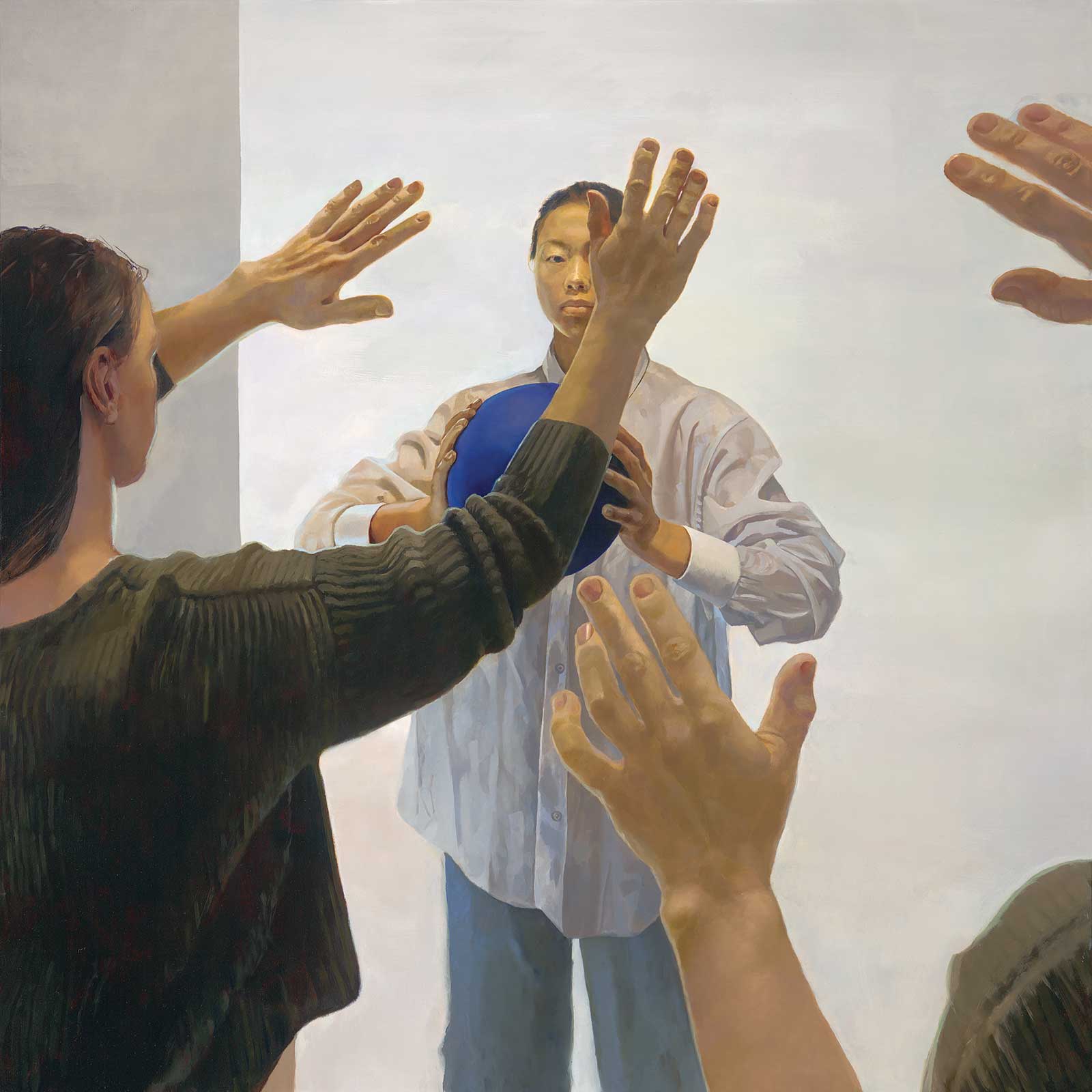
Absolute Only Best Possible Way, 2023, oil on canvas, 48 x 48". Courtesy of Gallery Poulsen
She ties her work to Søren Kierkegaard’s thinking. She says she was reading a lot about his philosophy when she made the new paintings and laughs about her insecurity about including any reference to him in her didactic commentary for her recent show at Poulsen Gallery in Copenhagen, quoting a Danish philosopher when showing her work in a Danish gallery. Imposter syndrome notwithstanding, Kierkegaard’s hunger for meaning chords the song of her work. Kierkegaard wrote, “What I really need is to get clear about what I must do, not what I must know, except insofar as knowledge must precede every act. What matters is to find a purpose…to find a truth which is truth for me, to find the idea for which I am willing to live and die.” Consistent to the thinker’s theme but willing to evolve, in her most recent painting Orcutt has revisited the corporate elevator, but this time she has stepped away from reality toward an alteration of dimensions, compressing the already cramped confinement of the lift into an even more claustrophobic space to increase the disquieting sense of not belonging in the corporate world, the frustration of being confined and purposeless. She says, “I wanted to have more ambition with changing the scenery to be more surreal, so the elevator ceiling is too low, too small, so they’re kneeling because it’s the only way they can fit into it.” Her interest in providing her paintings with the dense foundation of Kierkegaard’s philosophy is in harmony with the teaching of Jean-Pierre Roy, who was one of her professors at the New York Academy of Art where she trained. Whereas Roy is fascinated by the philosophical issues of sensual perception and his bright paintings enter the complex realms of science fiction and speculation, Orcutt prefers to be grounded in the issues of contemporary life and simplifies reality to clearly express her ideas.
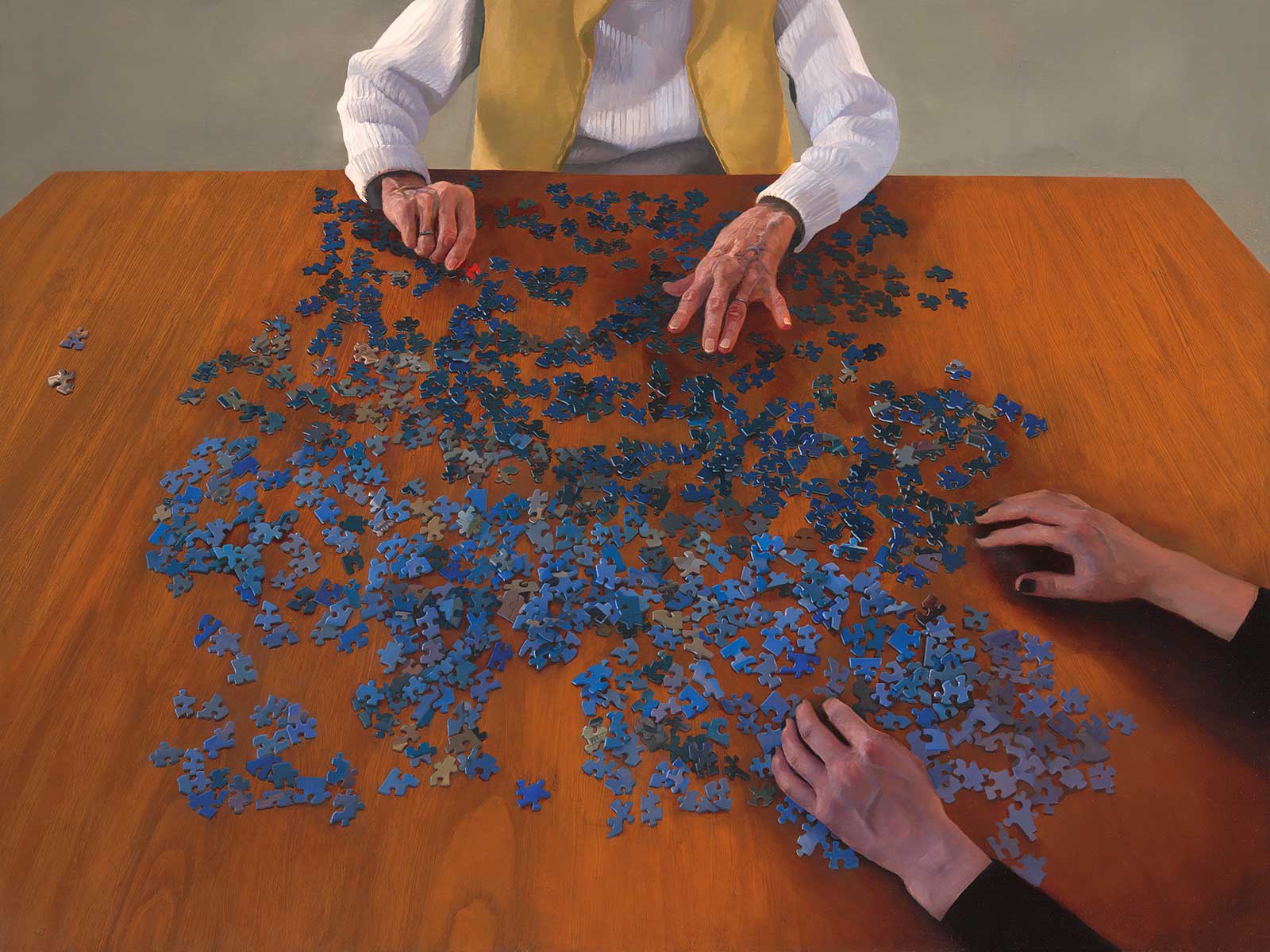
Memory Hierarchy, 2020, oil on canvas, 30 x 40". Private collection
Orcutt lived in Washington state for most of her youth, then went to the New York Academy. She returned to the West Coast to be close to family during the pandemic, thinking that the move would bring a sense of security but she was disappointed that it didn’t feel as much like home as the East Coast did. Her increased alienation infected her ideas. “These paintings do feel more isolated,” she continued, “The people are more separated from each other.” She painted Bored When it’s Over in an attempt to capture the sense of missing the main event—the feeling that her generation shares of being late to the party and unable to bring back whatever it was they missed. A figure lies largely out of frame beside the dominant couch. Something terrible has happened here, but there are no clues to enlighten us about what it was, except that a hand clutches a molded bunch of flowers. It looks like the real thing, but this is a fake, plastic love, a murder caused by false sentiment. “I liked how those fake flowers were more vivid than real flowers,” says Orcutt. She wanted to conjure, “an eerie feeling like something was ruined or something bad happened. Missing conflict.” Don’t get sentimental, the painting warns its viewers—sentimentality always ends up drivel.
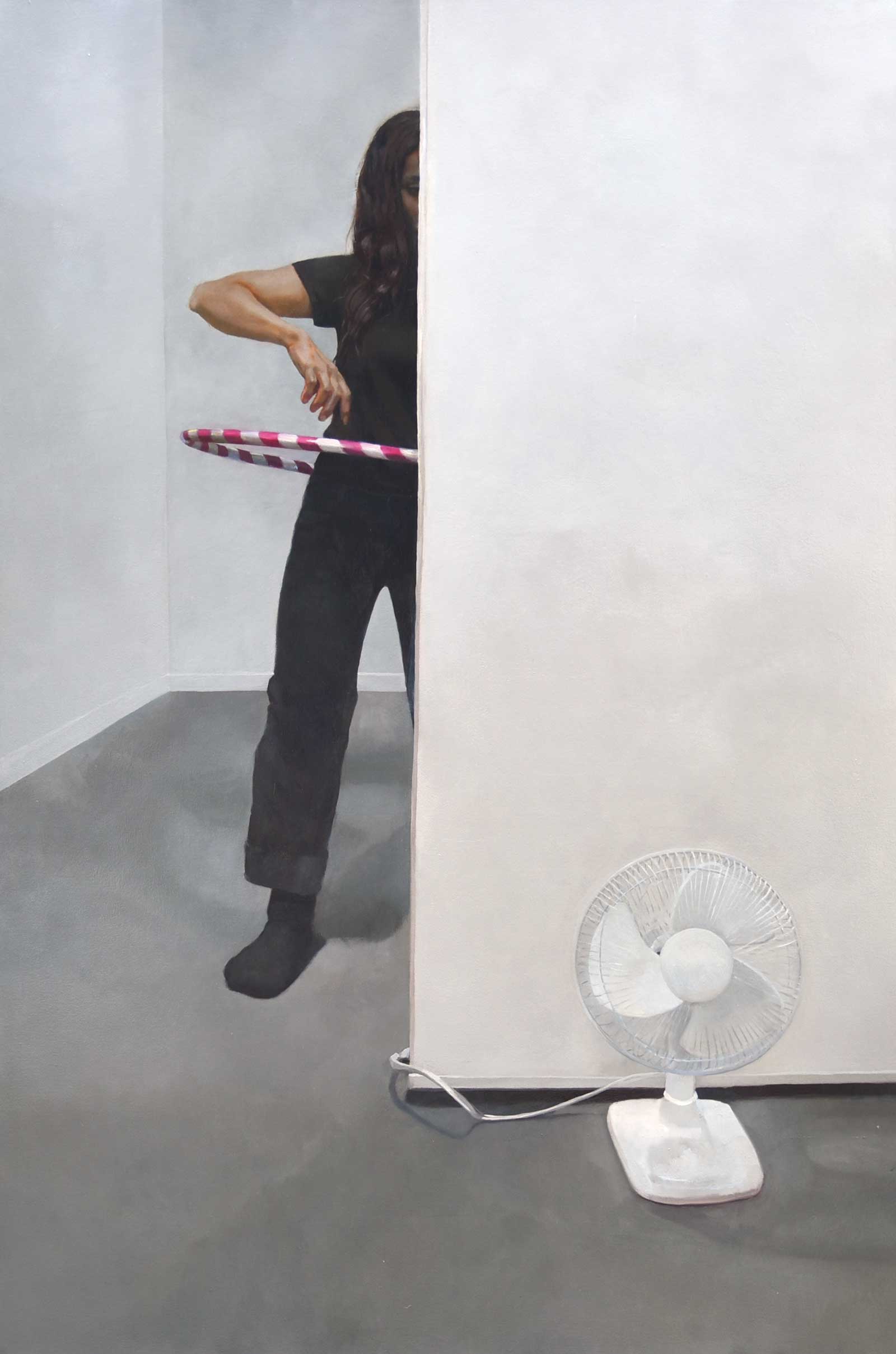
Stop Now and It Was All for Nothing, oil on canvas, 60 x 40"
If alienation is the guide to her ideas, then is there a refuge in faith? Enter Rolling Down a Hill, which recalls the expanse and isolation of Andrew Wyeth’s Christina’s World. The simplified geometrical composition of the grassy mound makes the painting feel strange and eerie, although the actions of the figure are childishly innocent. In awkward moments of self-protective embrace, the person hurls themself into the abandonment of rolling uncontrolled down the steep hill. There is a hint of ritual, an allusion to the scattered burial mounds of the Old World and the old magic of European folk traditions of hill races, when villagers threw themselves down steep embankments, attempting to win local glory and the heroic blessings of the nature gods, recklessly flinging themselves into chaos and trust of fate. There are rough weeds at the bottom of Orcutt’s hill but Orcutt says, “Some beliefs can seem silly, unless they’re true, and then it doesn’t matter if you look foolish.”
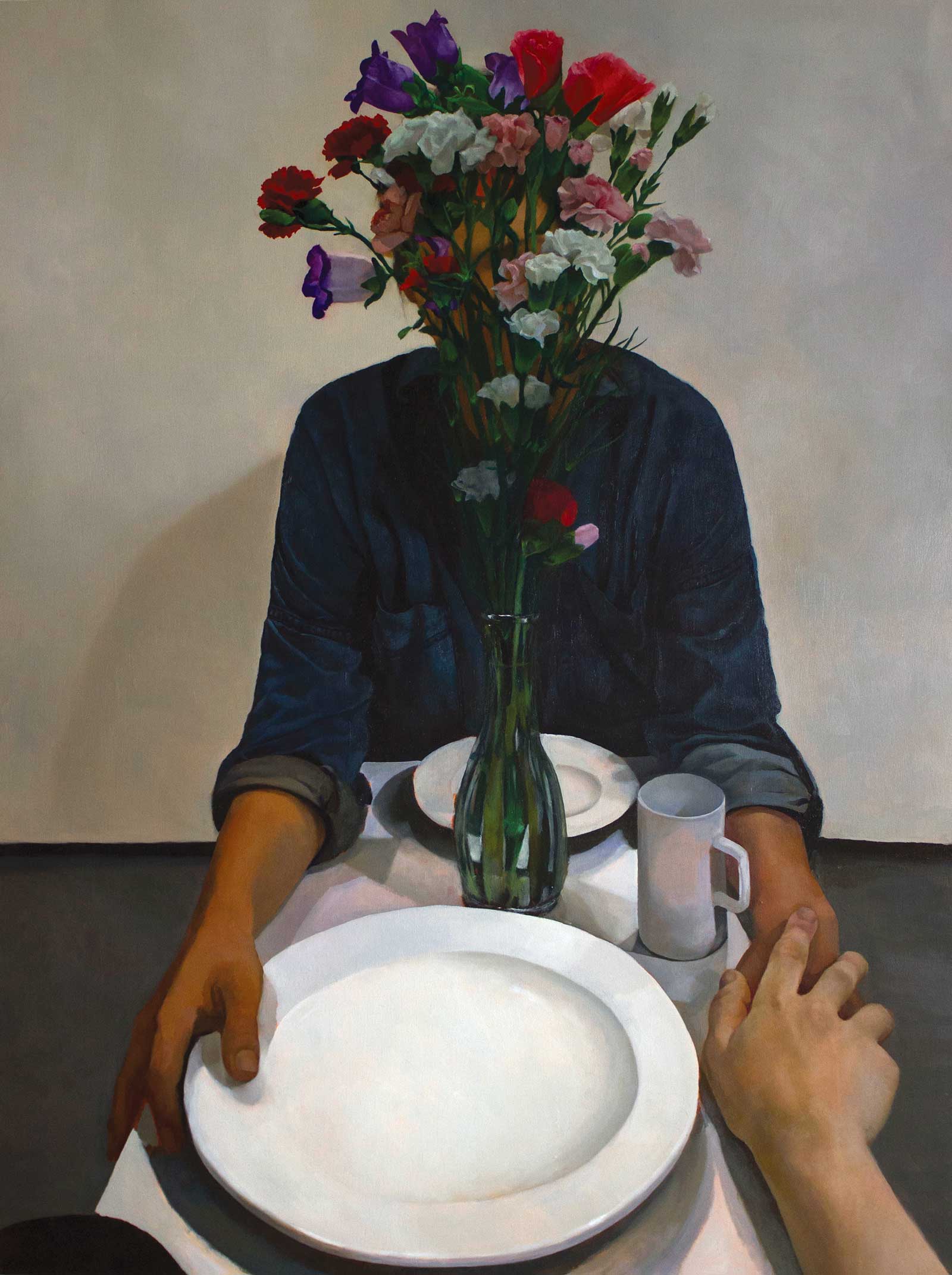
Sorry the Movie Wasn’t That Good, oil on panel, 40 x 30"
The heavens are fragmented in Memory Hierarchy, where two pairs of hands shuffle and sort the intricate jumble of jigsaw pieces, attempting to reorder an overwhelmingly abstracted and broken sky. How can we connect with the gods when the sky is in pieces? Orcutt acknowledges the problems of faith for seekers conflicted by doubt like a detuned radio. “It’s hard to believe in anything completely,” she says. “They’re not about God, but my belief in God does come into my paintings. I do believe in God now. But I wonder if it’s possible to truly believe in God. If you’re deciding to believe something, does that diminish the belief?” But Orcutt’s jigsaw-maker holds a single red piece against the desperate sea of blue. There may be hope then, however vague, that from that chromatic fragment of color a network of reconstruction might be built. “I’m trying to reconcile not being able to know for sure,” she says. —
+++
Michael Pearce is a dynamic writer, curator, and critic, and a champion of art that emerges from popular culture and shapes the spirit of the age. He has published dozens of articles about art and artists, and is author of Kitsch, Propaganda, and the American Avant-Garde. He is Professor of Art at California Lutheran University.
Powered by Froala Editor