The portrait artist John Singer Sargent (1856-1925) wrote, “I do not judge, I only chronicle.” Yet, he wasn’t above being provocative, painting a portrait of Isabella Stewart Gardiner that her husband wouldn’t allow to be shown publicly while he was alive, and painting a portrait of a Parisian socialite for the 1884 Salon that set Parisians on their ear.
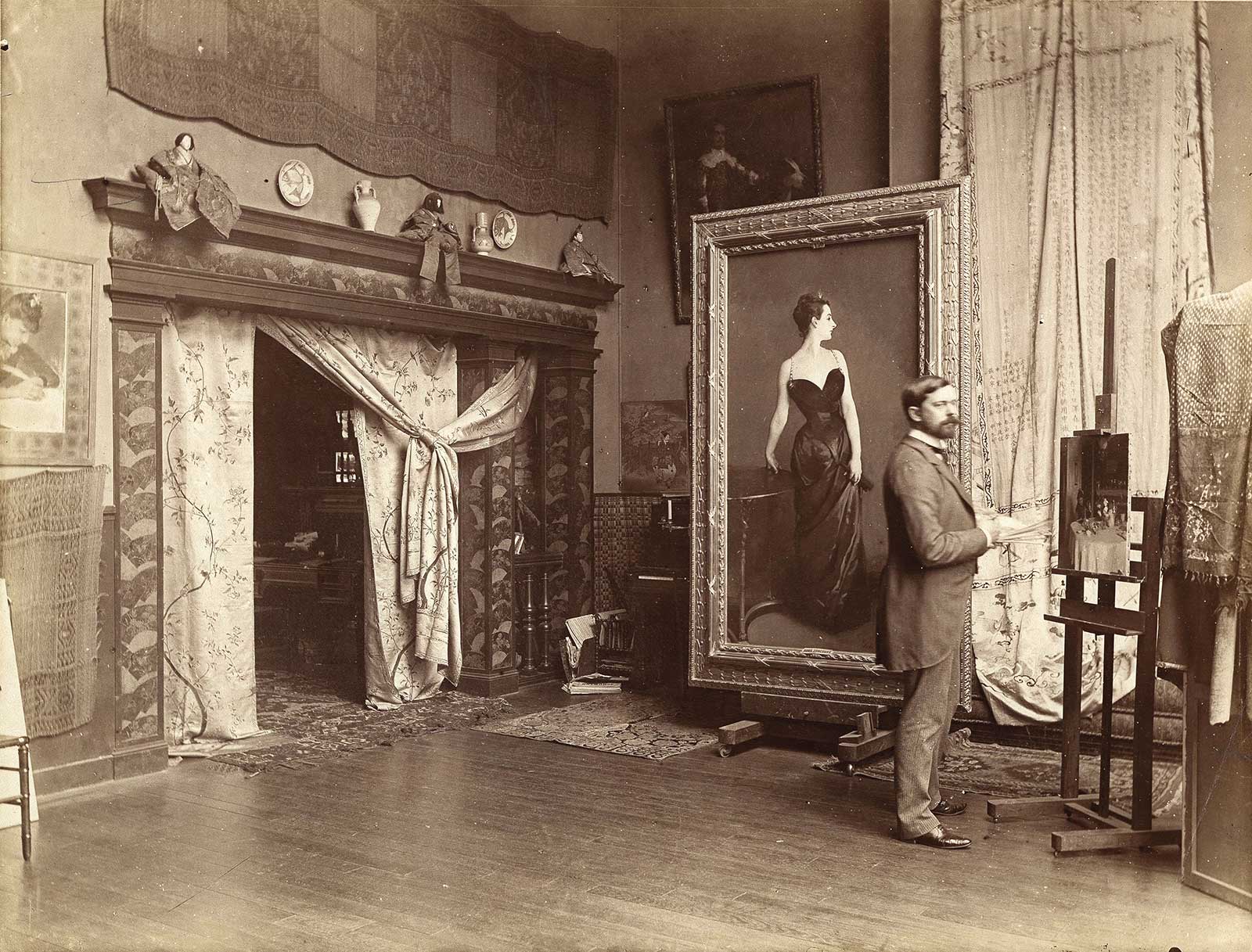
John Singer Sargent in his studio, ca. 1884. Photographs of artists in their Paris studios, 1880-1890.
Today, Sargent’s painting, Madame X (Madame Pierre Gautreau) hangs in the Metropolitan Museum of Art in New York. Madame Gautreau used a lavender powder on her skin which appeared creamy white in candlelight. In the original portrait, one of the jeweled straps of her dress had slipped off her shoulder. In the photograph of the painting in Sargent’s Parisian studio, he had already repainted the strap in a more proper location. The provocative, plunging neckline, however, remained.
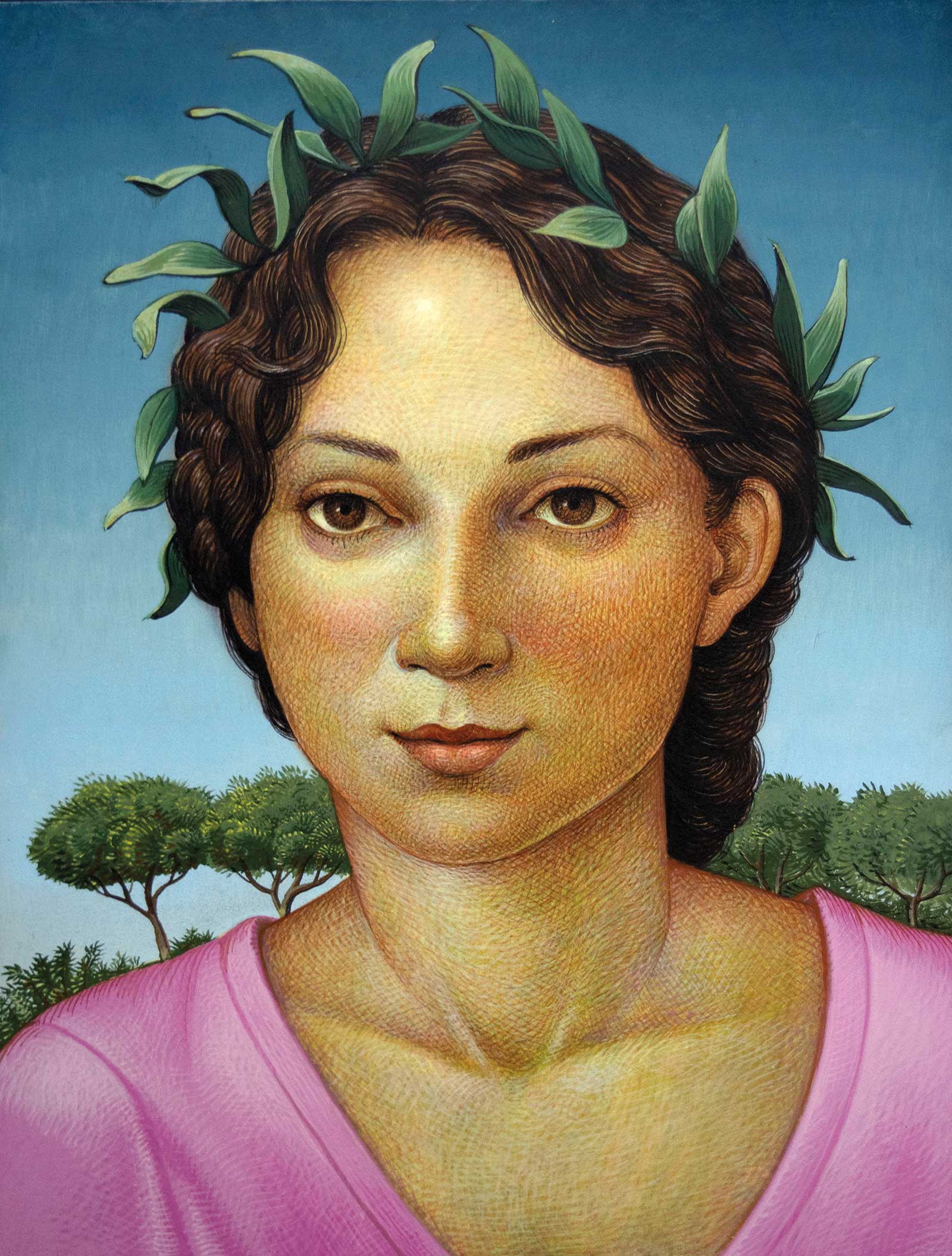
NüArt Gallery, Roma, egg tempera on panel, 12 x 9", by Michael Bergt.
In his biography, John Sargent, Evan Charteris wrote about the brouhaha when the painting was exhibited at the Salon. “There was a grand tapage (uproar) before it all day…I found him (Sargent) dodging behind doors to avoid friends who looked grave…I was disappointed in the colour. She looks decomposed…”
Sargent included a reference to Diana, the Roman goddess of the moon and hunting in Madame Gautreau’s tiara, which is in the shape of the crescent moon. He included another classical reference in the table legs that taper into winged sirens from Greek mythology.
Often in portraits, artists will include references to classical themes as well as to aspects of the sitter’s life. Alexandra Tyngexplains, “When I paint portraits, I allow hints and details of my subjects’ lives to creep into the portraits, while keeping the story firmly in service of the purpose of getting an accurate likeness and a balanced composition.”
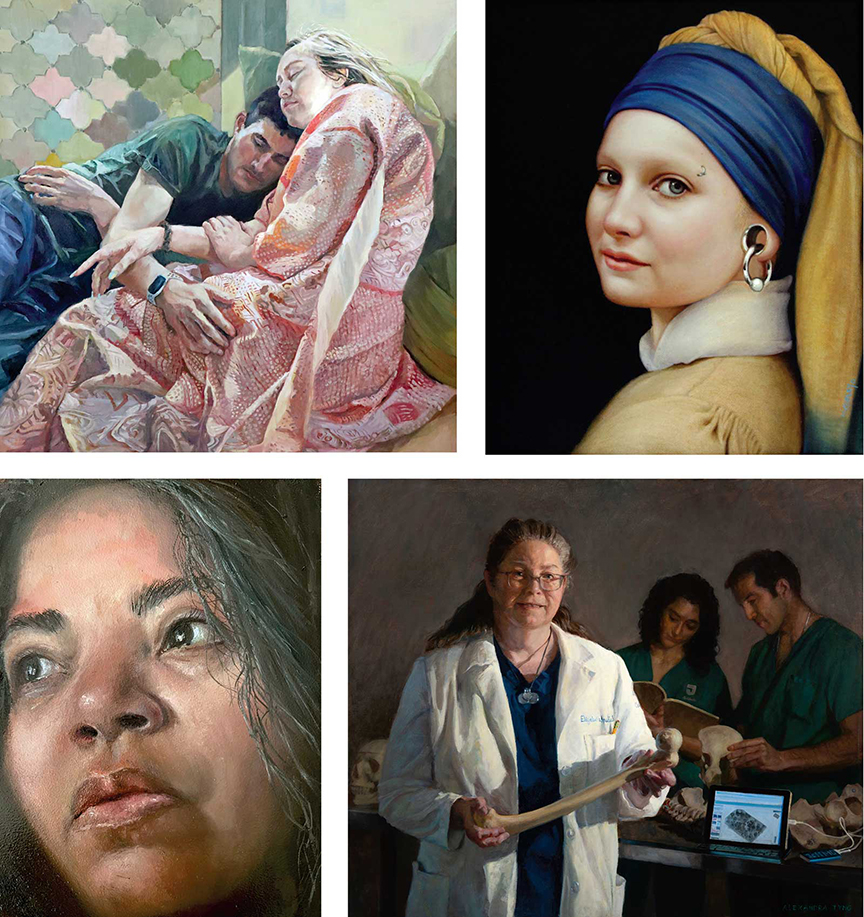
Top: 33 Contemporary, Of Dusk and Dawn, oil on cradled board, 36 x 36”, by Patricia Schappler; Ed Copley, Girl with a Chrome Earring, oil on linen, 12 x 10”. Bottom: 33 Contemporary, Looking Forward, oil on panel, 7 x 5”, by Christa Forrest; Thomas Jefferson University Collection, Dr. Elizabeth Spudich, Chief, Anatomy Education Division SKMC Dept. of Medical Education, oil on canvas, 34 x 40”, by Alexandra Tyng.
Michael Bergt says, “I’ve always been fascinated with the figure beautifully rendered and by pattern and decoration. In my new work, I focus on these two interests: my figure studies are given a context within the designs found in erotic Japanese ‘Shunga’ prints, Persian miniatures and the pattern traditions of Eastern Art.”
Ed Copley worked as a painting restorer, meticulously researching the methods of the masters which he now uses in his own paintings. His historical paintings are also scrupulously researched to assure their accuracy.
In Girl with a Chrome Earring, he refers to Vermeer’s iconic painting Girl with a Pearl Earring. He comments, “Having a great interest in the works of Vermeer and researching the story behind most of his paintings, I thought what a great tribute it would be for a modern-day artist to re-capture his style with modern-day images of the girl with the pearl earring.
“How would Vermeer react and capture his subjects in today’s world with girls being tattooed and having body piercings? When looking closely at Vermeer’s original painting of the girl with the pearl earring you will notice that he did not paint her eyebrows. I thought what a great place for a piercing to go along with a chrome earring.
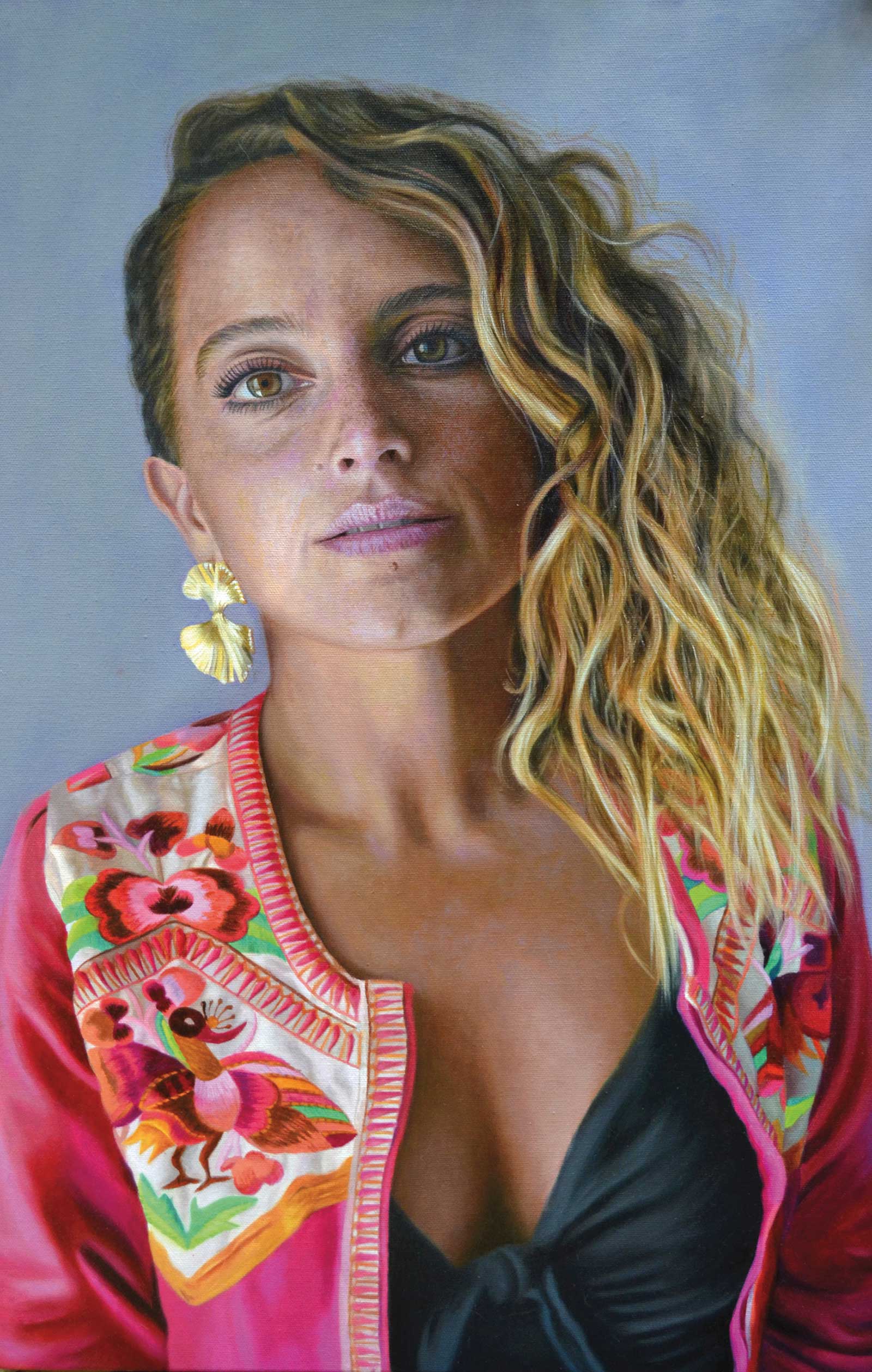 33 Contemporary, Daniela, oil on canvas, 24 x 16”, by Diana Carolina Lopez.
“I plan on doing a series of paintings as if Vermeer were alive in the 21st-century. I don’t plan on copying any of his works. I want to create new works using his style and methods. My many years of restoring Old Master paintings has taught me an abundance of lessons that I have since been able to utilize in my own painting process. All of my paintings will be done in oils starting with an underpainting right up to the final glazing of colors.”
Michael Bergt’s Roma came about as part of his teaching last year at the Rome Workshops. He explains, “I wanted to show the students how I start and work up a portrait painting in egg tempera. Over lunch, I asked one of my students, a young woman from Tunisia, to sit for me. Her face reminded me of some of the mosaics I saw at the Archeological Museum in Naples. I did the drawing, transferred it, and built up the layers with green underpainting and red ocher. As the painting neared the end, I felt I needed to honor where I painted it and the references I used for the style of the portrait. Therefore, I painted a crown of laurel leaves on her head and a stand of Roman Trees in the background.”
Alexandra Tyng’s portrait Dr. Elizabeth Struditchwas a commission from Thomas Jefferson University in Philadelphia.
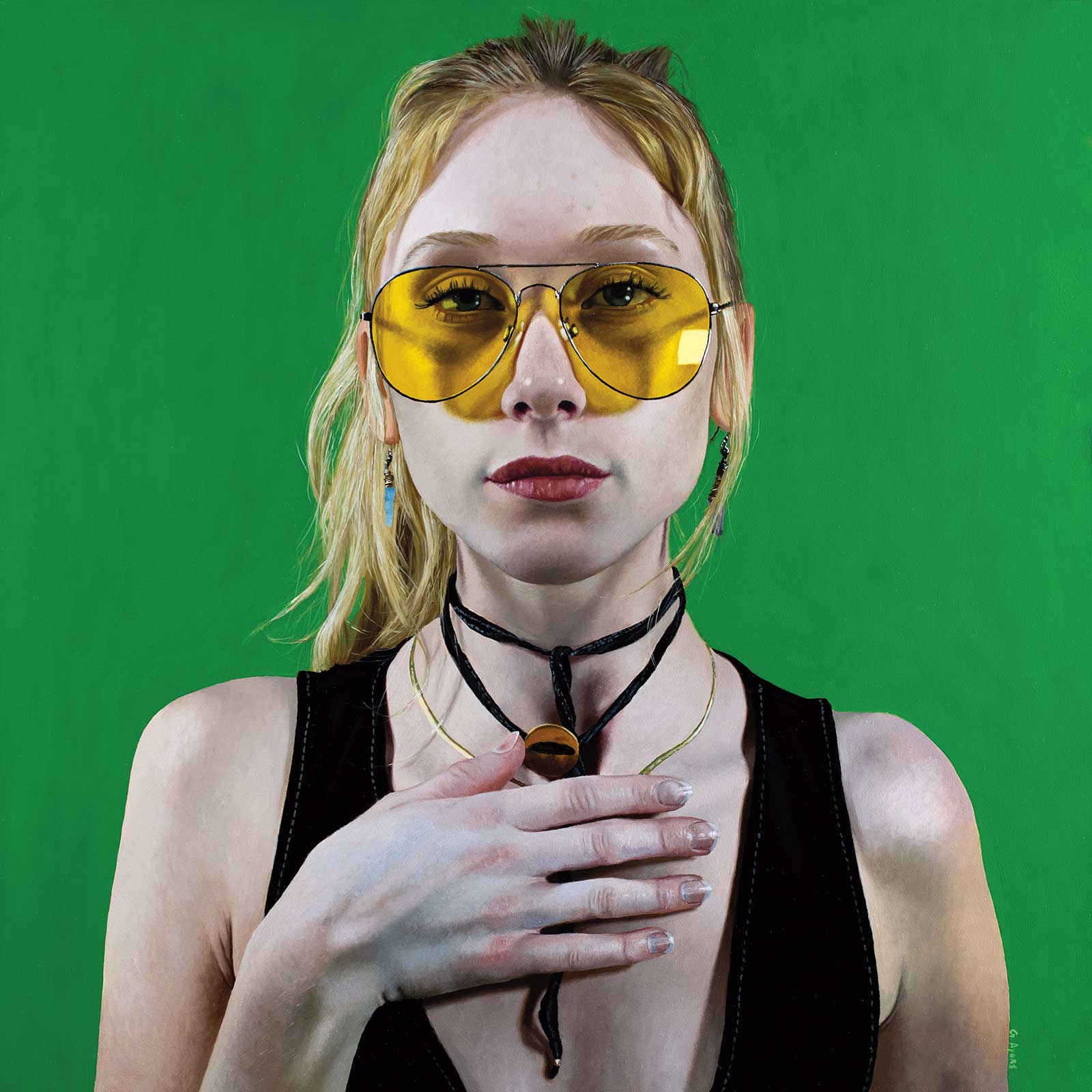 George Ayers, Green Girl, oil on panel, 16 x 16”
 She comments on the art of portrait painting. “It is a collaboration, a candid and open interchange between artist and subject. A person who agrees to be painted is allowing the artist to observe surface planes and colors, while also revealing to the artist, through eye contact and expressions and gestures, glimpses of what lies beneath the surface. The artist records all of that, not as a camera, but as a complex human being, and in doing so reveals profound things about him or herself through the act of describing another individual.
“I first understood collaboration as the daughter of two architects who worked primarily on commission. To my parents, a commission was not just an assignment or directive, but an interchange between architect and client: the ‘program’ consists of the requirements, goals and preferences of the client, who is paying the architect to satisfy the program. The architect has both vision and ability to create a work of art that also satisfies the program, achieving a result that transcends the sum of its parts.
“The beauty of approaching a commissioned portrait this way is that I don’t feel constricted by the ‘program’; I feel energized by it. It’s always my job to figure out how to join forces, to structure the collaboration. I include my clients in the process, by sharing my ideas as they develop, by respecting the clients’ reactions, and by incorporating their contributions in ways that please me aesthetically.
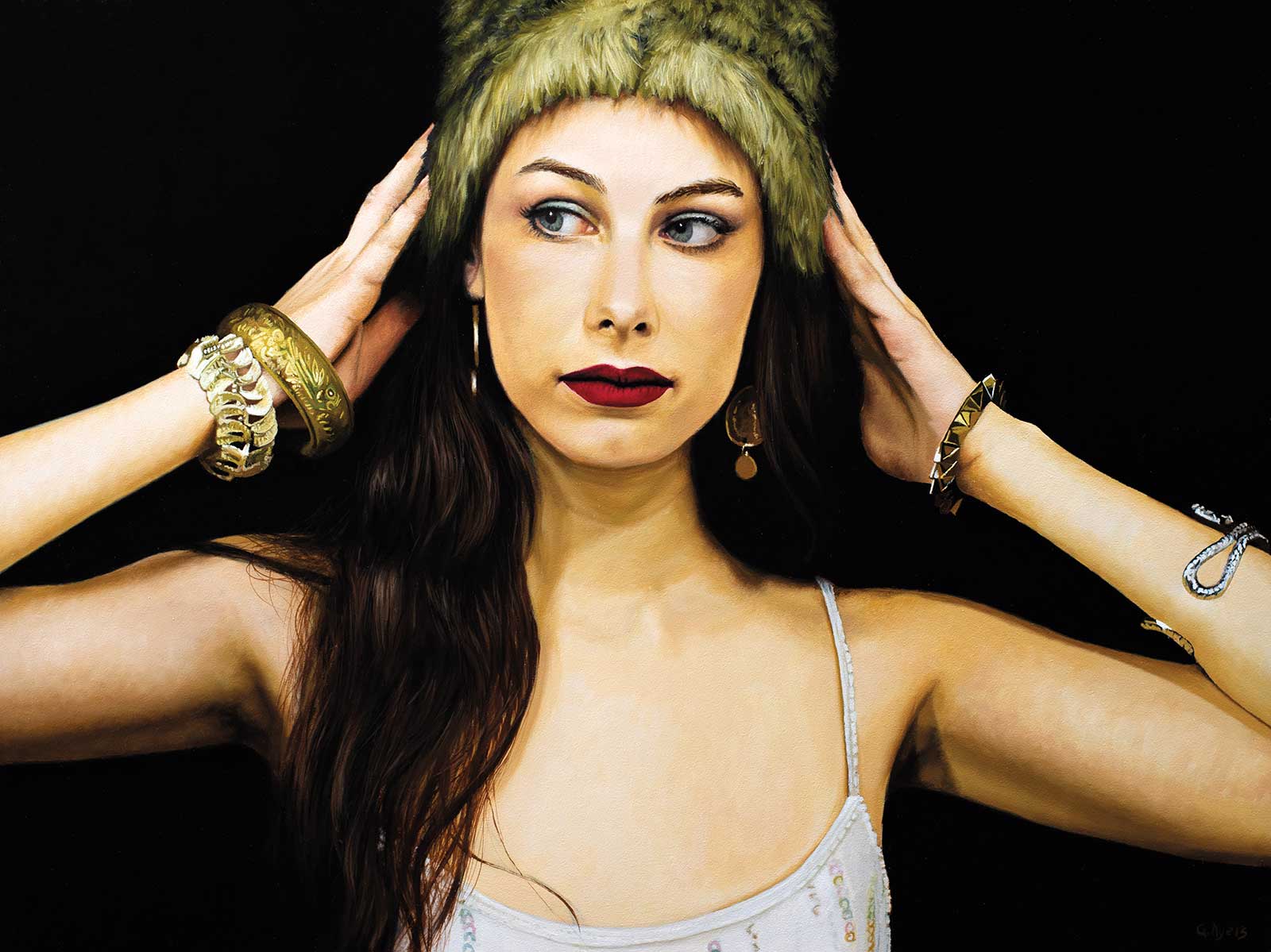 George Ayers, Rachel Hat, oil on panel, 12 x 16”
“I’ve always enjoyed storytelling…. In my figure paintings the theme is dominant while the people in them become characters in the service of the narrative. It may sound contradictory that they are ‘reduced’ to characters, while it is their unique likenesses and presences that inspire me and remain essential. I cannot explain this apparent contradiction, but it works for me.”
Continue reading for additional stories and insights on the art of portraiture, along with advice on how to establish or expand a collection of the genre.
Featured at 33 Contemporary in Chicago, and in collaboration with the international artist group PoetsArtists,are an assortment of talented, contemporary portrait artists. Artist Diana Carolina Lopez discusses her inspiration behind portraits like Daniela, pictured here: “Increasingly over time, I have found in painting much more than an expressive possibility—I have found an extension of myself, a natural connection with a complete process of introspection, interpretation [and] creation…The challenge of my work is to give visual form to these latent but invisible processes that we all share, using as artistic media a detailed realistic painting and drawing technique.”
 Grace M. DeVito, The Tree Climber, oil on canvas, 38 x 30”
Artist Christa Forrest explains, “My artistic story explores the uncomfortable, the self-doubt, the inner critic and the progress of my creative journey through my self-portrait (my selfie). This expanded into inviting others to share their ‘selfies’—providing the viewer with an inside view of my subject, their story and how they want to be portrayed.” Patricia Schappler also offers up an intimate view of human emotion in works like Of Dusk and Dawn. “Reminding me of my mother and aunts huddled together, sewing and embroidering and creating warmth, I began collecting vintage robes from around the world for an ongoing series using printed and patterned fabrics,” she says . “I purchase from women as a way of supporting their small businesses while working on mine, a simple and lovely way to connect moments as I paint familial portraits.”
When collecting, Schappler says, “If a collector feels emotionally and visually invested or intrigued, it’s a good place to begin. I think, collect what you want to linger with, what you love. Carolina Lopez adds, “These are very important times for women, we are arising awareness about our power. Supporting them in art now is a perfect opportunity to make history.”
Artist George Ayersspends a lot of time focusing on life's details, and shares that “this personality trait certainly manifests itself in my work as well. Having said that, my main focus in my work is always lighting and color as well as composition, and I try to include only as many details as I think necessary to capture the realism and overall message I’m trying to communicate.”
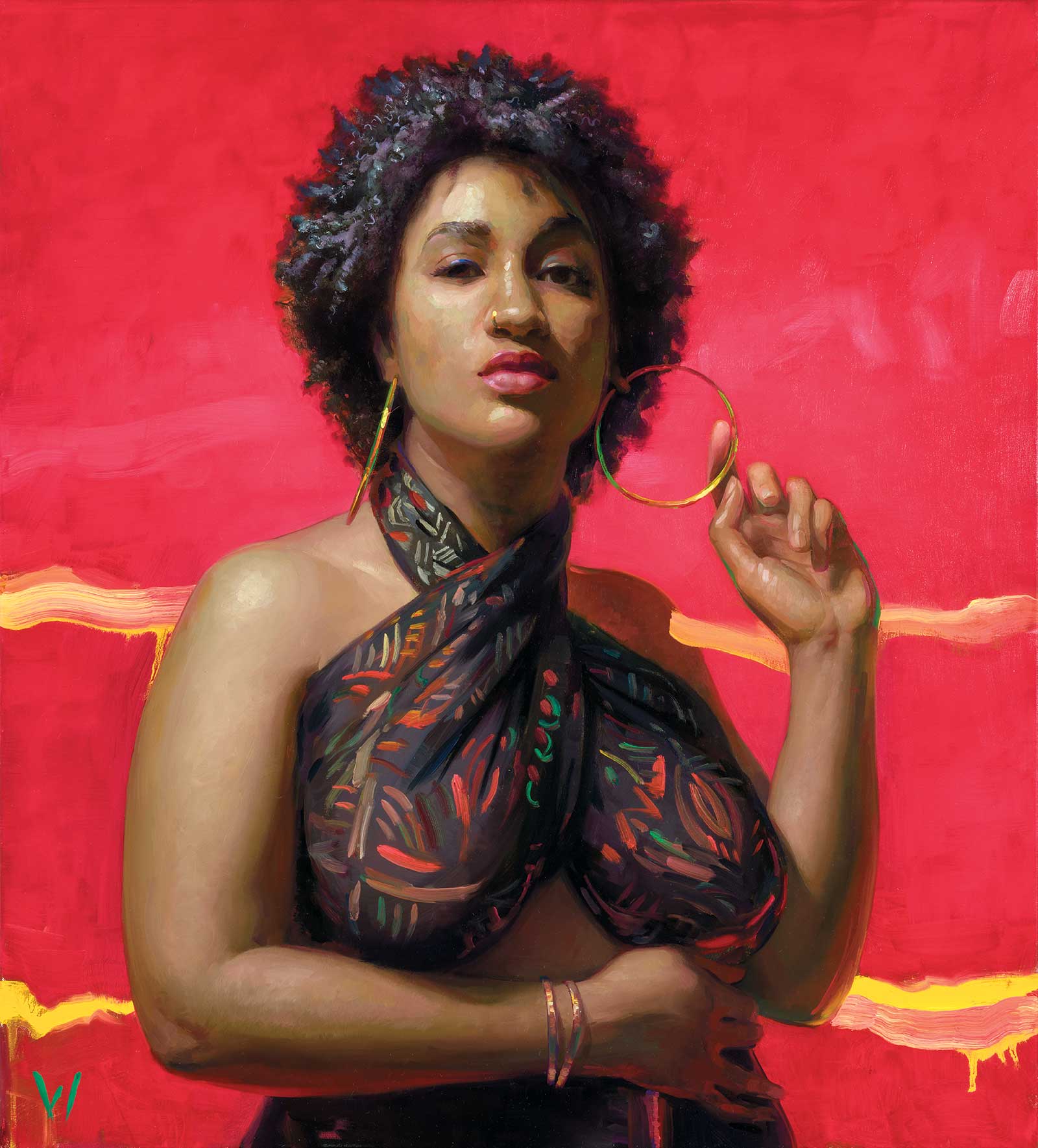
Patricia Watwood, Kyng Kimmah, oil on linen, 22 x 20”
He continues, “When viewing or collecting art, we all have different philosophies and interpretations as to what makes an image memorable. My approach is to be clear and concise on the ‘what’ and let the viewer contemplate the ‘why’ or simply let go of the ‘why’ and just enjoy the imagery.”
Grace M. DeVito’s portraits are inspired by her subjects, their energy and personalities. “My goal is to interpret that spirit not only into a portrait but also a beautiful painting,” she explains. “My years of experience coupled with thoughtful insights into the sitter are distilled and interpreted on the canvas.” DeVito is a Signature Member of the Portrait Society of America and has been painting portraits for over 20 years. She is also an exclusive artist with Portraits Incorporated.
“I would advise collectors who are interested in commissioning a portrait to find an artist whose work they connect with, that will meet the goals of the portrait,” DeVito continues. “Style is a consideration [as well]. Do you like a more detailed style or something more painterly? A beautiful portrait takes time to create, so allow enough time when scheduling.”
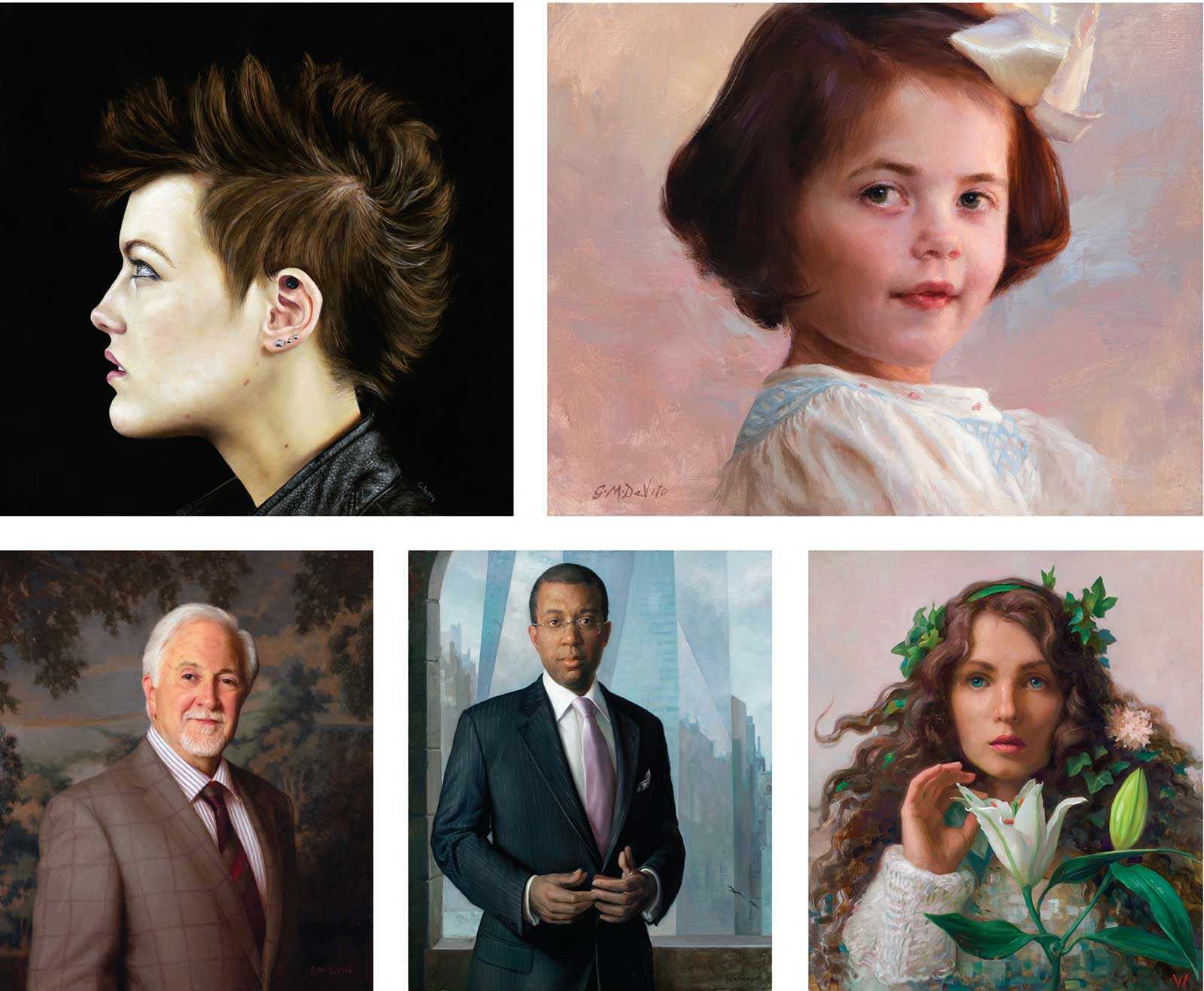
Top: George Ayers, Brooke, oil on panel, 12 x 12” ; Grace M. DeVito, Satin Bow, oil on canvas, 12 x 16”. Bottom: Grace M. DeVito, A Gentleman, oil on canvas, 30 x 26”; Patricia Watwood, Jim Johnson, oil on linen, 44 x 36” ; Patricia Watwood, Secret Garden, oil on linen, 20 x 18”.
In Patricia Watwood’s paintings and drawings, she is entirely engaged by the faces and figures of the beautifully diverse human character. “I want to capture and preserve the spirit, energy, passion and vitality that each individual brings to our world in societies, families and institutions big and small,” says the artist. “I want to convey the poetry of the human spirit, and capture in linen and oil, brushstroke and color, our beloved community to share with current and future generations.”
Watwood believes that “investing in a portrait is a truly special occasion, intended to bring you lasting joy in focusing attention on a beloved friend or admired colleague. Get the best portrait you can afford by considering an artist’s entire portfolio and range of experience. Consider the color palette, brushwork and style of artists, and whether the artist creates work that is more traditional or contemporary, considering the style of your home and tastes.” —
Featured Artists & Galleries
33 Contemporary
Zhou B Art Center, 1029 W. 25th Street, 4th Floor
Chicago, IL 60609
www.33contemporary.com
Ed Copley
www.edcopleyfineart.com
George Ayers
www.georgeayersartist.com
Grace M. DeVito
Stamford, CT
(203) 979-2472
gmdevito@yahoo.com
www.gracedevito.com
NüArt Gallery
670 Canyon Road
Santa Fe, NM 87501
(505) 988-3888
www.nuartgallery.com
Patricia Watwood
(646) 456-7169
patriciawatwood@gmail.com
www.patriciawatwood.com
Thomas Jefferson University
4201 Henry Avenue, Philadelphia, PA 19144
(215) 951-2800 www.jefferson.edu
Powered by Froala Editor