There’s something mischievous about the tinkling laugh that punctuates Shiqing Deng’s otherwise demure demeanor. Her work has a similar quality—it is one thing on the surface but there are layers of information, innuendo and, yes, humor—coursing beneath it. Although she claims her work is not meant to be serious or a form of social commentary, decoding the symbolism insists otherwise.
Deng, whose friends call her “Demo, ”is the recipient of the 2023 Bennett Prize, the largest prize offered solely to women figurative realist painters. She will be awarded $50,000, giving her the opportunity to spend the next two years creating new work in the figurative realist style for a solo exhibition that will ultimately travel the country. She plans to use the funds to help with rent for her Brooklyn studio, art supplies and realize her desire to make more ambitious work—even larger, more experimental—and, though she hesitates to share, assist with the expensive process of securing a Visa. Not only will the Bennett Prize mitigate legal fees, but it also strengthens her credibility as an applicant.
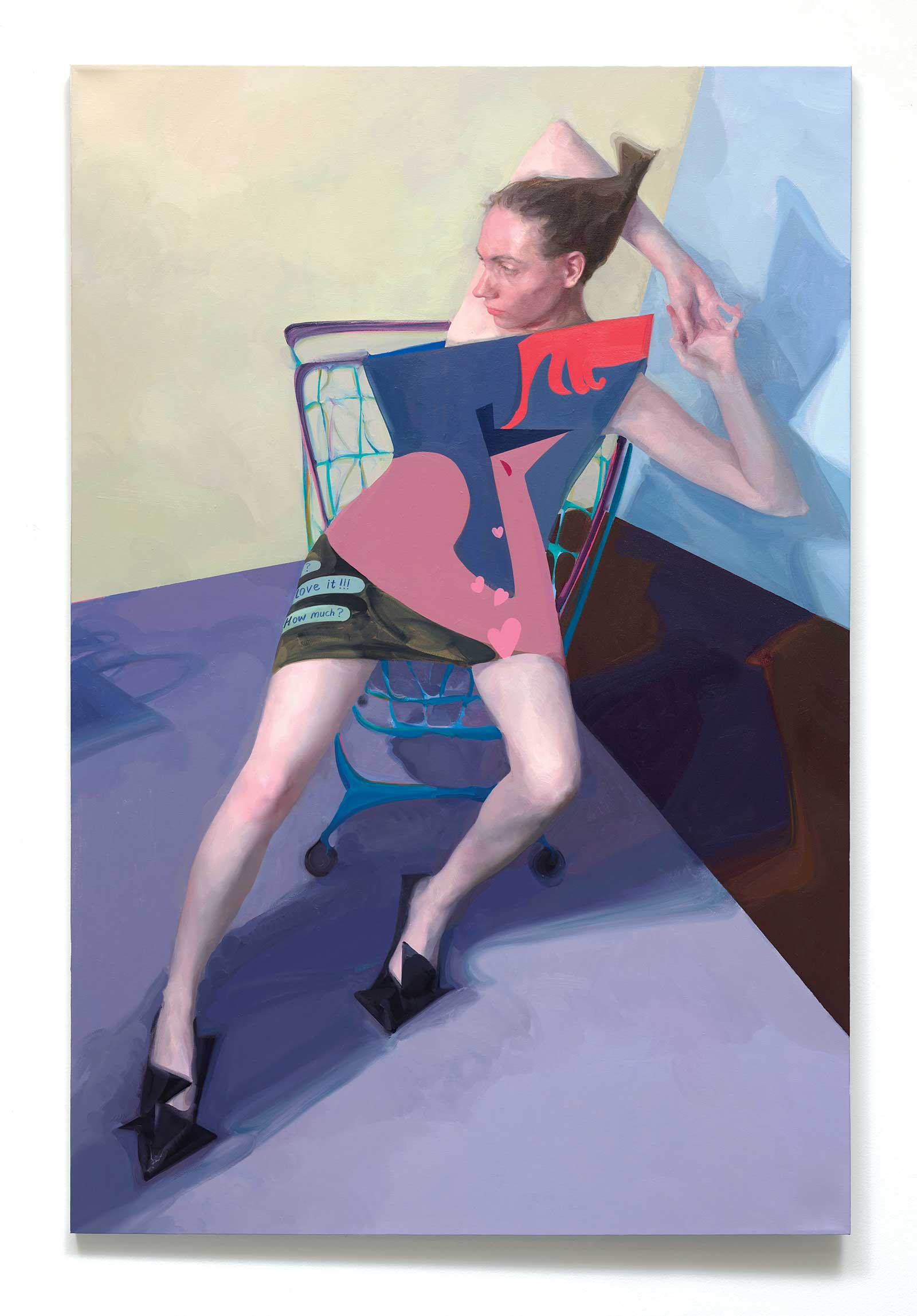 How Much?, oil on linen, 66 x 44"
Born in Xi’an, China, Deng earned her bachelor’s degree in fine art in Beijing at the prestigious China Central Academy of Fine Art. The school had a connection with New York Academy of Art and in 2016 she decided to apply for their MFA program. The school appealed to Deng because its focus was more traditional and on the figurative, rather than many art schools in New York City which lean contemporary and conceptual. She was also looking to get out of Beijing, because of the pollution and because most artists painted in the same style—“So much so that if you covered the signature you wouldn’t know whose work was whose,” says Deng.
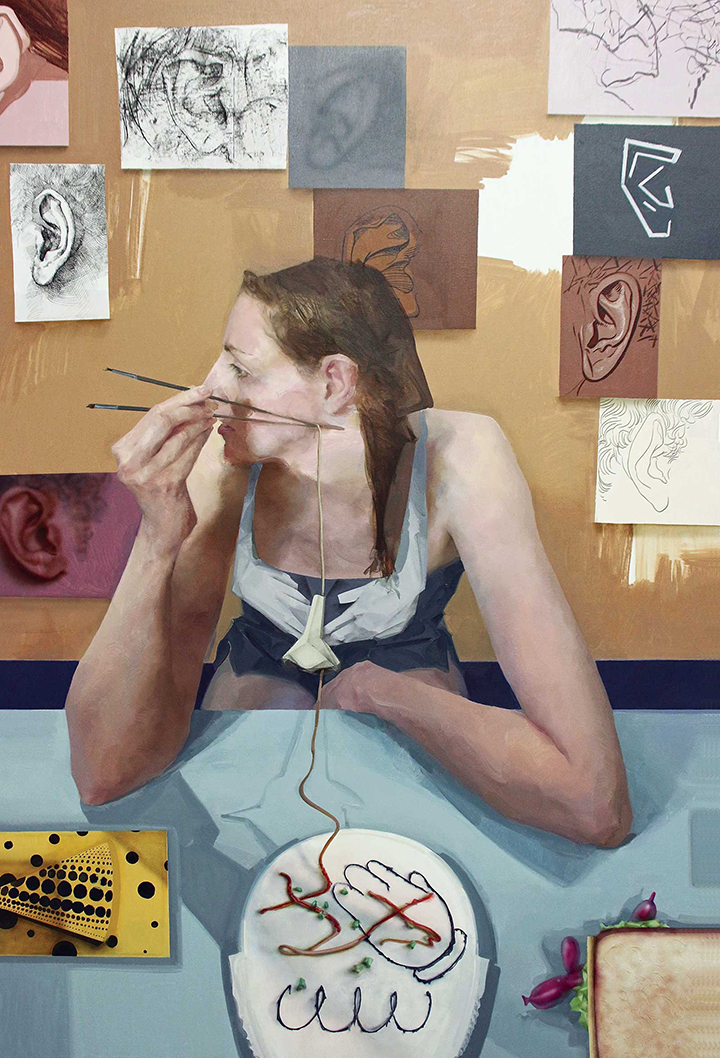
Visual Art, oil on linen, 72 x 46"
Deng was still searching for her own style when she arrived in New York but about two years in she found the missing element to developing a unique aesthetic all of her own. She was at a 2018 exhibition of renowned Japanese fashion designer Rei Kawakubo at The Met when it clicked.
“The show, the dresses, all the designs were very interesting,” says Deng. “I’ve always liked fashion and design but I had never thought to put it into my work. After I saw that show I felt like I wanted to experiment with it, combine some sort of fashion element in my work. I wanted to play with that element and design my own clothes in my work to convey the ideas I want to express. That was the starting point.”
Making a statement or telling a story through fashion is now a defining feature of her exaggerated, female-centric pieces. She combines textures and different shapes; some are cartoonish in a playful humorous way.
“I realized I can put interesting details and the person’s story and experiences into the clothes.”
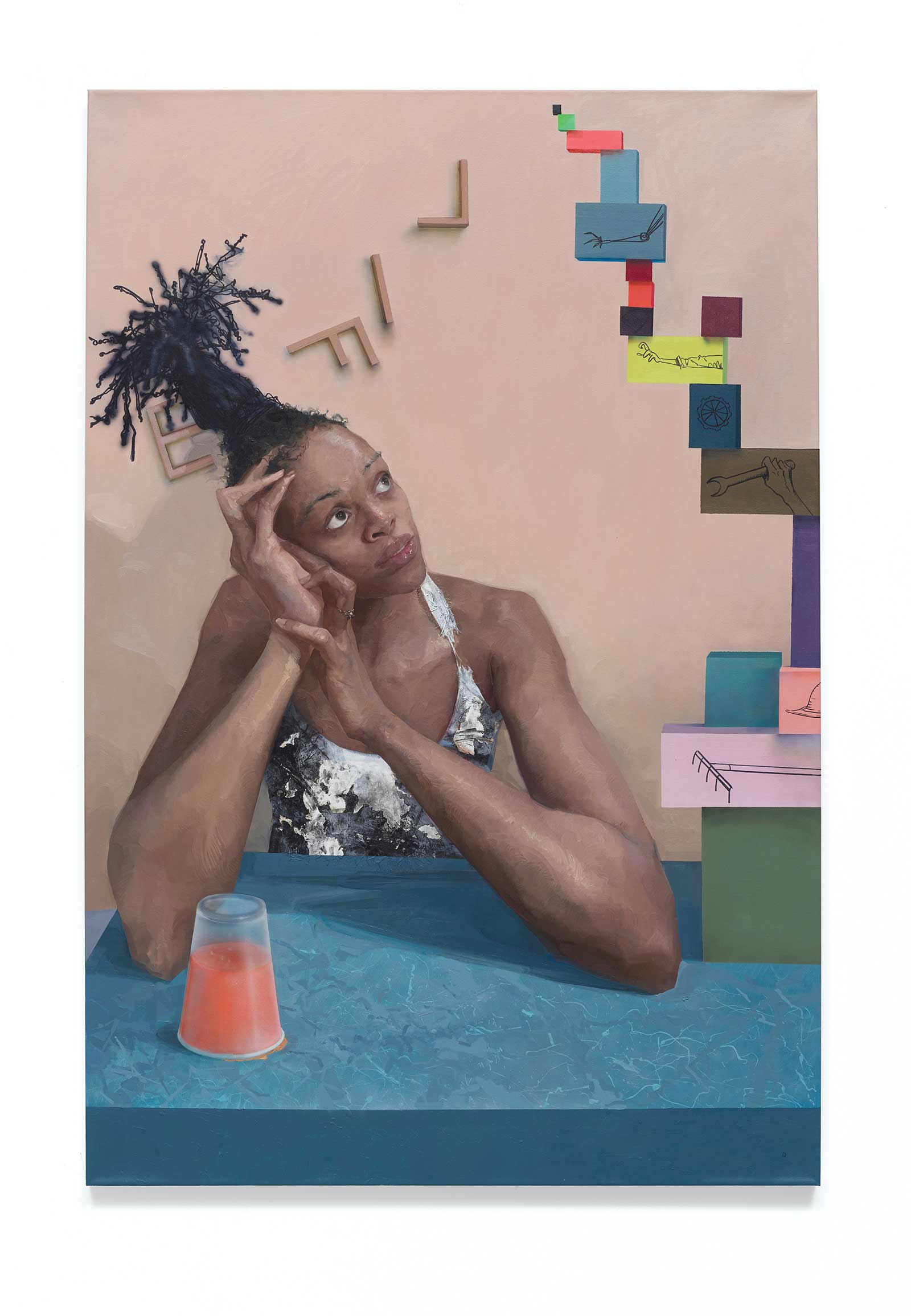
Life, oil on linen, 66 x 44"
Take the geometric couture in How Much?, the idea for which sprung from Only Fans, an internet subscription service used primarily by sex workers who produce pornography. The woman’s dress simulates a live chat with its text bubbles and rising hearts. A lecherous hand reaches down to stroke a cartoonish high heel, while the figure sprawls in a chair reminiscent of a shopping cart. “I was inspired by that content,” Deng says. “How much is this one, how much is that one?”
The ideas for Deng’s pieces often come from her friends’ lives, conversations with them or something she sees on the internet. Her friends are also her models. “My personal life isn’t that exciting—that’s why I need my friend’s stories! They don’t go to the studio every day,” she giggles. “We’re always gossiping and a lot of the time it’s where I get my stories.”
Visual Art,in which a woman pinches a “noodle” threaded through a disembodied nose between chopsticks, ensued from a more serious discussion with her peers about art. Sketches of ears are pinned to the wall and references to famous works of art stand in as the food: the yellow piece with the dots is a nod to Japanese artist Yayoi Kusama; the “plate,” Kaws; the sandwich, Jeff Koons.
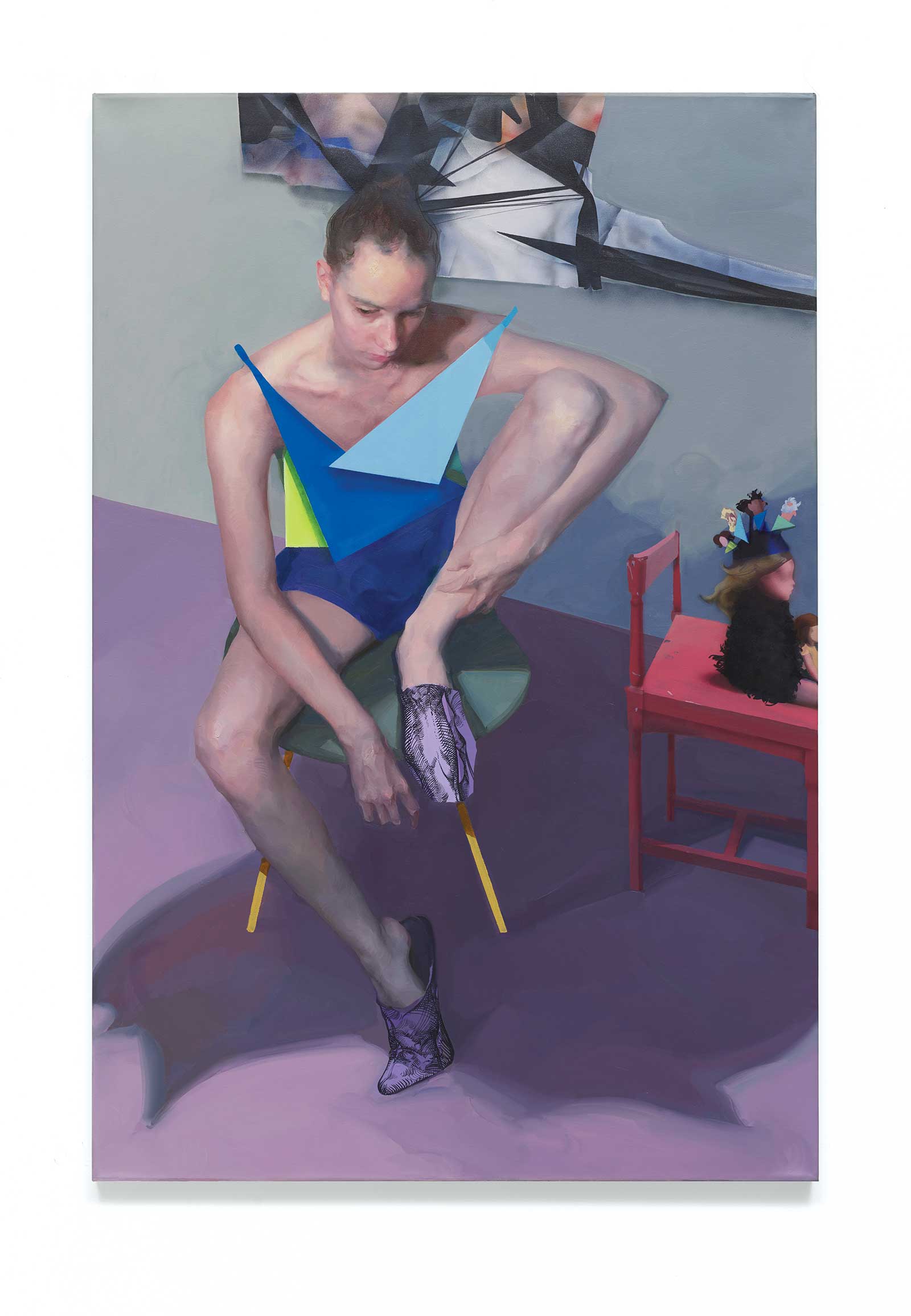
Split, oil on linen, 66 x 44"
“We’re always discussing the art market,” says Deng. “We were talking about the term ‘visual art’ and how it was funny because right now people are perceiving art not through their eyes, but through their ears. They’re asking, ‘Is the artist famous? Is it good in the market? They’re thinking, not looking. It’s no longer about the artwork itself.”
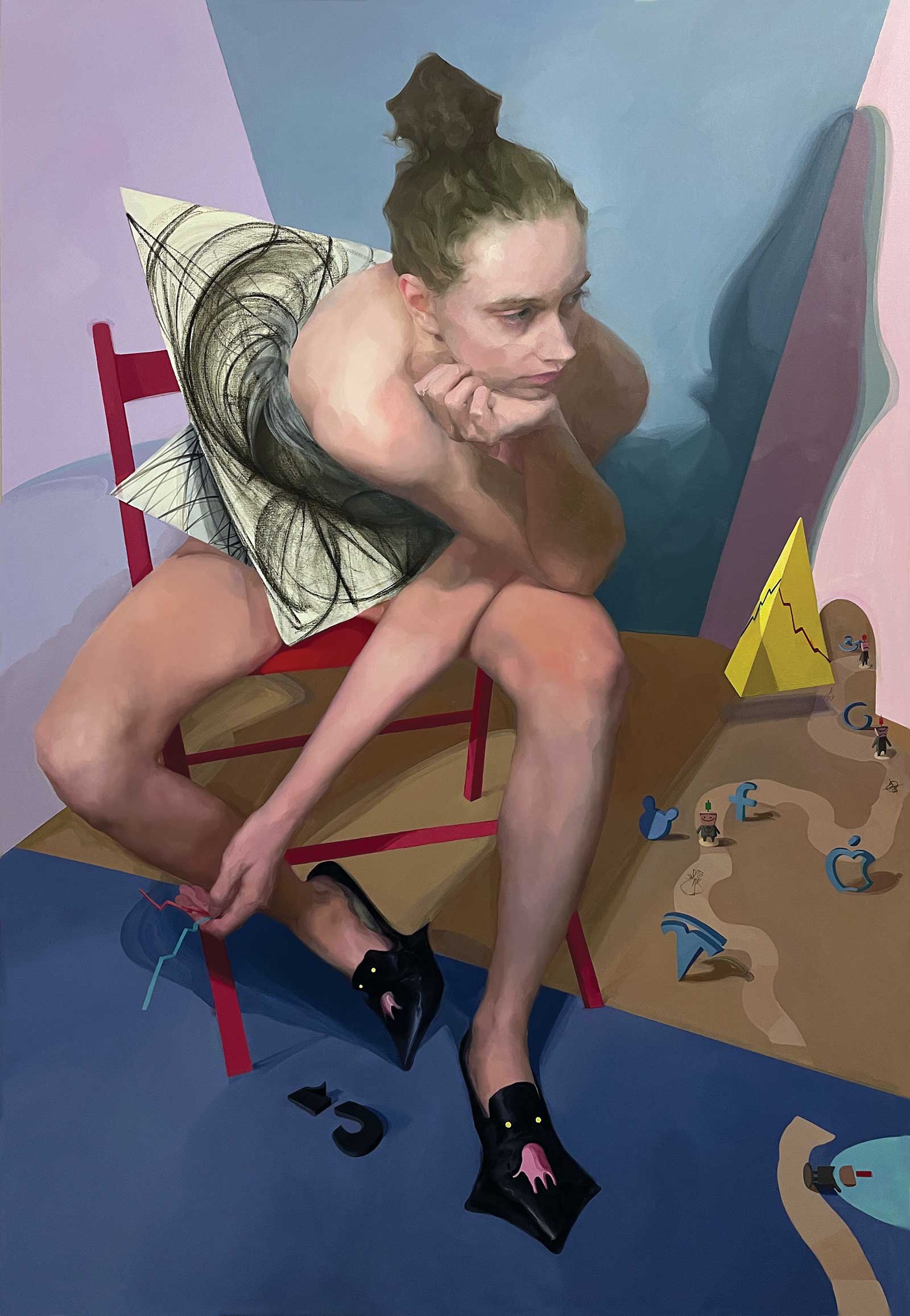
Weak hand, oil on linen, 60 x 40"
Life and Weak Hand depict more personal stories. “During Covid I felt a little desperate, like the little block that is almost falling but still not,” says Deng about the piece Life. “It’s very close but not yet.” The figure, in Deng’s distinct elongated, exaggerated style, wears a shirt held together by a thread; the upside down cup of liquid presents a precarious conundrum. “That’s what life felt like for me at that moment,” she shares. “Like everything was almost falling.” Look closely at the symbolism to understand how Weak Hand is Deng’s surrealist response to the stock market crash during that time and its personal financial repercussions.
“I convey the story through my designs in an interesting and playful way,” Deng says. “I don’t want to be critical—I want it to be funny. My style is surreal—it’s portraying reality but it’s not really reality…it’s more like I create a new reality inspired by reality.”
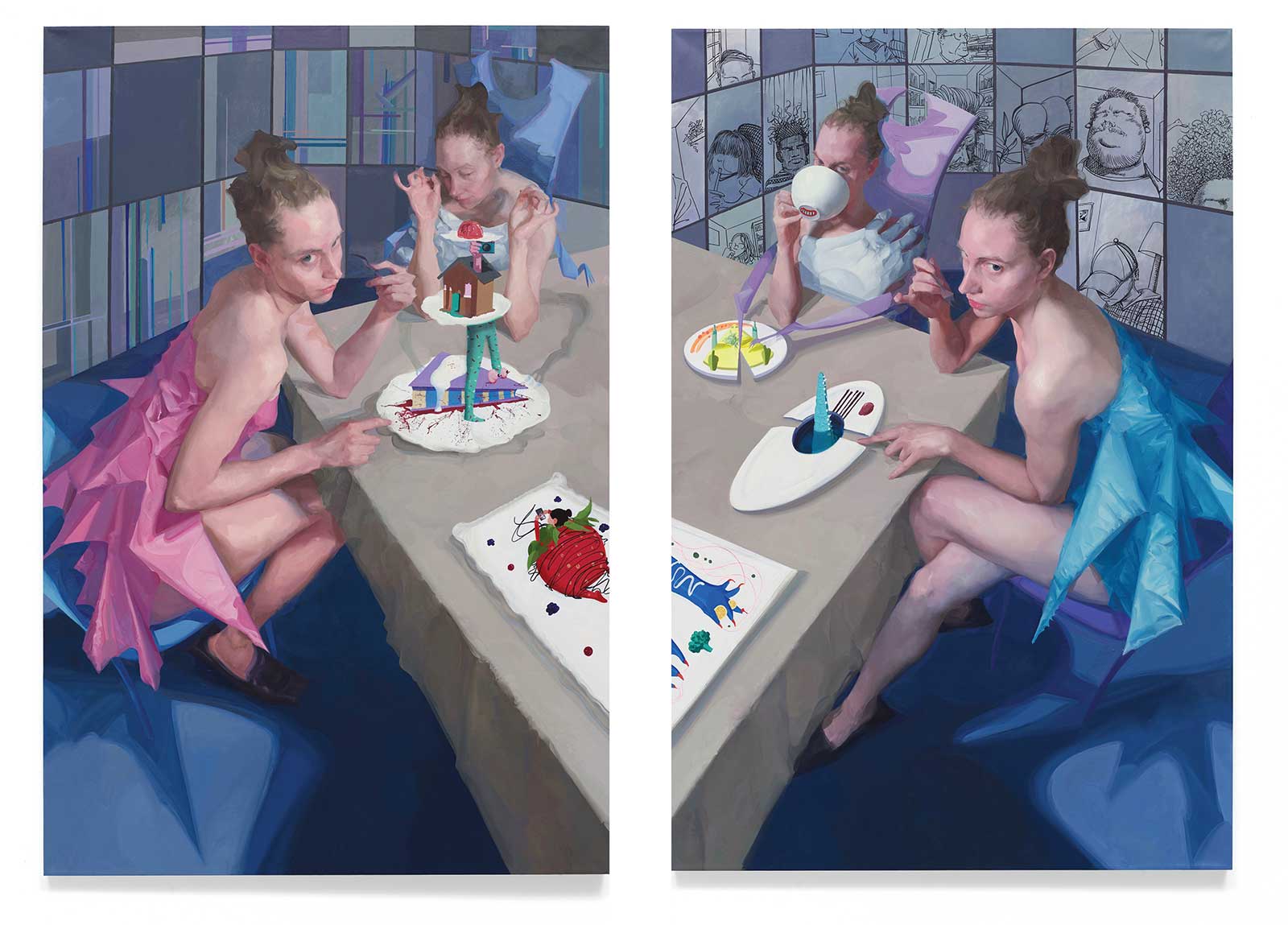
ASMR, oil on linen, 66 x 88"
The diptych ASMR is in the same vein as How Much? in that it references a very current phenomena—this time, the brain-tingling feeling of well-being triggered by familiar sights and sounds, like people eating. Pointily-clad women in origami shaped formal wear as angular as their bodies lean over strange food presentations, while sketched faces, ostensibly viewers, fill the “screens” in the background.
“It’s about the ASMR videos and consuming culture,” says Deng. “People are very bored. They’ll watch anyone doing anything. Before now you never would’ve thought this would be a thing. It’s very specific to the present time. I’m not into those videos but it’s very interesting to depict that kind of subject matter because it represents the now. It’s also very controversial—people either like it or hate it or feel bothered by it.”
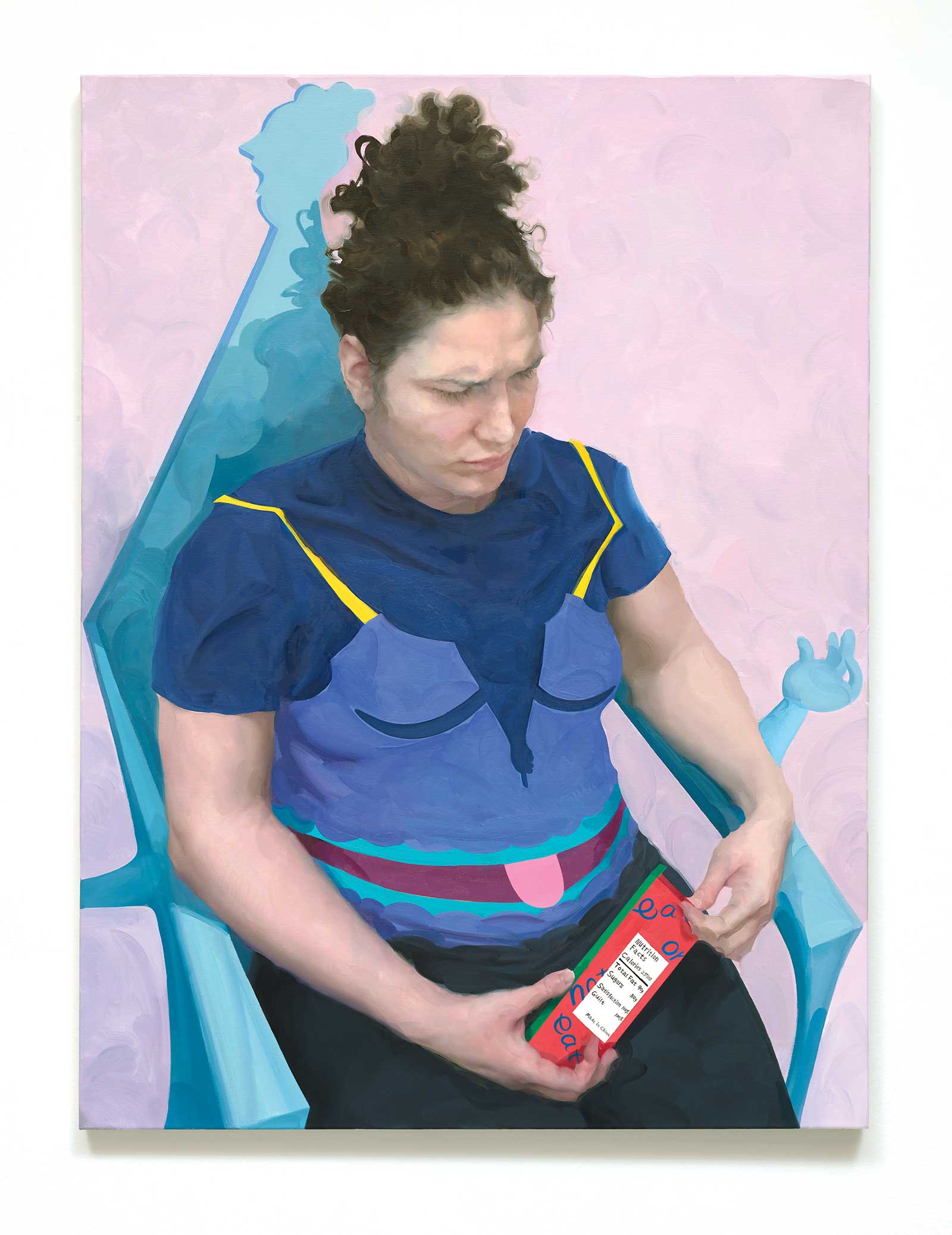
On Diet, oil on linen, 40 x 30"
Most of Deng’s work focuses on female subject matter and the female perspective and is set in interior scenes. She likes the theater aspect of it—each piece is a blank canvas for a scene from a play. “It’s like I’m the director and I get to create this artificial space,” Deng says. “Then I’ve got these characters in these costumes I’ve designed that I can arrange on this indoor stage I’ve created.”
Deng is still pinching herself to make sure she is awake. “It feels like it’s not real,” she says about winning the Bennett Prize. “Before [receiving it] I didn’t think about it or have any expectations. I didn’t think it was going to be me. This kind of thing is a very lucky thing and I already felt lucky as a finalist. Now I’m like, ‘Is true? Am I dreaming?’ It seems too good to be true. But I’m so happy.”
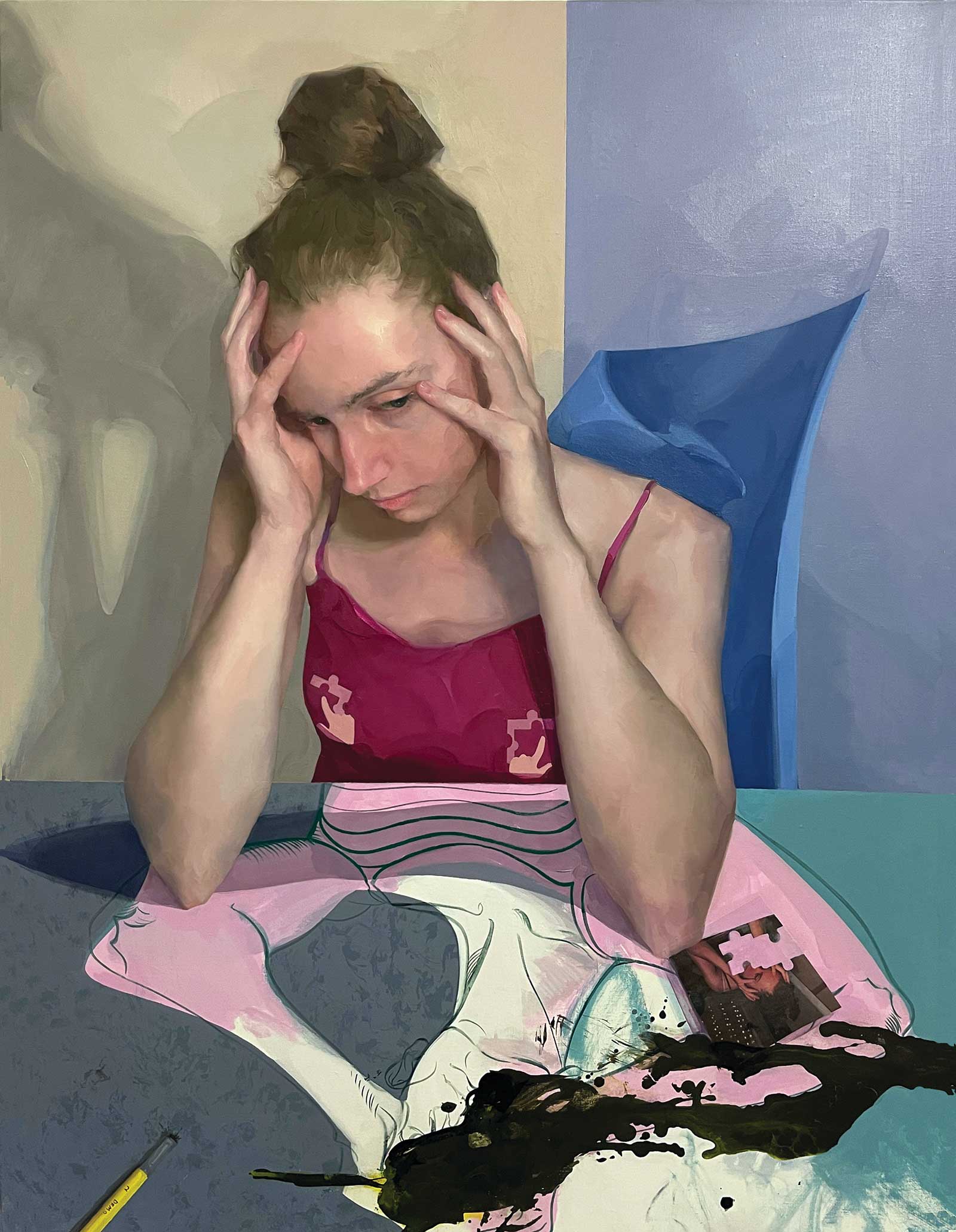
Masterpiece, oil on linen, 40 x 30"
Deng’s work will be on display with the nine other finalists in Rising Voices 3: The Bennett Prize’ exhibition, which runs through September 10 at the Muskegon Museum of Art, in Muskegon, Michigan. For more information visit www.thebennettprize.org. —
Powered by Froala Editor