Big Baby is F. Scott Hess’ enormous new depiction of himself as a grinning man-child, diapered and spreadeagled on a blue blanket decorated with nursery animals. It marks a milestone in his remarkable career. Twice life-size in scale, it is Hess’ first painting after his completion of a four-year-long mural project at the B’nai Jehudah synagogue, located in a suburb of Kansas City, Kansas. Hess was commissioned to paint two “pods” of images to wrap around the walls beneath gentle arches of windows above two large meeting rooms. The first pod was a narrative series showing the history of the synagogue's construction and the community that supported it, and the second was a series of images from the Tanakh—the Jewish Old Testament.
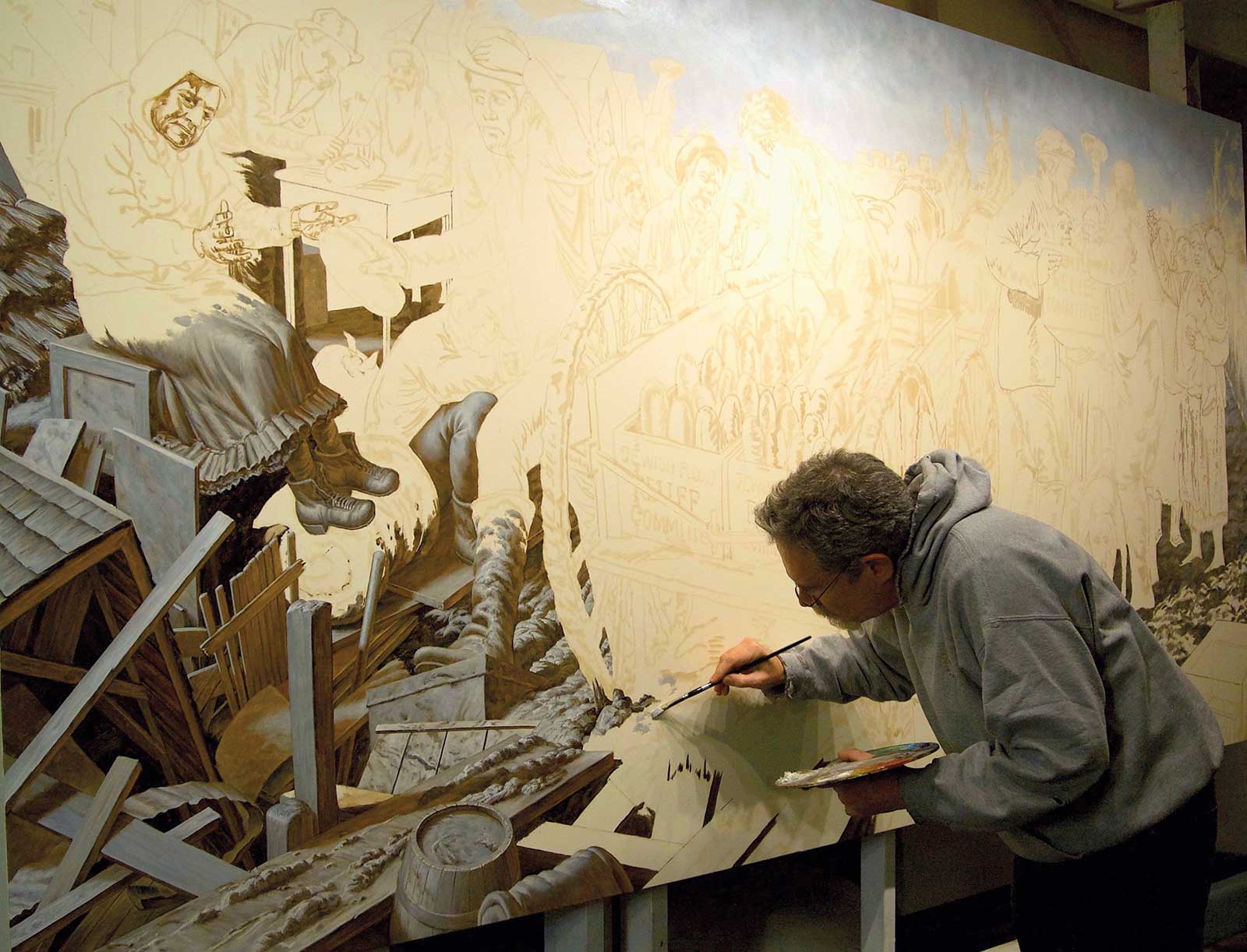
F. Scott Hess at work on the Temple B’nai Jehudah murals.
Hess was an unusual choice for the project. “Not being a religious person, it is a little odd,” he laughs. “I had always wanted to do the Sistine Chapel, but I realized that as a non-believer I wasn’t going to get a commission for anything like that…” He began the project delighted to follow in the footsteps of the great masters of the Renaissance—Michelangelo, Vasari and Raphael, and spent three months creating a spectacular series of sketches of the first pod of murals for approval, cleverly connecting the events of each panel to the next in a loop of narrative.
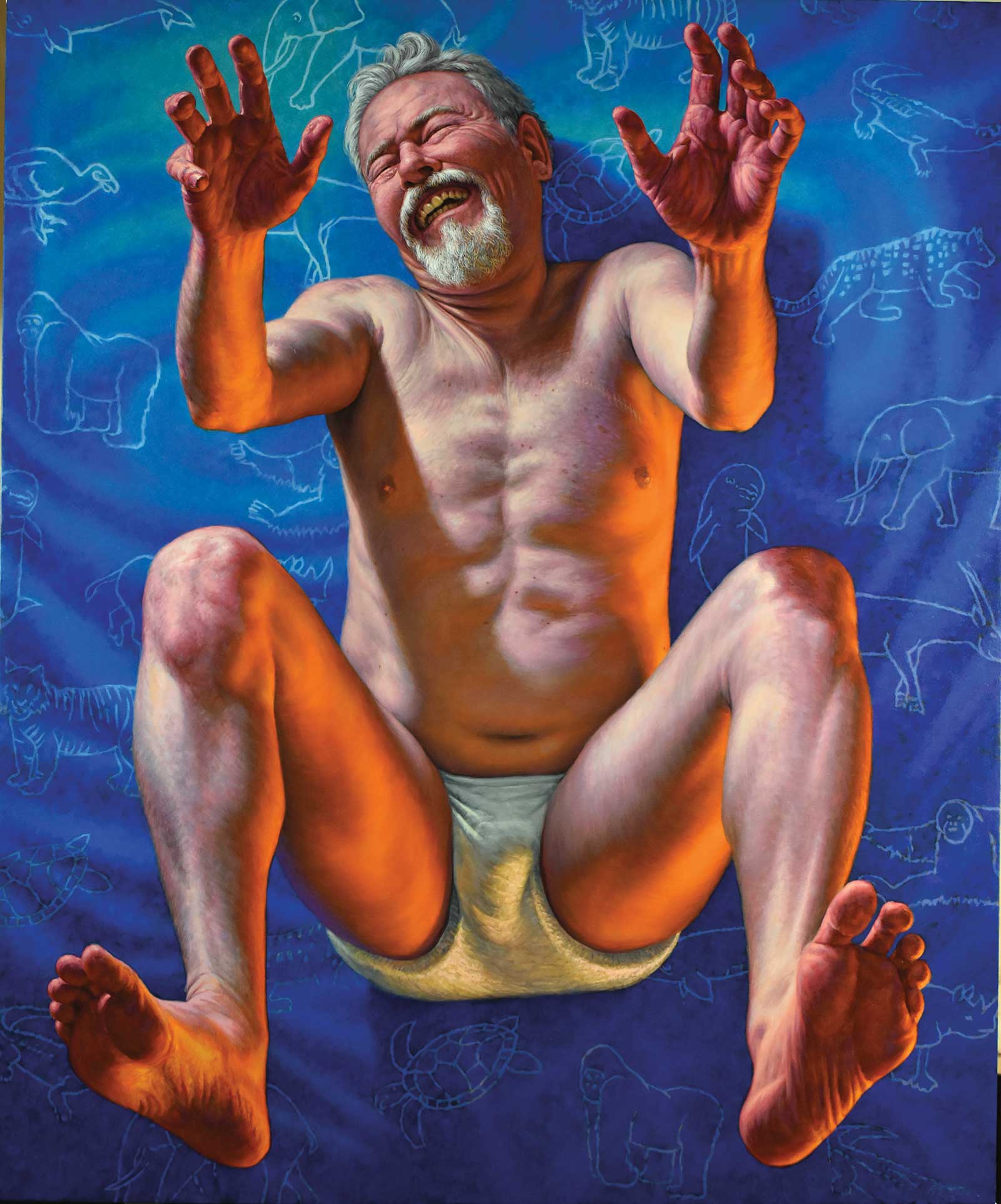
Big Baby, 2023, oil on Canvas, 54 x 45". Collection of the artist.
Hess tells stories with paint. Although the synagogue murals are Hess’ most major single project, they were not his first foray into religious art. He ended the turn of the apocalyptic 20th century with a six-year project titled The Hours of the Day, following the old Christian tradition of inspirational books of pictures designed to introduce religious propriety into each hour. Explaining his interest in religious content despite his own lack of faith, Hess says, “We all need stories; we all need mythology. One way or another we invent it and I’m quite conscious of inventing my own mythology of what happened in my life, and the people in my life.”
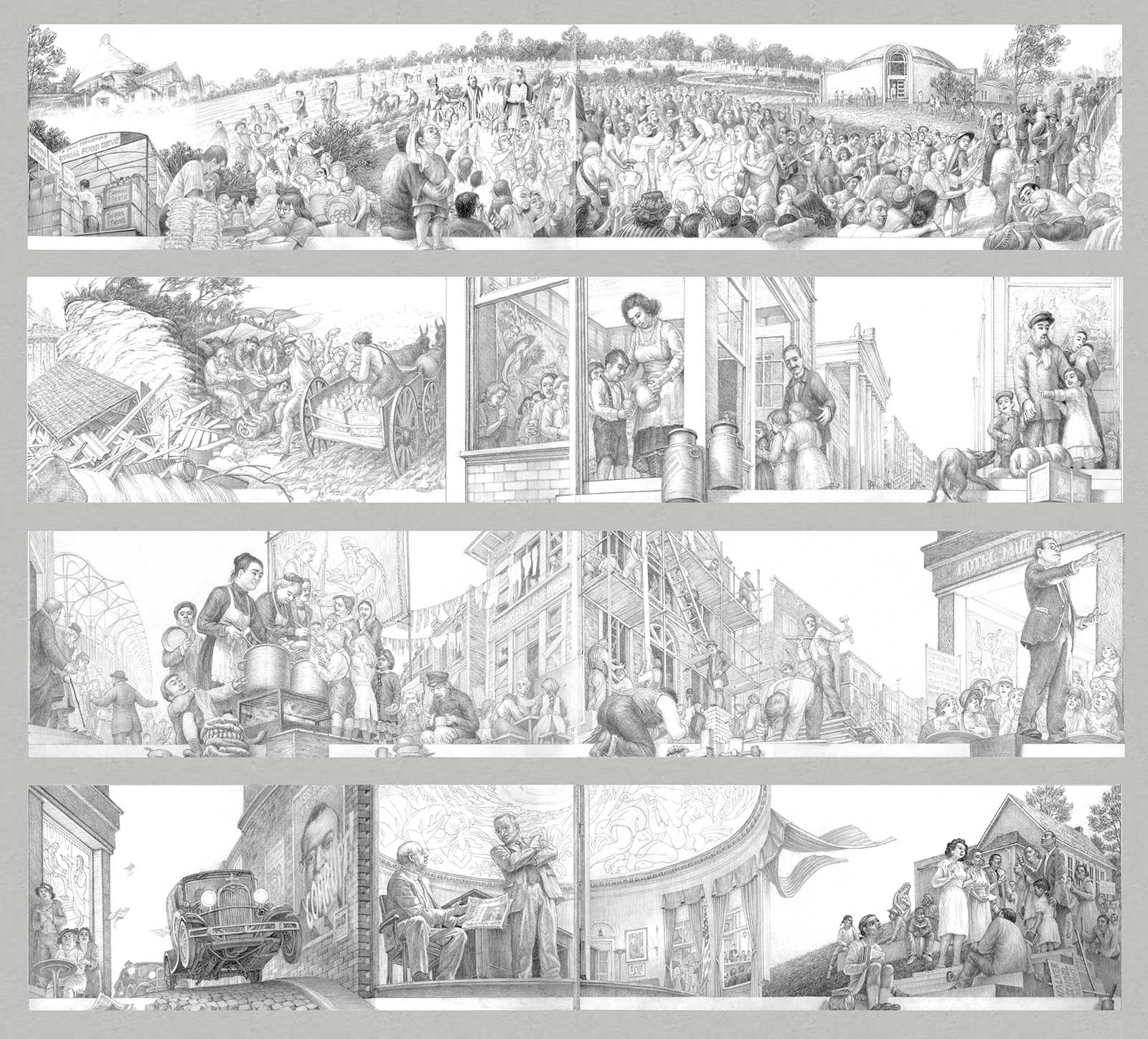
Hess’ rejected design for the first pod.
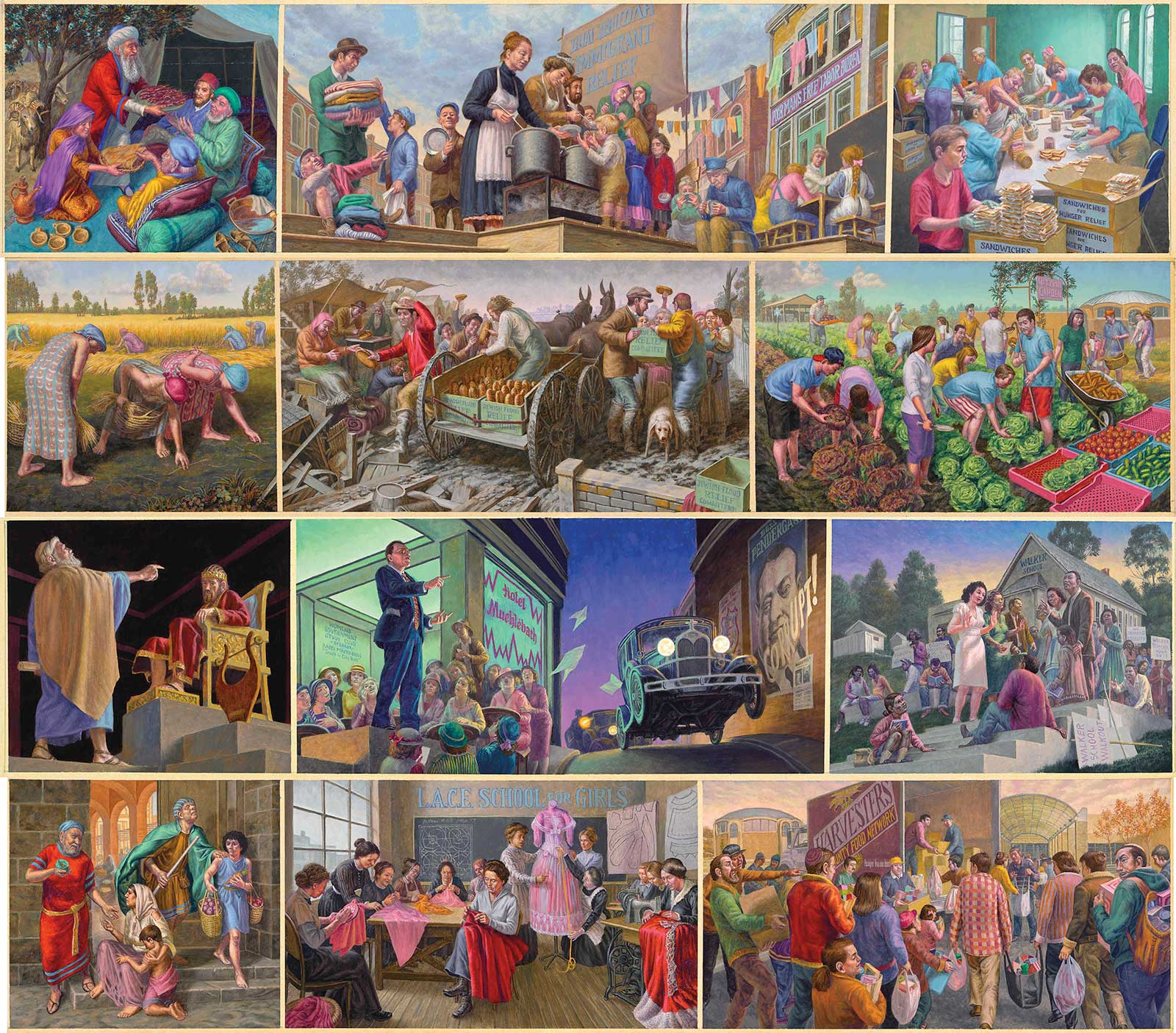
Color studies for the first “pod” at B’nai Jehudah synagogue.
The coherent integrity of Hess’ original vision for the story of the establishment and history of the synagogue suffered as he negotiated the difficult diplomacy of patronage—instead of a fluid narrative, the new imagery jumped from scene to scene, and the chronology cut abruptly from ancient history to the 20th century. “There was no way to reconcile the entire Gesamtkunstwerk, as they used to say,” says Hess, “Those first two years were the hardest thing I’ve ever done in art. But I’m pretty disciplined. And I’m fast. I covered 104 feet of painting in the first two years.” The paintings glow, filling the space with color, light and action, and each is alive with Hess’ adroit skill. He was commissioned to continue with another series of murals for the second pod, telling the mythic narratives of the people of Israel, the rich biblical tales of Abigail and David, Samuel and Saul, Elijah and Elisha. This time the process of preparing the imagery went more smoothly, and these paintings speak to each other with the fluidity Hess hoped for, with clever compositional tricks bridging the confining corners of the building’s architecture between each image.
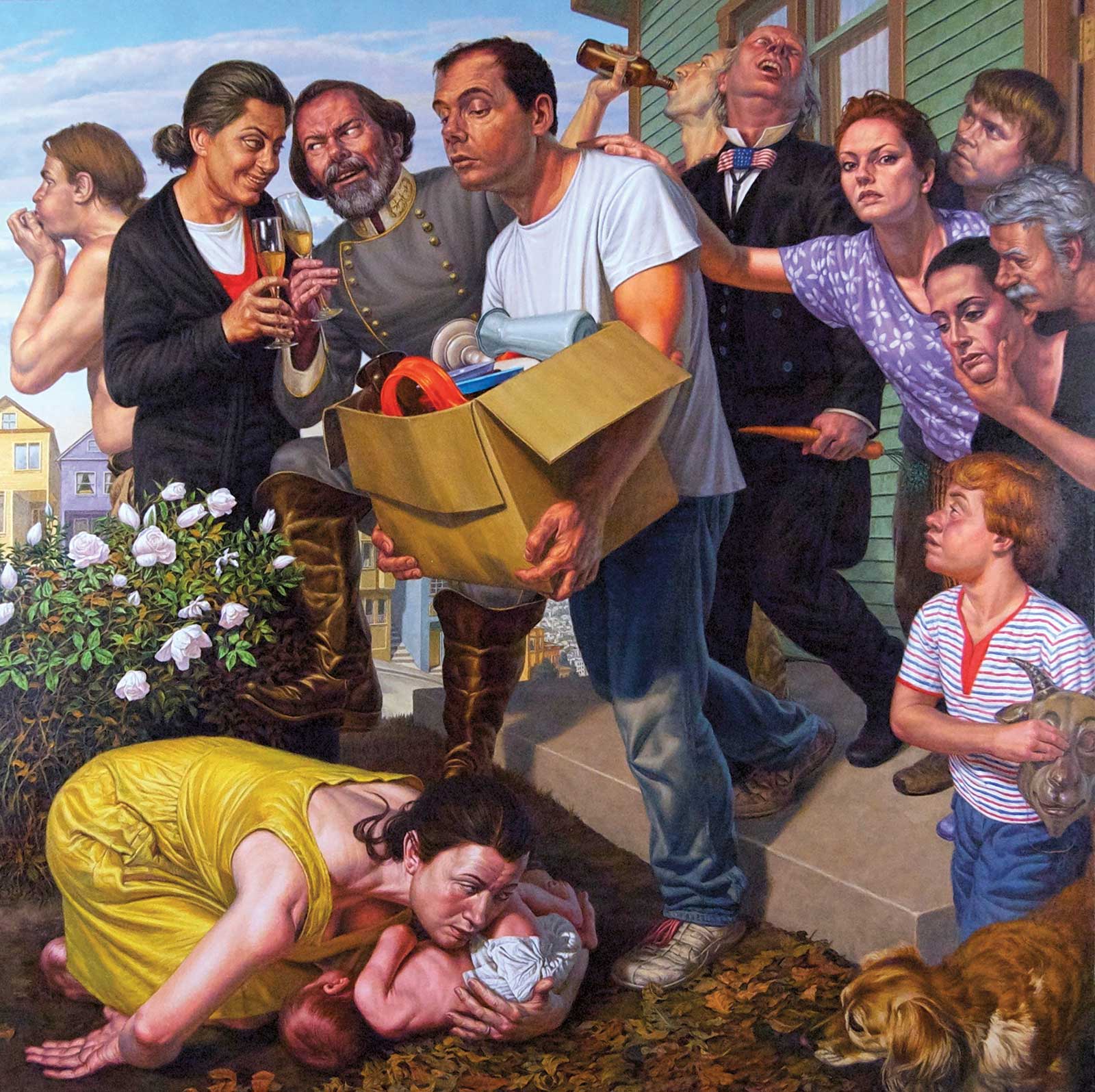
All the Goods of the World, 2013, oil and egg tempera on canvas, 72 x 72". Collection of Crocker Art Museum.
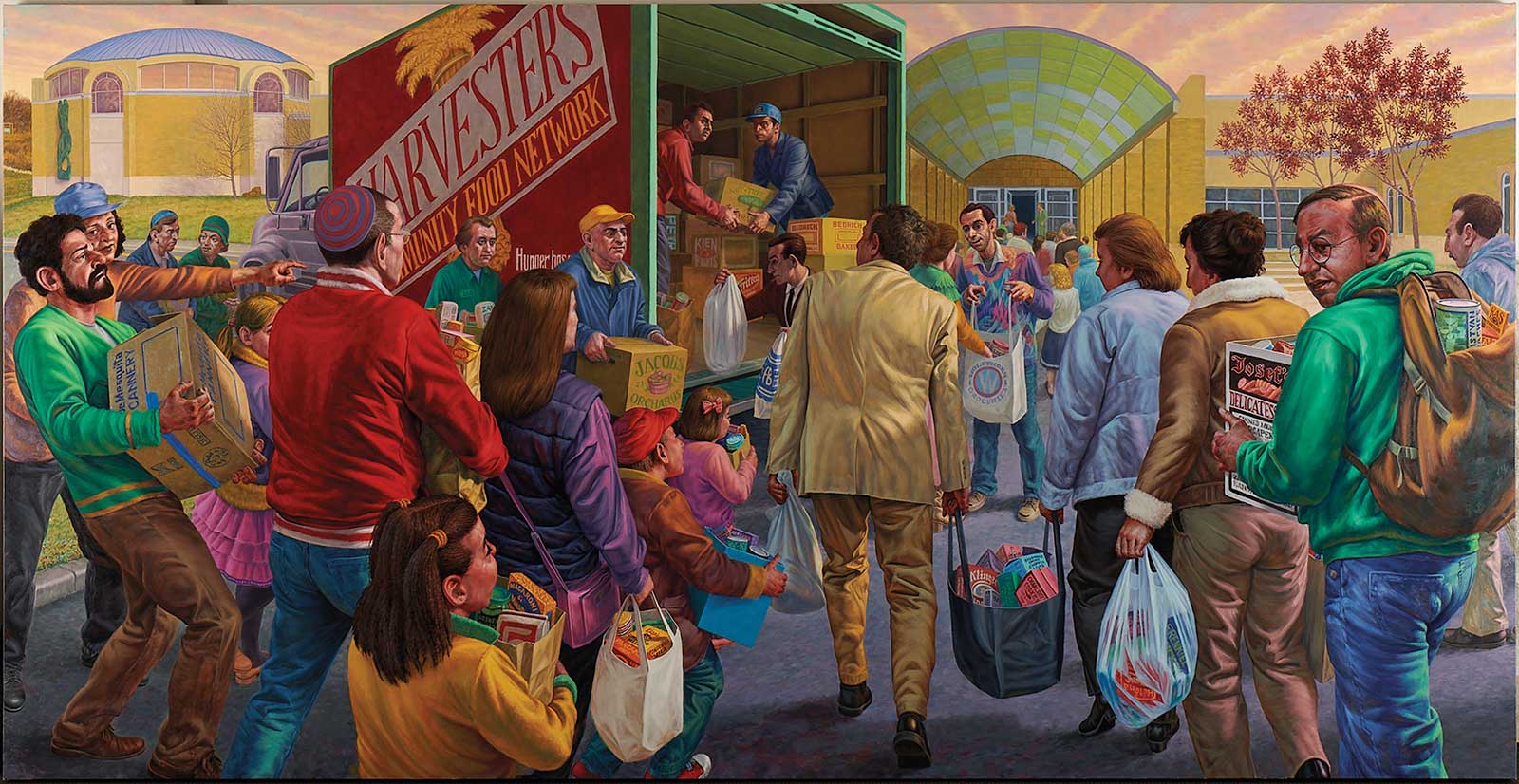
Food Drive Scene, 2019, oil on canvas, 64 x 113". Collection of Temple B’nai Jehudah.
The paintings were installed in 2022—he had produced an astonishing 208 linear feet of vivid murals. After the exhausting experience of painting the stories of the synagogue, a nine-month period of studio silence followed and, instead of the concerns of pigments, media and canvas, Hess found himself overflowing with words. He authored a lengthy memoir of the first 30 years of his career, and a series of 20 short narratives about an extraordinary year he spent in Iran between 1992 and 1993 when he was awarded both a grant from the National Endowment for the Arts and a J. Paul Getty Fellowship. He rewrote a historical novel about his ancestors which he first drafted when working on his memorable 2012 to 2014 touring show, The Paternal Suit, which imagined a bizarre fantasy of his family’s heritage that blended truth and fiction. Hess says The Paternal Suit was “…making a mythology of my life but I look back at all the art I ever made as having done that. In terms of history, reality can be bent and twisted, which is what The Paternal Suit was all about. We invent our histories as a nation, as a person and we cut out the parts we don’t like.”
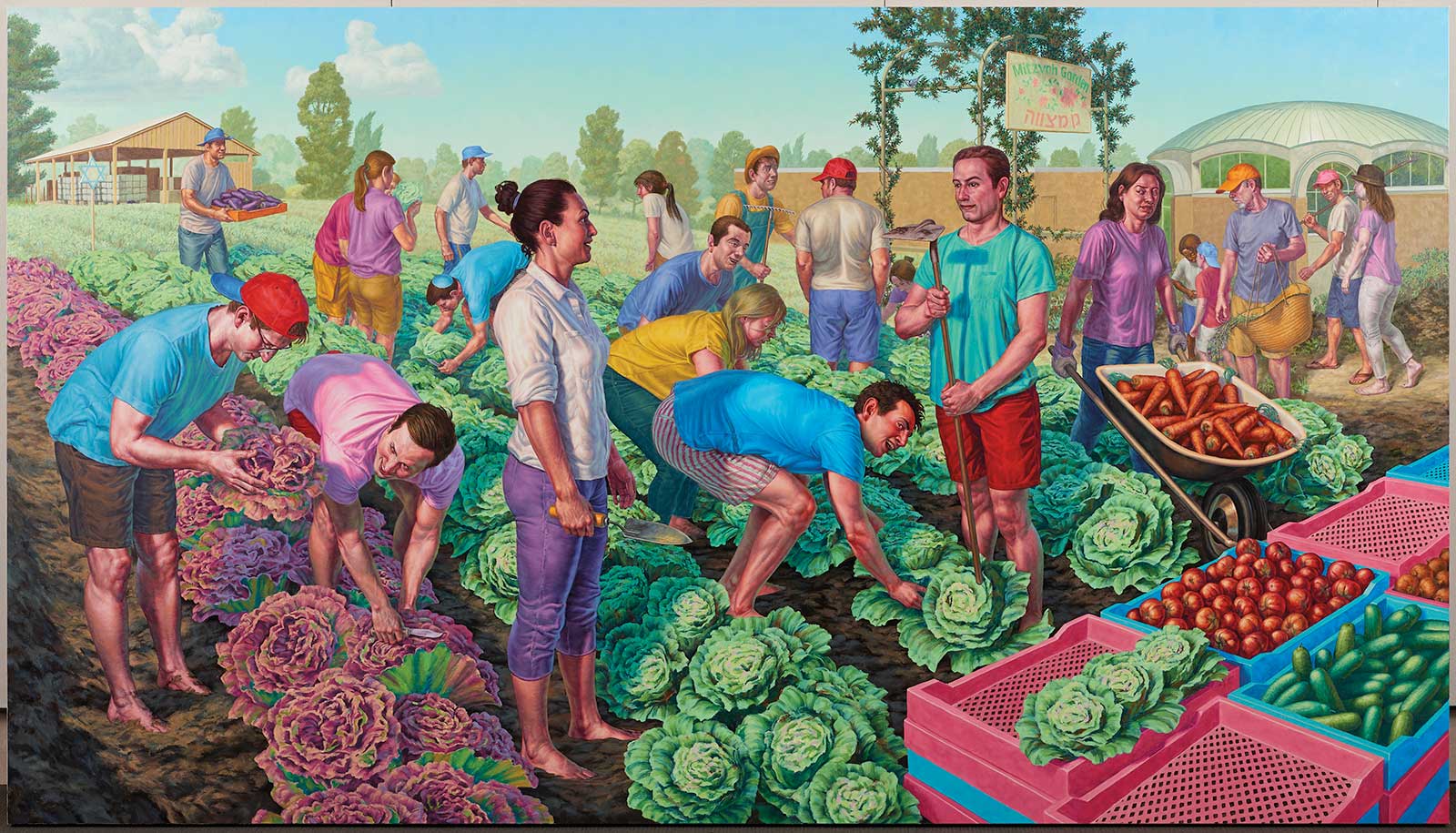
Mitzvah Garden Scene, 2019, oil on canvas, 64 x 113". Collection of Temple B’nai Jehudah.
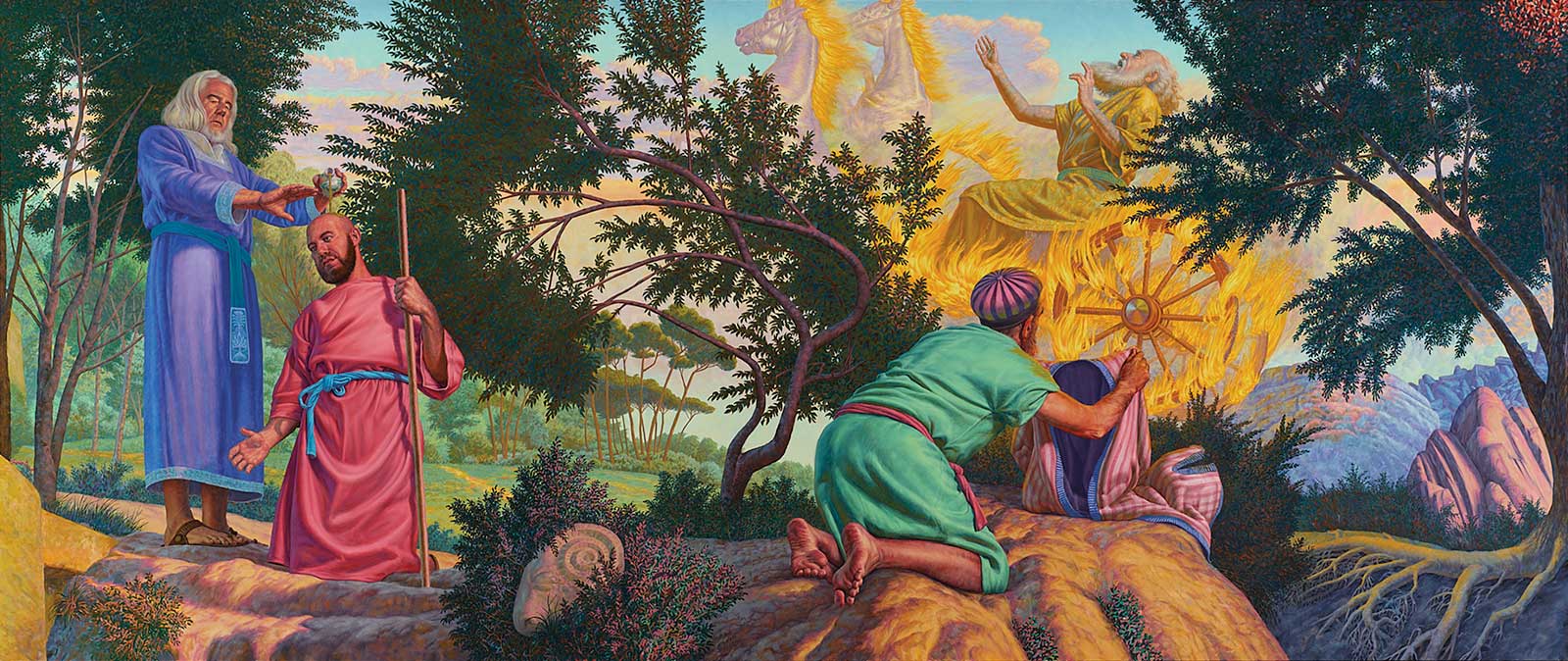
Samuel, Saul, Elijah, Elisha, 2019, oil on canvas, 64 x 113". Collection of Temple B’nai Jehudah.
But Hess consistently confronts taboo topics head-on. He began his rebellious career with drawings of bound and sensual women long before Fifty Shades of Grey popularized erotic bondage for readers and movie audiences. He found success with these voluptuous paintings and drawings in Austria when he lived in Vienna during the late 1970s and early 1980s. There they sold well to open-minded collectors familiar with the excesses and history of pre-war decadence during the Weimar Republic, and the gray moral ambiguities of Cold War Berlin. American audiences were not yet ready to embrace the edgy sexuality he revealed. “I’ve always made what I wanted to make,” says Hess, “I do have a dark and twisted streak, which has certainly cut into a degree of popularity, which I wouldn’t trade anything for, but it definitely had an effect. When I was making those early drawings, I didn’t get anywhere in the United States.”
Big Baby begins a new era of Hess, after the diluvian synagogue. He plans to return to working on a series of paintings developed from abstract blobs of color, finding figurative compositions in the random shapes he sees in paint splattered randomly onto small panels, and enjoying pareidolia as a tool for finding new imagery. As mischievous as ever, he said there was only one rule—that whatever he finds within the randomness cannot be censored. Before the mural project occupied his attention with its tempting scale, he produced a group of these, including his spectacular and clever self-portrait, The Dream of Art History, which was last featured in American Art Collector in June 2019.
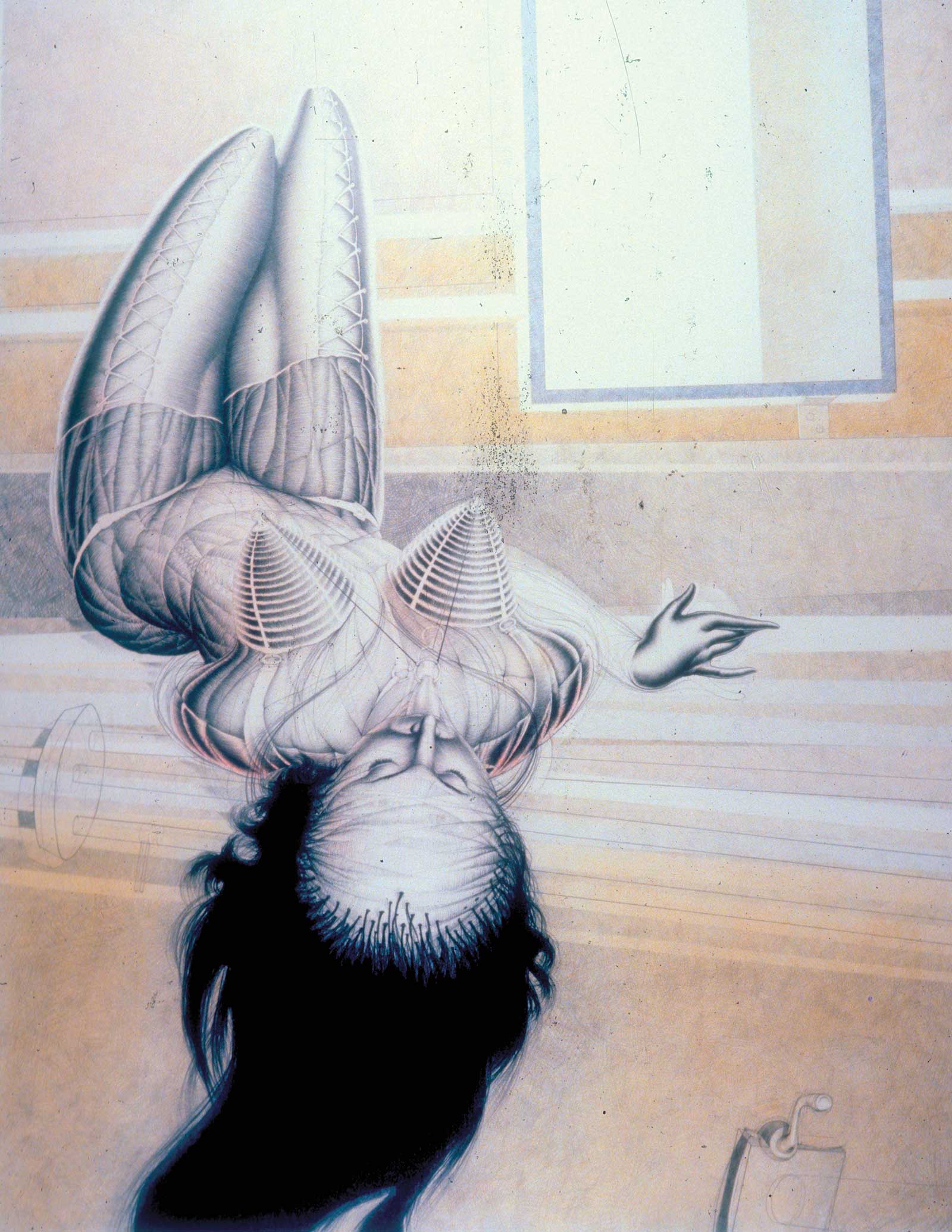
Tongue Tied, 1978, pencil, 29 x 23". Private Collection.
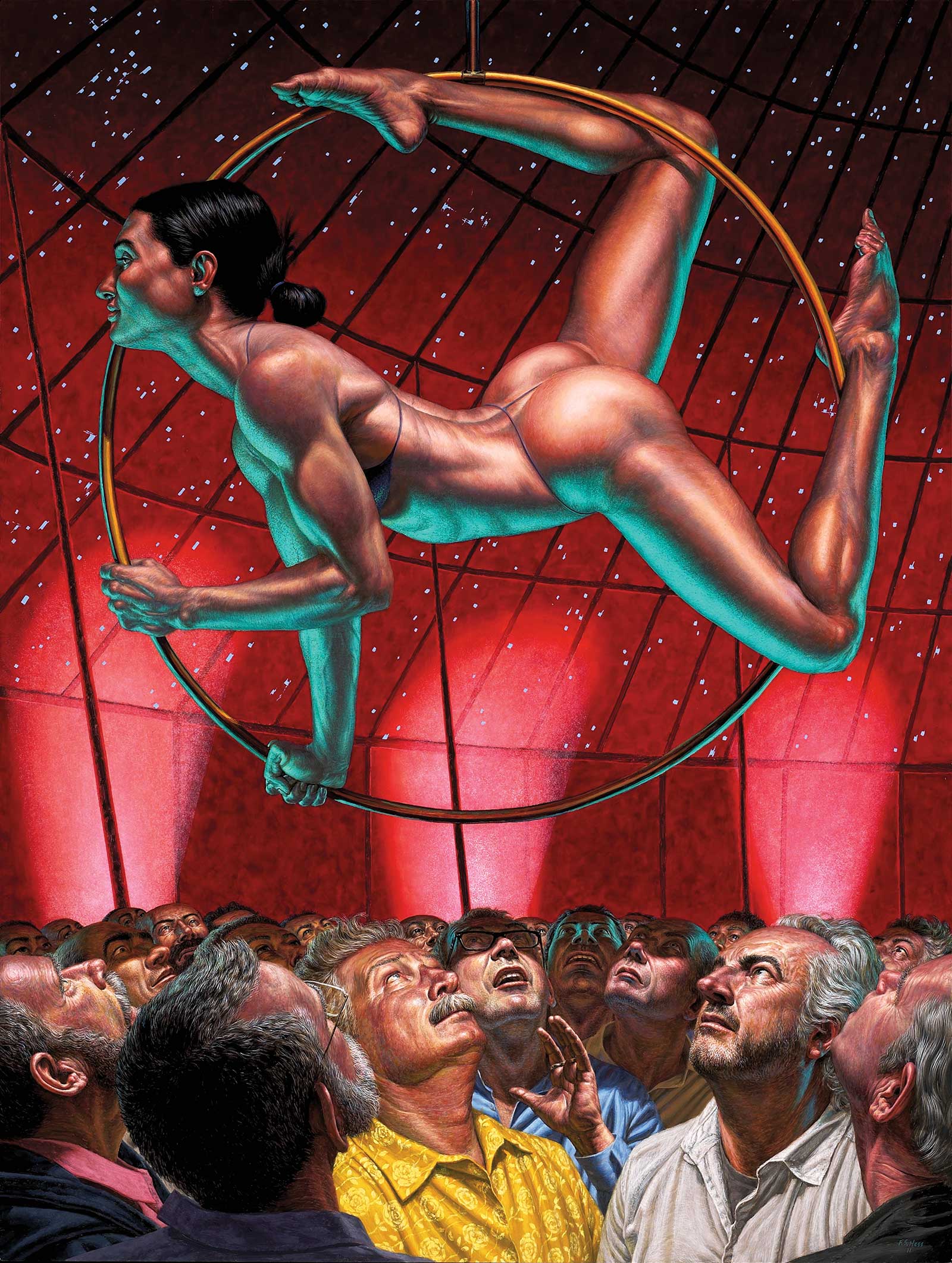
Suzie Q., 2011, oil on aluminum panel, 48 x 36". Collection of the Artist.
He has frequently turned his scrutiny upon himself as the subject of his work with characteristic irony and wry humor, playing the role of a civil war officer in his atavistic fantasy of family heritage, as an occasional model, and in cleverly doubled self-portraits painting himself painting, but his Big Baby stands alone as a milestone of self-commentary. Hess watched his parents and his wife’s mother going to their ends wrapped in diapers, and the painting is a dryly humorous prophesy of his own mortality—the animals on the child’s blankie are all endangered species. “Primarily it’s a sense of more or less coming to the end of a career, but it’s making fun of old white guys, too, as babies and victims,” explains Hess. “Mainly, the painting’s about coming to the end of life and making a little bit of fun of it. I get a wicked joy out of twists of the blade, delivering things which are deep enough to think about.” Asked whether the man-child is laughing or crying, Hess answered with a simple “Yes”—and a wicked chuckle. —
Michael Pearce is a dynamic writer, curator, and critic, and a champion of art that emerges from popular culture and shapes the spirit of the age. He has published dozens of articles about art and artists, and is author of Kitsch, Propaganda, and the American Avant-Garde. He is Professor of Art at California Lutheran University.
Powered by Froala Editor


