
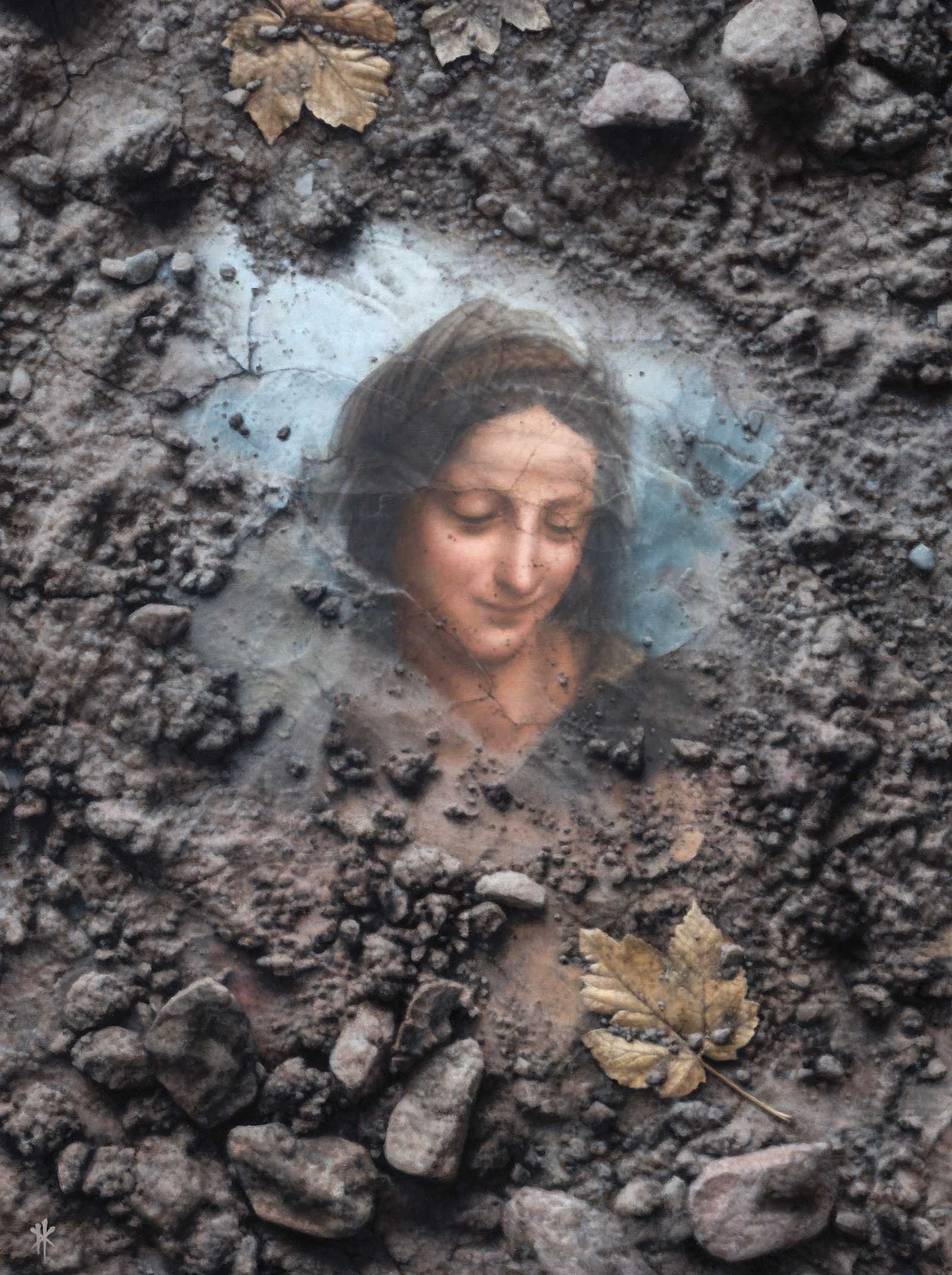
In his second solo show at Arcadia Contemporary, Patrick Kramer offers an array of “destroyed masterpieces.” Kramer recreates famous paintings as if they had been damaged in some way. Using trompe l’oeil, or trick of the eye effect, the masterworks appear in three-dimensional settings, scraped, covered in rubble, surrounded by objects or otherwise in a state of decay.
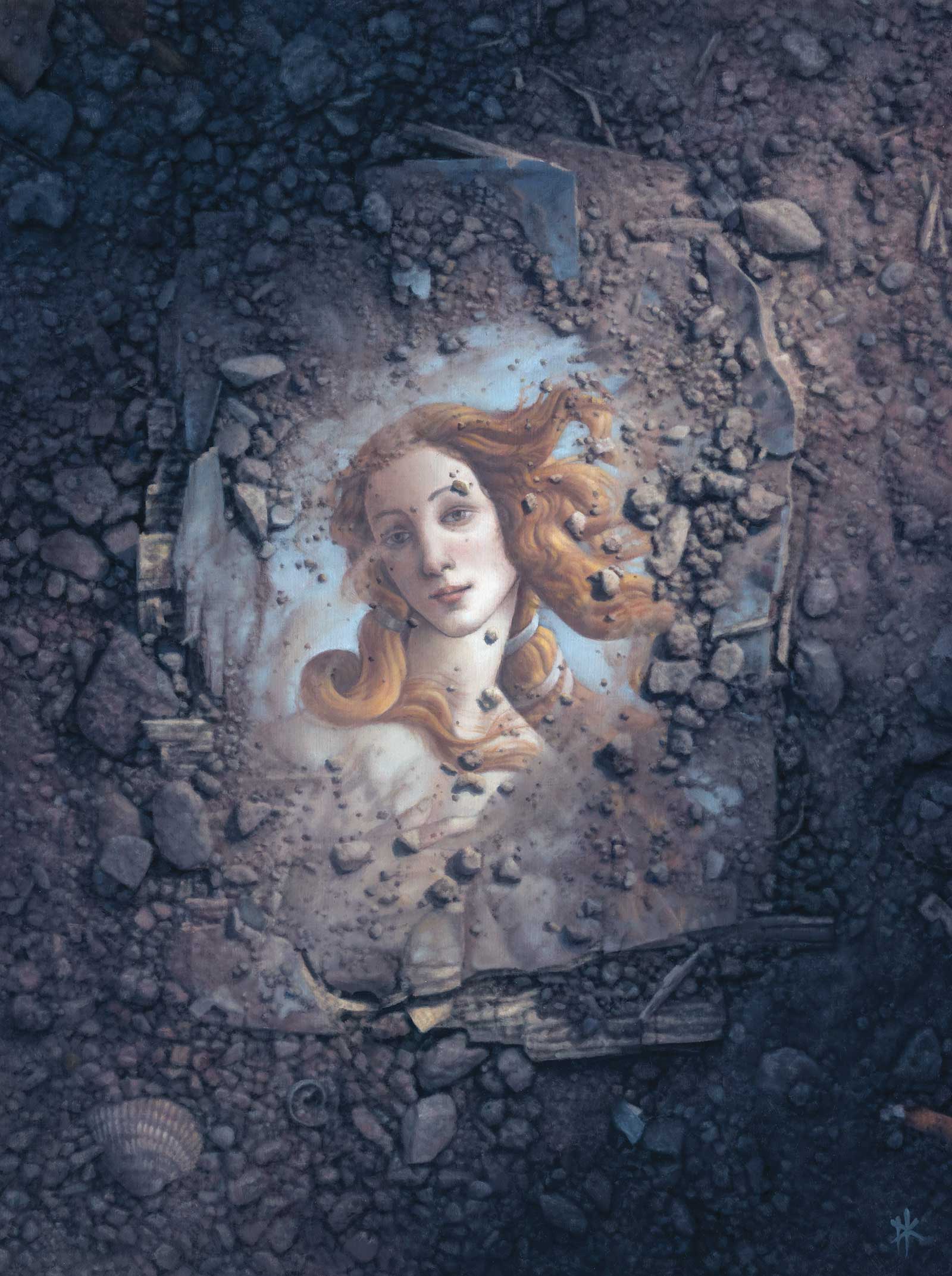
Discarded Goddess, oil on panel, 20 x 15"
Kramer made a name for himself with his impeccable realistic still lifes and figures, often featuring butterflies, flowers and beautiful women. In recent years, his tone has turned darker as he began imagining famous paintings under duress. One influence has been his wife’s work as an archaeologist. He started playing with covering masterpieces in rubble, as if they were excavated at an archaeological dig.
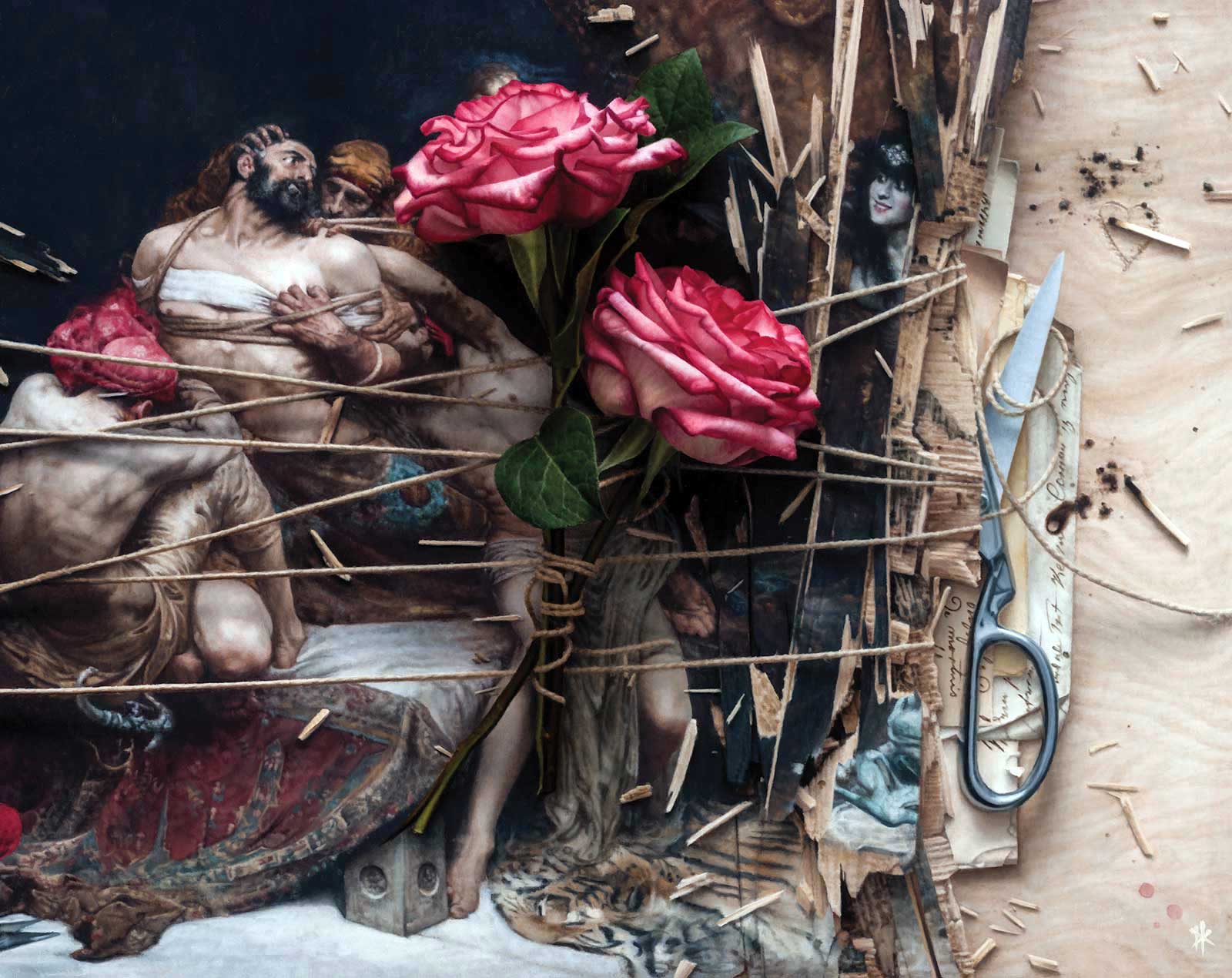
She Broke Your Throne, She Cut Your Hair, oil on panel, 24 x 30"
This approach is evident in paintings like Discarded Goddess, in which the goddess Venus peeks out coquettishly from clumps of dry earth. Venus’ face is taken from The Birth of Venus, the 15th-century painting by Sandro Botticelli. The original painting shows Venus emerging fully formed into the world, attended by angels, flowers and gentle sea breezes. Kramer’s Venus, however, has not weathered the ravages of the earthly realm. She looks almost laughingly fragile compared to the encroaching dirt.
Kramer admits his recent works reflect his own pessimism about the state of society. “My figures look out at you and say, ‘What have you done? Have you brought about the downfall of civilization?’”
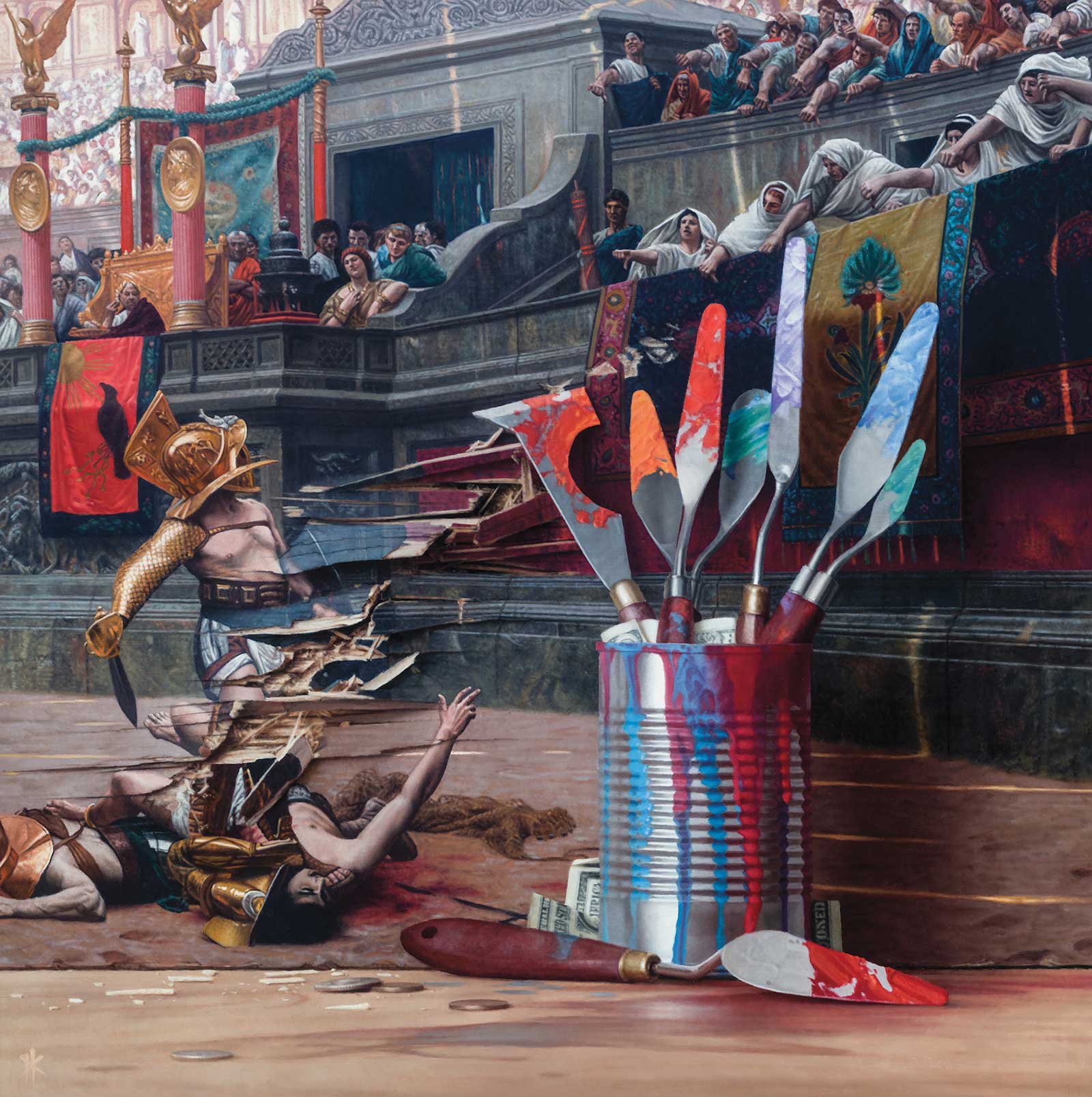
Consulting the Crowd, oil on panel, 30 x 30"
He is quick to note that he does not advocate for the actual destruction of art. Art vandalism, as in the case of eco-activists, leaves him cold. Instead, he wants to emphasize the dismay he feels about society and politics generally.
Global doom and gloom aside, some of Kramer’s paintings address more quotidian woes. She Broke Your Throne, She Cut Your Hair, for instance, is about bad breakups. “We all have experience with bitter romances,” he says. For Throne, Solomon J. Solomon’s 1887 painting Samson provides the pathos, and Kramer supplies the cutting shears, wilting roses, twine and burned love letters. Fans of Leonard Cohen will recognize the “Hallelujah” lyrics in the title.
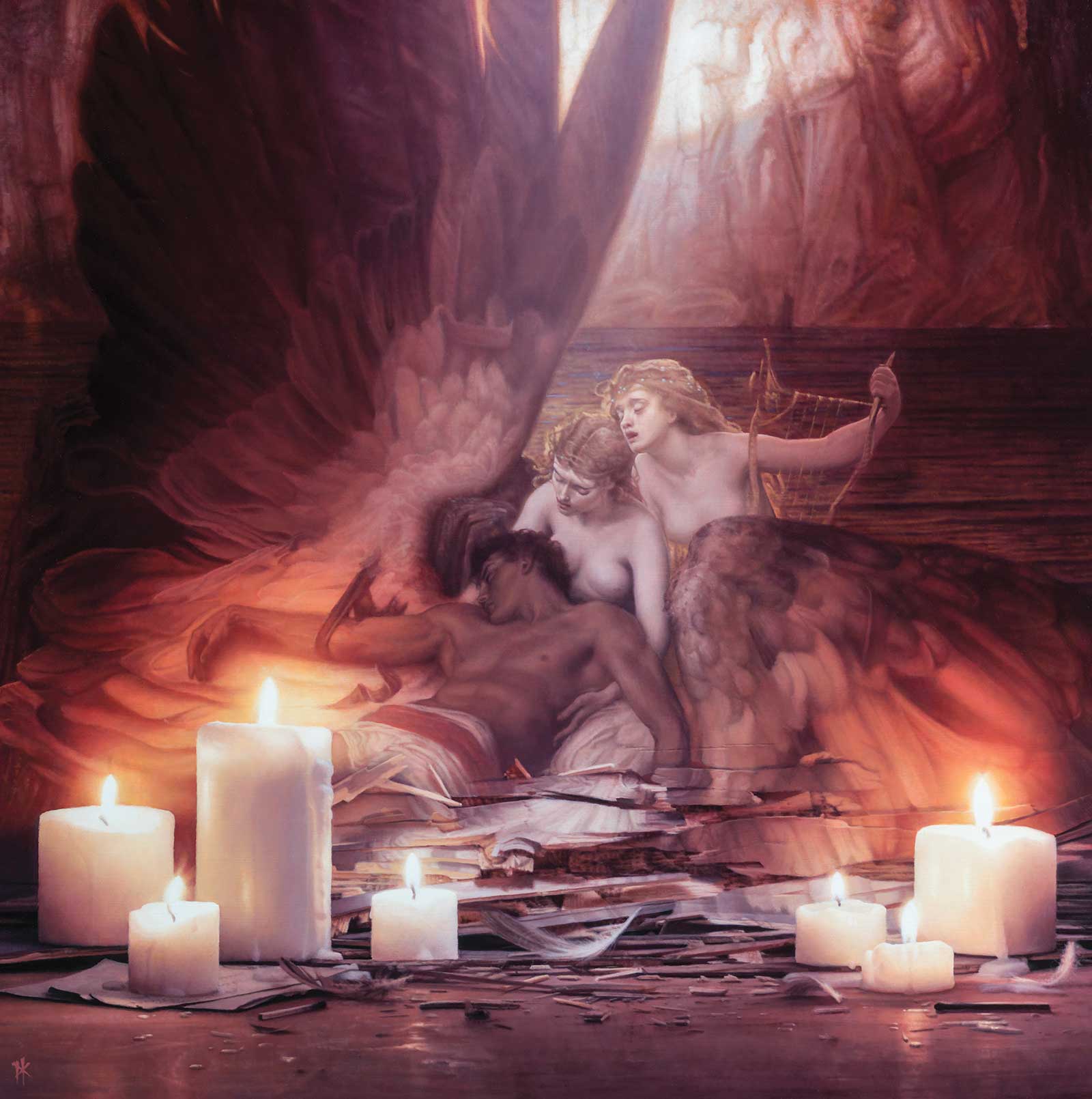
Lament for Icarus, oil on panel, 30 x 30"
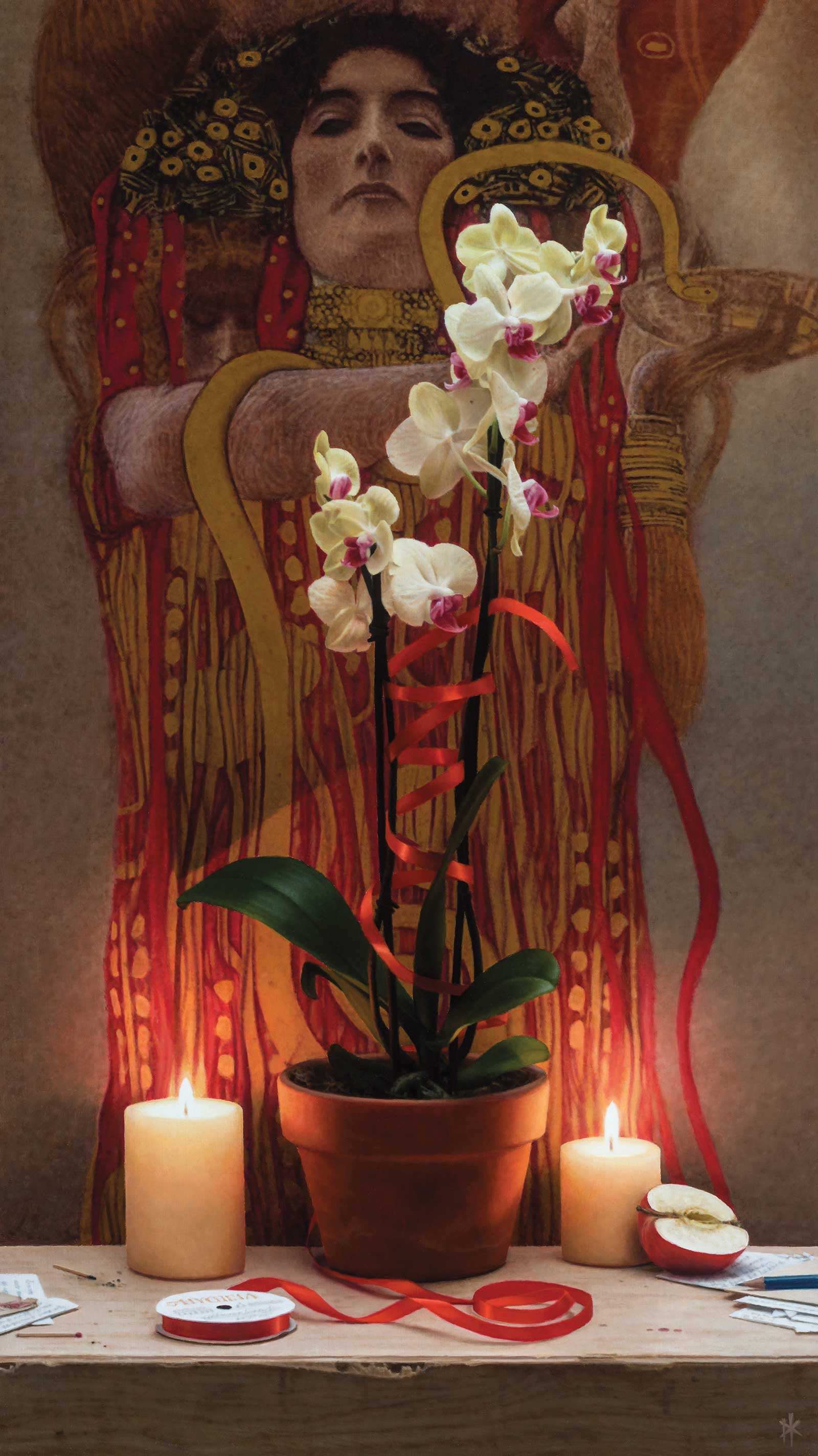
Serpents of Hygieia, oil on panel, 32 x 18"
Another brilliant piece in the show is Consulting the Crowd. Based on the 1872 painting Pollice Verso by Jean-Léon Gérôme, Kramer’s painting depicts Gérôme’s work having been chopped at by palette knives. Or at least we can assume those were the weapons used to stab and pry the panel board, as they sit guiltily in an empty tin can in front of the painting. Smears of blood-red paint on some of the palette knives echo the blood shed by the defeated gladiator in the Colosseum. “Pollice verso” is Latin for “turned thumb,” and Kramer has stayed true to the original painting by including onlookers booing and giving the thumbs down to the standing, victorious gladiator.
Recalled to Life, oil on panel, 24 x 18"
Kramer says the painting was inspired by his musings on an artist seeking an audience’s approval. Scattered around the tin can are paper currency and coins. “That’s a reference to financial incentives to pander to the crowd,” he says. “Like a performer holding out a can for tips.” He imagined the audience ultimately giving a thumbs down to the final work. But that certainly won’t be true of the work in this show, which is as captivating as the art that inspired it. —
Arcadia Contemporary
421 W. Broadway • New York, NY 10012 (646) 861-3941 • www.arcadiacontemporary.com
Powered by Froala Editor


