It’s not an uncommon fantasy—fleeing the city for somewhere wild and remote, living off the land—but a foursome of artist friends actually did it. Well, maybe not the last part, but close enough.
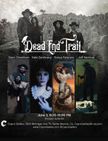
In their first group show together, artists Sean Cheetham, Kate Zambrano, Jeff Nentrup and Sonya Palencia present new works shaped by their firsthand experience of settling on adjacent ranches in the California mountains. Opening June 3 at Copro Gallery in Santa Monica, Dead End Trail explores the darker elements of the American West through the filter of each artists’ unique lens, interests and style.
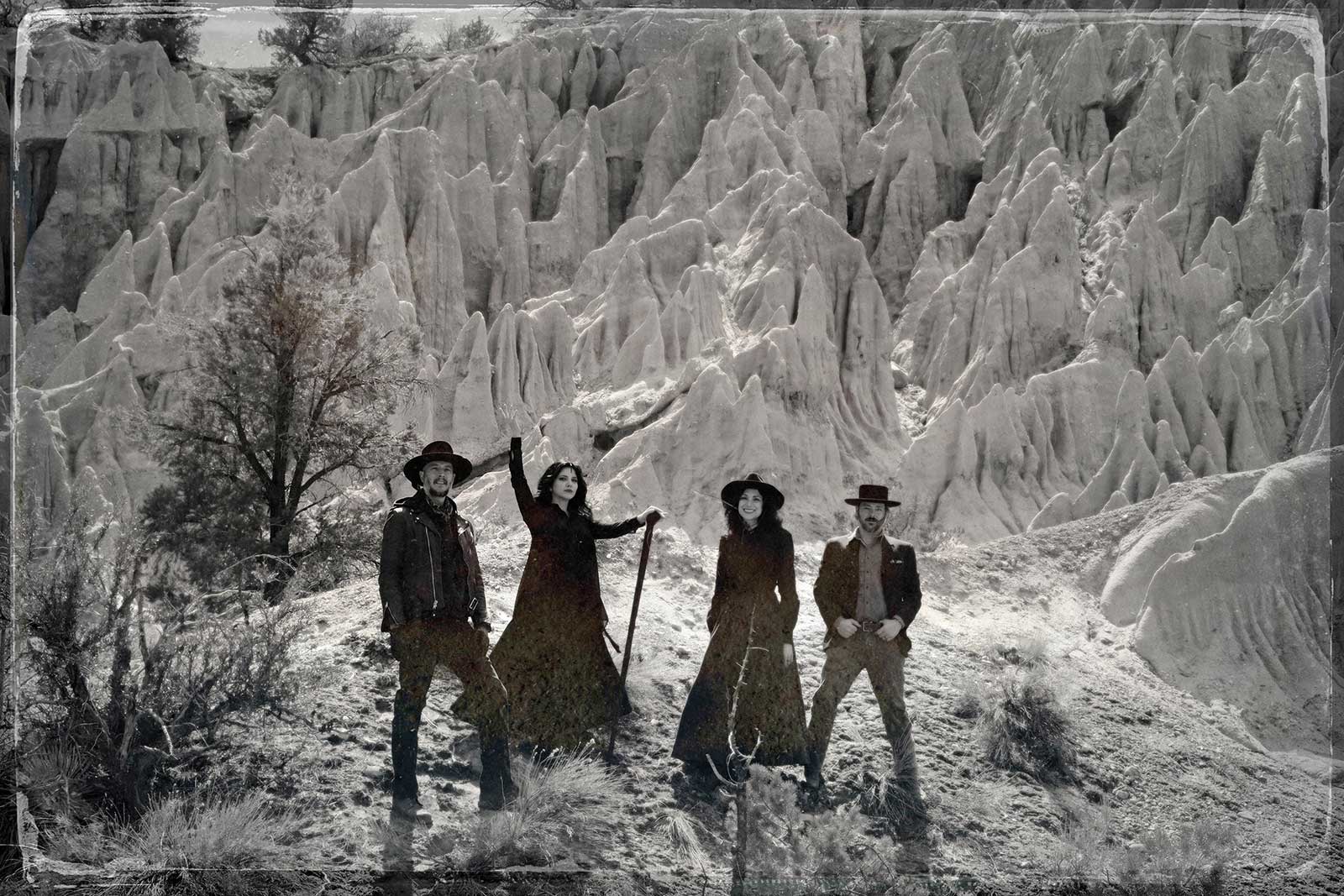
Left to right: Sean Cheetham, Kate Zambrano, Sonya Palencia and Jeff Nentrup.
Sean, Jeff and Sonya met in the late ’90s while attending Art Center College of Design in Pasadena, California. Jeff and Sonya eventually married, and Jeff and Sean have remained close friends and collaborators as artists and musicians ever since.
Life took a big twist for Jeff and Sonya in 2012, when the opportunity arose to make their daydream of trading city life for a quieter existence a reality.
“We were ready for a change of pace,” says Nentrup who was still living with Sonya in Pasadena. “We wanted to explore the mountain life and be inspired by nature and our surroundings a bit more than we were.”
When a 160-acre ranch on a dirt road that dead-ends at the nearly two million-acre Los Padres National Forest became available, the couple jumped on it.
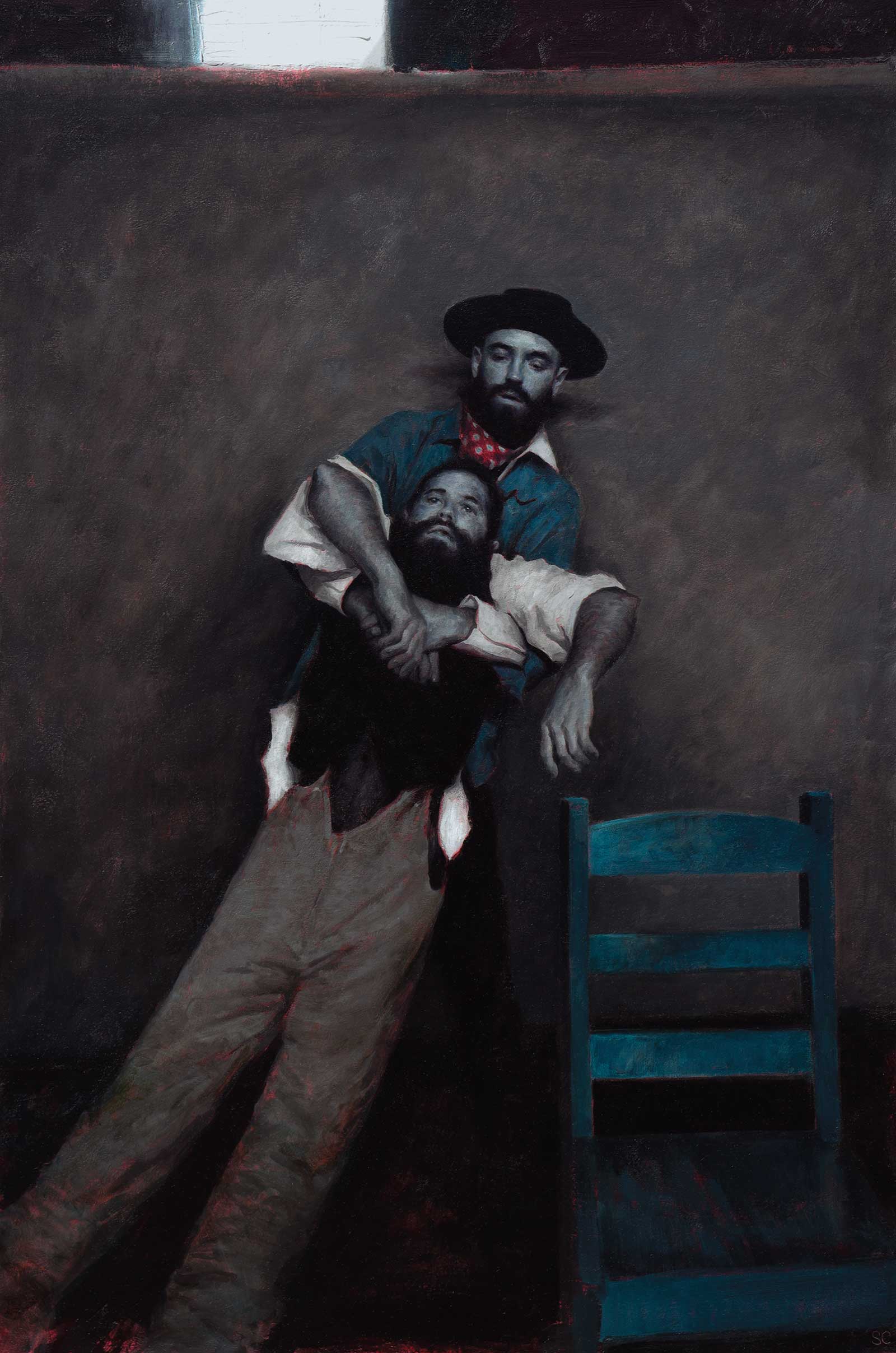
Sean Cheetham, Keseberg’s Cabin, oil on panel, 36 x 24"
“It was a bit of a gamble,” Nentrup says. “We weren’t sure how it was going to turn out. After we befriended the locals, they told us when they found out we were artists they gave us a year tops. Ultimately they became the same people who call me to help them manage their rattlesnake population—we’ve adapted quite well to say the least.”
In the decade since Nentrup and Palencia moved to the property, Cheetham has been a regular visitor. When he met Zambrano about six years ago, she began accompanying him. Two years ago a smaller property a quarter mile away from their friends’ place came up for rent and the couple decided to take the leap, too. Cheetham had been living in a one bedroom apartment in Los Angeles’ Koreatown for nearly 20 years, but he had a good idea of what they were getting into.
Their ranches may only be an hour from LA, but living that far from a grocery store isn’t easy by most standards and quite an adjustment for those used to urban amenities. Then there are the elements to contend with. Situated in an open valley a mile high on the border of high desert and woodland chaparral, the landscape is a rugged terrain of sage, scrub oak, rabbit brush, manzanita, juniper and pinyon pines teeming with wildlife, much of which humans want to avoid. It has a hostile climate with scorching hot dry summers and bitter cold snowy winters—they were snowed in for nearly a month this past winter.
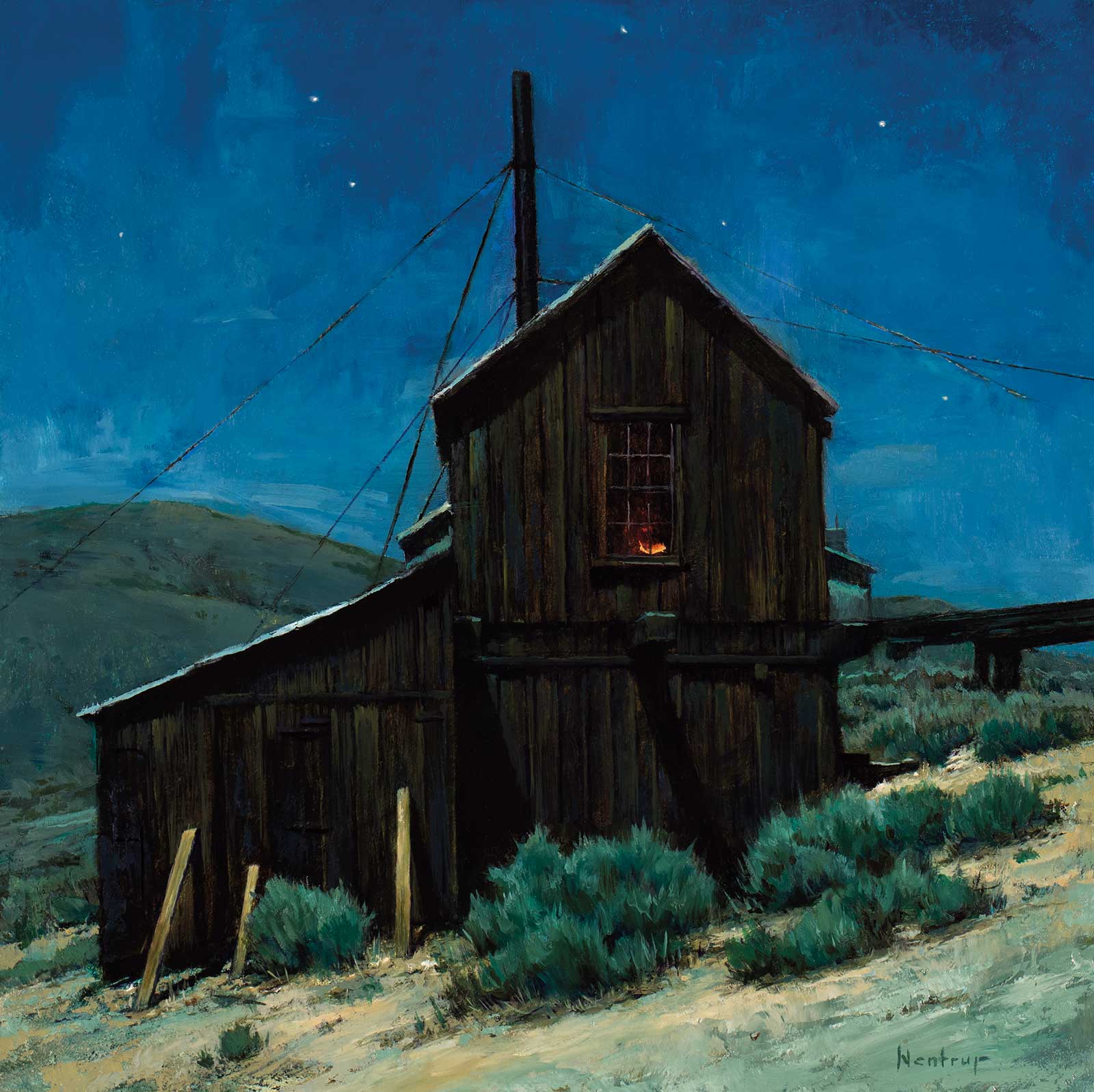
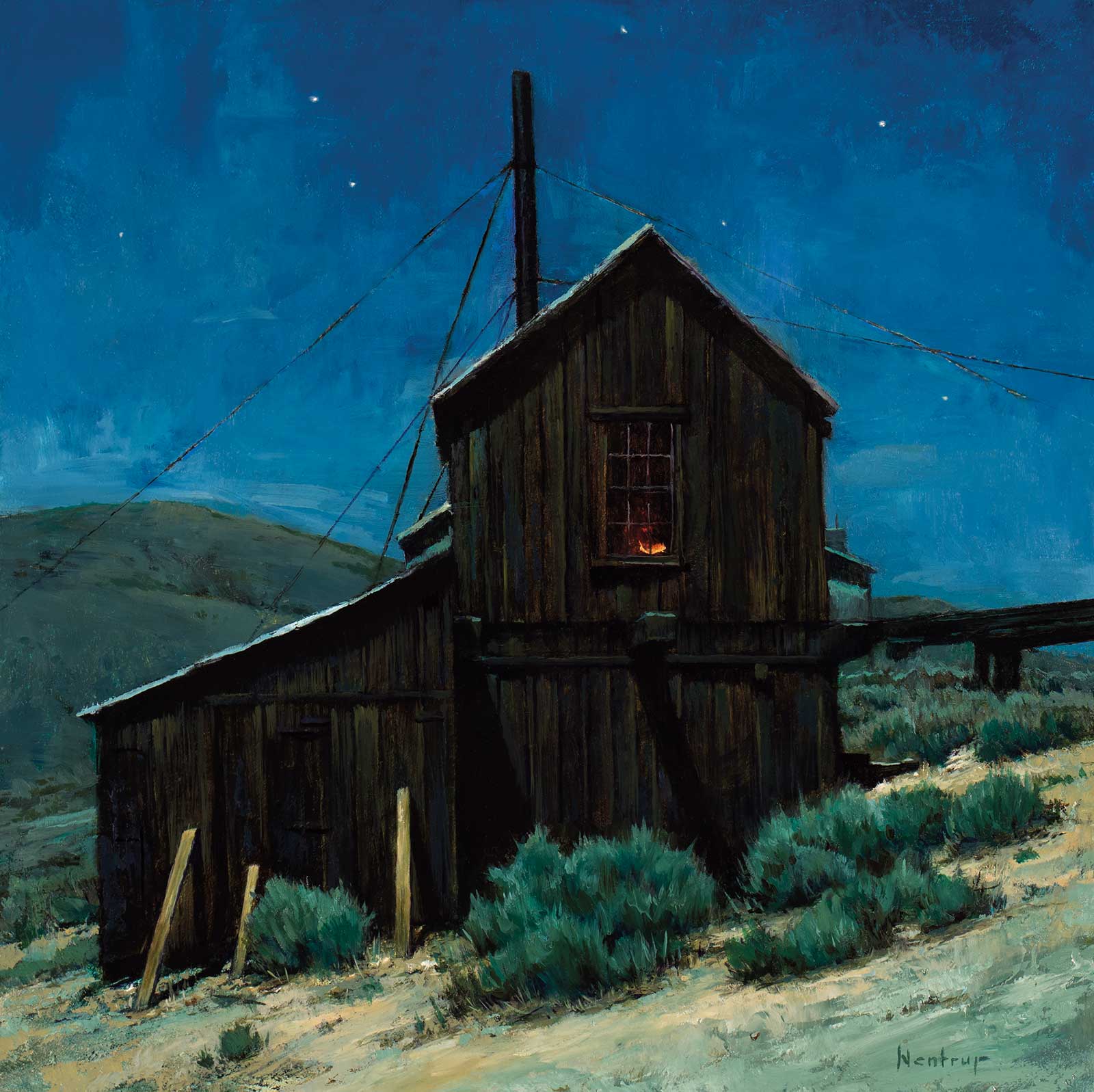
Jeff Nentrup, Squatter’s Rights, oil on panel, 10 x 10"
“It requires a lot of forward planning to live so remotely—stocking up for blizzards and heat waves,” says Kate. “Even with those inconveniences, it’s perfect for us for now. I really thought I would have a harder time without three markets within a mile radius that I could just pop into if I forgot something, but surprisingly that hasn’t really been much of an issue at all. I’ve realized I need so much less than society insists that I do.”
“People here, like the landscape, are tenacious and hardy—country living is not for the faint of heart,” says Sonya, adding that you have to be a little mad to choose the lifestyle at will. “I think living off of the San Andreas fault line in the middle of an explosive forest qualifies. We replaced the ‘Nature is Awesome’ slogan with ‘Nature is a ****’ in our household. She often tempts you with her blissful beauty and breaks your heart. It’s a brutal cycle and I suppose this makes us a little masochistic, but if I had to do over again I would. Oddly, it’s all in harmony.”
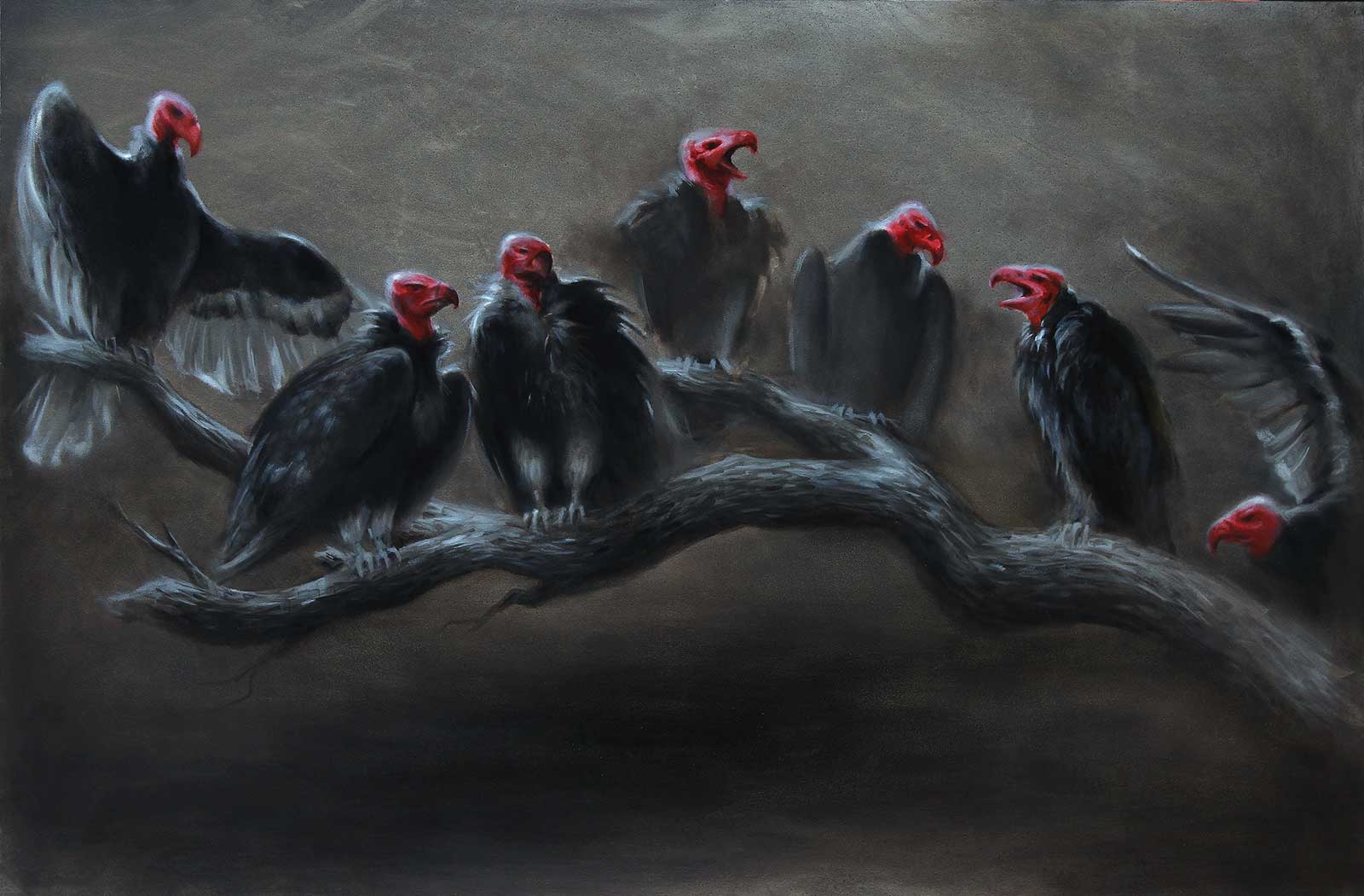
Kate Zambrano, Proof of Life, oil on panel, 30 x 45”
The experience has had a dramatic effect on their work, seeping in and taking it in new directions shaped by aspects of Western history, and the raw appeal and danger-laced freedom the modern day equivalent of frontier living delivers.
As do many, Nentrup ties his nostalgia for the West, and its increasing influence on his work, to watching Clint Eastwood movies with his father as a kid. More recently, it was the purchase of a cowboy-style six-shooter revolver before moving to the ranch. “It was a way of being able to look Sonya’s father in the eye when I told him I was moving out into the wilderness and I was taking his daughter with me,” he says. Later, he painted it.
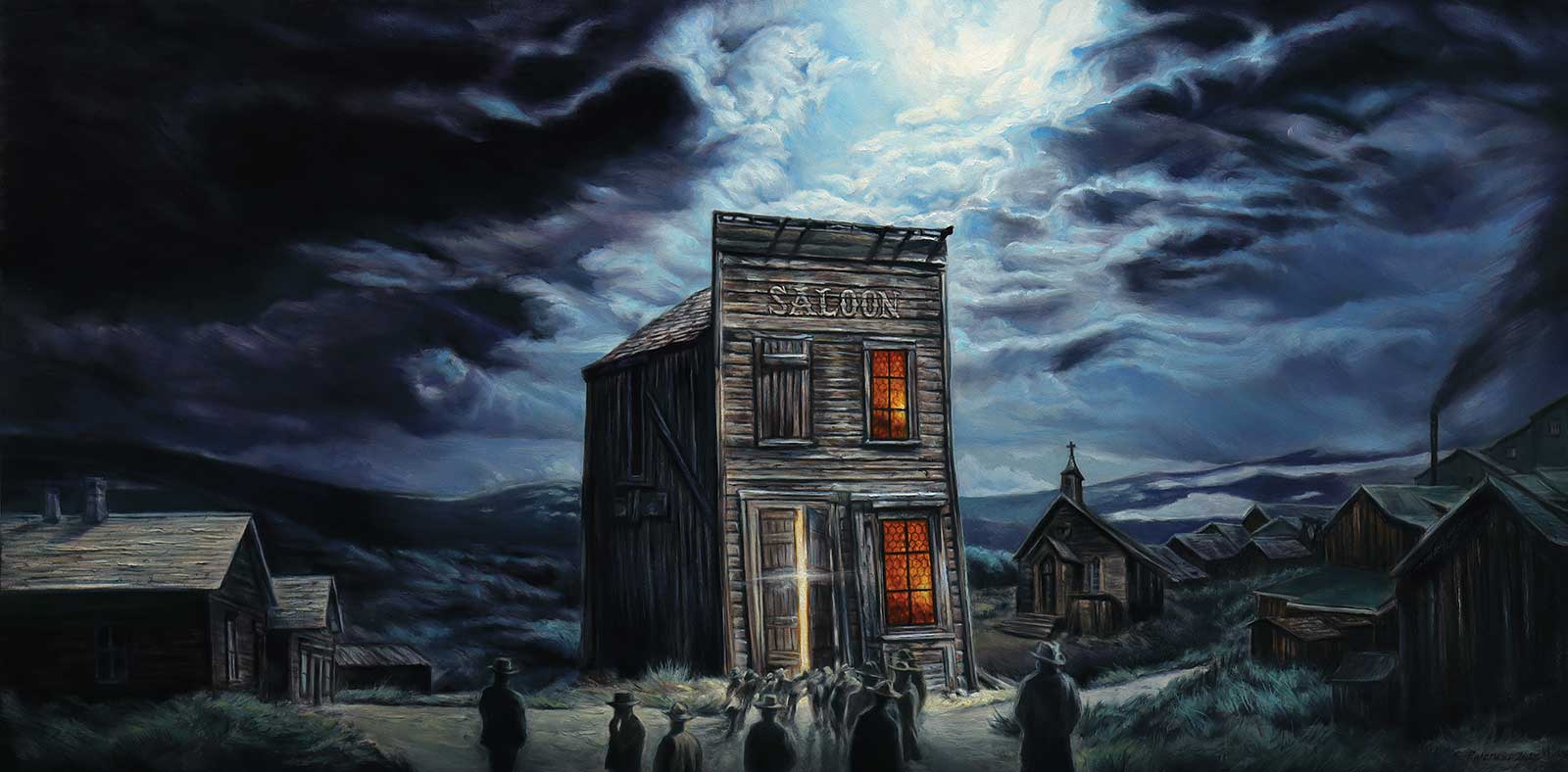
Sonya Palencia, Midnight Mass, oil on panel, 12 x 24"
Nentrup brims with excitement when talking about life on the ranch and the challenges seem to be a big part of what fuels it. “It was really moving up here that we sort of had to come face to face with the space—the emptiness has a real presence that took some getting used to,” he says. “In addition to the isolation and the small victories you have to eke out for yourself, it also has to do with a sense of freedom, in knowing you may be leaving some creature comforts behind in exchange for something very meaningful. It’s a different level of self-reliance and fortitude that you have to take very seriously. It got us thinking about the early settlers especially in these rugged areas. I think that’s really when this fascination with the West really blossomed for both of us.”
This comes across in works like Nentrup's Squatter’s Rights, a piece that maintains his surreal style that blends realism and abstraction. Cheetham modeled for Substrate and Apathy of Stars,morbid paintings depicting scenes of Old West death and hardship.
Jeff Nentrup, Substrate, oil on panel, 24 x 36"
Similarly, Cheetham found himself fascinated with iconic stories of the West.
Keseberg’s Cabin is a painting about Lewis Keseberg, the last person to be rescued from the Donner Party. “He was found alone with many body parts and a full belly,” Cheetham says. The neon-green lit painting Game Overis a reference to the Oregon Trail video game. Cheetham’s son had a T-shirt with a similar image and the two would play the game together, as he had as a kid. Cheetham grew up in San Francisco with trips to Lake Tahoe, where the story of the Donner Party and western expansion is deeply embedded in regional lore. “I think the subject of western migration is a relevant part of our history and the reason most of us are here,” he says. “I can’t get behind the idea of manifest destiny and so I tend to explore stories that surround it but don’t have the happy ending.”
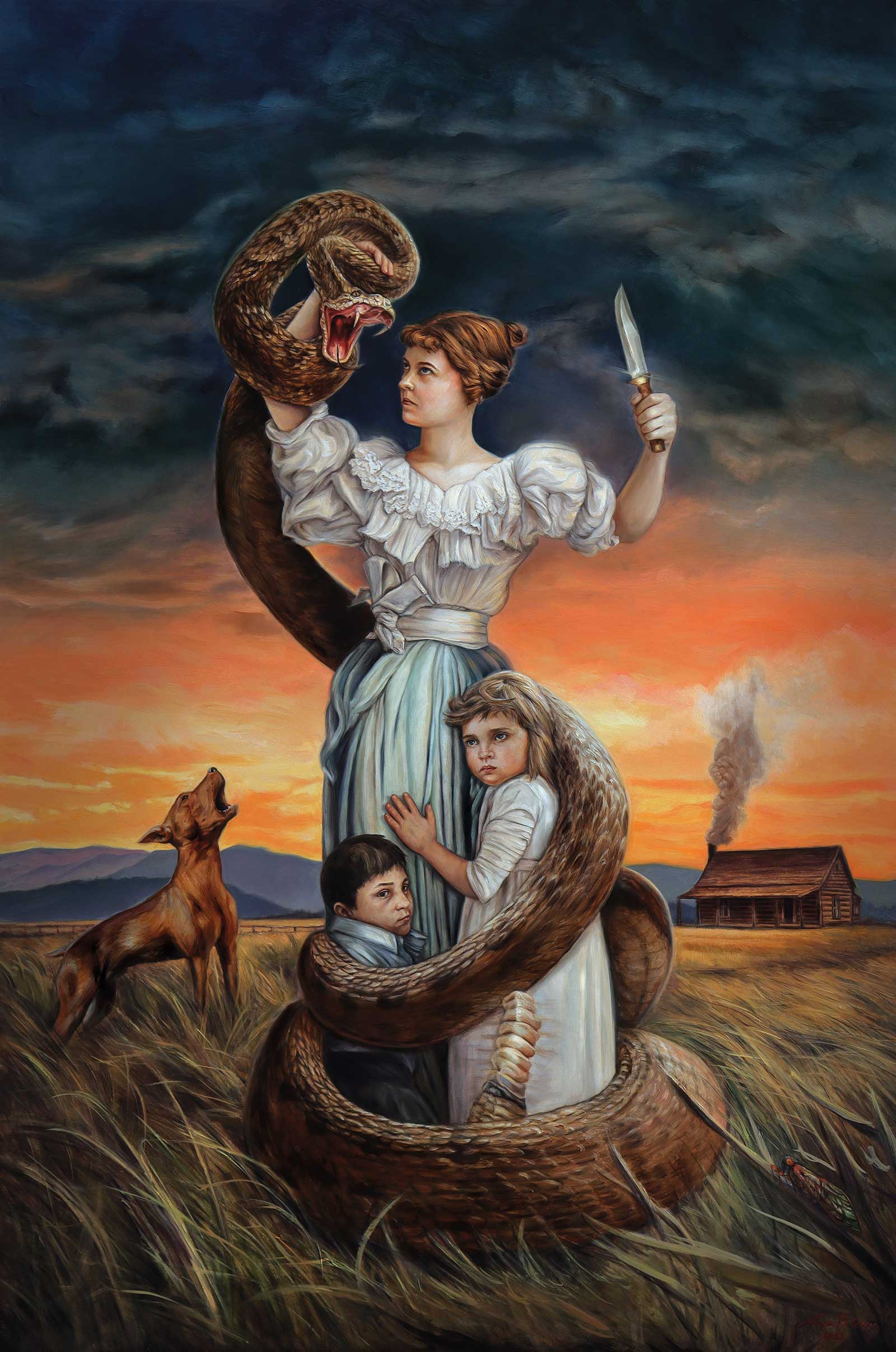
Sonya Palencia, Western Venom, oil on panel, 36 x 24"
Palencia and Zambrano’s recent work reflects a greater intimacy with the natural world. “I’ve transitioned from being a spectator of nature to actually feeling included,” says Palencia, whose work, as it does in Western Venom, often intertwines animal and human forms. The piece also alludes to the survival of the fittest, the lengths one will go to protect their family and home, while paying homage to heroic mothers everywhere. With an interest in pioneer life that dates back to reading Laura Ingalls Wilder’s Little House on the Prairie books, the painting Midnight Mass, a burning boom town bar, is about the traumatic effects of life on the American frontier. “Many turned to faith, but others leaned on the saloon to quiet their demons,” she says.
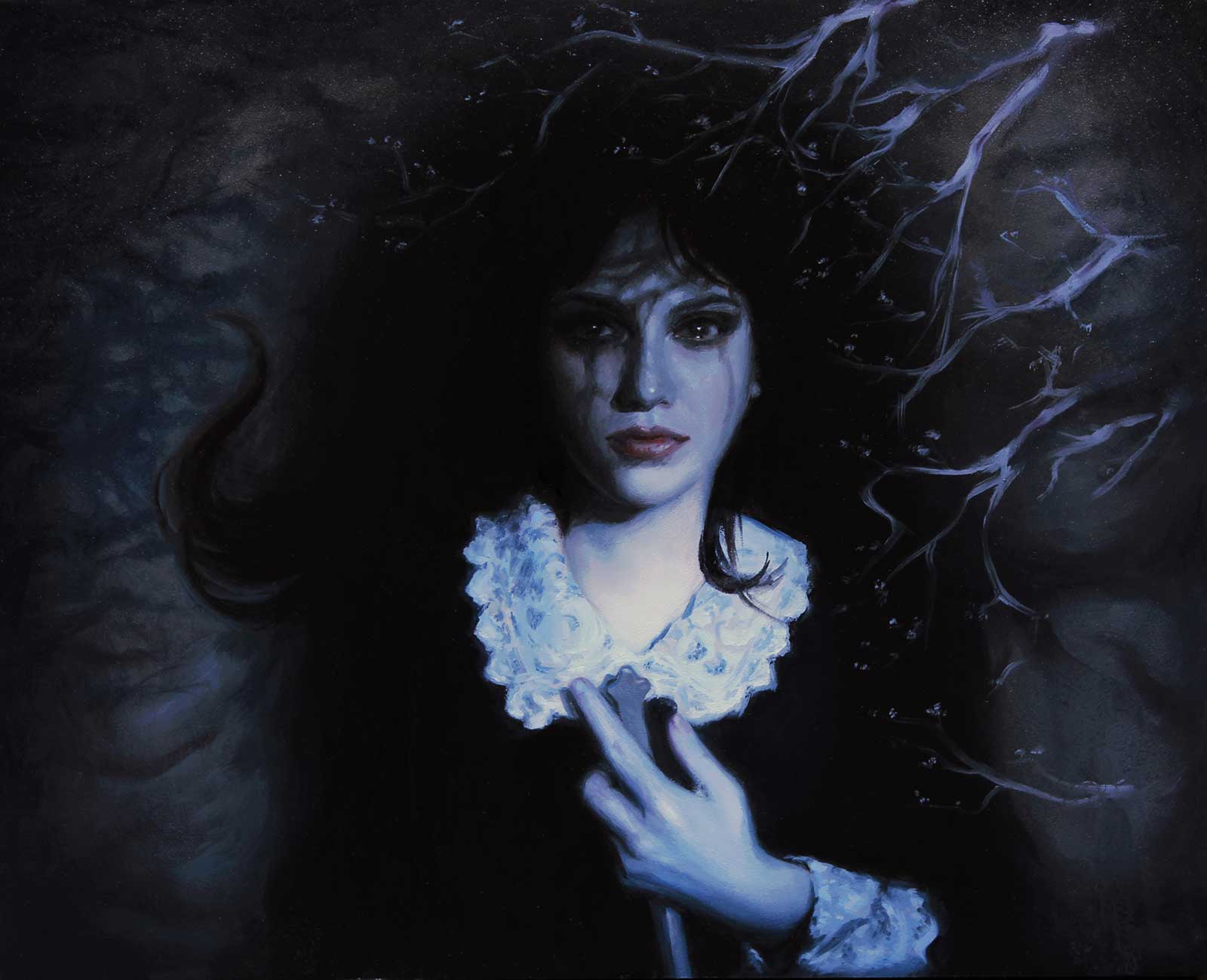
Kate Zambrano, Necromancy II, oil on panel, 16 x 20"
For Necromancy II, Zambrano revisited a self-portrait she painted in 2013. For the second iteration, rather than lying in the Northern Californian brush where she then lived, she placed herself in her current natural environment. The idea for Proof of Life came to her as she was falling asleep one night. “I had a vision of a line of vultures on a tree branch,” she says. She did a large scale drawing of the scene that remained a study for a year. When they were invited to participate in Dead End Trail,she decided the vultures needed to be painted. “These pieces are incredibly important to me as I feel that I am really tapping into something within myself that I’ve wanted to for a long time,” she says.
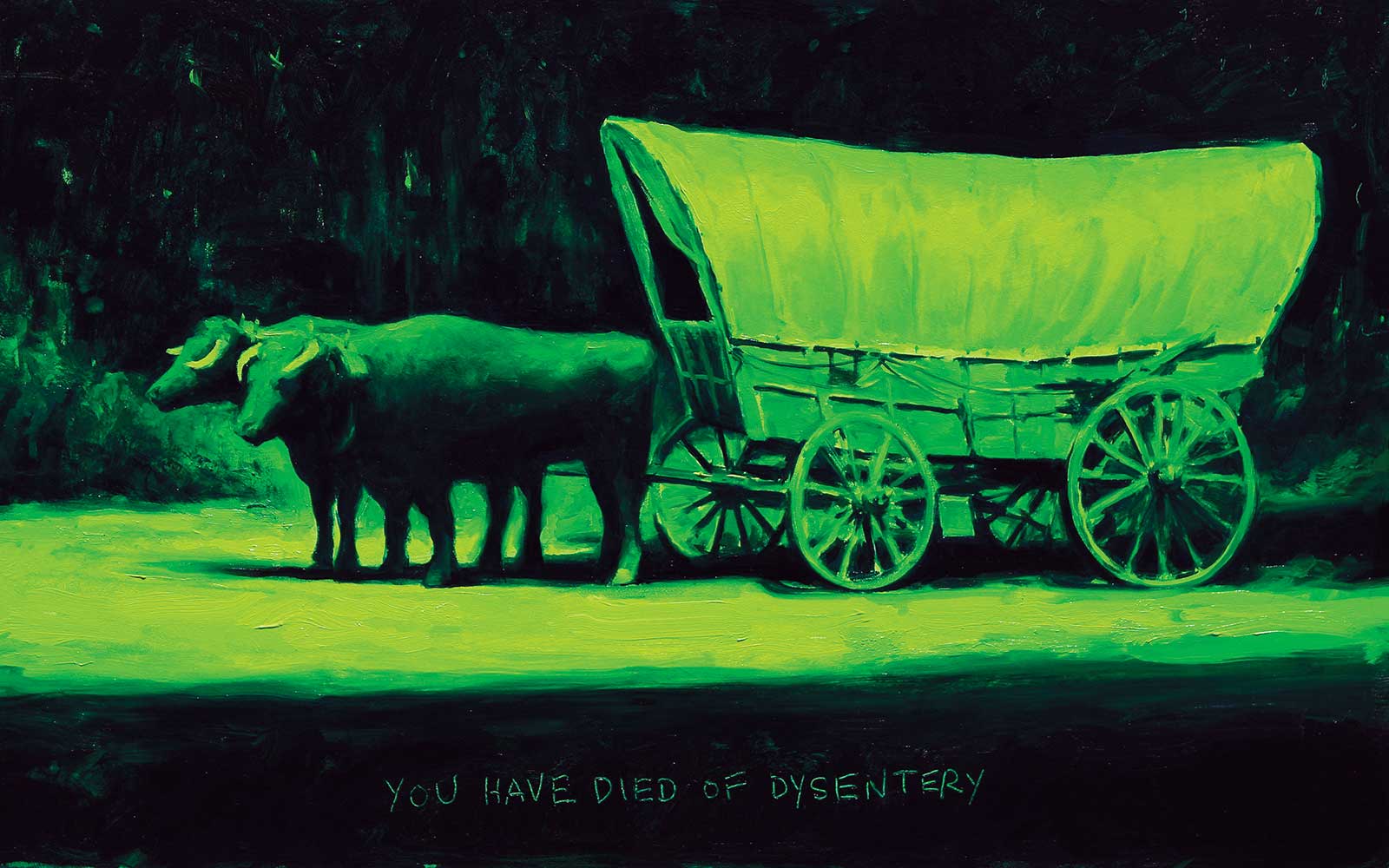
Sean Cheetham, Game Over, oil on panel, 10 x 16"
The artists have shown their work with one another in all sorts of configurations but never all four of them together. “Fitting” and “synergistic” are words they use to describe this group show that’s been a year in the making.
“We know we’re not cowboys or ranchers or frontier people, but we do live out here,” says Nentrup. “We rely on each other for our daily needs as well as for moral support and the camaraderie you need when you live in isolation. That part of it has been really exciting—really being able to enjoy our time together here. Knowing that it’s not going to last forever and that it’s a very special time for us. It’s living in that tension—we’re definitely reaching into a well-established tradition [of Western art] but bringing our experience to these new works. That’s where the authenticity comes in.” —
Dead End Trail
June 3-24, 2023
Copro Gallery, Bergamot Station Arts Complex
2525 Michigan Avenue, Unit T5
Santa Monica, CA 90404 , (310) 829-2156 , www.coprogallery.com
Powered by Froala Editor