Jimmy Wright has been president of the Pastel Society of America since 2013. Founded in 1972 by Flora B. Giffuni and headquartered in The National Arts Club in New York, the society has grown during his tenure. Last year, the society’s 50th annual exhibition, Enduring Brilliance,featured works from 33 states and 11 international countries and offered over $50,000 in awards. Wright is a master pastelist in the society, a designation for PSA members who have accumulated three PSA annual exhibition awards. In 2018, he was named an academician of the National Academy of Design.
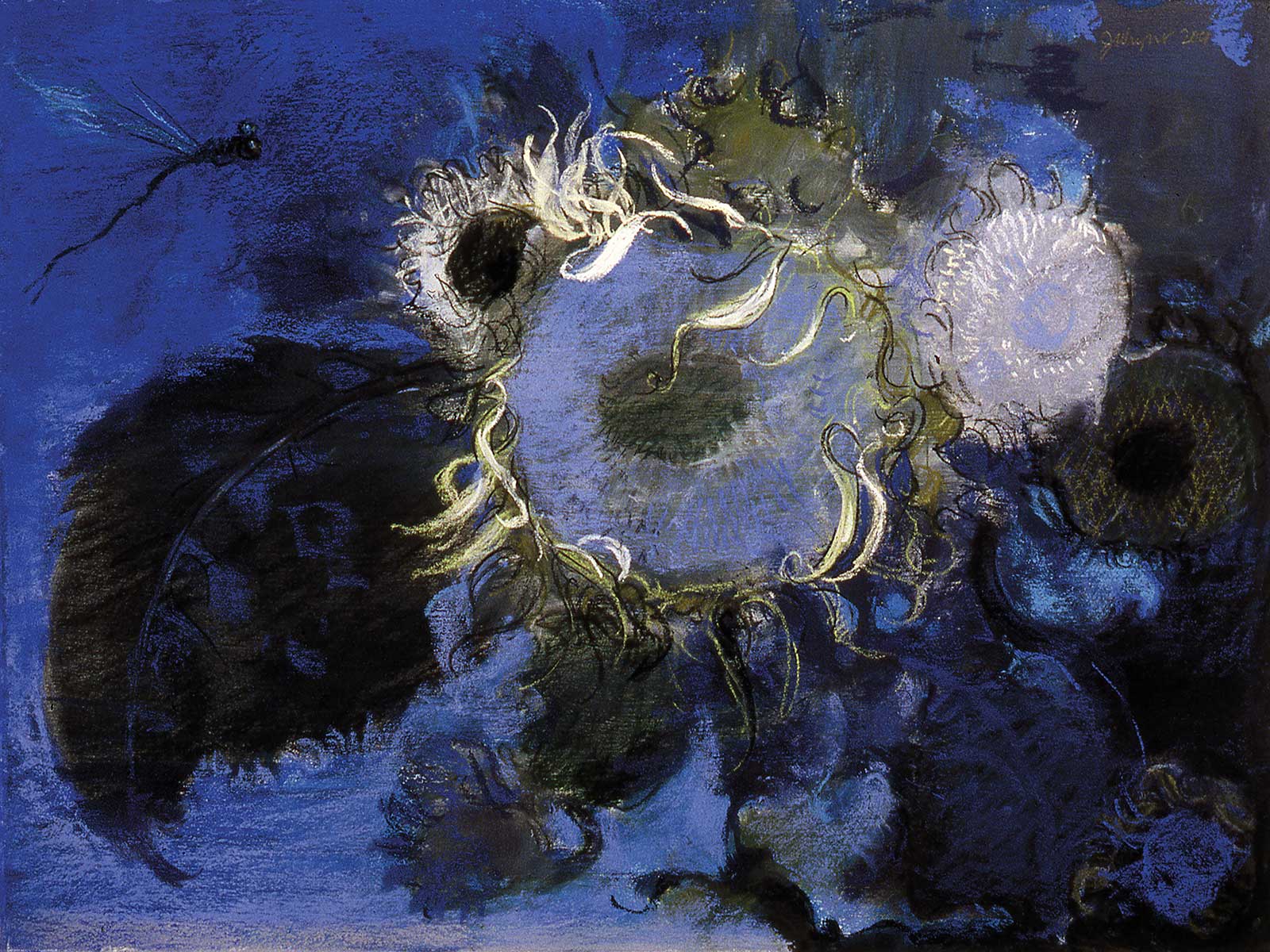
Dragonfly and Blue Sunflower, 2001, pastel on paper, 21½ x 29.” Private collection.
Raised on a farm in western Kentucky, his parents subscribed to five newspapers as well as Reader’s Digest and Life Magazine. It was in Life that he learned about artists such as Jackson Pollock, Frank Lloyd Wright, Picasso and Matisse. One issue contained a series of photos of Picasso’s home near Nice on the French Riviera and, at the age of about nine, he knew “that was exactly how I wanted to live.” He was already on his way, drawing and painting in watercolor. Years later he was a cover artist for Reader’s Digest.
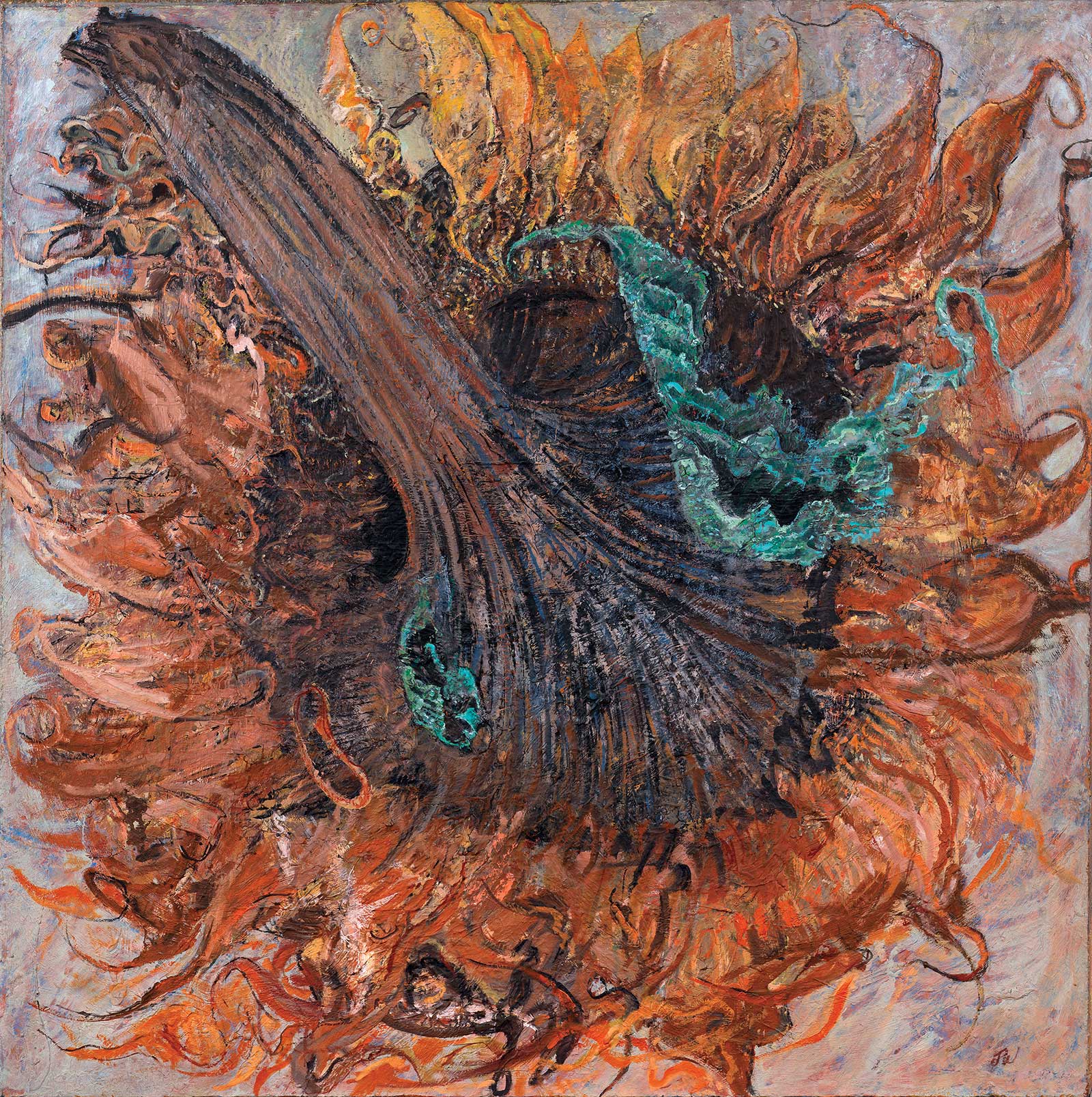
Flowers for Ken, Sunflower Stem, 1988-91, oil on canvas, 72 x 72.” Collection of the Speed Art Museum, Louisville, KY. Gift of Speed Contemporary. Courtesy Fierman, New York, NY and Corbett vs. Dempsey, Chicago, IL.
He spent a summer with his aunt and her husband in Denver, where his aunt enrolled him in an art class taught by Lester Burbank Bridaham. Bridaham had been a student and studio monitor for Kimon Nicolaides who wrote the seminal book, The Natural Way to Draw. Jimmy had also spent time observing and drawing the figure, learning to “look” and developing hand-eye coordination. Just before entering the School of the Art Institute of Chicago in 1967, he saw an exhibition of the work of Jean Dubuffet, founder of the art movement, art brut. The Tate Museum explains that for Dubuffet, the movement “which included graffiti, and the work of the mentally ill, prisoners, children and primitive artists—was the raw expression of a vision or emotions, untrammeled by convention.”
“Having had a very disciplined background in observational drawing,” Wright explains, “I was challenged as a young artist to use that observational skill in a way that reflected content that was mine alone. I became true to my own nature by being an expressionist.
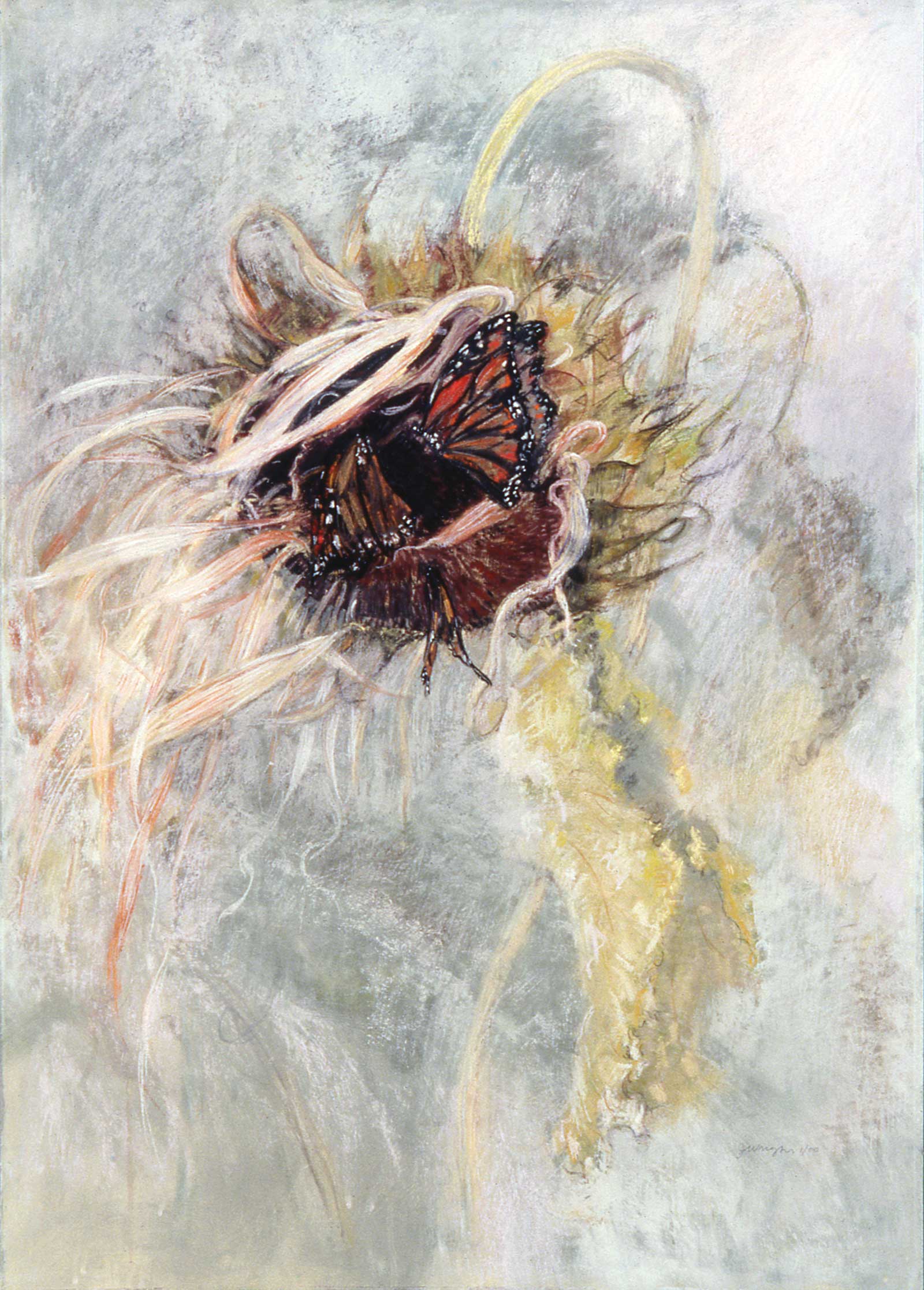
Three Monarchs, 2000, pastel on paper, 41 x 29.” Private collection.
“Toward the end of my study at the Art Institute, I took a painting class with Ray Yoshida, who influenced a group of artists who became known as the ‘Chicago Imagists and the Hairy Who.’”
The Chicago Imagists used bright colors and bold lines to create stylized images of the human form following in the tradition of artists such as Ivan Albright and Leon Golub. “There is a giant painting by Golub at the Art Institute that is a take on a classical theme but the surface is right out of art brut,” says Wright. “The surface is pock marked and burned.”
In 1974, Jimmy moved to New York and immersed himself in the intense gay scene of the period between Stonewall and HIV, producing imagist drawings and paintings of the bath houses and clubs of the city. In 1969, a riot against the police at the Stonewall Inn was a turning point for LGBTQ rights. The vibrant scene that followed came to an end when HIV ravaged the gay community.
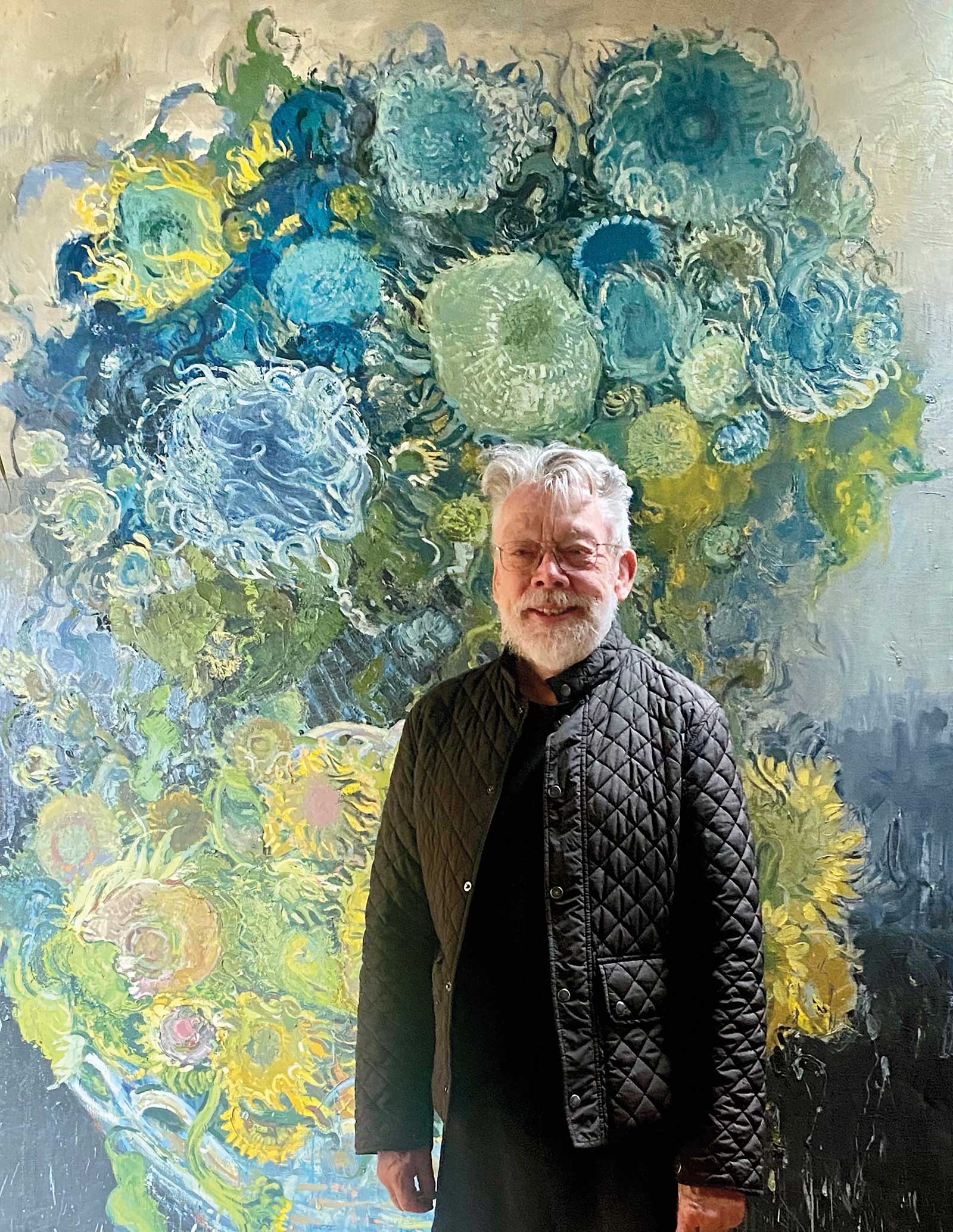
Jimmy Wright in front of his 96-by-72-inch oil painting, Sun and Shadow, 2001. Photo credit: Fabio Cherstich.
In 1988, Jimmy’s partner of many years, Ken Nuzzo, was diagnosed with HIV. As caregiver to Ken for three years, Jimmy pondered, “How do I hold onto myself without drowning in the moment of caring for someone. It was overwhelming on many levels. I needed a self-care strategy to maintain my sanity and I didn’t have time to be in the studio.
“I decided, ‘I’m going to paint a still life that doesn’t move’, that I could set up and walk away from and it would still be there whenever I could return. I would be just observing. All I would have to do is paint what’s in front of me. It would give me a moment to be self-contained. “At a farmers’ market I purchased a giant sunflower that had been grown from seed and laid it on a table.”
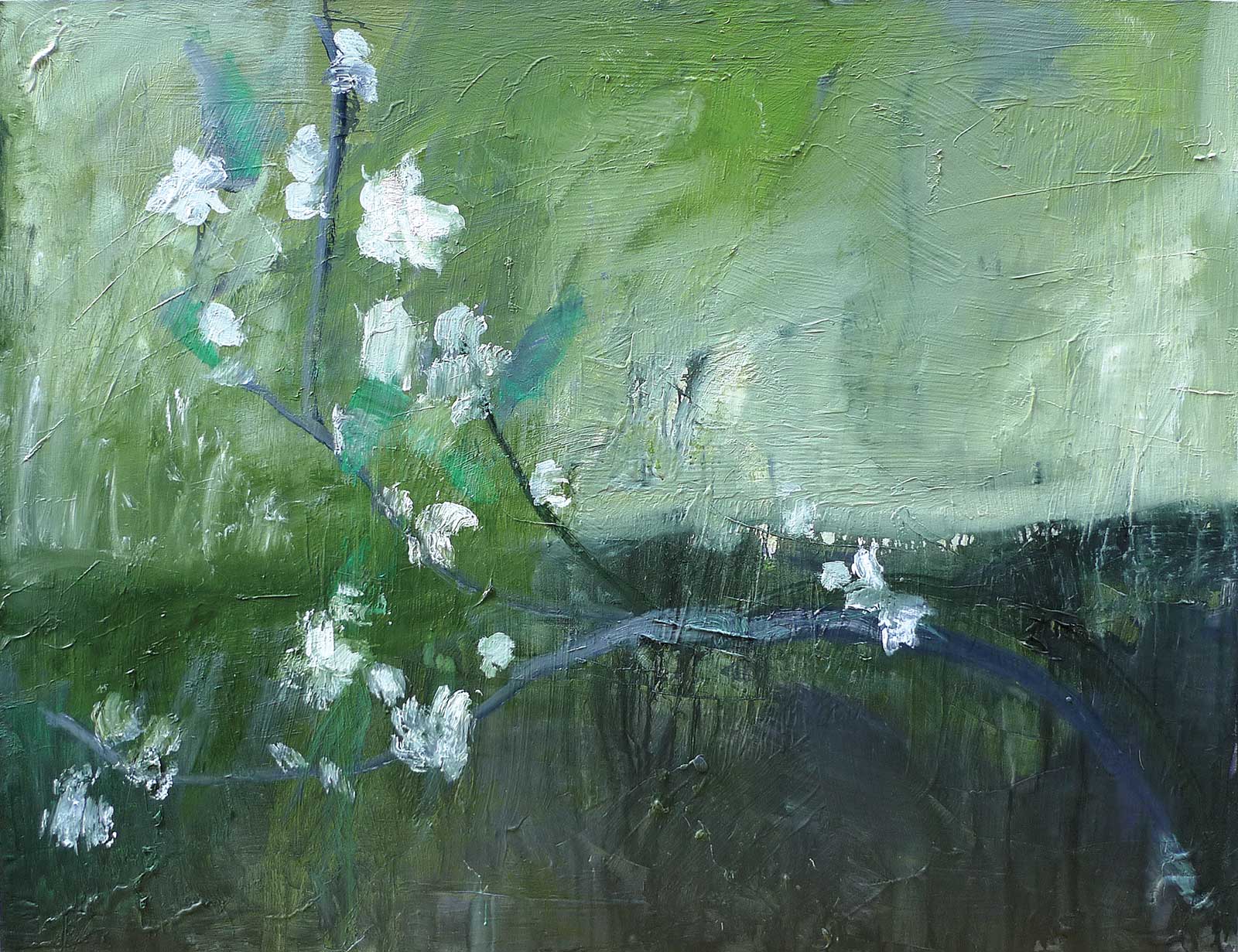
Cherry Blossoms No. 2, 2014, oil on canvas, 44 x 56.” Courtesy Fierman, New York, NY and Corbett vs. Dempsey, Chicago, IL.
He painted the sunflower in oil, observing, “As a mature artist, I was very interested in how something inert like oil paint can be a repository and hold emotion—how, through the manipulation of that paint, one can communicate what that emotion is. The first two sunflower paintings are the most condensed in terms of the emotions.”
Flowers for Ken, Sunflower Stem,1988-91, is one a series of five large canvases painted over the course of several years. As the farmers’ market, the sunflower withered and twisted its head away, faded remnants of its vibrant yellow formed a halo around the back of the fecund seed head.
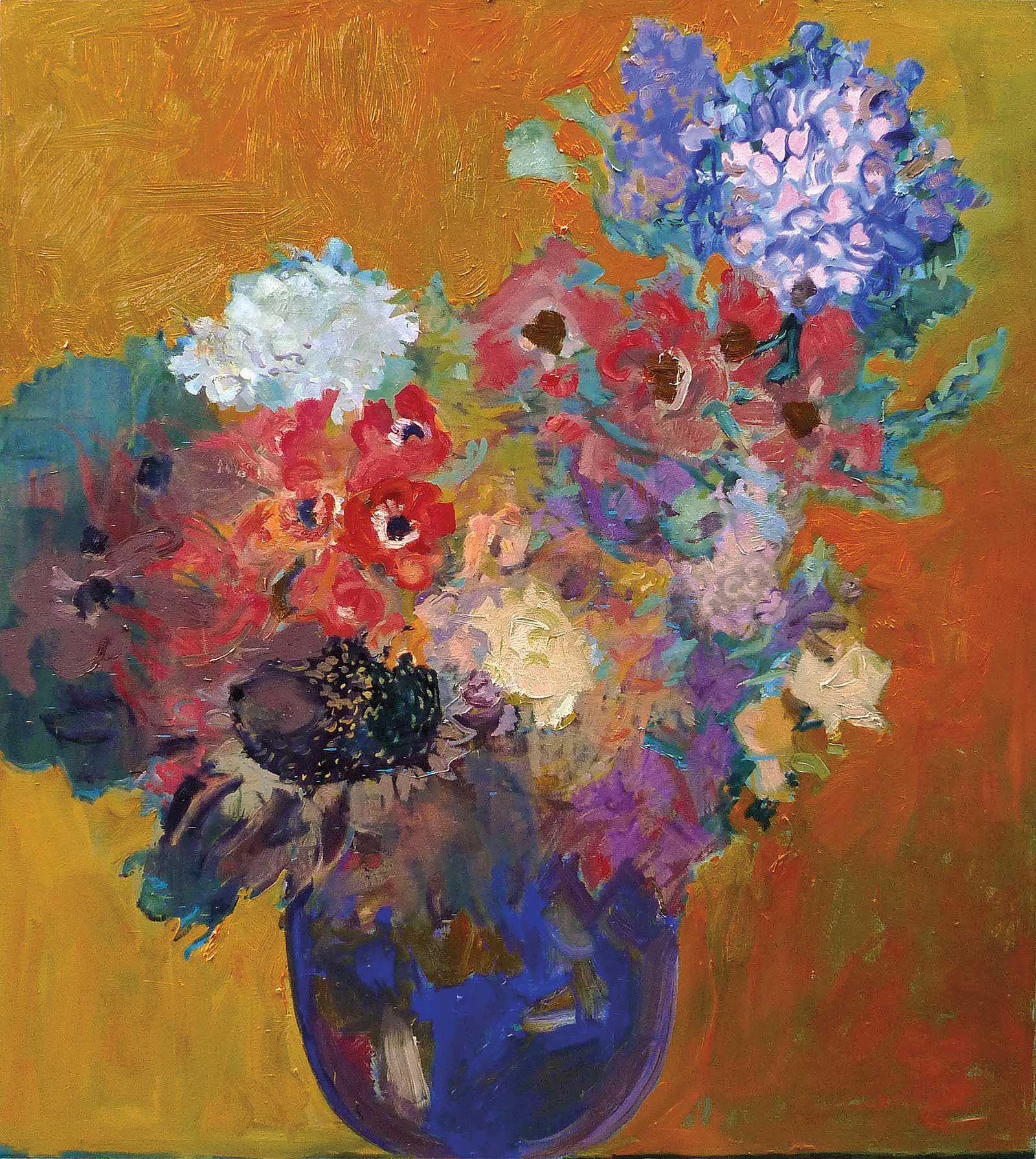
Untitled (Still Life), 2013, oil on canvas, 65 x 58.” Courtesy DC Moore Gallery, New York, NY.
The sunflowers marked the beginning of a new period for his creative output, allowing him to expand the tradition of the floral still life into a memento mori for his partner and for all who died in the epidemic.
As he continued the still lifes in pastel, he began making monochromatic compositions, only later laying color next to and over color. He recalled looking at the paintings of Odilon Redon and Pierre Bonnard at the Art Institute and a year-long class in the color theory of Josef Albers. He found the class tedious, cutting squares of colored paper and laying them on a square of another color. He learned however, that if you “play long enough, you find unusual combinations. You learn color is completely visual and relative. It can be made to do anything in a painting. It’s the opposite of observation.”
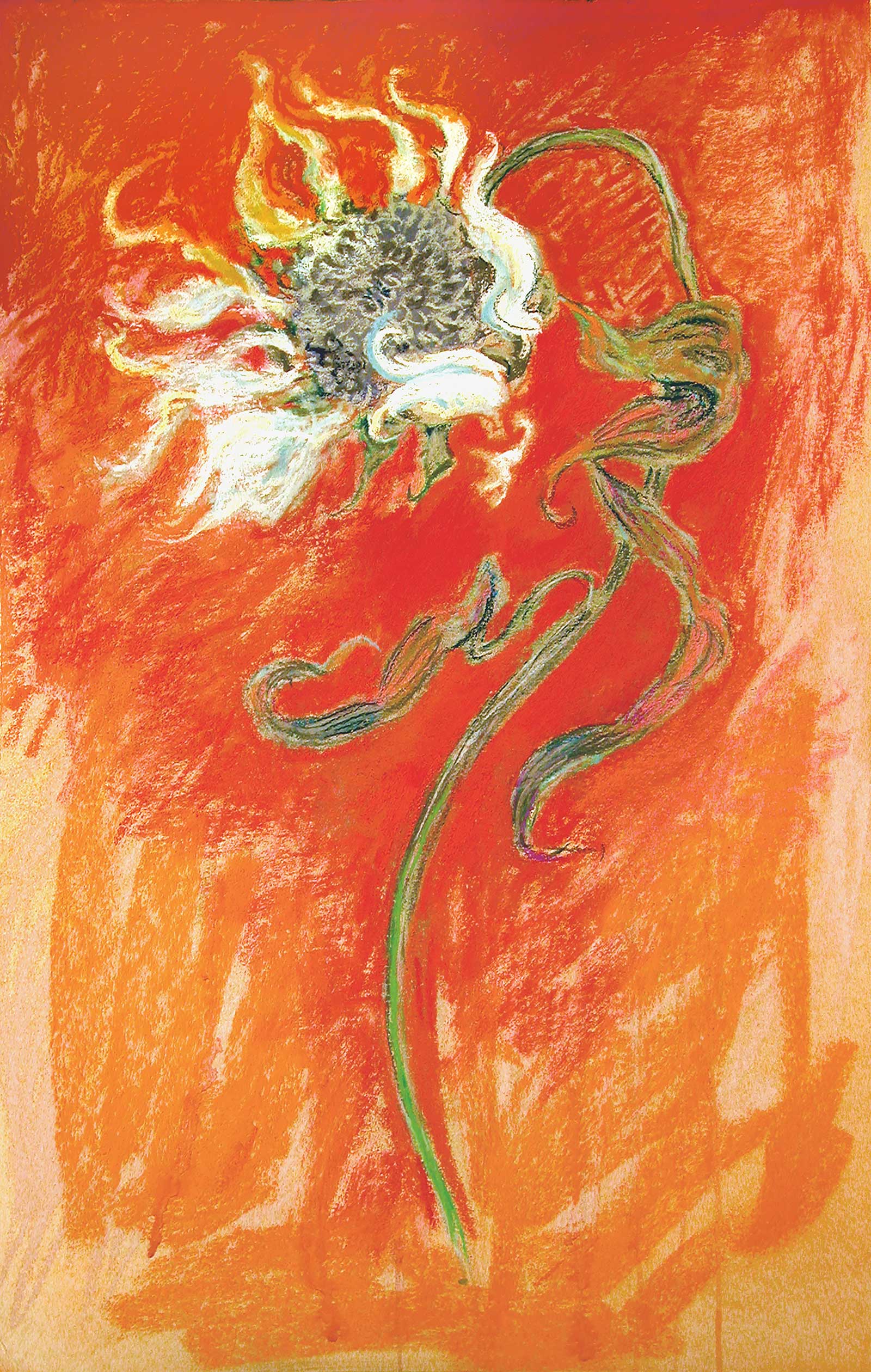
White Sunflower on Orange, 2009, pastel on paper, 21¾ x 14.” Private collection.
Often his choice of color is arbitrary. He will decide on blue, for instance, not referencing his subject, but, rather, the painting itself. In Dragonfly and Blue Sunflower he explores the range of blues, the iridescence of a dragonfly’s wings and associations with moonlight.
Flowers for Ken, Sunflower Stem is 6-feet square. His pastels are often drawn on a full sheet of 41-by-29-inch paper depicting a single blossom, as in Three Monarchs.The large scale allows him to be physically gestural, using his whole arm rather than controlling small strokes with his wrist.
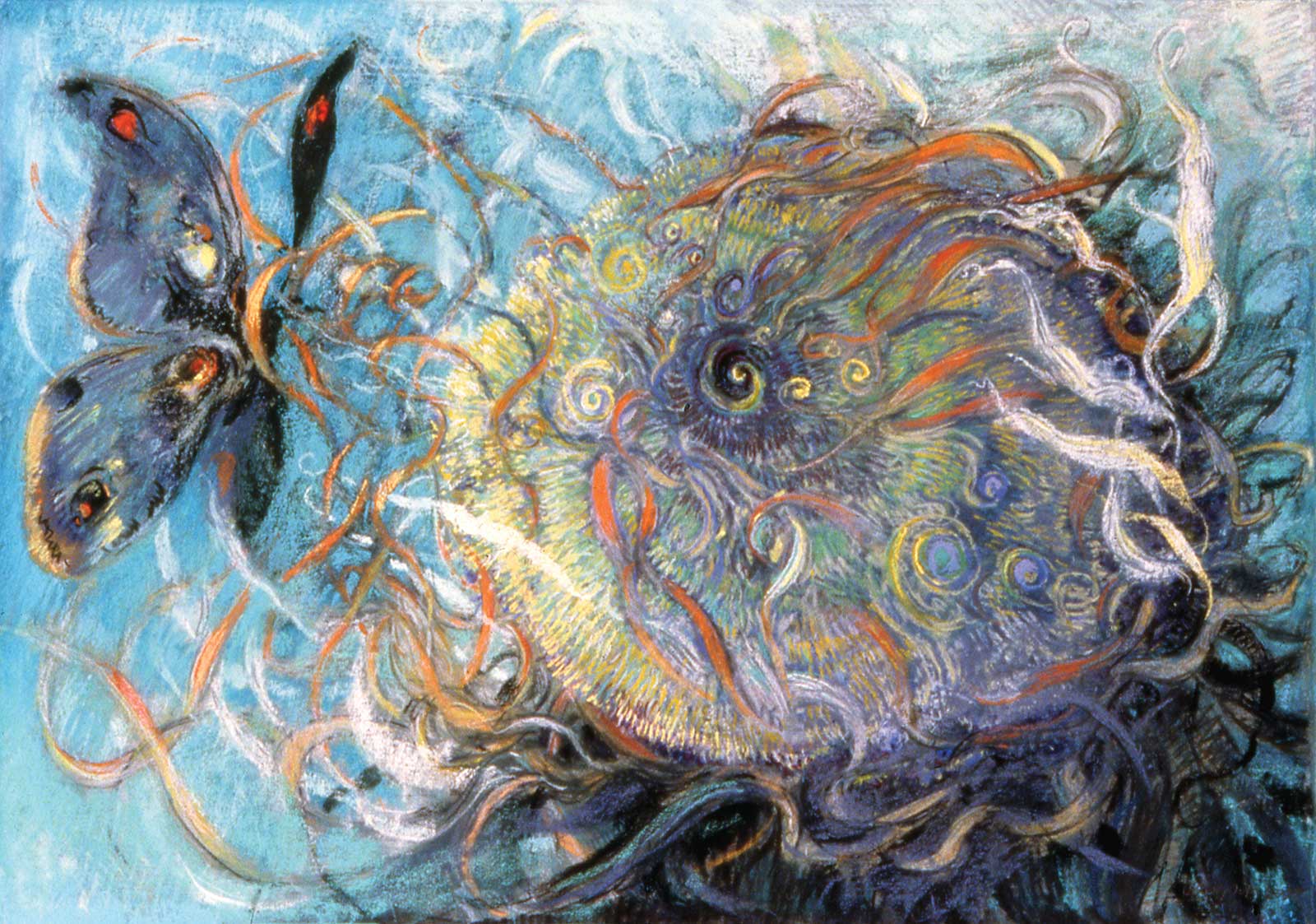
Moth and Blue Sunflower, 2000, pastel on paper, 29 x 41.” Courtesy Fierman, New York and Corbett vs. Dempsey, Chicago, IL.
Writing on creativity, Michael Michalko notes, “Paying attention to the world around you will help you develop the extraordinary capacity to look at mundane things and see the miraculous.”
Jimmy Wright’s pastel and oil paintings of sunflowers are nothing less than miraculous—enveloping the viewer in color and shared emotion. —
Powered by Froala Editor