When Winslow Homer (1836-1910) first exhibited his painting, Northeaster, 1895, there were two men in foul-weather gear crouched on the rocks to the left. Sometime before 1901, he painted the figures out and re-worked some areas of the wave. The painting became somewhat abstract but reveals the full force of a “nor'easter” off the coast of Maine—without the viewer wondering about why the men are there and what will happen to them. Homer’s studio at Prouts Neck, now beautifully restored and open to the public, sits on a rocky cliff overlooking the ocean.
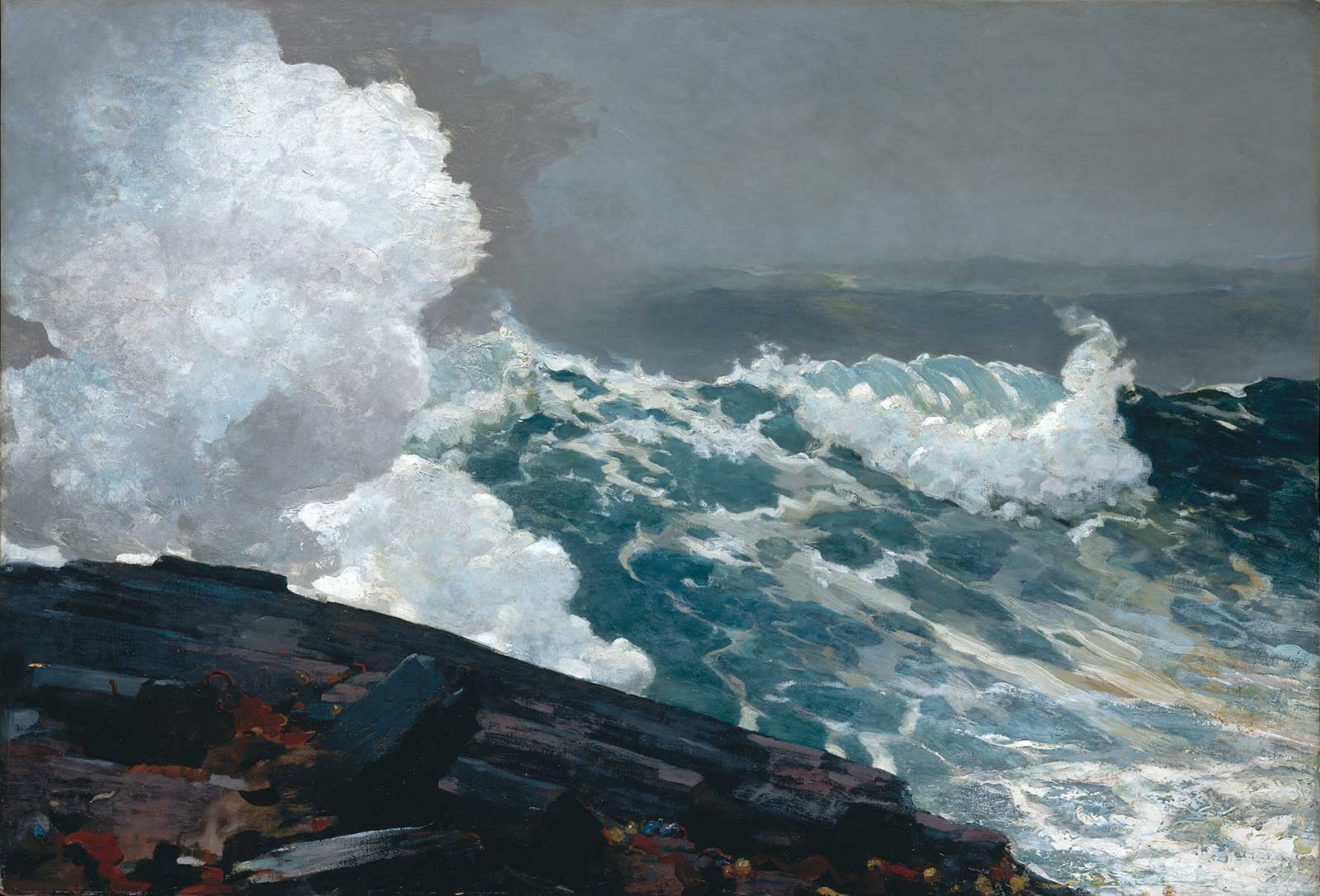
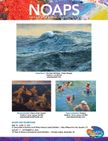
The Metropolitan Museum of Art, Northeaster, 1895; reworked by 1901, oil on canvas, 34½ x 50”, by Winslow Homer (1836-1910). Gift of George A. Hearn, 1910. Public Domain.
Homer wrote, “The life that I have chosen gives me my full hours of enjoyment for the balance of my life. The sun will not rise, or set, without my notice, and thanks.”Christopher W. Benson grew up “in and on” the water on the New England coast, a lot farther south than Maine. Newport, Rhode Island, was one of the country’s five leading seaports in colonial times, long before the mansions of the gilded age were built along its shore.
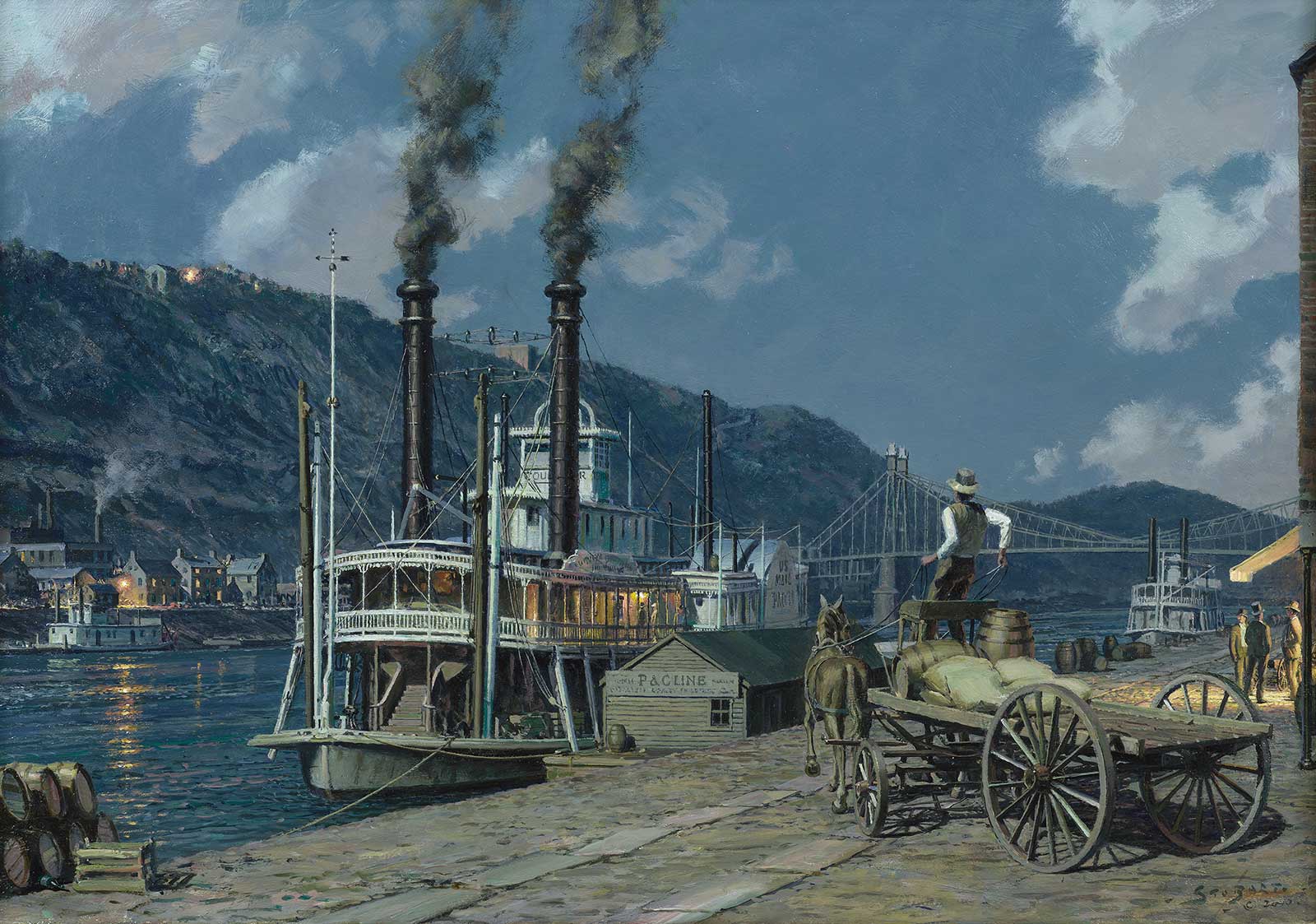
Rehs Contemporary, Pittsburgh Point Bridge from Water Street ca.1880, oil on canvas,14 x 20”, by John Stobart (1929-2023). Signed and dated 2000.
Benson’s seascapes, like Shorebreak, embody his deftly blending abstraction and realism. He has said, “I want to make de Koonings and hide them inside of Homers.” The eye and the mind wander along his fluid brush strokes, contemplating the translucent green of the breaking wave and the deeper blue of the distant sea, the depiction of an imagined scene and the energetic surface of paint. He remarks, “The thing I love is the paint. And I like the surface in both the realism and the abstraction.”
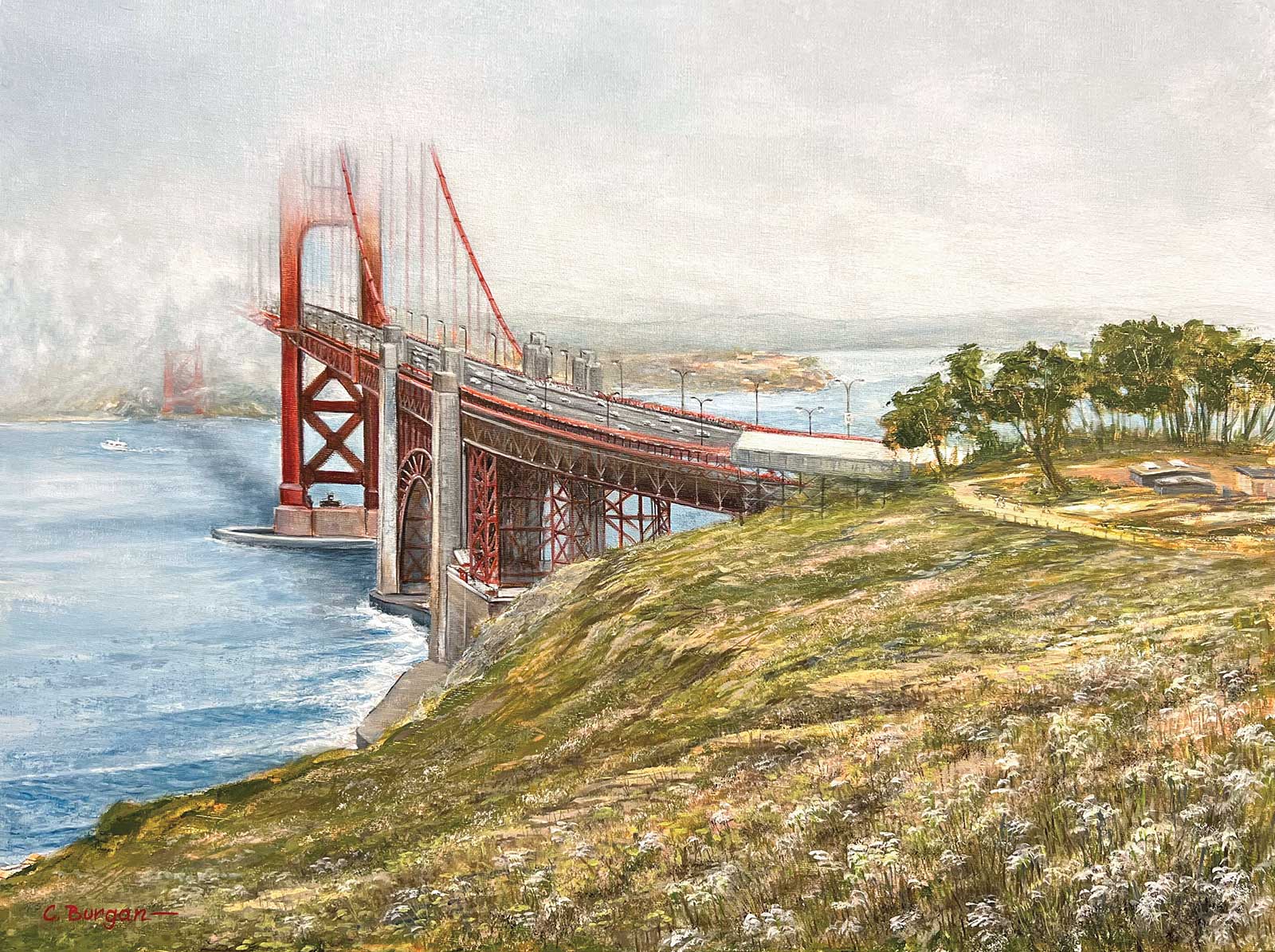
Tehachapi Arts Commission, Overlooking the Golden Gate, oil on canvas, 18 x 24”, by Chris Burgan.
The shore is more than sea and land. It is an area of abundant flora and fauna, sounds and scents. One of the joys of walking along the shore or in the dunes is coming across a stand of rosa rugosa or beach rose. The plants were introduced from Asia in the 1770s and are now so ubiquitous that in Connecticut they are considered invasive. The scent of their blossoms is intoxicating and their fruit—rose hips—are great for making tea, jams and jellies rich in vitamin C.
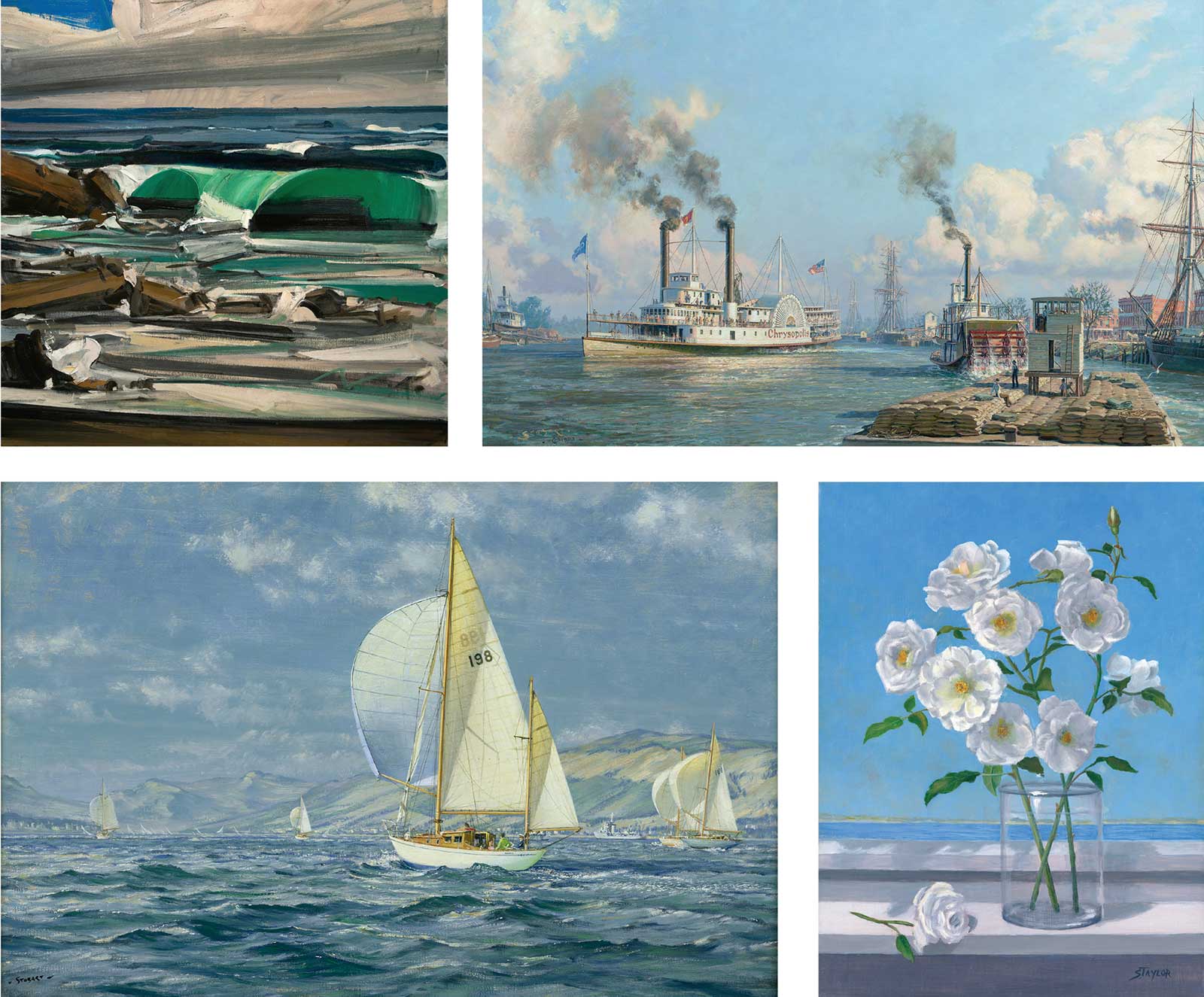
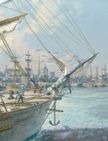
Clockwise from top left: Kennedy Contemporary, Shorebreak, oil on linen, 48 x 48”, by Christopher Benson; Rehs Contemporary, Sacramento: The Celebrated River Steamer “Chrysopolis” Leaving San Francisco in 1870, oil on canvas, 20 x 32,” by John Stobart (1929-2023). Signed & dated 1993; Tree’s Place Art Gallery, Summer Roses, oil on canvas, 16 x 12”, by Susanne Taylor; Rehs Contemporary, Navara on the Clyde, oil on canvas, 20 x 30”, by John Stobart (1929-2023). Signed.
Susanne Taylor captures the enveloping atmospheric light of Cape Cod, Massachusetts. When I checked with her to be certain the flowers in her painting Summer Roses are rosa rugosa, she affirmed that they are and commented, “I’ve spent my life going to Cape Cod in the summer, and today I spend half the year there...The natural beauty of the beaches, sand dunes, beach grasses and flowers—I can never get enough of it.”
There is a draw to the places of our childhood and, perhaps, a deeper draw to the ocean. A life-long sailor, John F. Kennedy wrote, “I really don’t know why it is that all of us are so committed to the sea, except I think it’s because in addition to the fact that the sea changes, and the light changes, and ships change, it’s because we all came from the sea. And it is an interesting biological fact that all of us have in our veins the exact same percentage of salt in our blood that exists in the ocean, and, therefore, we have salt in our blood, in our sweat, in our tears. We are tied to the ocean. And when we go back to the sea—whether it is to sail or to watch it—we are going back from whence we came.” Throughout this section dedicated to the genre of marine art and coastlines, you will hear even more from artists and galleries that share stories and insights into the creation process.
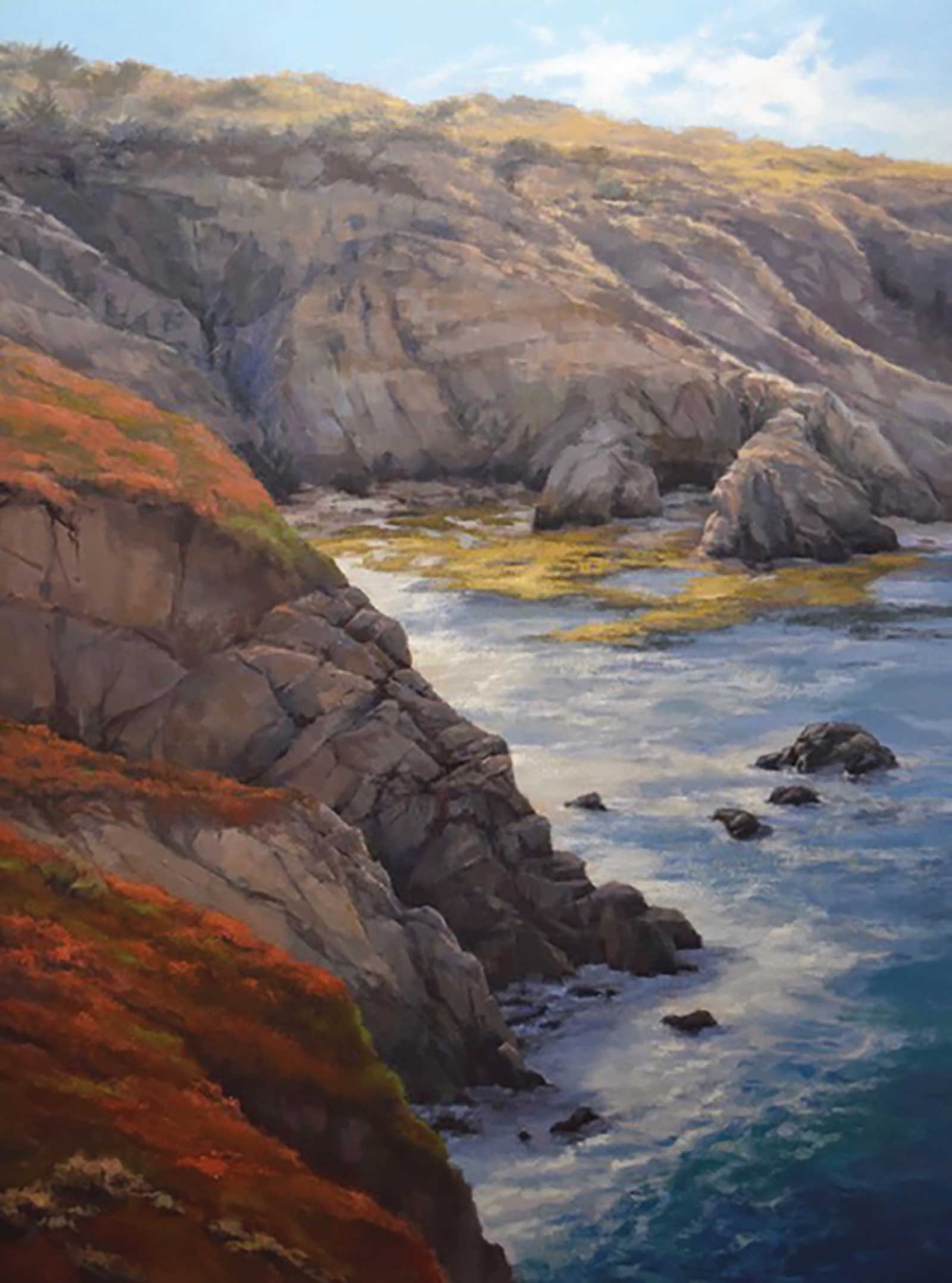
Tehachapi Arts Commission, Pacific Coastline, oil, 40 x 30”, by Laura Wambsgans.
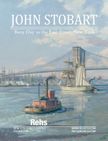
Artist John Stobart, represented by Rehs Contemporary, was a renowned marine artist whose paintings captured the beauty and majesty of ships, seascapes and ports around the world. His attention to detail, use of light and color, and ability to evoke a sense of nostalgia and wonder make his paintings truly exceptional. “Stobart’s works are highly sought after by art collectors and enthusiasts alike, and for good reason,” says gallery director Lance Rehs. “His paintings are not just beautiful works of art, but also valuable investments. Many of his paintings have appreciated in value significantly over the years and are likely to continue to do so. Owning a John Stobart painting will not only bring joy and beauty into your home, but it has the potential to be a wise decision for the future!”
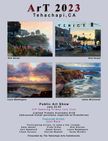
The Tehachapi Arts Commission in Tehachapi, California, presents three artists depicting marine and coastline scenes, pulled from their annual exhibition and sale. Laura Wambsgans’s plein air piece, Pacific Coastline, depicts a cove in Garrapata State Park, early in the morning. “From the cliff's edge I could hear the bark of sea lions and harbor seals echoing across the water, down below,” explains the artist. “With a gentle sea wind blowing, the sun first struck the water then slowly unveiled the cliffs.” Artist Chris Burgan is drawn to represent images of harmony and structure within the natural world. “Whether it is an epic landscape or a created place, my goal is to invite a shared emotional and analytical experience between myself and the viewer,” he says.
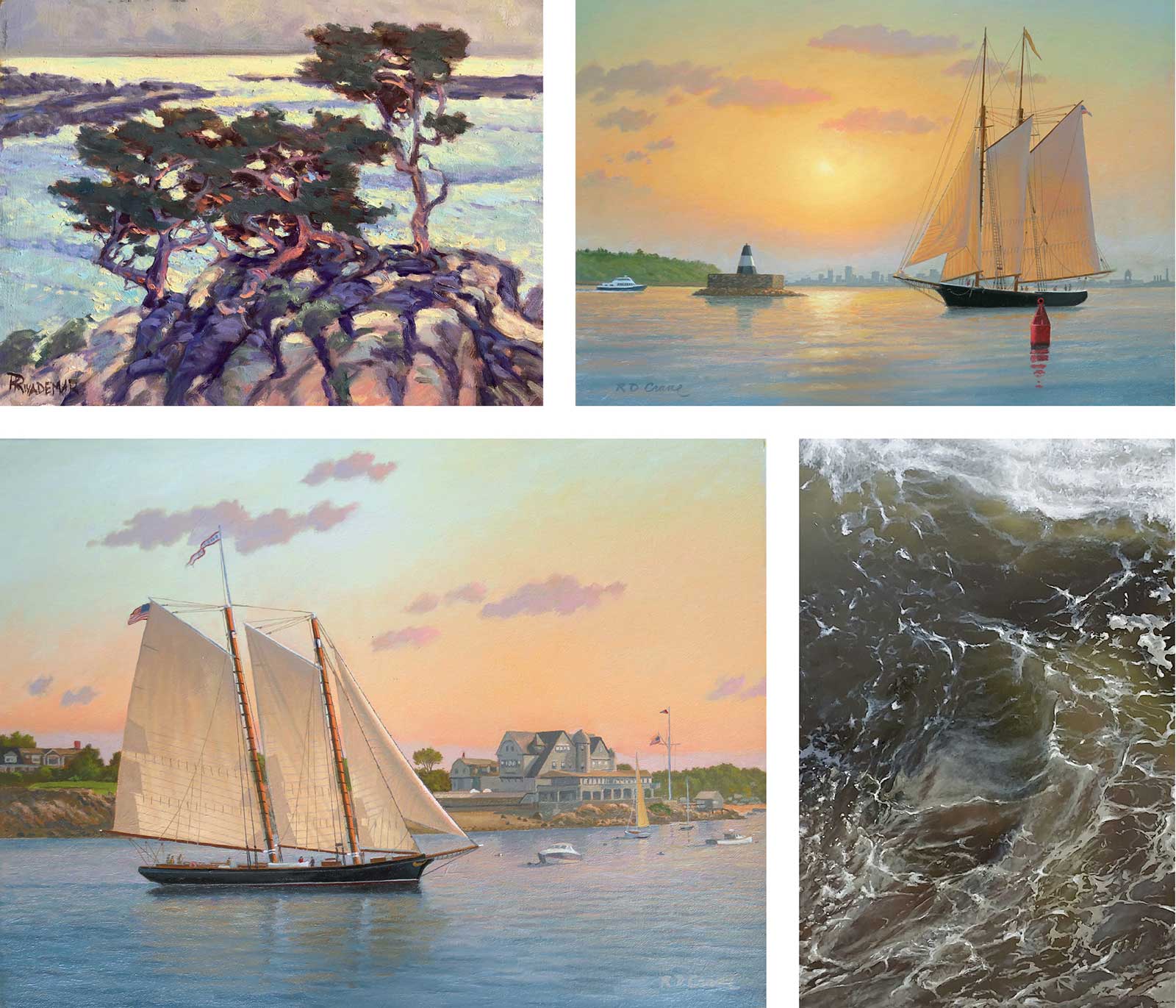
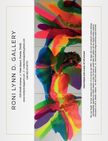
Top: Tehachapi Arts Commission, From Point Lobos, oil on panel, 9 x 12”, by Rodolfo Rivademar; Ray Crane, Boston Harbor Sunset Off Nix’s Mate, oil on canvas, 12 x 16”. Bottom: Ray Crane, Schooner Yacht “America” Arriving at Marblehead, oil on canvas, 12 x 16”; Reilly, Convolution, oil on canvas, 72 x 48”
About his piece From Point Lobos, Rodolfo Rivademar says, “It has everything I love when I paint out in Mother Nature (in plein air). It also follows the tenets of the tradition of the California impressionist school. The backlighting and that ocean of light leading into infinity can take me into a state of meditation. I sort of felt one with the subject.”
The commission’s Art 2023 event is set for July and boasts an impressive lineup of roughly 40 artists. Moved by lighting, composition and his love for the technique of the Masters, David Kizziar is inspired to create pieces which build from his natural artistic gift of portraying life-like movement and capturing tonal values to give perspective. “Growing up on the California Coast, it is not a surprise to see that much of my work has been inspired by the ocean,” says Kizziar. “My highly detailed, seascape drawings in monochromatic colored pencil, graphite or ink can take hundreds of hours to complete with no room for mistakes.” Collectors are often surprised by Kizziar's gentle and realistic interpretations of a subject, which make them feel like they are right there in the moment as the artist himself was, oftentimes eliciting an unexpected outward emotional and sometimes tearful response. Kizziar will be exhibiting this summer in Laguna Beach, California, at the Festival of Arts and the Sawdust Festival; and in October at The Cloisters at St. Francis in Sorrento, Italy.
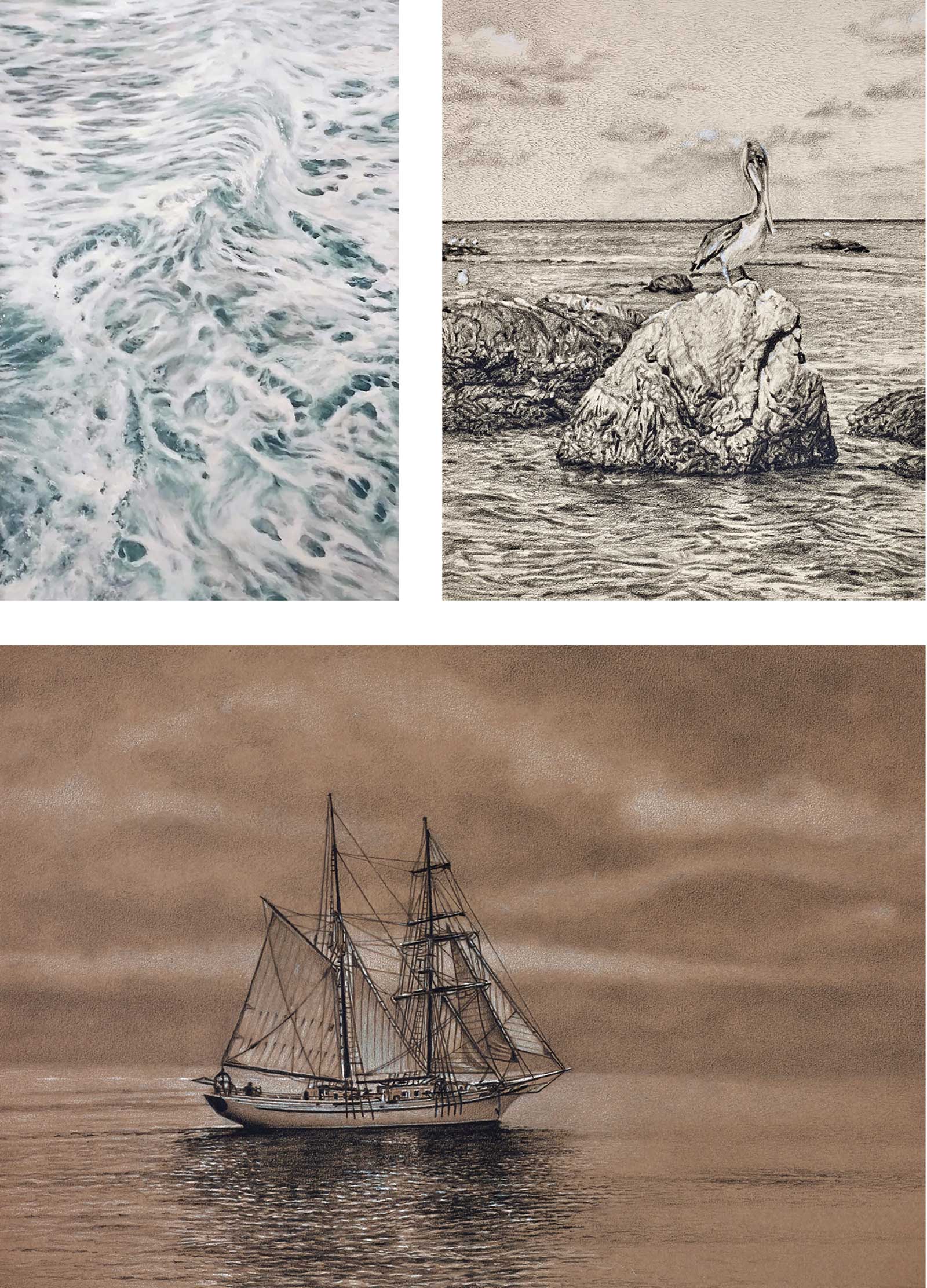
Top: Reilly, Eager, oil on canvas, 72 x 48” ; David Kizziar, Pelican Cove, graphite on toned paper, 8 x 6”. Bottom: David Kizziar, Sail Away, graphite on toned paper, 9 x 13”
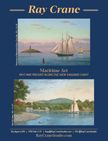
“In my paintings I bring past and present together, depicting vintage sailing vessels in real locations along the New England coast where they might have been seen in the past, and can still be seen today,” says artist Ray Crane. “In most cases, I also depict the ‘scene’ from the perspective of the mariner, looking across the water and back toward land. My paintings, done in a traditional style that is increasingly rare, are for the collector who appreciates traditional realism in portraying actual scenes and vessels that figure prominently in New England’s maritime history.” Often, Crane’s paintings also tell a story, as in the case of the three paintings depicted within this section. In Crane’s Arctic Explorers, the historic schooner “Ernestina-Morrissey” salutes the summer home of arctic explorer Admiral Robert E. Peary, on Eagle Island in Casco Bay, Maine. This 125-year-old Essex-built schooner also explored the Arctic, and one of its many expeditions included Admiral Peary’s son. In Boston Harbor Sunset off Nix’s Mate, we see a visiting schooner leaving Boston at sunset, with the city skyline glowing in the background. “It is passing Nix’s Mate Day beacon, which was named for a Capt. Nix, who was murdered by his first mate and hung there in 1636…,” Crane notes. In Schooner Yacht “America” Arriving at Marblehead, we see a replica of the famous 19th-century racing schooner-yacht “America,” first winner of the America’s Cup international sailing trophy in 1851.
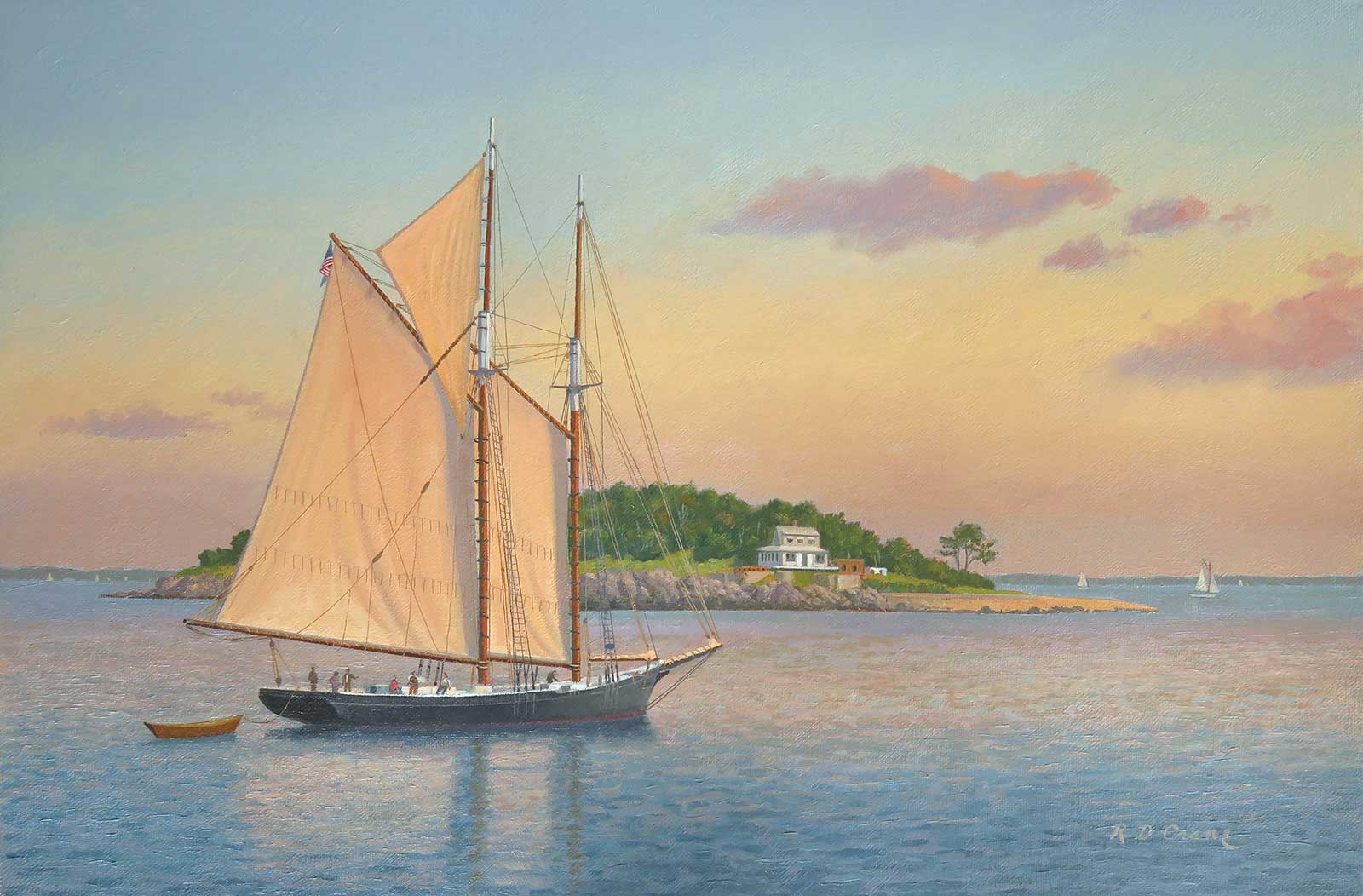
Ray Crane, Arctic Explorers, oil on canvas, 12 x 18”
Artist Reilly also has an “eye” for the ocean and hopes that its strength and power comes across in his paintings. “I have no politics or deep meaning in my works—rather just effort combined with talent to give the viewer a moment of something that is appealing to them,” says the artist. “When there is struggle, sometimes all you can do is ‘find victory in your effort.’ To do something you want to do, you may have to do things that you really don’t want to do to get there. That has been my journey to becoming an oil painter. In this technological age, for me it is freeing on so many levels to be able to grab a stick with bristles on it, dip it in liquified minerals and use my God-given talent to create paintings for others.” —
Featured Artists & Galleries
David Kizziar
Laguna Beach, CA
(949) 424-1527
www.davidkizziarfineart.com
Kennedy Contemporary
2043 Westcliff Drive, Ste. 102
Newport Beach, CA 92660
(714) 519-6297
www.kennedycontemporary.com
Ray Crane
Rockport, MA
(978) 546-1137
ray@raycranestudio.com
www.raycranestudio.com
Rehs Contemporary
20 West 55th Street, 5th Floor
New York, NY 10019
(212) 355-5710
info@rehscgi.com
www.rehs.com
Reilly
reilly@kmgraphics.org
www.reillyfineart.com
Tehachapi Arts Commission
(626) 945-3753
info@artstehachapi.org
www.artstehachapi.org
The Metropolitan Museum of Art
1000 5th Avenue, New York, NY 10028
(212) 535-7710
www.metmuseum.org
Tree’s Place Art Gallery
60 Route 6A, Orleans, MA 02653
(508) 255-1330
trees@tressplace.com
www.treesplace.com
Powered by Froala Editor
Powered by Froala Editor