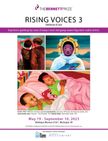
For the past two years, a selection of Ayana Ross’ work has been touring the country in an exhibition of works by the 10 finalists of the 2021 Bennett Prize, an award granted every two years to the most promising woman artist working in contemporary realism today. Ross, who won the $50,000 prize, has spent the last two years creating a body of work that will be the centerpiece of the exhibition of the 2023 finalists, the winner of which will be announced May 18 at the opening reception at Michigan’s Muskegon Museum of Art.
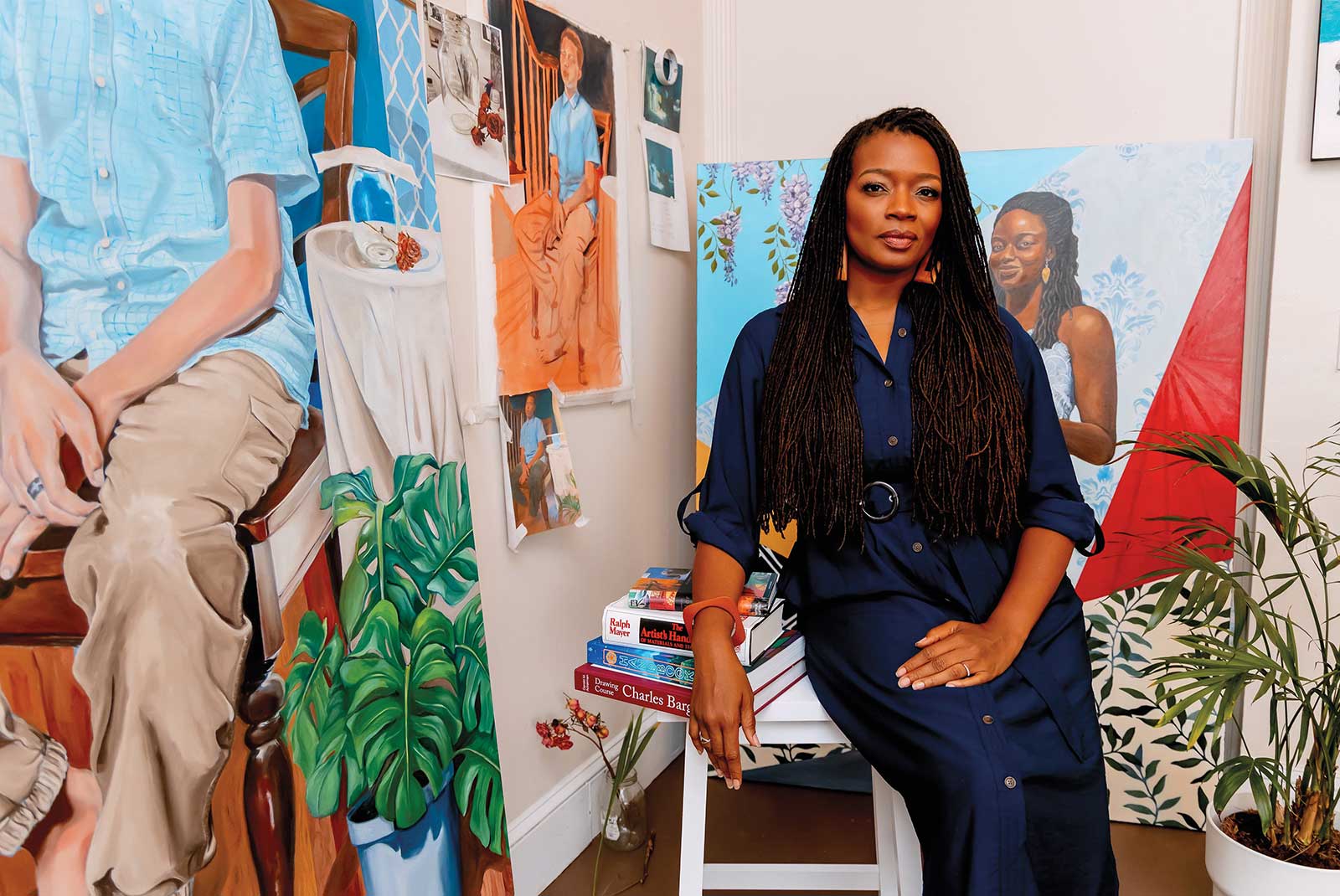
Ayana Ross in her studio.
Ross’ paintings contain volumes. They address complex issues of race, humanity, connection and the passing down of knowledge through the generations, but her work can also be appreciated simply for their aesthetic beauty and the tender moments of everyday life they often depict.
Ross followed her dream of becoming a fashion designer to New York City where she worked in the industry for a year. Witnessing the 9/11 attacks affected her deeply, and ultimately, she returned home to Georgia and eventually moved to North Carolina.
It was there, in 2005, while teaching elementary school, that she took her first intensive oil painting class.
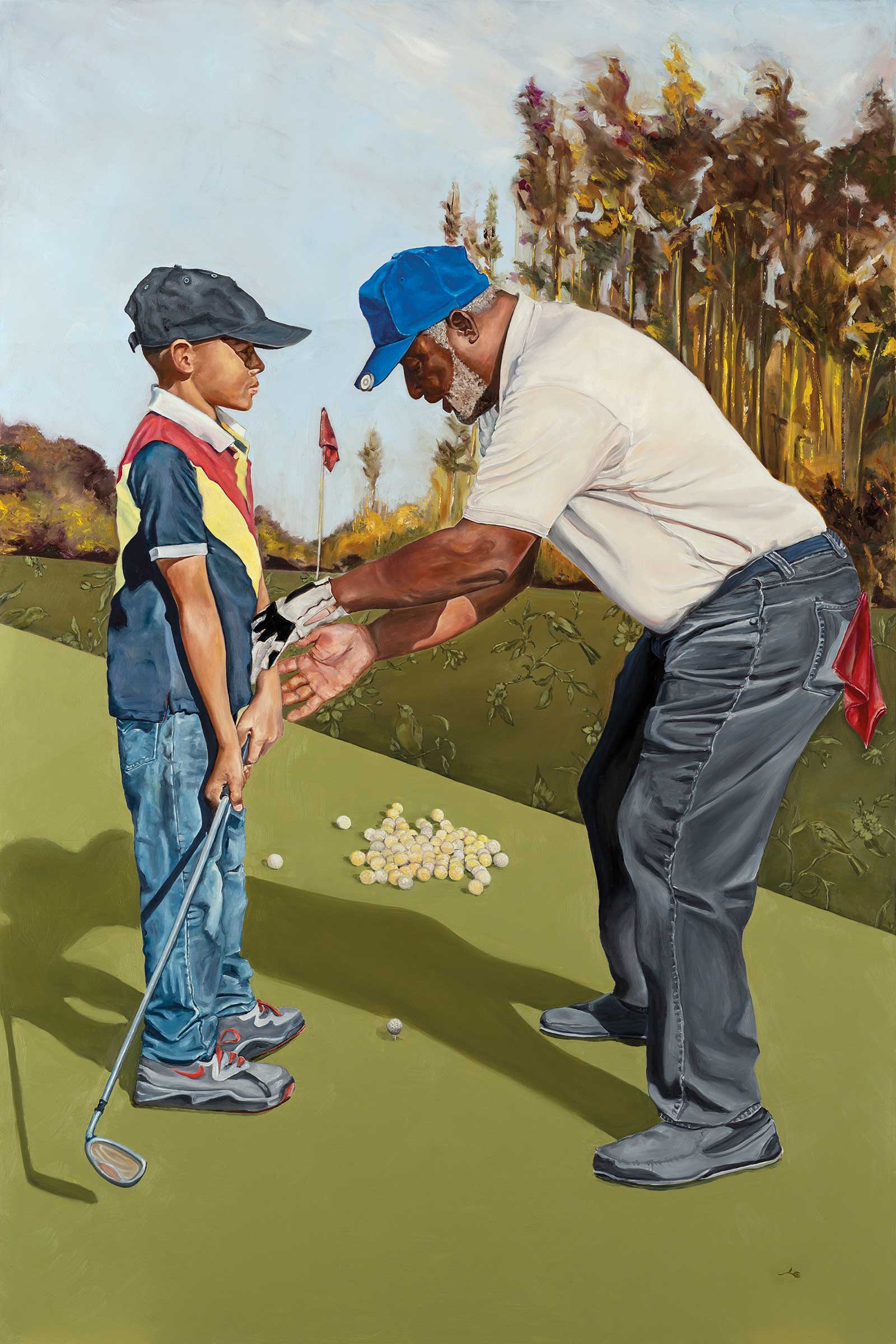
The Young Golfer, oil on canvas, 72 x 48"
“Art had never left me. I was always doing it. But like many artists, early on we dabble in a number of things. I continued to dabble in oils until it became more than a dabble—until it became the thing I wanted to spend the rest of my life getting better at,” she says.
It was a subtle progression that really gained momentum when she returned to Georgia in 2013, a newly divorced, single mother of four, to be closer to family.
“Painting became something I had to do, needed to do, to save my mind and spirit,” says Ross, who worked as an art teacher and held several side jobs. “The paintings took over one room at a time; the dining room, the living room.” Then people started asking about her work.
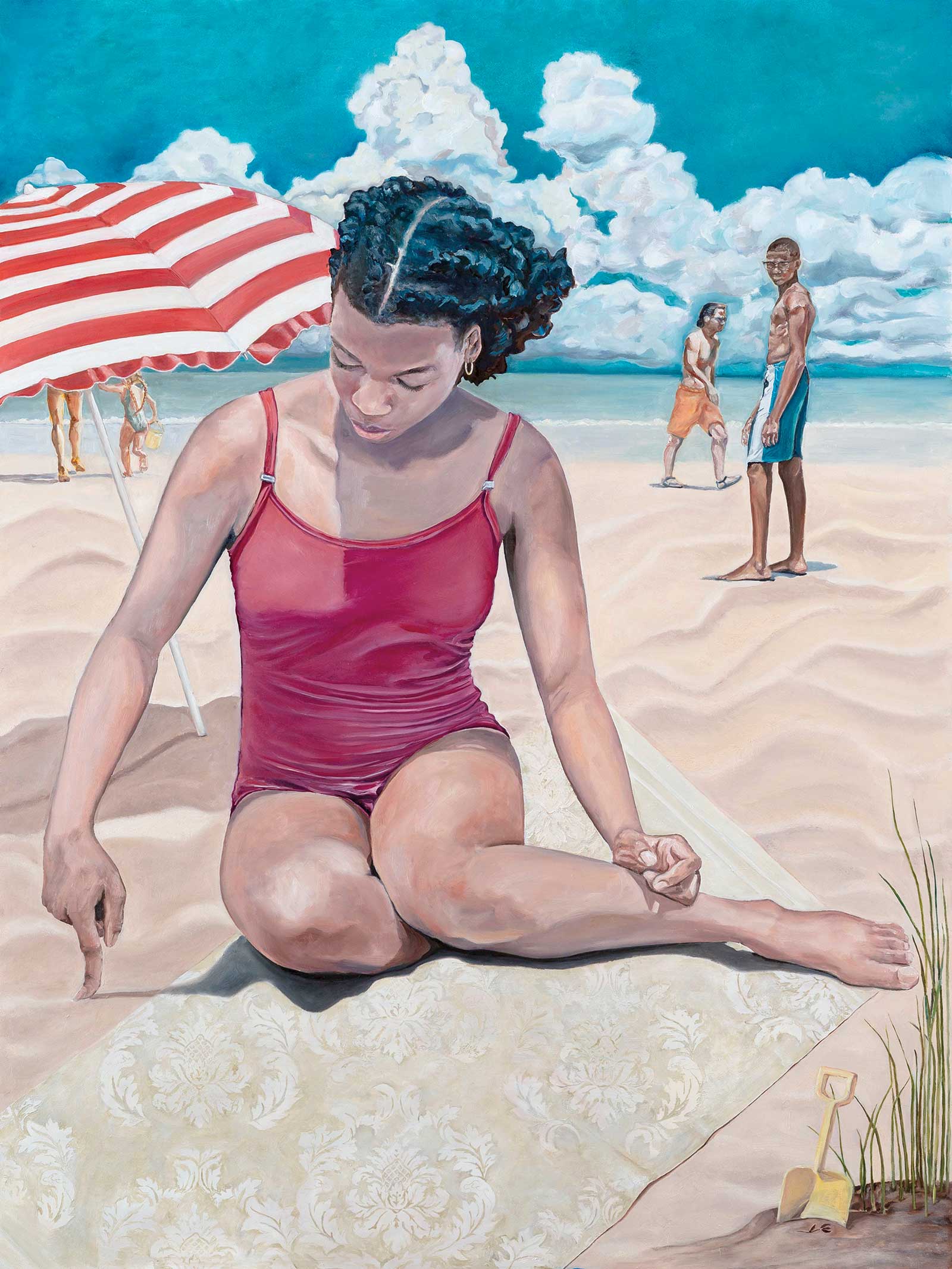
Writing in the Sand, oil on canvas, 48 x 36"
She also had an incredibly supportive network of friends and family who tirelessly promoted her work. As the interest in her art grew, she was able to let go of some of her part-time jobs. “The doing created more opportunities for doing,” she says.
Ultimately Ross earned a master’s degree in painting and it was during that program that a classmate suggested—then pestered—she submit her work for the Bennett Prize. When she won, it opened a tremendous opportunity for “doing” and the results are apparent in the paint.
“The gift of time it has given has been extraordinary,” she says. “To see what I’m able to do without the constraints I was operating under before…to stretch out and grow. It’s had a huge impact on my life and practice. I have had the time to delve in and go deeper in myself and make greater connections, which gives more meaning and depth to the work.”
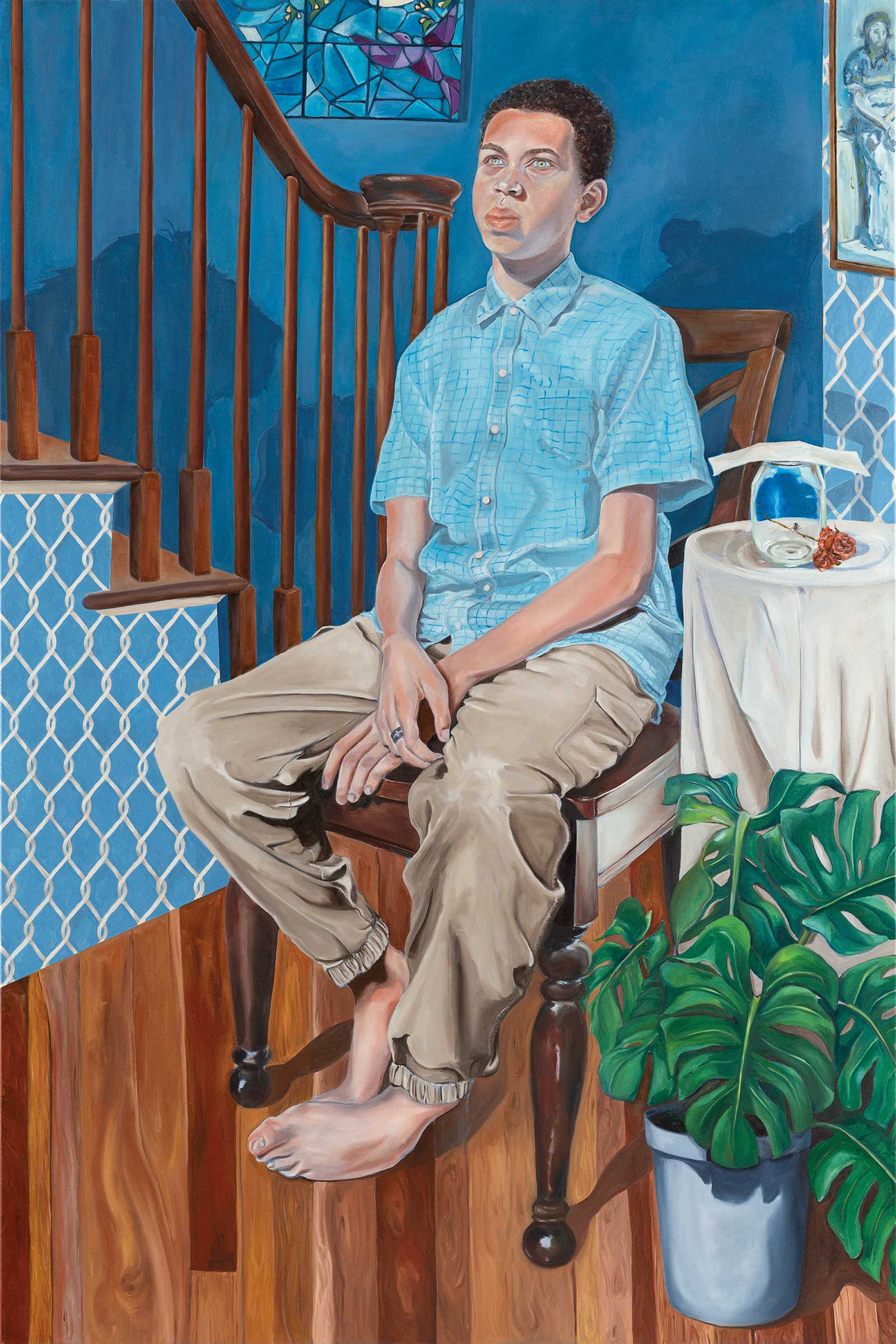
I Don’t Even Kill Flies, oil on canvas, 72 x 48"
Photographs are typically the starting point for Ross, and one of the gifts of time has been the ability to search for imagery that allows her to create more personally meaningful narratives as opposed to being a prisoner to whatever she could hastily find.
For her most recent body of work, Ross drew inspiration from artist Henry Ossawa Tanner but she places his 19th-century spiritual narratives in a modern context.
The Young Golfer, which depicts a grandfather-type figure teaching a young boy to golf, is a nod to Tanner’s The Young Sabot Maker, in which an older man proudly watches a boy put all of his might into carving a large wooden shoe. Like a lot of Tanner’s work—and Ross’ as well—it speaks to this idea of passing along traditions, knowledge and understanding from one generation to the next.
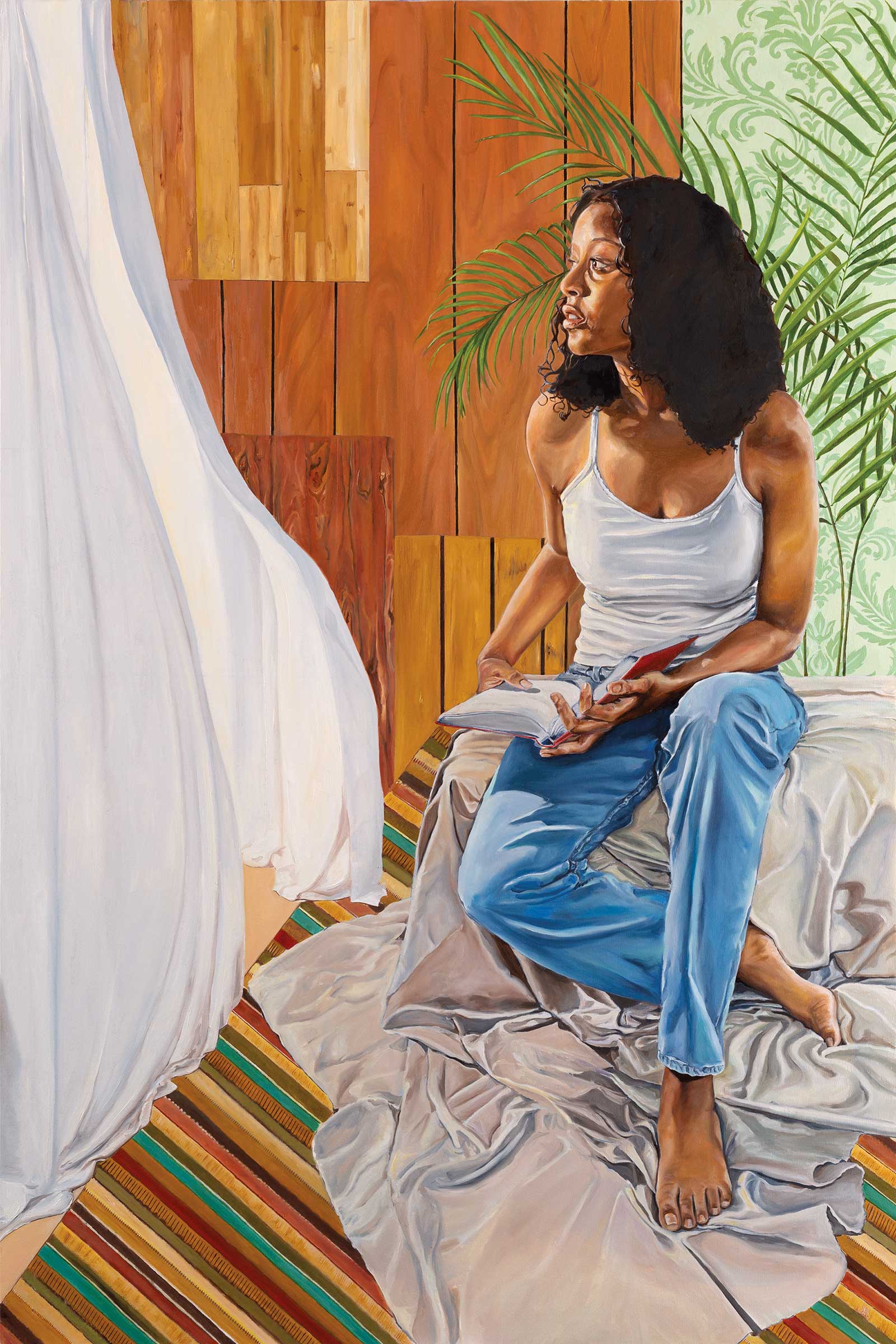
The Call, oil on canvas, 72 x 48"
“I think through those connections and through those moments of learning we feel part of something bigger than ourselves,” Ross says. “We have an opportunity to learn and grow…heritage and lineage helps us evolve as a people and society, and it’s all wrapped up in connecting. One of the ways we do that is through the sharing of knowledge.”
For Facts, a painting of a mother having an important talk with her son, Ross says she “kind of went off the rails and went more Norman Rockwell’s Facts of Life” than Tanner’s Christ and His Mother Studying the Scriptures.
The piece is full of symbolism and meaning. The closer you look, the more you find.
“My version speaks to those difficult conversations all parents have to have, and certainly with our black and brown children,” Ross says. “It speaks to those moments where you’re almost having to strip away a child’s innocence in order to expose them to some ugly truth in the world.”
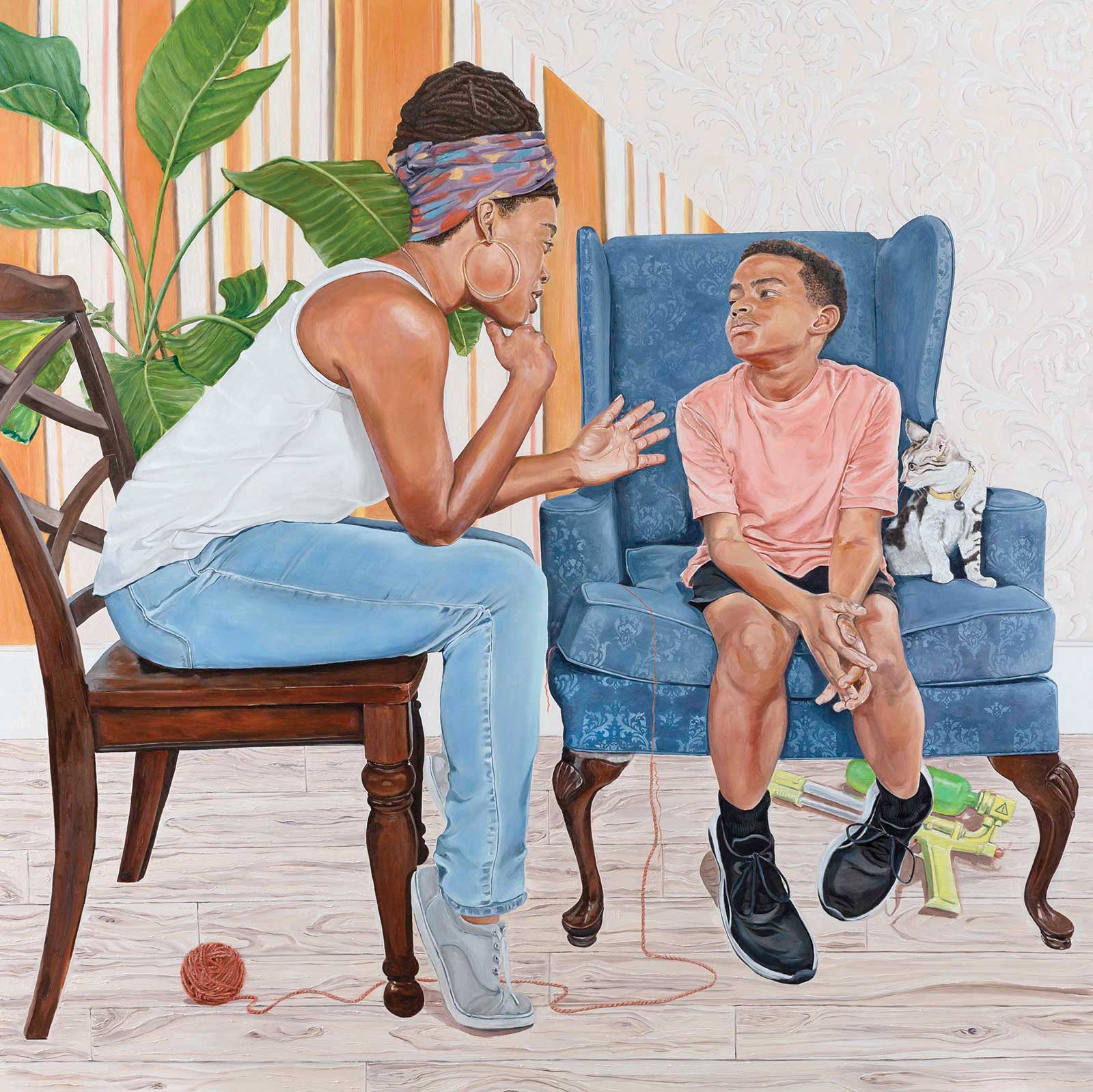
Facts, oil on canvas, 60 x 60"
Sometimes Ross loosely pulls from biblical references, as she did for Writing in the Sand, a touching image of a young woman on the beach that incorporates the stylized design elements that punctuate her work. It was inspired by a racially-fraught day at a Georgia beach.
“This piece for me speaks to ways in which the past leaves its imprint on the present,” she says. “In that moment especially, I was wondering if my children/the children are able to sense that history too. Is it written in the sand?” —
Muskegon Museum of Art 296 W. Webster Avenue • Muskegon, MI 49440 (231) 720-2570 • www.muskegonartmuseum.org
Powered by Froala Editor