The moment you look at a Jon Ching painting, a feeling akin to magic overcomes you. And not just because of the wonders of nature he depicts, but the ways in which he uses his imagination to combine them—tropical birds with feathers of honeycomb and crests of vibrant blooms, jellyfish whose tendrils transform into hydrangeas, or a seahorse sprouting branches of newly budding leaves. In Ching’s work, feathers become flower petals, tail fins become flames and fur becomes fungi.
In Plain Sight, oil on wood, 24 x 20"
Ching grew up on the island of O‘ahu, Hawaii. Like most kids, he didn’t fully grasp the innate beauty of his home growing up. Only after a perspective shift, moving to California for college, did he start to realize how special Hawaii was—and by extension, his love of the wider world of nature grew exponentially. “Leaving and learning more about Hawaii’s nature as an adult helps me see things with fresh eyes. It makes me want to go back and explore, especially the outer islands where there’s more preserved land. As kids, we don’t have context,” he reflects.
“When I first started diving into nature, it was totally new to me. Once I opened the door, I realized there were endless things to learn…I did my best to understand and teach myself biology as much as I could,” says the artist. “These days, because I’m morphing [my subjects] a lot of the time, I’m not worried about getting all of the specific traits correct…But when I do endangered species, I really try to stay true to their biology. I look at their natural habitats, their diets, where they fit into their ecosystems.”
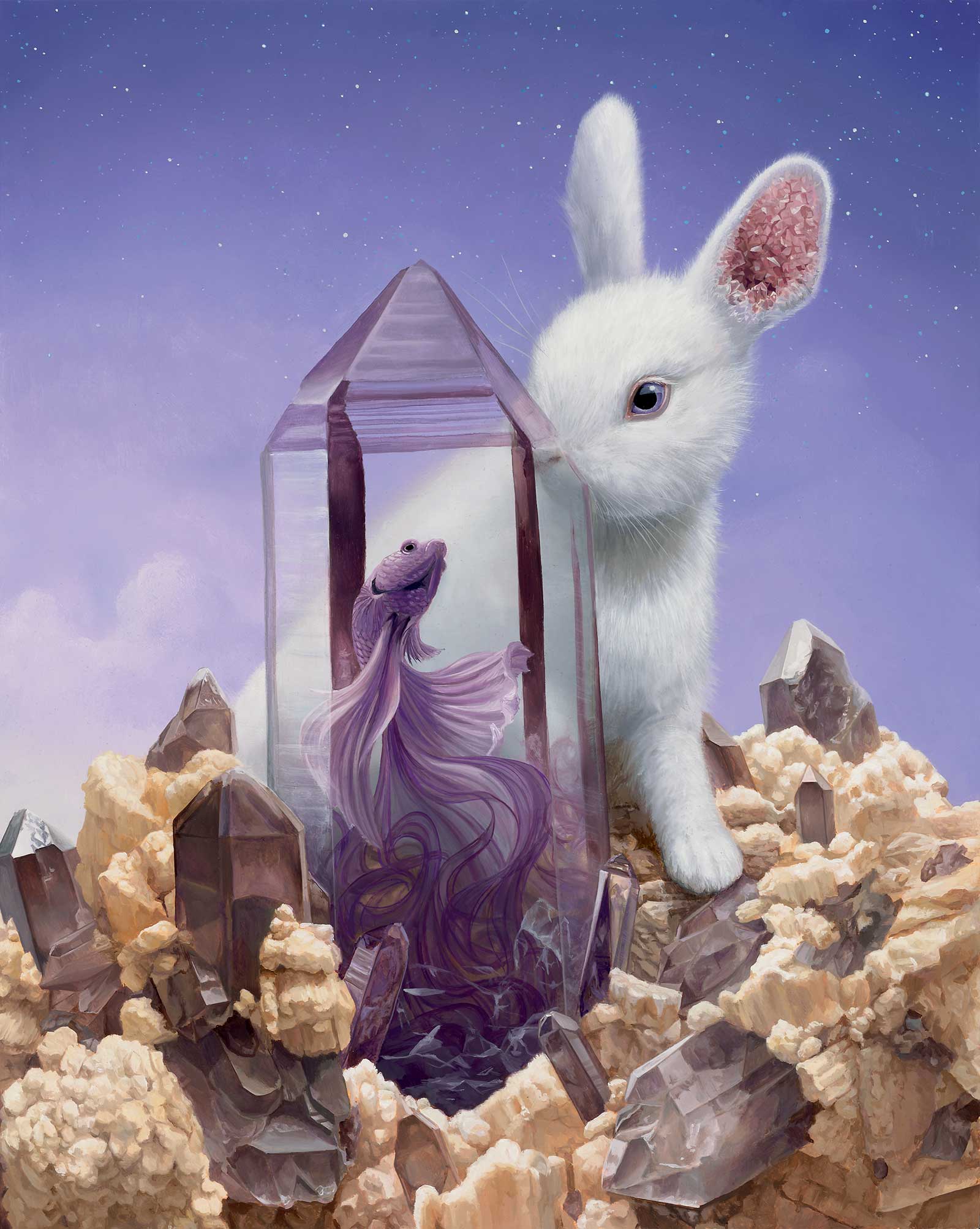
Djinn, oil on wood, 20 x 16"
Ching approaches his paintings in two ways. “One is more visually driven,” he says. For example, in one of his latest pieces titled Torch, the petals of sunflowers reminded him of fire. A chickadee is perched atop one of these flaming flowers, its head blending into licks of flame as well. “I call them visual homonyms. Visually this looks like this…So that will drive the composition of the painting, and then I’ll add different elements if I want to elaborate on that thought,” Ching adds. The other element of his artistic approach is the wider statement he might be trying to make. “That part [makes it] harder to come up with my cast of characters because they have to symbolize what I’m trying to say more correctly.”
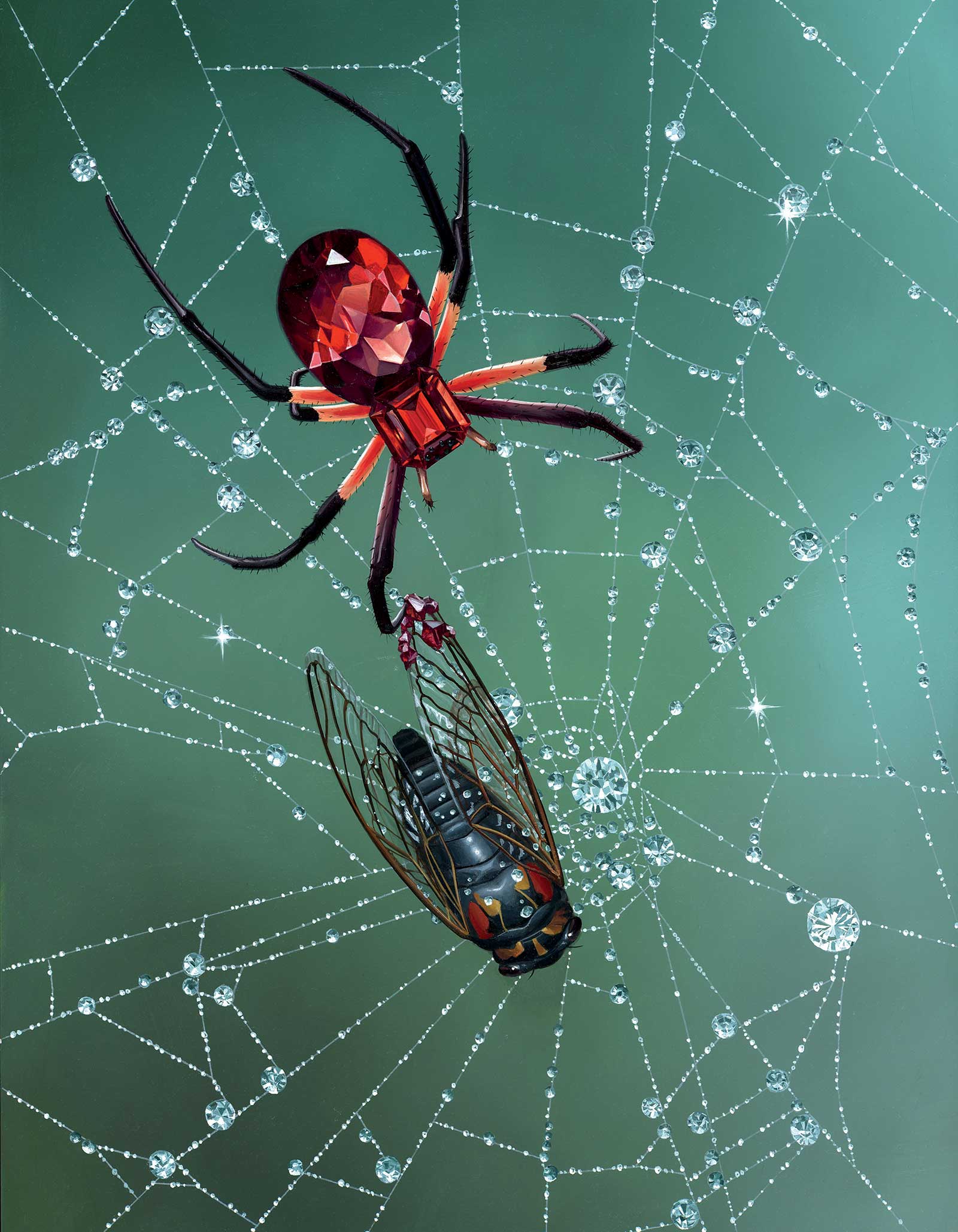
Arachnitite, oil on wood, 18 x 14"
A freshly painted piece by Ching (we’re talking paint still drying) is a good example of this concept. It depicts a snub-nosed monkey on a giant mountain of metallic rock. “It’s sort of symbolizing silicon. Raw silicon is this very metallic, silvery, angular blob of metal. [The primate is] sitting atop that and eating a piece of it with metal spikes growing out of its head,” says Ching. Whenever he paints primates they’re usually a stand in for humans, he adds. “It’s this idea of our consumption of electronic devices and how insatiable our hunger of it is. You are what you eat. The monkey is growing these metal spikes. I knew I wanted something to be eating this metallic [material].”
These two paintings are part of a fresh body of work by Ching. They’re also representative of a new direction he’s been exploring lately. “My art is about celebrating the life on this planet and the magic on this planet, but I realized that I never really paid homage to the planet itself. So I was looking for ways to really celebrate Earth and not just what’s on it. Crystals, minerals, gems—those are very clear evidence of the magic that is this planet. Even if you forget about the amazing life that thrives on this planet, the planet itself, the rock itself, is so incredible. I wanted to just bring that element in, and I think I’m still figuring out how to best do it.”
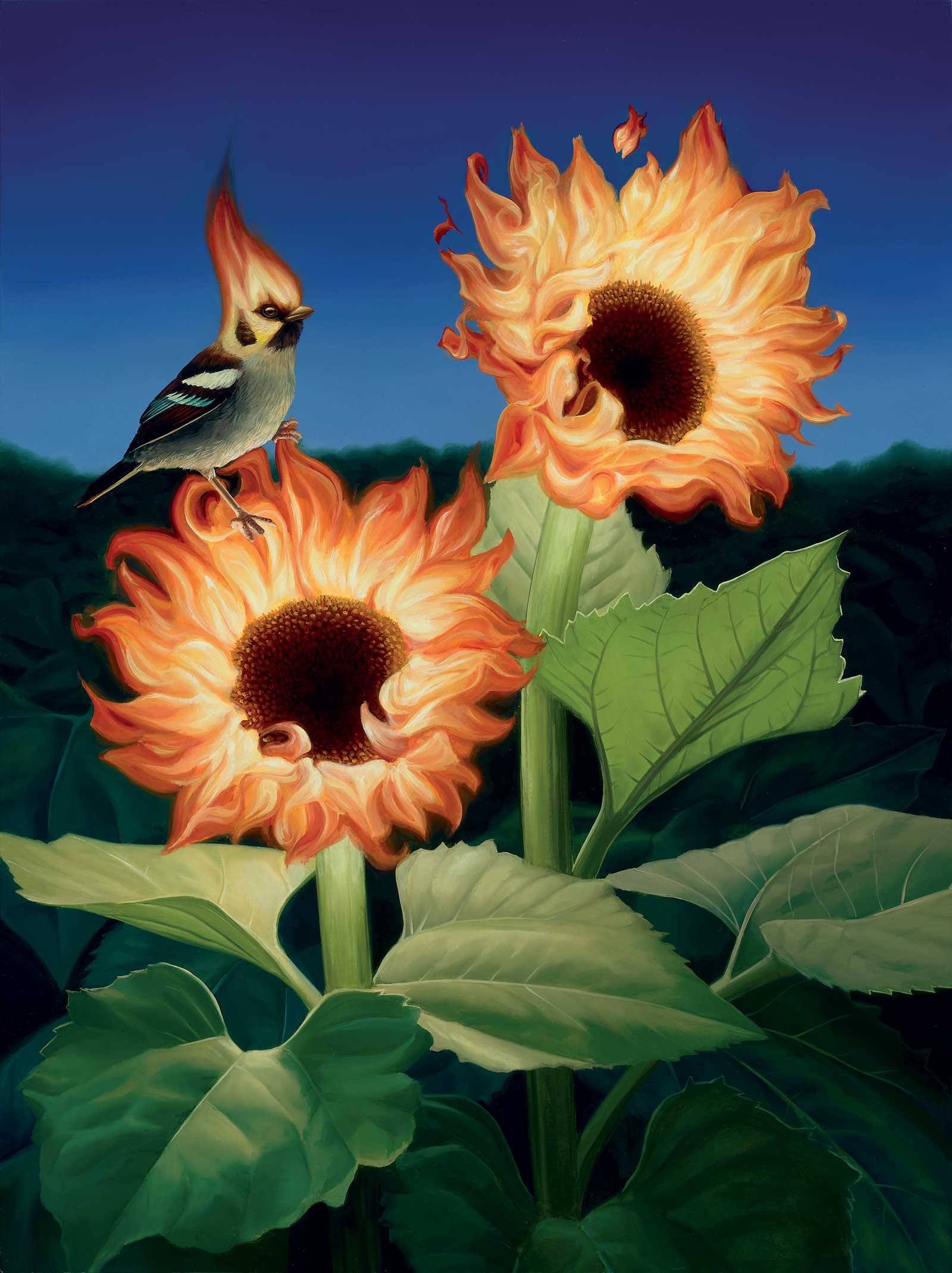
Torch, oil on wood, 24 x 18"
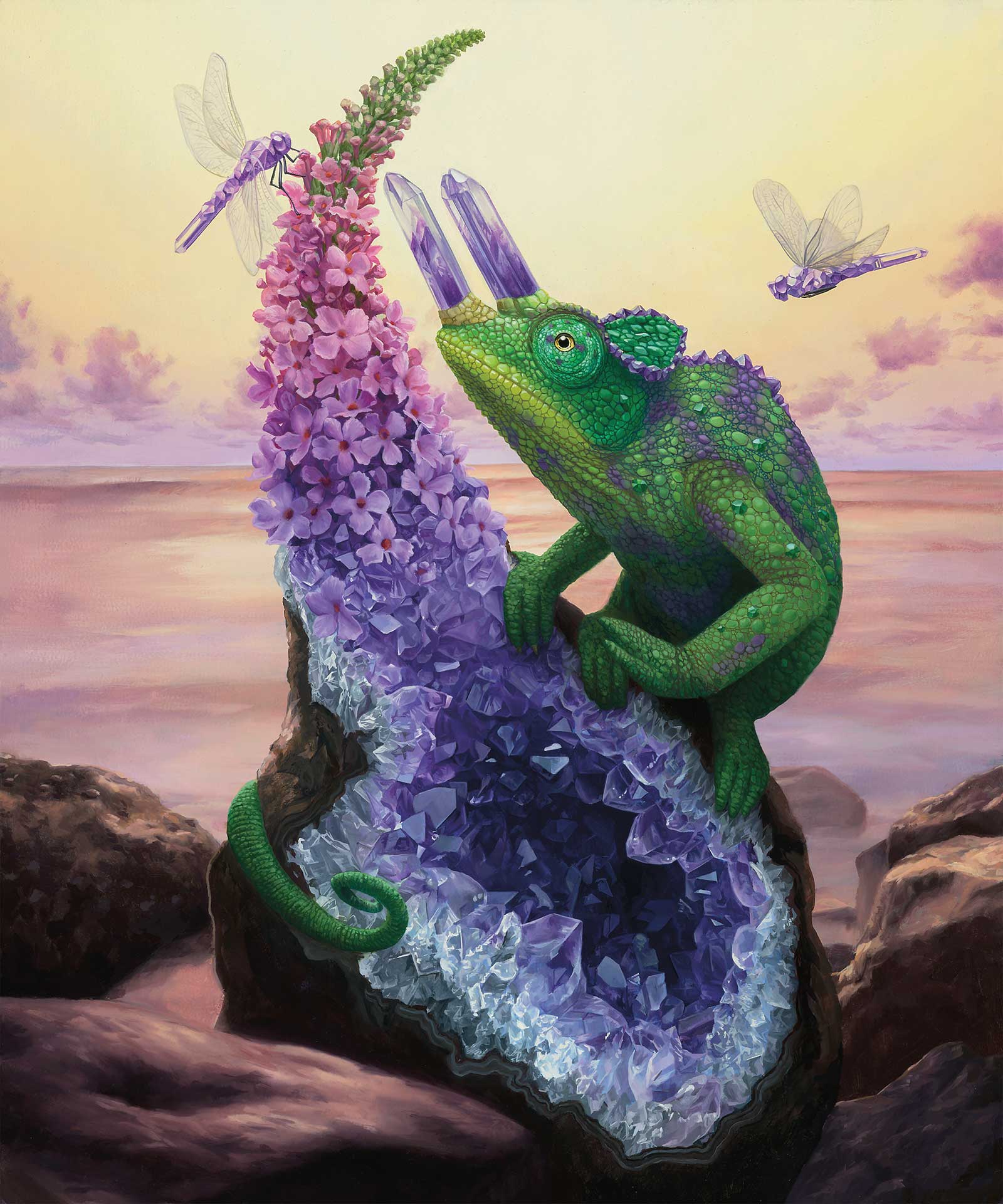
Even if Ching is still figuring things out, he’s gotten a pretty tremendous start. His new body of work takes that idea of morphing fur, feathers and fins into fungi and flowers, and places crystals and minerals in their place. It all started during a recent trip to the Natural History Museum in Los Angeles with his young son and in-laws. Eventually, they went to explore the gems and minerals wing, and soon Ching found himself knee-deep in geology. “It was mind blowing how amazing the specimens are there,” he recalls. Later, he went back on his own and spent hours observing as closely as he could, “looking at these crazy structures the earth grows. I couldn’t stop thinking about those for a while. Lately, I’ve trusted where my intuition wants to take me more.”
The first painting to emerge from that experience was that of a chameleon wrapping itself around a geode. In the center are shards of quartz that wind upward and transform into a Miss Ruby butterfly bush. “I love chameleons because they can change the color of their skin, so I thought it would be cool if it was touching a crystal and crystallizing itself,” the artist says. The scales of the chameleon are subtly morphing from an acid green to the purple, crystalline structure of the amethyst. On either side of the composition, two dragonflies made of that same violet mineral buzz about.
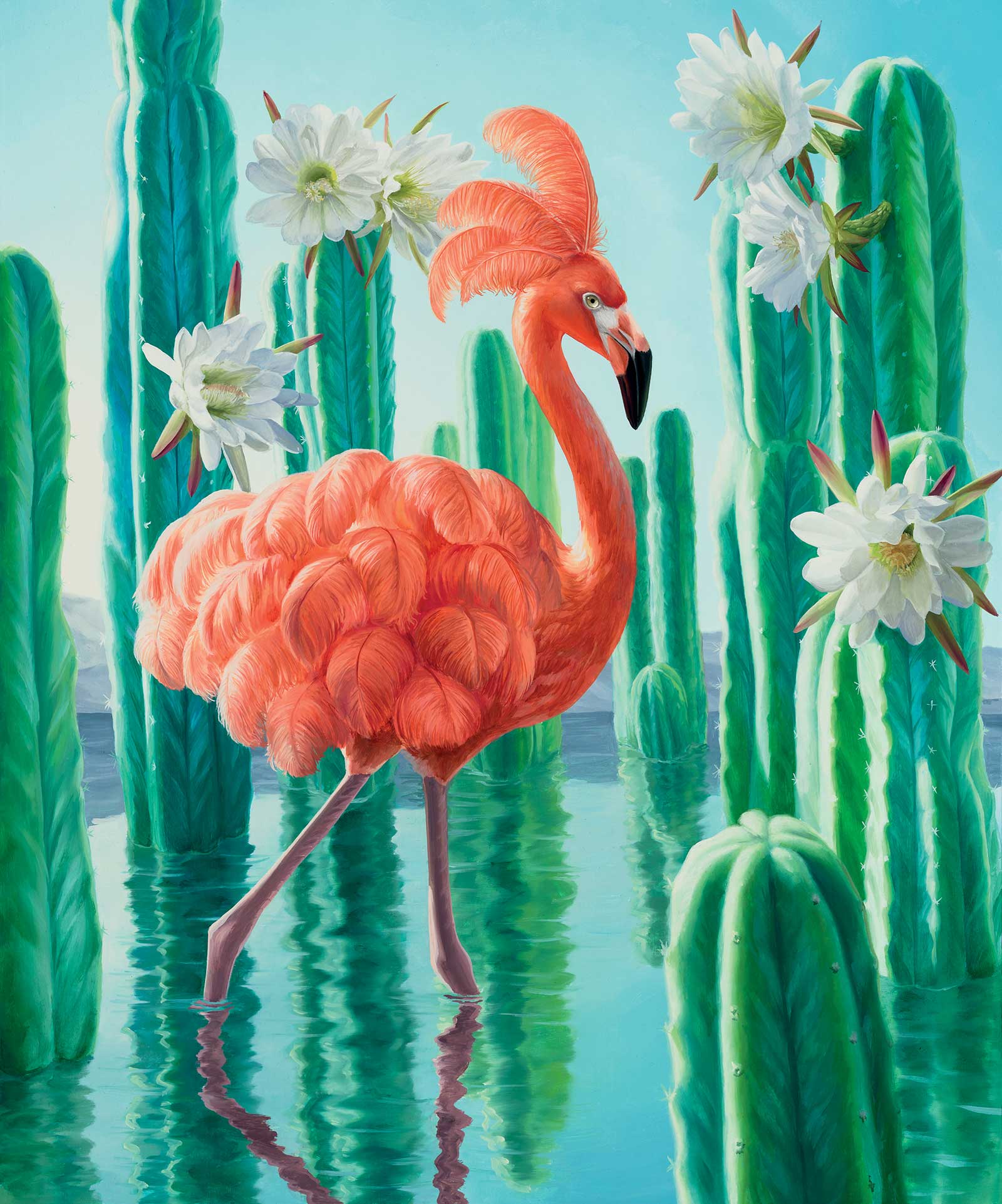
Arroyo, oil on wood, 24 x 20"
Typically Ching depicts vertebrates because we, as humans, more closely relate to them in a number of ways. They have two eyes. We have two eyes. In this new body of work, animals are still significant, but it’s less about these “charismatic characters” being the primary focal point. Instead, Ching is working on pieces that feel quieter, touching more upon the beauty of nature as a whole. He cites another new piece, Arachnitite, in which a spider crawls toward its prey on an elaborately spun web. Upon closer inspection, you’ll find that the spider’s body is actually made up of two crimson gems. Upon even closer inspection, you’ll notice that the water droplets across the web aren’t water droplets at all, they’re diamonds.
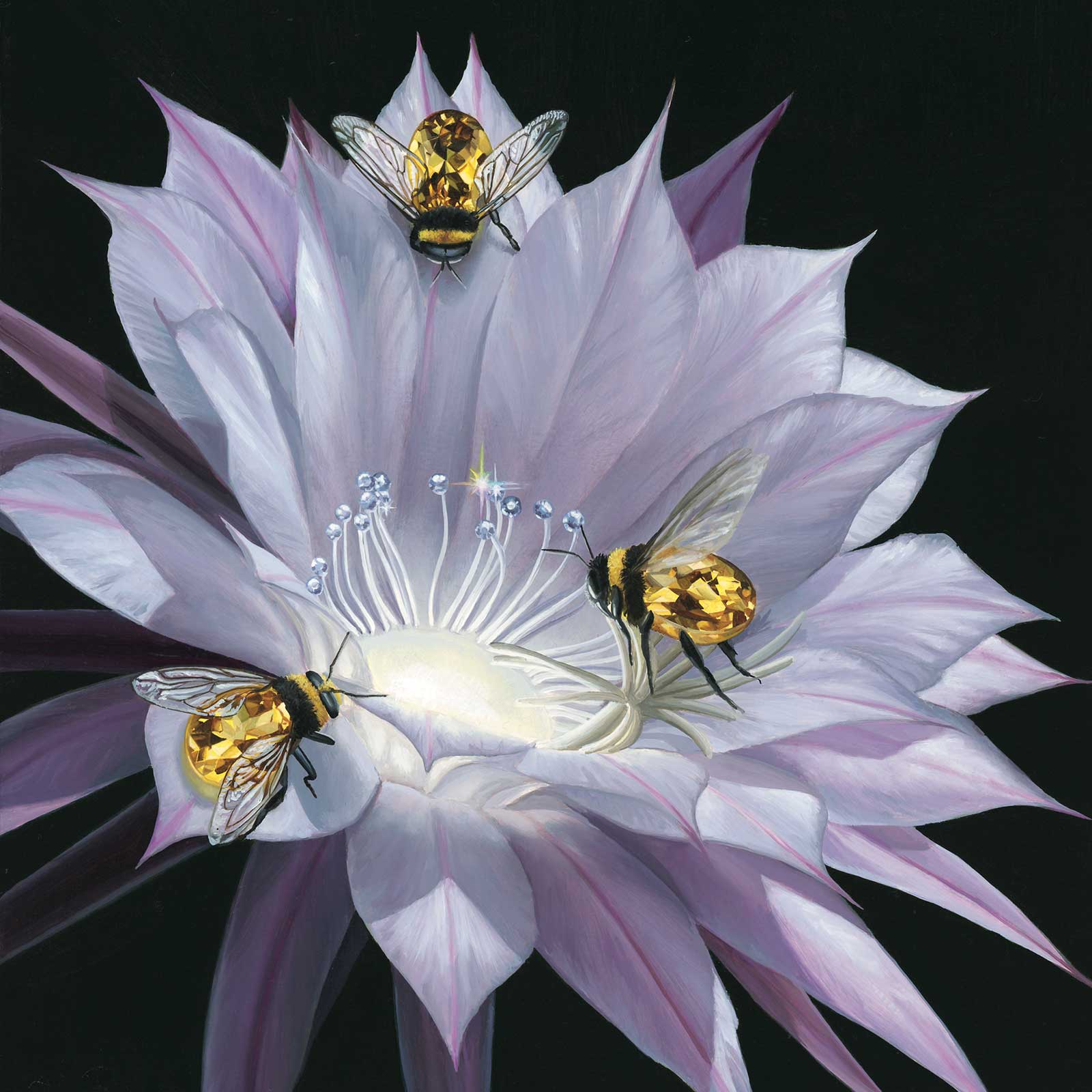
Antherine, oil on wood, 12 x 12"
“It’s a lot different from what I usually do,” says Ching. “I wanted to explore making quieter pieces. Insects are very polarizing…So I’m trying to do these quieter pieces that are less about the animal itself and more about the beauty that exists in the world…and also push back against our cultural biases about certain animals.”
Another new piece features crystal bumblebees. “There isn’t this main character you can connect to,” he says, “it’s more about just enjoying this beautiful scene of nature with some magic sprinkled over it. From far away, it’ll look like bees buzzing around a flower, but as you get closer, there’s a twist.”
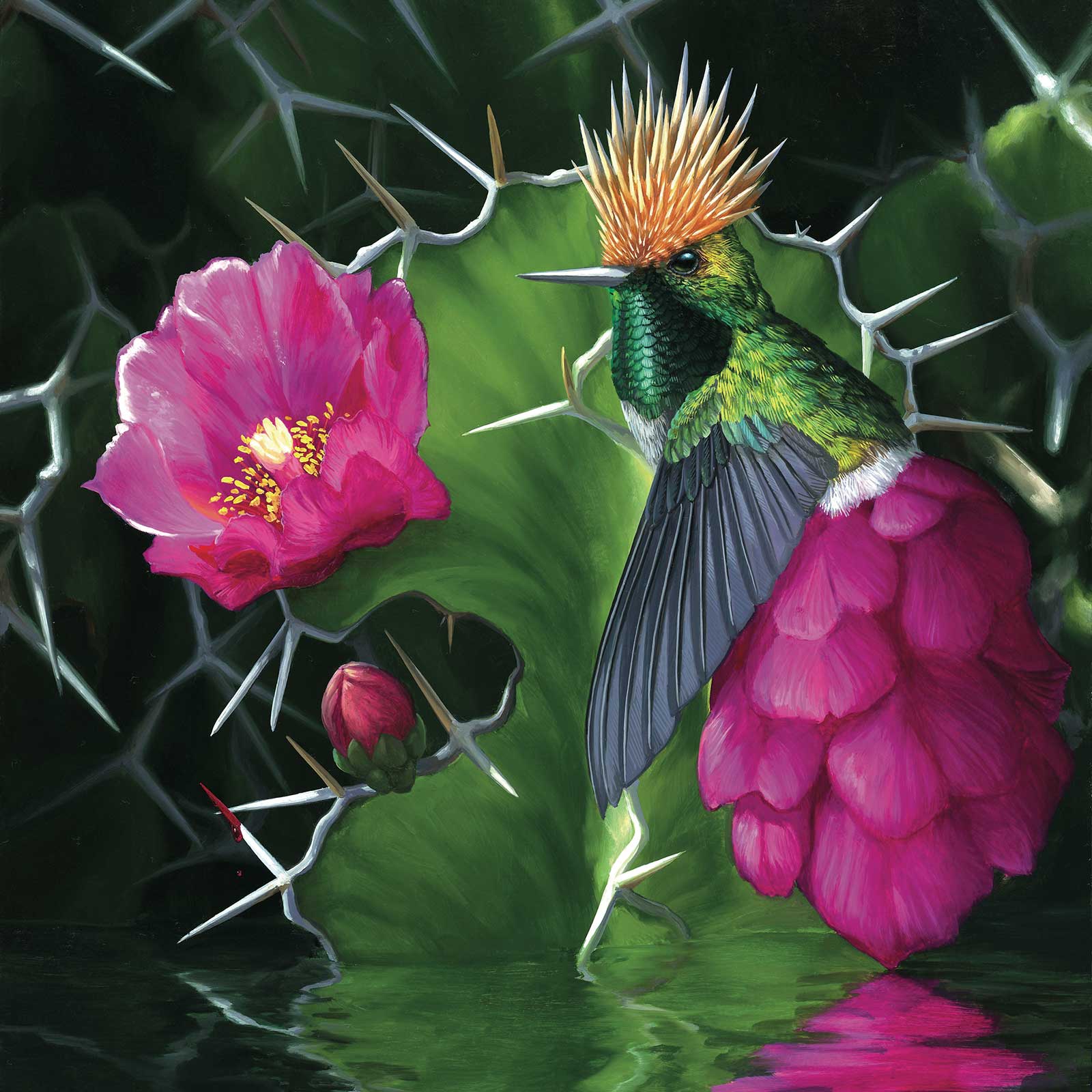
Prick, oil on wood, 12 x 12"
This spring, Haven Gallery in Northport, New York, is hosting a solo exhibition of Ching’s new work. The show, Terra Brio, runs from May 6 to June 4. Ching says he hopes viewers will be able to slow down and quietly reflect on the paintings in the show, noticing new elements and perhaps expanding their own worlds. “It’s a balancing act of painting something people want to look at, which I’m trying to push myself to not feel beholden to, but at the end of the day, I want people to [enjoy them],” he adds.
“It’s a natural world, but it’s also sort of a supernatural world.” —
Terra Brio
When: May 6-June 4
Where: Haven Gallery, 50 Main Street, Northport, NY 11768
(631) 757-0500, www.havengallery.com
Powered by Froala Editor