A close look at a museum’s collections reveals not just individual works of art that can be singled out or included in a themed exhibition, but also a rich variety of associations among the works themselves.
For A World Within, the Huntsville Museum of Art has assembled works by women artists in their collection and has explored the artists’ associations with past traditions, their utilizing traditional media in new ways and their embracing their role as “artists” without the pigeonholing of the characterization “women artists.”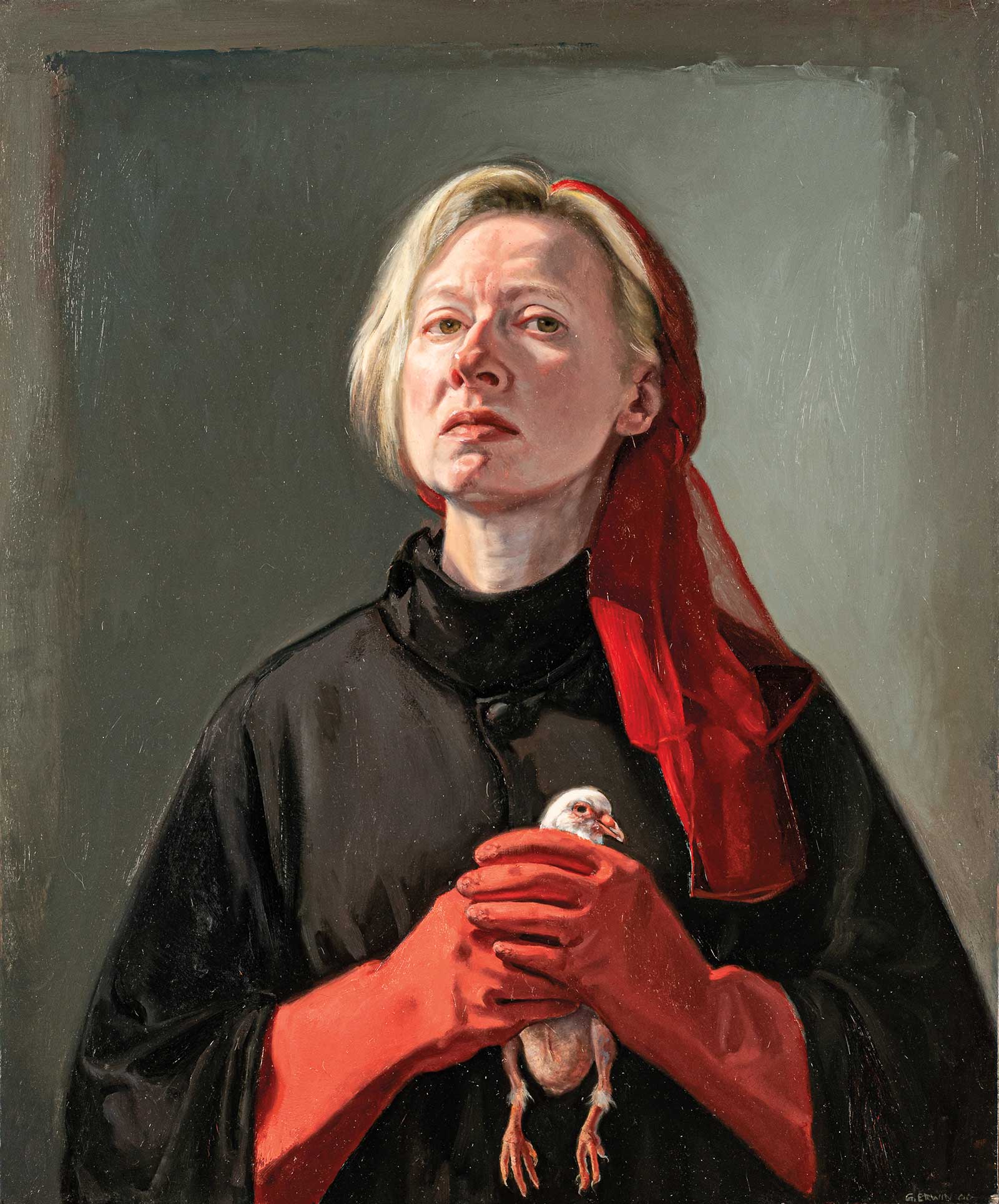 Gaela Erwin, Self-Portrait as St. Poulette (detail), 2000, oil on panel, 24 x 20”
The museum explains, “Feminine art and craft practices grounded in the traditions of past generations have been a source of inspiration to the present day. As time has gone by, women refused to be relegated to their traditional roles, and pressed for recognition of their talents. The result is that ‘women’s work’ has inspired future generations of artists who are no longer subject to the same societal restrictions. Some of these artists have embraced or reinterpreted traditions, while others have diverged and left traditional approaches behind and expanded into steel working, glass manipulation, ceramics and experimental mediums. A World Within explores some ways some women artists contemplate these traditional mediums, experience the world and portray themselves.” Dana Brown, Work Companions, 2002, watercolor on paper, 18½ x 18”Gaela Erwin has been inspired by the religious iconography and portraiture of 14th- to 16th-century Europe. She says, “I infuse my paintings with a sense of intimacy, rawness and vulnerability, transporting the genre into the contemporary realm.” Initially, the paintings were self-portraits and now include family members. Her self-awareness and the intimacy of her relationships with her family occasion insightful psychological portraits that reveal the sitter as well as the character they represent in her paintings.
 Cynthia Wagner, Saint Dorothy, 2019, ink, paper, gold leaf, acrylic on canvas, 72 x 32"Self-Portrait as St. Poulette, 2000, represents an imaginary saint who is the patron of chickens, protecting them from disease and other calamities. Working in France, she studied and was inspired by the portraits of saints in regional churches. She chose a quail “with really great feet” at the farmers’ market for her model. Since she paints from life, she froze the quail between “sittings.” Her partner donned red gloves and held the bird which over time, began to deteriorate and, eventually he had to prop the bird’s head up with a pencil—none of which is evident in the reverential portrait.
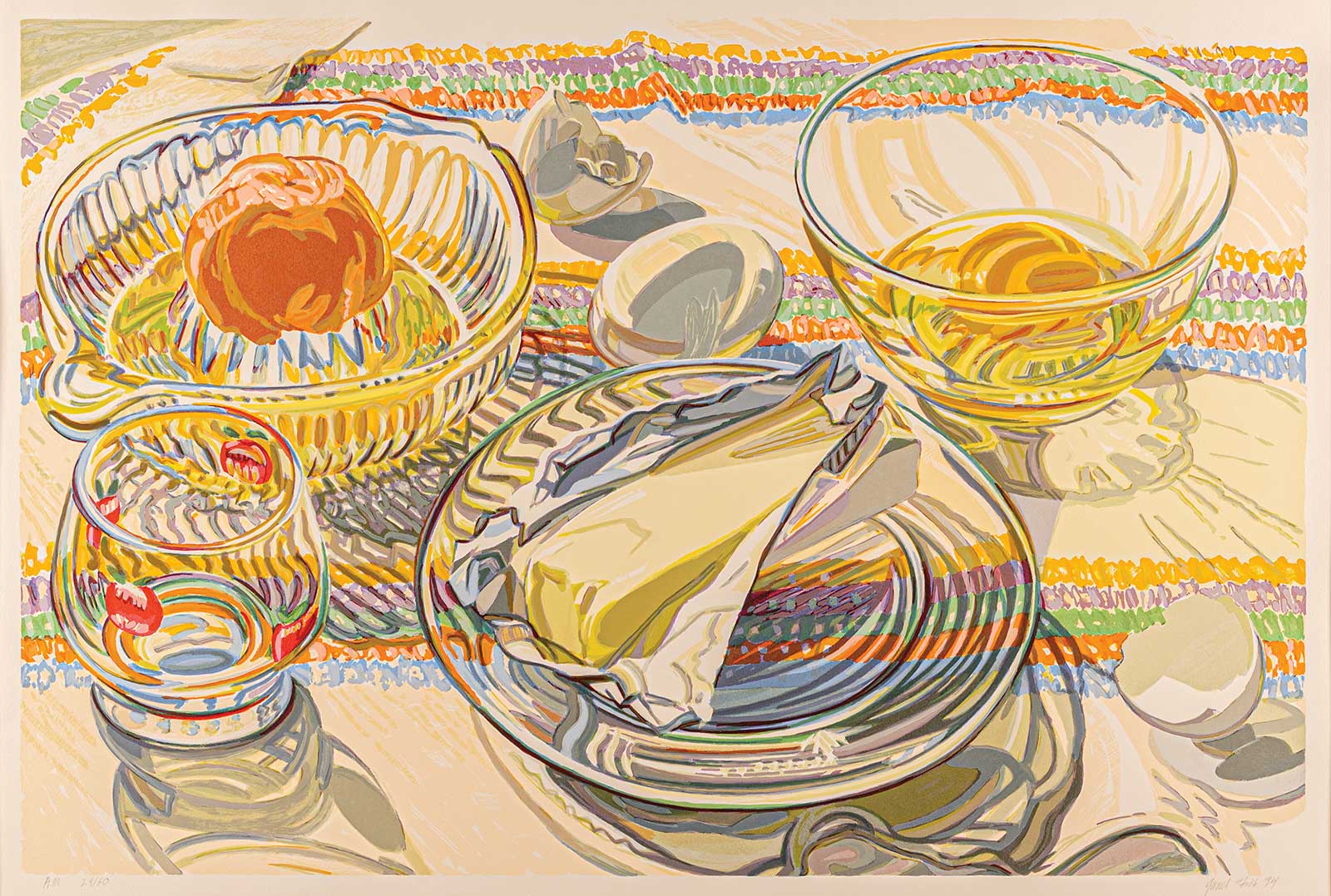 Janet Fish, A.M., 1994, 16-color screenprint, ed. 24 of 60, 24 x 36"The traditional craft of constructing quilts for comfort also involved attention to design and intricate stitching. Over time, quilters broadened their approach to design and the traditional craft of women broadened to include men. Both now create quilts that are considered works of art.
In the 1980s, Pamela Studstill was among the innovators who brought quilt making into the art world. Her work is now in the collection of the Smithsonian Institution’s American Art Museum.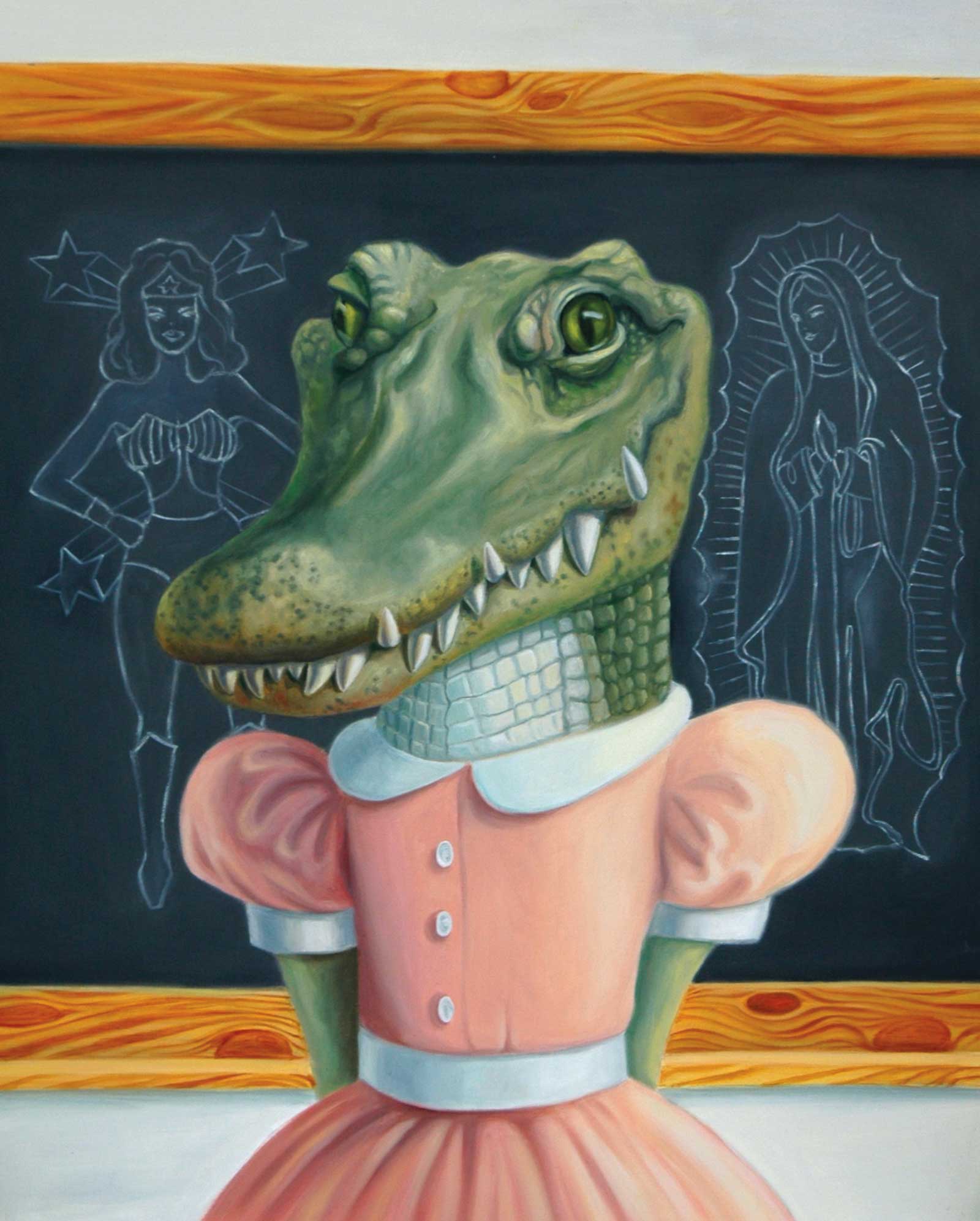 Dori DeCamillis, Thy Self, Thy Foe, 2011, oil on panel, 19½ x 15½"
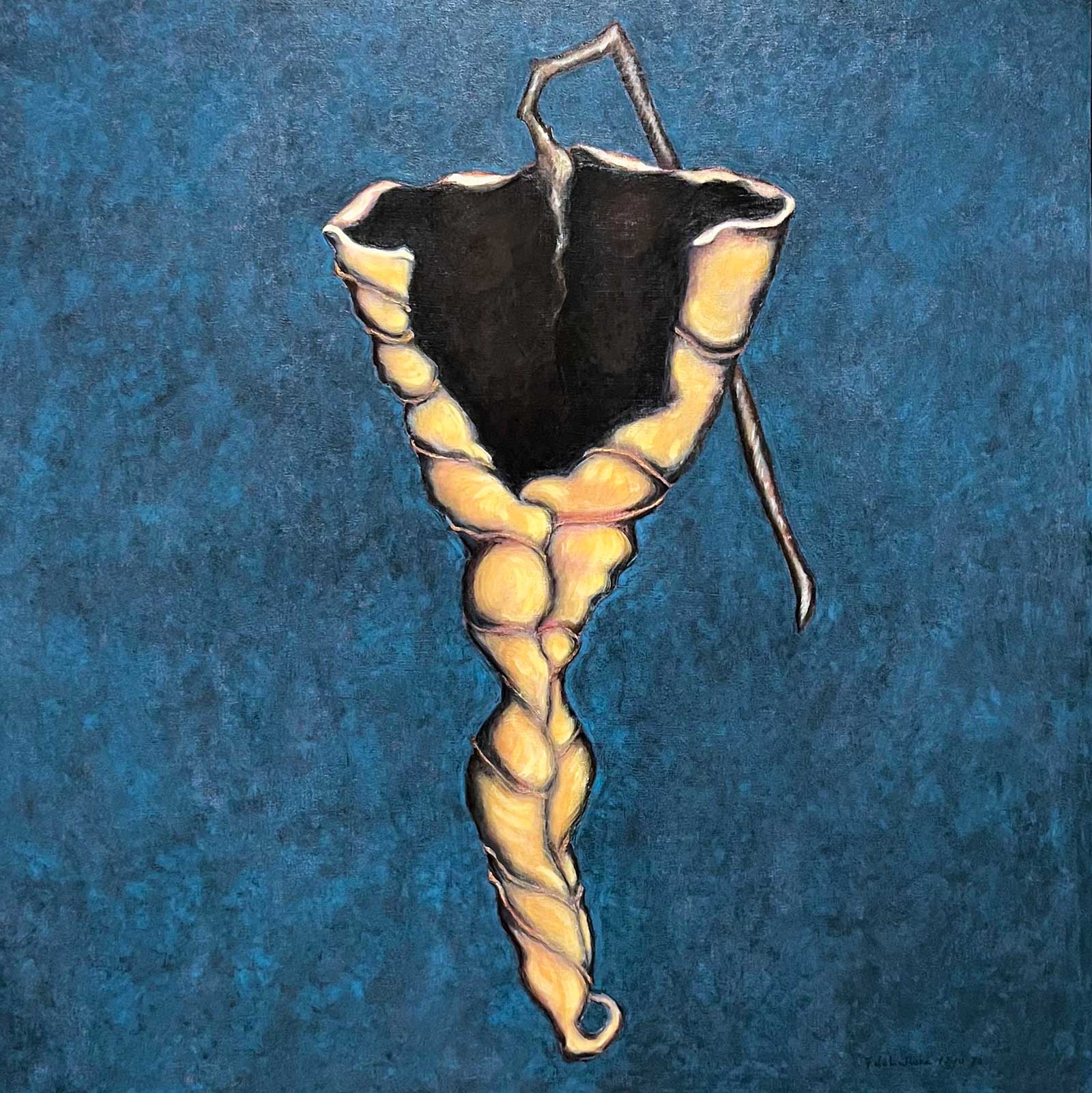 Frances de La Rosa, Hackberry Leaf, 1996, oil on canvas, 48 x 48"
Originally a painter, Studstill combines her painterly skills with her quiltmaking skills to create designs of subtle color shifts and relationships. She says, “By painting on my fabrics, I achieve a greater range of color and pattern than would be possible by using just solid-colored fabrics.” The quilts are numbered rather than titled because, as she explains, “I don’t want people to think about ‘things’ when they look at the quilts.” The change in light of the central portion of Quilt 89, 1990, suggests a landscape with light sky at the top and terra firma at the bottom, a narrow border surrounds the central area, graduating from light at the bottom to dark at the top. She says, “Each one of my quilts is a study in light.”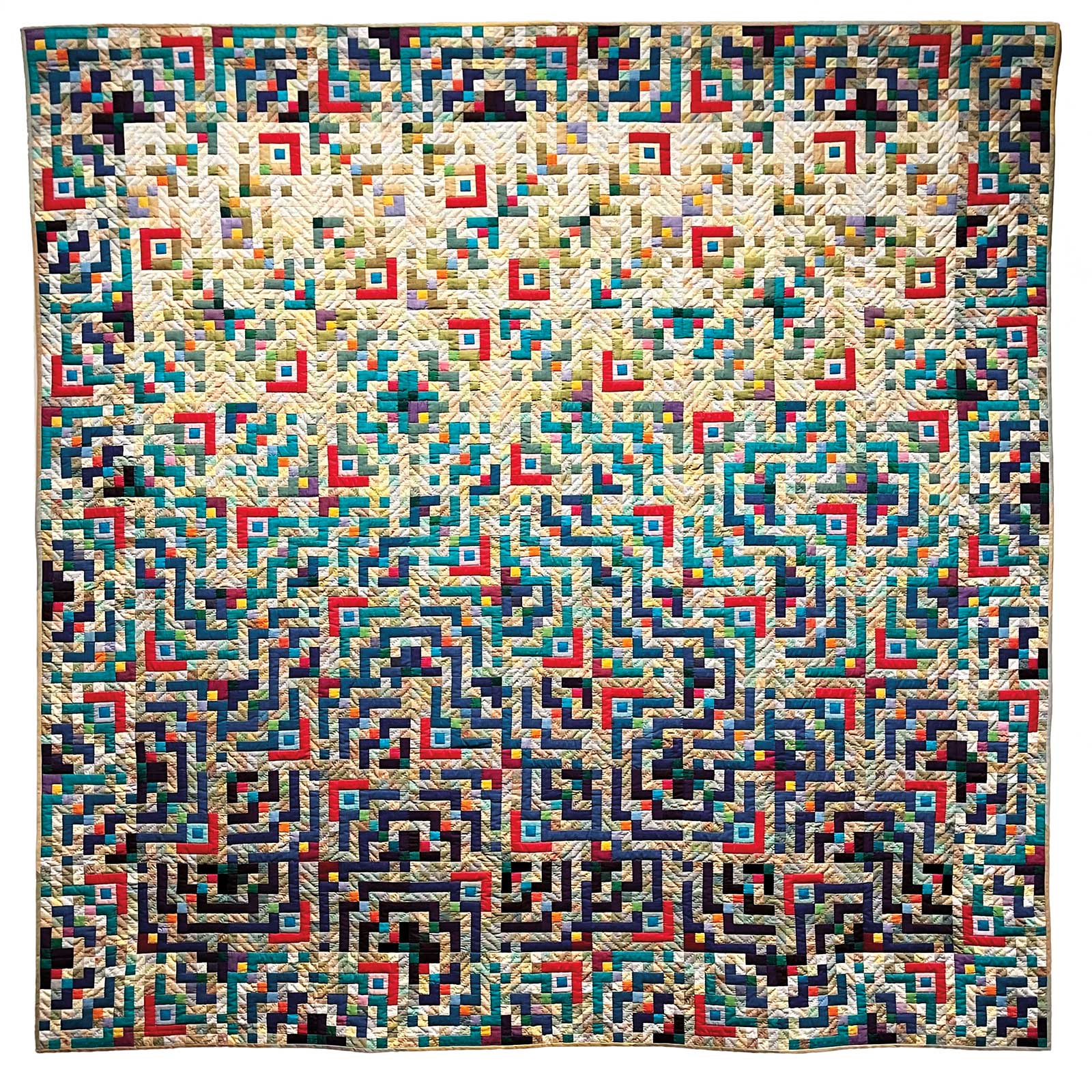 Pamela Studstill, Quilt 89, 1990, cotton and fabric paint, 72 x 72"
Denise Stewart-Sanabria uses light to enliven the objects skillfully arranged in her colorful still lifes—with a caveat: “I specifically do not label my work as ‘still lifes,’ which I consider an archaic and inaccurate term for what I am creating. Still lifes have traditionally been genre paintings of domestic items and food, often with symbolic references attached to them connected with life, death and survival. What I am doing is pure observation—how the eye perceives my subjects in all their beauty as light hits them, intensifying the color saturation. I am also interested in their ability to create complicated abstract compositions when combined in groups or scattered across the picture plane.”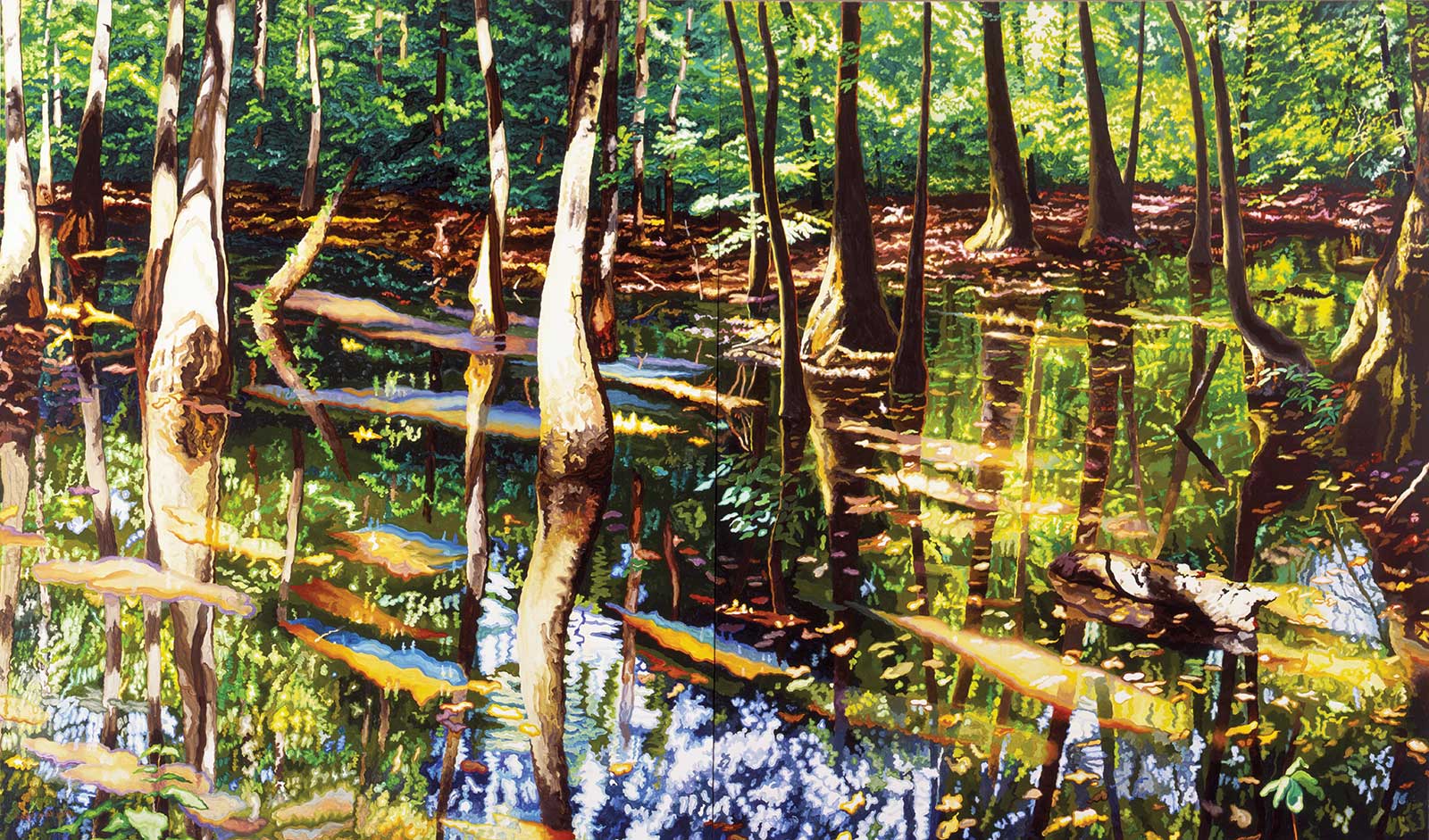 Mary Ann Pope, Swamp, 2002, oil on canvas, 84 x 50"Arranged before a Dalí-esque scene of a bacchanale, the fruit and pastry in Bauhaus Dalí Does Décor, 2018, appear to have been debauched in the frenzy of the party. A rhythmic play of maraschino cherries dances across the composition.
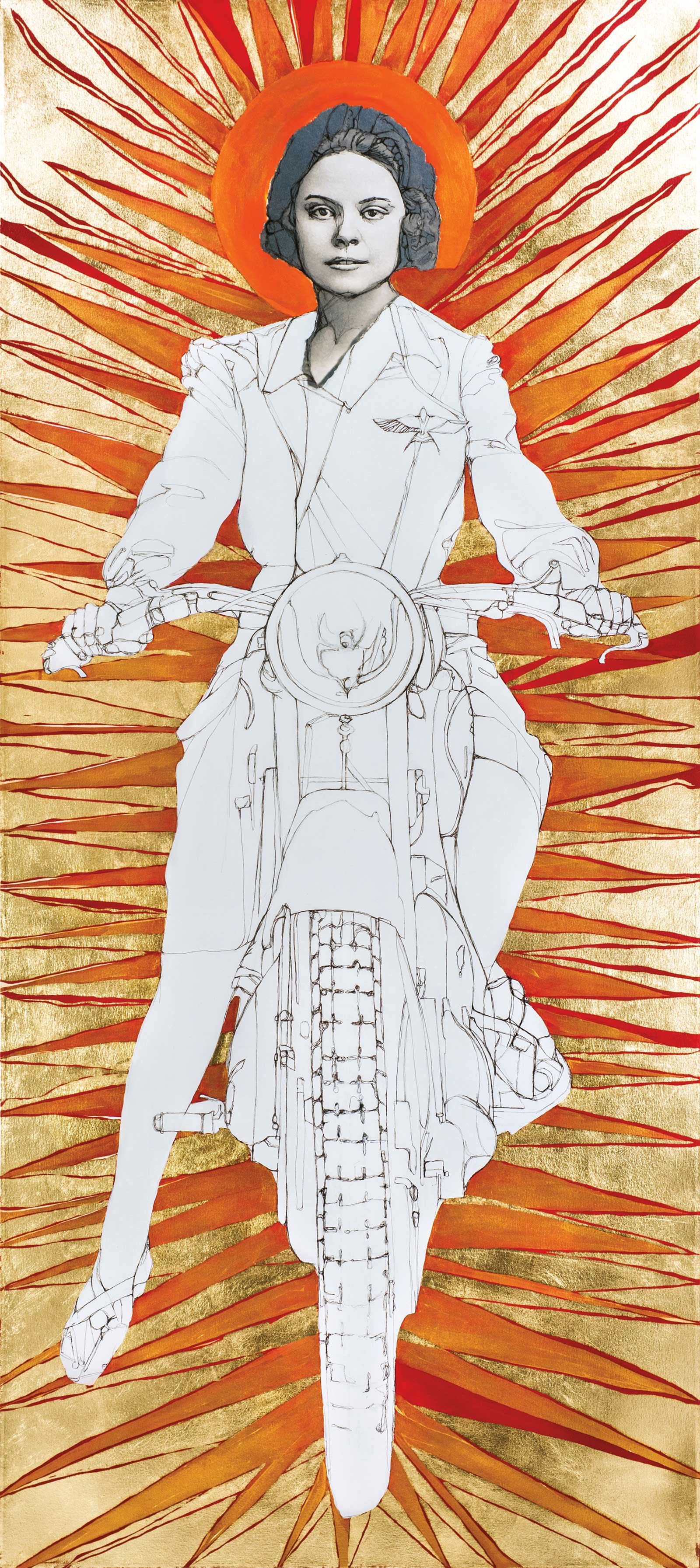
Cynthia Wagner creates fictional worlds “that explore the social and psychological aspects of humanity, including issues of gender role and the transitory nature of life.” In Saint Dorothy, a photograph of a woman is superimposed on a drawing of a leather-garbed motorcycle rider emerging from an aureole of golden light reminiscent of the miraculous painting of the Virgin of Guadalupe.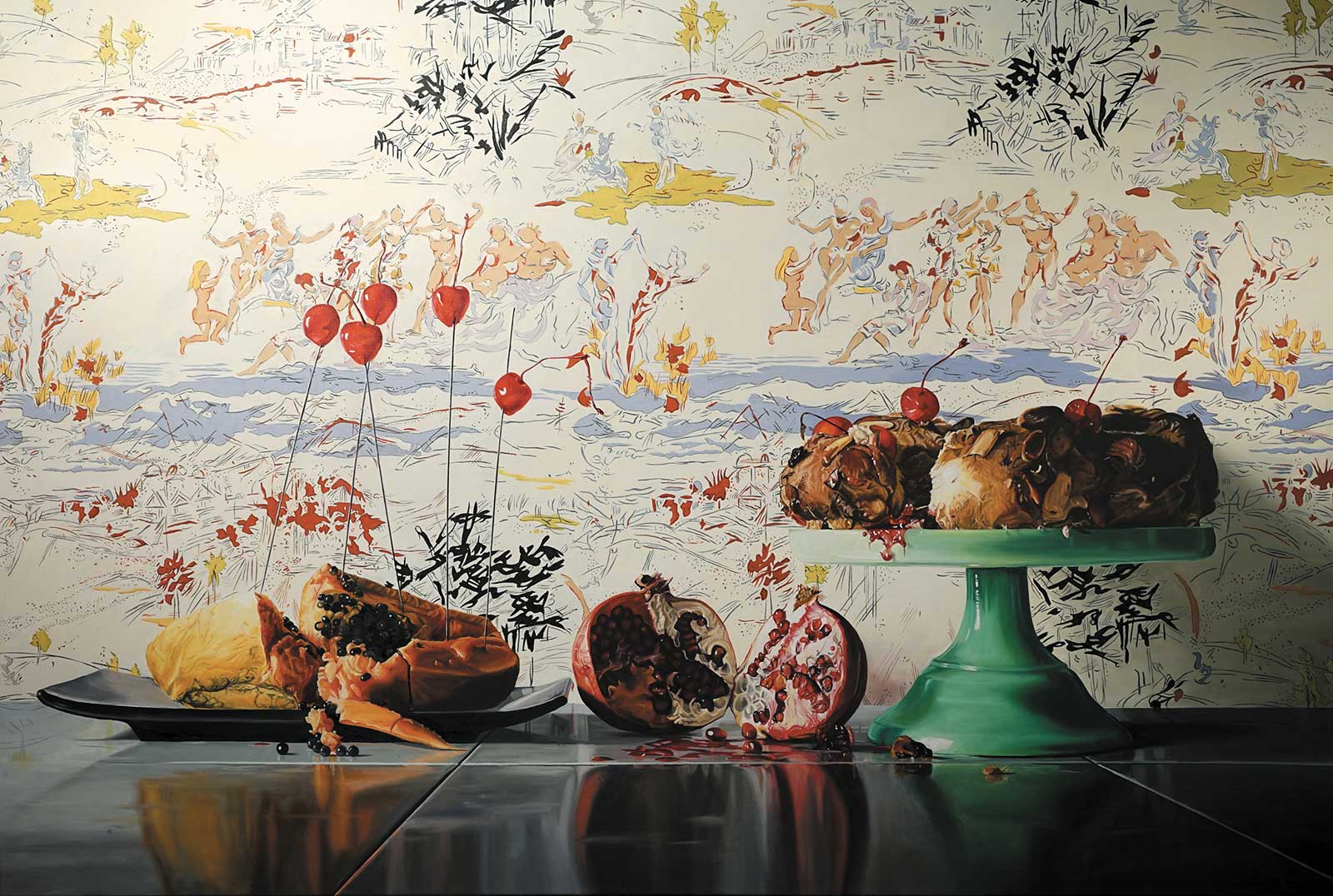 Denise Stewart-Sanabria, Bauhaus Dali Does Décor, 2018, oil on canvas, 42 x 62"The portrait is of an actual biker, Dot Robinson, who, the museum explains, was “an Australian co-founder and president of Motor Maids, Inc., one of the first female motorcycle groups. The Motor Maids quickly spread to North America and became a social club of sorts where women could ride motorcycles and maintain their femininity.”
Saint Dorothy embodies Wagner’s interest “in exploring the connections between the past and present as well as expressing the complex spiritual/supernatural nature of humanity in combination with mortality and time.”
A World Within continues at the Huntsville Museum of Art through February 26. —
A World Within: Art by Women from the Permanent Collection
When: Through February 26
Where: Huntsville Museum of Art, 300 Church Street S., Huntsville, AL 35801
(256) 535-4350, www.hsvmuseum.org
Powered by Froala Editor