Cityscapes are often records of their history—early buildings preserved and cherished—or they are models of the present, with all vestiges of the past demolished and the newest eventually giving way to the next new thing.
New York City retains some of its early buildings and squares. Its predominant open space is Central Park, which opened to the public in 1859 after the displacement of 1,600 poor Irish, German and African American residents, the moving of three million cubic yards of soil, the blasting of stone ledges, and the planting of 270,000 trees and shrubs.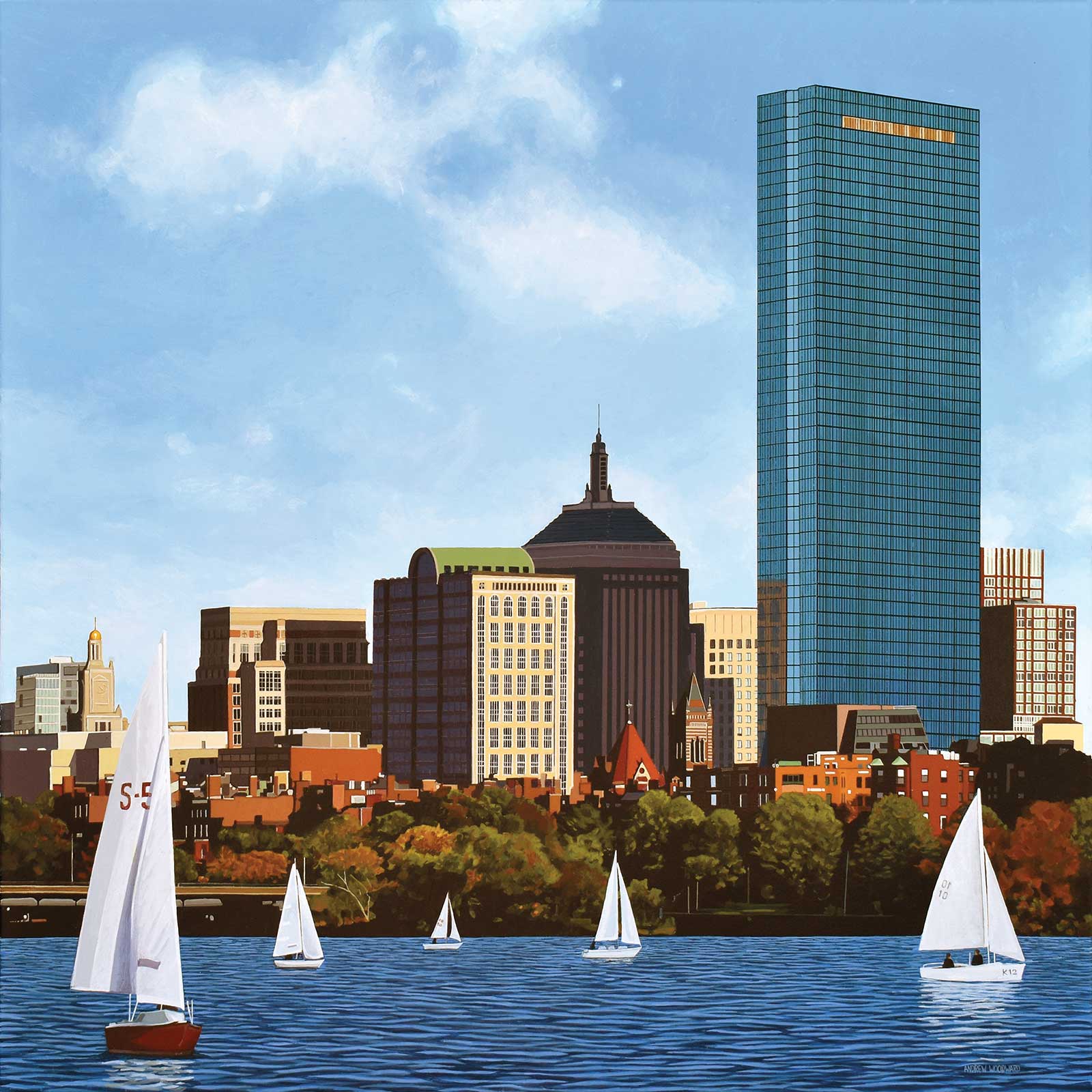 Arden Gallery, Charles Sun, acrylic on canvas, 36 x 36”, by Andrew Woodward.
About 200 years earlier, farther south on the island of Manhattan, members of the Lenape tribe camped and fished near a trout stream named Minetta Brook. The Dutch and then the English began to farm the area and in the 1780s the City of New York purchased 8 acres for use as a potter’s field (a burial ground for the indigent), and the site of a public gallows. In 1826 the area was leveled and landscaped and dedicated as the Washington Parade Ground. New York University (NYU) opened its first major building at the northeast corner of the park in 1836. It was demolished in 1894. Its Gothic revival style was echoed in 1840 in the nearby Reformed Dutch Church which was demolished the year after the NYU building.
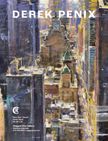
Otto Boetticher (1811-1886) came to the U.S. from Prussia and was active in New York as an artist and lithographer and often depicted military maneuvers. His painting, Seventh Regiment on Review, Washington Square, New York, 1851, is now in The Metropolitan Museum of Art. Prominent in the background are NYU’s first major building and the Reformed Dutch Church.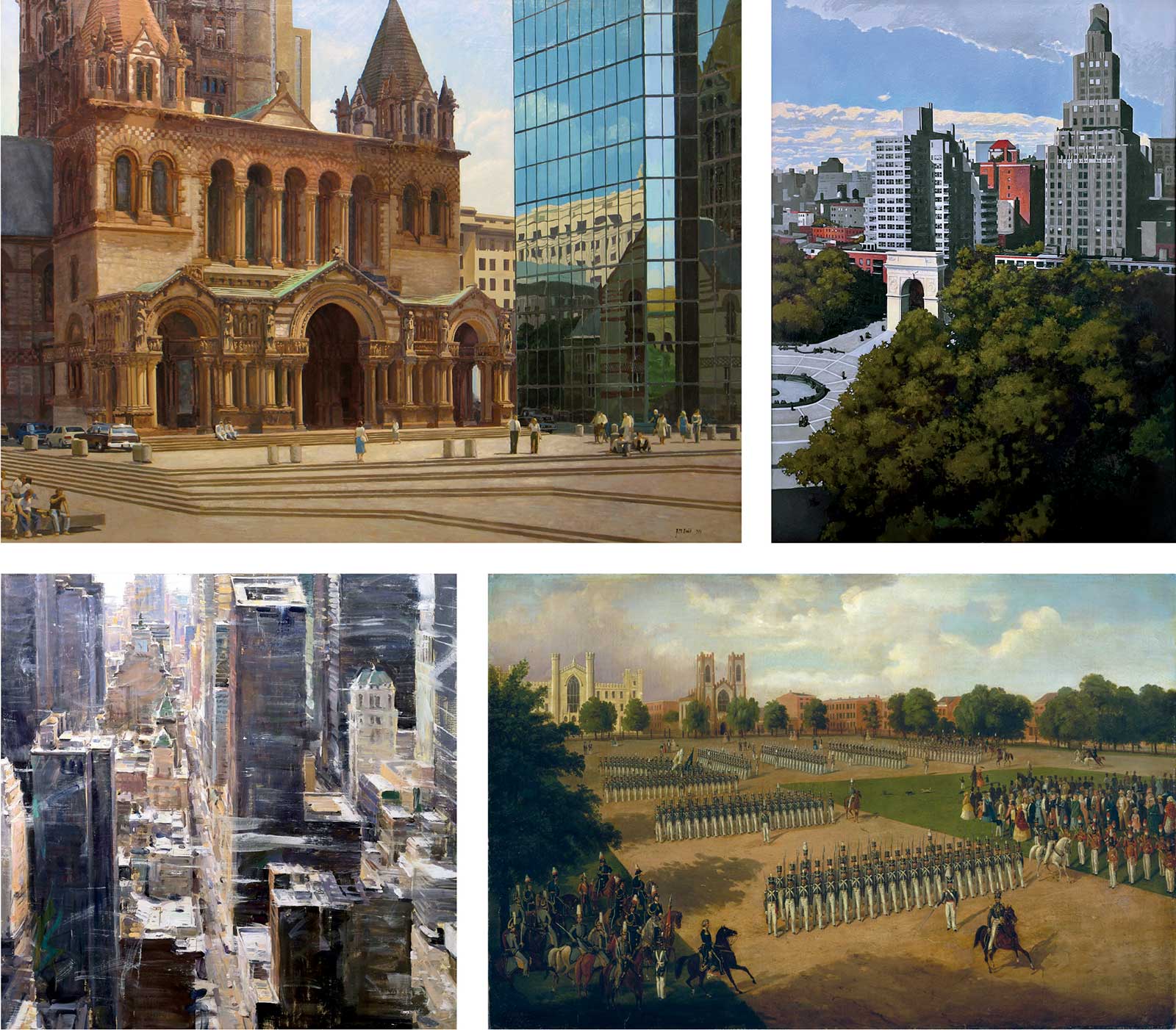 Top: Vose Galleries, Trinity Church, oil on masonite, 36 x 48”, by Joel Babb; Nathan Mellott, From an Upper Floor, oil on canvas, 48 x 36” . Bottom: Claggett/Rey Gallery, New York, New York, oil, 48 x 48”, by Derek Penix; Otto Boetticher (1811-1886), Seventh Regiment on Review, Washington Square, New York, 1851, oil on canvas, 24 x 36”. The Metropolitan Museum of Art, NY, NY. The Edward W. C. Arnold Collection of New York Prints, Maps, and Pictures, Bequest of Edward W. C. Arnold, 1954. Public Domain.In 1889, the Washington Square Arch was dedicated in honor of the centennial of George Washington’s inauguration. It was designed by Stanford White. Washington Square has been a gathering place for protesters, artists, chess players, students, local residents and tourists ever since.
Nathan Mellott attended NYU. His painting, From an Upper Floor, depicts the landscape today, dense thickets of trees on the once barren parade grounds, the arch, a more modern fountain and the city rising in the background.
Mellott describes the genesis of his painting. “From an upper floor study-room among the stacks of NYU’s Bobst Library where, on the first floor, there is a portrait of the benefactor by Everett Raymond Kintsler. This painting was composed only to lie in wait against a wall among many unfinished paintings. An NYU alumna visiting my studio commissioned me to complete it. The dominant canopy of trees draws in social life and respite from the city rising behind in with its show of masonry canyons and the abstract plotting of apartment windows. Sneaking in the distant upper right corner is the Empire State Building, blown out with light and hazy in the still and beautiful sky of an archetypal New York summer day.”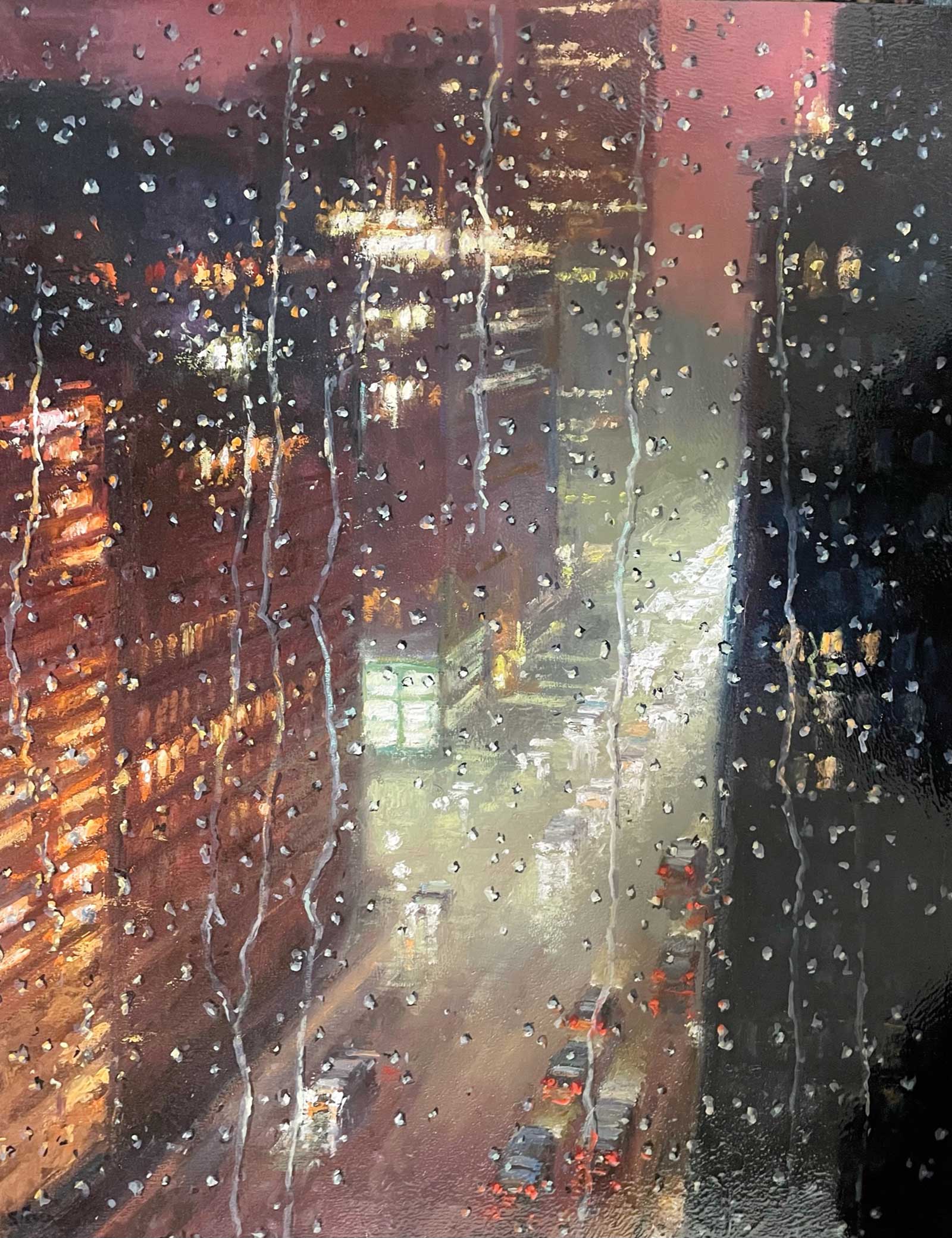 Celebration of Fine Art, Hotel View, oil, 30 x 24”, by Gregory SieversBoston’s architectural history is in its cityscapes and, perhaps, best seen from on or across the Charles River. Andrew Woodward moved to Boston in 1999, painting the iconic buildings of its past and present. He lived there for over a decade. Charles Sun is dominated by the class tower of 200 Clarendon Street, designed by I.M. Pei and opened as the John Hancock Tower in 1976. To its left and in its shadow is the Berkeley Building, opened in 1947 as John Hancock Insurance Company’s first Hancock Tower. Its distinctive weather beacon displays light patterns to indicate the weather forecast.
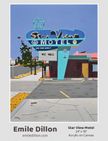
 Emile Dillon, Gatewood Motel, acrylic on canvas, 24 x 18”Barely visible toward the base of the old Hancock Tower is the roof of Trinity Church Boston, designed by H.H. Richardson in a style that is now known as Richardsonian Romanesque and opened in 1877. Only 20 years earlier, the location had been a part of Boston Harbor known as Back Bay. It was gradually filled in between 1857 and 1882 and still known today as Back Bay.
Although it appears diminutive in Woodward’s view from the river, it dominates Copley Square, reflected in I.M. Pei’s glass tower and facing McKim Mead and White’s Boston Public library across the square named after the colonial painter John Singleton Copley. Charles Follen McKim was a partner in the firm with Stanford White who designed the Washington Square Arch.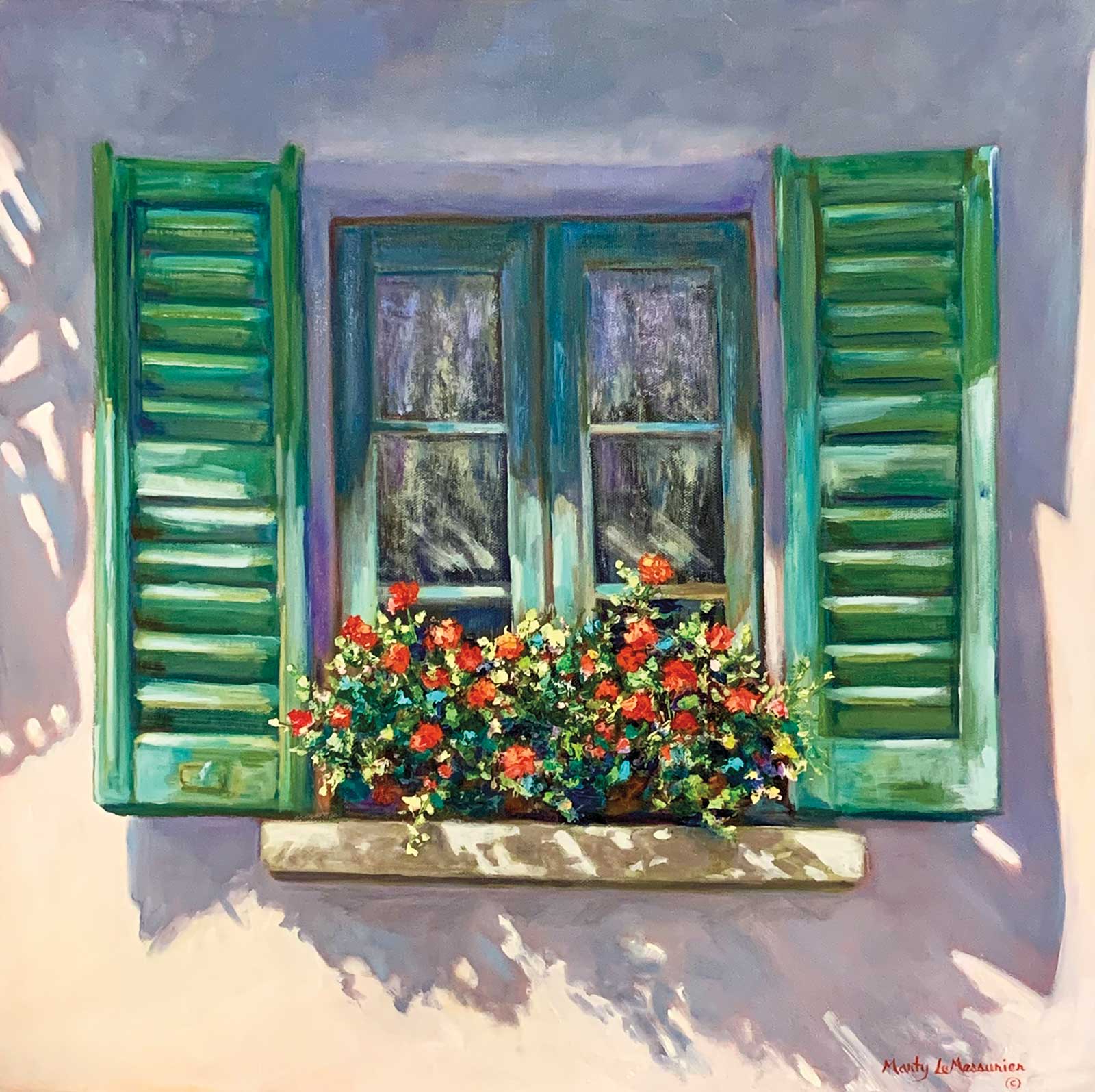 Celebration of Fine Art, Touch of Italy, oil, 22 x 22”, by Marty LeMessurier.
Joel Babb received his MFA degree at the School of the Museum of Fine Arts Boston at Tufts University and taught there for many years. His Trinity Church, Boston, Massachusetts, depicts the richly decorated building holding its own against the neighboring glass skyscraper. Babb says, “Painting Boston’s cityscapes, I suppose, is a little bit like Sargent painting Venice—it is a subject richly suggestive of the past, with an elevated aesthetic. I don’t wish to paint in Sargent’s style, though it would be wonderful to be able to, but Boston really is a great subject for thinking about the relation of the past to the present.”
Bright lights, bustling streets and electrifying energy—this is the archetypal atmosphere of the big city. Often, the walls of its buildings, streets and sidewalks carry hundreds of years of history, alongside the stories of modern day. Venture through this special section to take in more views of the city and learn about what inspires the artists who paint them. 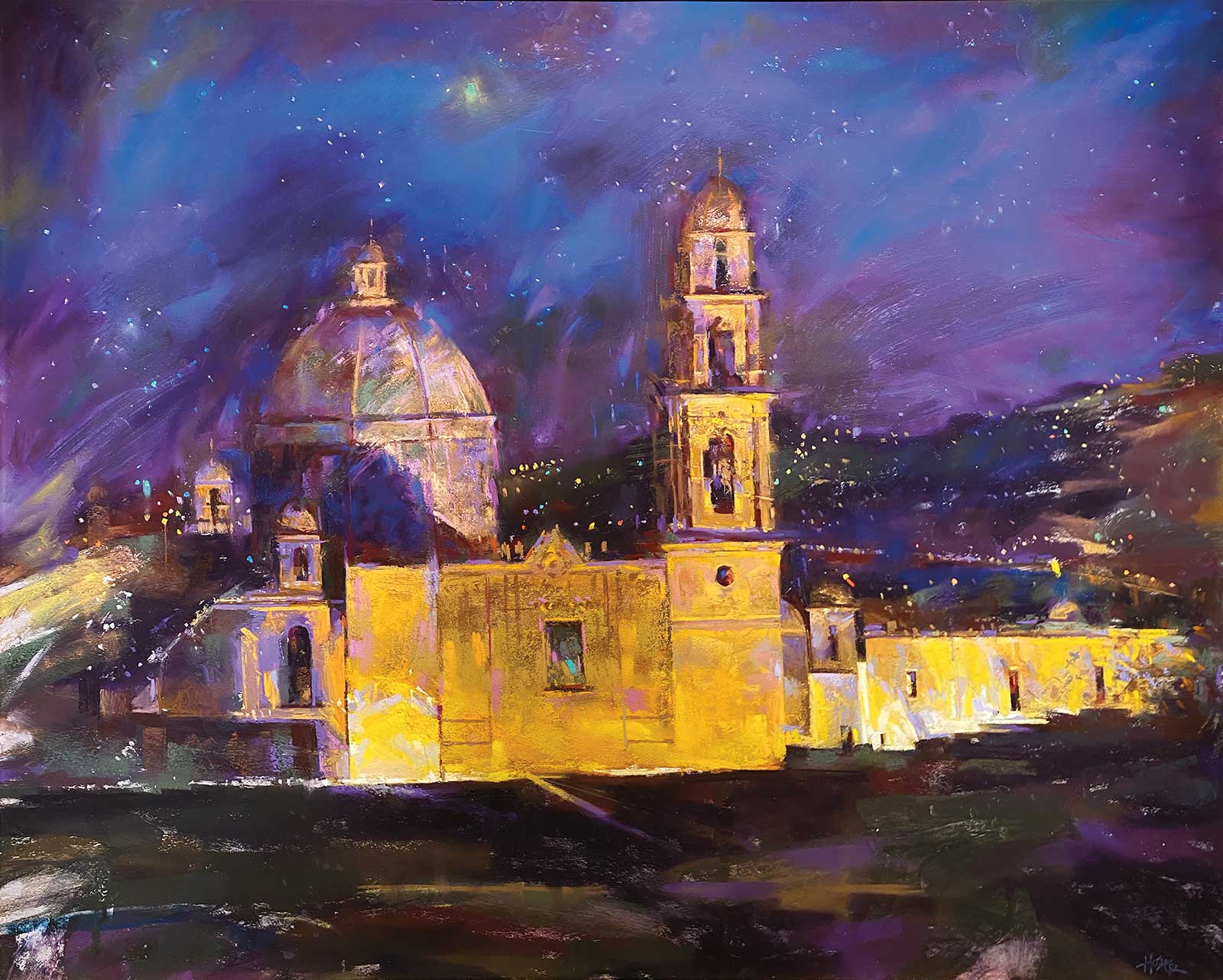 Claggett/Rey Gallery, Starry Night, Iglesias de San Francisco, pastel, 24 x 30”, by W. Truman Hosner.
“The romantic allure of a cityscape—be it a bird’s eye view or a quiet silhouette—charms us and allows us to embrace its radiance with a full heart,” says Maggie DeDecker, owner of Claggett/Rey Gallery in Edwards, Colorado. “Nostalgia and longing can drive the impetus to collect reminders of places we’ve been or desire to go. It is essential that every fine art collection include a painting of this genre no matter the style or connection.” Claggett/Rey showcases artwork from painters and sculptors who capture the art of urban scenes (along with a variety of other subject matter). Among these artists are Derek Penix and W. Truman Hosner.
DeDecker continues, “Paintings of this genre draw you into the cacophony of the hustle and bustle of busy streets, horns blazing while historic architecture dances around...If you are missing this delight in your collection, it’s time to take the leap.”
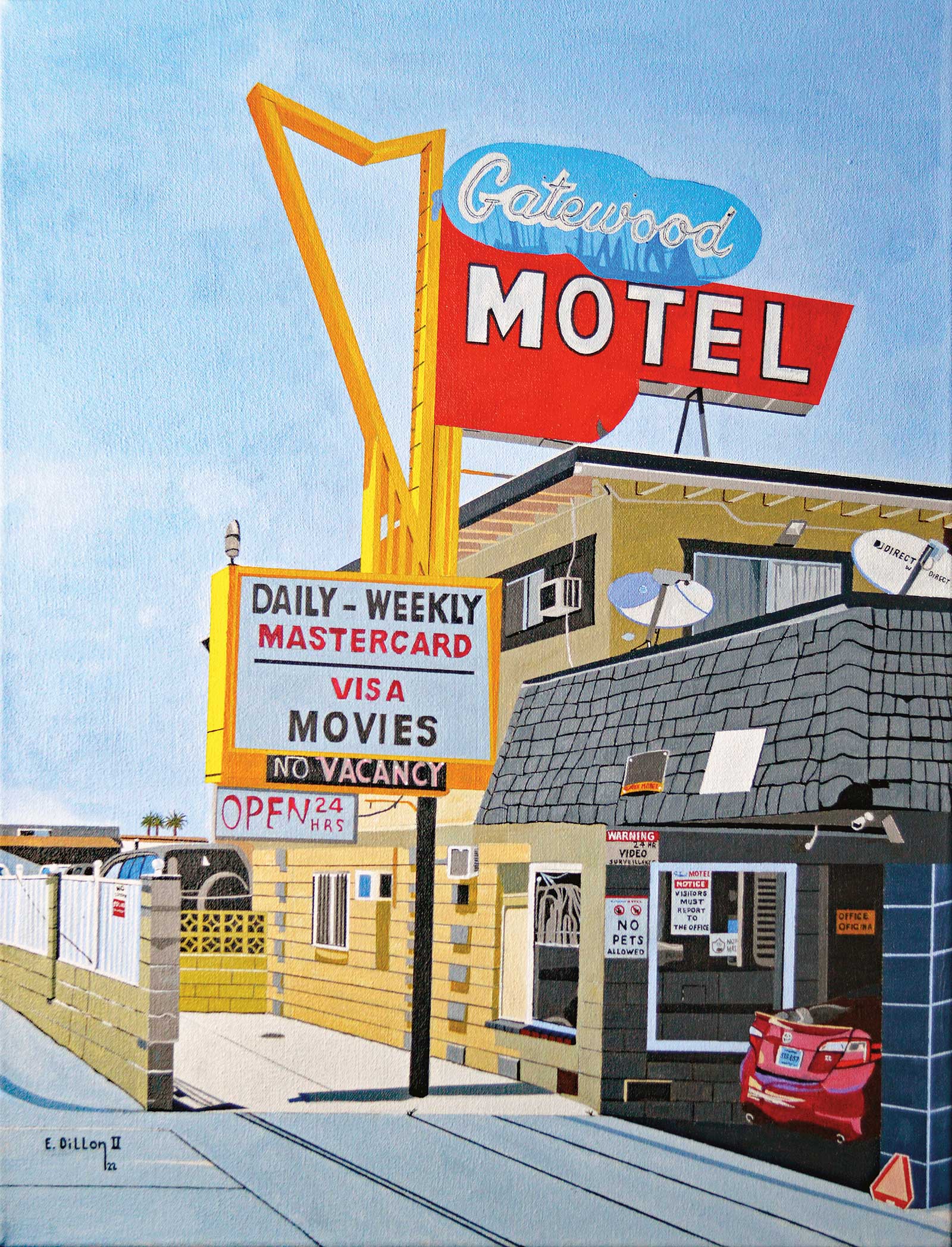
Emile Dillon pays attention to the constantly changing landscape of metropolitan cities. “I spent a lot of time photographing all the motels on East Fremont Street, most of which were in the process of being torn down for new construction. Some had the wire fences in place and the wrecking ball in the parking lot. As a result, my paintings provide a permanent keepsake of the past,” he says. His paintings employ bold color with a precise photographic style, drawing the viewer in. 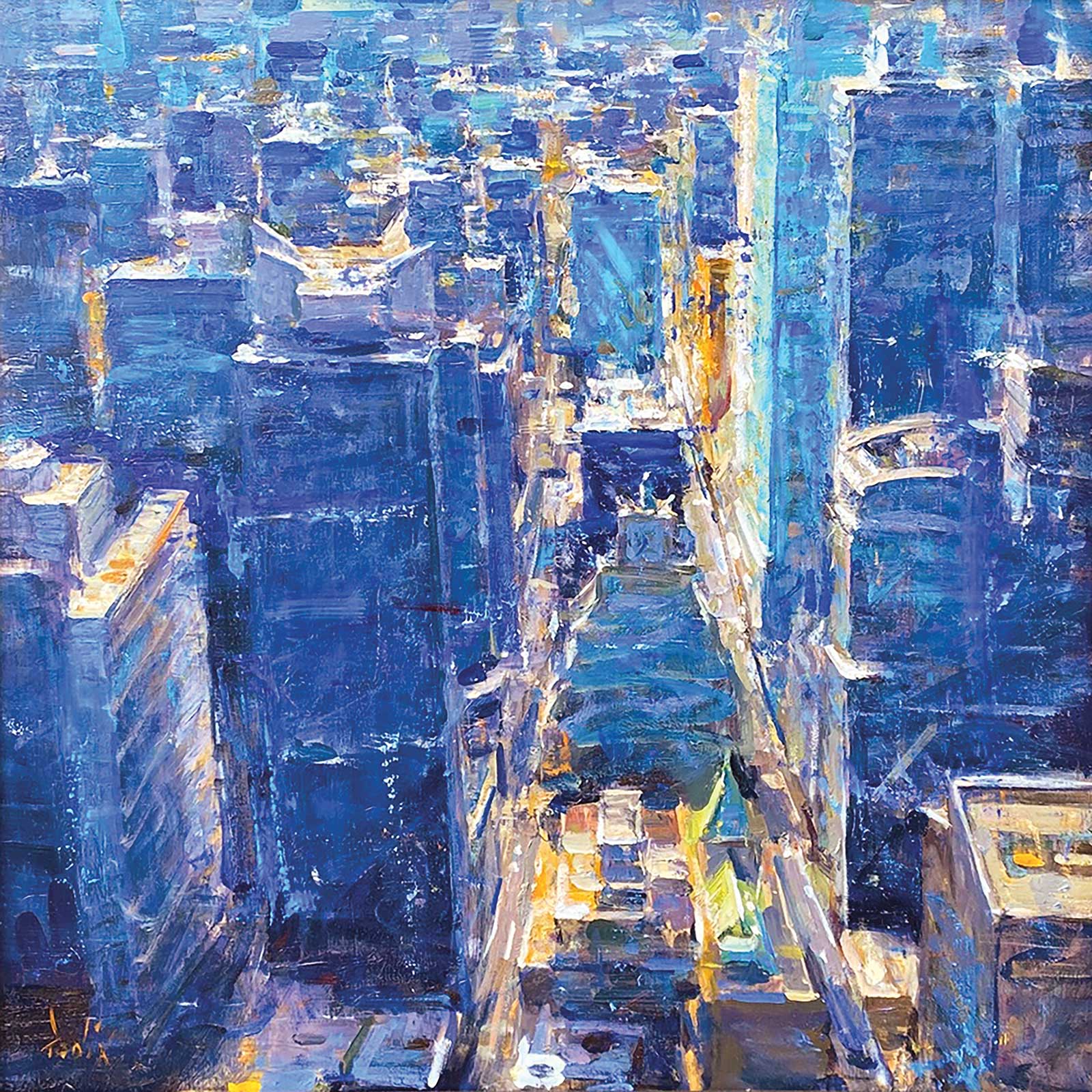 Claggett/Rey Gallery, New York Blues, oil, 24 x 24”, by Derek Penix
Every year beginning in January, the Celebration of Fine Art returns to Scottsdale, Arizona. This juried, invitational show has come to be recognized for its diverse array of exceptional art, and especially its inviting and interactive atmosphere that encourages connection between art lovers and artists. Within this diverse selection of art, showcased in a massive 40,000-square-foot space, are many depictions of city scenes from artists like Gregory Sievers, Stuart Yankel, Pete Tillack and Marty LeMessurier.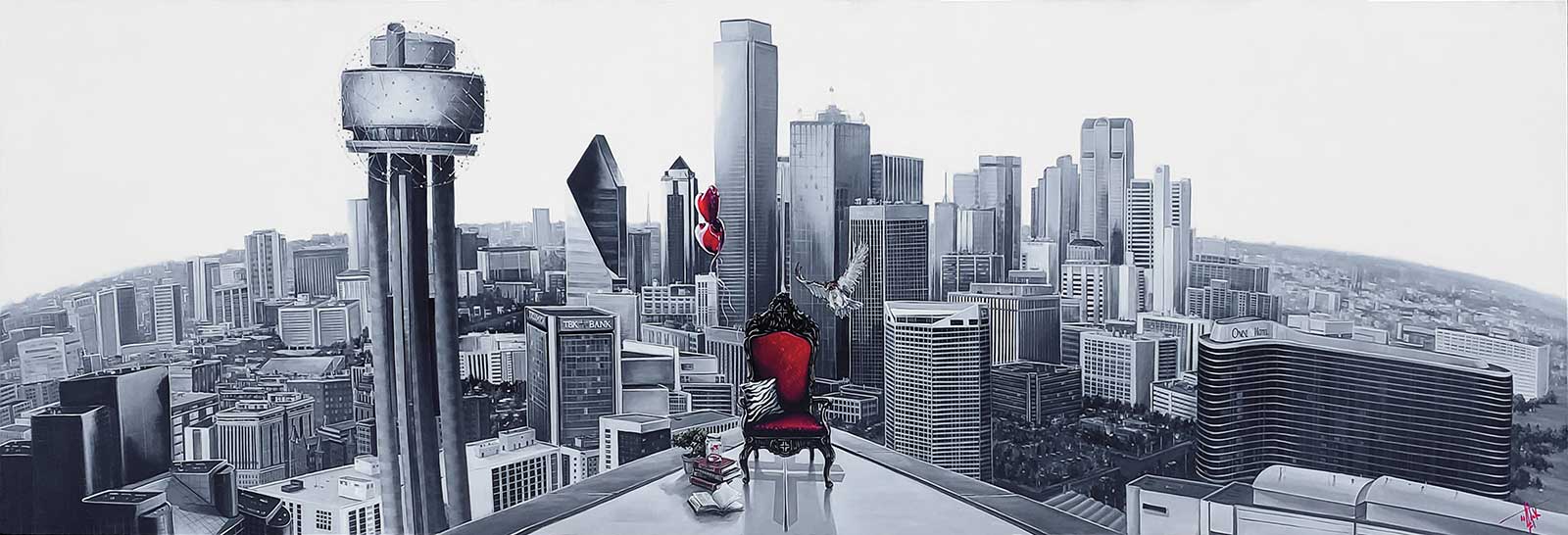 Celebration of Fine Art, Sky’s the Limit, oil on canvas, 41 x 125”, by Pete Tillack
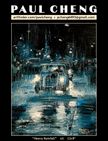
“One of the greatest aspects about art is that it can take you back to a time and a place in your mind as you gaze at the work of art. There is something especially compelling about a cityscape that can transport the viewer and evoke a memory of a trip or a moment in time,” says Susan Morrow Potje, co-owner and show director. “There is always a story that goes along with a good cityscape.” Throughout the 10 weeks of the show, visitors will see new works being created every day. The Celebration of Fine Art runs from January 14 to March 26.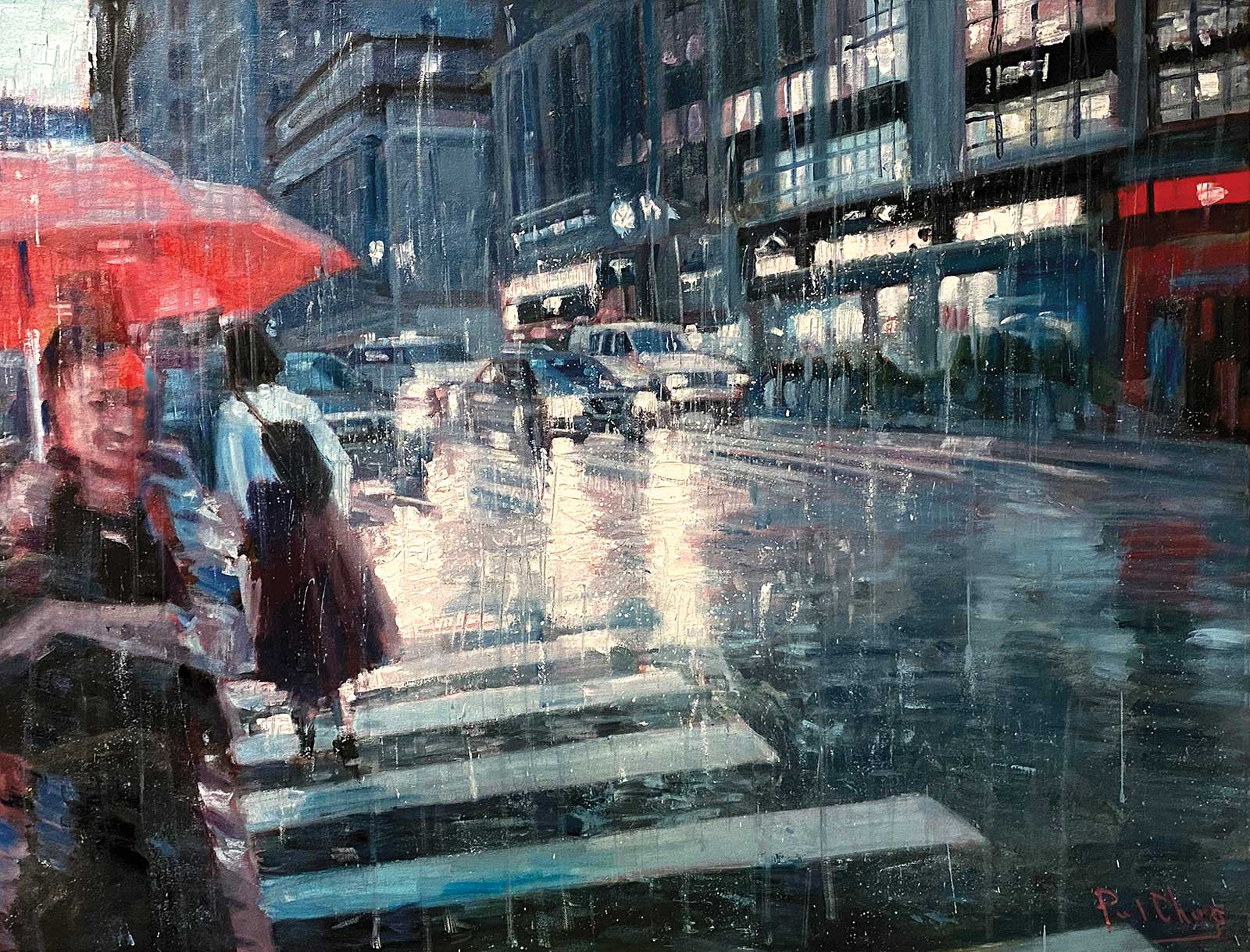 Paul Cheng, New York Rain, oil, 30 x 40”Growing up in a big city, Paul Cheng has been particularly in tune with metropolitan vibes since childhood. He focuses on “the city’s architecture...the smell of people and business, various climates and seasons, the matching of natural light and countless lights and various colors, sunshine, overcast days, rainy days and snowy days, the endless changes of color and light and dark contrast.” He adds, “In particular, the history and culture of ancient buildings in some ancient cities [makes] me very excited. The design style and historical traces of ancient buildings are really beautiful…I will continue to draw and capture new creative inspiration.” —
Featured Artists & Galleries
Arden Gallery
129 Newbury Street, Boston, MA 02116, (617) 247-0610
ardengallery@gmail.com
www.ardengallery.com
Celebration of Fine Art
18400 N. Hayden Road, Scottsdale, AZ 85255, (480) 443-7695
info@celebrateart.com
www.celebrateart.com
Claggett/Rey Gallery
216 Main Street, Suite C-100
Edwards, CO 81632
www.claggettrey.com
Emile Dillon
www.emiledillon.com
Paul Cheng
www.artfinder.com/paulcheng
Vose Galleries
238 Newbury Street, Boston, MA 02116, (617) 536-6176
info@vosegalleries.com
www.vosegalleries.com
Powered by Froala Editor