Marsden Hartley (1877-1943) admired the poetry of Walt Whitman (1819-1892) who wrote, “We don’t read and write poetry because it’s cute. We read and write poetry because we are members of the human race. And the human race is filled with passion. So medicine, law, business, engineering…these are noble pursuits and necessary to sustain life. But poetry, beauty, romance, love…these are what we stay alive for.”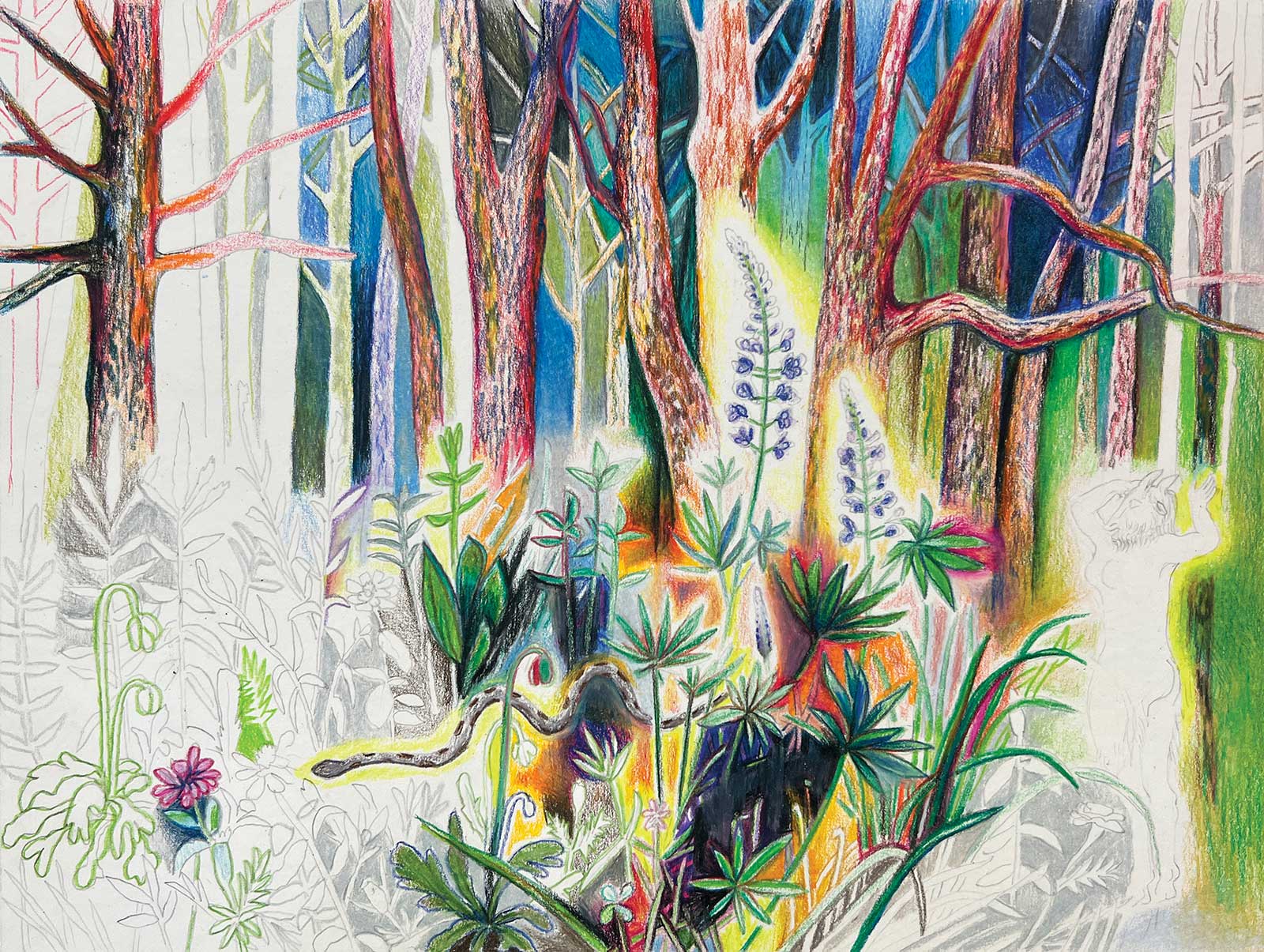 Jennifer Coates, Satyr, Lupines, Snake, 2022, gouache and colored pencil on paper, 9 x 12”. Courtesy of the artist and High Noon Gallery, New York, NY.
In his poetry, Whitman explored the connection between the individual and the universal, an exploration that Hartley undertook in his own work. He wrote to his friend the Irish American poet Shaemas O’Sheel, “My work embodies little visions of the great intangible...Some will say he’s gone mad—others will look and say he’s looked in at the lattices of Heaven and come back with the madness of splendor on him.”
Hartley was born in Maine and became a peripatetic painter, traveling the world, moving in the circles of the international avant-garde, but regularly returned to Maine.
He often returned to the subject of Mountain Katahdin, the highest mountain in Maine. His fascination recalls Cézanne’s regularly returning to the subject of Mont Sainte-Victoire. Cézanne was drawn to the aesthetic qualities of Mont Sainte-Victoire and by his emotional response to it. Hartley’s motivation, despite his identification with the mountain and its spiritual associations, was more practical. He wanted to be known as its “official portrait painter,” and more generally, “the artist from Maine.”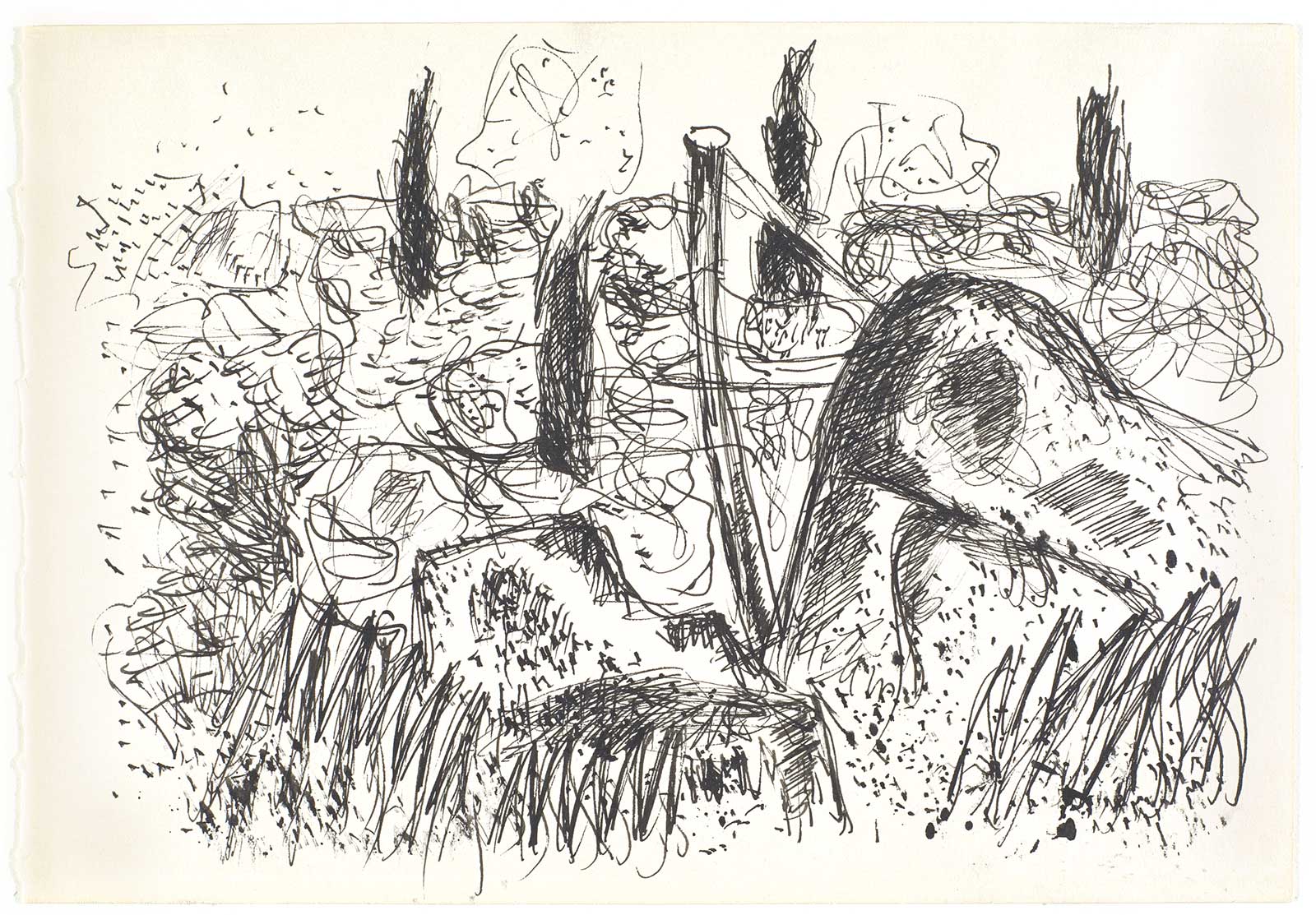 Marsden Hartley (1877-1943), [Dogtown study: Rocks, Fence Post, Juniper Trees, and Shrubs], ca. 1930s, black ink on white paper, 6 7/8 x 10”, 1955.1.37. Bates Museum of Art, Marsden Hartley Memorial Collection, gift of Norma Berger.After his first visit to the peak in 1939 he wrote to a friend, “I have achieved the ‘sacred’ pilgrimage to Ktaadn [Mountain]—exceeding all my expectations so far that I am sort of helpless with words. I feel as if I have seen God for the first time, and find him so nonchalantly solemn.”
In the exhibition And So Did Pleasure Take the Hand of Sorrow and They Wandered Through the Land of Joy at Bates College in Lewiston, Maine, through March 18, eight artists were invited to select a work from among the more than 100 drawings in the museum’s Marsden Hartley Memorial Collection to be displayed with their own work.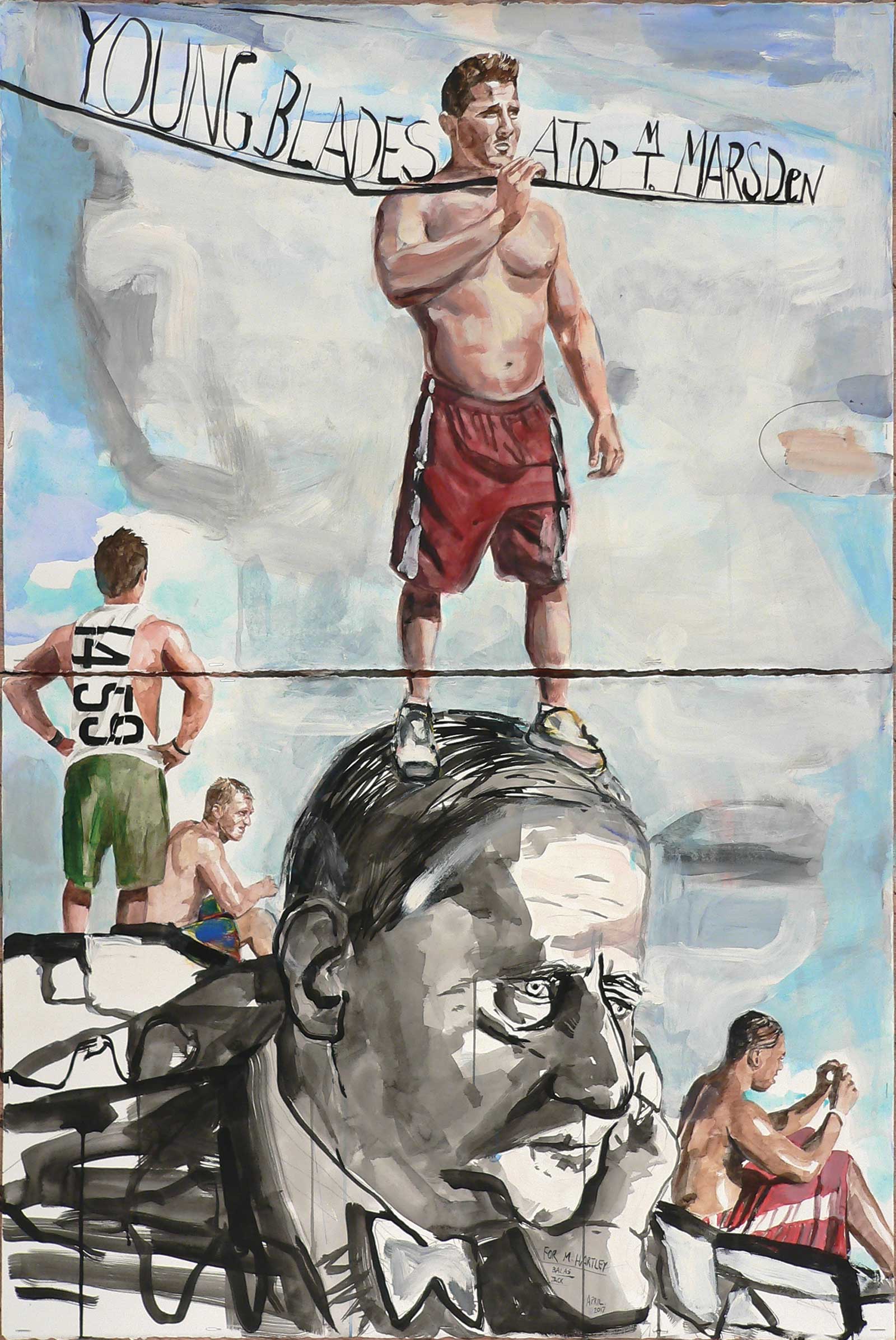 Jack Balas, YOUNG BLADES ATOP MT. MARSDEN (For Marsden Hartley) (#1459), 2017, watercolor, ink, and acrylic on paper, 45 x 30”. Bates Museum of Art, gift of Jack Balas and Wes Hempel, 2018.11.1.
Jennifer Coates chose to pair Hartley’s drawing, Dogtown study: Rocks, Fence Post, Juniper Trees, and Shrubs with her mixed media piece, Satyr, Lupines, Snake. Hartley visited Gloucester, Massachusetts, several times but shied away from the picturesque waterfront. He opted to explore the abandoned 18th-century community of Dogtown. He observed, “Dogtown looks like a cross between Easter Island and Stonehenge—essentially druidic in its appearance—it gives the feeling that an ancient race might turn up at any moment and renew an ageless rite there. Dogtown is therefore not the ground for sketch artists and that is why they never go there—much too eternal looking for the common eye.”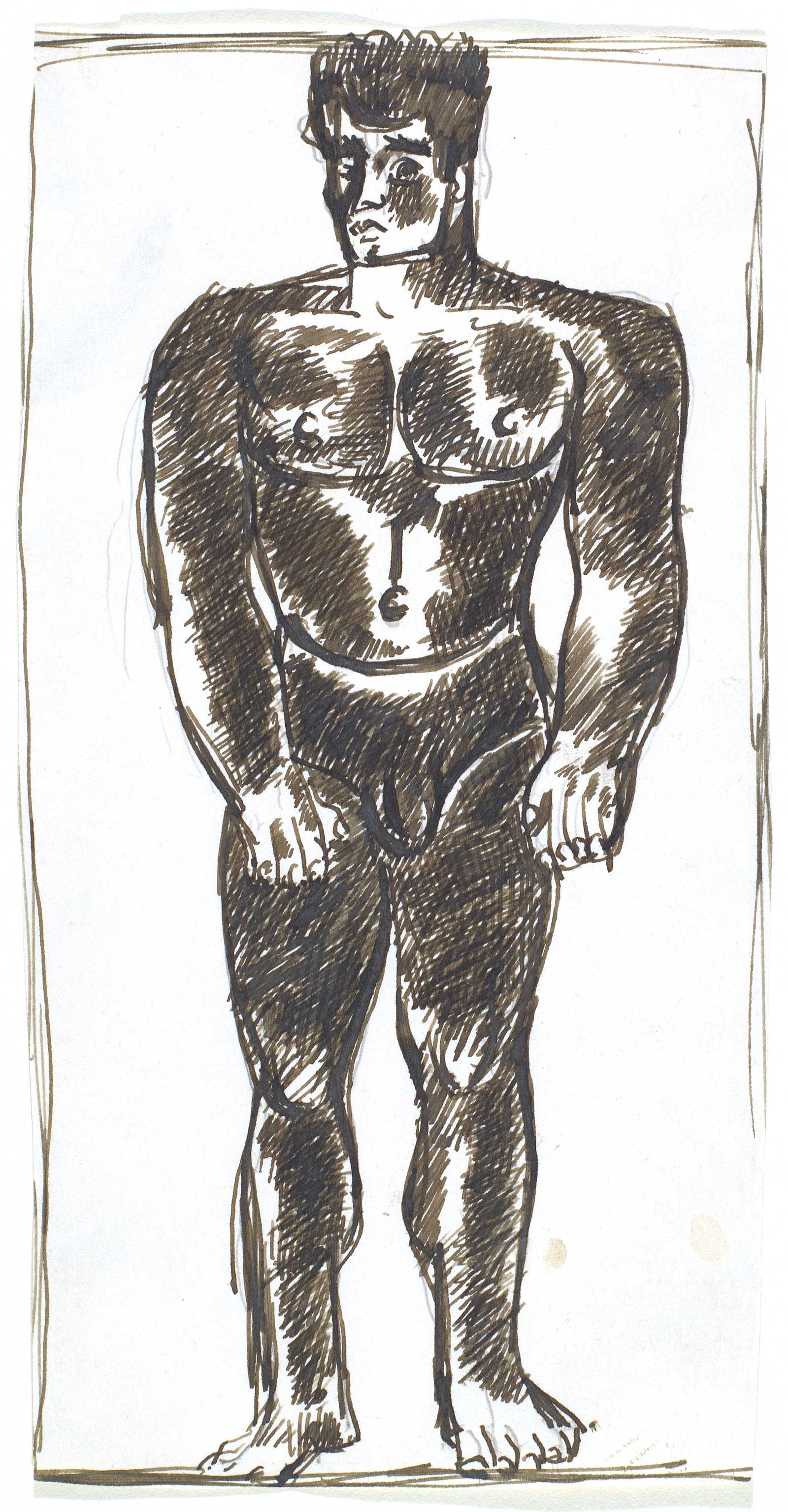 Marsden Hartley (1877-1943), [Standing Male Figure, No. 1], ca. 1938-41, graphite and black ink on paper, 93/8 x 4”, 1955.1.6. Bates Museum of Art.
In his drawing, Coates writes, “the lines are buzzing with energy. He re-inhabits the landscape with the residue of handmade lines and scratches on paper. There is an urgent desire to interpret what he sees and a sense of devotional mysticism.”
Coates considers her work is more plant-focused than rock-focused. She describes her paintings of her neighborhood Pennsylvania landscape: “My drawing and painting practice involves amping up light intensities and suffusing the landscape with a rainbow of colors from earth hues to candy to neon. There are gnarled apple trees that no longer produce fruit, woodland tangles by the side of the road, wild blackberries that encroach on paths, plants that glow Gatorade green in spring, and wither to black in fall. I feel compelled to record what I know will disappear—a keen alertness to a threatened natural world and a cataloguing of what exists where I am while I still can.”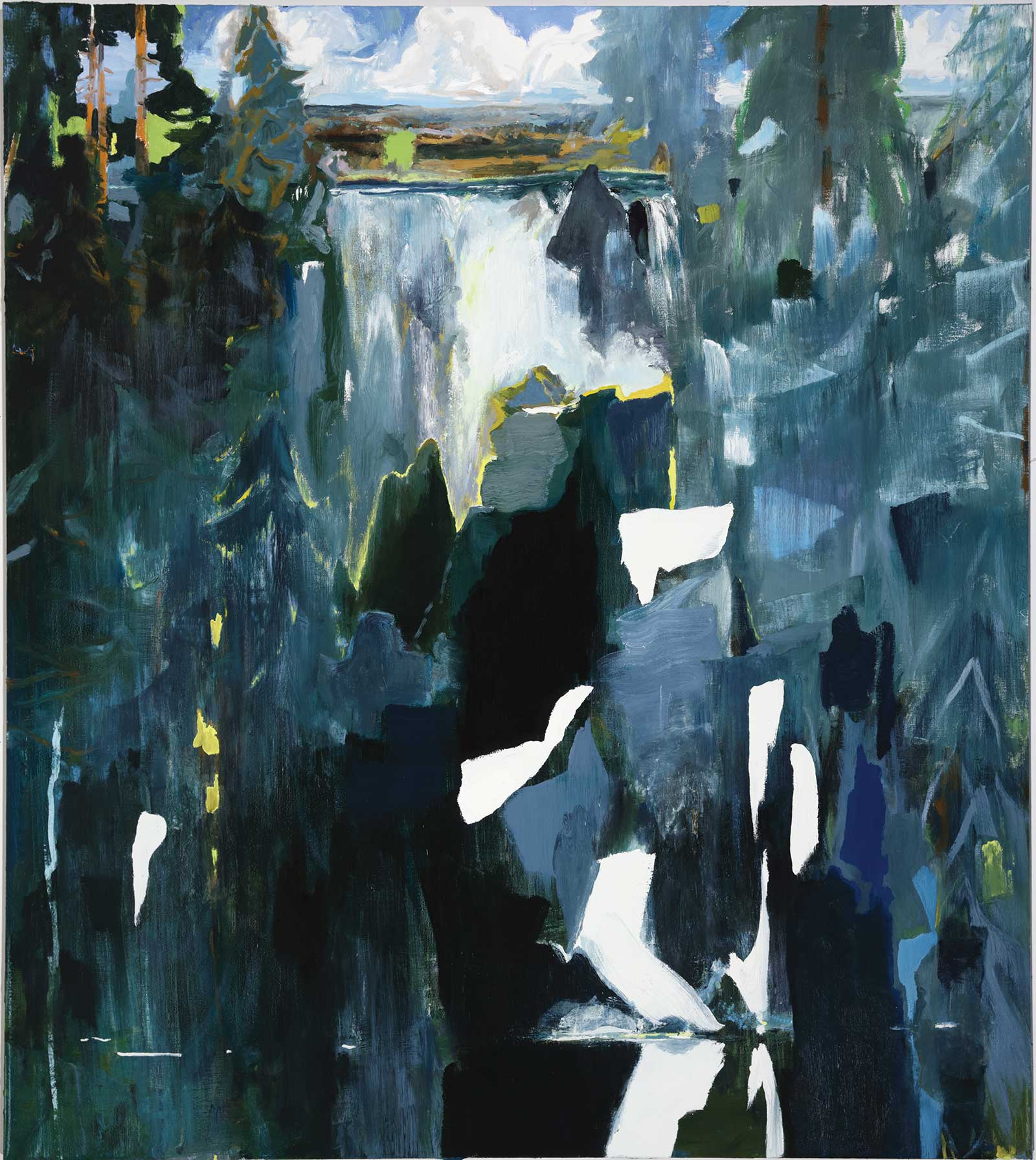 Eric Aho, Source, 2019, oil on linen, 90 x 80". Courtesy of the artist and DC Moore Gallery, New York, NY.
The museum notes, “Some of Hartley’s prominent, deeply personal themes include loss, mysticism and symbolism. The exhibition title is a passage from The Royal Love Child, a 1904 poem by Hartley, and these words encompass many of these concerns.
“Great artists impact subsequent generations of artists and that is evident in this exhibition. And So Did Pleasure...includes the work of accomplished artists ranging in age from their 30s to 90s who, rather than imitating Hartley, make work resonating with it in style, subject, idea and locale.”
Eric Aho selected a drawing of a forest glen to accompany his painting Source. Echoing Whitman and Hartley he writes,
“‘I am not a surface painter,’ Marsden Hartley once said, ‘the thing must be brought clearly to the surface in terms of itself,’ and though it’s unclear exactly what he meant, his expression evokes the depth of personal meaning he perceived in his subjects and explored on his canvases,” says Aho. “Such an attitude toward painting took the peripatetic Hartley on a search well past reality (because ‘to illustrate externals means nothing’), finally leading him to where ‘every picture is a portrait of something seen.’
“Hartley’s ideas resonate with me in relation to my own painted efforts as I also view the depiction of the landscape as a sort of self-portraiture. Or to put it another way, as Hartley might, the self and nature are fused together by looking and feeling closely, and rise to the surface through the action of painting.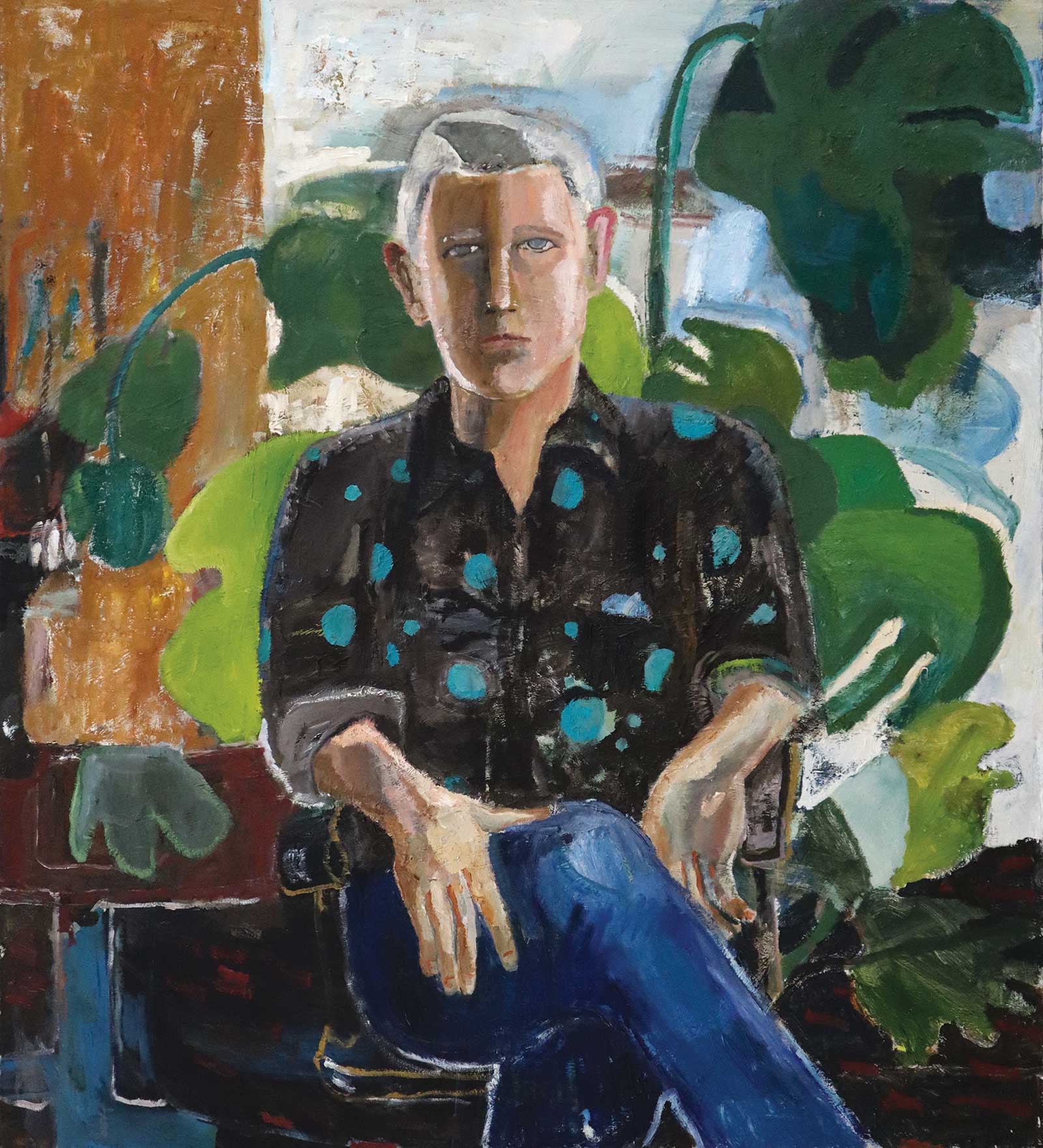 Mark Milroy, Win Knowlton, 2019, oil on linen, 40 x 36”. Courtesy of the artist and Nancy Margolis Gallery.“Known to work tirelessly, Hartley both lost and discovered himself in his painting. His obsession with the landscape became, in so many ways, an extension of his identity. ‘Symbolism can never quite be evaded in any work of art,’ he once said, ‘because every form and movement that we make symbolizes a condition in ourselves.’”
In addition to his landscapes and still lifes, Hartley painted burly male figures—lumberjacks, lobstermen, swimmers—reflecting the masculine ideals of the time as well as his own homosexual ideals. Randall Griffey, head curator of the Smithsonian American Art Museum has written, “Aggressively asserting their physical vitality while at the same time projecting a saint-like divinity, they call to mind Walt Whitman, whom the painter described, together with Cézanne, as among the great liberating voices in the arts.”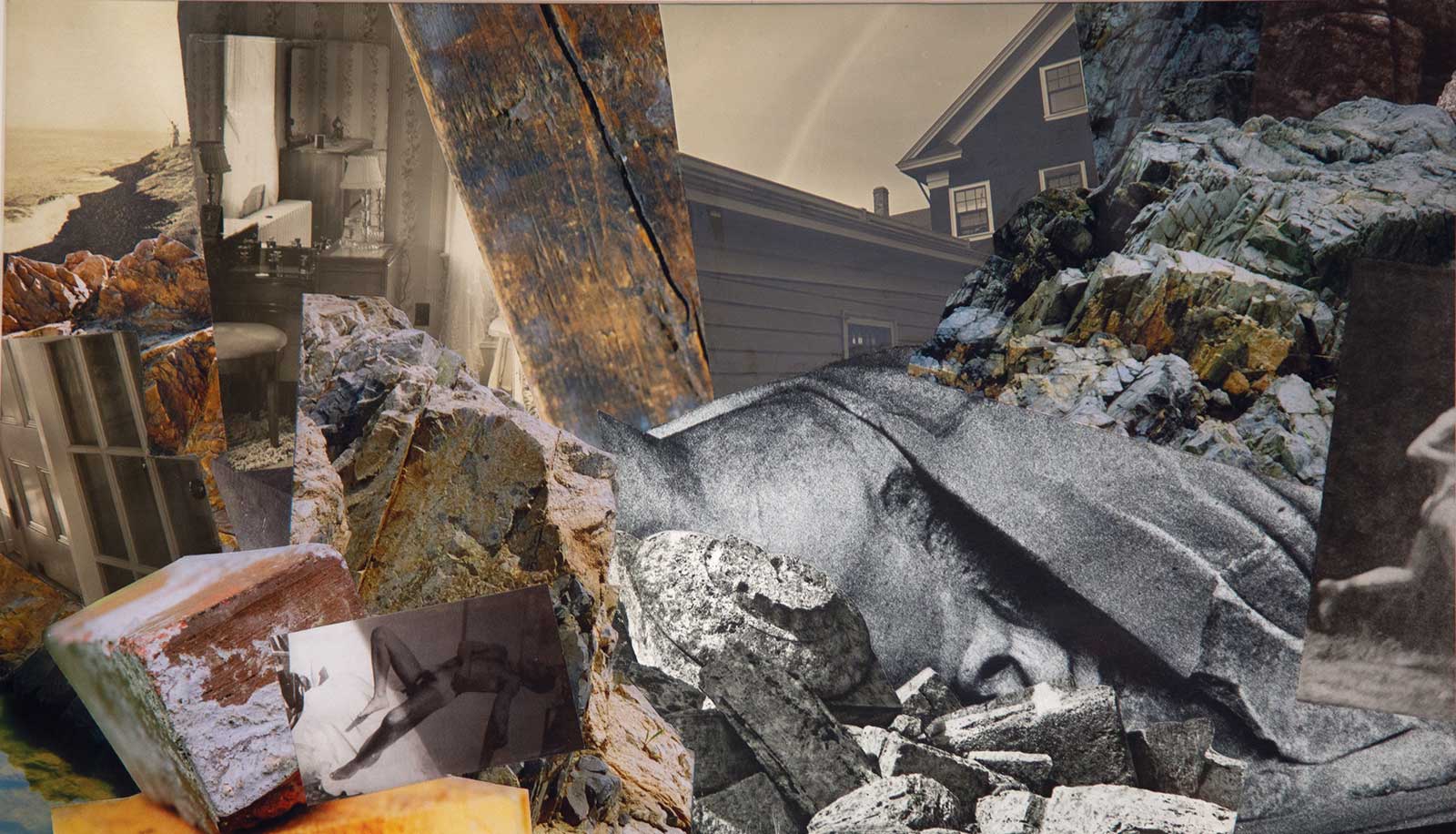 John O’Reilly, Dogtown-Hartley Series 10-14-09, 2009, Polaroid, color coupler print, halftone, gelatin silver print, 10 x 17”. Bates Museum of Art, gift of James Tellin, 2021.3.7.
Jack Balas has chosen Hartley’s drawing, Standing Male Figure, No. 1, to accompany his painting Young Blades Atop Mt. Marsden in which he has turned Hartley into a mountain himself. Balas writes, “It’s easy to see why I might respond to a drawing of a big beefy guy by Marsden Hartley when looking at my own paintings in the exhibition: big and beefy guys get my attention! I was certainly aware of Hartley’s work while in art school, but more for his bold and crude drawing style than for his connection to Maine. I was keenly aware of Maine, however, when it came to the landscapes and seascapes of Winslow Homer, Andrew Wyeth and Edward Hopper, and in fact on my first trip to the state the first thing I did, after dropping down from Quebec, was camp in Baxter State Park and climb Mt. Katahdin, before heading to the coast to take in lighthouses and fishing villages and my first view ever of an ocean (I was 19).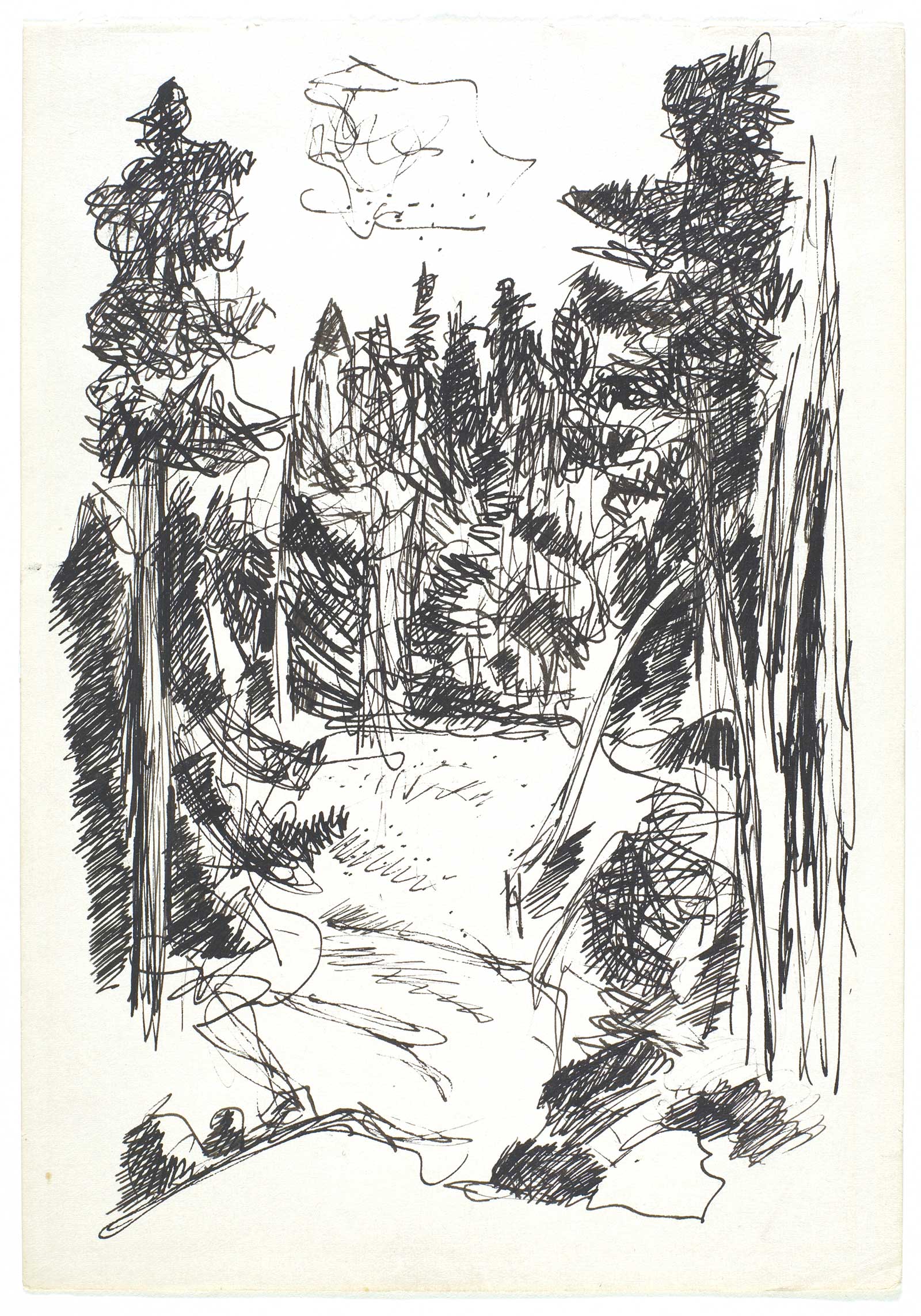 Marsden Hartley (1877-1943), [Forest Glade], ca. 1935-36, black ink on white paper, 9 7/8 x 6 7/8”, 1955.1.42. Bates Museum of Art, Marsden Hartley Memorial Collection, gift of Norma Berger.“Big beefy guys did gain my attention over those years, however, and slowly they muscled into my work, especially after
I discovered them at all hours on the beaches of Waikiki, Honolulu,” continues Balas. “So to look anew at Hartley’s work then was to feel a kind of parallel experience, and find myself saying ‘soulmates.’ One year, I even took along the Met’s new Hartley catalog to Waikiki, redrawing a number of his images into my yearly series of beach drawings Tattoo Detour.
I do wonder how he might have navigated today’s more open times when it comes to sexuality and desire, but those answers fall to those of us who have followed in his steps. My painting here in the show, Young Blades Atop Mt. Marsden, certainly pays tribute. It’s an honor to be showing it and my other work on the same wall as his.”
Other artists in the exhibition include Katherine Bradford, Jennifer Coates, Mark Milroy, John O’Reilly and Dan Schein. —
And So Did Pleasure Take the Hand of Sorrow and They Wandered Through the Land of Joy
When: Through March 18
Where: Bates College Museum of Art, Olin Arts Center, 75 Russell Street, Lewiston, Maine 04240
Information: (207) 786-6158, www.bates.edu
Powered by Froala Editor