Luke Hillestad’s recent show of oils at Copro Gallery in Los Angeles was full of medicine and magic, an offering of herbal healing through images of pagan and Christian mythology and lore. His figurative paintings reach into the past, weaving the spells of the ancients into his images, telling tales of trust and tradition, each image tying people and plants together.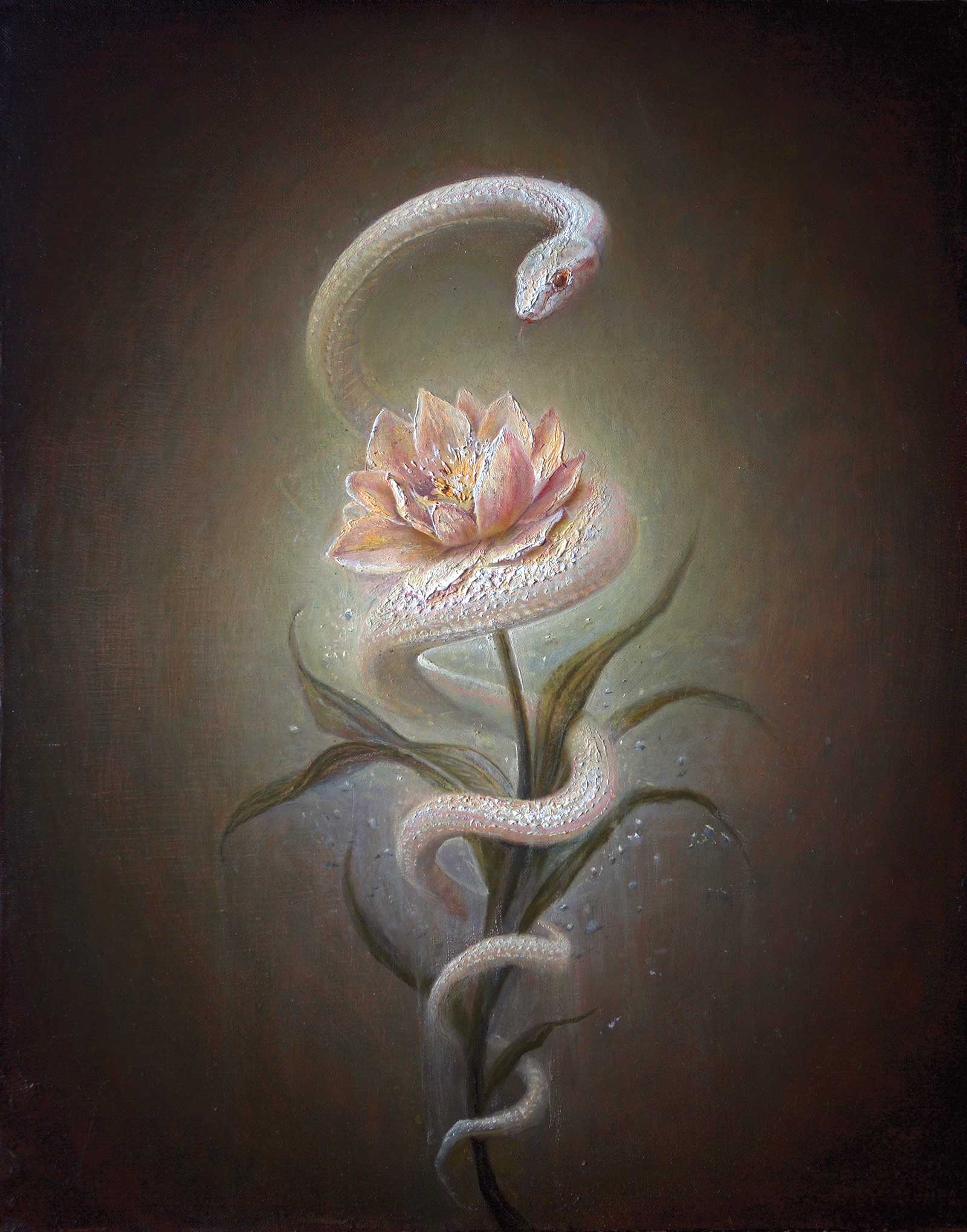 Gilgamesh’s Flower, oil on linen, 20 x 16"The floral fingers of the long tradition of botanical art reach back to the paleolithic caves of prehistory, where fearless hunter-gatherers painted their lamp-lit shamanic visions onto the dark faces of rock walls beside the snoring bulk of hibernating bears, inextricably linking herbal medicine and spirituality into the earliest moments of art history. Delicate mushrooms and flowers hide among their primordial paintings of beautifully rendered charcoal herds of black buffalo and red ochre prides of lions. Hillestad binds his work into this lineage of health and therapy, using texts like “The Epic of Gilgamesh” and “The Iliad” and Pliny the Elder as sources.
His small emblem painting, Gilgamesh’s Flower, was inspired by the hero of the ancient epic written about 2000 B.C. In it, a Noah-like character told King Gilgamesh where he could find the flower of youth hidden at the bottom of the sea, but warned him that it had thorns like a rose. Fearlessly, Gilgamesh tied stones to his feet and dove into the depths, and despite the thorns, he grasped the flower and brought it to the surface. Worried about the consequences of eating it, he decided to return to Uruk, the capital of his kingdom, planning to test some of the flower on an old man to see its effects, then eat it himself to return to his youth. However, on his journey home Gilgamesh decided to take a dip in a spring to prepare for his arrival. While he washed in the cool waters, a snake stole the flower, and shed its skin. Gilgamesh wept.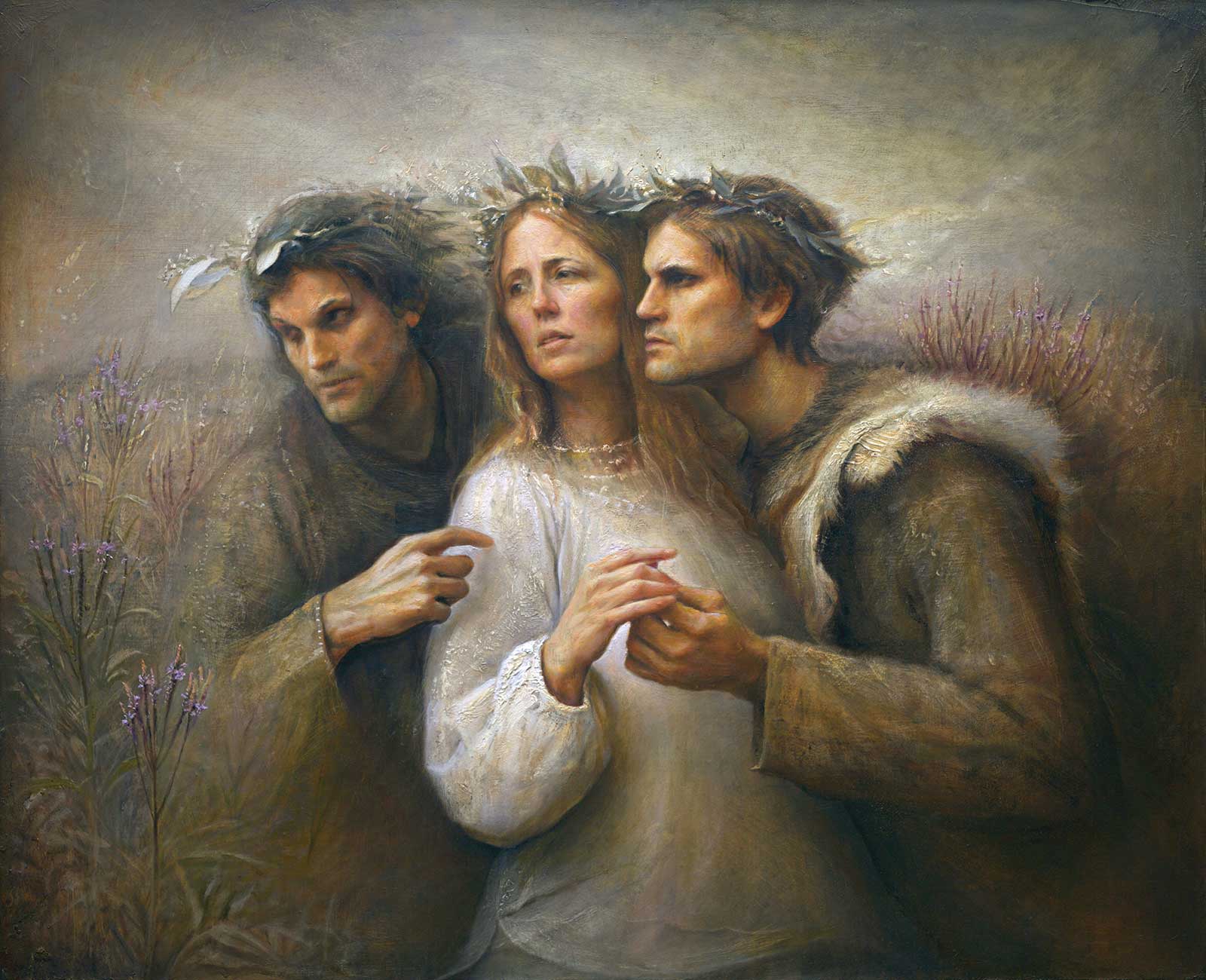 Pages of Vervain (Verbena hastata), oil on linen, 26 x 32"
Hillestad’s potent paintings are deeply concerned with memory and cultural heritage, and they also pay homage to the traditions of craftsmanship, in which techniques are passed through time from generation to generation. His hand bears the imprint and unmistakable influence of his teacher, Odd Nerdrum, who created a phenomenal body of groundbreaking 20th-century figurative work, then emulated the ancient and simple palette of Apelles, and the texture and scrape of Rembrandt. Hillestad first made the pilgrimage to Nerdrum’s Norwegian studio in 2008, then his Paris mansion in 2011, and returned to Norway in 2012. There, he learned the methods of the master by watching him at work. Hillestad recalls, “The craft of painting is very particular in a lot of ways…it’s strange because even though it’s technical, it’s very difficult to write. I often find myself remembering technique that’s muscle memory, and I could hardly put it into words. It’s physical; it’s not metaphysical; it’s one of the five senses. It’s integrated sense—witnessing the technique and then immediately going to apply it in the students’ studio.”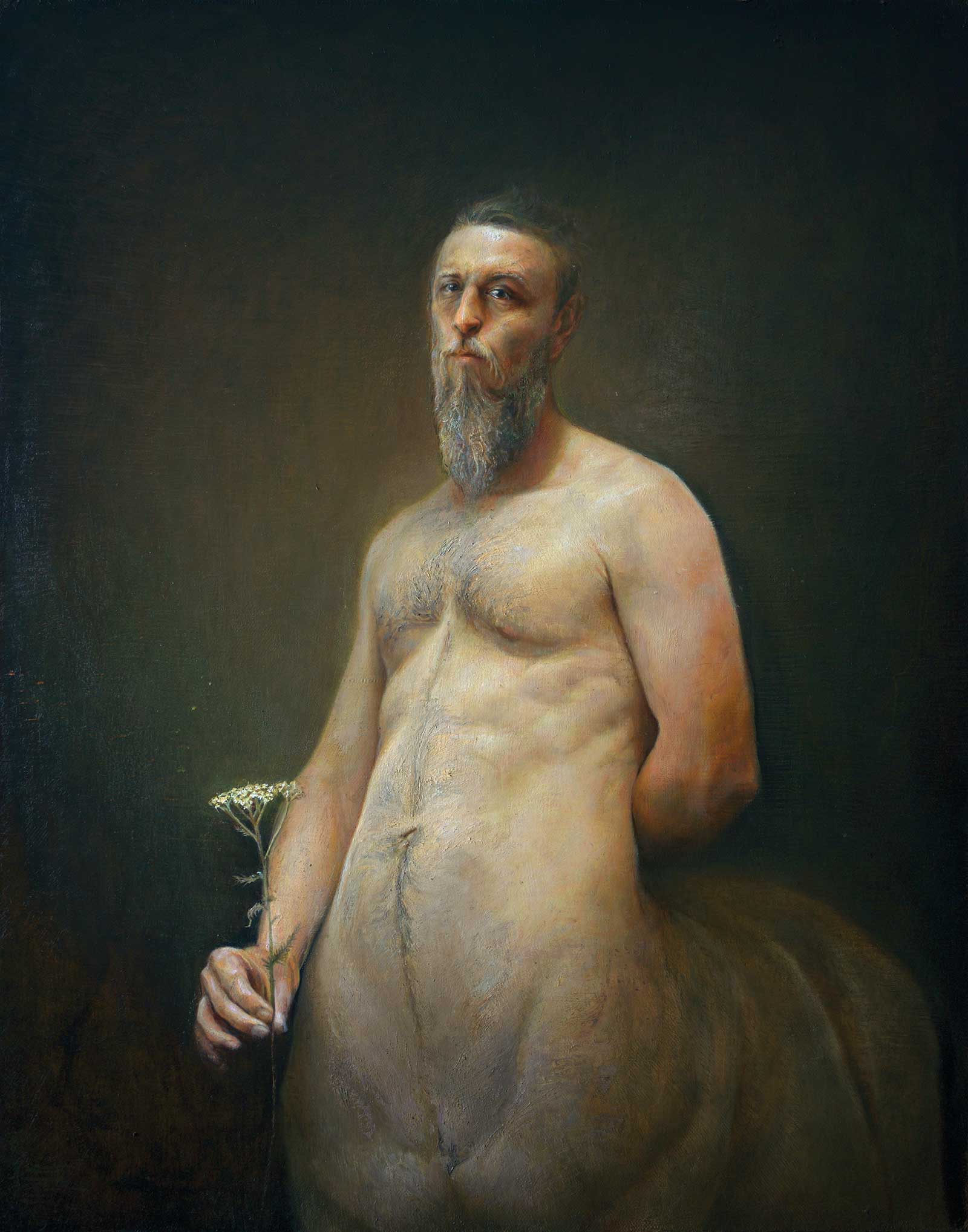 Chiron’s Yarrow (Achillea millefolium), oil on hemp, 39 x 31"
His training wasn’t only technical. He says his spiritual debt to Nerdrum feels immense but also that his experiences in the studio freed him to express himself. Hillestad says, “I feel like I had everything I owe to him before I knew he existed. Seeing his work tapped into what was already there. I’m Aristotelian in that I owe him every technique he taught me.” He is keenly aware of his place in the lineage of tradition. “I’m still pursuing Nerdrum’s excellence, along with Rembrandt or Titian, and things I like from Botticelli and a whole host of people, and I have their books open next to me just like I did 12 years ago. I think it’s interesting for people to witness Odd working with books open next to him like Munch and Renoir. The method of working among masters is co-evolution, so when I pursue excellence, my ambition will frequently encounter Nerdrum.”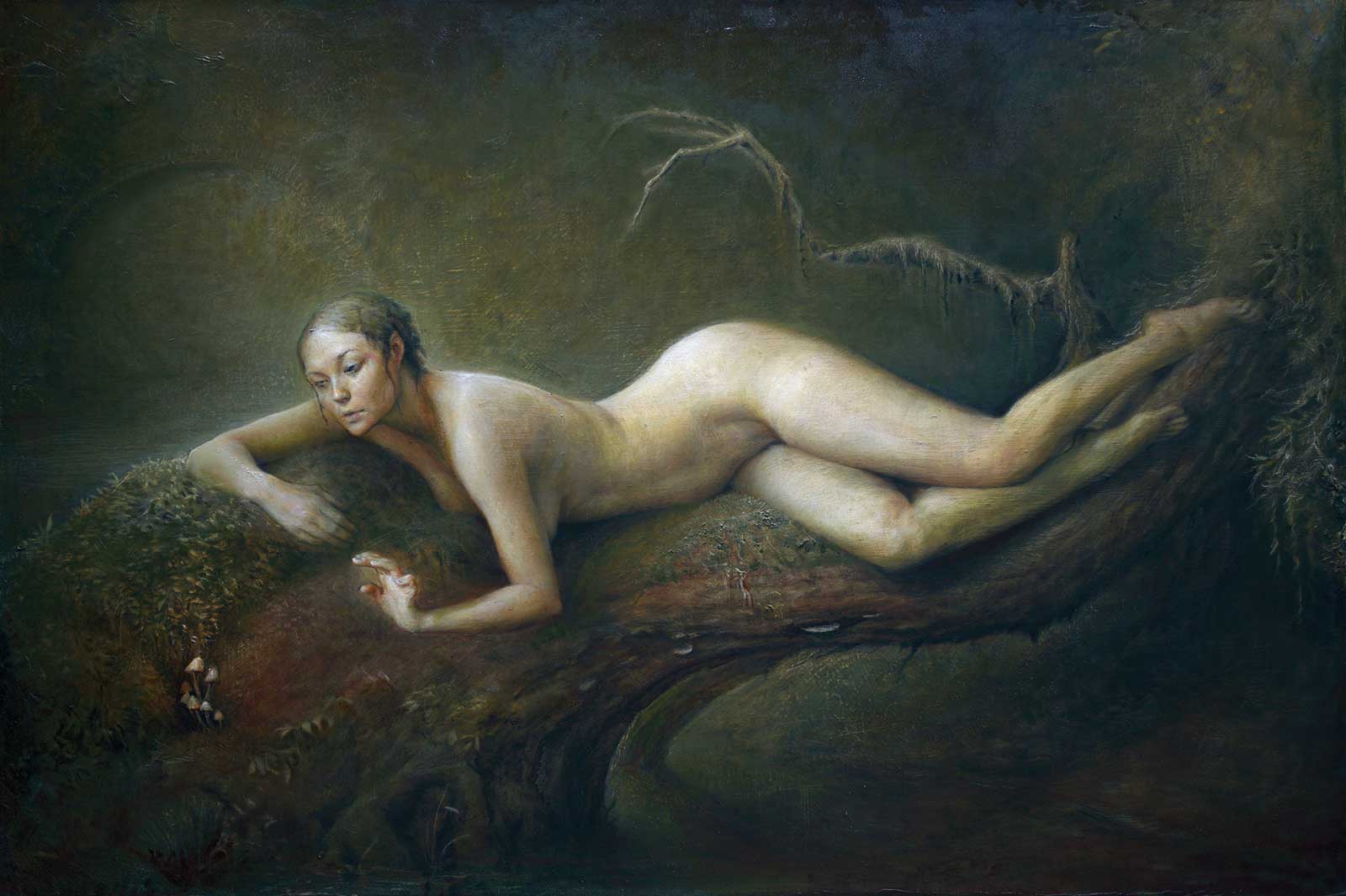 Mushroomer, oil on linen, 24 x 36"
While this latest exhibit reveals Hillestad’s care to maintain his technical debt to Nerdrum, he has stepped away from the thematic subjects favored by his mentor and found a new, collaborative voice based on his relationship with his wife, Michelle. She has become a serious student of medicinal herbalism since the couple moved away from Minneapolis to New Ulm, a small town in the heart of rural Minnesota, where the television series “Little House on the Prairie” was filmed. These paintings of mythology, and herbalism, health and magic, are born from the Hillestads’ shared knowledge of plants for therapeutic treatment, and their relearning of lost lore.
Their home is hung with vervain, which Pliny tells us was gathered by druids on nights of the new moon when Sirius was rising, using it for clearsighted divination and prophesy. Hillestad’s painting Pages of Vervain (Verbena hastata) illustrates both his debt to Nerdrum and his path into the future, for while it is deeply indebted to Nerdrum’s apocalyptic refugees, the figures are young and leanly modern, and garlanded with leaves and flowers, and surrounded with the delicate stems of eponymous vervain. The archetypal woman in white is the chosen one, selected to be a disciple of herbs like the apostle in Caravaggio’s The Calling of Saint Matthew.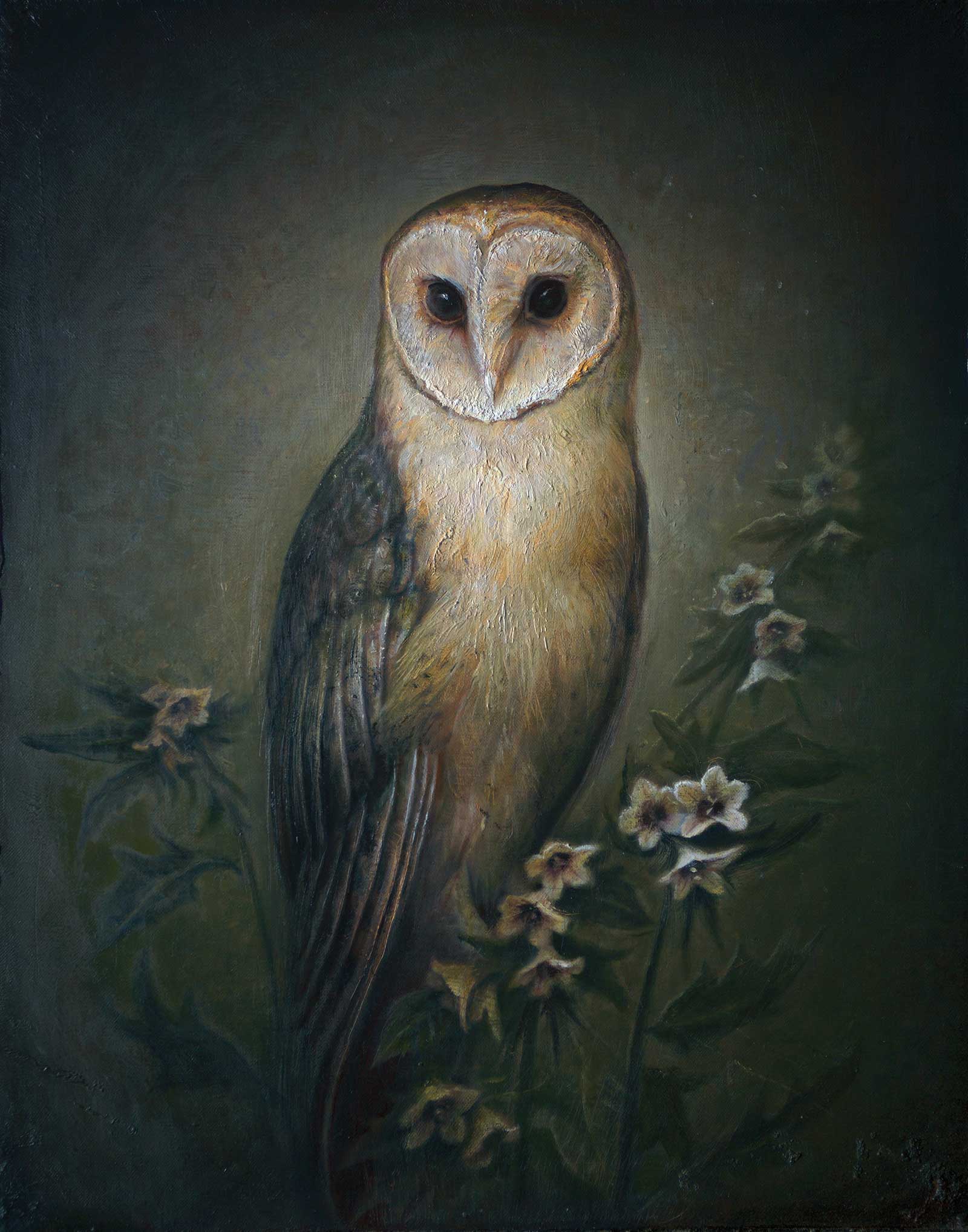 Henbane (Hyoscyamus niger), oil on linen, 20 x 16"
Hillestad is at his most pagan with his Beltane, reimagining Goya’s Witches’ Sabbath as a costumed ceremony celebrating nature, rather than as a propaganda painting of a horror fantasia designed to frighten Christians and fetishize pagans as devil-worshippers. A woman leads a draped figure with a goat’s head to a trio of herb-gathering and delicately horned women. A small fire burns in a broad bowl, and one of the three drops a mandrake root into the flames, and has henbane draped over her arm. Another offers a sprig of rosemary for remembrance and gazes at us, reminding us of the fearful flames of persecution suffered by past pagans. In the background a figure dances silhouetted by a bonfire beside a flowering hawthorn tree.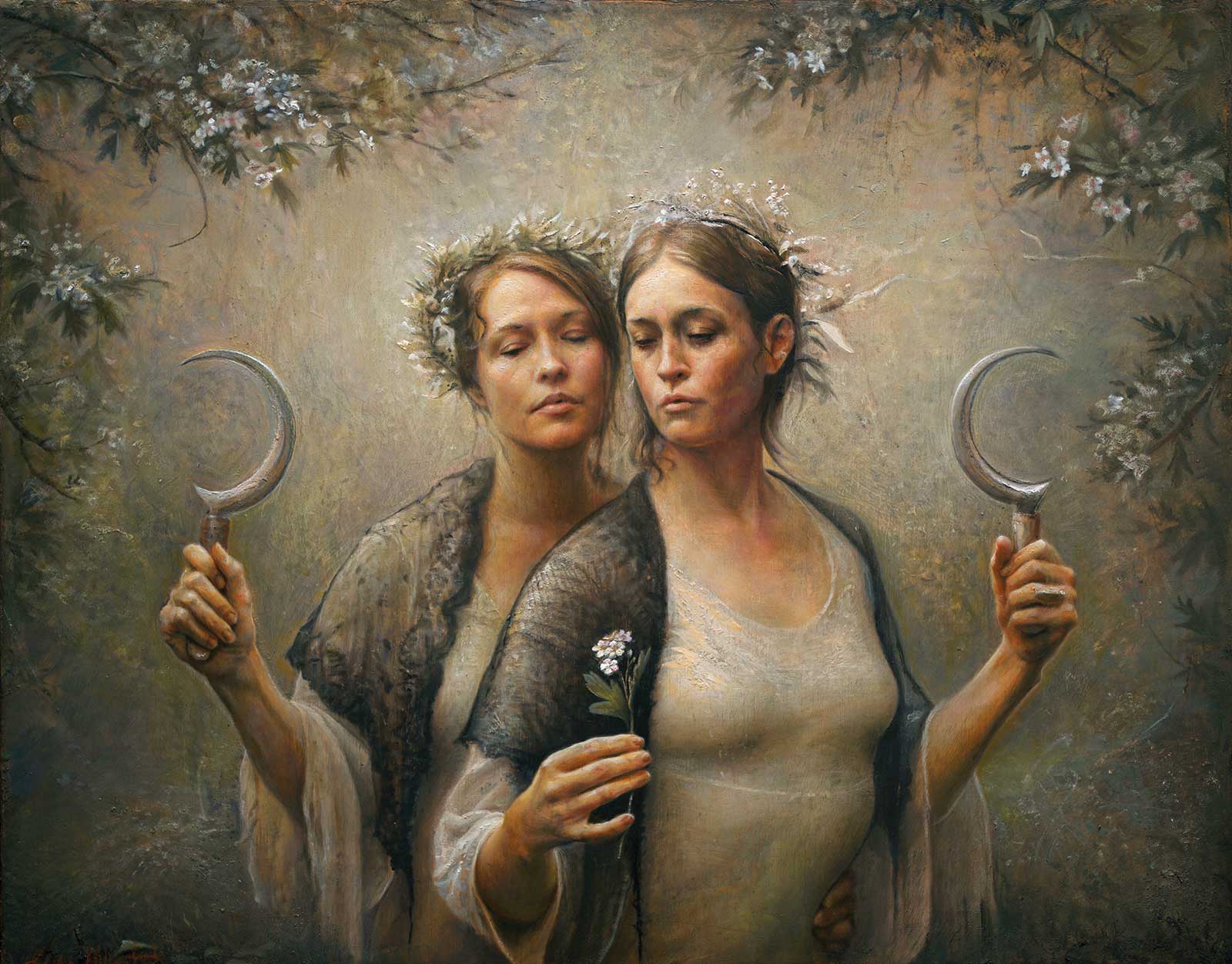 Hawthorn (Crataegus monogyna), oil on linen, 22 x 28"
Hillestad emphasizes that he crafts his images to provide healing, saying, “I wonder what would happen with the medical industry if we understood how much visual stories can heal us. I heard about how the old tragedies were used to help heal soldiers who were coming back from war as a therapy, and I think there’s an enormous therapeutic function to the stories of the paintings. I won’t be charging the insurance companies any time soon though.”
Sometimes the paintings are especially personal. His Chiron’s Yarrow (Achillea millefolium) is a melancholy portrait of Chiron the Centaur, the wounded healer who gave yarrow to the mythological warrior Achilles to thicken the blood of his wounded soldiers. Hillestad has a metal heart valve implant and takes a daily dose of blood thinner. “I have a visceral reaction to stopping the blood from continuing to flow,” he says.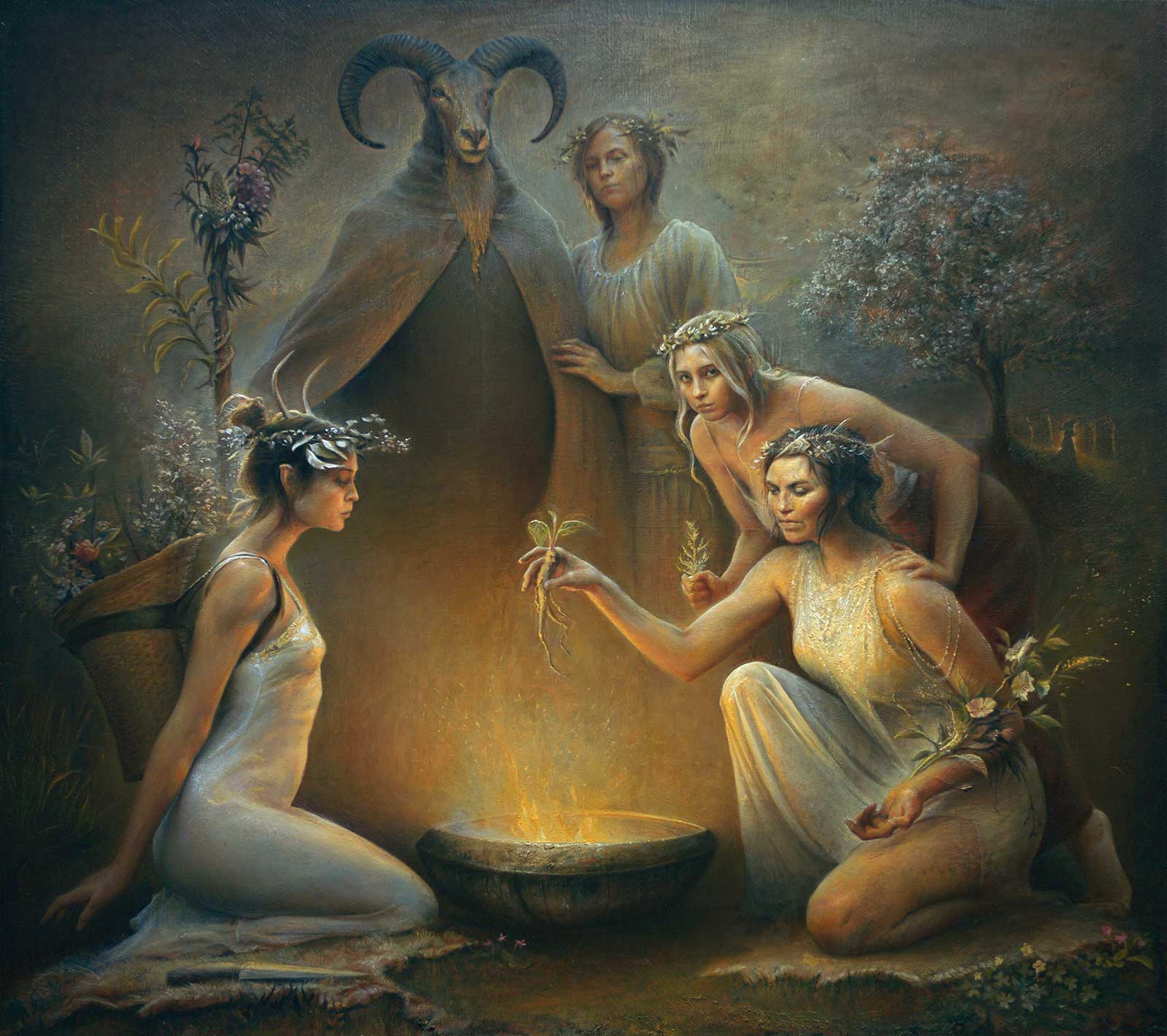 Beltane, oil on hemp, 45 x 51"The paintings stretch the boundaries of conventional illustration. Hillestad’s naked Mushroomer stretches along the trunk of a fallen tree, reaching for a cluster of medicinal fungi growing in a cozy hollow. Her pose refers to Nerdrum’s Sandlickers, but Hillestad has exaggerated the proportions of her body to Mannerist extremes, and entered the realms of imaginative realism by extending a leafless and threatening branch which reaches clutching claws toward her. The Mushroomer is reminiscent of Shakespeare’s drowned Ophelia, who over-reached to display her bouquet of nature’s bounty on a willow which grew aslant a brook, and fell to her drowning death. The painting is a warning—this mushroom posy comes with risk. We may drown in the stream of mind. —
+++
Michael Pearce is a dynamic writer, curator, and critic. He is a champion of skill-based art that emerges from popular culture and shapes the spirit of the age. He has published dozens of articles, and is author of Art in the Age of Emergence. He is Professor of Art at California Lutheran University.
Powered by Froala Editor