The complexity of nature is mirrored in the complexity of techniques in Julia Lucey’s aquatint etching collages. She can be inspired by the flora and fauna in her own yard or what she sees on hikes along the trails that surround her northern California home.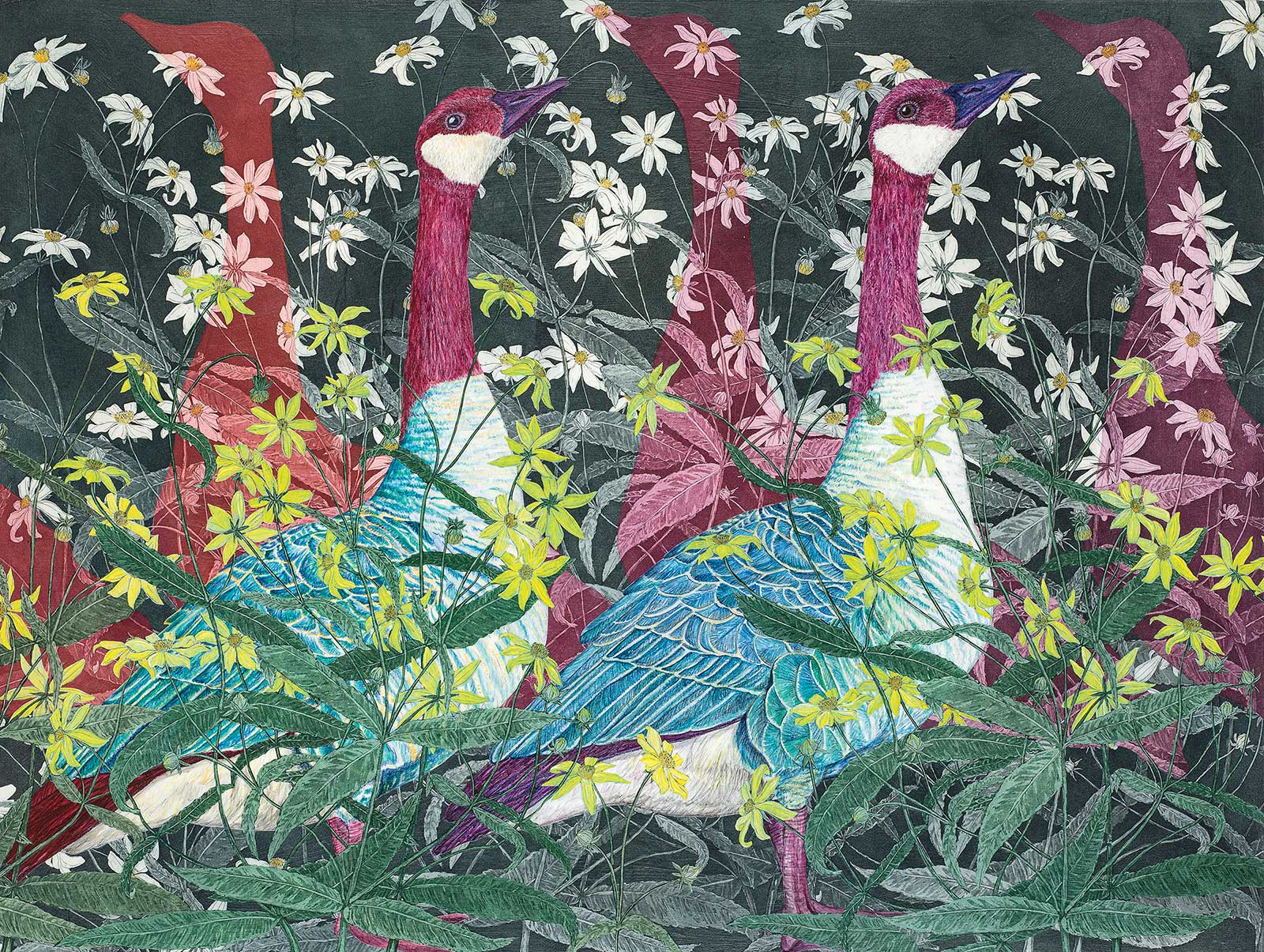 Canada Geese, mixed media collage (aquatint etchings and acrylic), 30 x 40"
She comments, “My work has always been inspired by my love of being outside in wild places. It is not just the calming escape it creates, but the curiosity and desire to know what inhabits each place. I have been creating individual etchings of the plants and animals that live near my home. In some ways these etchings reference the natural history prints of artist/biologist catalogers such as Audubon.”
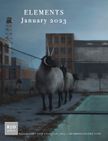
Unlike the botanical/wildlife paintings produced as editioned prints, Lacey’s images are unique, assembled from the individual etchings she has printed in a variety of colors, cut out and assembled into intricate compositions. Within the collage there are often animals painted in high detail in contrast to monochromatic silhouettes of other animals. The painted images represent native species, and the silhouettes represent non-native species.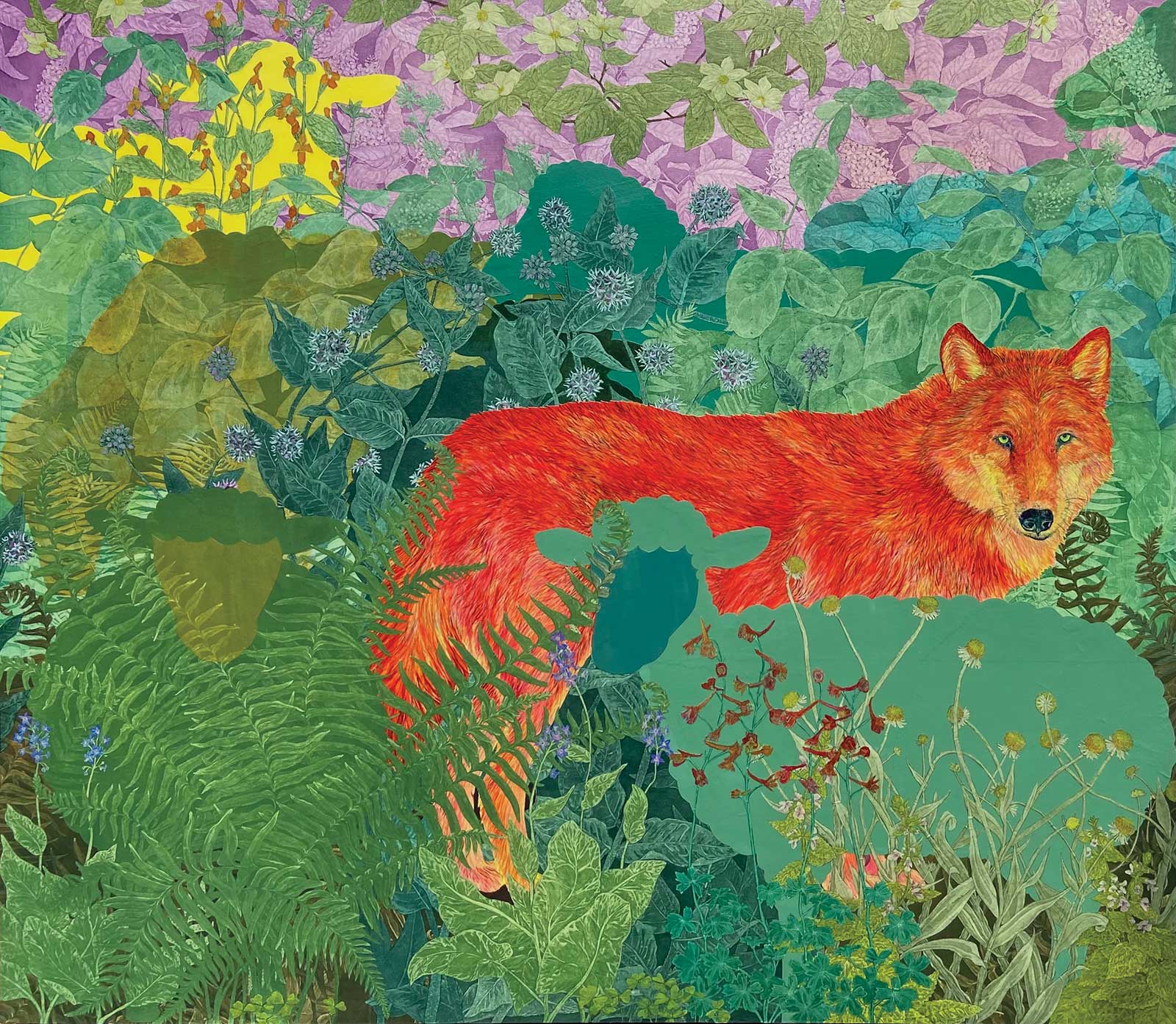 Wolf and Sheep, mixed media collage (aquatint etchings and acrylic), 42 x 48"
The complexity of nature in her own backyard inspired her collage Dogs and Cats. She has bird feeders whose visitors attract her neighbor’s cat which is chased away by her own dog. In the collage the dogs and cats are silhouettes since they are domesticated and not native. The cat’s expressive eyes are prominent, however, watching for birds or, perhaps, daring the dogs or their humans to make them leave.
The cats sit in a toyon or Christmas berry shrub. The berries will mature and later provide a feast for the birds. The dogs cavort in a sea of bur-marigolds which appear again in her Canada Geese collage.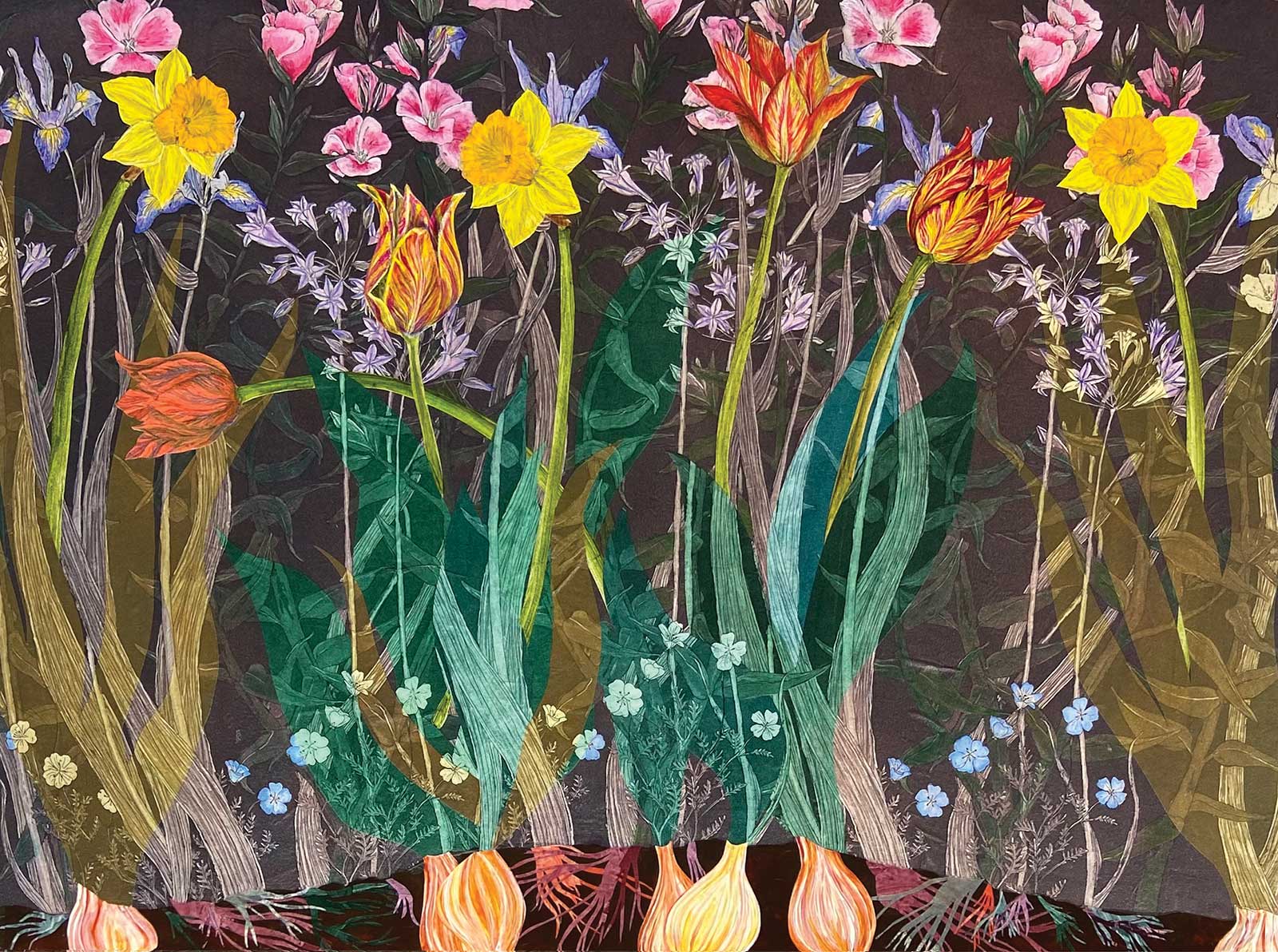 Tulips and Daffodils in California Wildflowers, mixed media collage (aquatint etchings and acrylic),
18 x 24"The complexity of the relationship of native and non-native species is reflected in Wolf and Sheep—domestic sheep graze in the wolf’s natural habitat. The sheep are important to the agricultural economy, however, providing wool and meat. Agriculturalists and environmentalists are continuing to explore ways to protect the sheep without the wholesale eradication of the wolves as has happened in the past. Lucey relates the unexpected introduction of llamas to protect the sheep. Llamas are alert, natural herders and are territorial, bonding with the sheep and chasing off predators.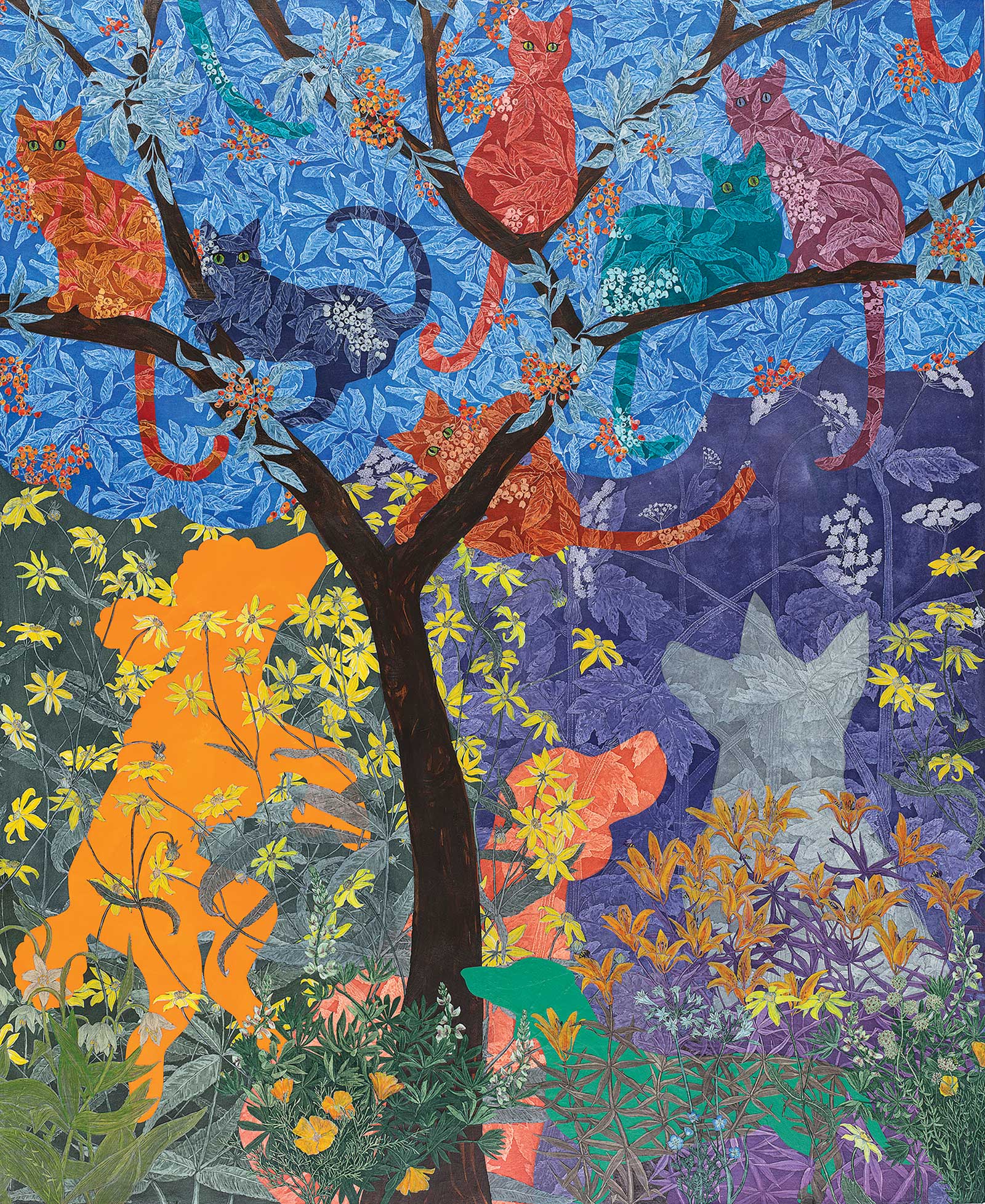 Dogs and Cats, mixed media collage (aquatint etchings and acrylic), 55 x 44"
We’ve, perhaps, all made collages at some time in our lives, cutting out images from magazines and gluing them down in increasingly thickening compositions. Lucey prints her etchings on Japanese Awagami Mingeishi paper that is strong enough to stand up to the etching process and thin enough to avoid the thickness of traditional collage.
Her etchings are produced and printed from copper plates at the Kala Art Institute in Berkeley, California, where she has been an artist in residence. She explains, “There are three steps that I use to create my etching plates and print them. These are hardground [for line work], aquatint [for creating areas with different gray tones] and then lastly, printing. The idea of etching is that you create ‘grooves’ or recessed marks in a flat metal plate using acid. Ink is rubbed into the grooves and then, using an etching press, pushed into damp paper.” She stores the prints in flat files at her home in Fairfax, California, and brings them out to cut and assemble at her kitchen table.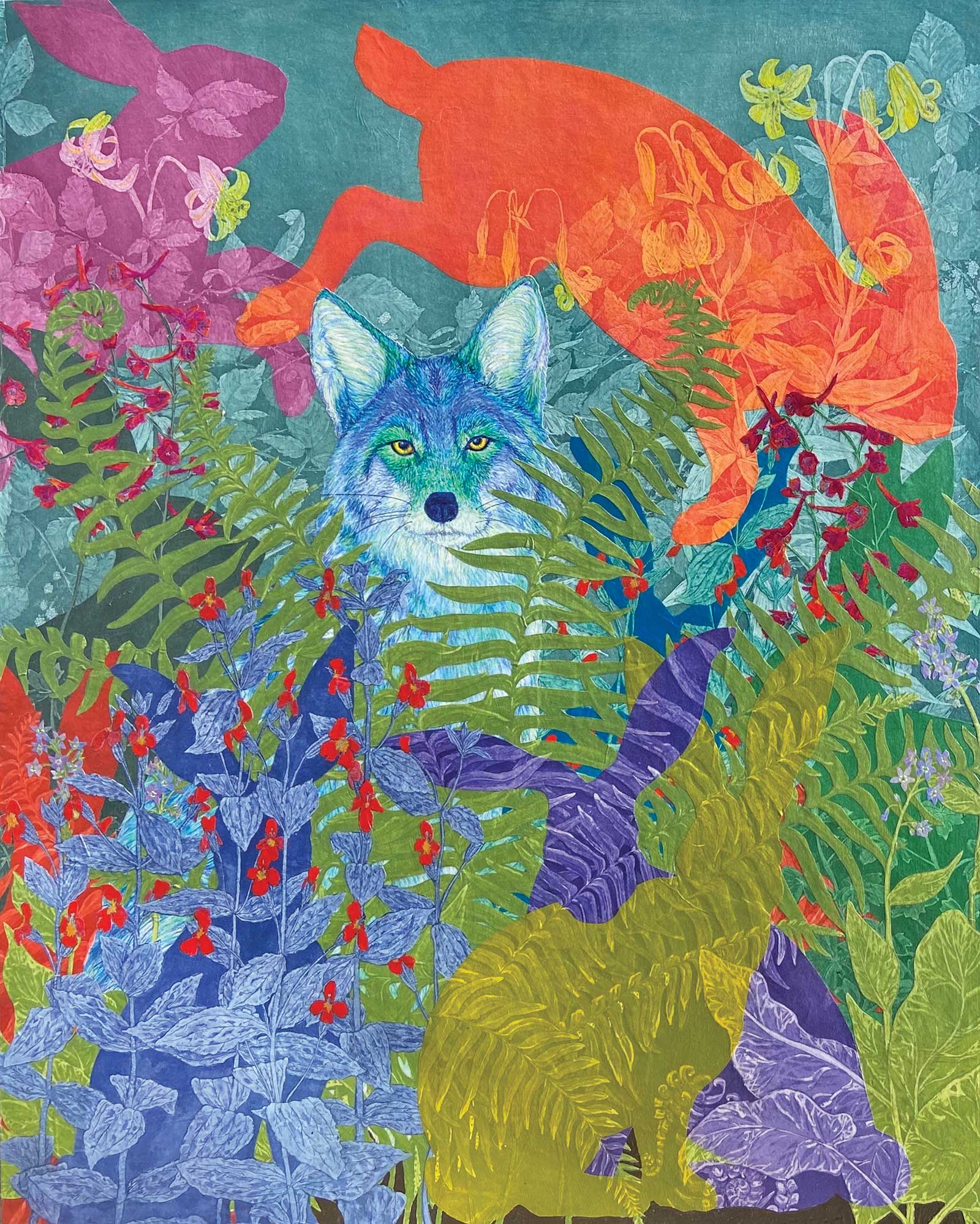 Coyote and Hares, mixed media collage (aquatint etchings and acrylic), 30 x 24"“I have been using the etchings as a base to build new landscapes,” she explains. “Where I have been closely paying attention to the shapes and locality of species in my etchings, I have become much looser in the way I collage and color them. I hand cut each plant out of the paper and then reassemble them on panel to create new worlds. In some of the worlds I reference narratives and folk tales I imagine could happen but with local animals as the characters. In other collages, I set the animal gaze out toward the viewer in judgement. And in others, the pieces are simply about the magical feeling of being in a wild space.”
Menagerie, an exhibition of her latest work, will be shown at Wally Workman Gallery in Austin, Texas, from January 7 through 29. —
Wally Workman Gallery
1202 W. Sixth Street • Austin, TX 78703
(512) 472-7428
www.wallyworkmangallery.com
Powered by Froala Editor