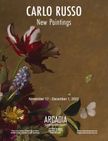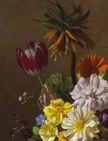
Heavily influenced by the old Dutch masters, Carlo Russo works in what he calls the traditional style of still life painting. Whereas “contemporary” still life works might depict ordinary, modern objects in a bright palette, Russo portrays timeless subject matter—florals, objects, surfaces—that could have existed hundreds of years ago.
“Traditional” also refers to his aesthetic and method of painting. Against muted backgrounds, he designs his floral compositions on the canvas as opposed to making an arrangement and then painting what he sees before him.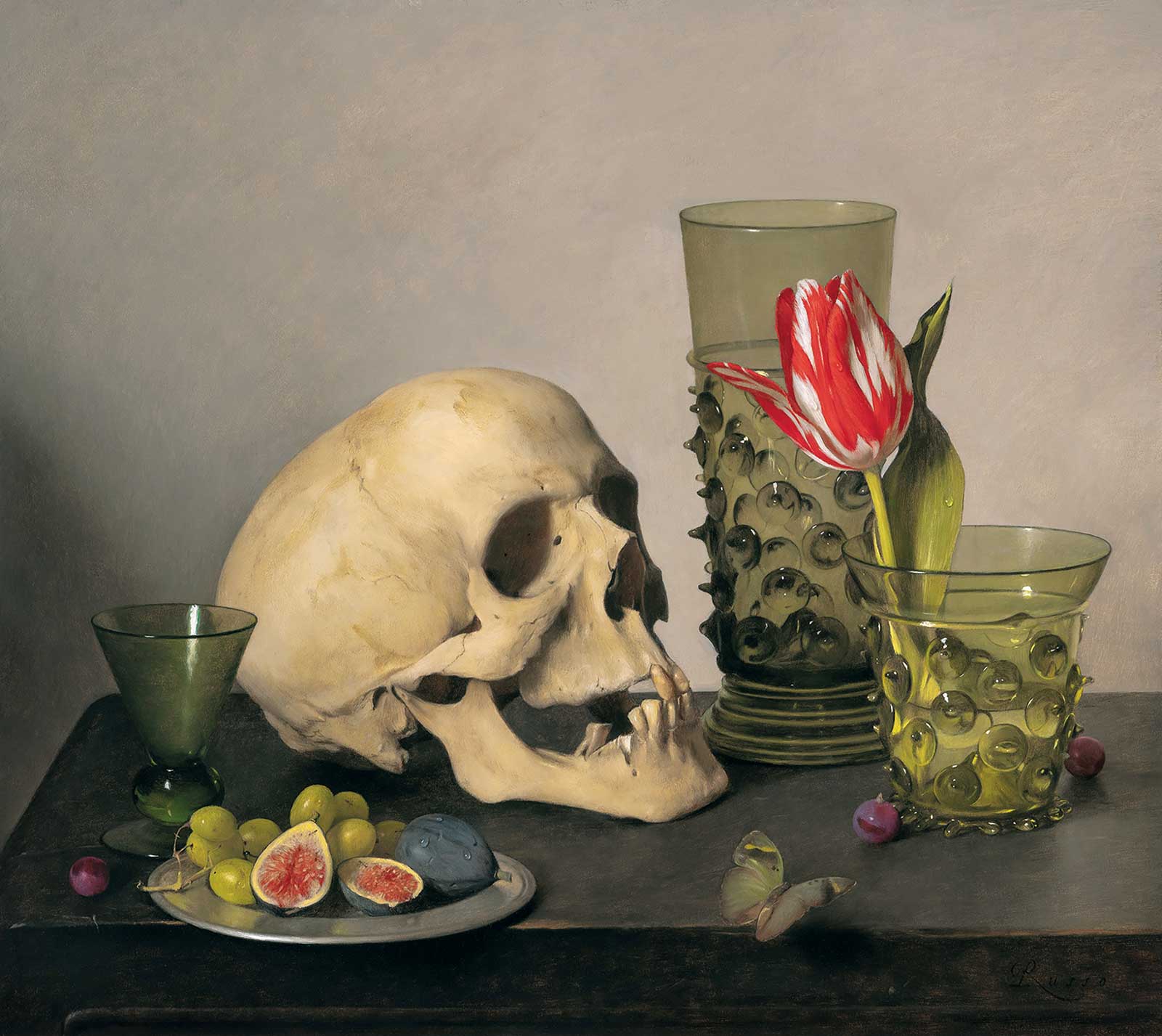 Skull and Tulip, oil on panel, 16 x 18"
Once best known for his landscapes and figurative work, Russo tackled florals about a decade ago to overcome what he perceived as a weak area in his skill set. At a certain point he grew comfortable creating them in a painterly fashion but felt it wasn’t consistent with the style of his other work. After deciding to hone in on the detail of the flower, the next challenge was arranging them in the Dutch style of the 16th and 17th centuries.
That’s not to say that Russo doesn’t paint from real life. He plucked the flower in Skull and Tulip directly from his garden. But his larger floral bouquets require a different technique.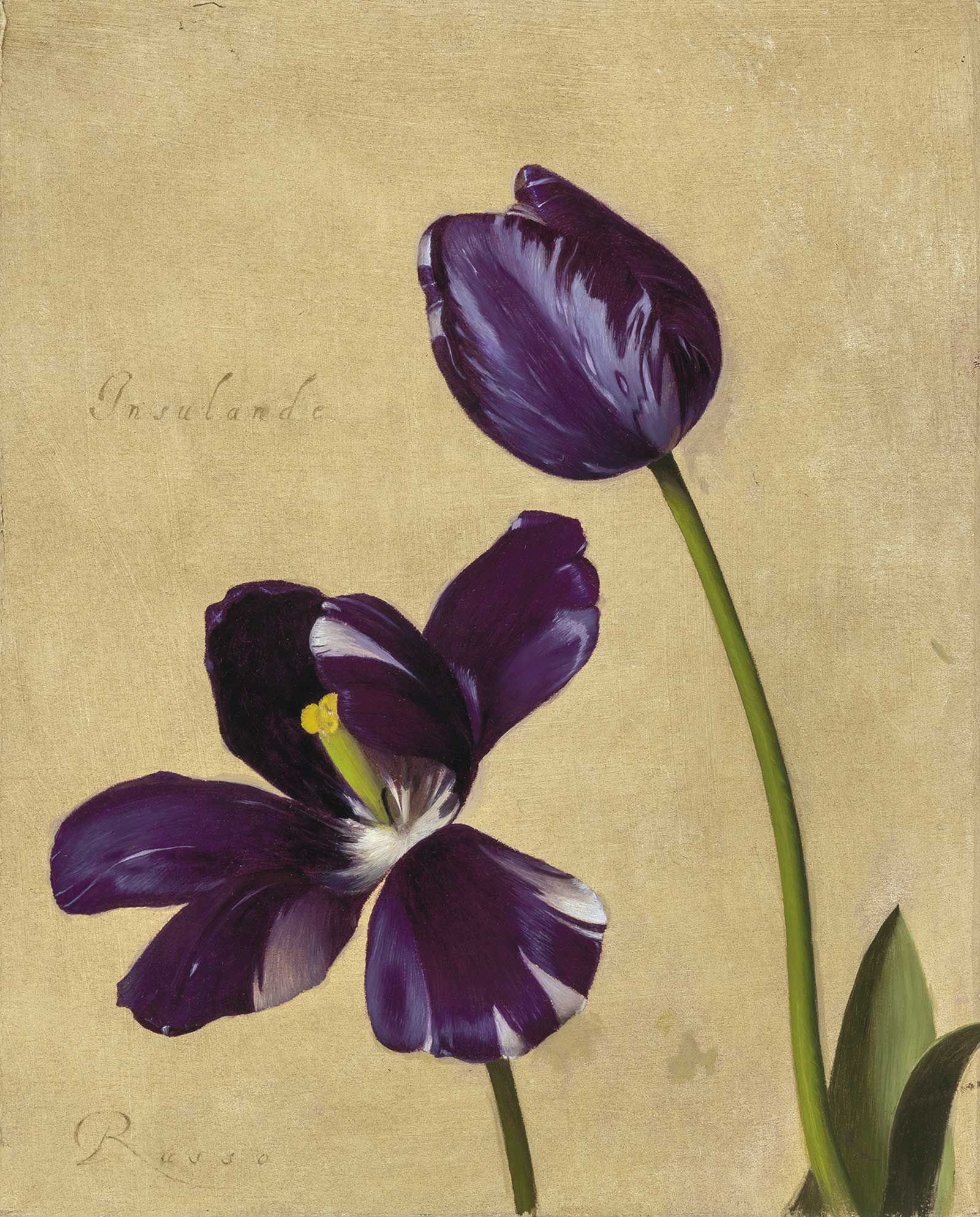 Insulande, oil on panel, 10 x 8"
“They never existed together that way in real life,” Russo explains. “They never could—most of those flowers don’t bloom at the same time of the year. What you’re really seeing is an invention, a fantasy.” To mitigate this challenge, Russo has amassed a catalogue of studies of individual flowers that he can refer to when he doesn’t have access to a particular species. Some of the studies have been developed into paintings like Insulande, which harkens back to the Dutch botanical illustrations that bridged the gap between art and science.
Russo’s florals take shape over many months as the artist creates his bouquet on canvas, striving to achieve an elusive sense of fullness and roundness. “You can’t just drop a flower in anywhere; it has to look as if it belongs. You work back and forth. It’s a push-pull with the different flowers and the light and shadow to get that sense of turning in the vase.”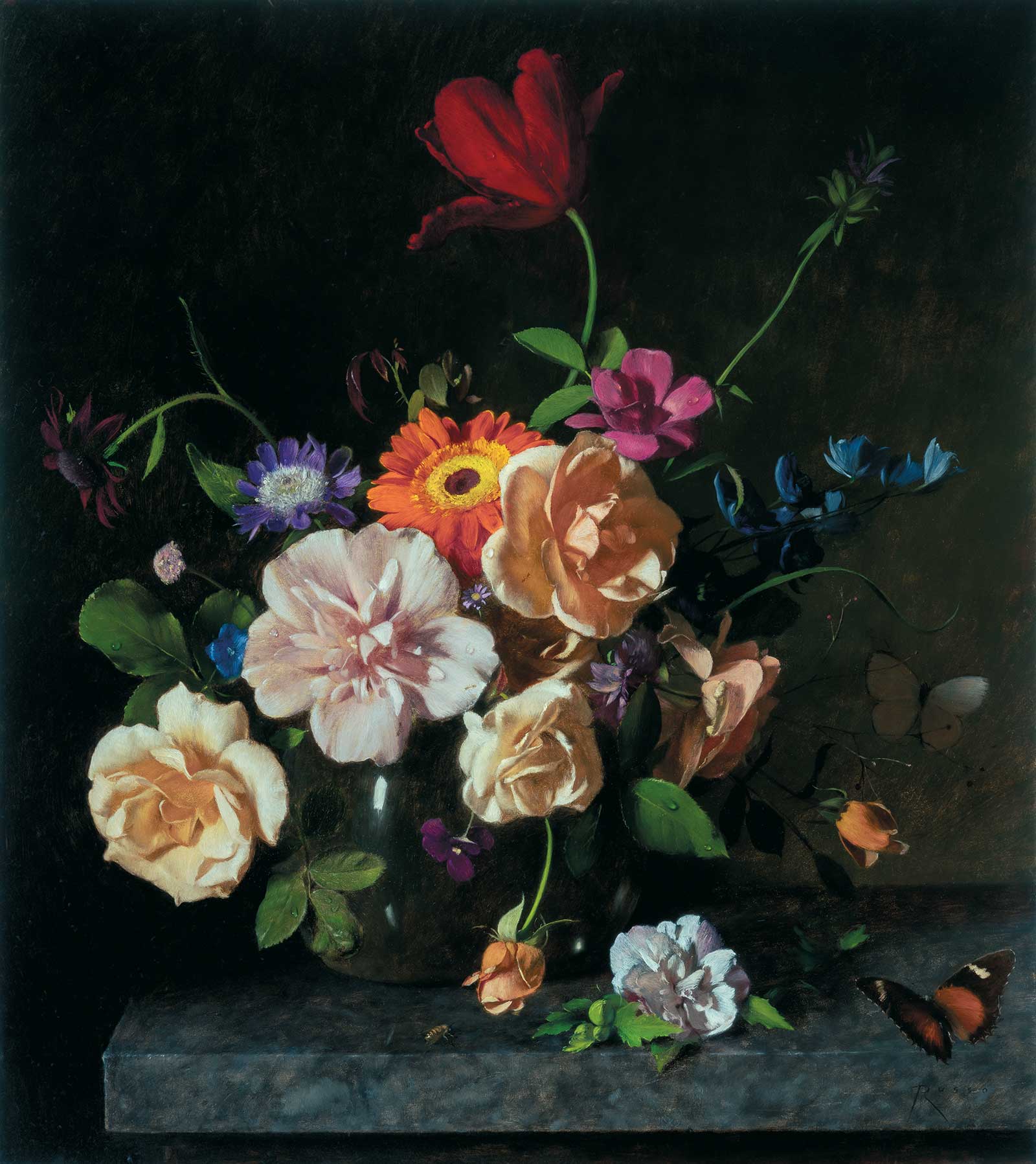 Rachel’s Song (Summer Bouquet), oil on panel, 18 x16"
For his object-centered still lifes, Russo does assemble the composition before painting it, a process he describes as creating a mini set design. But that doesn’t stop him from freewheeling during the painting process, especially when it comes to more ephemeral objects like fruit or flowers. “Sometimes I’ll keep adding things. The finished painting is never exactly like the arrangement I was working from.” 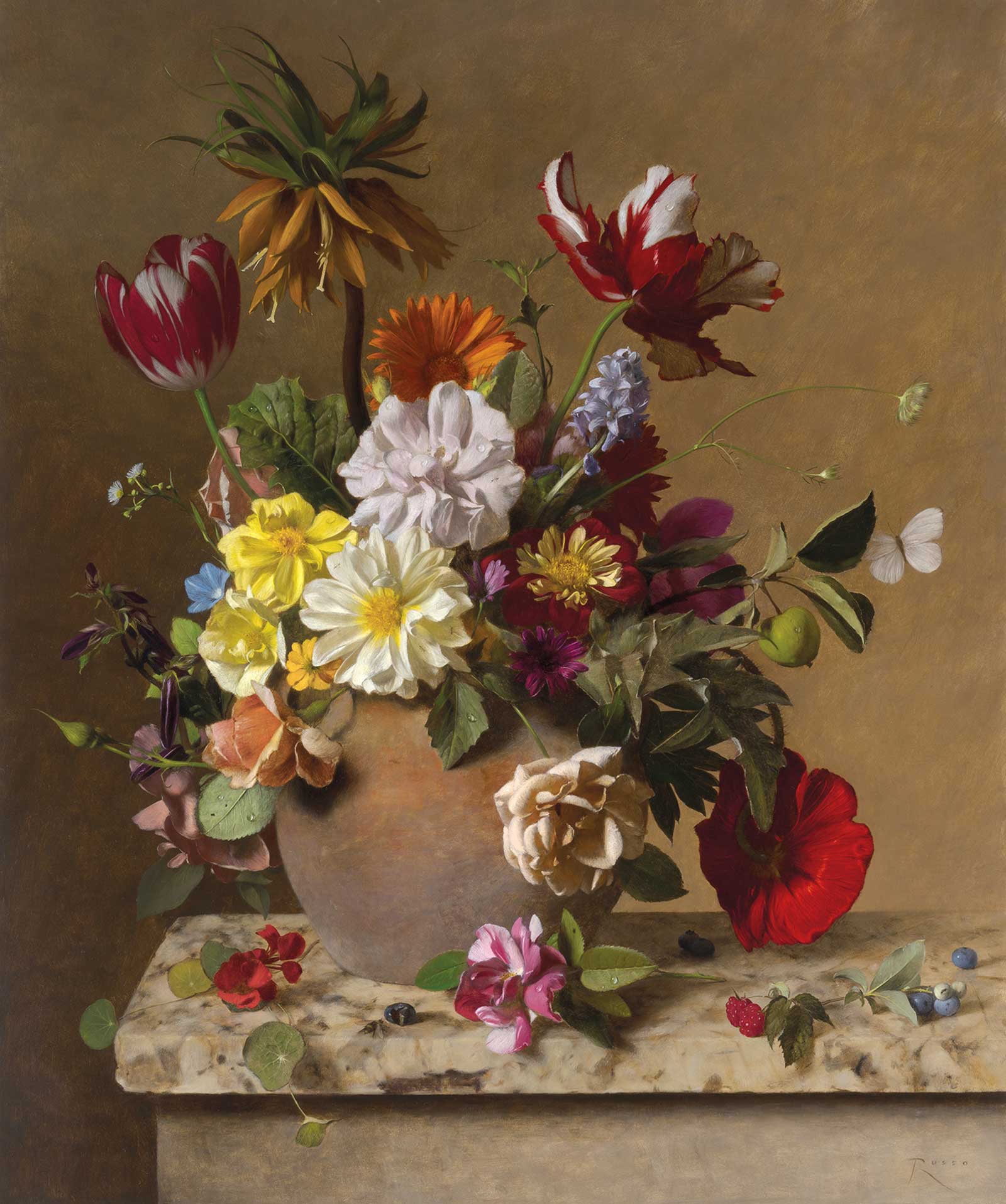 The Living Garden, oil on panel, 24 x 20"
Russo paints objects that command his interest, like the human skull he borrowed from a friend for Skull and Tulip. “When you get ahold of something that really grabs ahold of you, you just want to paint it.” He ended up working it into a composition with knobby Dutch glassware and the tulip from his garden. “It was the perfect finish for that piece. It is such a beautiful color and pattern creating this beautiful juxtaposition of strong intense chroma and muted color.”
Russo knows some people may find fruit on a table boring but that’s far from true for the artist. “It’s something that never really goes out of style. Although it’s been explored by many artists, it’s a question of how you paint it. It’s still new because it’s new to me. There are so many possibilities, so many combinations…It’s like putting all these puzzle pieces together until you find a pleasing, interesting arrangement.” —
Arcadia Contemporary 421 W. Broadway • New York, NY 10012 • (646) 861-3941 • www.arcadiacontemporary.com
Powered by Froala Editor