Sculptural fragments from antiquity—heads without bodies, torsos without heads, arms or legs—retain their connection to the familiarly corporeal and the skill of their creation.
The Musée Rodin in Paris notes, “Convinced of the evocative power of the fragment, Rodin worked the hands or feet of his figures separately. His private collection of antiquities included many archaeological fragments: hands, heads, and torsos…These sculptures influenced his own aesthetic, prompting him to remove the arms or heads from some of his sculptures. The Walking Man, for example, is an enlarged version of St. John the Baptist, without the head and arms which Rodin regarded as superfluous details, liable to detract from the expression of movement he wanted to convey.” 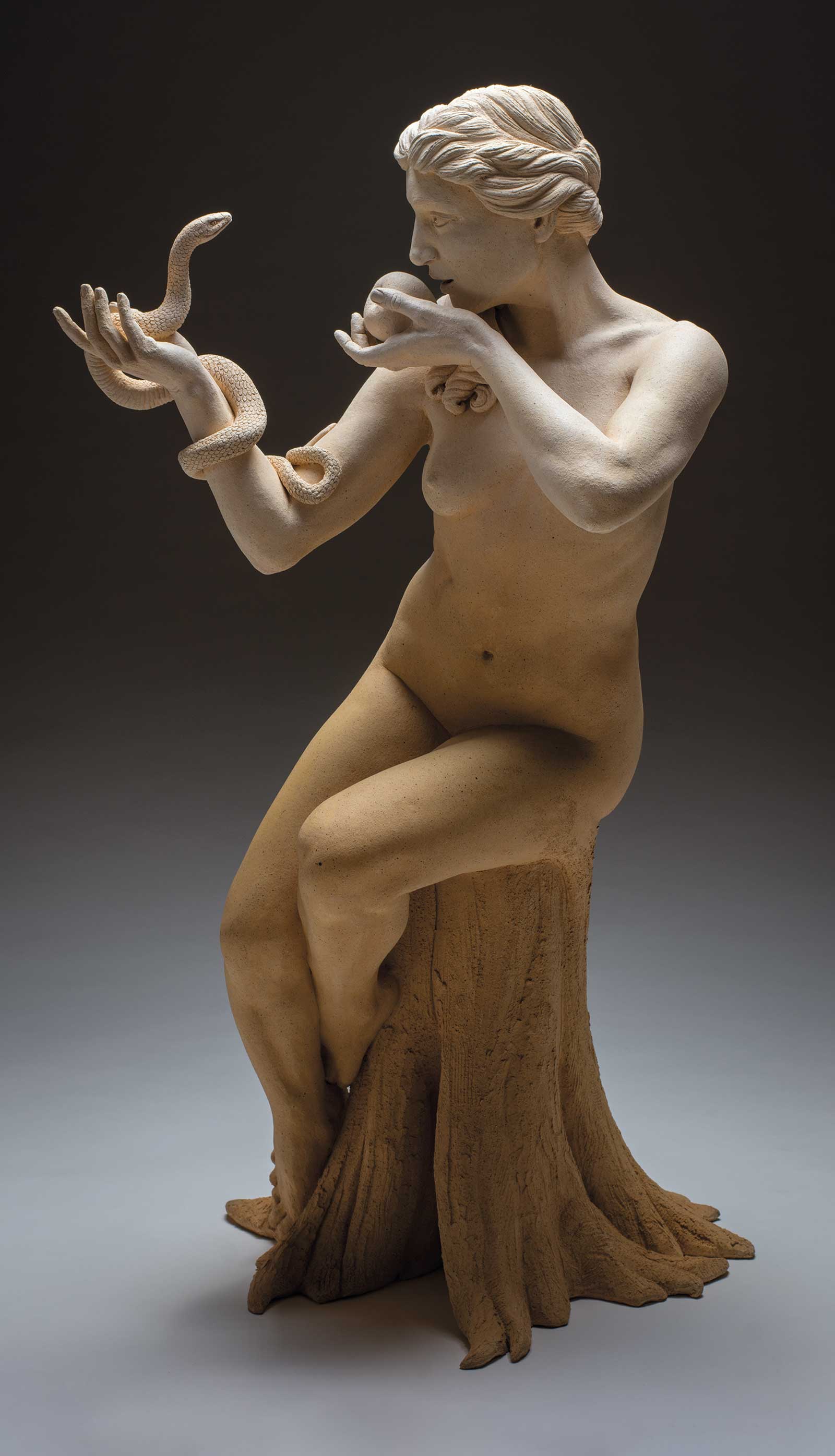 Evoke Contemporary, Eve Chooses Choice, fired clay, 37 x 18 x 16,” by Kristine Poole.
Writing about Rodin and his creation of fragmentary sculpture, the poet Rainer Maria Rilke commented, “In the art of sculpture…it is left to the artist to make out of many things one thing, and from the smallest part of a thing, an entirety.” Rodin, himself, said “these divine fragments…move me more profoundly than living persons.”
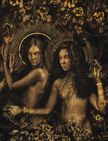
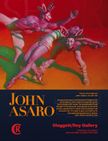
In his figures, Nathan Mellott refers to “deteriorating classical and ancient statuary but they have greater inspiration in heightened awareness of the corporeal. The palms refer to the most common trees in the world’s oldest cities while giving a sense of depth and space for the balletic, aerial bodies. The flat color application was inspired by Etruscan and Grecian painted pottery.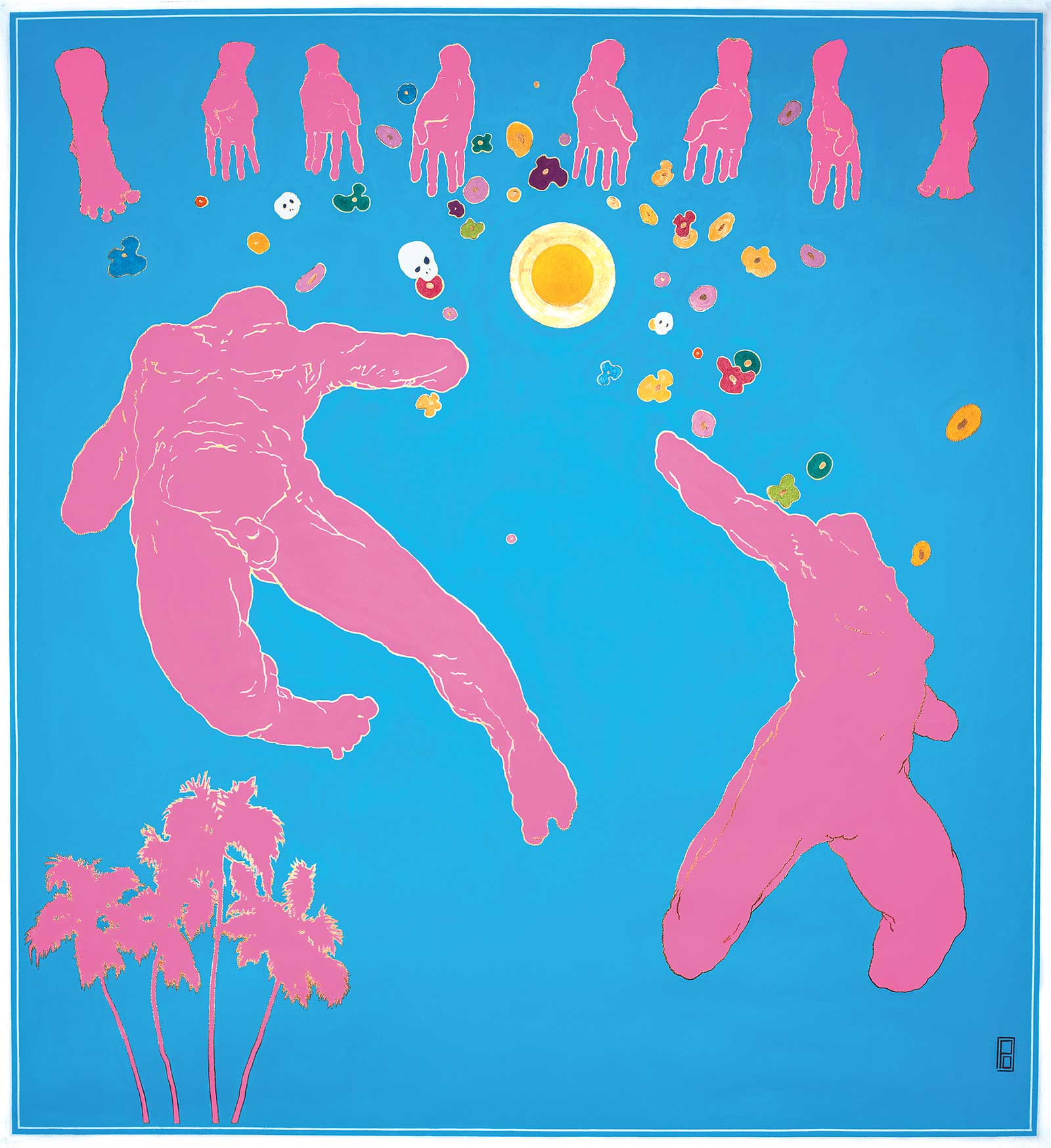 Nathan Mellott, Two Bodies and Ceremony, oil, acrylic and enamel on paper, 55 x 51”
“I look for a quality (in my work and others’) which testifies to our contemporary existence; that carries the torch forward. If we hold true that those who came before us are more base or savage than ourselves, then we prompt future generations to hold those same beliefs of us. So happiness and sadness in every corner; timelessness; love, desperation, the poetic and vulgar; simultaneity; the sacred and debased; the deep past and the deep future in the present.
“The hands are showering the bodies with flowers as if it were the fates blessing these unfolding events. The skulls are a (redundancy on the) message of temporality and mortality, plucked from Central American traditions, and their motifs laden with reverence for lineage and the memory of the dead.”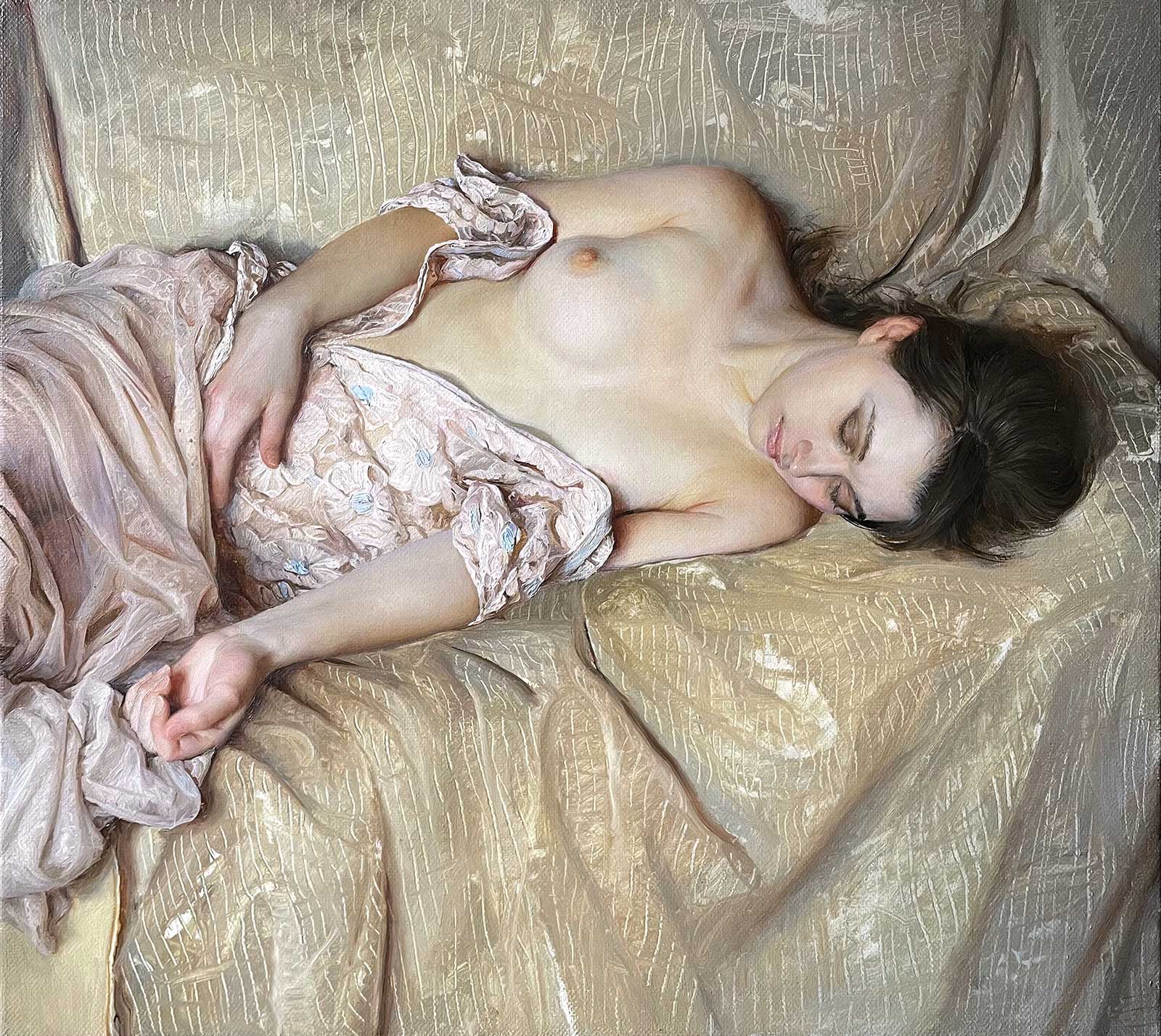 Maxwell Alexander Gallery, Pink & Blue Flowers, oil, 18 x 20,” by Serge Marshennikov.
Kristine Poole holds that those who came before us are not more base and asserts a positive interpretation of the story of Eve. In her clay sculpture, Eve Chooses Choice, she declares “The desire for the freedom and power to choose for ourselves is as inherent in human beings as breathing. This piece gives a new perspective on the biblical story of ‘the fall of man from grace’ in the garden of Eden. Rather than relying on blind obedience to externally imposed structures, in this powerful gesture, Eve is knowingly and willingly choosing to choose right from wrong, good from evil for herself. With this, she also willing accepts the consequences of her decisions. This piece represents the moment of choosing, with Eve and the serpent acting as partners in her transformation into a fully realized human being.”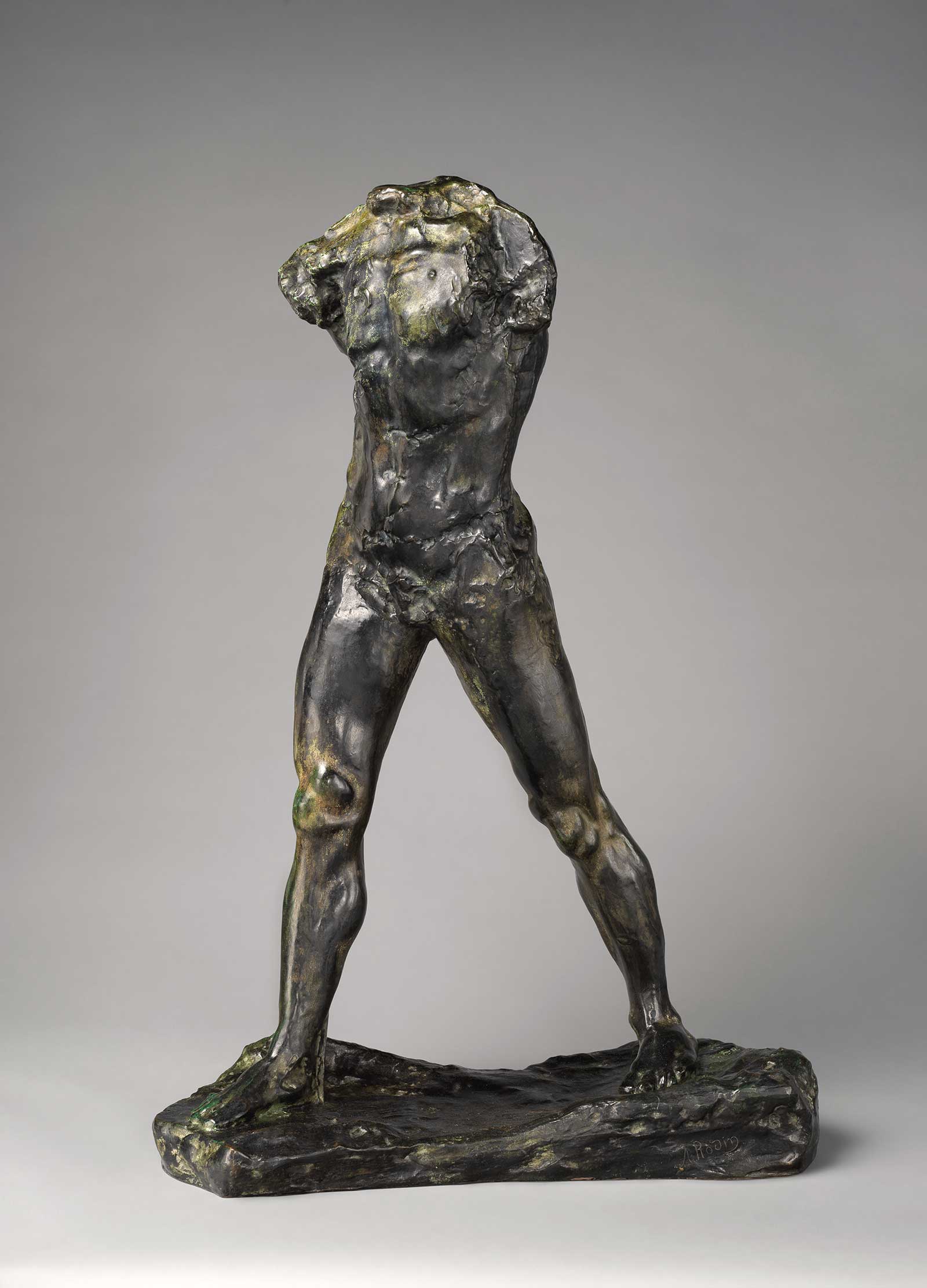 The Metropolitan Museum of Art, The Walking Man (L’homme qui Marche), modeled before 1900, cast before 1914, bronze, 33½,” by Auguste Rodin (1840–1917). Gift of Miss G. Louise Robinson, 1940.
Serge Marshennikov’s female figures are removed from the historical context of being objects just as Poole’s Eve is relieved of the burden of original sin. They are fully realized human beings comfortable in their selfhood. They are seen in private moments independent of the gaze of the viewer, neither displaying themselves nor being displayed. Marshennikov admires the work of Andrew Wyeth who wrote, “I search for the realness, the real feeling of a subject, all the texture around it...I always want to see the third dimension of something...I want to come alive with the object.”
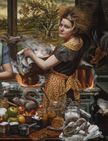
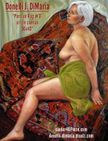
Marshennikov says, “After all of the thought and preparation is done to make a new painting—the pure joy begins for me. I think that people become painters because of the pure elation that is felt during the process of painting. I experience an overwhelming happiness when I paint.”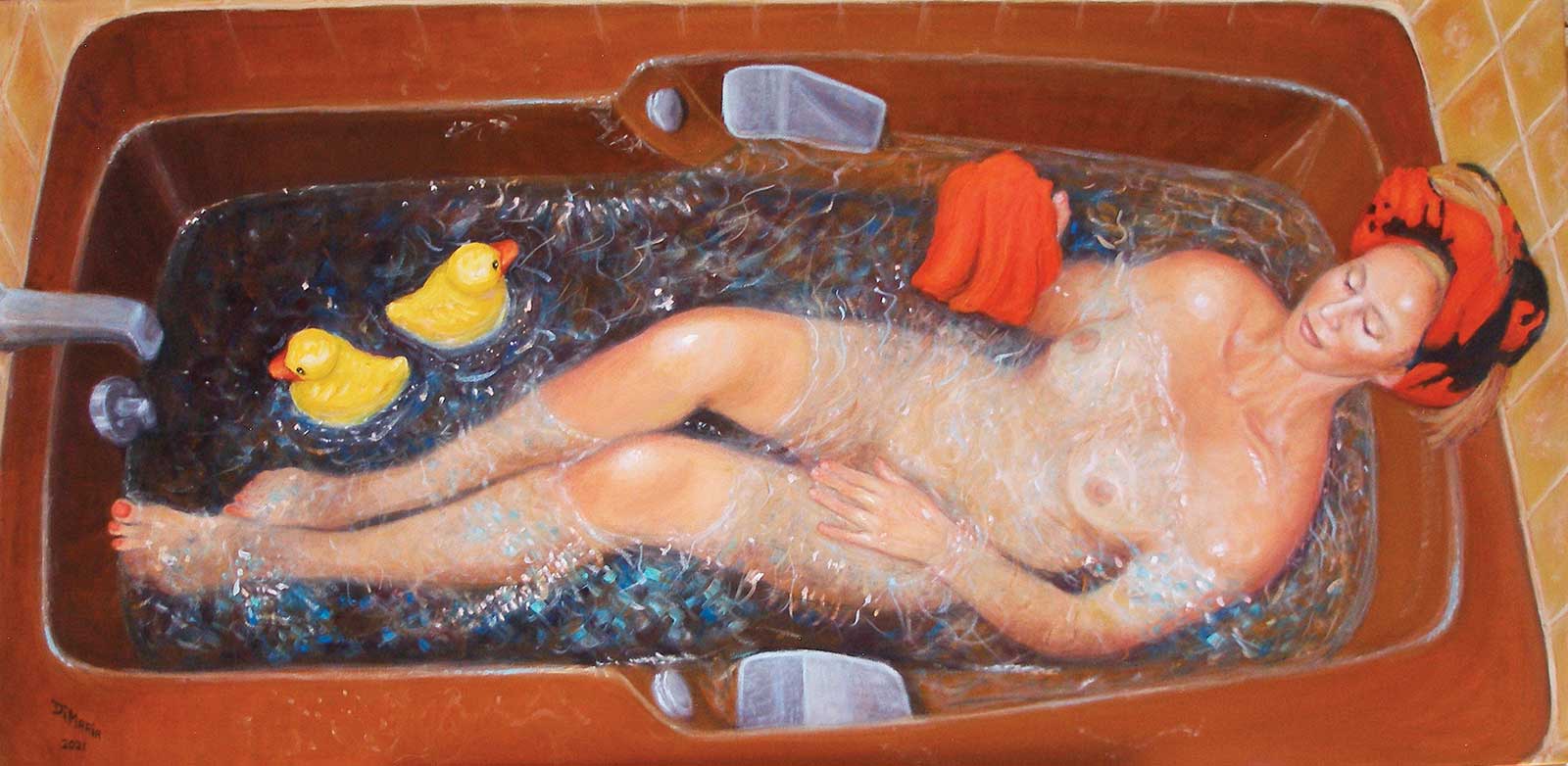 Donelli DiMaria, Bath #5: Nude with Rubber Ducks, oil on canvas, 24 x 48"
Rodin said, “The body always expresses the spirit whose envelope it is. And for him who can see, the nude offers the richest meaning.”
These artists of the nude are products of traditions and history, but bring contemporary, personal and fresh insights.
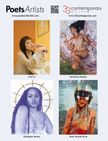
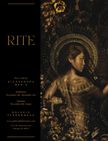
Artist Erica Calardo investigates the idea of different worlds communicating with each other, as well as the concept of being on the verge of different situations. “This comes from my previous studies in theoretical mathematics, modal logic and artificial intelligence, focusing on possible worlds semantics,” she explains. “I work with worlds generated by my own imagination and AI-generated landscapes, to ideally build a bridge between humans and machines.” The resulting images embrace technology within a strong traditional technical framework with echoes of the Old Masters. “My new works embrace imagination, verbal descriptions, technology, philosophy, modal logic, tradition and Old Masters’ skills. I paint mainly female nudes—the complete absence of mundane accessories and fashion items brings them to the ideal dimension of the pure generative inner force of the sacred feminine,” she says. “Paintings should tell a story, convey an ideal, be the image of what we aim at becoming. Paintings are mirrors reflecting the dreams of their creators as well as their viewers. They are not merely decorative objects, they should talk about culture, lost stories, ideals in a constantly evolving exchange with the viewer.” 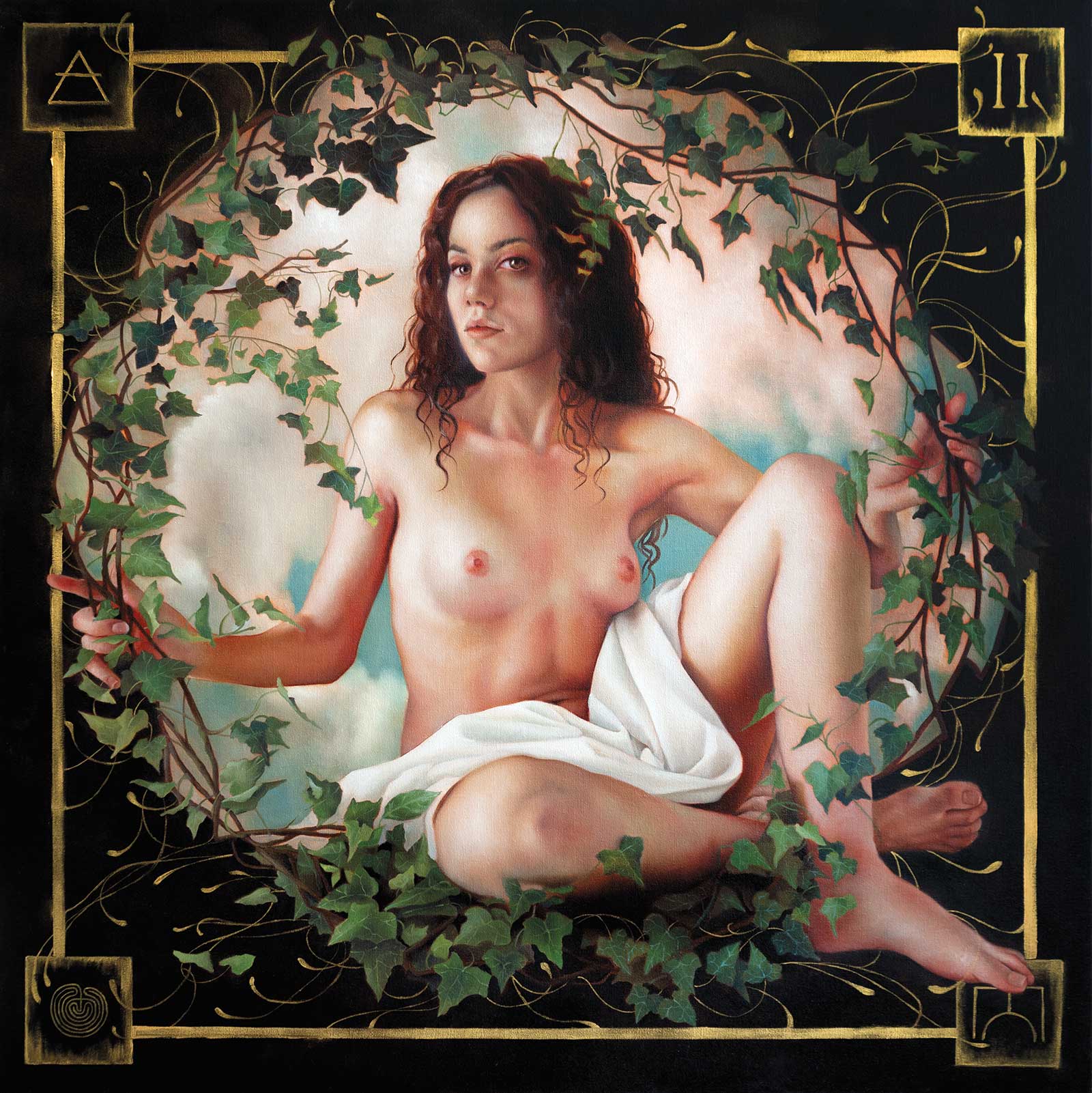 PoetsArtists, Ariadne, oil on Belgian linen, 39½ x 39½", by Erica Calardo.
“This is my newest painting in an ongoing series of local self-identified witches,” says artist Kimberly Dow of the work featured here. “Where I live in Asheville, North Carolina, it is very deeply spiritual and full of funky performers. I am inspired by the humans around me. Often, it is the divine feminine archetype I want to paint. Our longing for the power that women wield is something that fascinates me. The knowledge in terms of healing, growing and creating is magical. The hidden mysteries we women seem to carry have always been a great source of wonder.” 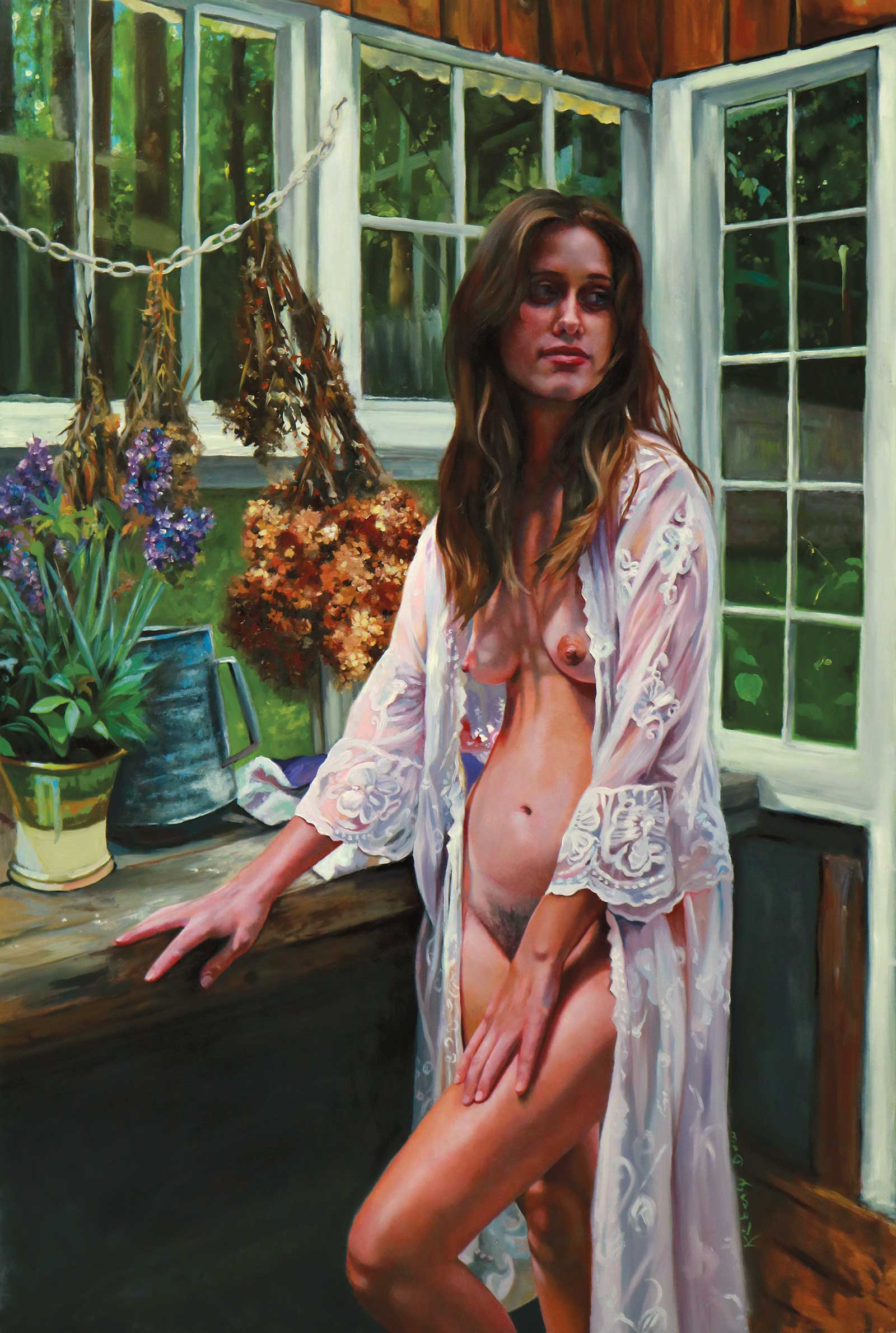 PoetsArtists, Garden Whispers, oil on panel, 36 x 24", by Kimberly Dow.
“All three of the artists [featured above] work primarily in figurative contemporary realism with the majority of their artworks focusing on nudes and most precisely, the female nude,” says arts advocate Didi Menendez, representing the PoetsArtists community and 33 Contemporary Gallery in Chicago. “They are expanding on their series by collaborating with artificial intelligence or their local community, incorporating cultural folklore while keeping the feminist eye centered on their message.” 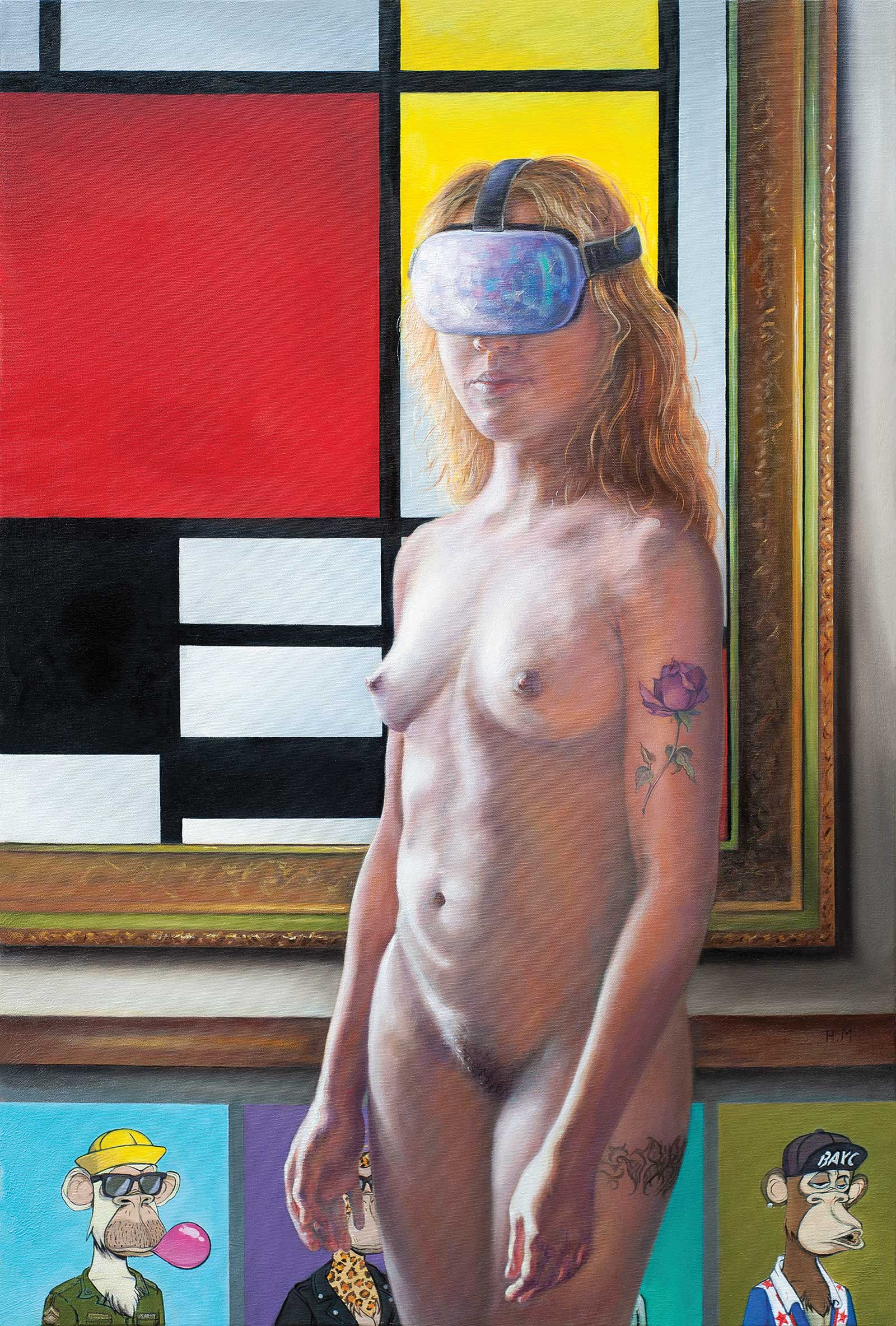 PoetsArtists, Somewhere in a Parallel World, oil on canvas, 36 x 24", by Homeira Mortazavi.
Although Donelli DiMaria was trained as a realist painter, in recent work he has tried to combine elements of satire and social commentary with reference to paintings by the great masters. “The painting Bath #5: Nude with Rubber Ducks is an example of this, where I have combined the classical painting of a female bathing with satire on Western society by including the rubber ducks. The bathing nude is a classical reference to Edgar Degas. The rubber ducks are not only an iconic Pop Art symbol but are also linked to social realism as having been used in protest movements.” —
Featured Artists & Galleries
Donelli J. DiMaria
(505) 992-3468, cinder48@msn.com
https://donelli-dimaria.pixels.com
Evoke Contemporary
550 S. Guadalupe Street, Santa Fe, NM 87501, (505) 995-9902
www.evokecontemporary.com
Maxwell Alexander Gallery
406 W. Pico Boulevard, Los Angeles, CA 90015, (213) 275-1060
www.maxwellalexandergallery.com
Nathan Mellott
www.nathanmellott.com
PoetsArtists
www.poetsandartists.com
Powered by Froala Editor