The prestigious International Guild of Realism for yet another year, hosts the best of the best in contemporary and classical realism. Of their roster of 525 members, this year will feature over 200 artists and 218 impressive works of art, with viewing access across three websites. 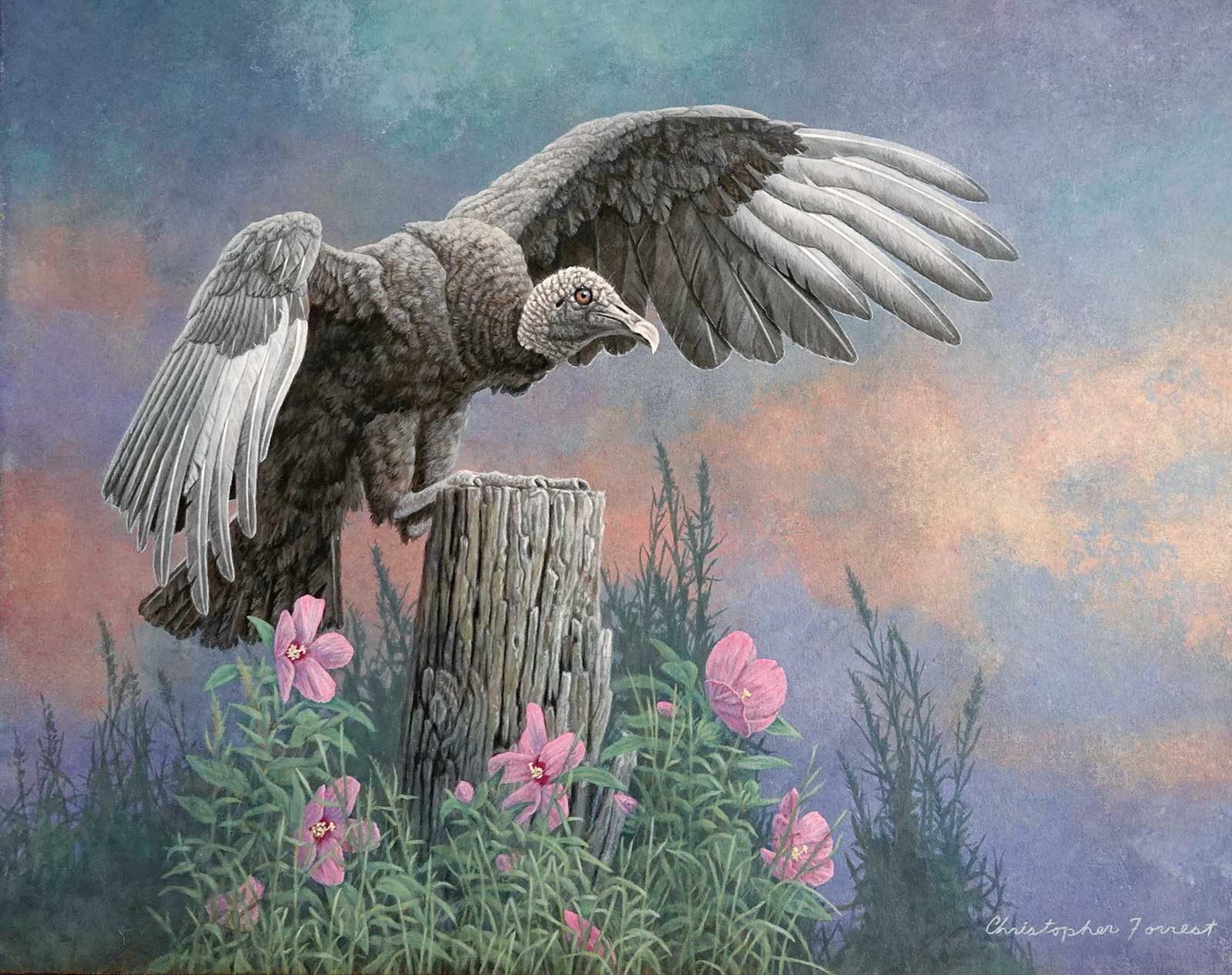 Christopher Forrest, We All Have Aspirations, acrylic on panel, 16 x 20"
“We believe that selling paintings online will be the wave of the future, especially with younger art buyers, so we will be giving a strong effort to make this a success in many ways,” reads the IGOR website.” The organization prides itself in selecting some of today’s finest realist artists and provides them with “professional assistance and connects these artists with collectors through sanctioned gallery and online exhibitions.” IGOR also recognizes their talented members through cash and prize awards.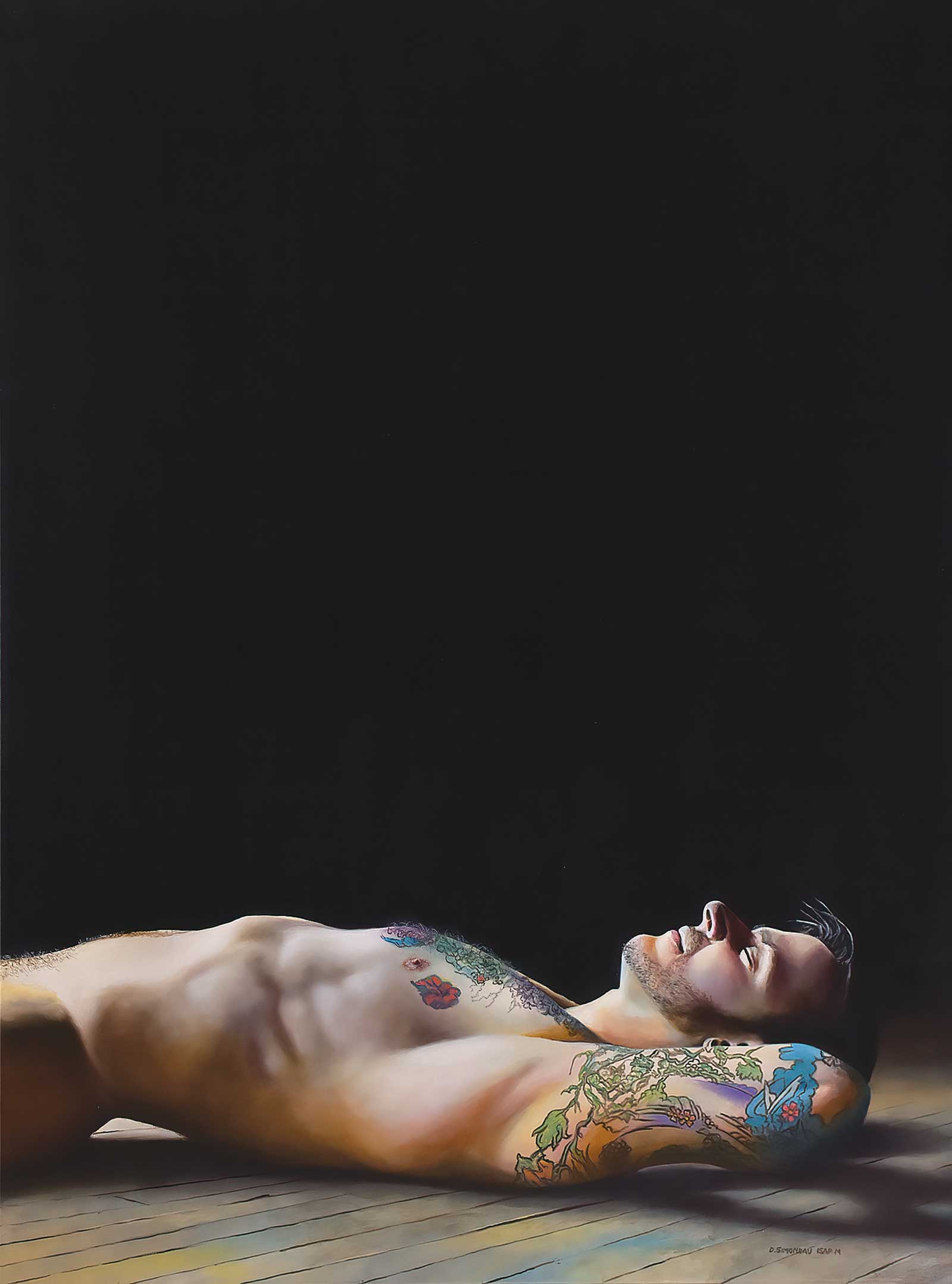 Dan Simoneau, In the Eye of the Storm, acrylic, 40 x 30"
Viewers will see a variation of styles including trompe l’oeil, magic realism, contemporary and photo realism, a diversity of mediums and a plethora of subject matter ranging from landscapes and wildlife, to figurative work and still life, and everything in between.
Artists like Christopher Forrest will bring to the exhibition his wildlife image We All Have Aspirations, depicting a buzzard perched on a log and set against a colorful sky. Of the piece he says, “Recently I was at a Chesapeake Bay wildlife refuge photographing ospreys, and noticed a flock of vultures around the dock area. Ugly as this bird is, I suddenly felt inspired to paint a buzzard. My wife strongly questioned my choice of topic. However, I thoroughly enjoyed painting what really is a magnificent raptor…”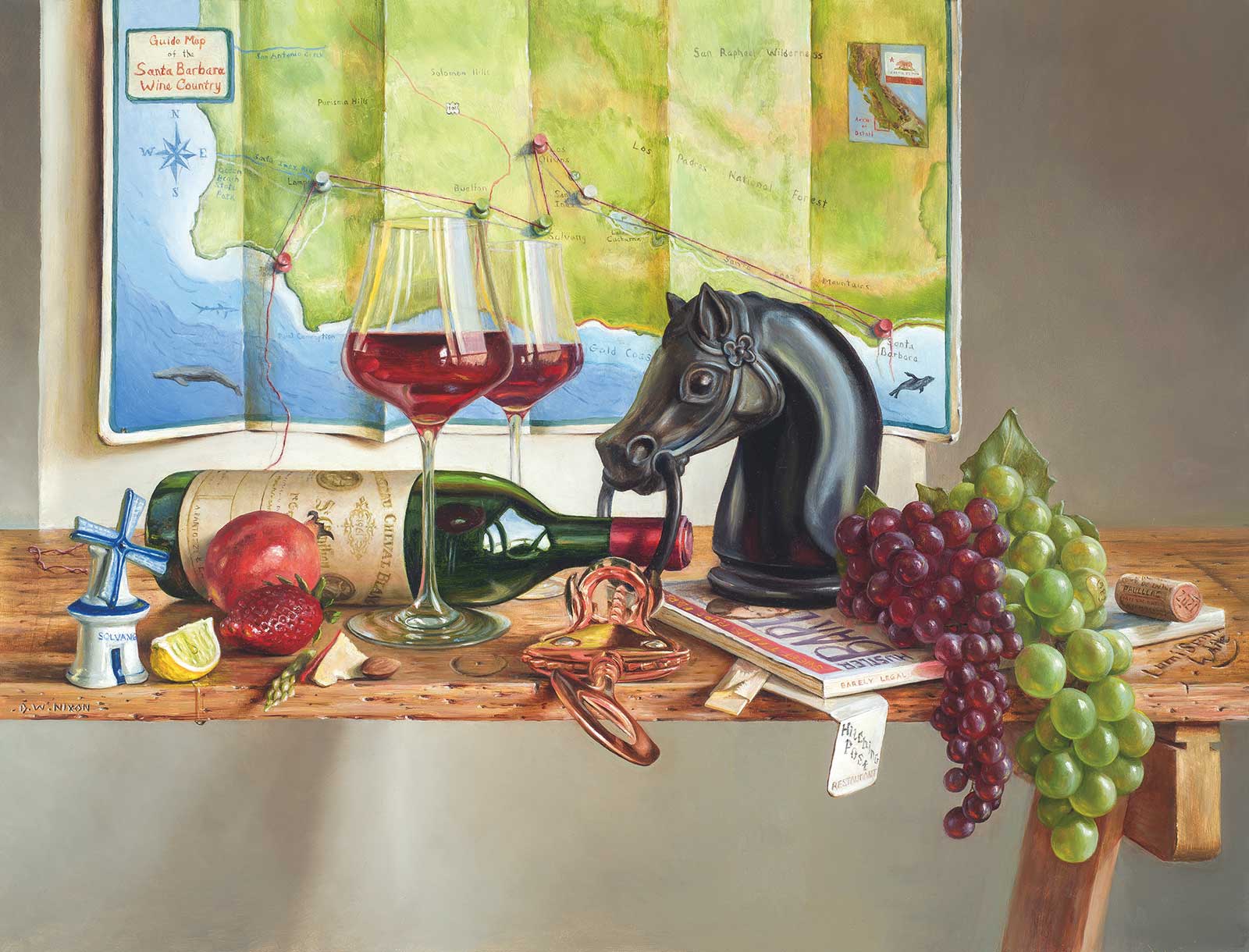 Daphne Wynne Nixon, Ode to the Movie ‘Sideways’, oil on board, 18 x 24"
Dan Simoneau presents figure work like In the Eye of the Storm, showcasing his skills in bringing out even the finest details—as in the case of his subject’s tattoos. “My work is about light and shadow,” he says. “I’m fascinated by the way light defines the sculptural form of objects, whether human figures or inanimate objects. While much of my work is influenced by Caravaggio’s work, I also love working with more subtle lighting…”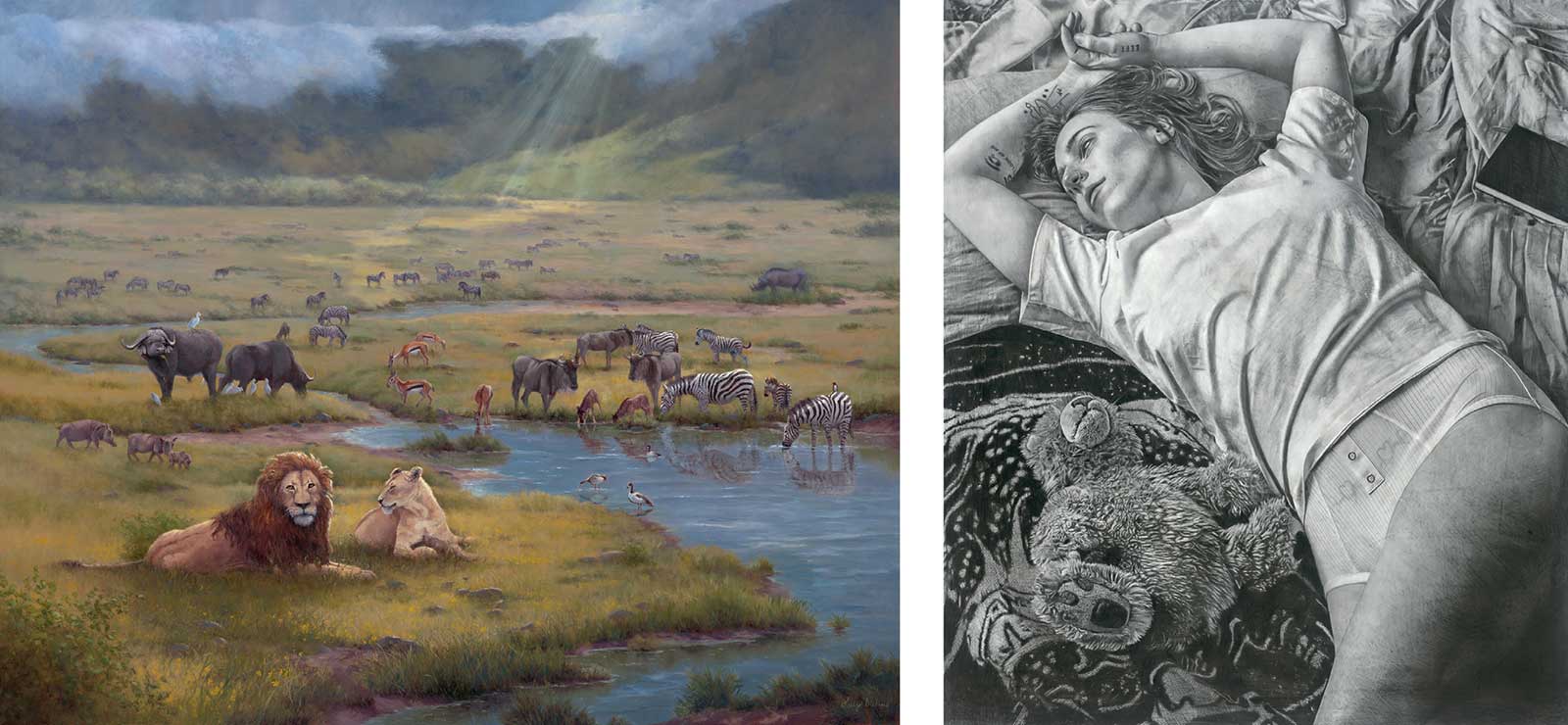 Lucy Dickens, A Sense of Eden, oil, 42 x 52”; Tracy Frein, Insomnia, colored pencil, 30 x 26”
Still life scenes like Daphne Wynne Nixon’s Ode to the Movie ‘Sideways’, was inspired by the “rare bottle of ‘61 Cheval Blanc from the movie “Sideways,” hence the bottle lies sideways,” the artist explains. “The two glasses represent two friends who love to wine taste in Santa Barbara (map with stops shown by pushpins) and at the Hitching Post near Solvang, hence the windmill and horse. The food refers to actor Paul Giamatti tasting wine, ‘mmm…a little citrus, maybe strawberry, passionfruit…just the faintest soupçon of asparagus and a flutter of a nutty Edam cheese…are you chewing gum?’”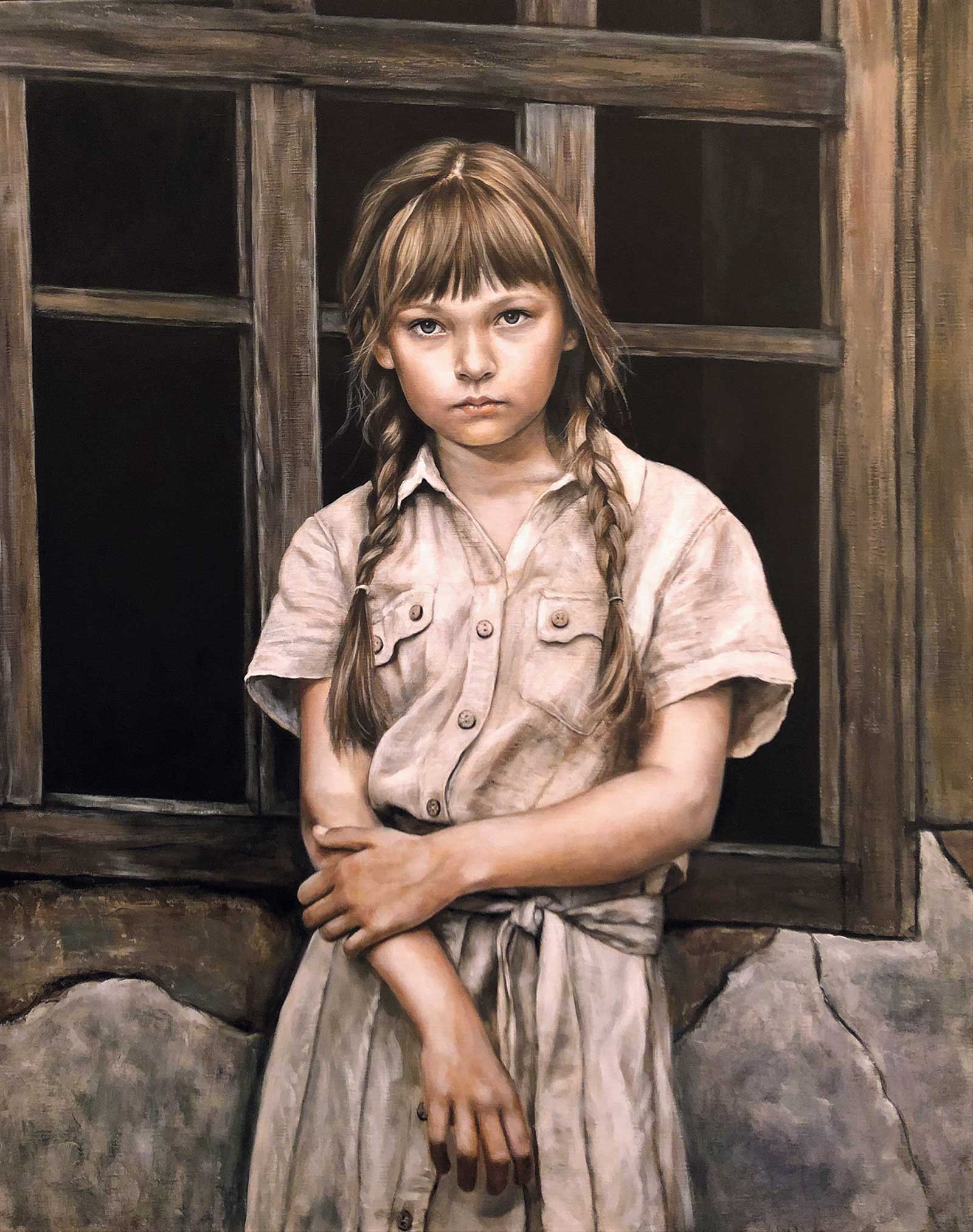 Elizabeth Hoddevik, Child Portrait, oil on canvas, 30 x 24”
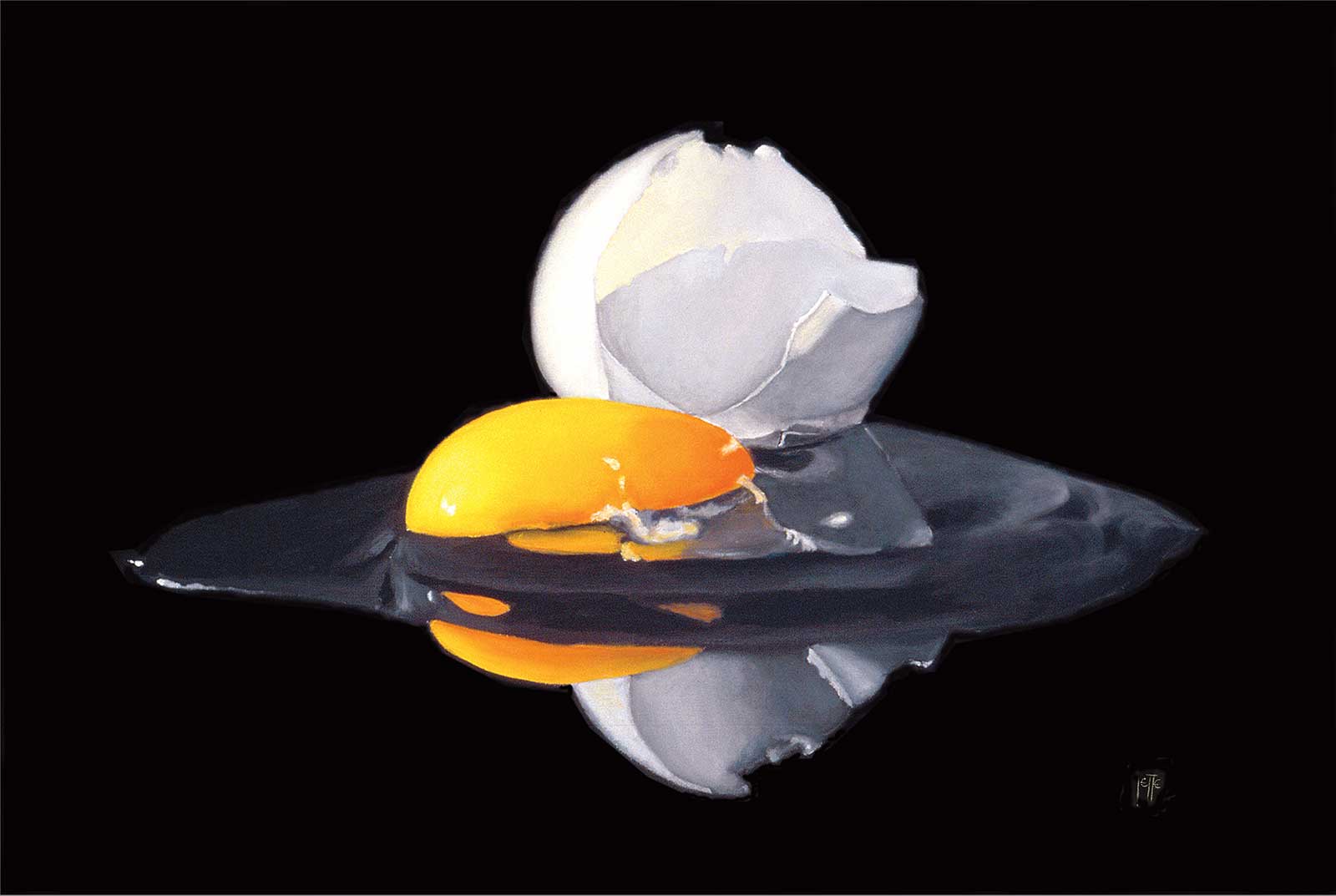 Jette van der Lende, Life is Protected, oil on linen, 27 x 41”
In oil and watercolor, Deborah Flood features her equestrian piece The Horse Parade. “The inspiration for my work comes from many years of having grown up with Appaloosa and Quarter Horses on our family farm,” she says. “Since I was a young child, I’ve always loved to watch and paint horses doing their thing, and the bonds that happen between the owner and the horse. The history of working with horses also shows up in my work through my Homesteading series.
More birds of prey are represented in Ed Copley’s Red Tail Landing. “One of the birds of prey that I enjoy painting the most,” says Copley, “is the red-tailed hawk. It is a familiar sight in North America. This big hawk is also a talented voiceover artist, standing in for one of the most often-seen raptors on television. The red-tailed hawks long, raspy call is often heard on TV and in movies when a bald eagle is shown. In reality, the bald eagle has a chittering, high-pitched call, which apparently doesn’t sound imposing enough to go along with its tough appearance. But the red-tails call has been deemed macho enough to substitute for the eagles…”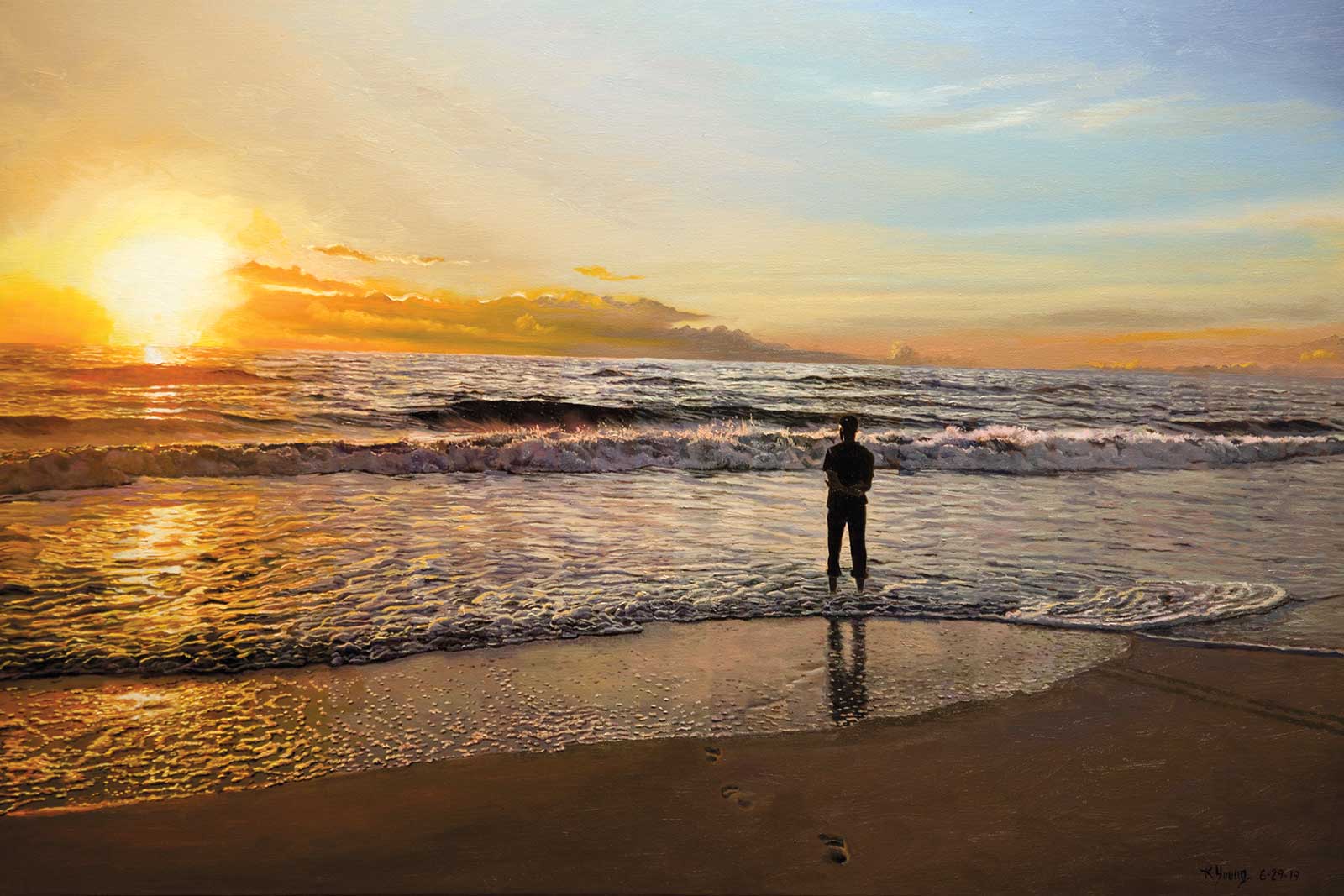 Kenneth Young, Sunrise at Ormand Beach, oil, 24 x 36”
Elizabeth Hoddevik’s recent work, as in her show piece Child Portrait, portrays the perseverance of harmed people, particularly young females—their ability to thrive despite trauma. She captures the essence of her resolute young subjects, the light within them as well as the pain, their determination along with their vulnerability. She is inspired by the work of the Old Masters. The clarity of their pieces focused on facial expression and body language. “It is my hope that my work can bring light into the lives of the viewer,” she remarks.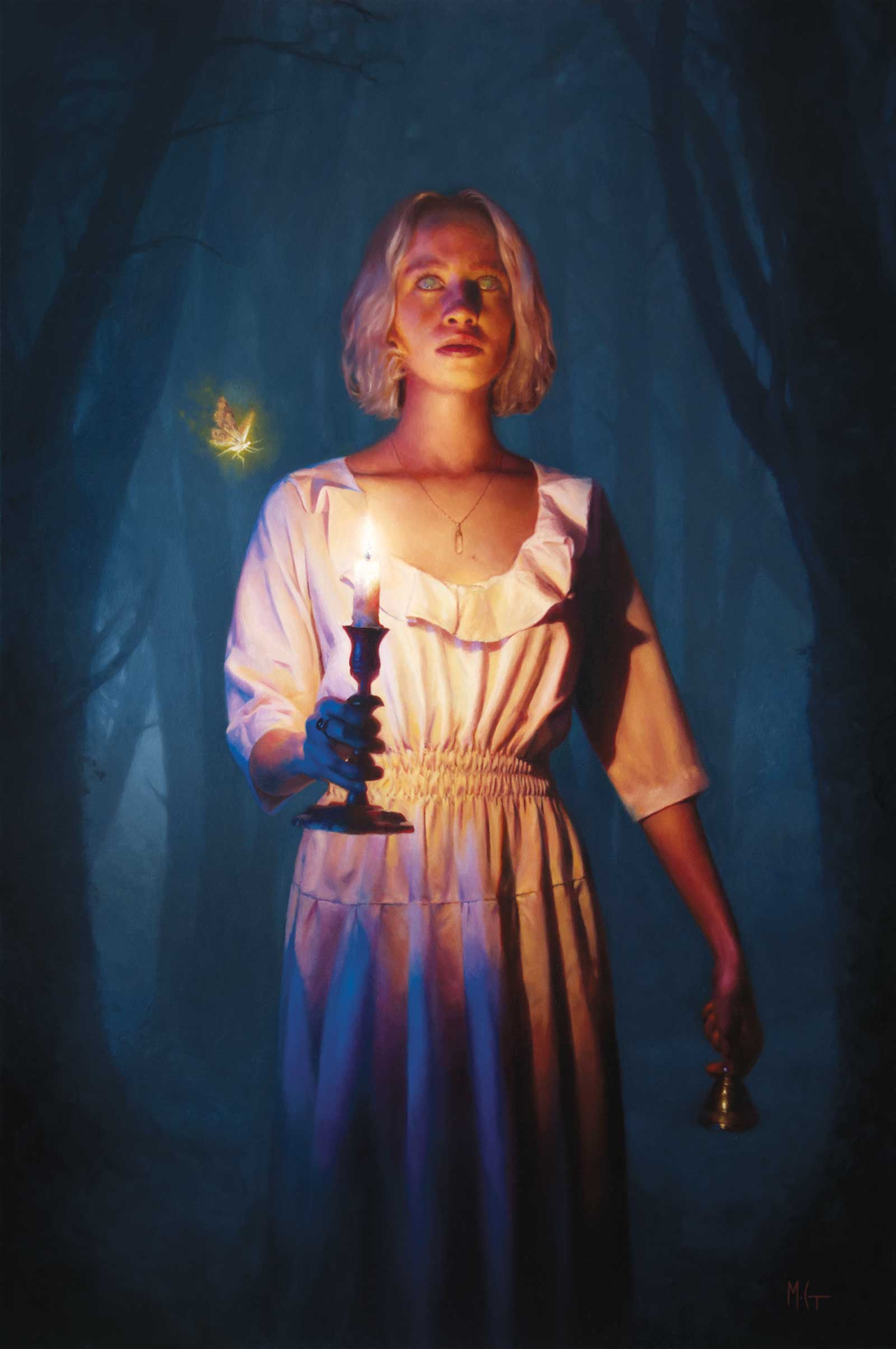 Marco Campos, Phototaxis, oil on canvas, 60 x 40”
By painting portraits of common things, Jette van der Lende removes all connotations that may relate to specific people, places or times. Her show painting of a cracked egg, Life is Protected, is one fine example. “…Life, the yolk of an egg, can sometimes endure much and sometimes little—with only the thin eggshell as a protection,” says the artist. “Life is fragile, and yet you can bear so much. As an artist, you have to let yourself be vulnerable. By mirroring the revealed egg, I protect it, as I try to protect myself. It is the universality of these symbols and what they represent that is significant to all of us, no matter who we are…”
Of her glorious fruit and pitcher still life piece, Precarious, Karen Burns says, “Precarious, yes, but actually quite sturdy. [This work] is inspired by cleaning out the prop cupboard, stacking things up and moving things around. These ‘prop stacks’ actually became a series and are part of The Tarnished Collection on my website.”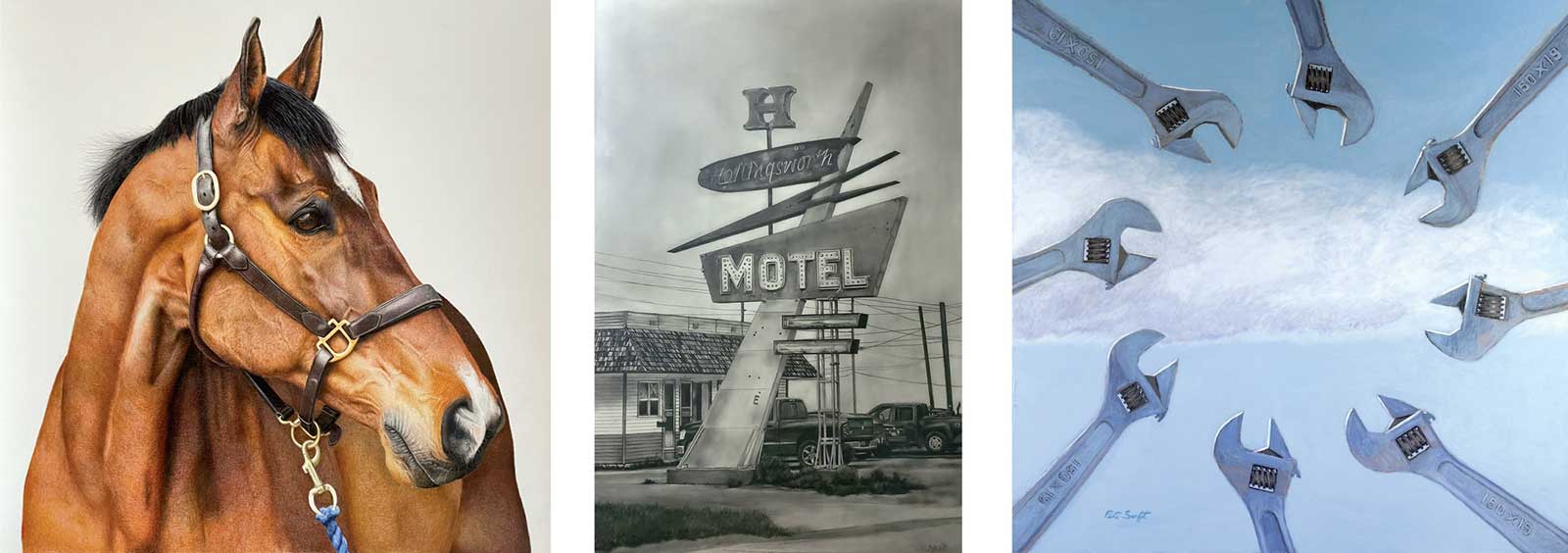 From left: Sharon Moseley, London 52, colored pencil, 19½ x 19½” ; Patsy Lindamood, Hollingsworth Motel, graphite on cradled ampersand claybord, 36 x 24”; Peter Swift, Dignity of Work – Eight Wrenches, acrylic on canvas, 48 x 48”
The elements in the environment of Lucy Dickens’ A Sense of Eden—every leaf, animal, cloud—without question, bend gently toward the light. “So do I,” she says. “It’s with this notion that I collaborate with my environment to bring these spectacular scenes to canvas. This is my intention; to take in these scenes and express my gratitude for being part of it by painting landscapes and wildlife from around the world, seeking to bring light, beauty and a story.”
Unique to the exhibition is Mike Zagorski’s painting MAXimum Imola, depicting 2021 Formula 1™ world champion Max Verstappen’s dominating performance on his way to winning the 2022 Emilia Romagna Grand Prix in Imola, Italy. “I grew up in the UK and have followed F1 for decades,” says the artist. “After picking up painting during the pandemic, I quickly gained an international following for my automotive artwork and my ability in capturing wet conditions. I’m obsessed with painting complex subjects and capturing the smallest details. Automotive artwork scratches that itch!”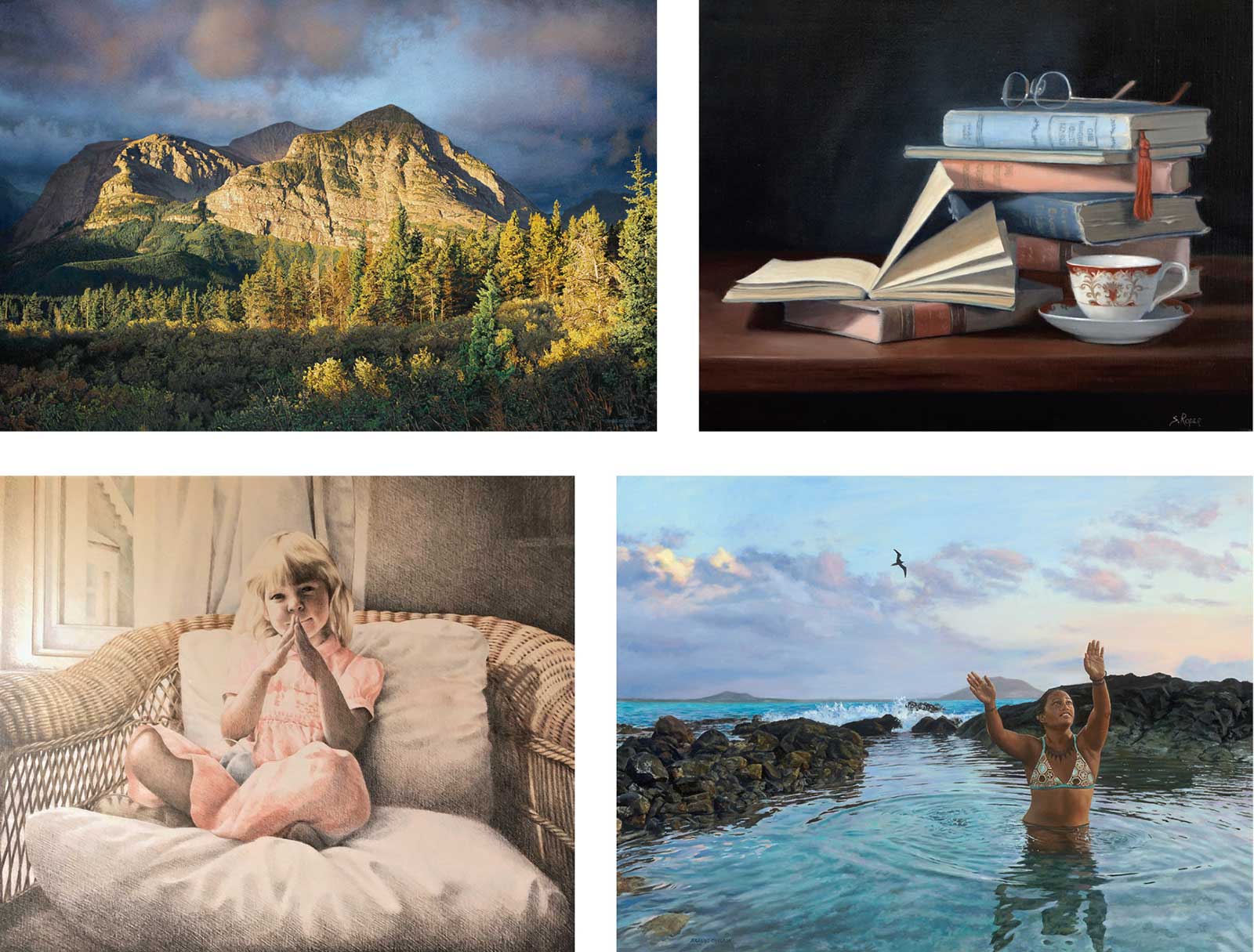 Top: Robert Steiner, Glacier, acrylic on aluminum, 16 x 24”; Sherry Roper, Well Read, oil on linen, 16 x 20” Bottom: Lisa Raymer, Jessica, colored pencil, 20 x 24”; Vonnie Brenno Cameron, Ka’iulani, oil on canvas, 36 x 48”Tracy Fein’s inspiration for show piece Insomnia is drawn solely from his subjects and their hidden emotional truths. “Each subject is a compelling visual portrayal of the human spirit, determination and courage,” he says. “I strive to show the viewer that while at first glance, my subjects show a sense of inner fragility, as well as giving them a visual voice. Capturing this inner fragility is what has moved me forward documenting my subjects and their dealing with mental illness, addictions and social stigmas.”
Kenneth Young quotes the great Michelangelo in stating, “The true work of art is but a shadow of the divine perfection.” Michelangelo’s words strike a harmonious chord that resonates deep within the artist and works like Sunrise at Ormond Beach. “I see beauty everywhere—even in what some might consider commonplace and ordinary,” says Young. “I find great pleasure in capturing and preserving it with brushes and paint so that I can enjoy it later and draw attention to it for others to know that amidst the suffering and uncertainty, there is goodness, peace and harmony. It serves as a reminder that these virtues will triumph in the end.”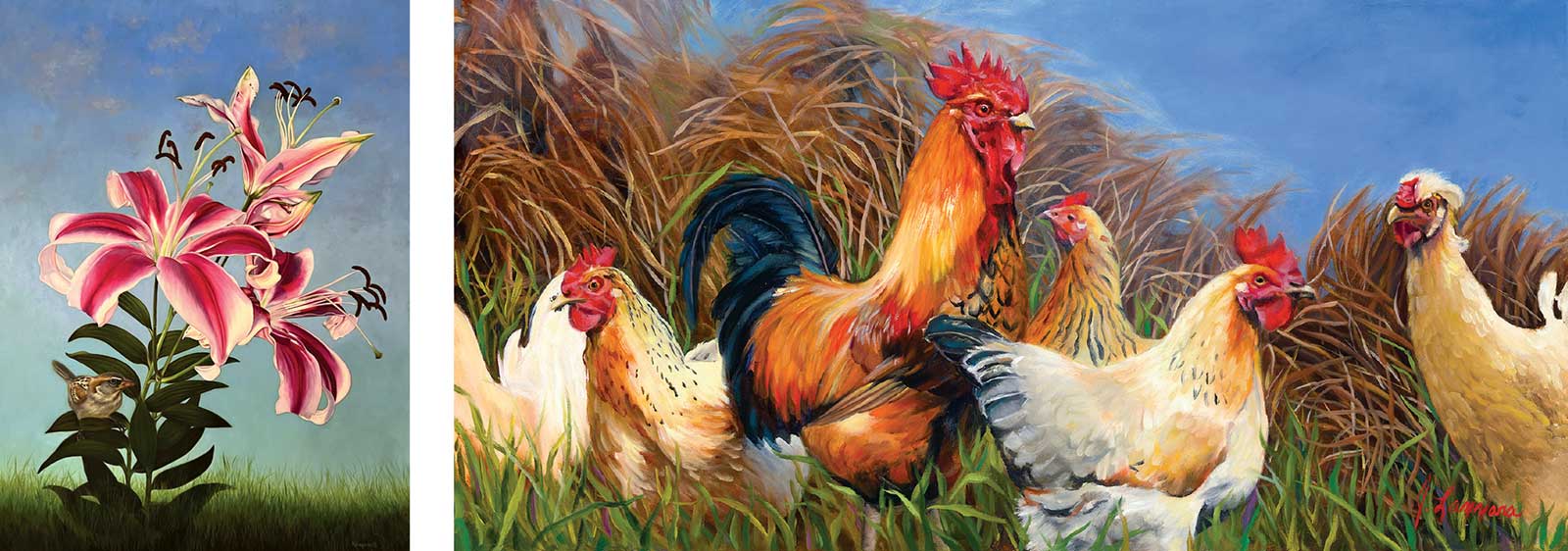 Sue Killingsworth, Consider the Lilies, oil, 40 x 30”; Joyce Lazzara, Hen Pecked, oil on canvas, 18 x 36”Figurative painter Marco Campos, brings to light a tragic story in his show piece Phototaxis. He explains of the painting, “The moth, blindly seduced by a flame, is unaware of the destiny that awaits her. Human beings suffer from diseases and disorders in our minds that blind us, making us think that we are walking towards something that could bring well-being to our lives, when in reality, it is something that could rather lead us to our ruin. In this story, both the woman and the moth meet similar fates.”
Peter Swift’s process begins with the examination of simple objects—“The objects we see every day, but never see at all,” he says. An example of this is portrayed in Swift’s acrylic painting Dignity of Work – Eight Wrenches, depicting wrenches displayed in a circle and set against a blue, clouded sky. “My work honors American workers—the folks who use their savvy, experience and hard work to build and fix the buildings we live in and the machines we use every day.”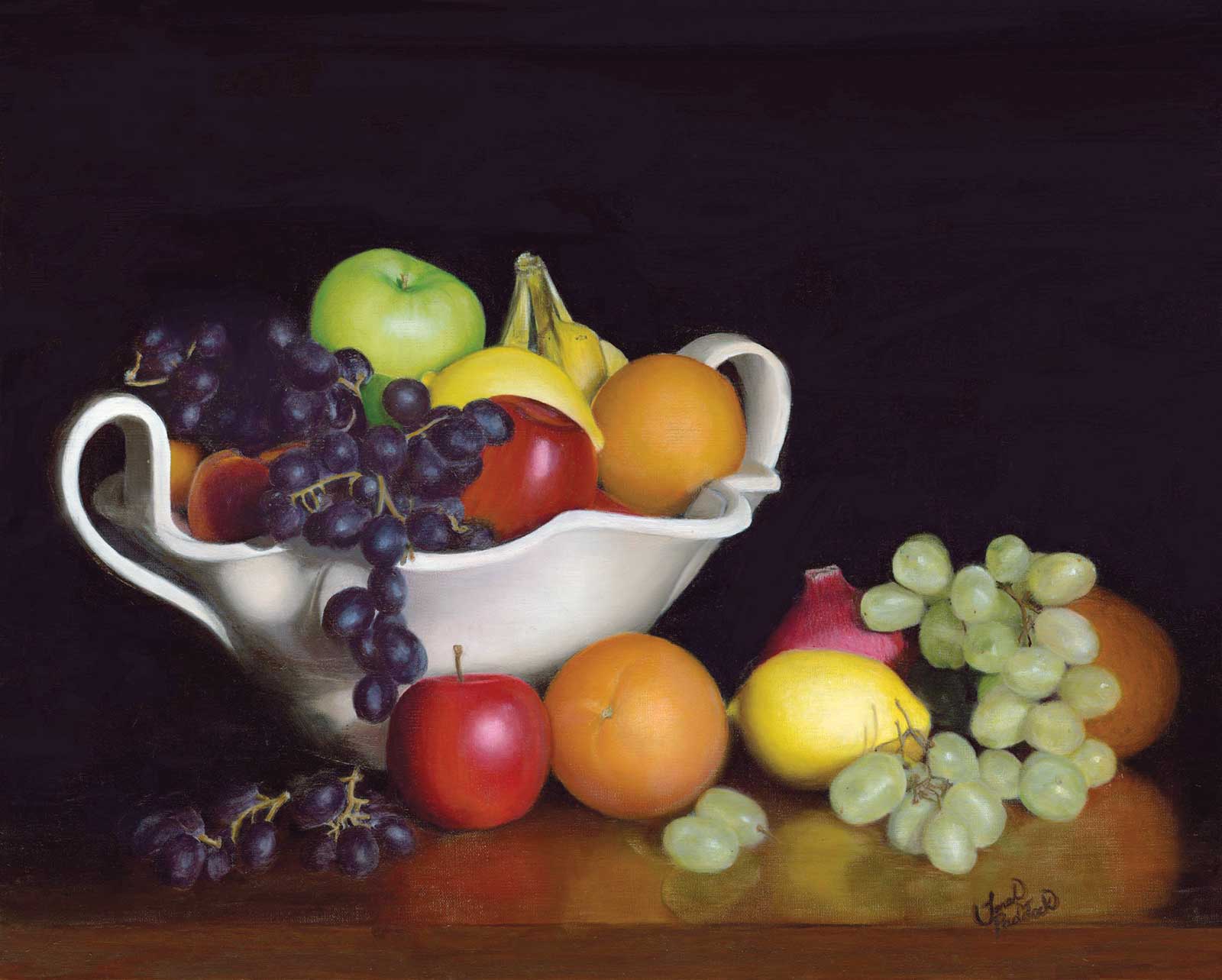 Sarah M Paddock, Early Morning, oil on linen, 16 x 20”
In Robert Steiner’s photo realistic Glacier, we see a “glorious dawn in Glacier National Park,” he remarks of the scene he was able to witness in person. “Capturing the drama of the cloud formations was the particular challenge. In my paintings, I try to communicate my sense of wonder and appreciation for the unspeakable beauty of the natural world. I have always marveled at the infinitesimal detail of the universe which exists simultaneously within its infinite expanse. This painting is an attempt to capture this sublime feeling.”
Sharon Moseley displays her lovely horse depiction London 52, rendered in colored pencil. “When I saw the photograph of London 52 a.k.a. Dan, I knew immediately I wanted to draw him,” she says. “His pose and anatomy blew me away. With the owner and photographer’s consent, Dan is the third horse I have ever drawn. I had an urge to learn the realistic details and tonal values in the eye, skin, hair and leatherwork. I’m loving this newfound journey with colored pencils and looking forward to more challenges.”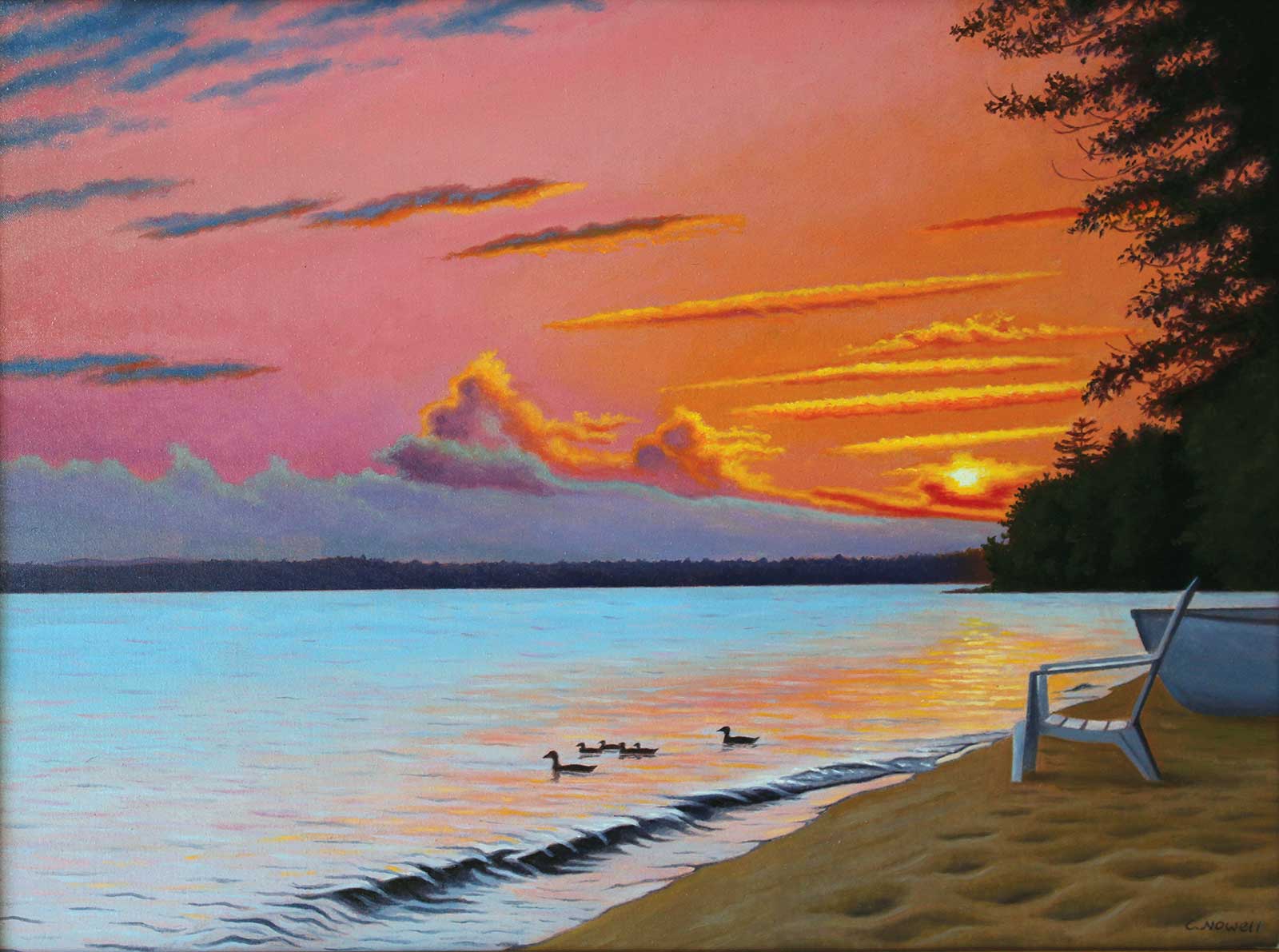 Charles Nowell, Sebago Sunset, oil on canvas, 18 x 24”
For still life pieces like Well Read, featuring a stack of books, a teacup and reading glasses, Sherry Roper explains “Dramatic light, texture and color are what initially draws me to a subject, but what really excites me are the details most would otherwise overlook. I try to draw attention to these details that I feel capture the essence of the objects in my paintings. The texture of an orange segment, the intricate decoration on a teacup, the frayed edges of an old book—these are the properties I love to enhance in my still life paintings.”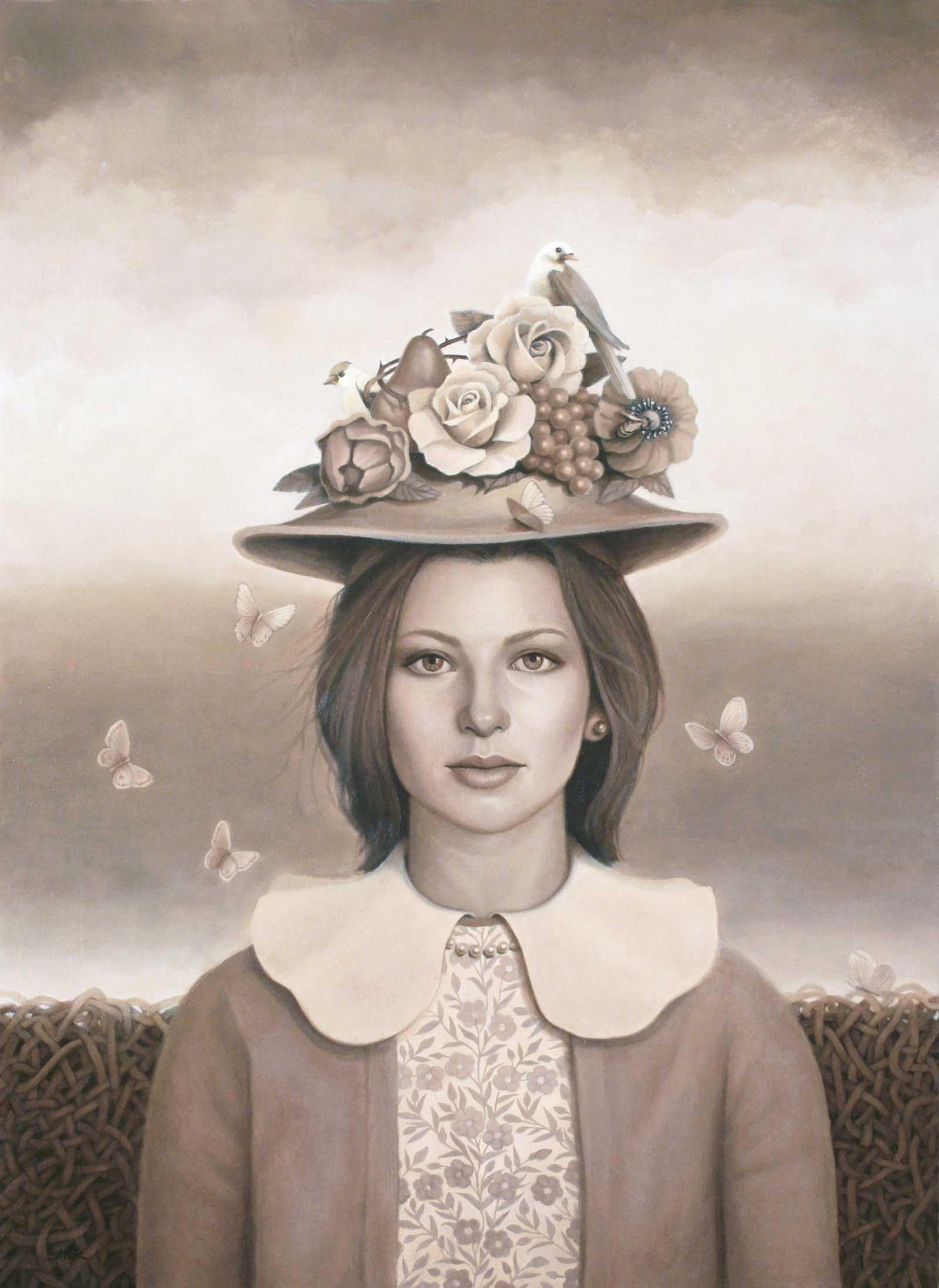 Susan Helen Strok, Garden Party, oil on cradled board, 30 x 22”
Joyce Lazzara brings “colorful joy” to the exhibition with her oil painting Hen Pecked, featuring several chickens and a rooster. “You can’t beat the color attraction with chickens,” says Lazzara. “The verbal and visual conversation going is nonstop. It was fun to paint while in in my studio in Durango.”
Lisa Raymer’s artistic focus is atmosphere—whether a landscape, figure study or urban scene. “I find colored pencils particularly well suited in conveying this moodiness,” she explains. “The granular surface creates a subtle vibration accompanied by translucent colors that layer and build depth.” We see this in Raymer’s show piece Jessica— “A sweet pose bathed in warm, late afternoon light; colors soften, shadows deepen,” the artist describes.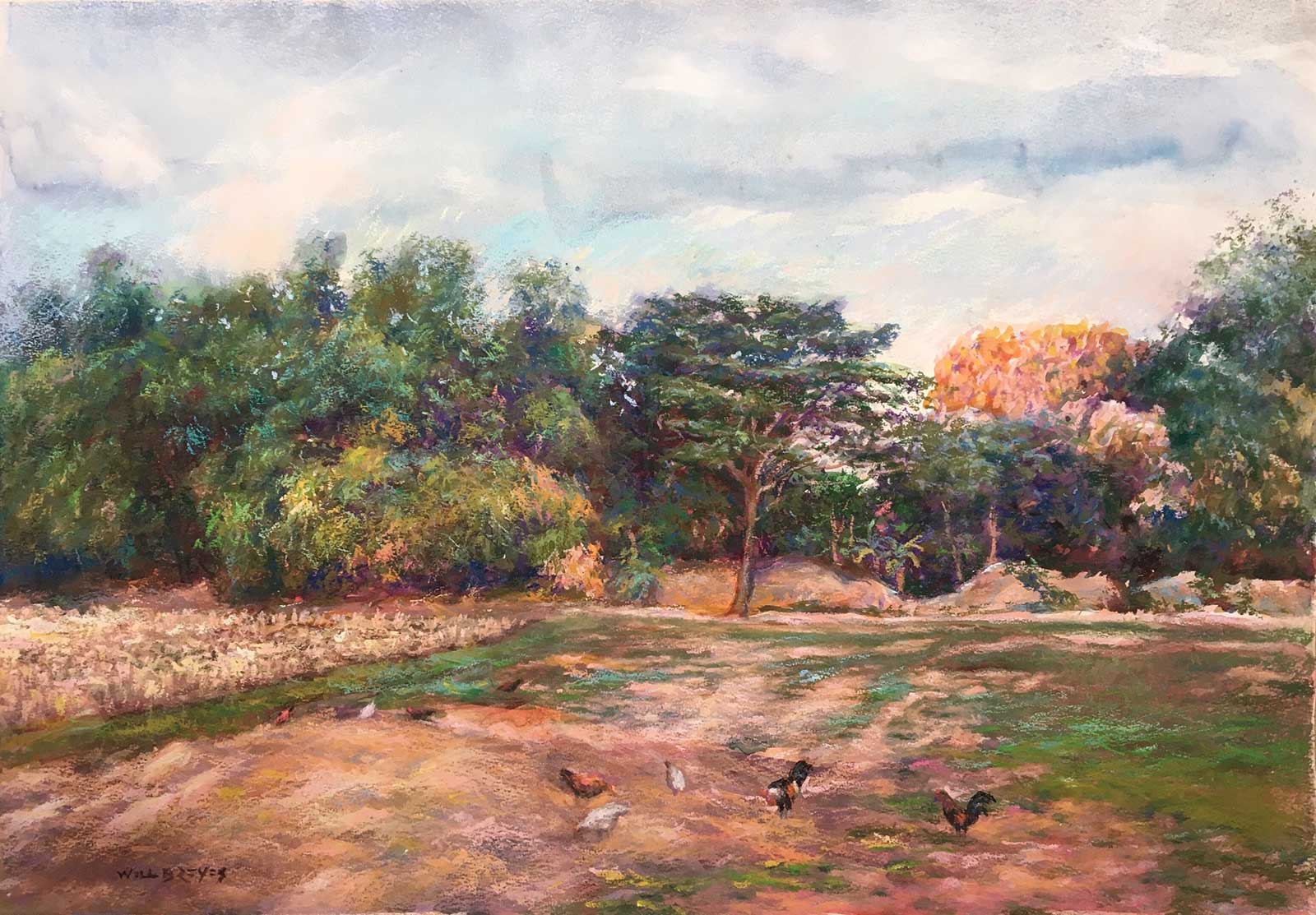 Will B. Reyes, God’s Grace Abounds in the Fields, oil pastel and watercolor, 15 x 21”
Never one previously drawn to painting landscapes, these days, Patsy Lindamood is developing a series of Texas panoramas featuring grain silos, grain elevators, disintegrating homesteads and other vintage Midwest scenes, like in her moody piece Hollingsworth Motel. “These vistas are comprised of a broad range of values, populated with subjects which are consummate examples of strong lines and shapes…,” she says. “Absent the romance of color, working in shades of grey is like telling a short story rather than writing a novel.”
Sarah M Paddock explains that her realism is “very human, traditional in form and practice, yet contemporary in contrast and chroma. I concentrate intensively on surface, light and the relationship between objects. Much like Clara Peeters and the Spanish bodegon painters of the early 17th century, I aim to paint the ordinary with extraordinary reverence.” By painting still life in the tradition of academic realism, as in the case of Paddock’s painting Early Morning, she gives treasured possessions and everyday objects the attention that honors them as the artifacts of our living.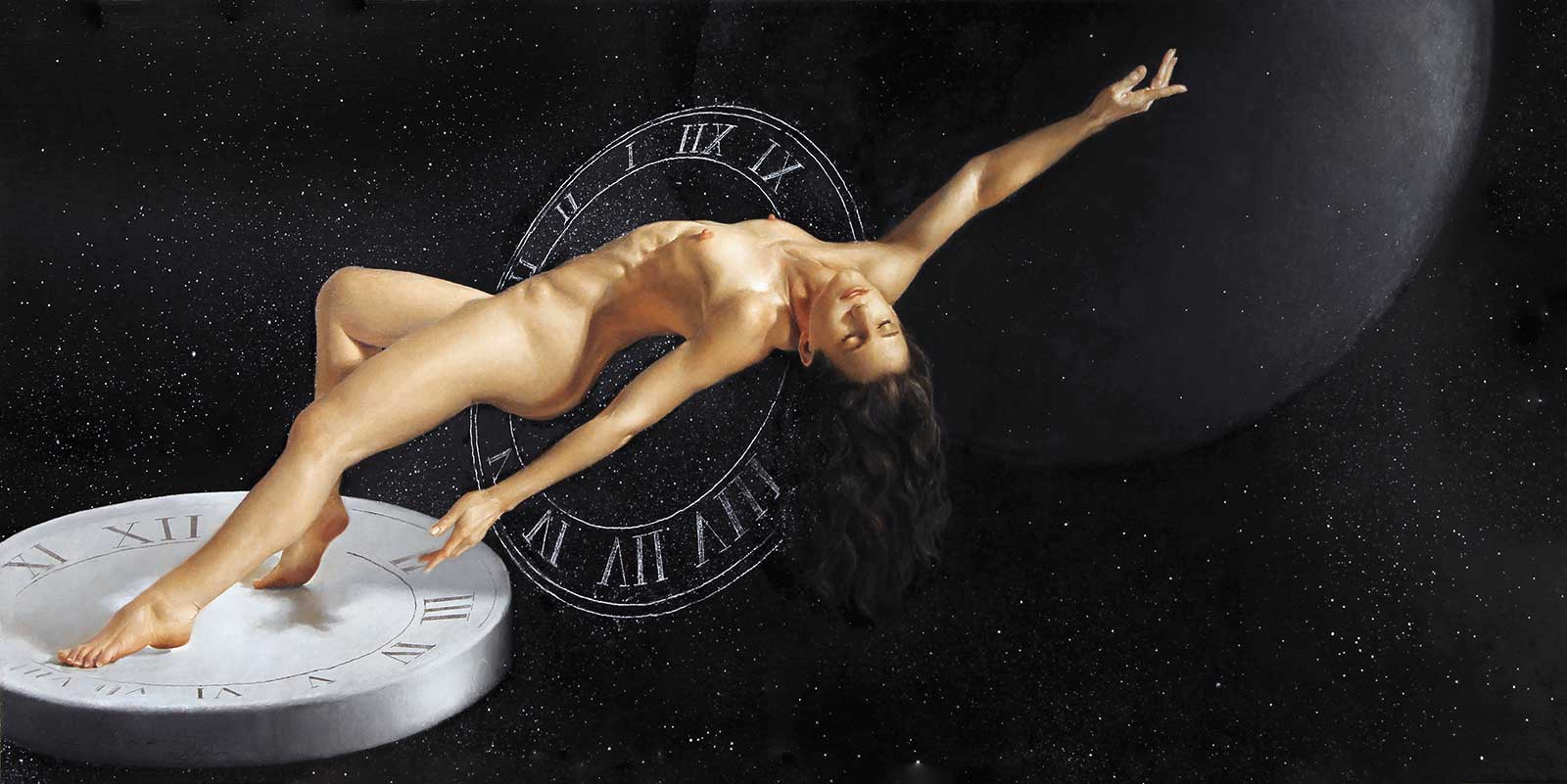 Lisa Rickard, Canopus, oil on canvas, 18 x 36"
“My love of gardening and faith frequently work in chorus to inspire my art,” says Sue Killingsworth. “Nature speaks to me of magnificence beyond this world. I am drawn to realism because I want the viewer to enjoy a similar thrilling encounter with beauty that I initially feel when I discover my painting subjects.” In her show piece Consider the Lilies, we see Killingsworth passion come to life, along with clear technical skill in conveying mood through light and color.
Susan Helen Strok’s painting Garden Party was inspired by an old sepia family photograph of a woman in a flowered hat. “The photo was a bit hazy and indistinct,” Strok explains, “so I opened my mind to play. I knew the title was going to be Garden Party and my muse kept telling me to add different flowers, fruit and birds—this is the final result. I look at her and realize that she is Gaia, the Earth Goddess, walking through a barren world consumed by storms. She is the earth in bloom, attracting life, asking it to stay alive. ‘Join my party,’ she says, ‘I will bless you with my love. Have hope and bloom again.’”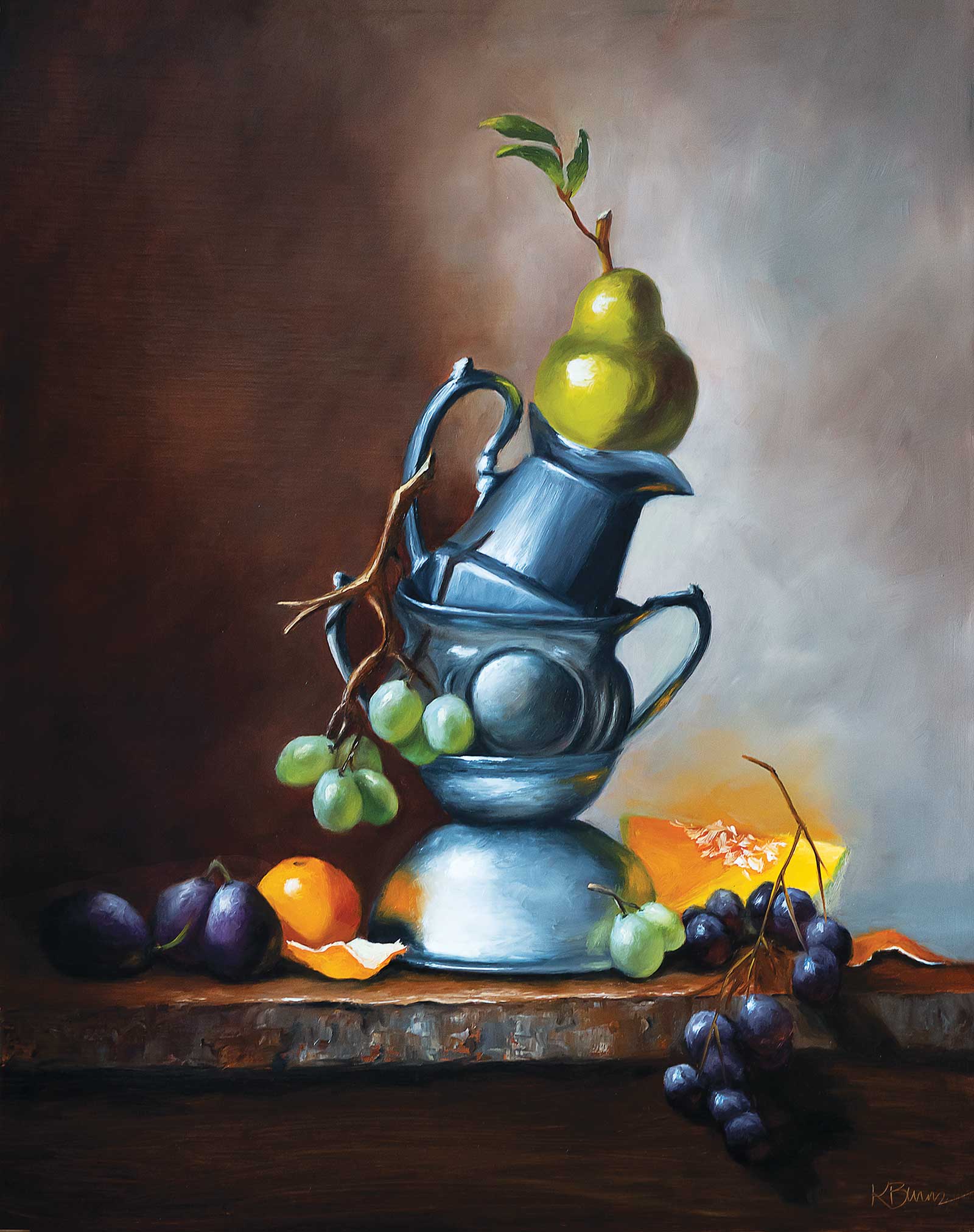 Karen Burns, Precarious, oil on archival panel, 18 x 14”
Having been raised in Hawaii, Vonnie Brenno Cameron now finds inspiration in painting ocean and beach life from California and Hawaii, landscapes of New Mexico and portraits. Her favorite subjects combine people and portraits with landscapes and scenes that capture a moment in time—featured in Ka’iulani, pictured in this section. “This can be a gesture, an expression, in a setting that is also fleeting,” Cameron says, “like dramatic clouds and skies, light in a landscape, waves breaking or busy urban scenes.”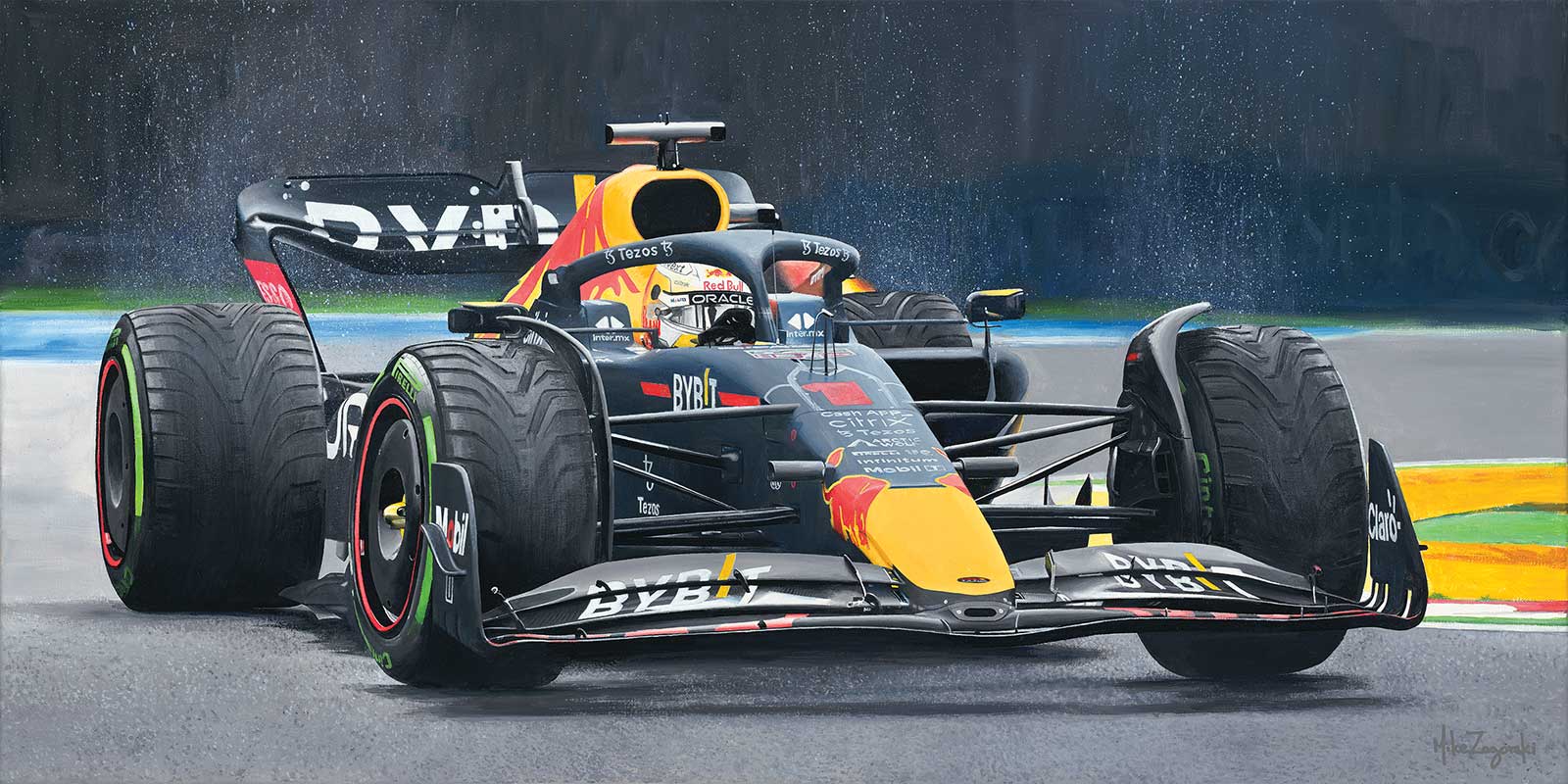 Mike Zagorski, MAXimum Imola, acrylic on canvas, 24 x 48”
Will B. Reye’s painting God’s Grace Abounds in the Fields, depicts a typical countryside scene in his home province in the Philippines. “To the left of the middle ground can be seen a portion of a newly-harvested rice field,” says Reye. “In the foreground is a flattened stack of dry hay where free-range chickens are foraging. In the background are clump of trees and bamboo grove forming a border to the fields. These features in a bucolic setting may seemingly look ordinary, but they possess a charm that is timeless, inspiring and moving.”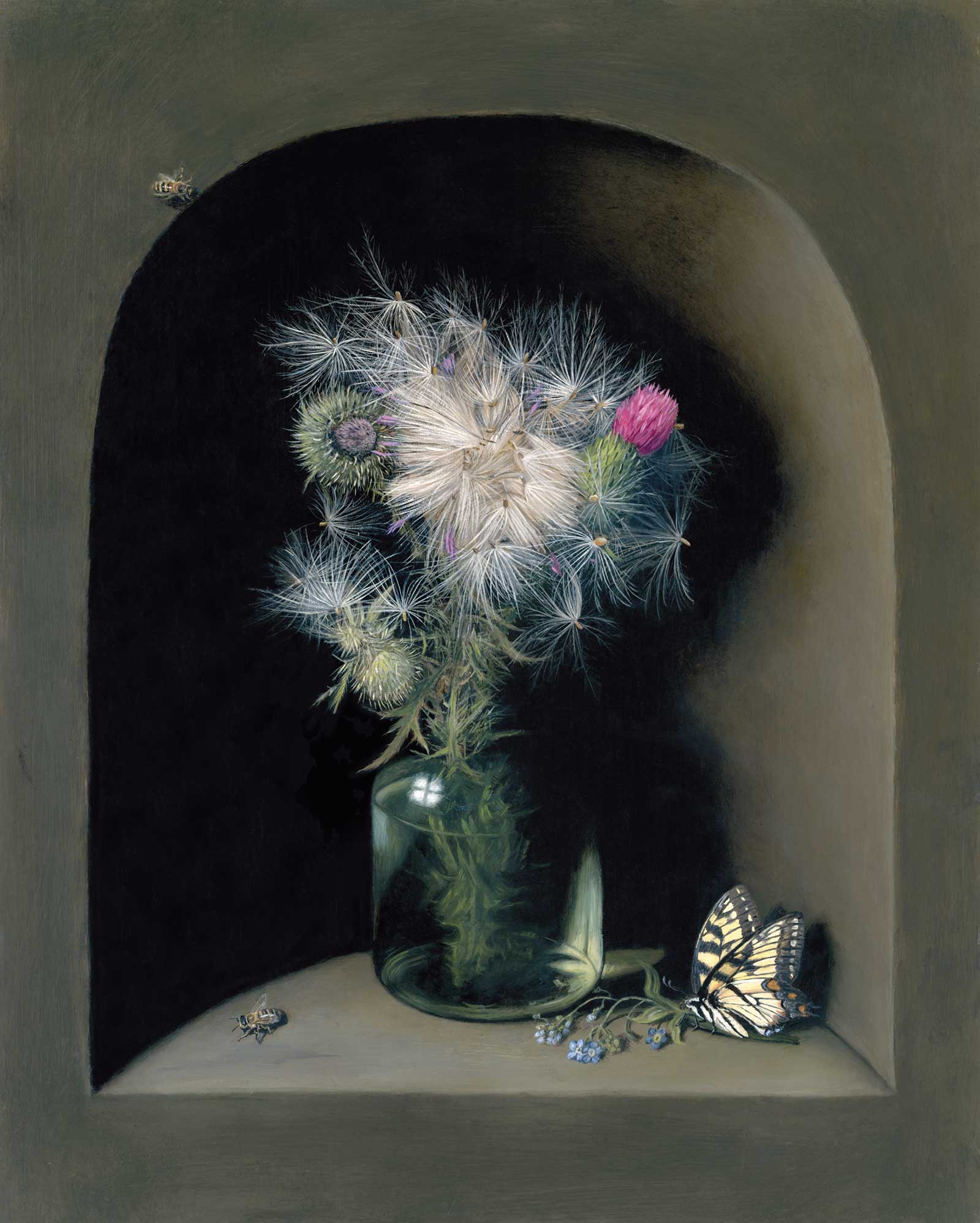 Rebecca Luncan, Thistle, oil on aluminum, 14 x 11"
Lisa Rickard explains that her show piece Canopus “is the third painting in a series of allegorical figures about youth, adolescence and adulthood. She is named after one of the ten brightest stars in our night sky. Her gesture symbolizes the projecting piece on an ancient sundial that tells time by the changing position of its shadow as earth rotates on its axis while orbiting the sun. The story is about the stage of our lives as an adult when time seems to be passing too quickly.”
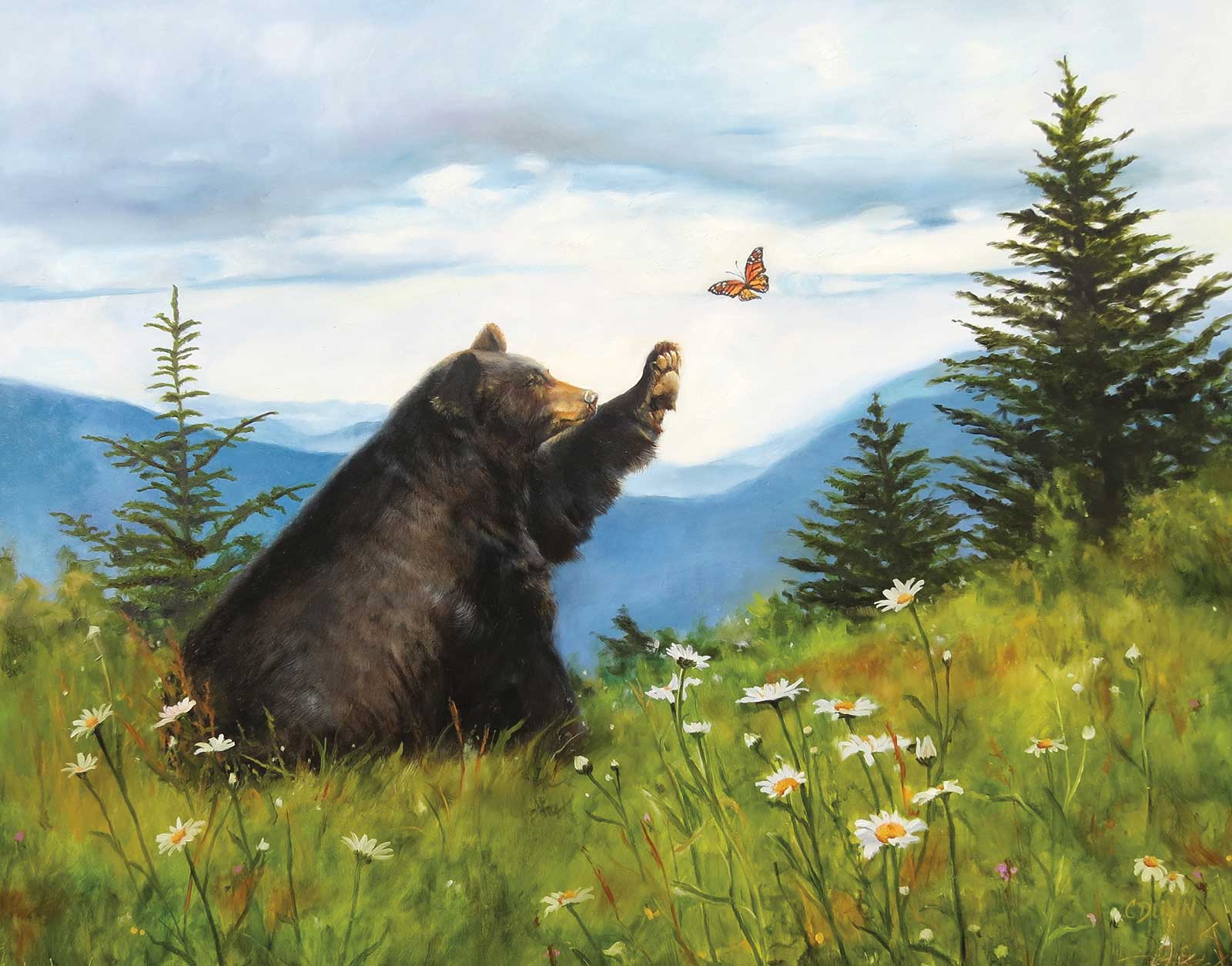
Cristy Dunn has deep roots in the Southern Appalachian Mountains. The music and culture, the mountain sunsets, creeks and streams, and the wildlife are all a source of endless inspiration. “I’ve painted as long as I can remember” says Dunn, “and my hope is that my work reminds the viewer of the sacredness within us all.” In show piece Among the Wildflowers, of a bear playfully pawing at a butterfly in a lush, green field, Dunn’s inspiration and expertise in depicting the natural world comes to fruition.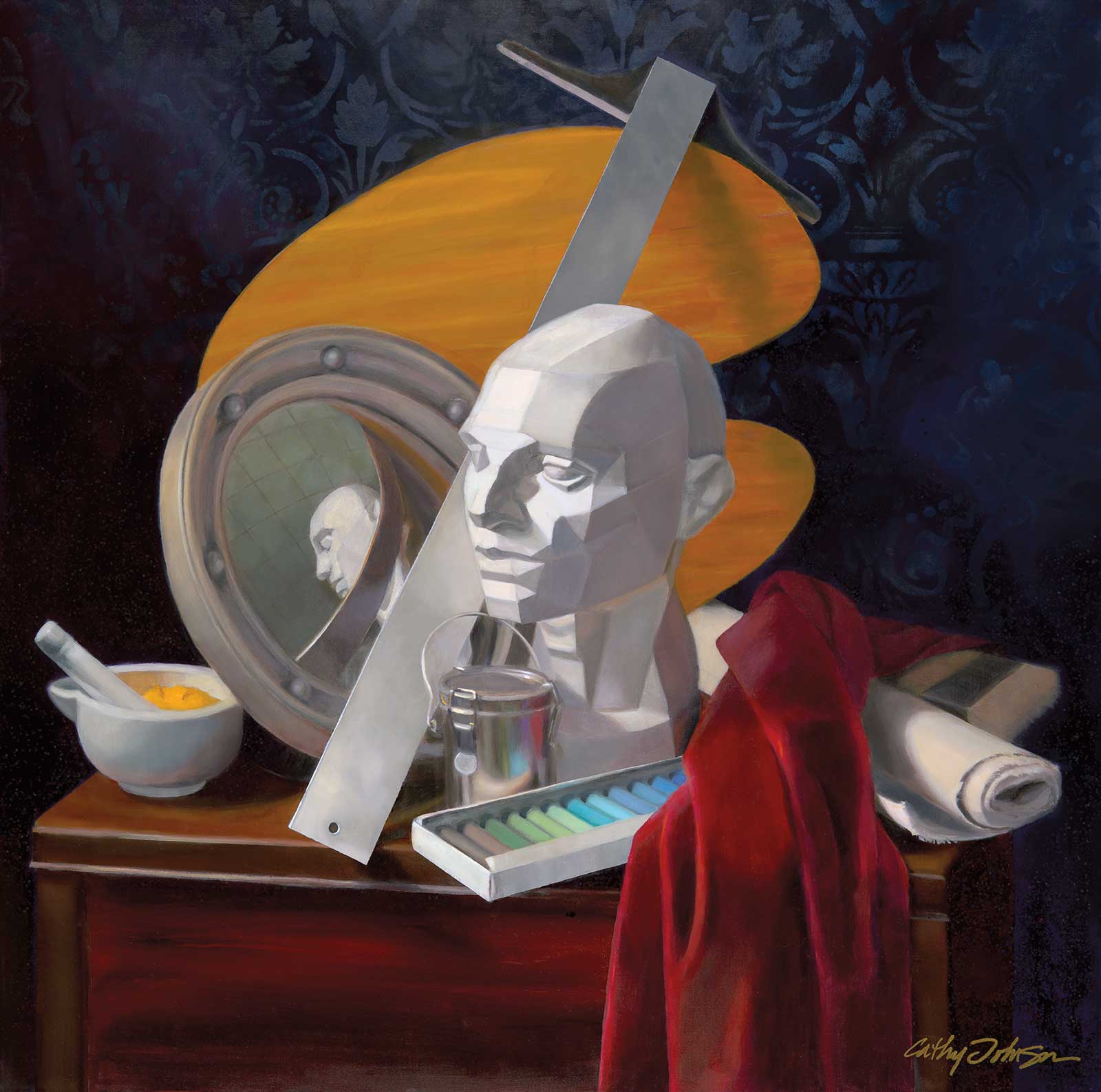 Cathy P. Johnson, Altar to Art, oil on linen, 30 x 30"
 Cristy Dunn, Among the Wildflowers, oil on panel, 24 x 36"
“I love the complexity and subtly of nature, our connection with the world and with each other,” says artist Cathy P. Johnson. “I paint in order to explore and reflect on a moment in time and bring it to life using the interplay of colors, forms, tones and textures.” Through her painting, as in her show work Altar to Art, Johnson shares her perspective with the viewer and hopefully connects with them at both an intellectual and emotional level.
Charles Nowell’s Sebago Sunset is a magical place where his wife grew up. “Until the pandemic, I had never experienced the magic of the sunsets, the joy of the simplicity of life on the lake or the pure pleasure of watching the day end over the waters of a lake in Maine,” says Nowell. “Capturing this image in paint and sharing it with others is my life’s passion.”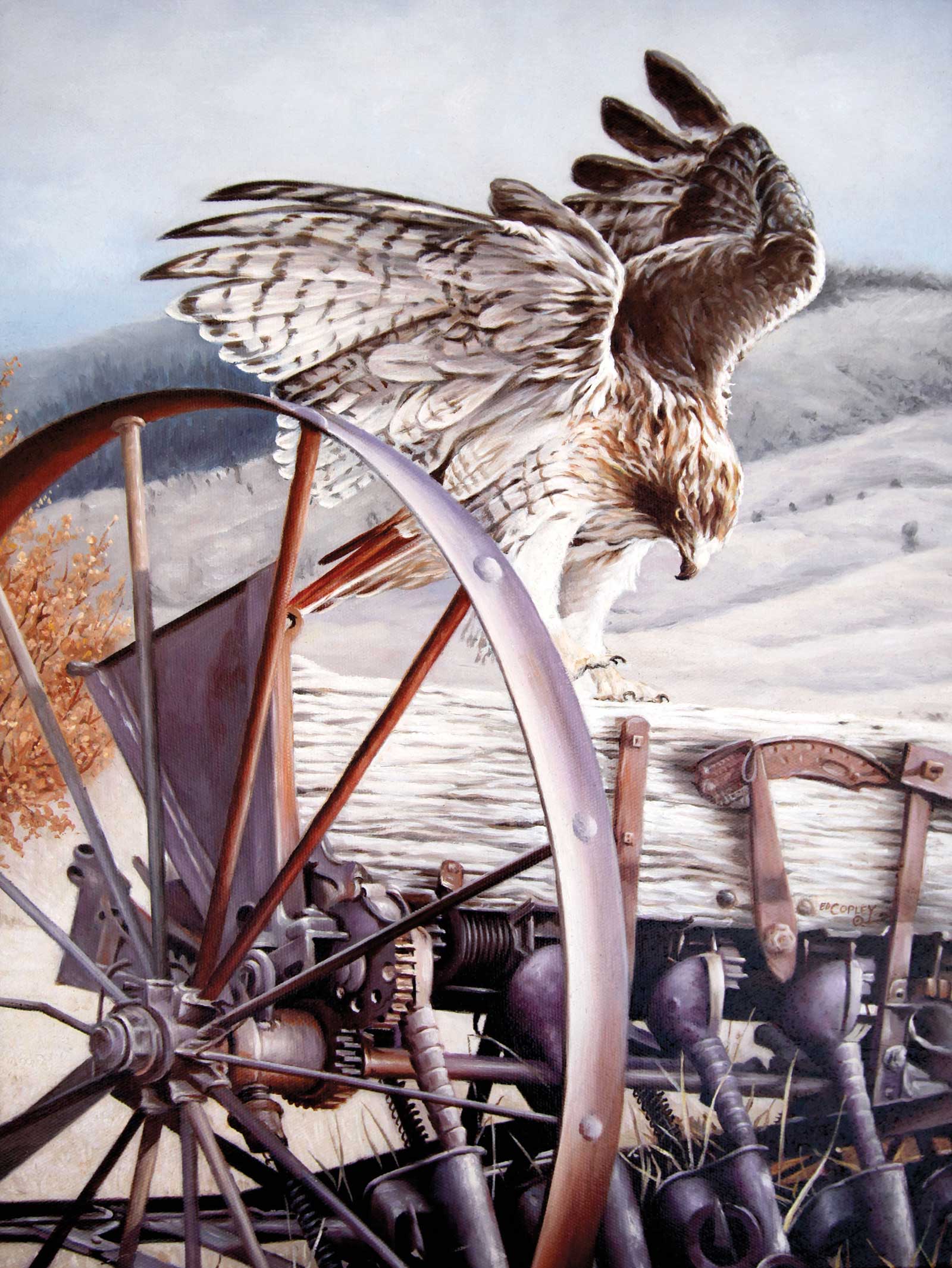 Ed Copley, Red Tail Landing, oil on linen, 17 x 13”
Animal, figure and still life painter Rebecca Luncan draw’s inspiration for her oil paintings like Thistle, featuring a highly detailed vase of thistle with butterfly and bees, from memories of growing up on a small family farm in Ohio, and the people and animals that grace her life in the Seattle area today. Viewers can also see the influence of portraiture from the Northern Renaissance and the Dutch Golden Age. By using time tested techniques dating back as far as the 1500s…Rebecca’s paintings have a timeless character that will weather the tests of time.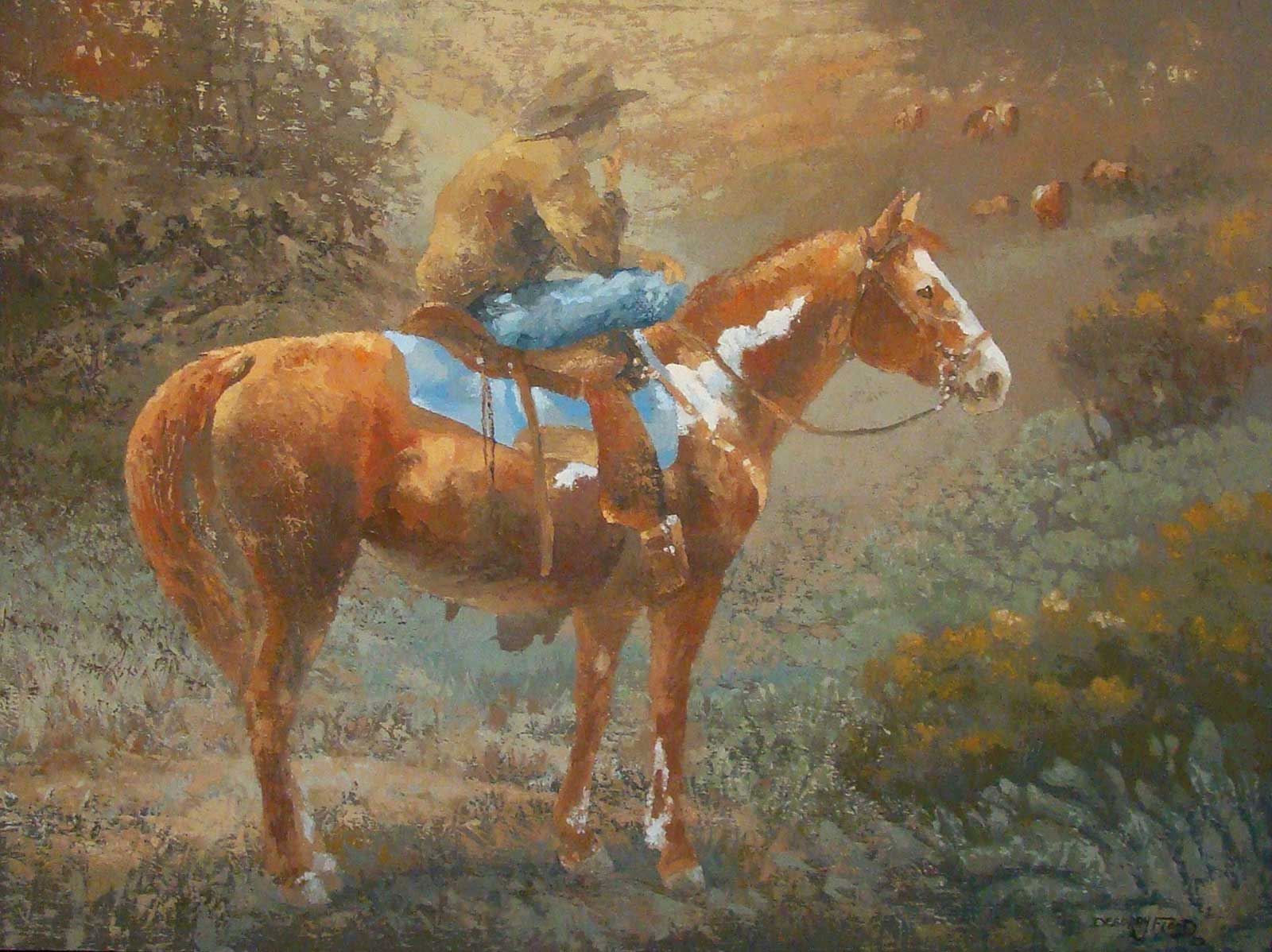 Deborah Flood, The Horse Parade, oil on wood panel, 18 x 24”Through December 20, the International Guild of Realism’s Fall Salon Online Exhibition will showcase these masterpieces and many more on the following websites: www.americanartcollector.com, www.qcfinearts.com and www.realismguild.com. —
International Guild of Realism’s Fall Salon Online Exhibition
When: October 20-December 20, 2022
Where: View the show online at www.americanartcollector.com, www.qcfinearts.com and www.realismguild.com.
Powered by Froala Editor