Roger Dean’s wildly popular art is instantly recognizable from the covers of classic rock albums, and as the inspiration of the landscapes of the blockbuster movie Avatar, and has been published as millions of posters and books. His beautiful paintings were contemptuously brushed away as proletarian fantasy by the bony aestheticians of the old New York hegemony, but when it is properly placed in the context of art history and globalization, it becomes clear that his work captures perfectly the zeitgeist of our cross-cultural time. His career as a successful professional painter began in the 1960s, as post-modern artists first began challenging the power of the New York avant-garde, and began combining creative techniques and compositional crafts gathered from traditions around the globe into new hybrid forms.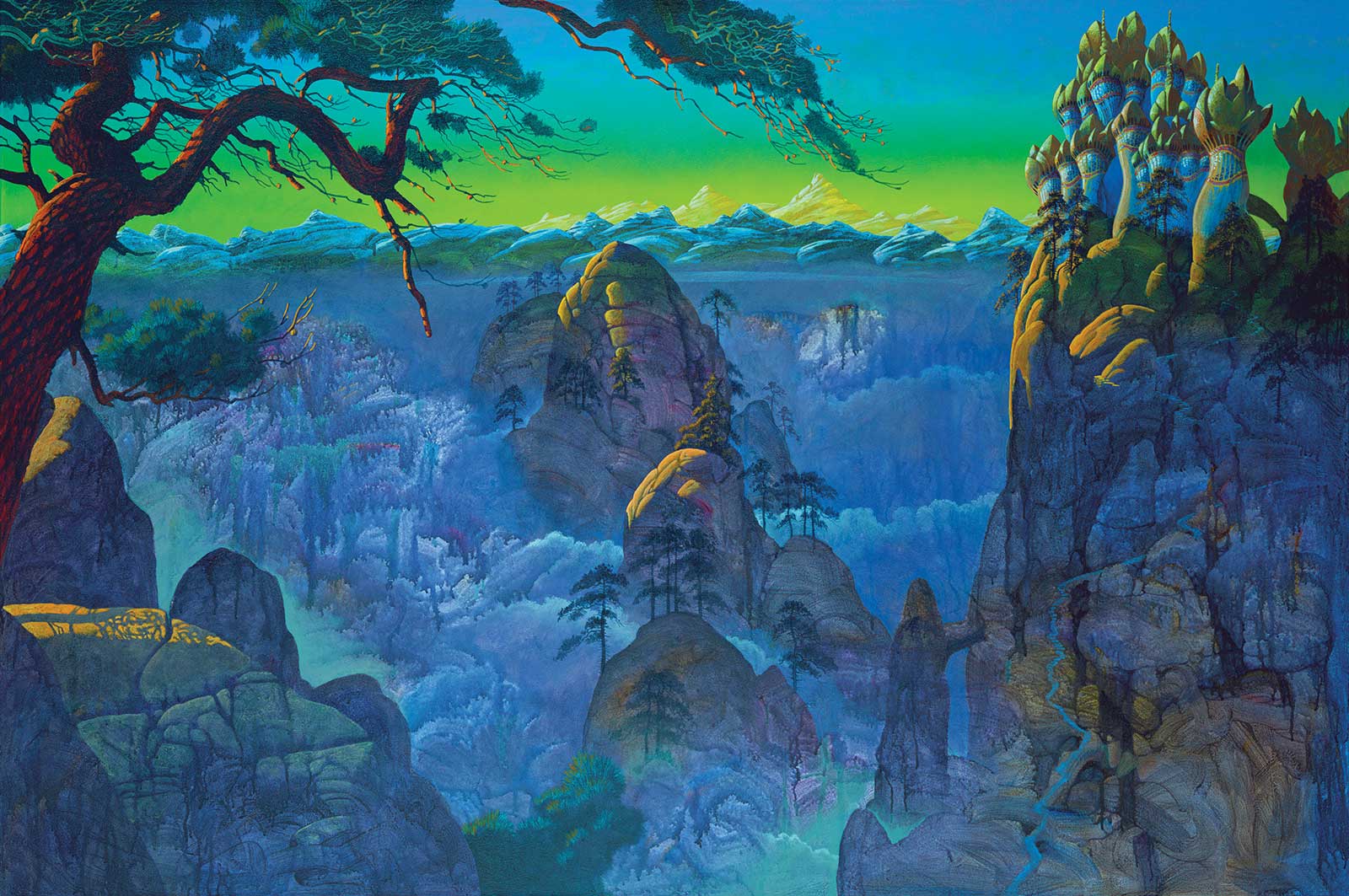 Roger Dean, The Quest, 2021, acrylic on canvas, 48 x 72"
As a young man, Dean lived in Hong Kong, where he became familiar with the ancient Chinese compositional technique known as shan shui hua, which reached its peak during the Song dynasty between 960 and 1279 CE. He has been completely consistent to its use throughout his career. The delicate, smoky atmospheric perspective of Song landscape paintings is created by carefully balancing three areas of the composition—the near, the middle and the far. The “far” is the softest edged part of the composition, at the top of the image. The middle ground is clearer, but detail is most crisp in the foreground. As well as using the conventions of shan shui hua, Dean is fond of painting unusually exaggerated geological formations, developing them from the characteristic mythic mountains of Chinese landscape paintings like Shen Zhou’s exquisite Ming dynasty scroll, Lofty Mount Lu, of 1467.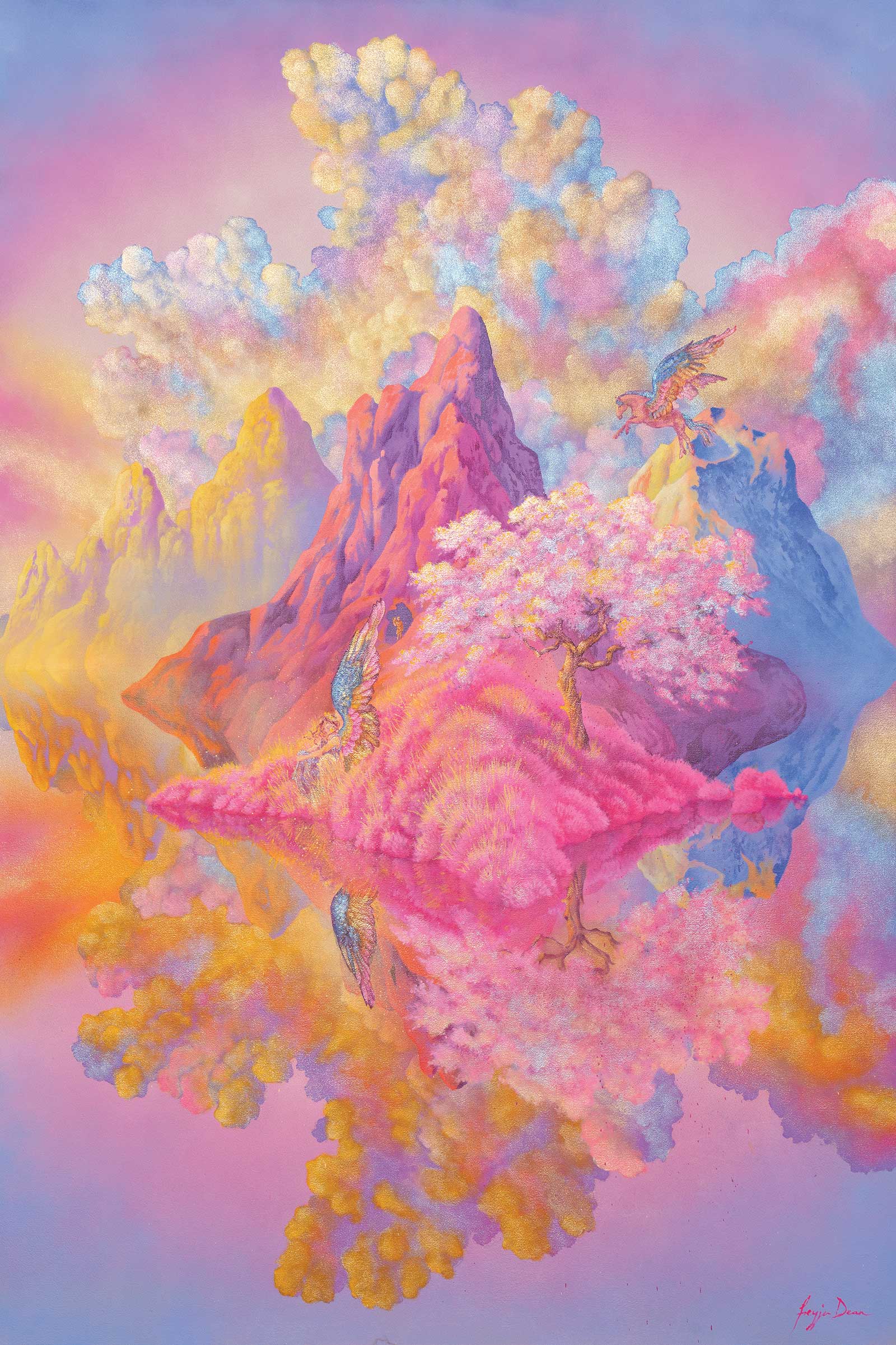 Freyja Dean, Medusa’s Family Reunion, 2021, acrylic on canvas, 64 x 44"
But Dean’s sensitive cross-cultural approach to painting the landscape is solidly grounded in Western art history, too, with long roots in late medieval European art. His visionary images are directly related to the fantastic landscapes of Northern Italian paintings of the Madonna, and his flying creatures to the astonishing bestiaries of Northern European painters of literary allegories, like Hieronymus Bosch. In the lush Madonnas, access to the distant paradise is mediated by the holy mother and child, who are conventionally seated between us and the promised kingdom. The heavenly realm is within the reach of the viewer, but only through accepting the grace of Jesus, and asking for the intercession of the mother of God. But there is no barrier between us and heaven in Dean’s landscapes—no religious intercession is required—his paradise is available to all. In Dean’s paintings we freely enter a wonderland of creativity where no utopian theological rules bind the antediluvian garden behind rigid religious walls. The distant mountains are blue, the color of the high firmament; the bright earth is verdant green, pathways and rivers wind into its benevolent folds; and Dean breaks the bonds of heavy gravity to free us from the weight of earthy life. His Eden is available in the present, in the imagination.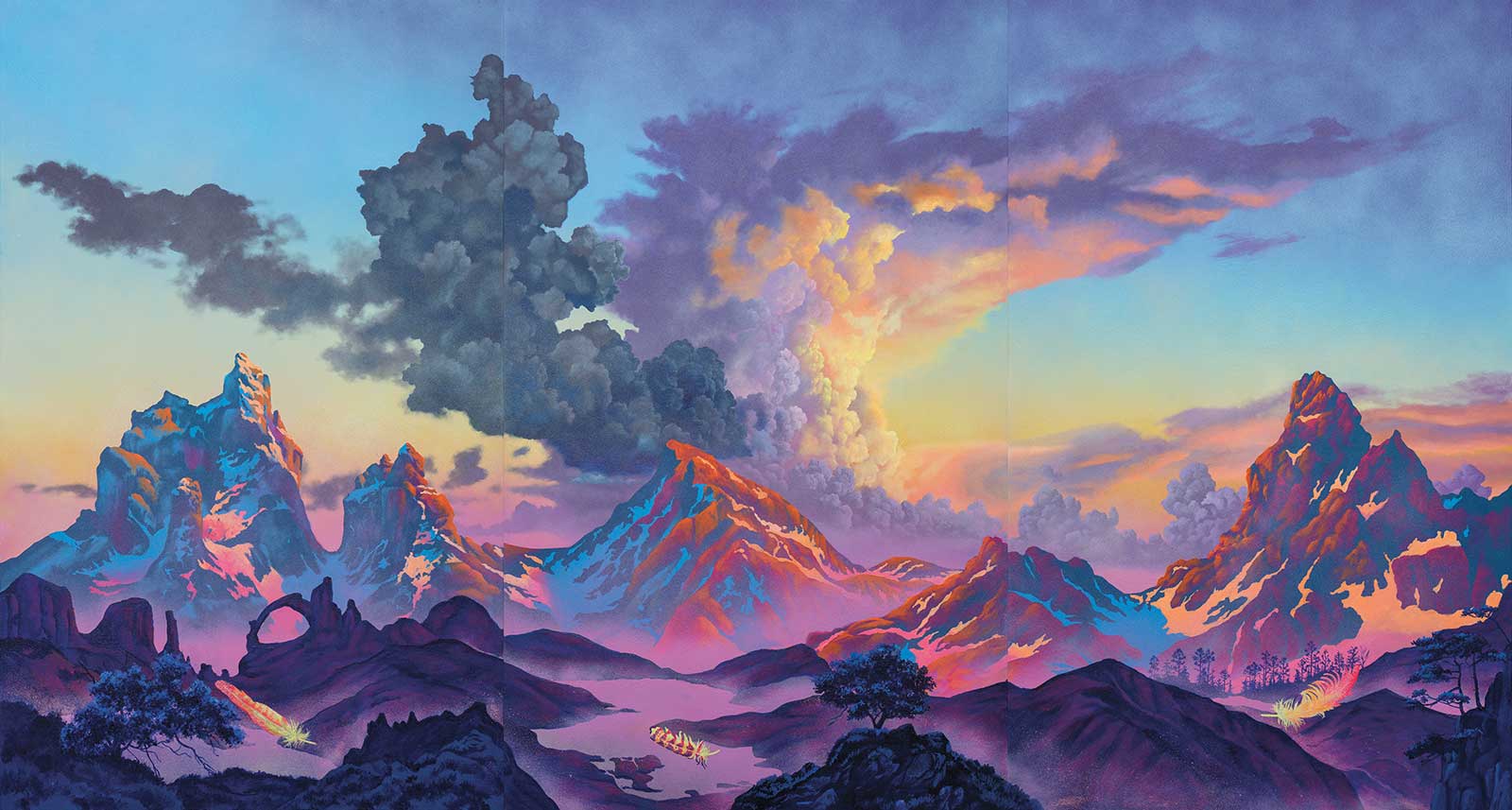 Freyja Dean, Three Feathers (triptych), 2022, acrylic on canvas, 46 x 28 3/5" (each)
Dean’s beautiful new painting The Quest has deliberately flipped the conventions of both shan shui hua and the heavenly landscapes of the icons. Here, the middle ground and foreground are painted in the gentle blue and purple hues usually reserved for distance, and drift in and out of detail and softness, while the distant mountains are hard-edged, and the horizon sky is brightly colored in greens and yellows. Those greens and yellows pick out sunrise highlights on trees and weathered granite, and an abstract pathway winds toward the strange organic structures built high on the stone buttresses.
Logic still rules in Dean’s utopian landscape, and he is the master engineer of imaginative composition. The ecstatic arches which raise into the softly blended sky in his famous Gates of Delirium were first conceived from the soaring fan vaulting of Canterbury cathedral, where sublime and high stone ceilings of floating stone rise to the celestial sphere. His floating islands of fractured stone are cousins to the rock formations of Leonardo Da Vinci and his followers, who loved creating gravity-defying landscapes as the backdrops to their work—heaven had to be more wonderful than the scenery of the fallen earth, and the environment must be more Edenic than reality.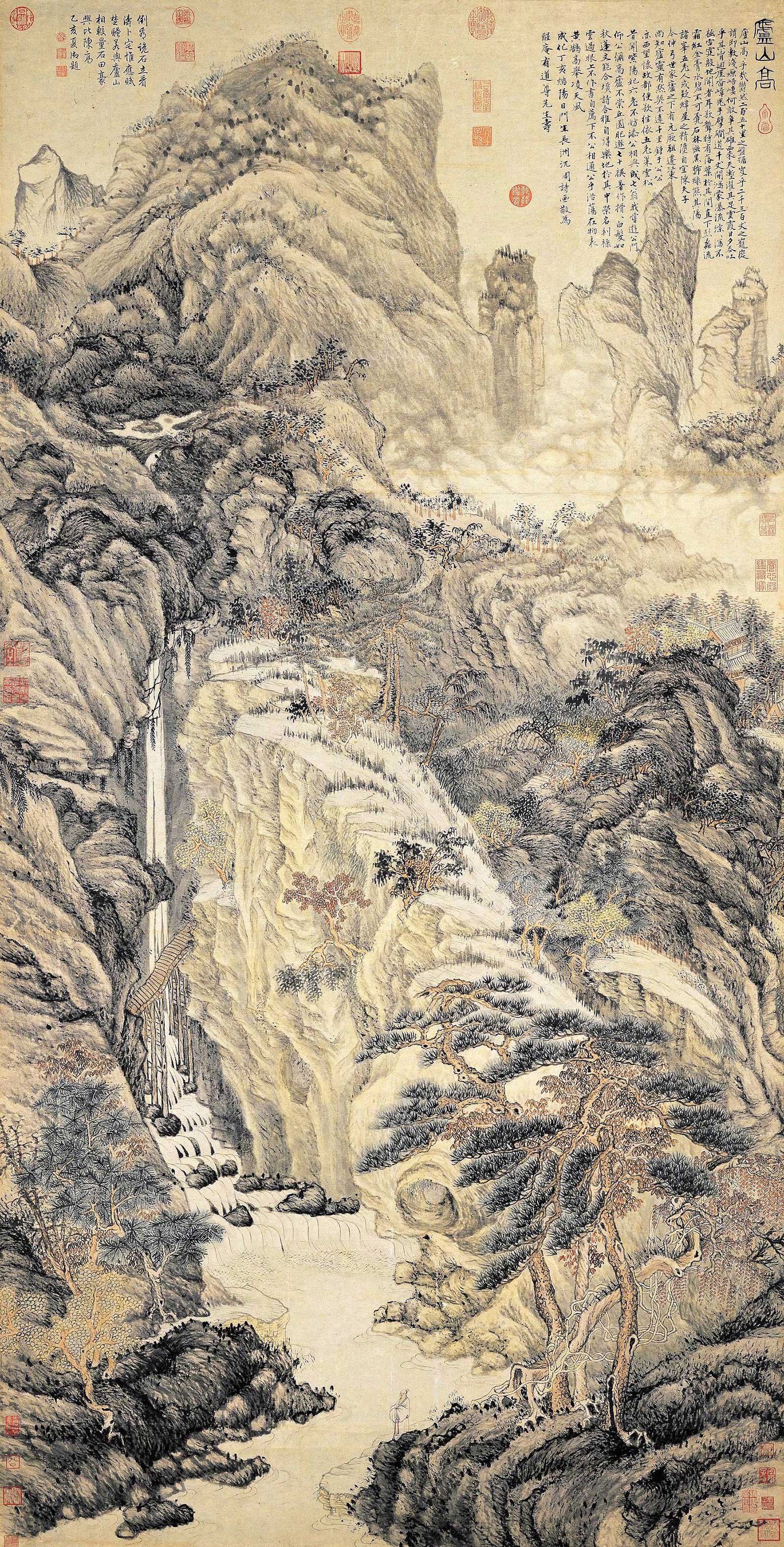 Shen Zhou 沈周, Lofty Mount Lu 廬山高, hanging scroll, ink and colors on paper, 76 x 39". Ming dynasty, 1467.
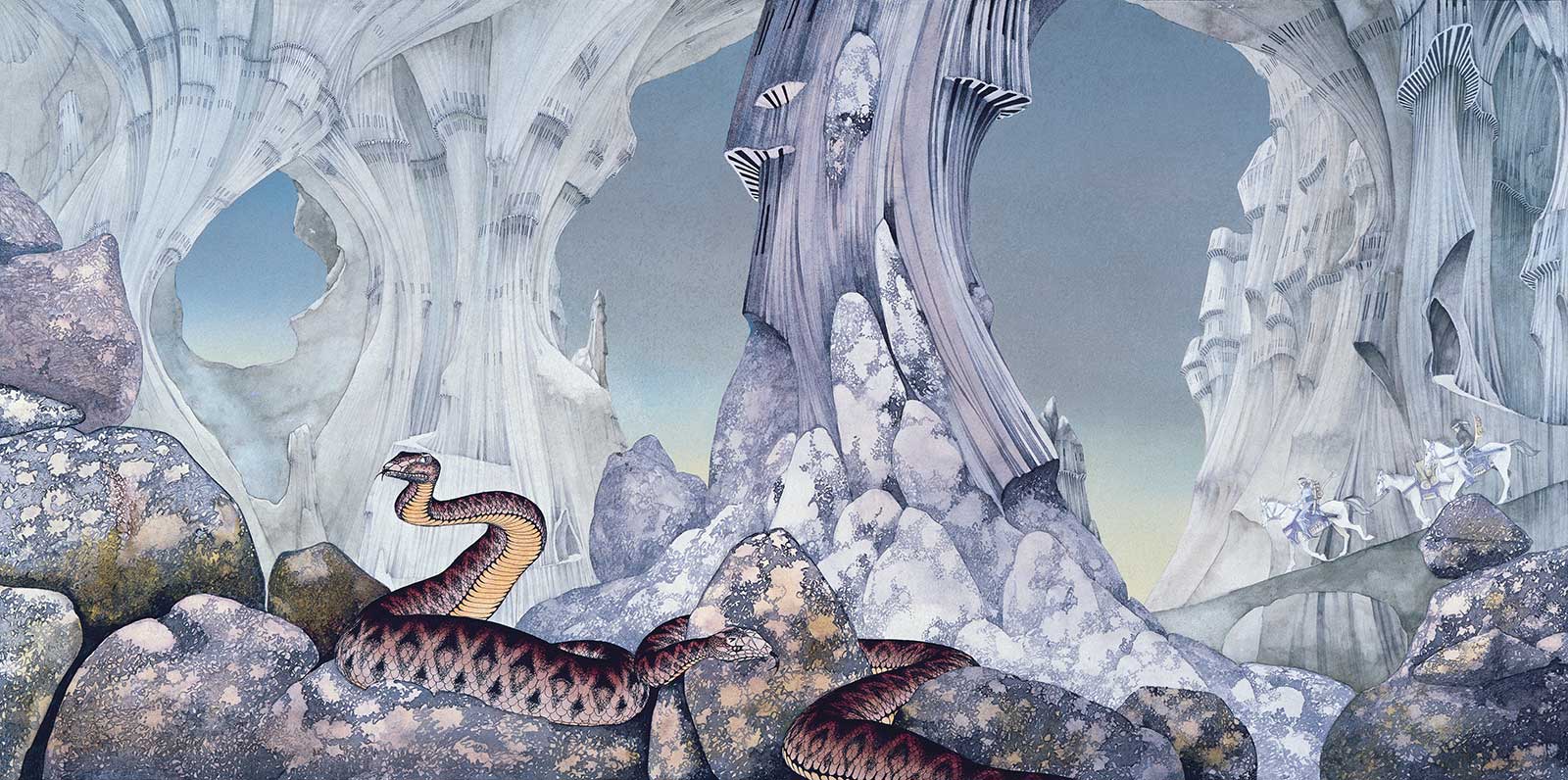 Roger Dean, Gates of Delirium (Relayer), mixed media and watercolor on board, 16 x 32"
Like the late medieval artists of the high gothic bottega workshops, who passed the secrets of their ateliers down through generations, Dean’s daughter Freyja Dean has followed the ancient tradition of dynastic initiation as her father’s student, and she has learned much from him. Her paintings have the characteristic airy lightness of her father’s work; she approaches the landscape with a similar regard for atmospheric perspective, and she is comfortable with simplifying forms with the same decorative enthusiasm Dean shares with early Renaissance fresco painters.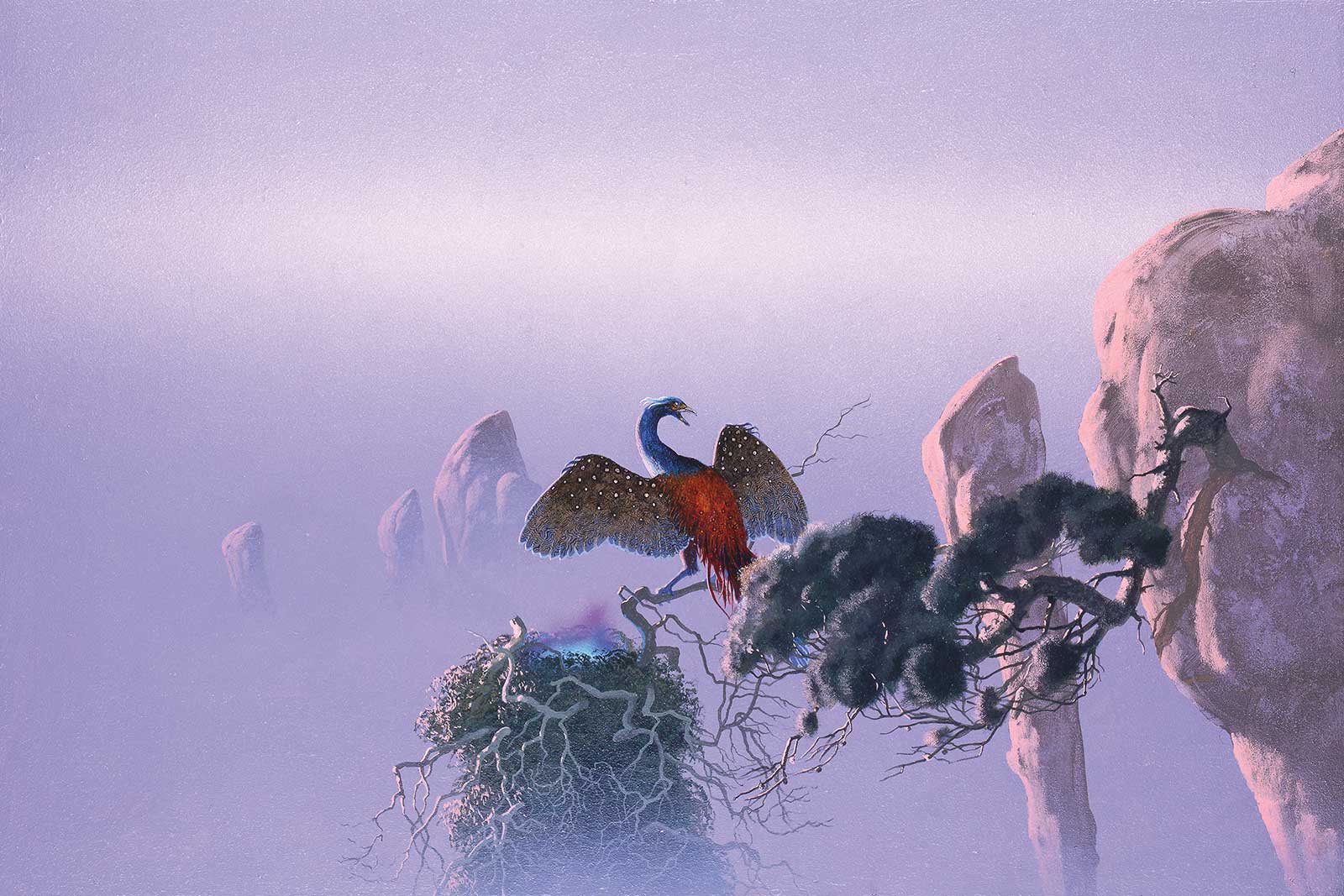 Roger Dean, Phoenix, 2008, acrylic on board, 24 x 36"
Freyja’s apprenticeship has given her work early strength and maturity, but she follows an independent journey into Eden, living and working in Tokyo, where she has found new paths into cross-cultural creativity which combine her interests in human anatomy and beautiful body modifications, imagining the endless physical possibilities practical trans-humanism may offer. Her paintings of altered people predict an uncanny future in which the boundaries between species are blurred, and genetic hybridity has become a real possibility. Like her father, Freyja underpins her art with logic and science. She applies her medical training to her studio work—she made synthetic body parts for the Royal College of Surgeons, and has degrees in medical illustration and forensic facial reconstruction.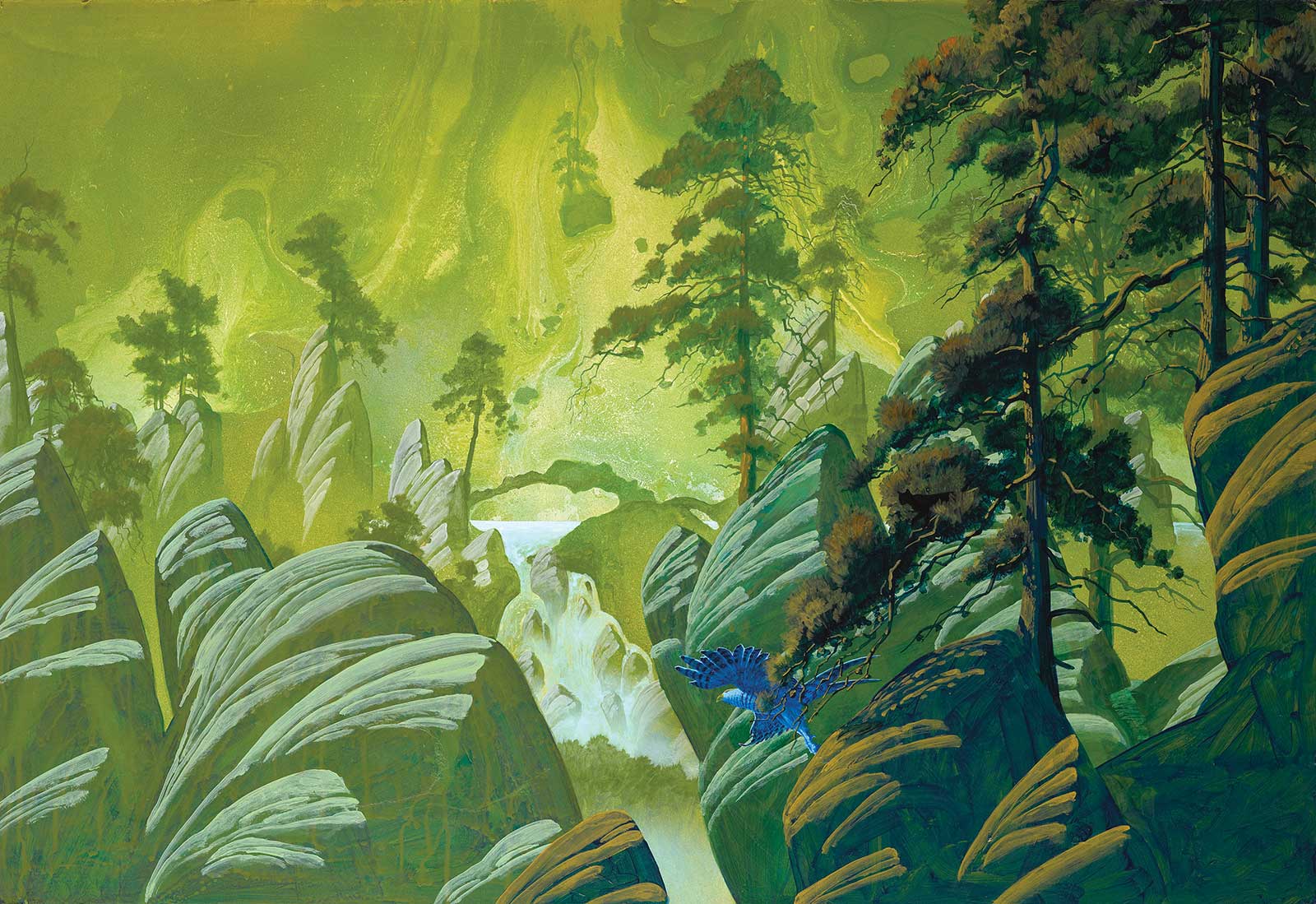 Roger Dean, Fly From Here, 2011, enamel and acrylic on board, 20 x 30"
Both of the Deans involve walking and dreaming in their work. Roger is an obsessive sketcher and loves using his drawings of his favorite trees as he develops his paintings—the twisted Monterey pines scattered in the California landscape around Carmel and Big Sur, gnarled yews from the ancient forests of England, the giant redwoods of the Sierras. Although Freyja is also a walker, and her work constantly refers to nature, she wanders into her looser images with more vibrantly colored and abstract wildness than her father, finding satisfaction from discovering the structures that are implied in her bright preliminary washes and pulling them from the subtle spaces of suggestion. Her studio daydreams are the consequence of abandonment to the natural forms her media makes as much as they are studies of the real landscape, and these abstractions are as important to the final composition as her loosely formal initial sketches. To Freyja, paintings are like gardens, a third space poised between imagination and nature, and she leaps into the landscape, into the sherbet atmospheres of visionary skies. Who needs a path when we can fly?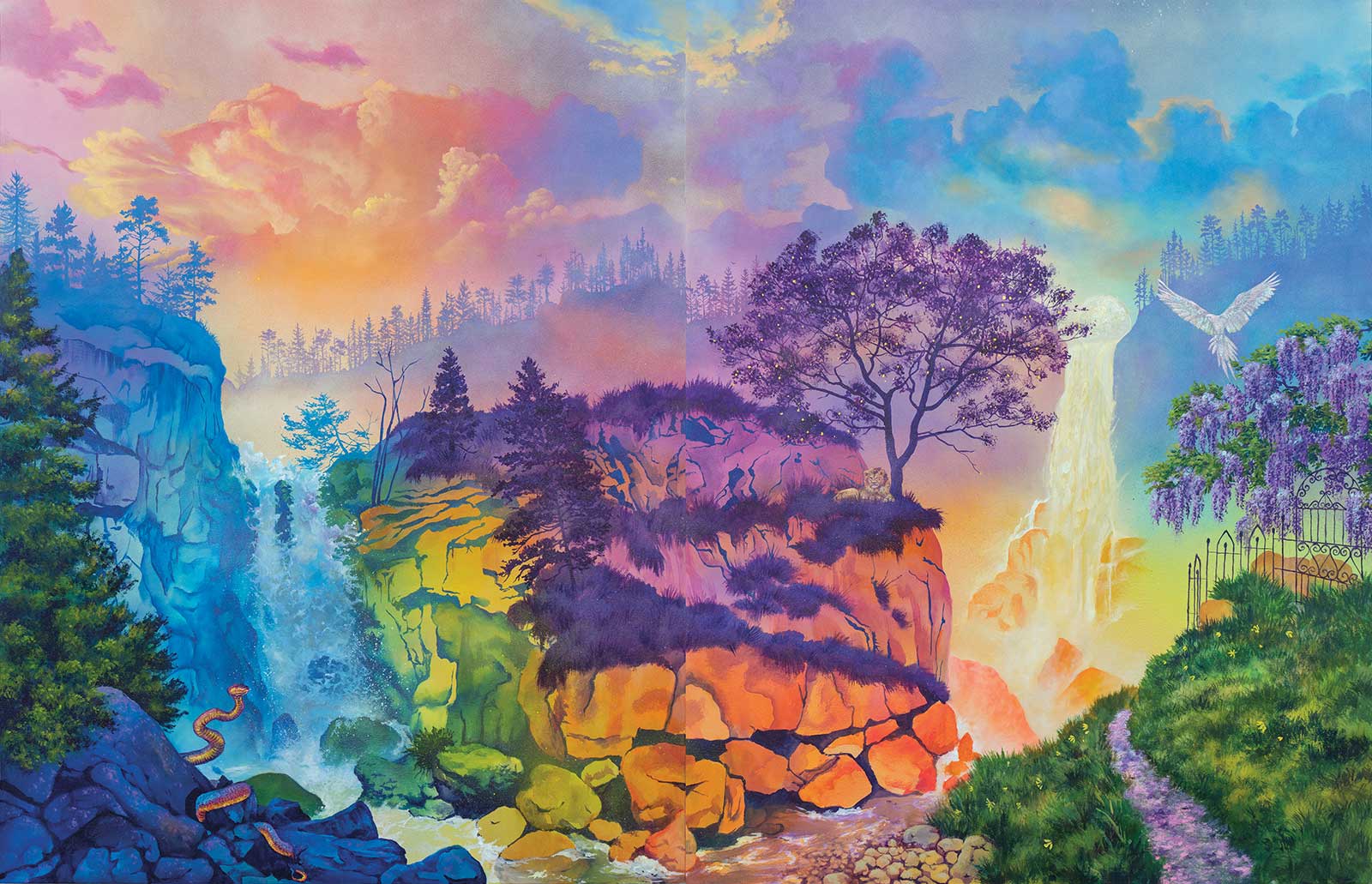 Freyja Dean, The White Parrot (diptych), 2022, acrylic on canvas, 46 x 35 4/5" (each)
Roger Dean and Freyja Dean’s joint exhibition The Secret Pathway at Haight Street Art Center in San Francisco runs through October 30, after which it will move to the Chambers Project gallery in Grass Valley, California. A new interactive company, Chambers Obscura is producing a huge immersive lightshow of Dean’s work at The Gray Area, San Francisco, that opens November 15 and runs through January 29, 2023. With a multimillion dollar budget and 15 engineers who have been working on it for months, the Deans are entering the next level of spectacle and fame. —
The Secret Path: The Art of Roger & Freyja Dean
When: Through October 30, 2022
Where: The Haight Street Art Center, 215 Haight Street, San Francisco CA 94102
Information: (415) 363-6150, www.haightstreetart.org
+++
Michael Pearce is a dynamic writer, curator, and critic. He is a champion of skill-based art that emerges from popular culture and shapes the spirit of the age. He has published dozens of articles, and is author of Art in the Age of Emergence. He is Professor of Art at California Lutheran University.
Powered by Froala Editor