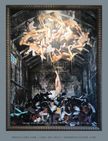


On September 11, 1777, British forces led by William Howe defeated the Continental Army led by George Washington at the Battle of Brandywine at Chadds Ford, Pennsylvania. The retreat of American troops was led in part by the Marquis de Lafayette, a 20-year-old French nobleman who had come to America to serve in the Revolution. Lafayette was wounded in the battle and is said to have rested under a sycamore tree on the farm of Gideon Gilpin, a tree that may have been over 50 years old at the time.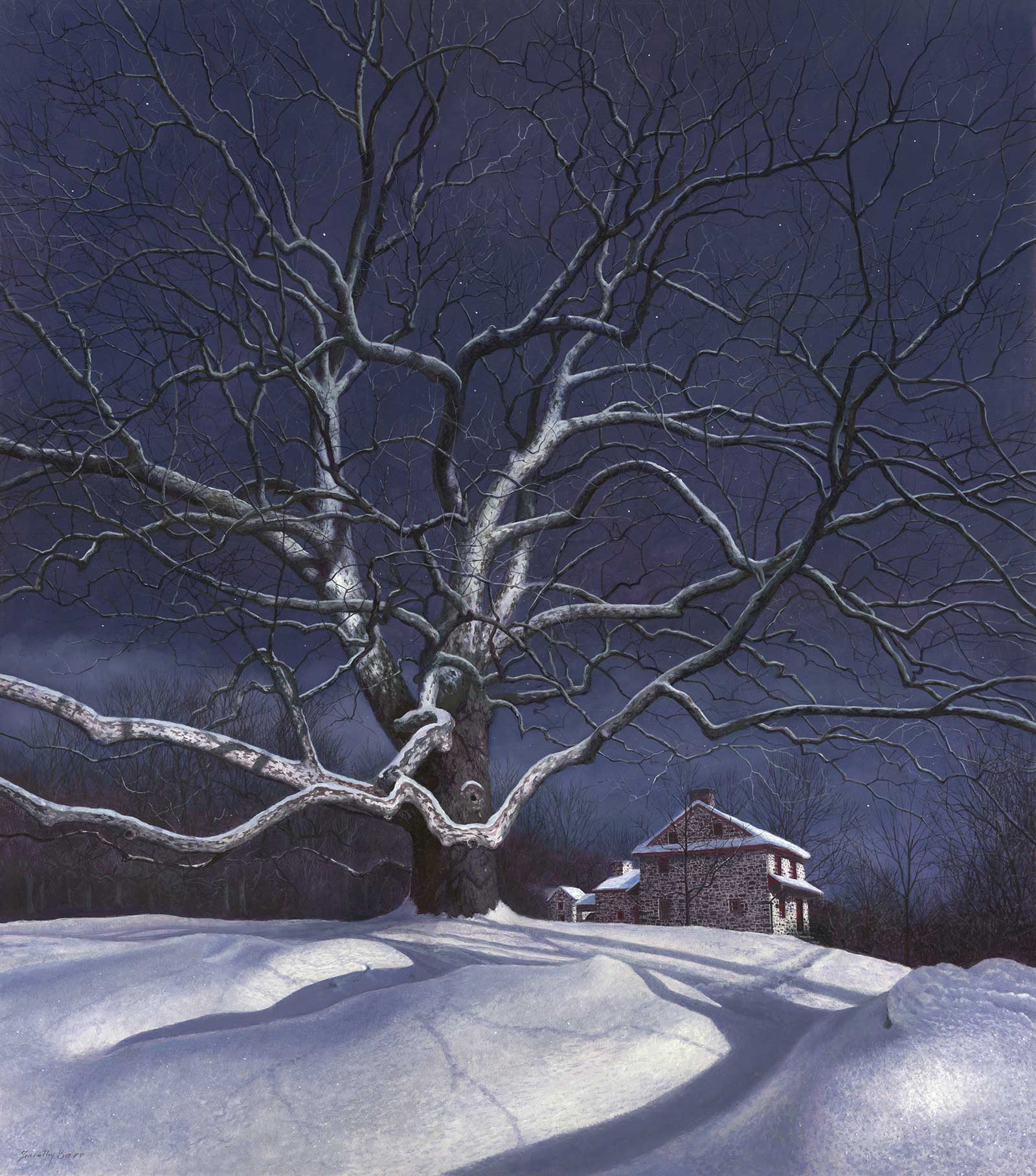 Timothy Barr, Moonlit Lafayette Sycamore, oil on panel, 34 x 30". Courtesy Somerville Manning Gallery.
Today, the “Lafayette Sycamore” stands proudly at 109 feet tall and 23 feet around next to the Gideon Gilpin House in Chadds Ford. British soldiers had plundered Gilpin’s property and he had to open a tavern there to support his family. The tree has attracted artists for generations.
When he was a boy, Tim Barr was captivated by N. C. Wyeth’s 1920 painting, Buttonwood Farm. (Fine-grained sycamore wood was often used to make buttons.) Later, his son Andrew Wyeth painted the same subject. When Barr eventually saw the tree, intrigued by its shape, he said, “I’ve got to do this tree.” And that he did. Many times—each time learning something more about the tree and each time perfecting his painting technique a little more. “I was always climbing huge trees as a kid,” Barr says. “The monumental size of the creature is jaw dropping and awe inspiring when you stand below its overstory. Paintings can only attempt at capturing that aspect of the tree. I’ll keep trying.”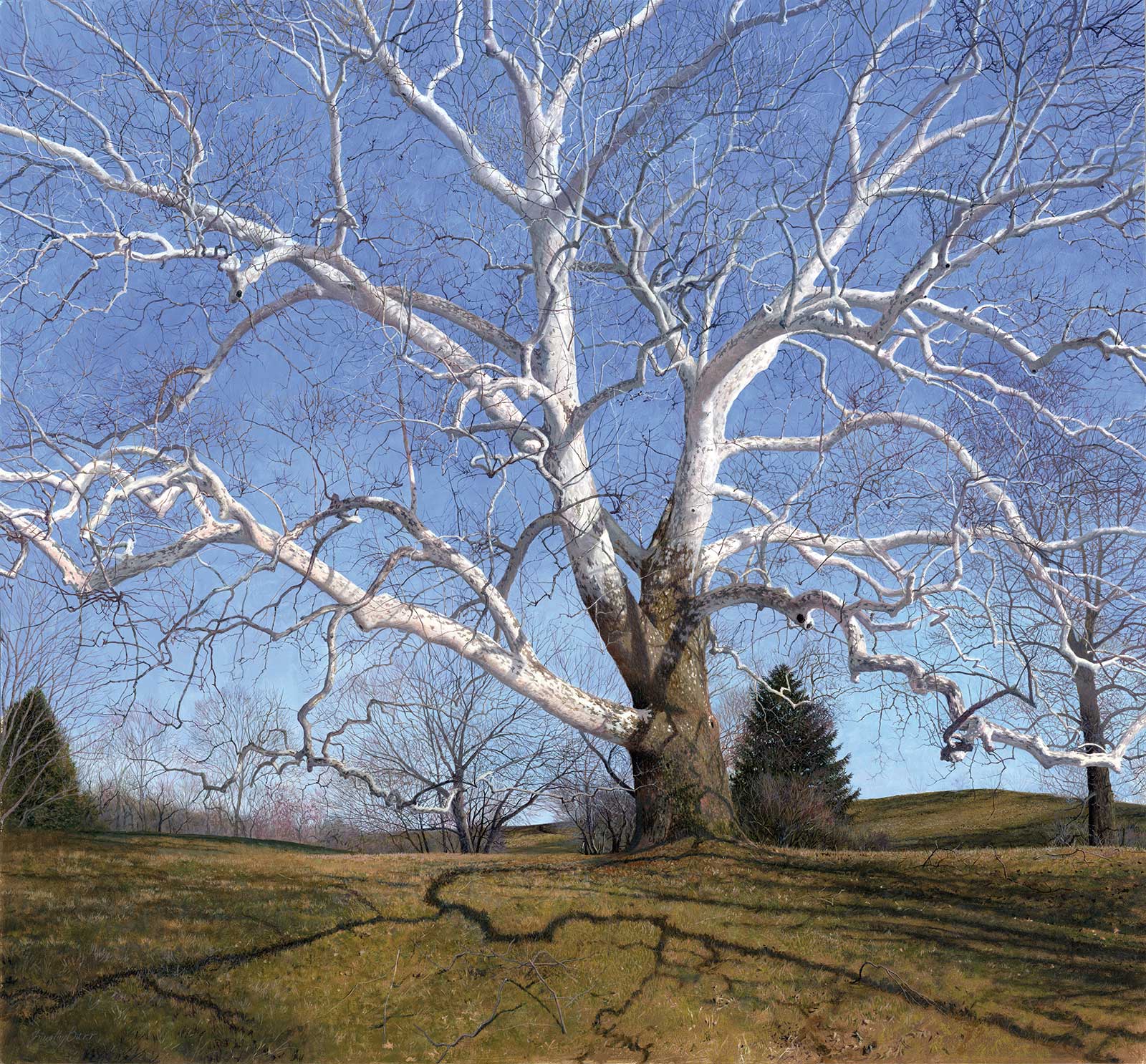 Timothy Barr, Skin and Bones, oil on panel, 39 x 42". Private collection.
He has painted it in its naked glory as in Skin and Bones, fully-fledged in its summer leafiness and in the dead of winter as in Moonlit Lafayette Sycamore. The tree as beautiful object continues to fascinate as does its silent witness to history. In Skin and Bones the shadows of its branches cast on the ground suggest veins and arteries reaching out and connecting to other trees.
In his book, The Hidden Life of Trees: What They Feel, How They Communicate, the German forester Peter Wohlleben, writes, “Trees live in symbiosis with hyphae (fungus/mold roots). A teaspoon of dirt contains kilometers of these roots. One species can spread throughout entire forests over centuries. They exchange nutrients with trees, along with information about insects, drought and other dangers. It’s like a ‘wood wide web.’”
Aspen trees can regenerate through their root systems sending up identical clones that can fill over 100 acres. An aspen clone in Utah has been estimated to have established itself after the last ice age, 14,000 years ago. Because of their structure, aspen leaves flutter in the wind, giving rise to the phrase “quaking aspen.” Their brilliant autumn yellow is a favorite subject for painters.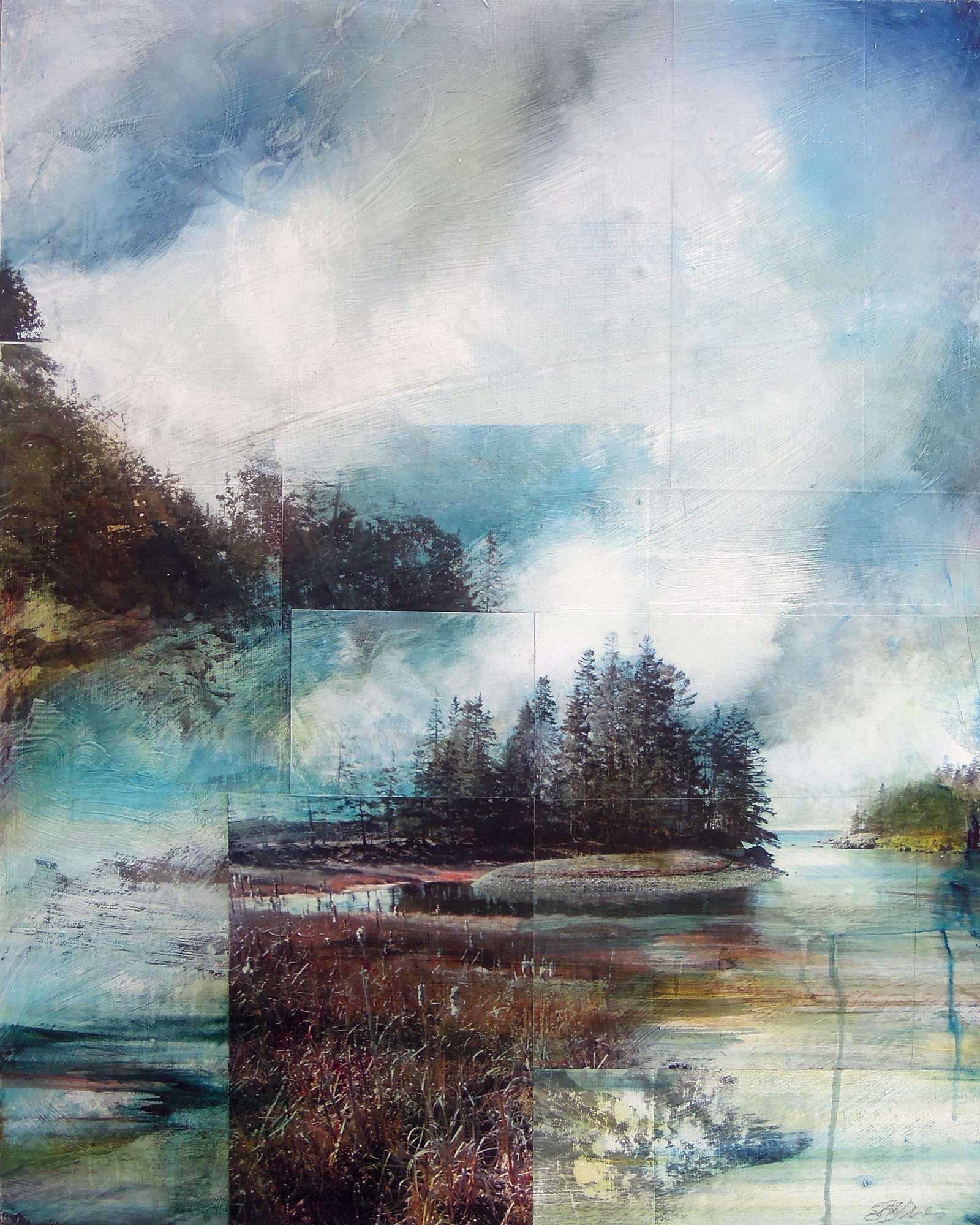 Susan Barnes, After Rain, mixed media on panel, 30 x 24”. Courtesy Greenhut Galleries.
After a 15-year career as a technical illustrator, painting independently on the side, Ken Daggett moved to Taos, where he paints most days out of doors, constantly inspired by the northern New Mexico landscape. His appreciation of the landscape is also a learning experience. “For me, painting is a never-ending challenge,” he says, “and I will spend my life gratefully pursuing that challenge. I learn and grow with each new painting.”
The smooth aspen bark often becomes fissured with age and its black markings can appear like eyes watching as you walk through a grove. In Aspen Path, Daggett reduces the attraction of detail to enhance the experience of walking through the aspen grove and the brightness of white trunks and yellow leaves in the sunlight.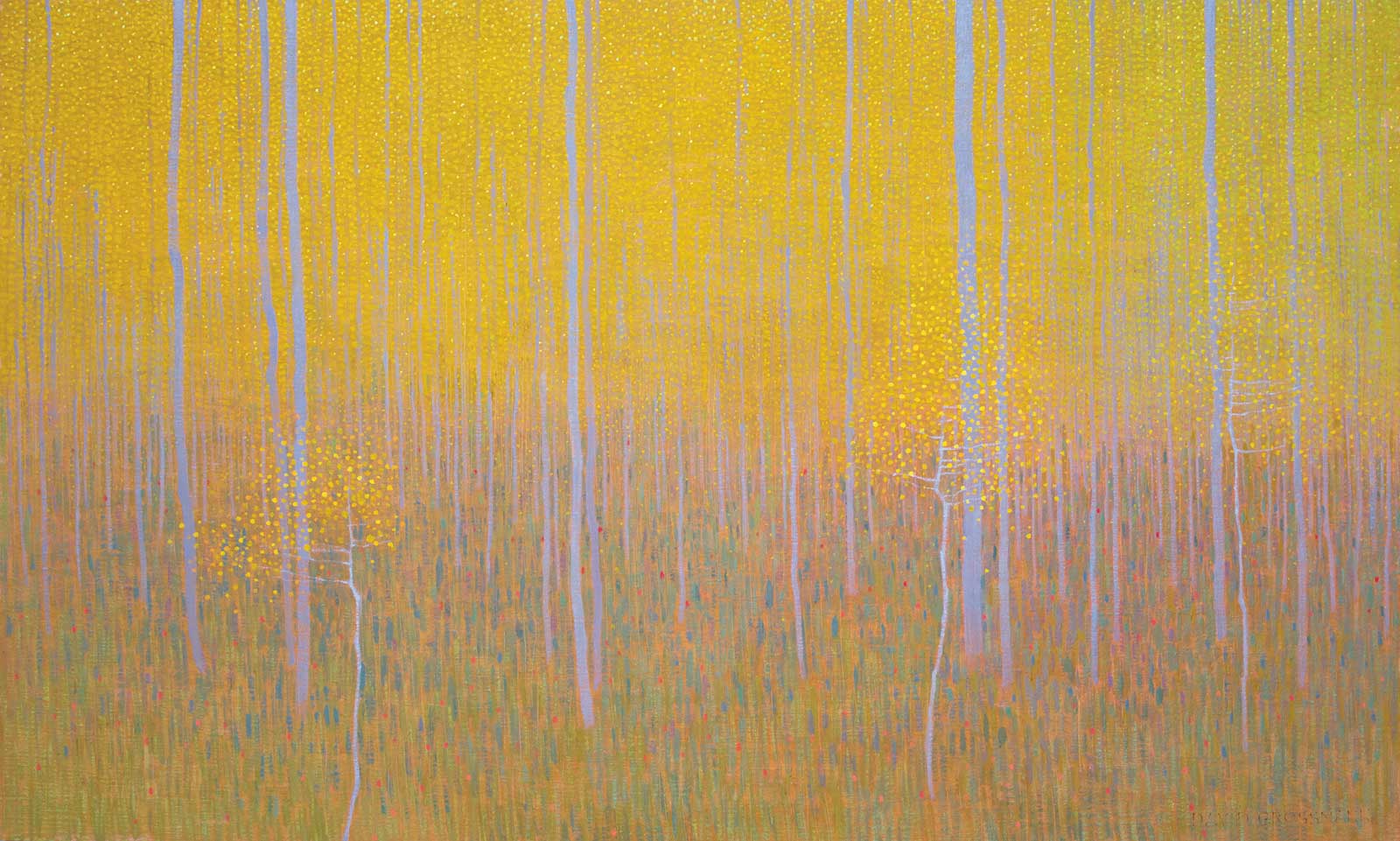 David Grossmann, Yellow Aspen Patterns, oil on linen panel, 30 x 50”. Courtesy Altamira Fine Art.
In Yellow Aspen Patterns David Grossmann appears to eliminate detail altogether. But, on closer examination the painting is made up of myriad tiny details of leaves and Klimt-like color. “I wanted to capture the fragile feeling of autumn as the golden aspen leaves steadily fall to the ground and the whole forest seems to radiate with color,” he says. “As I worked on this piece I became completely absorbed in painting layer after layer of leaves.” Commenting on another painting of aspens, Grossmann writes, “I was running on a trail through an aspen grove when I had the sense that I was being watched. As I slowed my pace I realized that it was the forest itself—the markings on the trees, the profusion of flowers—that seemed to be observing me and inviting me into itself.”
That reminded me of the last lines of David Wagoner’s poem, Lost. “If what a tree or a bush does is lost to you, / You are surely lost. Stand still. The forest knows / Where you are. You must let it find you.”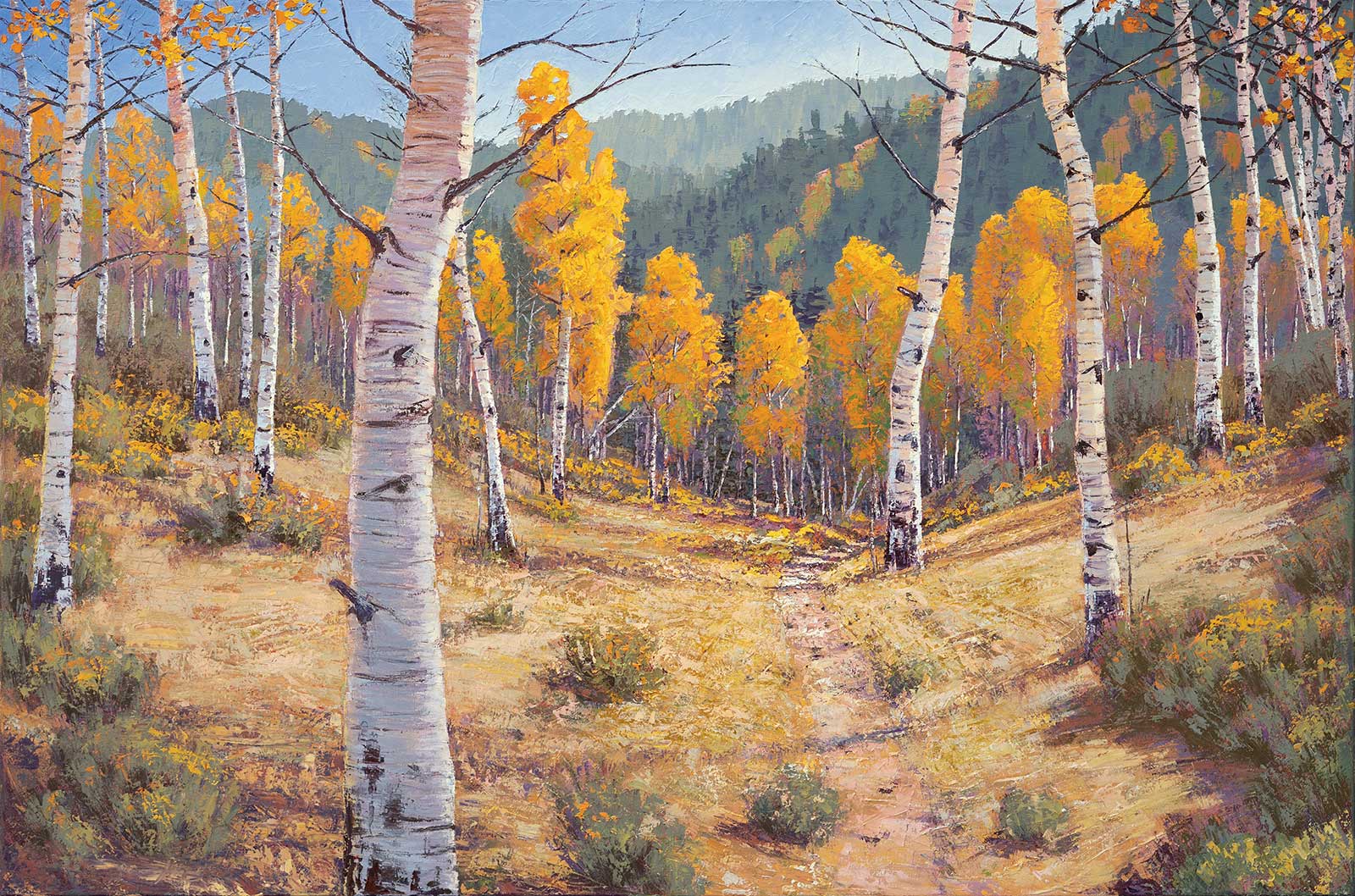 Ken Daggett, Aspen Path, oil, 40 x 60”. Courtesy Meyer Gallery, Santa Fe, NM.
Susan Barnes evokes the variety of sensual experiences of trees in her mixed media work. She lived in Alaska and Montana before moving to Maine where she combines painting, collage and photography to evoke the many atmospheric qualities of Maine. In After Rain, rain evaporates after the storm in misty clouds and the collaged elements recall multiple impressions of the scene.
The philosopher Jiddu Krishnamurti wrote about experiencing trees. “Do you know that even when you look at a tree and say, ‘That is an oak tree’, or ‘that is a banyan tree,’ the naming of the tree, which is botanical knowledge, has so conditioned your mind that the word comes between you and actually seeing the tree? To come in contact with the tree you have to put your hand on it and the word will not help you to touch it.” —
Powered by Froala Editor