When the Southwest Indian Fair and Industrial Arts and Crafts Exhibition opened in Santa Fe in 1922, it featured Navajo rugs, Plains Indian beadwork and basketry and focused on pottery to promote the making of and interest in Pueblo pottery. It was held indoors and the artists were not present. This year, the 100th Santa Fe Indian Market, sponsored by the Southwestern Association for Indian Arts (SWAIA), will be outdoors on the Santa Fe Plaza with about 850 artists from more than 200 tribes presenting and selling their work, broadened from the early years to include textiles, jewelry and paintings among other media.
Contemporary Indigenous painters draw on their tribal traditions as well as the movements that have shaped 21st century contemporary art.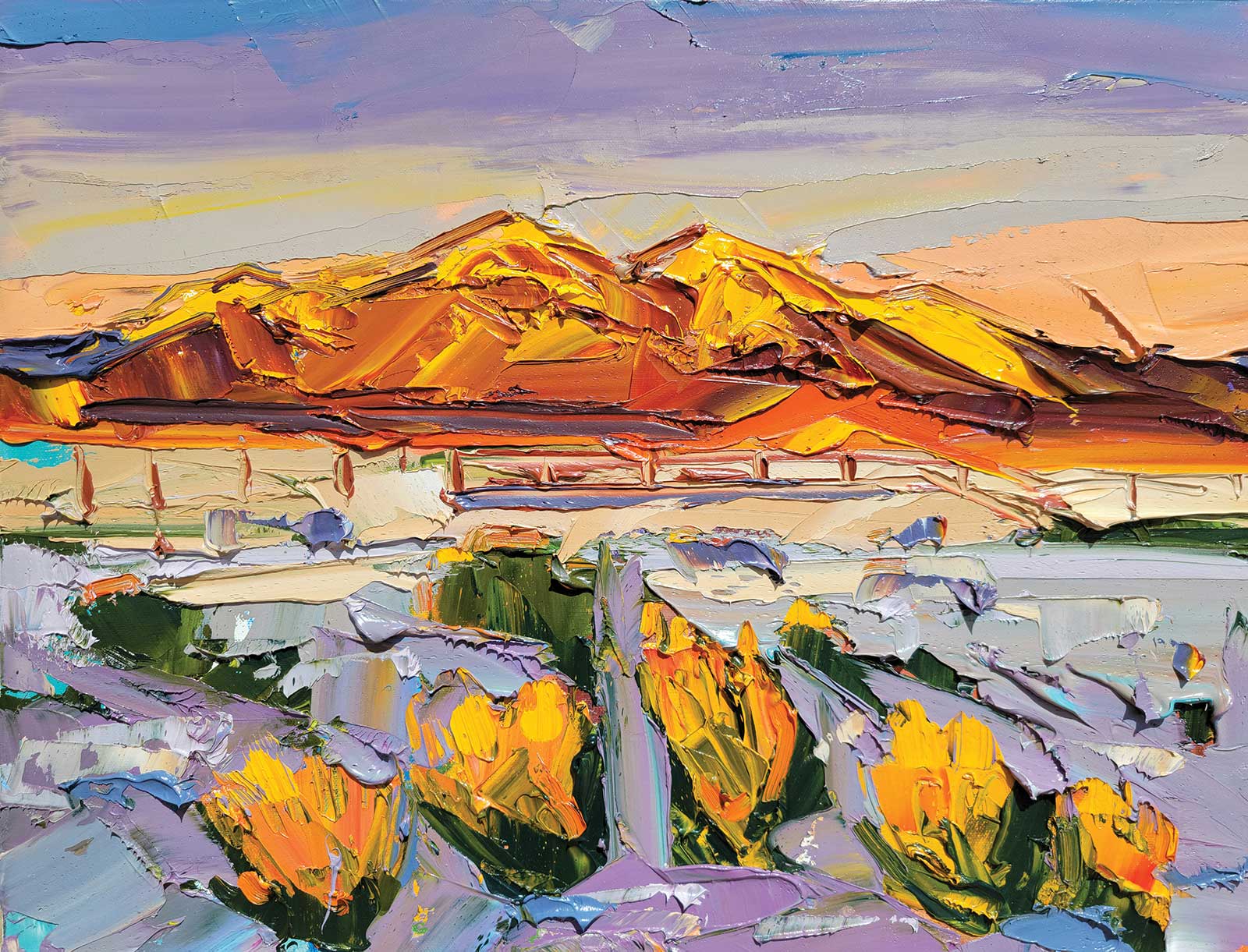 Mateo Romero, Taos Series, oil on canvas, 18 x 24"
Mateo Romero (Cochiti) paints familiar scenes from Pueblo lands, titling his paintings with the original Tewa names for the sites. The Tsi Ping Owingeh series depicts the iconic Cerro Pedernal made famous by Georgia O’Keeffe. The translation of the Tewa name is “Village at Flaking Stone Mountain.” He pays homage to the spirit of the land in an energetic application of paint recalling the abstract expressionists of the mid-20th century.
Romero began showing at Indian Market right out of college and was soon winning top awards. He was the poster artist in 2008. “I wasn’t sure I could make it in the art world and getting into Indian Market was a huge shot in the arm psychologically and financially. Organizations like SWAIA helped me learn there’s a place for me. In the beginning there were fewer painters. Today the field is different. It’s bigger and there’s more digital work and videography. Indian Market focuses on excellence.”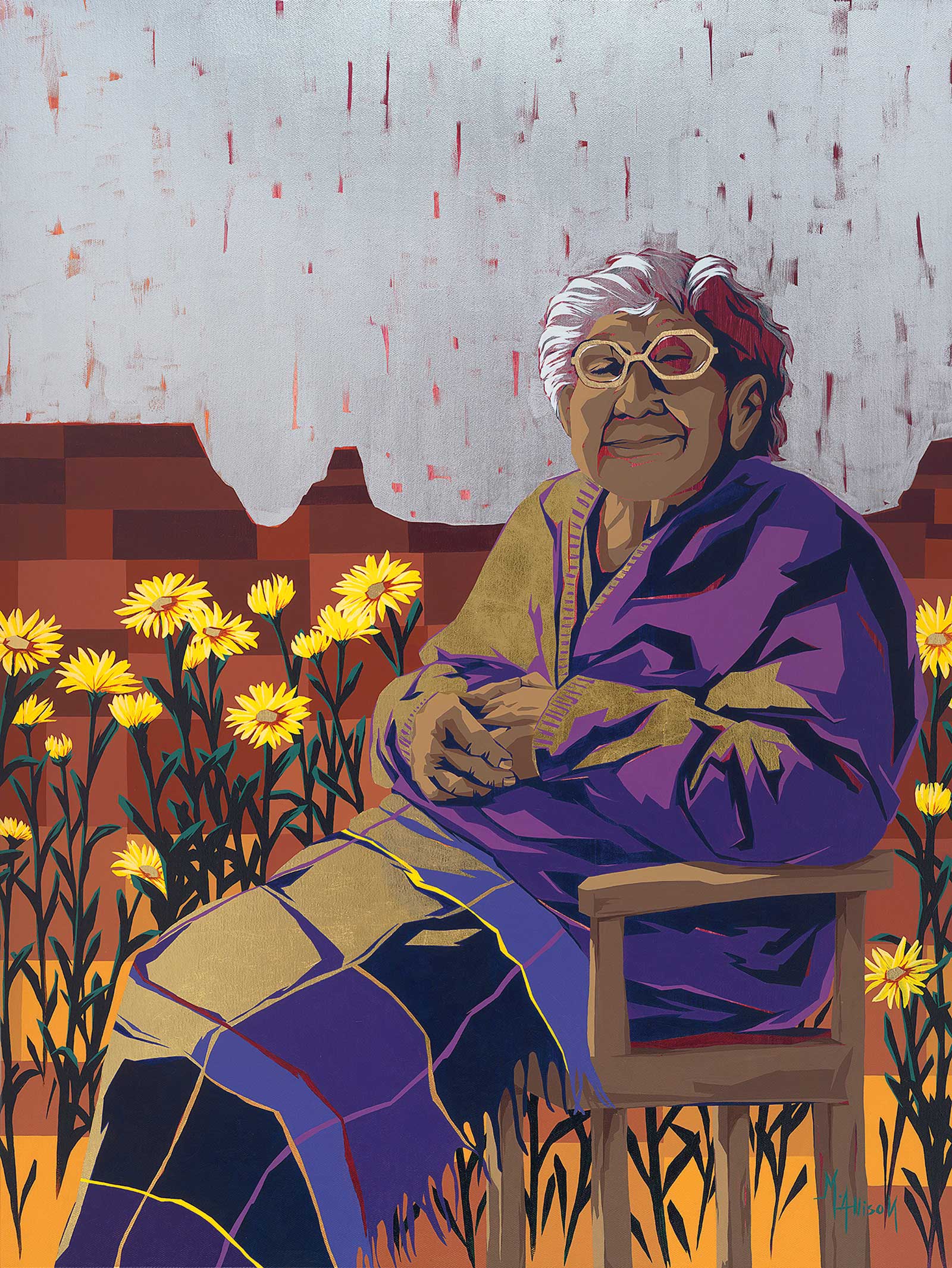 Marla Allison, Helen of Mesita, acrylic and gold leaf on canvas, 48 x 36"
During the disruptions of Indigenous life in mid-19th century, artists turned to materials that were available to them. Many used colored pencils to draw scenes from their lives from warfare to domestic and ceremonial activities on pages they obtained from settlers’ ledger books. At that time it was primarily a male dominated medium.
Dolores Purdy (Caddo) veers from the imagery of historic ledger art. “As an artist who uses the same materials used in the historic art genre, although the quality and quantity of colored pencils have improved significantly,” she explains, “I strive to bring a feminine perspective. I am not trying to copy or even ‘look like’ my ancestors’ work, but rather emulate a surreal pictograph narrative…In my work I attempt to disrupt entrenched Eurocentric narratives about Native stereotypical art by exploring changing boundaries while still using iconography typically found within Native art. Besides the bright colors and vivid imagery, tongue-in-cheek humor is often seen in my work. [The piece] shown here [is an] example of the surreal colors along with some of my hallmark shapes of ladies...that show my efforts of interpretation of contemporary art but using iconic Native imagery.”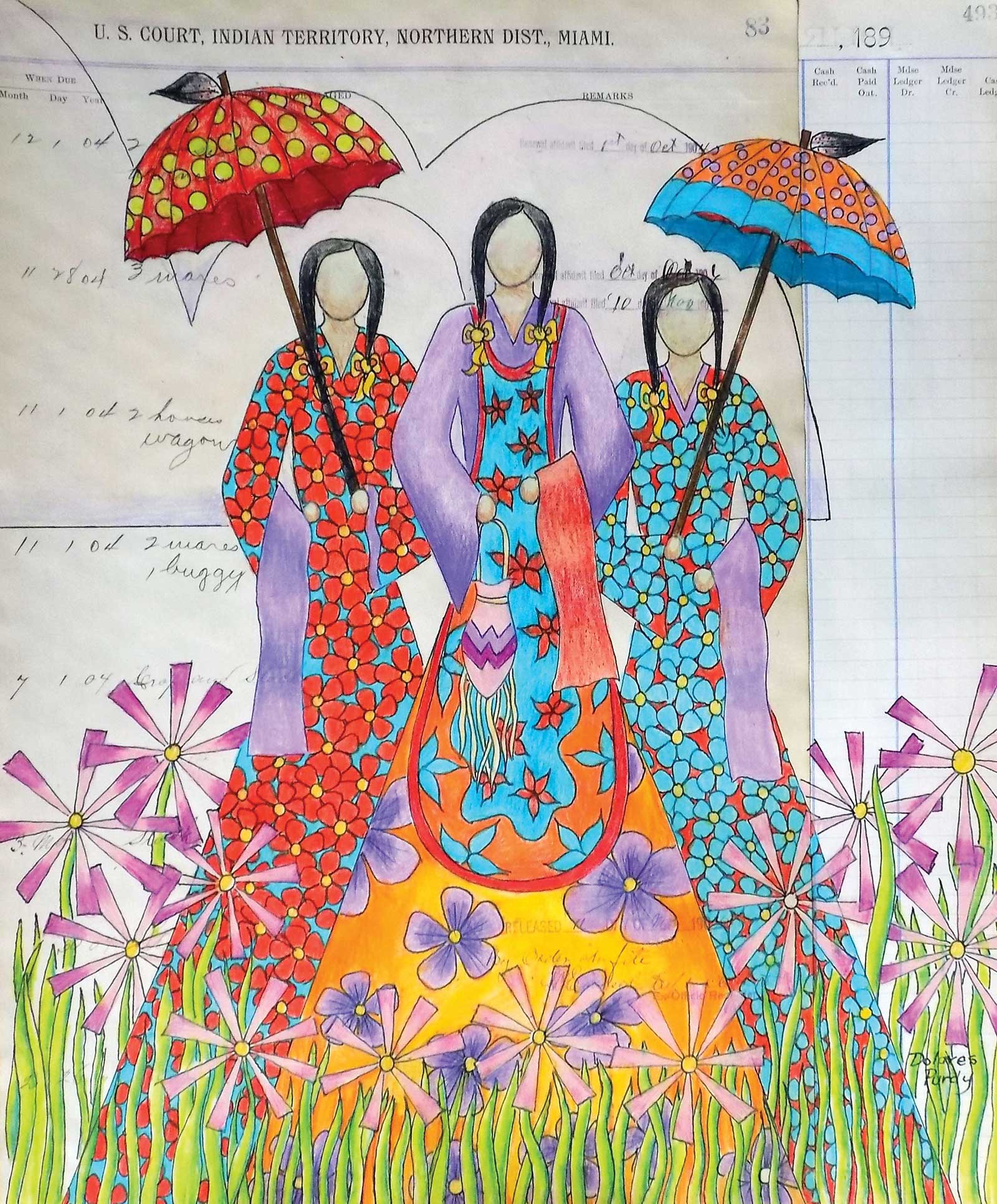 Dolores Purdy, Sister Love, colored pencil and India ink on ledger page, 16 x 13"
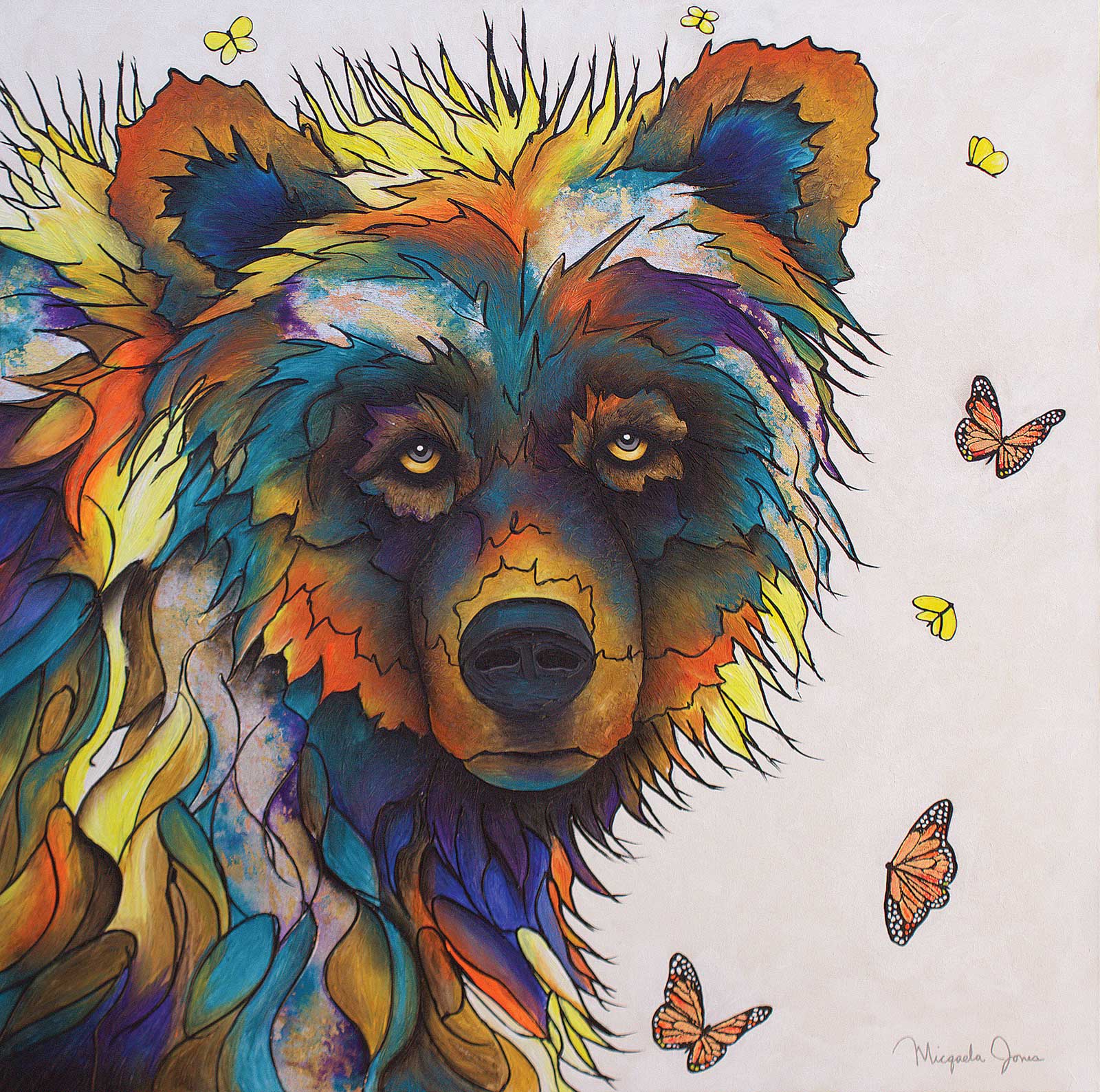 Micqaela Jones, Spring, mixed media, acrylic and gold/copper leaf, 36 x 36"
Micqaela Jones (Western Shoshone) returns for her 16th consecutive year and was the poster artist in 2017. In her painting, Spring, she continues a theme of communication among animals in their natural habitat. She says, “This year I plan on having a mix of my two painting styles—my bold colorful paintings that I am known for, as well as the more contemporary white background newer style. I have also been incorporating more of the gold, silver and copper leafing, and I love the way it adds another dimension to my pieces. Often, I am asked about the significance in my animal interaction pieces. I generally love to leave my art open to the viewer’s feelings and interpretation. Many times when I am painting those types of pieces, I love to imagine what could be happening between the animals, maybe they are sharing secrets and passing wisdom to each other. But at the end of the day, I create artwork that I hope people can connect with, pieces that will bring joy and happiness.”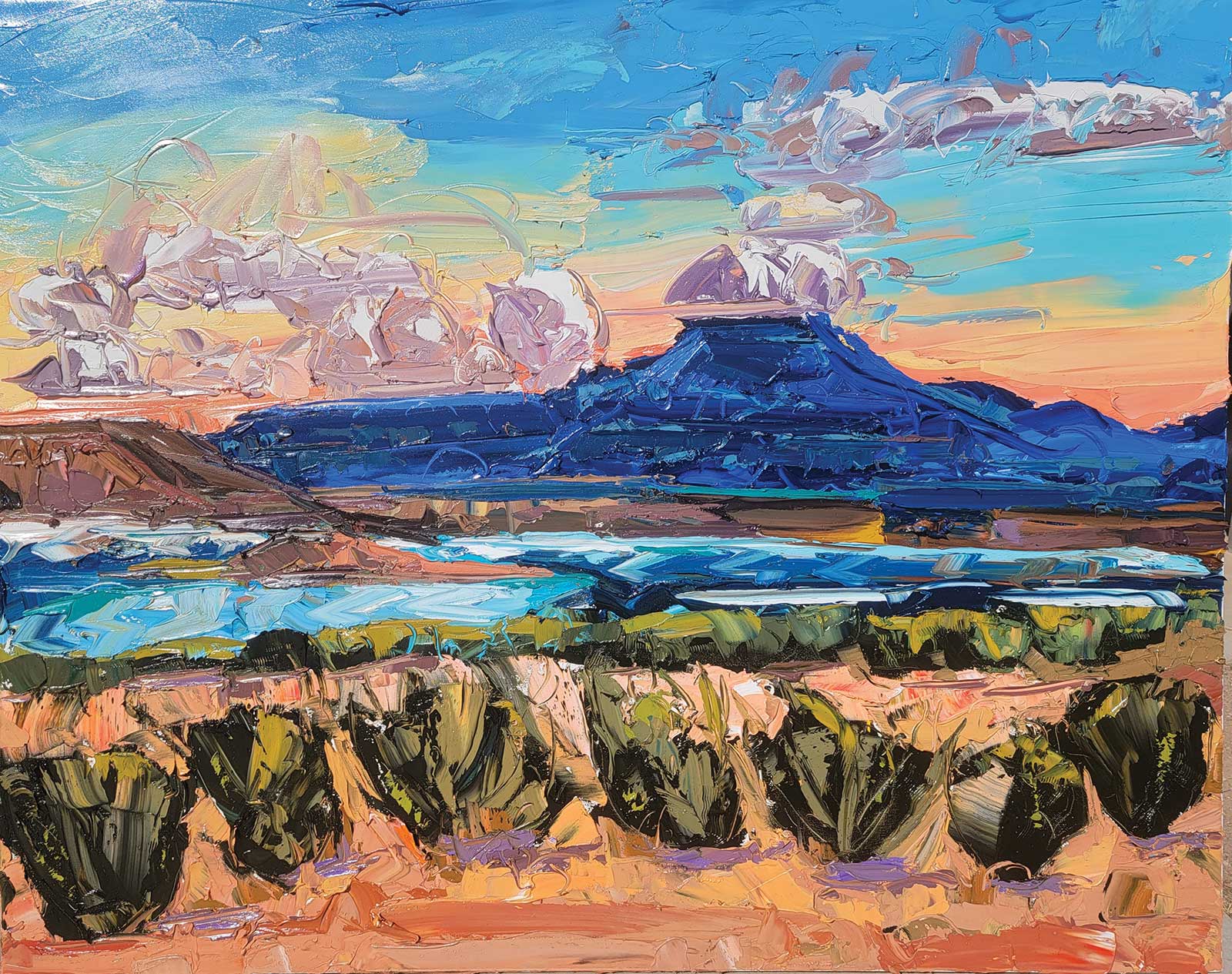 Mateo Romero, Tsi Ping Owingeh Series, oil on canvas, 48 x 60"
Marla Allison (Laguna) says, “Helen of Mesita is a portrait of my great grandmother. She lived until I was in my early 20s. My sister was her home care nurse and when I finished art school she invited me to spend some time with them. I carried my sketchbook with me to keep myself busy. We laughed and joked about everything we could. For the painting, I researched the color purple—the color of royalty—and put little bits of gold leafing on the small daisies that grow all over the reservation.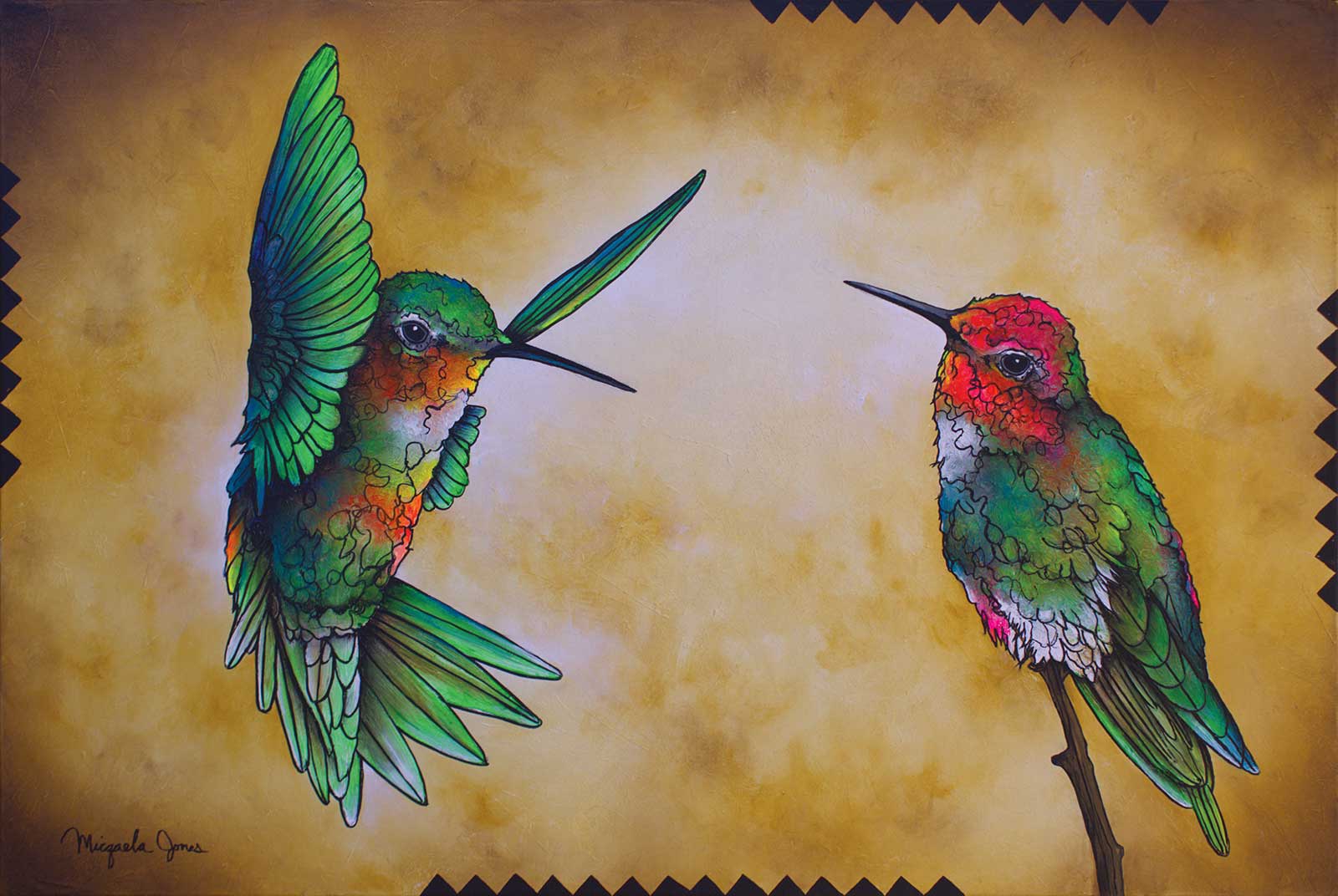 Micqaela Jones, Showing Off, acrylic, 24 x 36"
“The squares in the mesa and the broken planes of light are shapes that make up her outfit. I realized that I want that to be how I paint a surface, separating the light to allow the shadow to be the form and the surface as well. I am creating a unique style of painting which I am calling ‘Pueblo futurism’." I draw on several different abstract styles found in art history. The work is based on my own culture’s traditional Pueblo pottery designs as well as cubism and futurism. My beginnings are raised with traditional beliefs and customs in my ancestral family village, which is in the western desert landscape of New Mexico. My paintings often reflect the histories, landscapes, and culture of my people as well as life within and outside the reservation. Every Native American is a storyteller.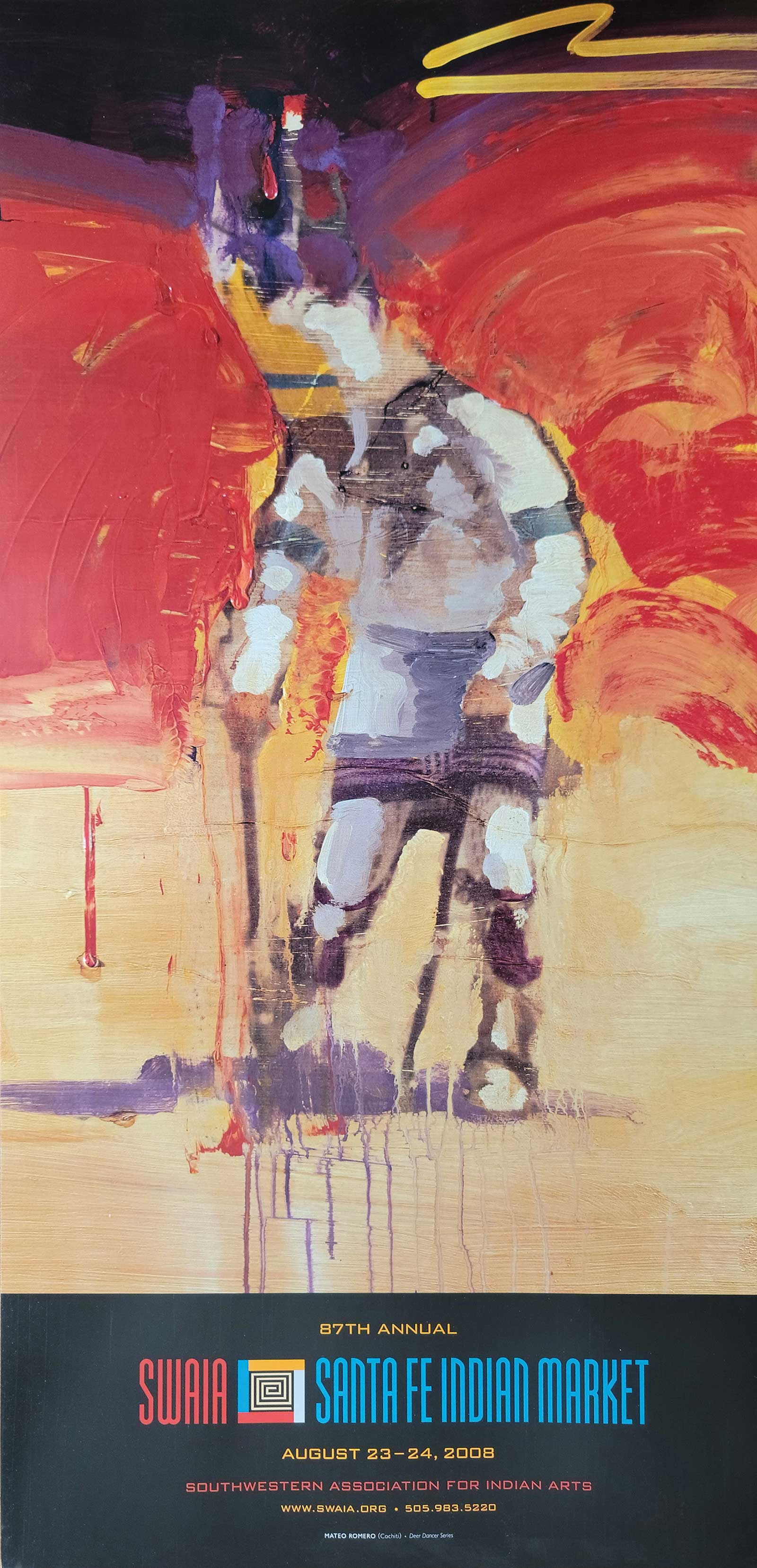 Mateo Romero’s poster for 2008 Santa Fe Indian Market.
“It’s a rare gift to show at Indian Market, especially this year. The history of those who came before and all the connected lives fuel my contemporary life. I’m happy to be a little part of that.” —
Santa Fe Indian Market
When: August 20-21, 2022
Where: Santa Fe Plaza, Santa Fe, NM 87501
Information: (505) 983-5220, www.swaia.org
Powered by Froala Editor