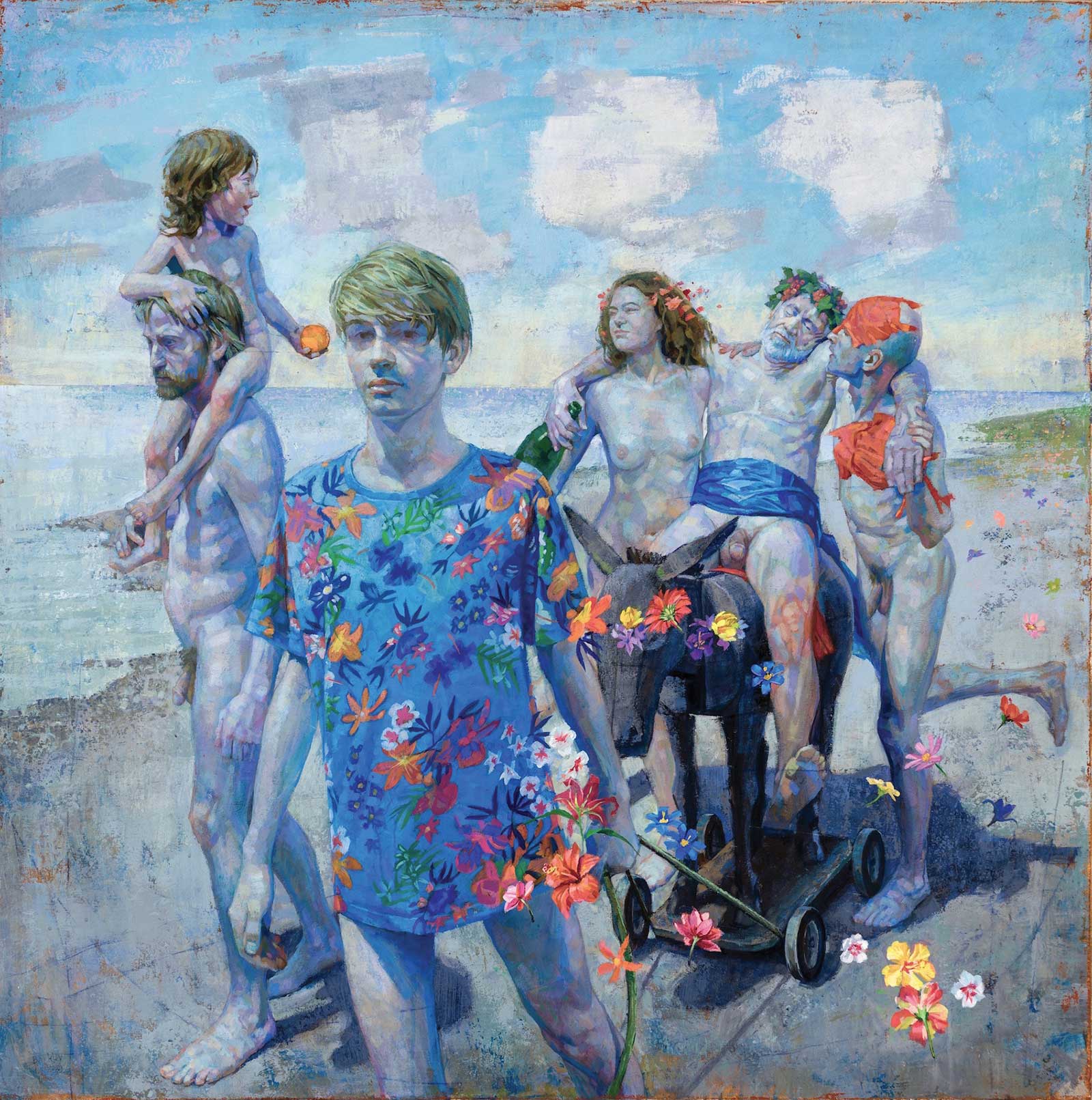
In a naked procession, two crawling men, barely draped in tiger stripes of soft shredded paper, haul a battered child’s triumphal cart through a blasted landscape of trash. On it, the careless demigod Bacchus is perched upon a golden cushion balanced on boxes. He is embraced from behind by a satyr-turned-Mephistopheles wrapped in ragged red, who pinches an inch of Bacchus’ belly. The satyr gazes at us, warning of the consequences of self-indulgence. Bacchus’ nude and dancing devotees cluster around him, wrapped brightly in blue plastic. A woman blows a double flute, a garlanded man shoulders a jug of wine, a basket of fruit is held high by a naked bacchante pleasure-seeker. Bacchus’ teacher Silenus is draped over a crude handcart, with a taxidermist’s donkey head attached to the front. Behind the crowd of figures, two men carry a theatrical backdrop painting of Titian’s Bacchus and Ariadne, set in a bucolic landscape of green trees and blue skies—the only members of the parade who are disturbed by the stark contrast between the pleasure of Dionysian indulgence and its consequences gaze at the scene concealed behind the drape—a panorama of poisoned yellow smoke pouring across the sky from two red-striped towers of a power station, and scattered trash and streams of effluent covering the dead earth. This is Daniel Barkley’s brilliant Triumph of Bacchus I, a rich allegorical display of beautifully painted bodies.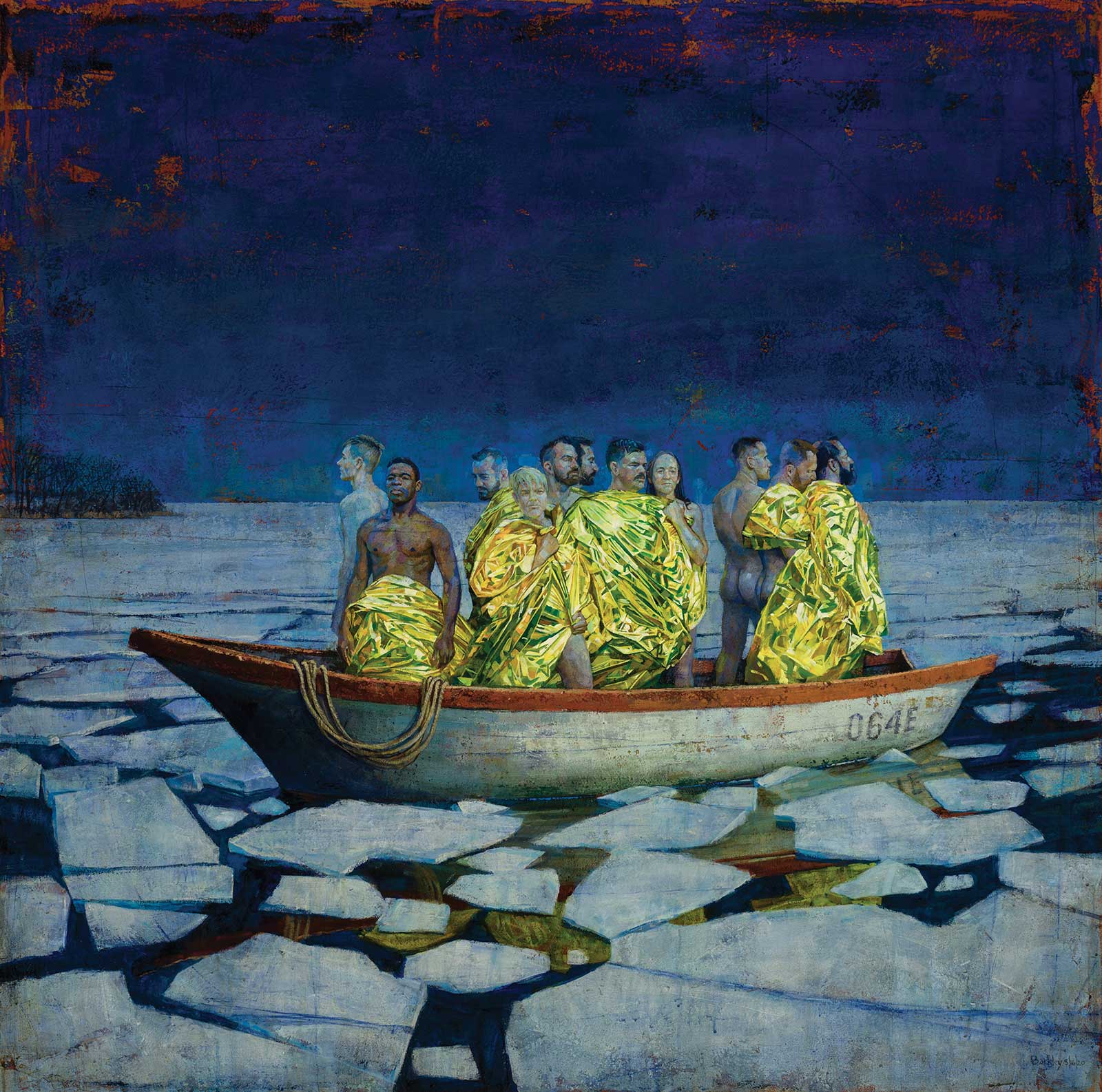 Daniel Barkley, Refugee Boat, acrylic on canvas, 48 x 48"
The allegory is clear. The bacchanale is consumption, but its harvest is pollution. The price of selfish consumerism is environmental catastrophe, which makes fools of us all. The blue plastic which wraps the characters fulfils the message of the painting, but it has been Barkley’s signature for decades. “I was on the Maid of the Mist, the little boat at Niagara Falls,” he says, “…looking down at everybody wearing these blue ponchos, and I thought, ‘that is gorgeous.’ It became a replacement for clothes that brings our very contemporary world of plastics into my paintings, which don’t take place in any particular time.” He pushed the concept further with gold—another Barkley signature—often covering his models in gold leaf, and relishes painting the high contrast metallic finishes of the shining metal over bare flesh. But he sees gold as a deceptive and mutable material—the naked men and women who float abandoned on his refugee boat are wrapped in the golden space blankets used to help prevent hypothermia in disaster relief. He says he was moved by the desperation of refugees from Syria who crossed the Mediterranean to get to Greece and Sicily. Keenly aware of the irony of being folded in precious metal in a moment of destitution, he says, “They were in such a horrible predicament, and yet they were covered in golden blankets which made them look gorgeous…that’s so beautiful and that’s so horrible.” Barkley is an honest man and strips any signs of dissembling or pretention from his conversation and his paintings.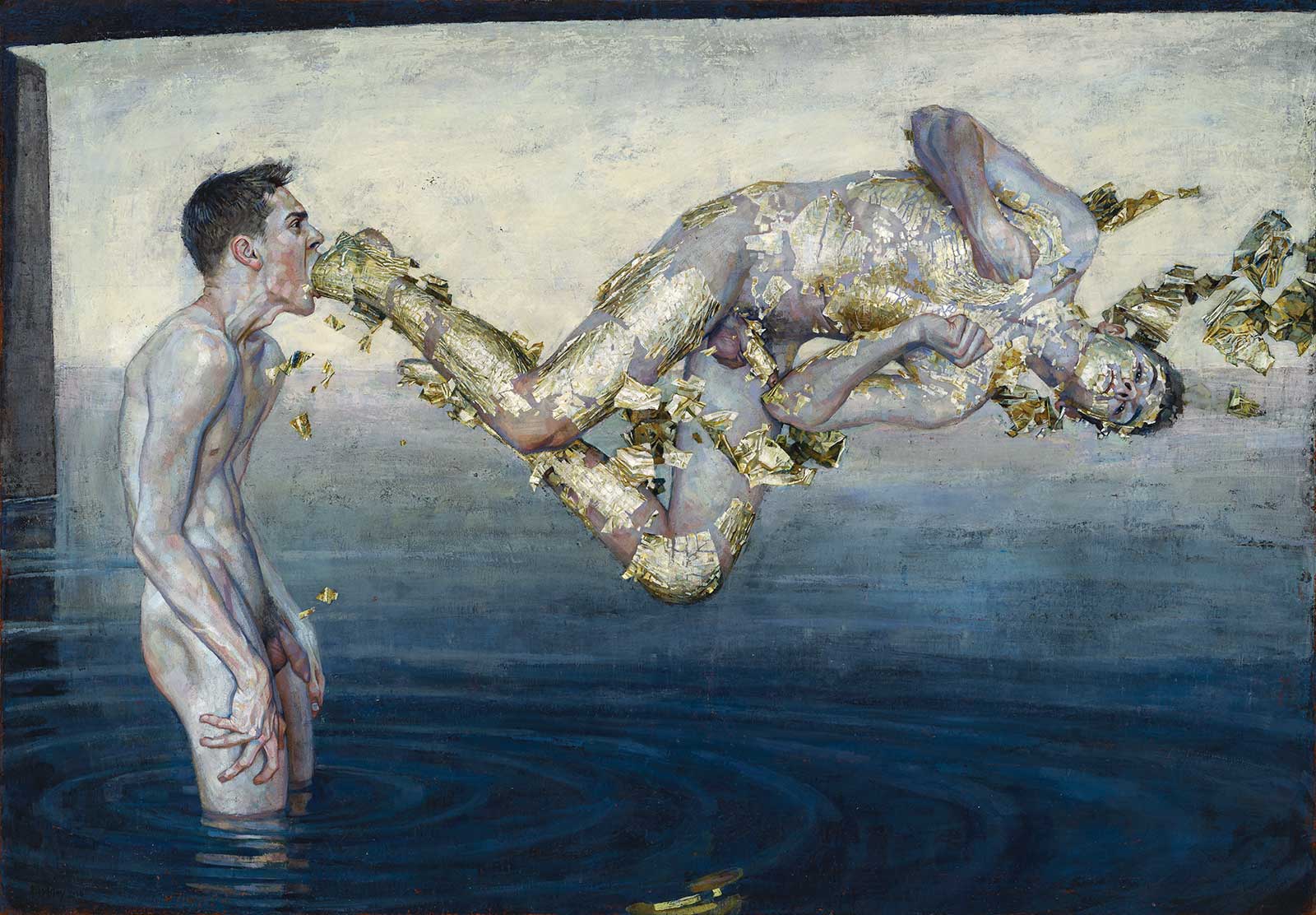 Exorcism II, acrylic on canvas, 50 x 72"
Barkley was raised in Montreal, Canada, and the imagery of his Catholic upbringing there serves as inspiration for much of his visual lexicon. In a voice lightly accented with Canadian French, he says, “Christian images were certainly around me as a kid. I’ve always been intrigued by them…crucifixions, images of exorcism, with a little red man coming out of someone’s mouth—I loved the surrealism of it, and the surrealism of the martyrdom of the saints. The Saint Lawrence River was named that because it was St. Lawrence’s day when Jacques Cartier sailed down it. Lawrence was roasted on a grill by the Romans, and apparently, he said, ‘I’m done on this side, it’s time to turn me over.’ Those images are part of my life.”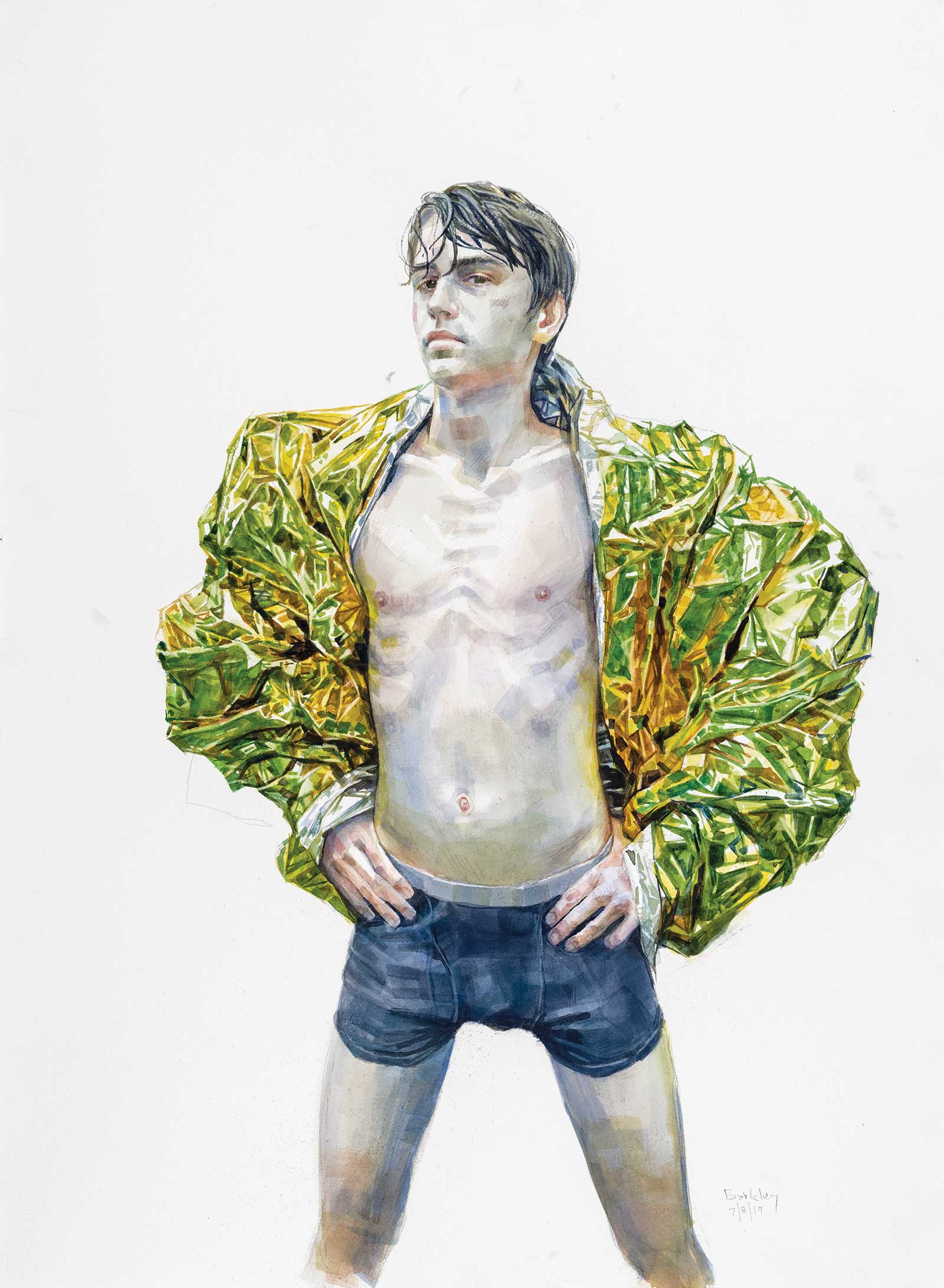 Études Pour Réfugié II, watercolor on paper, 32 x 22"
In the old Christian church, priests performed the dramatic ritual of exorcism to expel parasitical demons from their hosts. Possession was said to be responsible for madness, for perverting humans into sinful lives, for being the source of depravity and deviation. The rite established the priests as a superior power, and afterwards, the purified victim was rendered into a new life of docile devotion to the dogma of the church, trading one kind of submission for another. In Barkley’s painting of the rite, Exorcism II, a gilded man emerges from the wide-stretched mouth of the possessed, vomited like a golden butterfly emerging from a carapace, his child-like arms clutched close to his chest, his fists clenched to his heart. Barkley has cleverly flipped the narrative. He says, “He’s better now that he’s come out of that other fellow’s mouth.”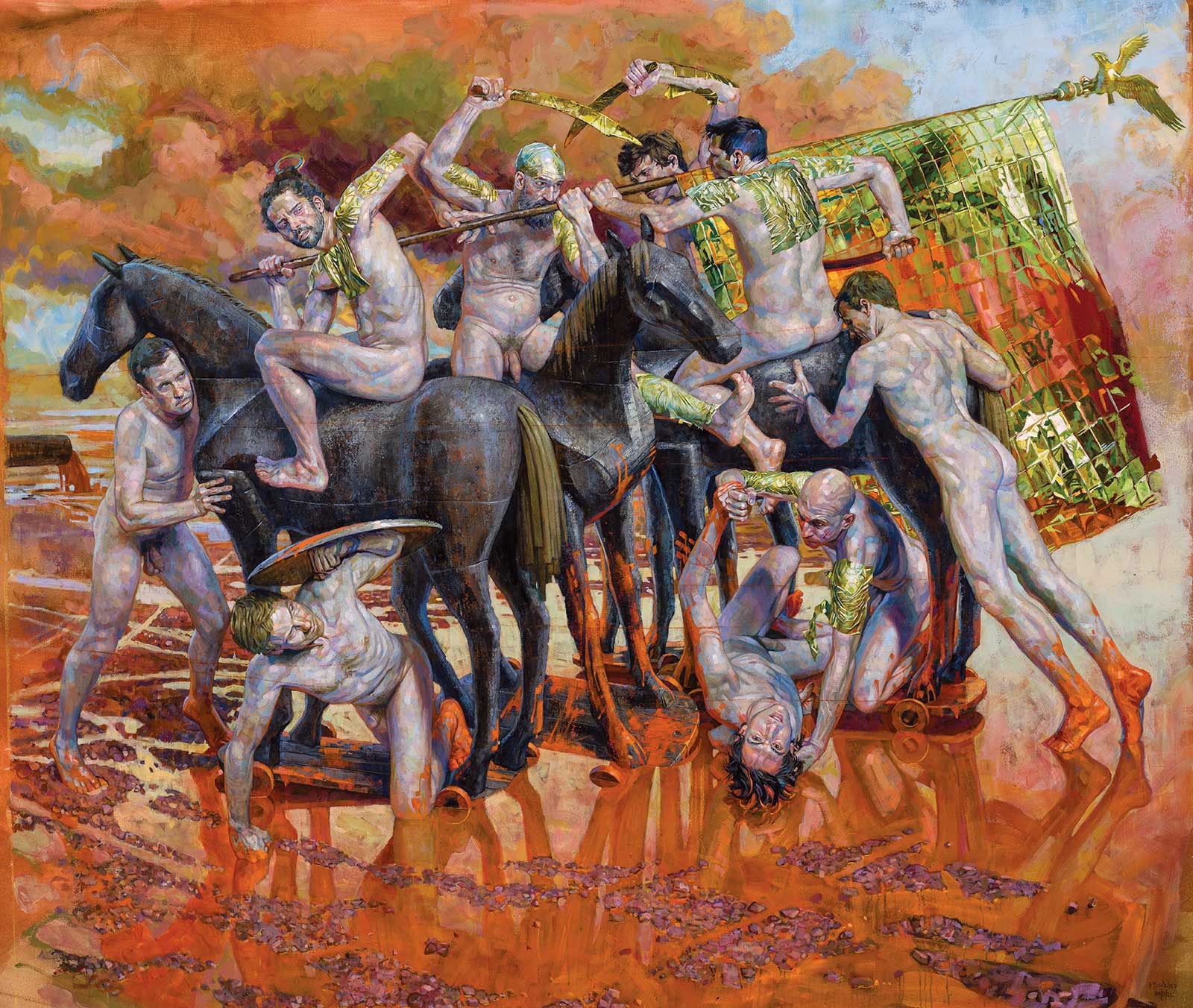 Battle (Anghiari) (detail), acrylic on canvas, 72 x 84"
Triumph of Bacchus I has sold to a collector in Portland, where it hangs beside paintings by gay icons Kehinde Wiley and Keith Haring. “I don’t feel like a gay icon,” Barkley says, “but I do get emails from young gay artists who look up to me, and I’m always surprised. It’s not something I walk around with every day, going ‘I’m a gay icon.’ I never ever think of such a thing, except when someone writes to me and says that looking at my work when they were teenagers made them decide to go into the arts. It’s very touching. I’m going to be 60 in summer, and there was none of that for me. There was David Hockney, and I really liked his work, but he was one of the only ones, a figurative painter dealing with the male body, a more observational painter. Francis Bacon was much more charged.”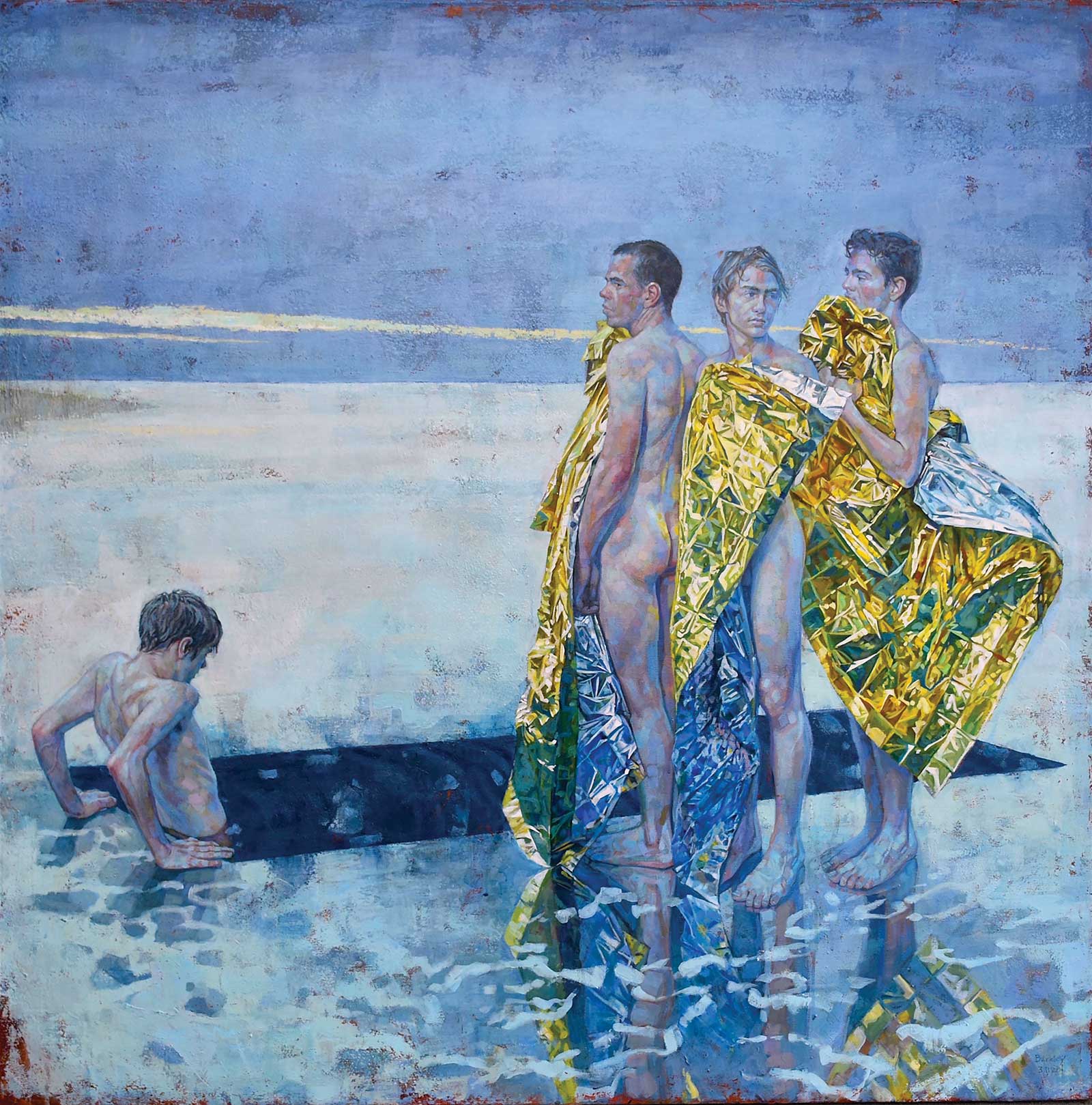 Winter Swim, acrylic on canvas, 60 x 60"
 The Youth of Bacchus, acrylic on canvas, 48 x 48"
Barkley enjoyed painting his bacchant triumph so much that he painted a second version of it. He says, “It deserved a second go, with a slightly different take, a slightly different size. I did it because I could. When paintings are selling, it gives you a license to try it again, try something else.” Success has brought him creative freedom, but he is pragmatic about his place in the lineage of art history. He speaks about making studies of Peter Paul Rubens’ tiger hunts, and recently completed his homage to Rubens’ painting of Da Vinci’s Battle of Anghiari, which was exhibited in XL5 Exposition de Type Colossal in Montreal, which runs through August 14. In Barkley’s version, Battle, the warriors ride wooden horses, pushed into the fight by willing men. Their shoulders are covered with useless golden armor as thin as leaf. Their shining banner reflects the polluted orange light of the battleground’s slippery mud. Barkley frequently references the Old Masters. “They’re a source of inspiration,” he says, “They built their imagery on what had come before. I’m continuing along the same lines, without too much hubris, I hope.” —
+++
Michael Pearce is a dynamic writer, curator, and critic. He is a champion of art that emerges from popular culture and shapes the spirit of the age. He has published dozens of articles about art and artists, and is author of Art in the Age of Emergence. He is Professor of Art at California Lutheran University.
Powered by Froala Editor