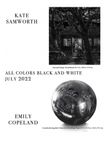
Color is frequently a point of discussion when observing art. “The color is vibrant,” one might say, or “Those colors seem to really pop.” Often viewers will pick out their favorite colors—sapphire blues in mountain lakes, oranges that warm and soothe within sunsets, or the emeralds of an eye that peers out of a painting—as their attention slips through the different hues in an artwork.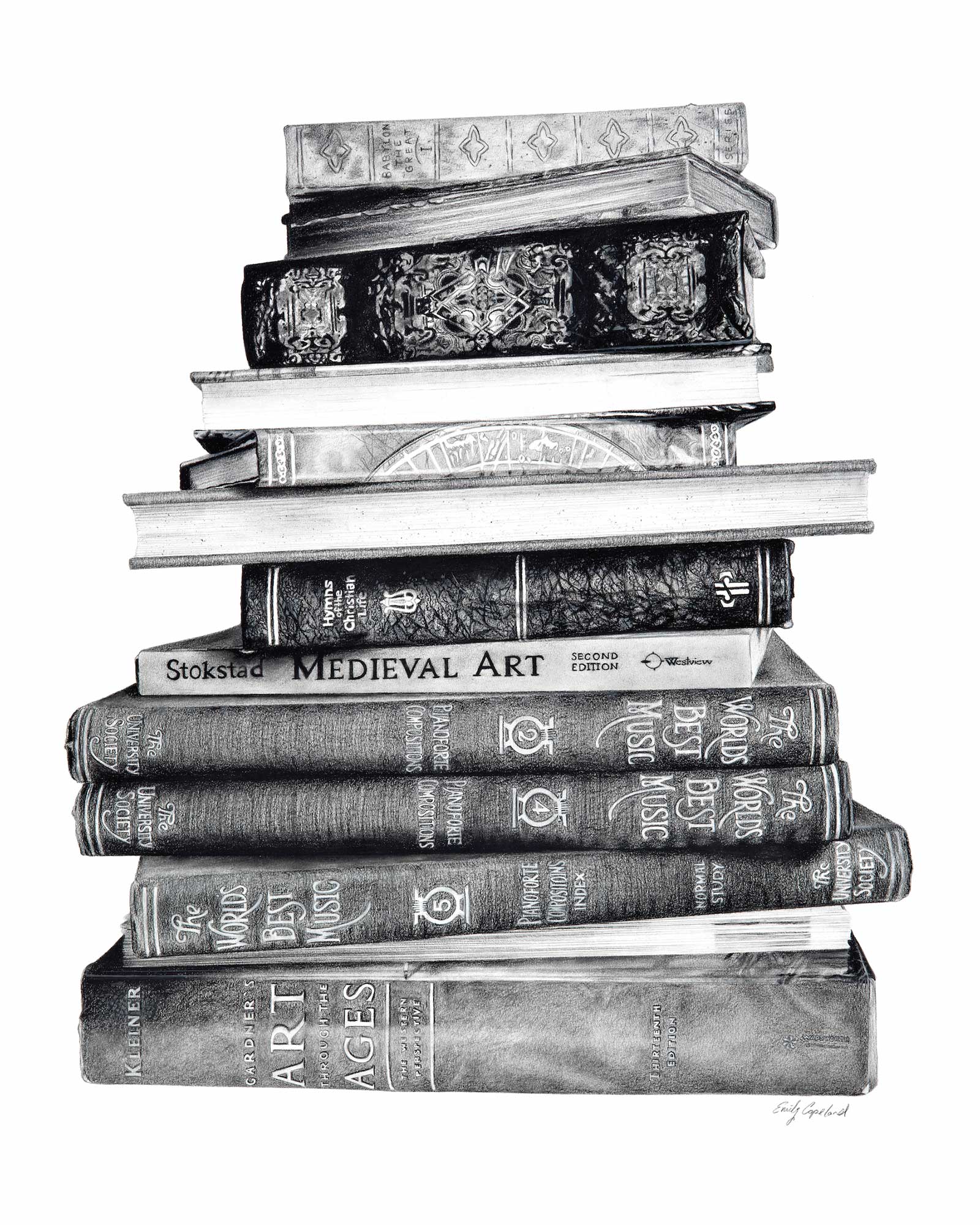 Emily Copeland, Stack of Books, 2014, charcoal on Stonehenge Paper, 42 x 32"
What many viewers don’t discuss, at least not as much, is value—the lightness and darkness of a color. A painting’s values are right there in every corner and every color of the work, and yet values are so strongly tied to color they can be tricky to wrap your head around. Sometimes it’s helpful when color can be stripped away entirely, which is what RJD Gallery is doing with a new three-artist show opening July 1 in Romeo, Michigan.
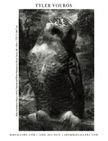
“Color abounds in the black-and-white artwork of Emily Copeland, Kate Samworth and Tyler Vouros—color that is seen and unseen, real and imagined,” says Joi Jackson Perle, the gallery’s director. “These artists each uniquely and masterfully demonstrate how less coloration is more, opening up magic portals to worlds not traveled in traditional, color-filled paintings. Each artist, with vivid imagination and a skillful hand, invites us to see the world as they see it, in radiant, expressive richness and in full color within the realm of black and white.”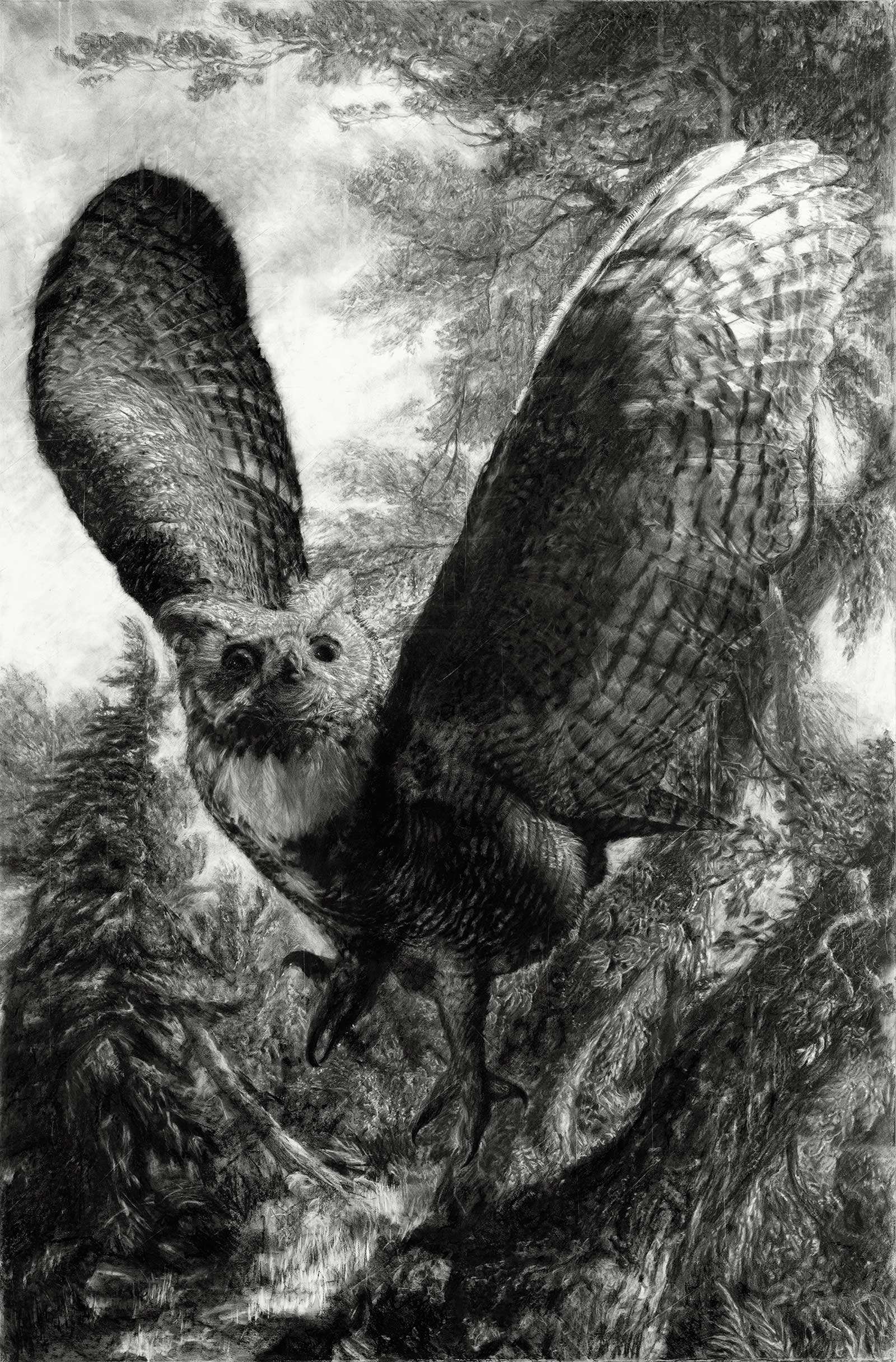 Tyler Vouros, Kingston (Great Grey Owl), 2019, charcoal and water mounted on deep canvas, 55 x 35"
Copeland will be showing several major pieces, all of them black-and-white still life images done in charcoal. One of the works, Stack of Books, with its tower of paper perfectly rendered in form, shows the subtlety of her medium as well as the delicacy of her application. Her charcoal can convey texture, weight and even color. “Stack of Books, was part of a five-part series of everyday objects, all stacked on top of one another. It included poker chips, books, a wood pile, a suitcase filled with clothes and teacups,” Copeland says. “They were specifically styled based on shape, from tall cylindrical items, to rectangular items, to the pyramid in the middle. Stack of Books was particularly fun to arrange as it’s filled with music and art history books, travel journals and some beautiful finds from an antique store years before. Every book represented a part of me and had a connection to some part of my life. It was a way to add pieces of myself into a drawing, almost like a self-portrait.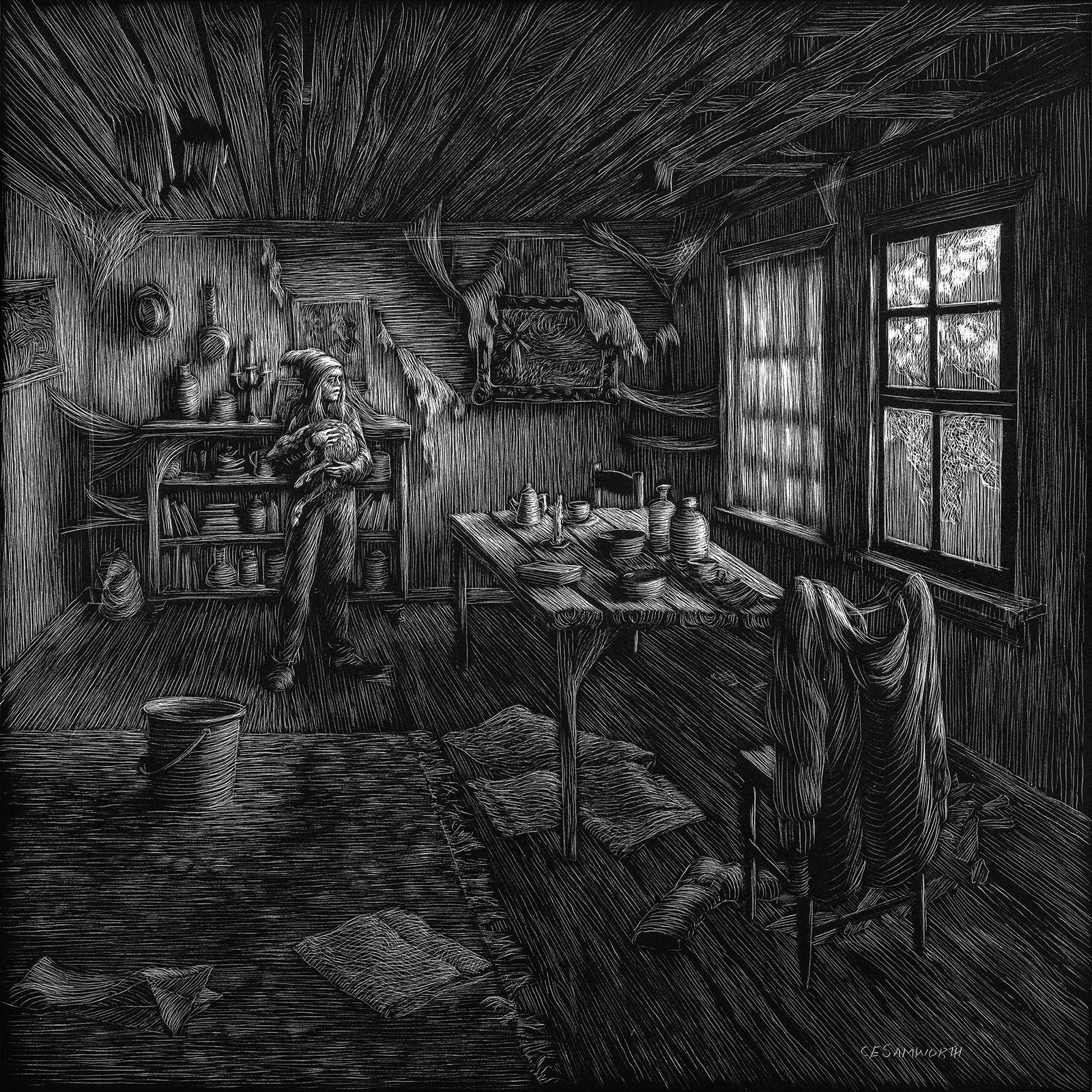 Kate Samworth, Injured Fawn, scratchboard, 8 x 8"
I also loved working with interesting novel cover textures and the delicacy of the pages, having each book facing different directions to get the best composition and range. It is still one of my most enjoyable pieces to work on to this day.”
Copeland admits there are positive and negatives working in black and white, but believes “a drawback to working in strictly black in white is that you can almost lose a realness to an object. When realism is done in color, you feel like you can practically grab it, feel its texture or taste it depending on the subject matter,” she says. “When it’s black and white, you’re attempting to make it look as photorealistic as possible. It will often not go past it looking like a photograph, however, I believe that there are a lot of positives to working with these shades. When color is removed, the emphasis of an image naturally shifts to other elements such as texture, tones and details you wouldn’t have typically noticed before. It also allows you the ability to manipulate the lighting and shadows. You can then use only four shades to achieve an entire grey scale of blacks to whites…Black and white is also timeless. It’s both old fashioned and modern at the same time.” Emily Copeland, Tessa Virtue’s Olympic Skates, 2018, charcoal on Stonehenge paper, 33 x 50"
Samworth’s works are completed in black and white, but are done in the vastly different medium of scratchboard. “I love the scratchboard medium in particular because it is evocative of etchings seen in past centuries of natural history illustration and picture book illustration,” she says. “Scratchboard was, in fact, developed to replace traditional printmaking used in newspaper and magazine illustration. I love it because it allows for delicate lines. It’s also a reductive process, which means that the white lines are revealed when the black surface is removed, which lends itself perfectly to chiaroscuro and dramatic lighting.”
The artist, who also paints in oils and acrylics, says that having limitations can be helpful as an artist, if nothing more than to kick-start creativity. “I absolutely believe in the power of limitations as applied to art. I like to explore an idea or theme from multiple angles to discover the possibilities of different approaches. For example, I would sketch the same figures, like the girl and the bear inside a house, and try lighting the scene from a window off to the side, or from a lamp on a table or a hole in the roof. Each has a different atmosphere,” Samworth says. “Working in black and white allows me to focus on creating atmosphere through dramatic lighting, though this would also, of course, work in color.”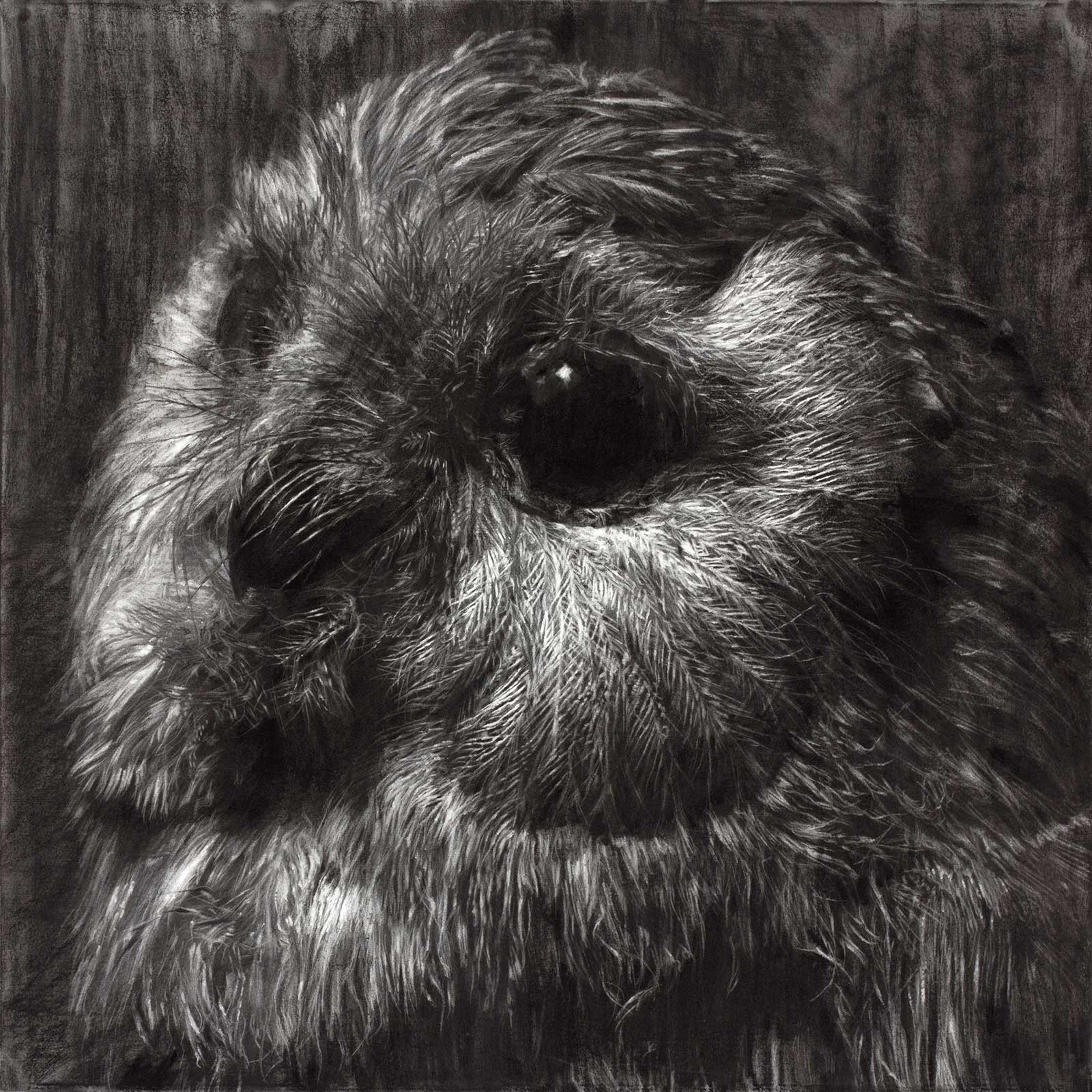 Tyler Vouros, Saroo (Aegolius Acadicus), 2019, charcoal and water mounted on deep canvas, 41 x 23"
In the work Home Before Dark, Samworth creates a terrifying forest filled with light and ominous energy. “This piece, like several of the others, is an expression of fear. The sun is about to go down. She and the animals have been spooked—we don’t know by what I don’t want to guide the story in a particular direction and don’t know if I want to introduce another human yet, but I imagine that it might have been a person that spooked them. It may have been something supernatural,” she says. “I’ll probably revisit the idea at some point. I’ve done a couple of versions. She was wearing a skirt in one version and it felt really different in tone. The light coming through the trees gives me lots to explore. That’s another example of setting boundaries as means for exploration.”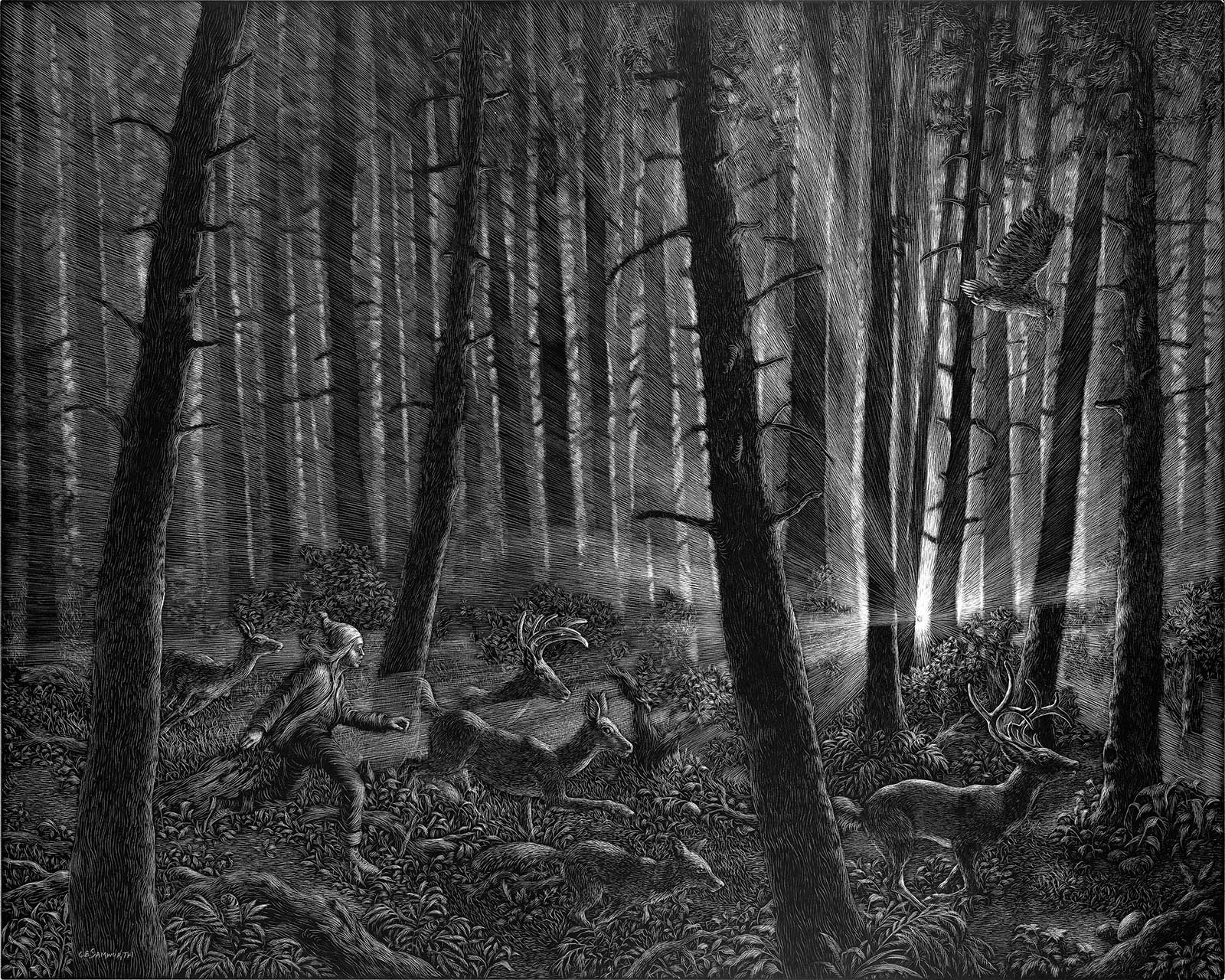 Kate Samworth, Home Before Dark, scratchboard, 20 x 16"
Other works in the show include Vouros’ magnificent wildlife charcoal drawings, including several owls that are painted in moody scenes with pitch-black shadows and white-hot highlights that show the extremes that black-and-white imagery can create. The artist works by drawing with the darkest charcoals he can find and then the work is more reductive as he uses every kind of eraser on the market. “One of the major benefits of working in black and white is that it all can be reduced down to value. Trying to maintain the hierarchy of light and dark can be tough. I’ll even use a mixture of charcoals knowing that some can go darker than others,” Vouros says. “The other thing about my work is I don’t use any white. Instead I use the light of the paper. I have to be careful while I work because I want the paper to be super luminescent, which can be tricky because I really attack the paper.”
For Vouros’ birds, he visits a raptor rehabilitation center in New Hampshire to find inspiration, though he often credits his 11-year-old daughter, who was drawing owls long before he was. “She inspired me,” he adds.
The show will be on view throughout the month of July. —
RJD Gallery
227 North Main Street • Romeo, MI 48065
586) 281-3613 • www.rjdgallery.com
Powered by Froala Editor