Every year Painting the Figure Now presents a new body of figurative art created by some of the most esteemed artists working today. These pieces capture sentiments, themes and emotions as vast and complex as the human experience itself. But that singular concept of personhood is what each work of art has in common—portraying that ephemeral glimpse into what it means to be a person.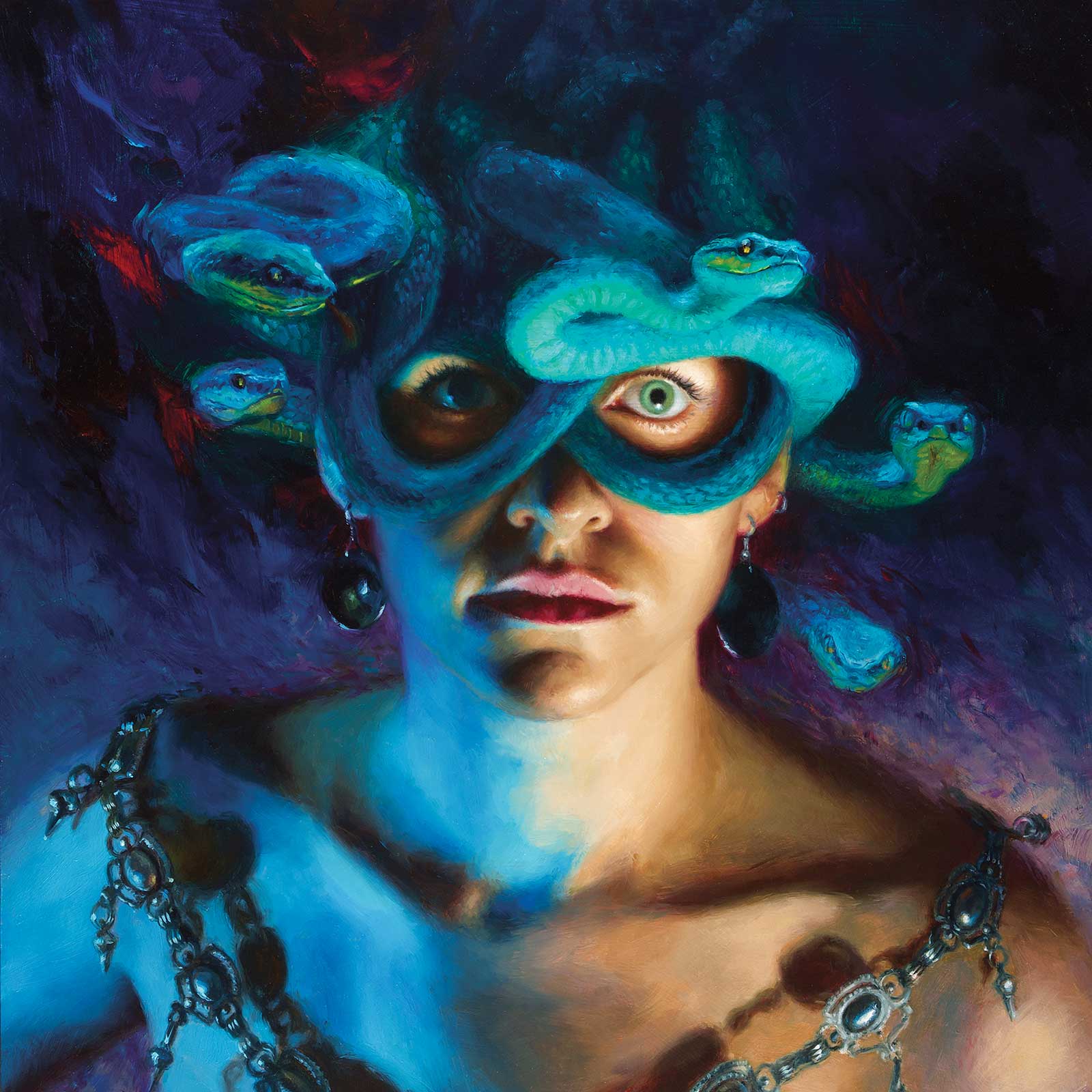 Terry Strickland, Medusa, oil on panel, 16 x 16”
“Beyond Painting the Figure, that additional word ‘Now’ quietly appended to the theme subtly ties everything together,” says guest curator Samuel Peralta. “The artworks all have a perspective that’s contemporary, compelling and current. It’s an immediacy of the moment, a present-day perspective, captured in every frame…I look for a strong narrative or symbolic undercurrent in the way the artist treats their subject matter—what [poet] T.S. Eliot in called the ‘objective correlative’ that elevates the piece.” Co-curators of the exhibition include PoetsArtists’ Didi Menendez and David Hummer of the Wausau Museum of Contemporary Art, where the show takes place. 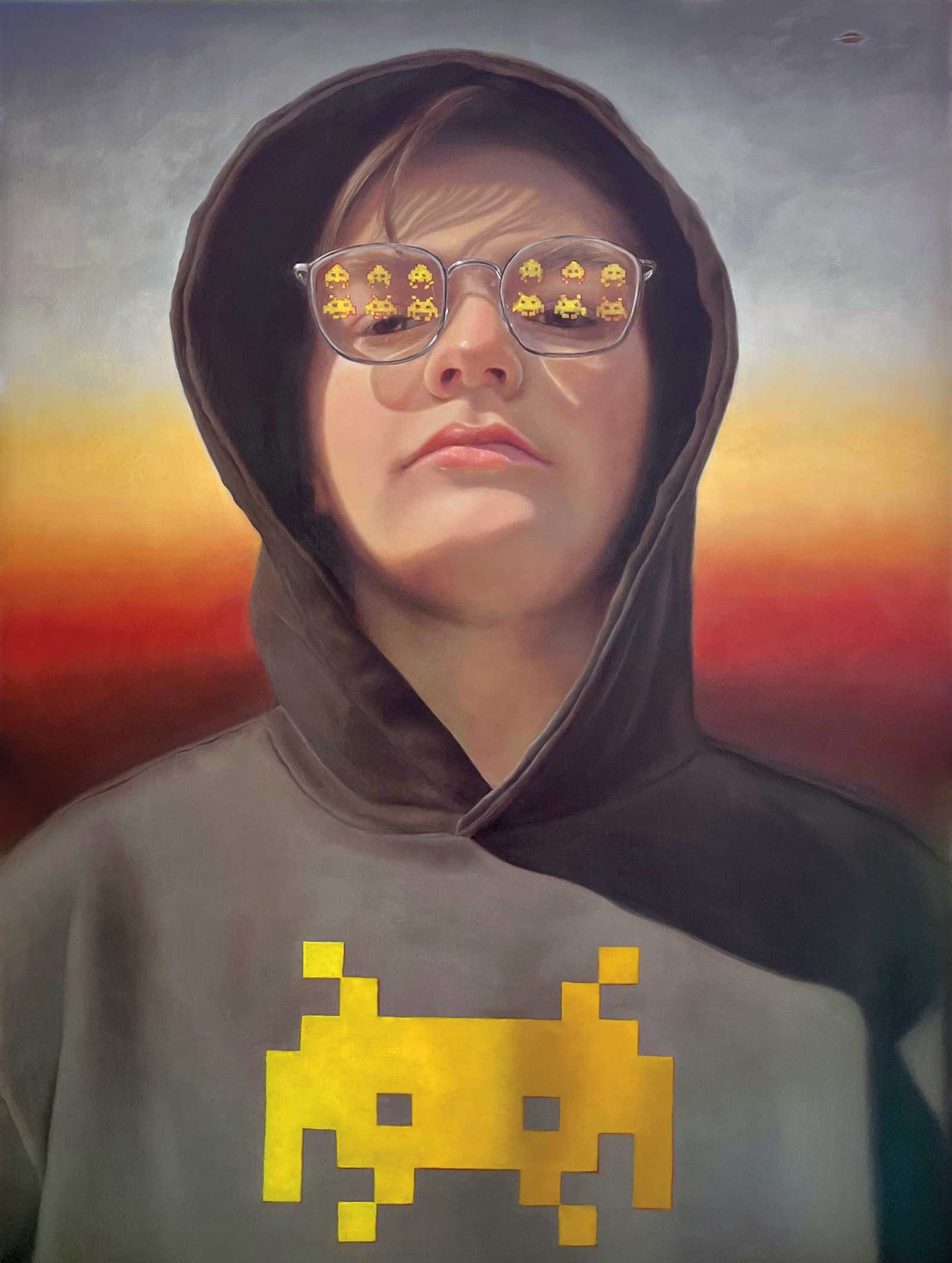 Amy Gibson, They Said the Answer Was 42, oil, 24 x 18”
Rendered in hues of acid greens and electrifying blues, Terry Strickland’s oil Medusa delves into the idea of perception and intent. Infinitely complex, our perceptions of the world and the people around us are based on varying circumstances, personal experiences and individual biases, something impossible to entirely liberate ourselves from. “Medusa [is] intimate and terrifying,” says Strickland. “She’s a fascinating character whose personae differ depending on who’s looking. Villain, hero, monster or beauty? Medusa has been a symbol of the wickedness of women, the face of feminine rage, and perceived as a victim. The viewers’ ‘gaze’ is the ultimate barometer, revealing more about them than about Medusa, the myth. Apropos because with Medusa it’s all about the gaze—her stony, deadly gaze. My Medusa’s intent is not evident. She’s engaging us with the pull of her expression but her intent is left to us.”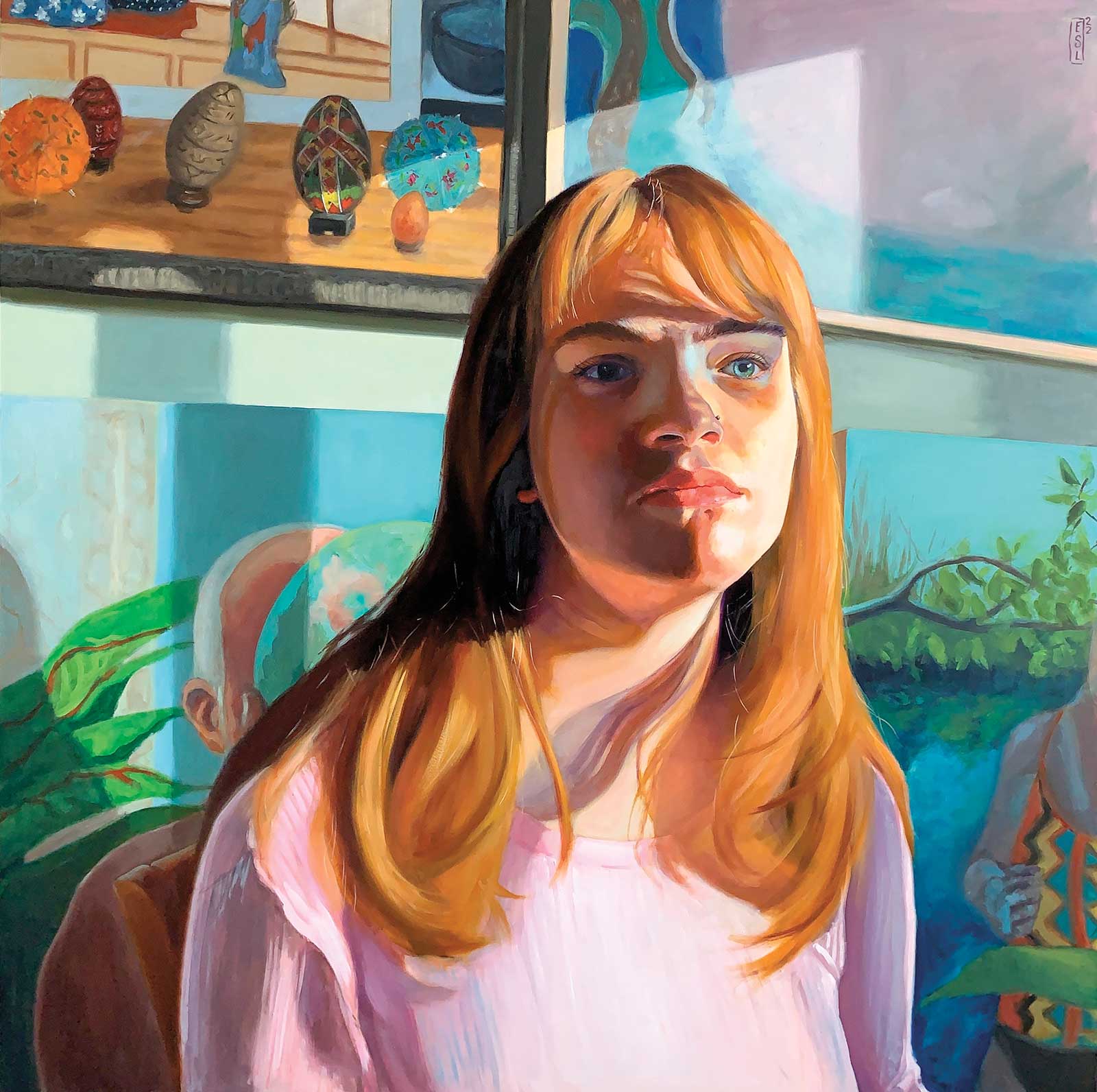 Ellen Starr Lyon, Morning Light Sleepy Face, oil on panel, 30 x 30”
Radical Joy distills a sense of pure and unencumbered delight. The charcoal and collage piece depicts a woman mid-laugh, the smile lines around her eyes offering warmth and openness. “She’s full of gratitude for her journey. She is beautiful inside and out and she has embraced self-love with ‘radical joy.’” says artist Traci Wright Martin. She explains that the layers of paper symbolize the walls we often put up and the baggage we often have to carry, including cultural expectations of femininity (see the series of locked chests on her right shoulder), as well as the everyday joys of listening to music (the music notes on her chest). “There is an awareness present at all times in all these layers,” Martin continues, “a knowing and an understanding for all the components and experiences that make us who we are. The theme that weaves in and out of my art most often is a conversation on representation. I want my viewers to catch a glimpse of themselves in my work. In my eyes, the most impactful work is one that functions as a mirror, however large or small the point of reflection might be.”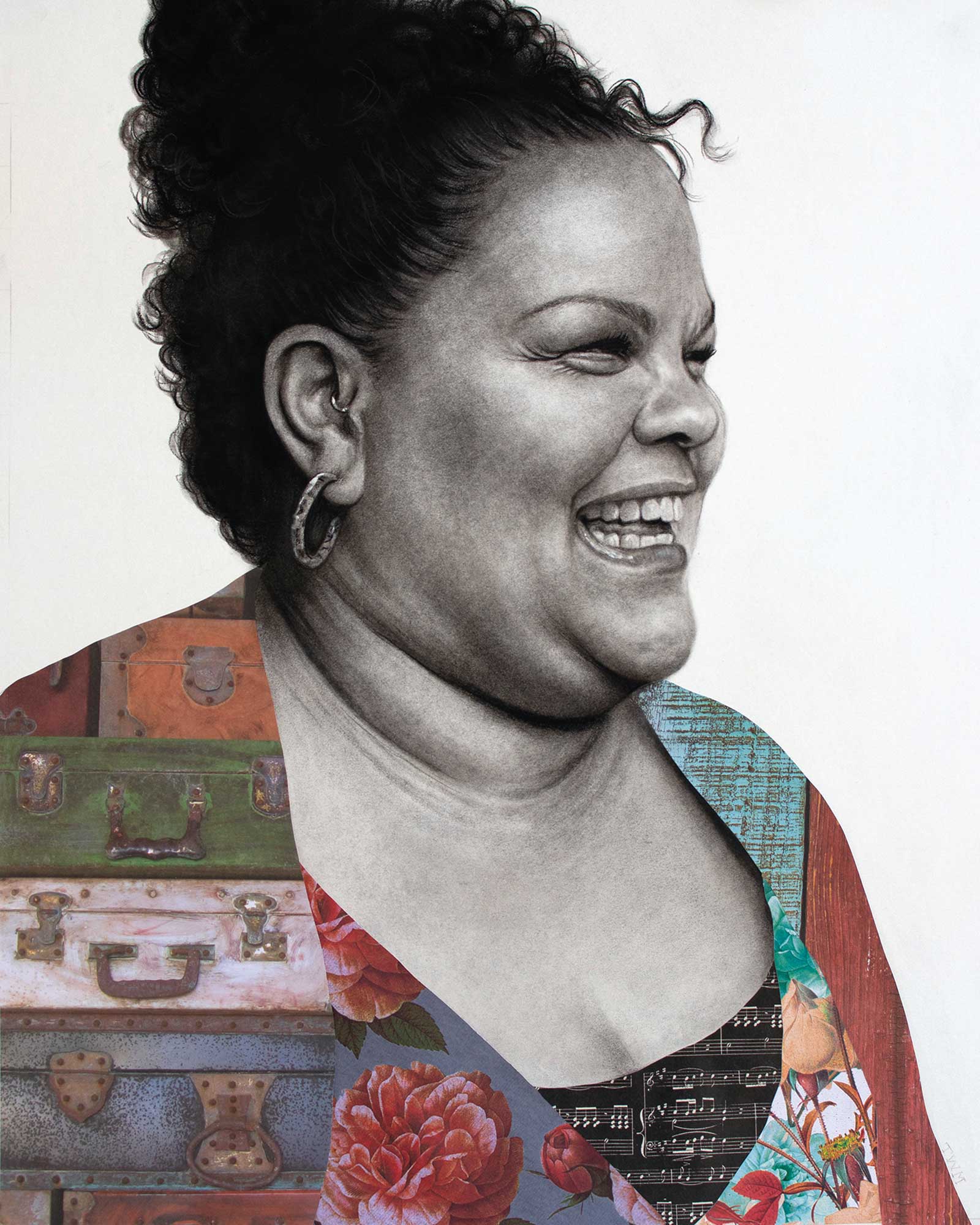 Traci Wright Martin, Radical Joy, charcoal and collage on Stonehenge paper, 16 x 20”
The transitory nature of life is explored in Morning Light, Sleepy Face, a portrait of artist Ellen Starr Lyon’s daughter. “My children have been my muses for the last few years for three reasons. The first, and I suppose the most obvious, is that I never tire of looking at their faces. They change so quickly that if you blink, you’ll miss it. Alongside the physical changes are the emotional ones. As an artist and mother, I feel driven to process the heightened vulnerability that teens exist in; something as adults we unconsciously (and consciously) learn to temper. The final reason is practical and one of opportunity. They are the faces in my environment that catch the impromptu, amazing, fleeting effects of bright natural light falling over a surface. I prefer to be surprised rather than attempt to manufacture something interesting, and I hope that the surprise and delight shows in my work,” says Lyon. “The background here, unknown to the viewer, is that this is a portrait of my youngest child. My son has already moved on and my daughter will attend college in the fall. This portrait represents a goodbye and a transition for us both. I think the posture, expression and strong sunlight and shadow speak to all sorts of transitions we all experience.”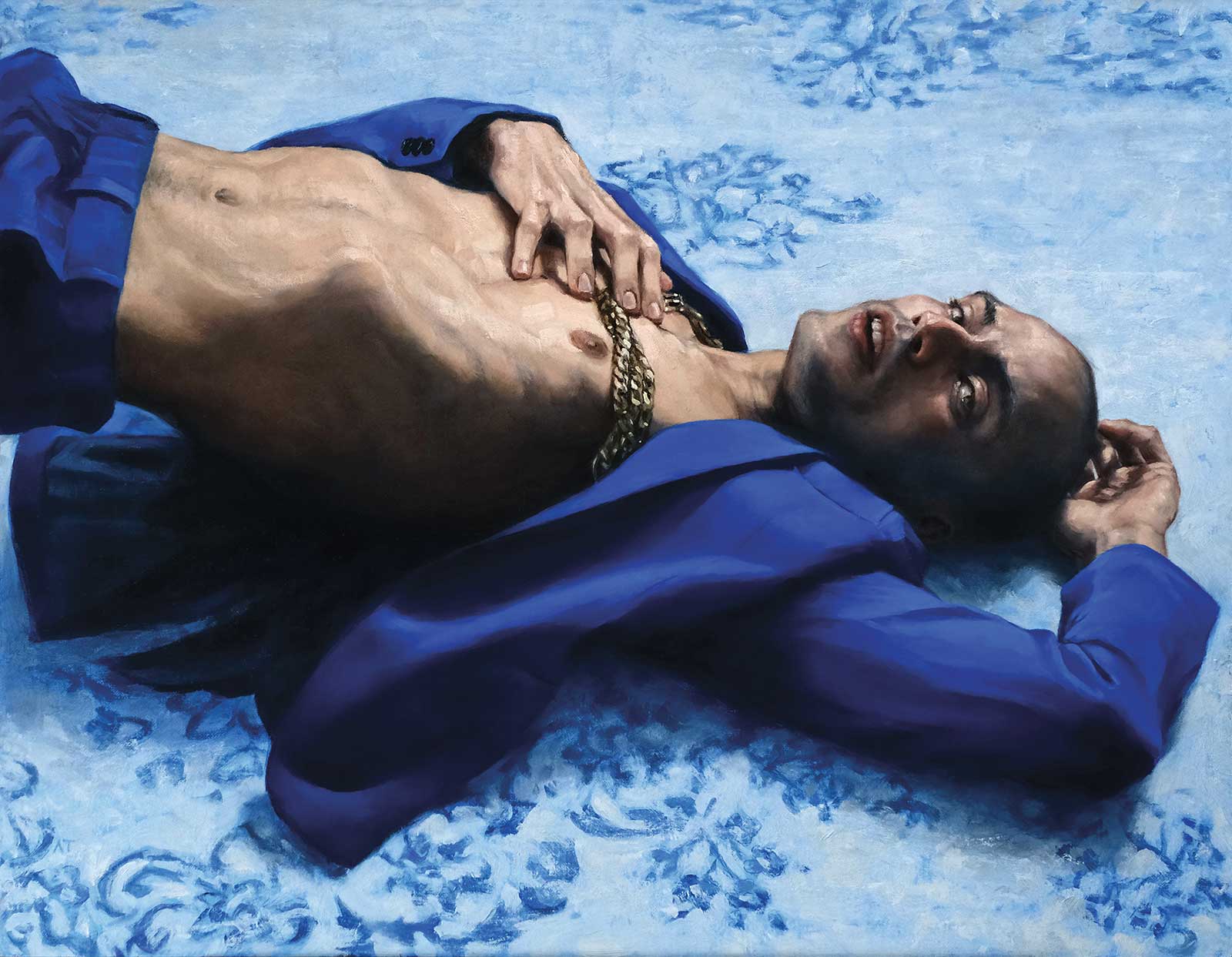 Alessandro Tomassetti, Spellbound, oil on linen panel, 14 x 18”
Another painting in the exhibition, Spellbound, is the first in a series of collaborations artist Alessandro Tomassetti did with a ballet dancer named Francisco. The highly pigmented blue of the dancer’s blazer and slacks create an icy contrast against the pale blue floor on which he lies, his hips arching upward while he meets the viewer’s gaze. “I knew I wanted a reclining pose to maximize the impact of the cobalt suit against the patterned rug but asked Francisco to continue to explore and interact with the light until I saw something I could work with. When he lifted his hips off the ground the composition went from static to something more dynamic and sensual,” says Tomassetti. “His arched back and the high-contrast illumination of his torso and face had me imagine a mystical moment was being captured, a moment of enlightenment or transfiguration or ecstasy. To heighten this concept, I opted to abstract the florals of the rug and have them dissolve into mandala-like patterns as though delineating a sacred space. As with most dancers, Francisco is keenly aware of the shapes and spaces he creates with his body.”
The artist continues, “Impactful paintings walk a line between familiarity and intrigue. This is especially true of figurative work and portraiture, where it isn’t quite enough to get a good likeness or to render something realistically. There has to be something else that engages you and begs more attention. As a painter, and also as a collector, I like to look at a portrait and think, ‘I feel like I know this person’ as much as I think ‘I need to know who this person is.’”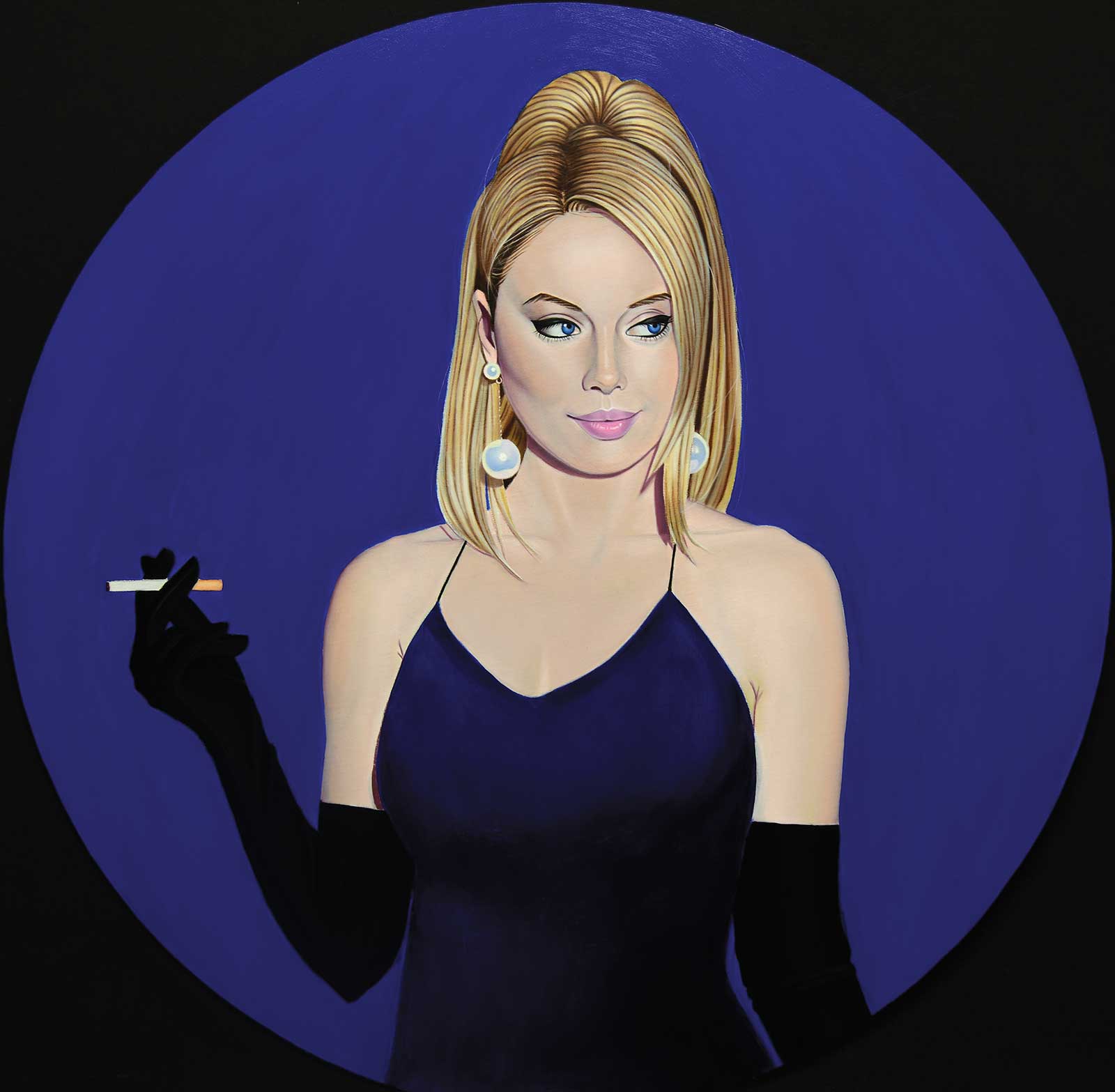 Suzy Smith, Indigo Velvet, oil on aluminum panel, 24"
Painting the Figure Now 2022 will be held at the Wausau Museum of Contemporary Art from July 7 to October 1. Show curator Peralta adds that the artwork in this exhibition will be included in a time capsule bound for the moon as part of the Lunar Codex, a phenomenal project founded by Peralta himself, in which a collection of works from thousands of artists across the world will be launched in three time capsules to the moon. Since the physical artwork is far too heavy, the images will be distilled on disks about the size of a quarter and readable by any humans who are able to retrieve them in the future. Works in Painting the Figure Now will be launched in the Polaris time capsule via the SpaceX Falcon Heavy rocket in 2023 to 2024 and deposited on the lunar south pole. “Every piece in this exhibit,” he says, “will be a part of history.”
For more information about the Lunar Codex, visit www.lunarcodex.com.
Painting the Figure Now 2022
When: July 7-October 1, 2022
Where: Wausau Museum of Contemporary Art 309 McClellan Street, Wausau, WI 54403
Information: (715) 298-4470, www.wmoca.org
Powered by Froala Editor