Alexandra Manukyan has worked with the flamboyant gestures of choreography for more than a decade, but her new works balance the sensuality and eroticism of the spectacular ballroom’s body language with a mysterious and intimate self-reflection. Although her new figures recall the exuberance of the dances of the Caucasus, with the extravagant gestures and formal movement of proud performers, and the costumes are flavored with the cheerful scent of floral headdresses worn during spring-time celebrations and in the harvest festivals of ancient Armenian custom, Manukyan says she is principally influenced by her work as a fashion designer. “I love my country,” she says, “but I’m more of an international artist. I make most of the jewelry and costumes…I love fashion, and it’s almost like doing a line of fashion design. Beautiful girls and beautiful clothes.”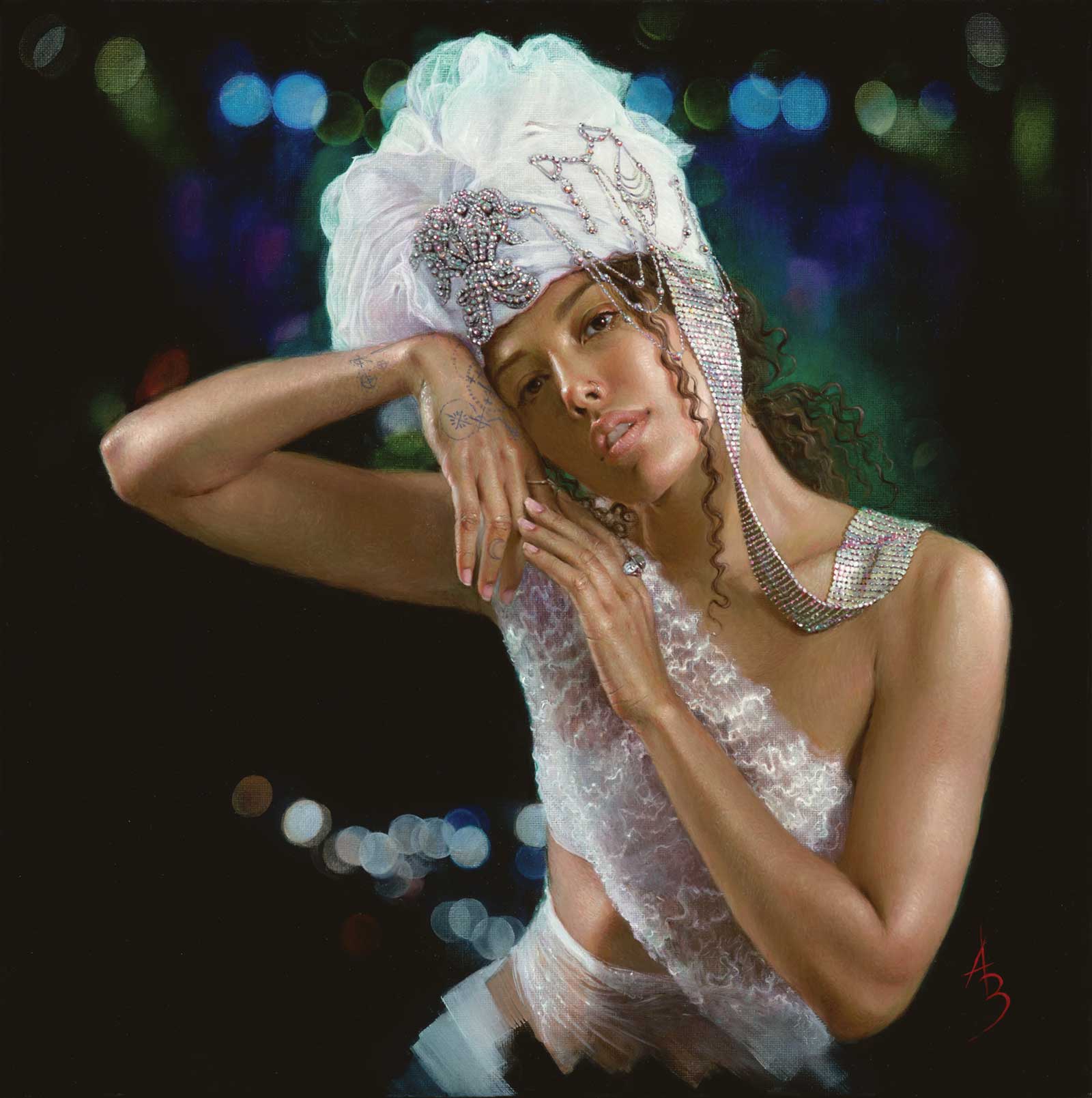 Diaphanous, oil on Belgian linen, 20 x 20"
Manukyan came to Los Angeles in 1990. “It was right before the collapse of the Soviet Union,” she says, “We came as immigrants. We didn’t want to live under the communist regime.” Her family’s timing was perfect, for occupying Russian forces abandoned Armenia soon after they came to America, and war ripped into her old country. The current imperial Russian invasion of Ukraine evokes unpleasant and emotional memories for her, “Anything that is happening in Ukraine mirrors Armenia,” she says, recalling the invasion of Nagorno-Karabakh by Azerbaijan and Turkey. “It was an awful period. Little by little the dust settled and people started scrambling through and organizing. There was a mafia which took over the government, there were regimes which had close ties to Putin.” Far from war, here in the safety of the golden state she found her career as an artist, first working as a fashion designer, then turned to painting and becoming a popular and respected teacher of figurative oils.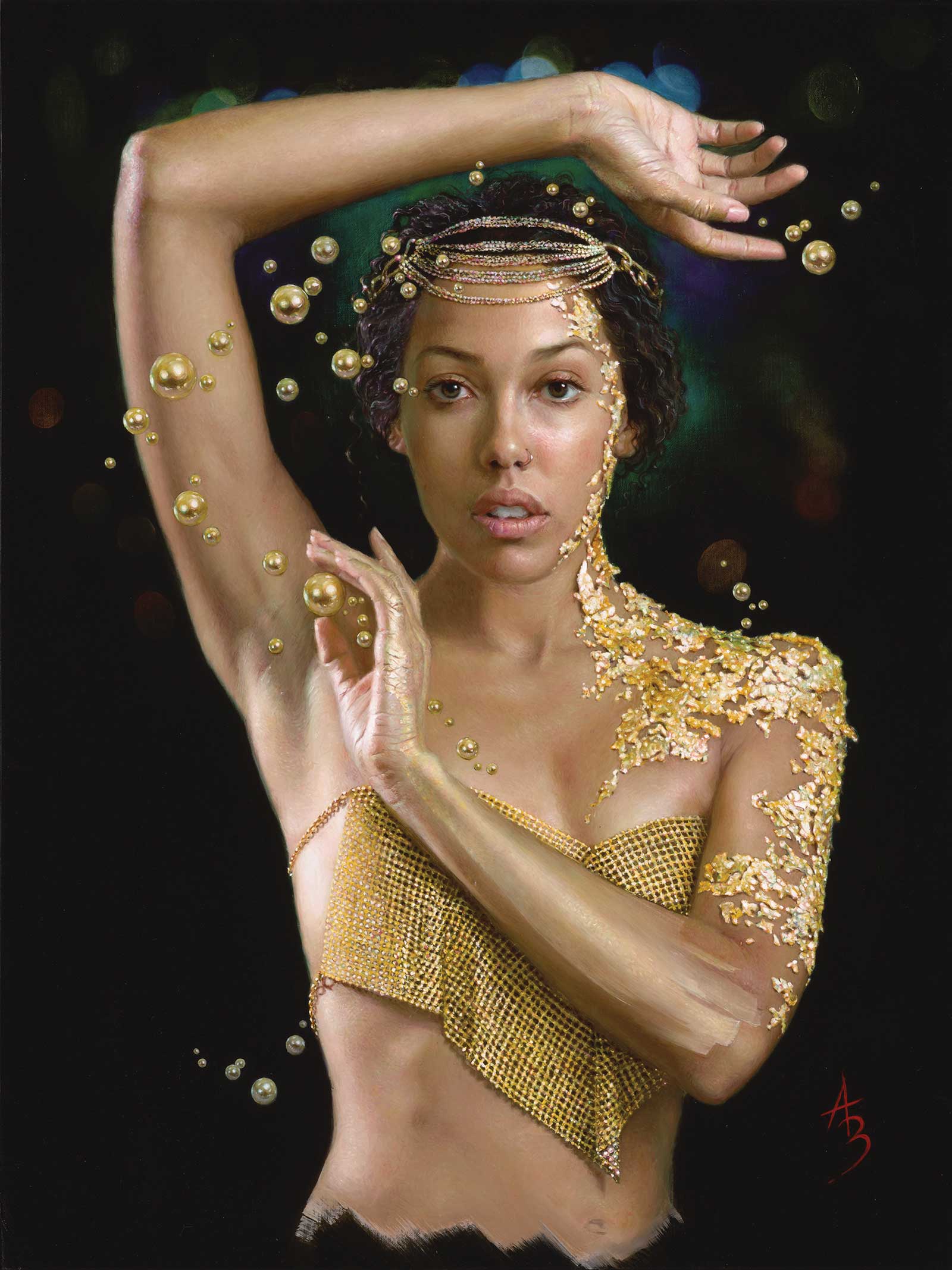 Transcendent, oil on Belgian linen, 24 x 18"
The new paintings extend Manukyan’s body of work with a new, mystical aesthetic. She has slipped past the glib dramas of display and entered the quiet and veiled spaces of the heart, making paintings of gorgeous, dancing souls that seem to inhabit an inner space, her models wrapped in eternal gold and virginal white, with flawless skin shining in scaled areas of pounded leaf, glowing with the brilliance of reflected light. This is the most intimate work of her career.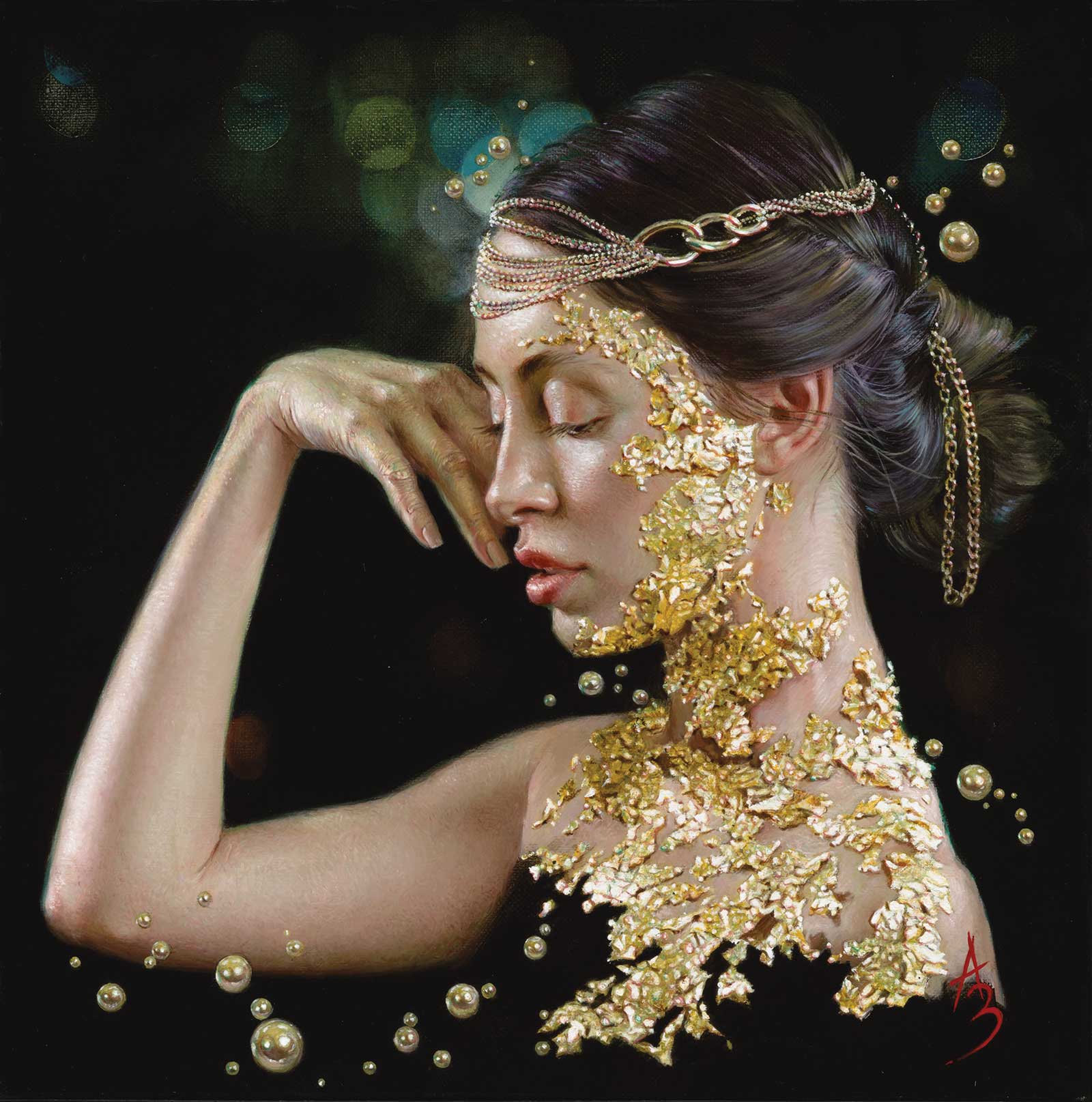 Resplendent, oil on Belgian linen, 14 x 14"
Colored glowing balls of low light behind her gilded characters suggest the nocturnal lights of a private performance in a liminal nighttime space. Their soft photographic focus sets up the magical realism of little floating golden orbs, conjured into levitation by the hands of the women. “We connect gold with the cosmos,” she says, “if you go to an Orthodox church, they’re flooded in gold. You really feel transported…I love looking at the interior of Greek churches, they’re so opulent and beautifully designed. The reflection of that golden light is overwhelming.” When the women gaze out from the paintings, it is with complete self-possession, with the detached confidence of master magicians practiced and skilled in their supernatural manipulation of elemental forces. In a sense, they are all self-portraits, for Manukyan paints with complete assurance and has the practiced hand of a carefully prepared master. “I know what I’m going to do beforehand,” she says, “I have a theme. The reason I did these is because I wanted to talk about the metaphysical and spiritual meaning of the gold, and what it means for humans and how we respond to gold. A wonderful artist, Brad Kunkle, started using gold and silver leaf, and there seemed to be a surge—they’re very sellable. There is something in gold that humans connect to, almost on a quantum level…I don’t know if it’s the color, or the shine, something aesthetically captivates humans.” But Manukyan didn’t want to use real gold leaf, preferring the delicious gift of illusion. “I painted it. I tried to challenge myself. It is very hard to do that crumpled gold leaf texture, but it is also very therapeutic, and meditative, trying to go through each and every detail…it’s very satisfying and very challenging.”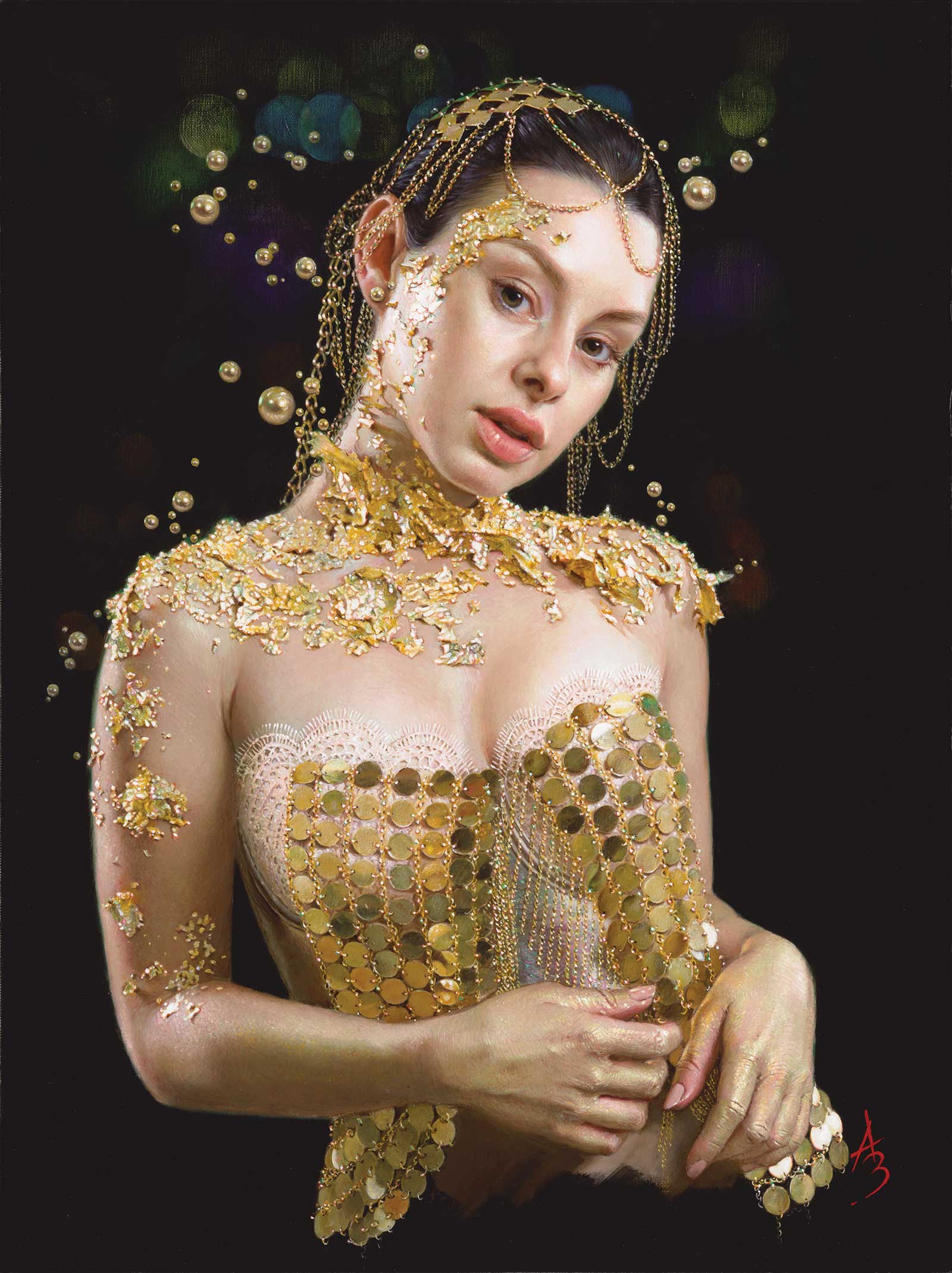 Ethereal Aurum, oil on linen on wood panel, 24 x 18"While working as a designer, Manukyan discovered ukiyo-e woodblock prints, falling in love with the serene harmonies of the floating world. She has painted hybrid versions of them behind her dimensional and dynamic models, birds, the whirlpool, cherry blossoms, relishing the contrast between their flat and static aesthetic and the depth and dimension of masterly Western figurative work. The contrast helps to create the sense of motion that Manukyan wants—like the lens blur it helps to create a magical delight. In a solo show at Denver's Abend Gallery last year, she tested her instinct to experiment with this combination of flatness and illusion and produced a small portrait, Where the Winds May Take You, painting a woodblock of a swooping heron behind a brunette nude, who wears only the tattooed image of a geisha print over her naked body. It sold immediately.
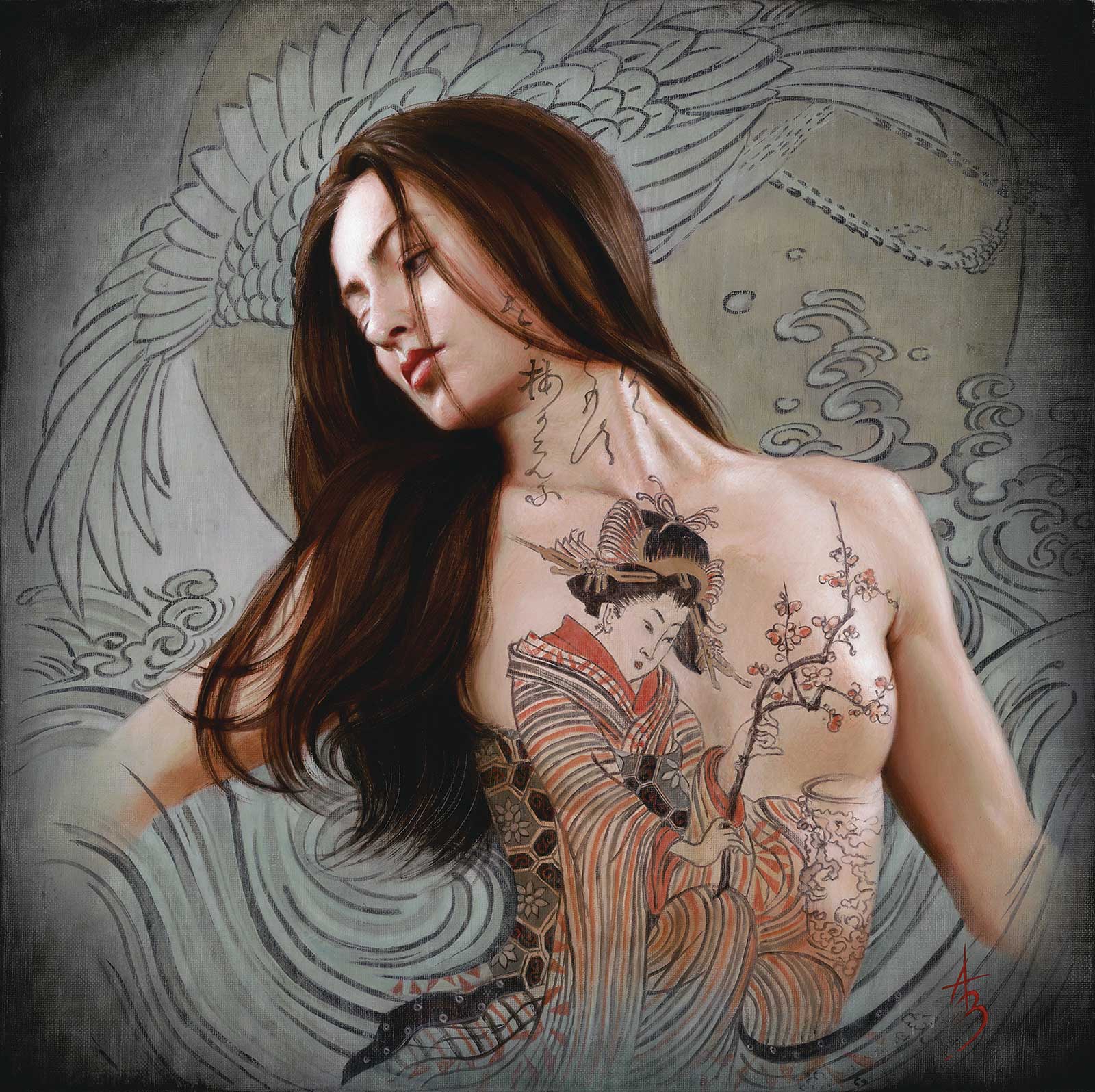 Where the Winds May Take You, oil on Belgian linen, 18 x 18"
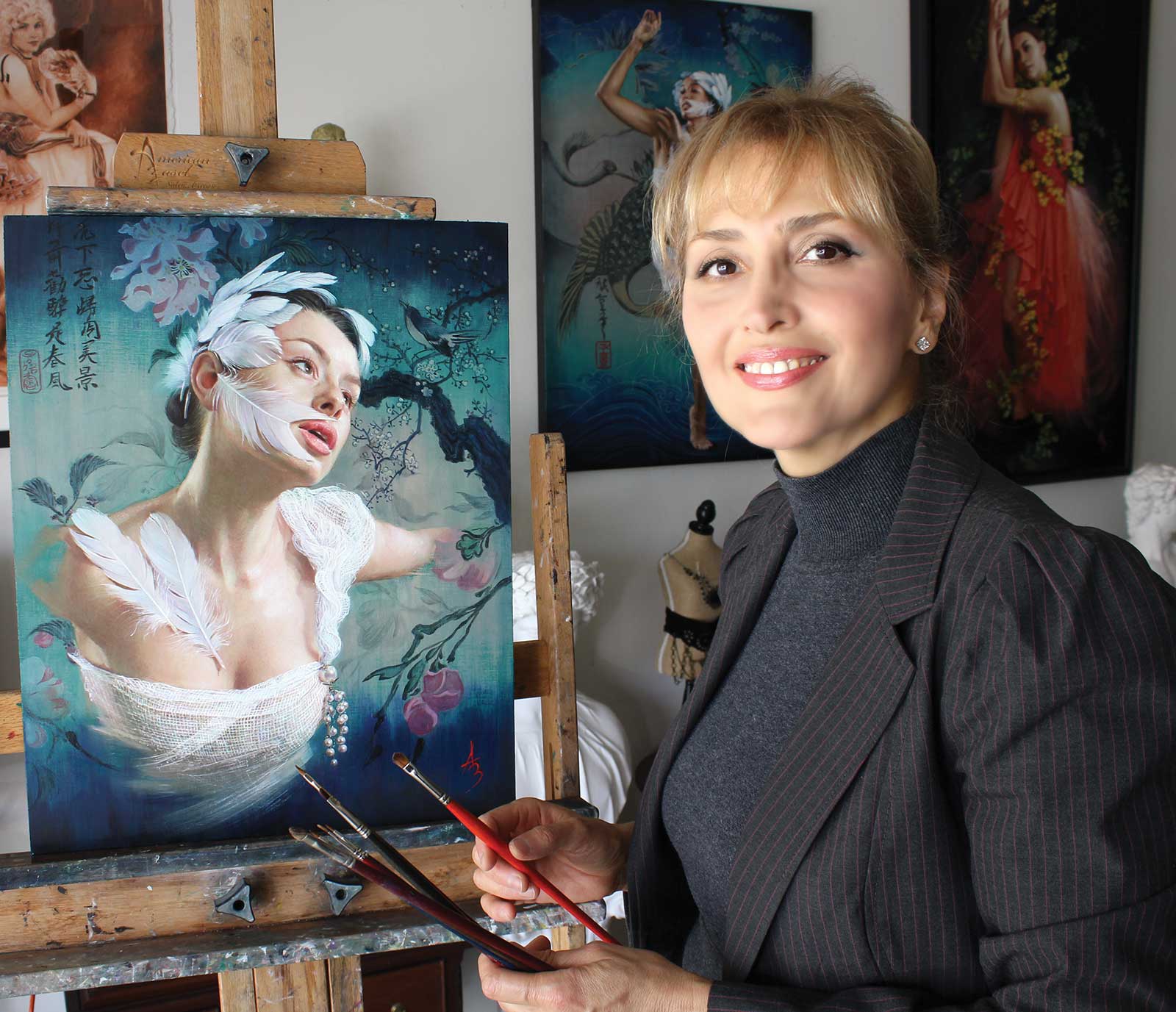 Artist Alexandra Manukyan with her painting Silent Melody, oil on linen on wood panel, 20 x 16". Photo by Paul Karmiryan.
Sentiment was murdered by the avant-garde in the West, but it never died in the East, and now postmodernity allows a leveling of all things, and Manukyan has embraced the pleasures of sensuality and symbolism. She contrasts the hard-edged shine of gold, with the softness of feathers, with pure white cloth, but ties the three together in a trinity of allegorical meanings. These are symbols of mankind’s approach to the divine—gold as the flawless, permanent, pure, emblem of the one; light feathers as a metaphor for escaping the earth to ascend upward to the heavens, white as the pure cloth of the beautiful bride of God. “I wanted to have the same themes—spiritual, symbolic and metaphysical, but depict them in different ways," she says. "In this case it’s the birds in flight in connection with the cosmos.” A split feather opens over the parted lips of the models’ mouths—it can be enjoyed as a suggestive and erotic gesture, but it also ties the breath and the word together with flight, a moment of prayer, attaching the dance and the body to the sublime. The sublime dancer emerges as a theme—in The Wrinkled Sea Beneath her Crawls she balances before a swirling whirlpool, dancing on the edge of destruction, in I Know Not How to Find the Spring, she is over the waves again, ascending among stylized herons, feathers on her skin. These dancers are speaking with their movements of meeting god, whispering secrets to the divine. —
+++
Michael Pearce is a dynamic writer, curator, and critic. He is an active and enthusiastic participant in the conversation about 21st century art and its roots, especially contemporary imaginative realism. He has published dozens of articles about art and artists, and is author of Art in the Age of Emergence. He is a champion of art that emerges from popular culture and shapes the spirit of the age. He is professor of art at California Lutheran University.
Powered by Froala Editor