In an artist statement for her paintings of the four elements—earth, air, fire and water—Leigh Li-Yun Wen quotes James Joyce ruminating on his protagonist Leopold Bloom in his novel Ulysses. “What in water did Bloom, waterlover, drawer of water, watercarrier returning to the range, admire?” He then proceeds, in a 473-word sentence, to list water’s many qualities. Wen cites, “…Its universality…its unplumbed profundity…the restlessness of its waves and surface particles…” and, later, “…its persevering penetrativeness in runnels, gullies, inadequate dams, leaks on shipboard…”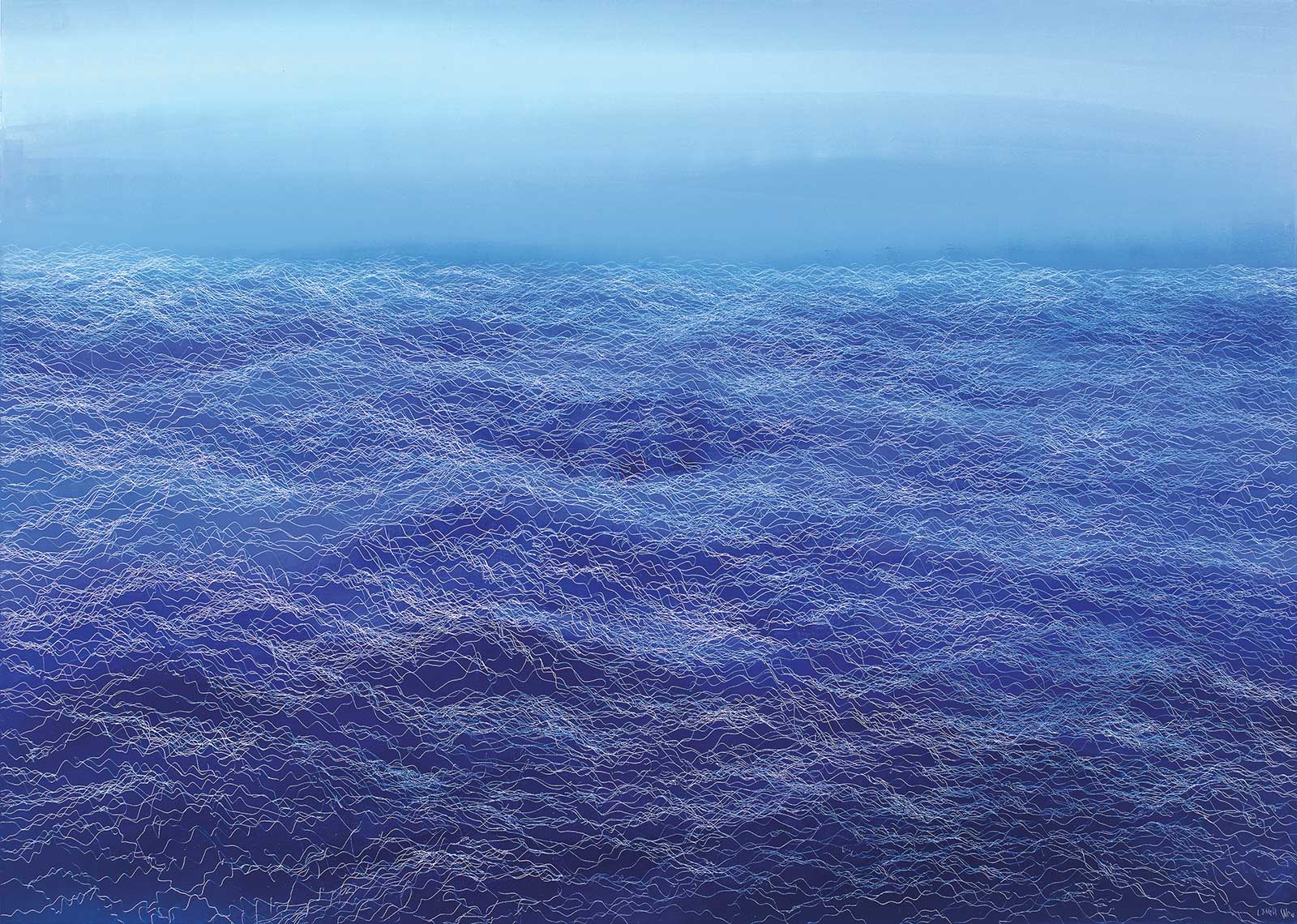 Baltic Blue, oil on linen, 64¾ x 89 1/3"
She paints often enormous canvases with many colors which she covers with a dark layer of paint. “My working method,” she says, “is a process of subtraction from darkness to light. I carve into the wet paint with a stylus to bring forth the individual lines that are the central motif of my work. These lines flow across the canvas in rhythms and frequencies that create depths and swells on the painted surface. Something of the self is lost in the resulting tangle, and then regained, only to be lost again. Simplicity and harmony exist within the chaos of the world.”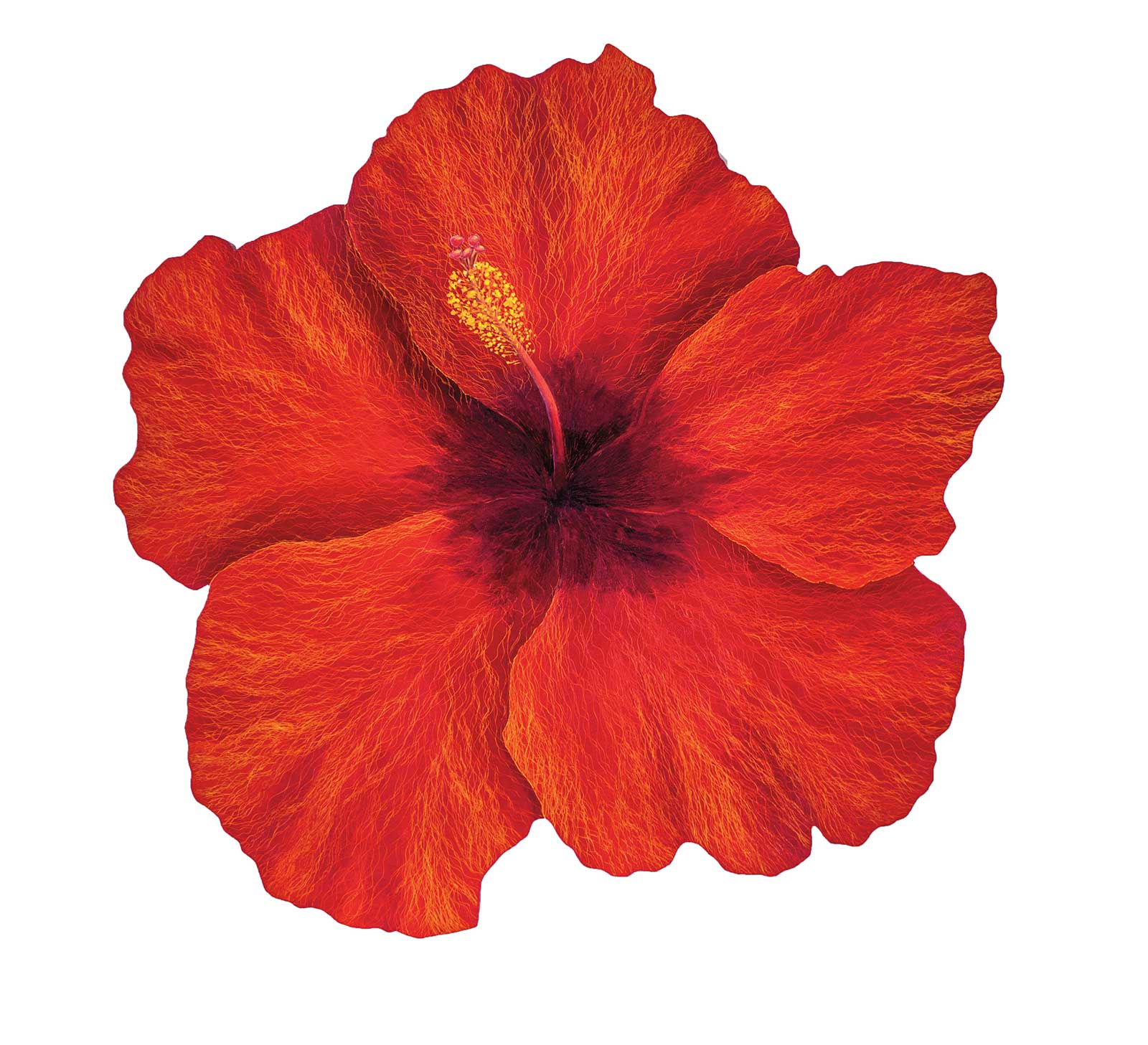 Hibiscus IX, oil on canvas, 68 x 68½"
She explains, “I work in several different media, including printmaking, metal engraving, fiberglass, ceramics. Though most of my paintings are completed entirely with oil on canvas, they retain elements of these other mediums, in particular, the scored and scratched textures of the intaglio plate and the engraved surface. In a sense, these borrowings also express the tension and richness of simultaneously inhabiting two different worlds, where both, as Joyce wrote in Ulysses, carve their ‘persevering penetrativeness’ into my psyche.”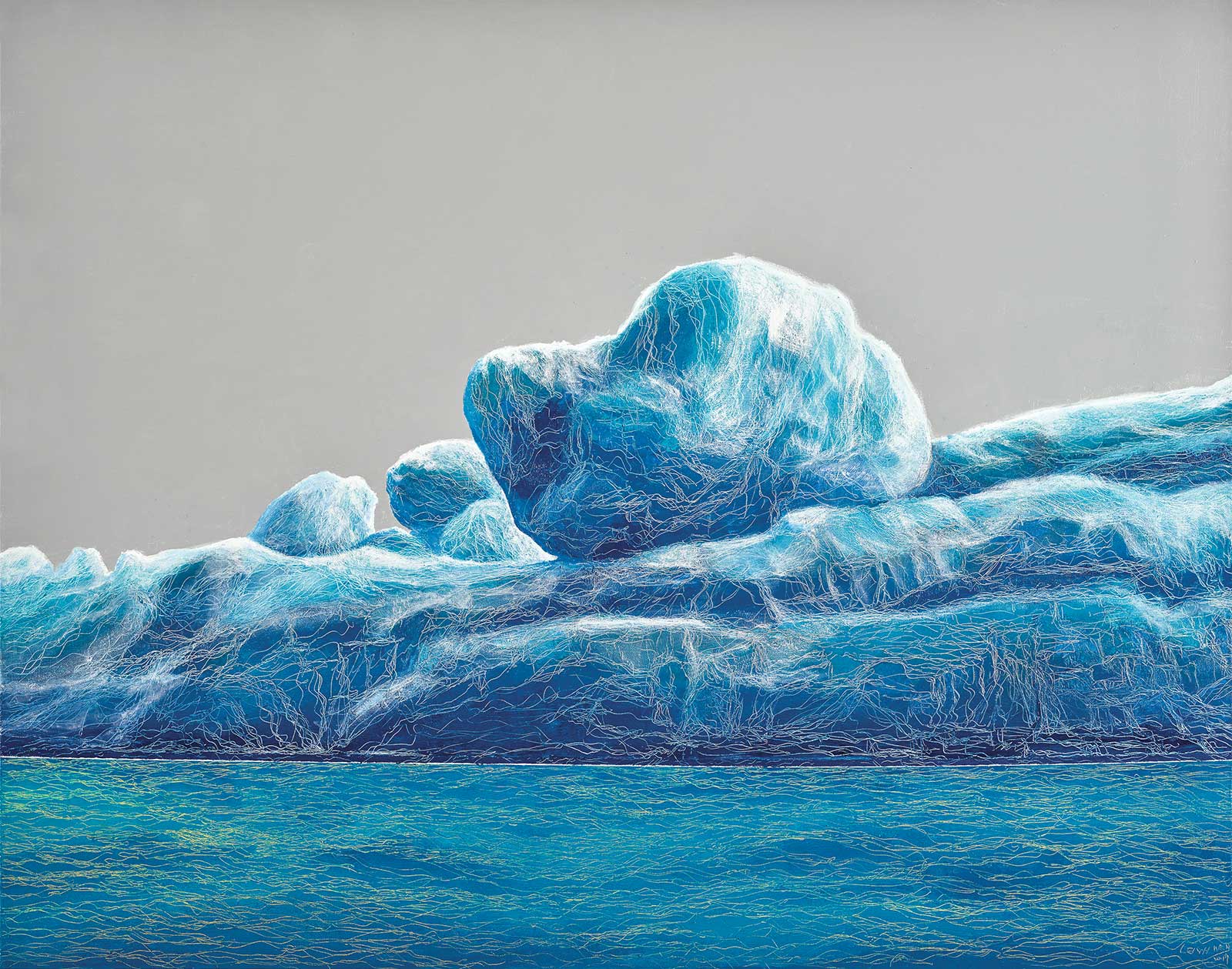 Iceberg V, oil on linen, 51 x 63¾”
Wen was born in Taiwan, an island where she developed “a deep affinity for the elemental power of water and forces of nature.” She came to the U.S. and received her BFA from Washington State University and then her MFA from the State University of New York, Albany, in 1994. It was at about that time that we met. In 1999 I included her work in the exhibition Re-Presenting Representation IV at the Arnot Art Museum in Elmira, New York, and the following year, presented a solo exhibition of The Four Elements as part of her first Pollock-Krasner Foundation Grant.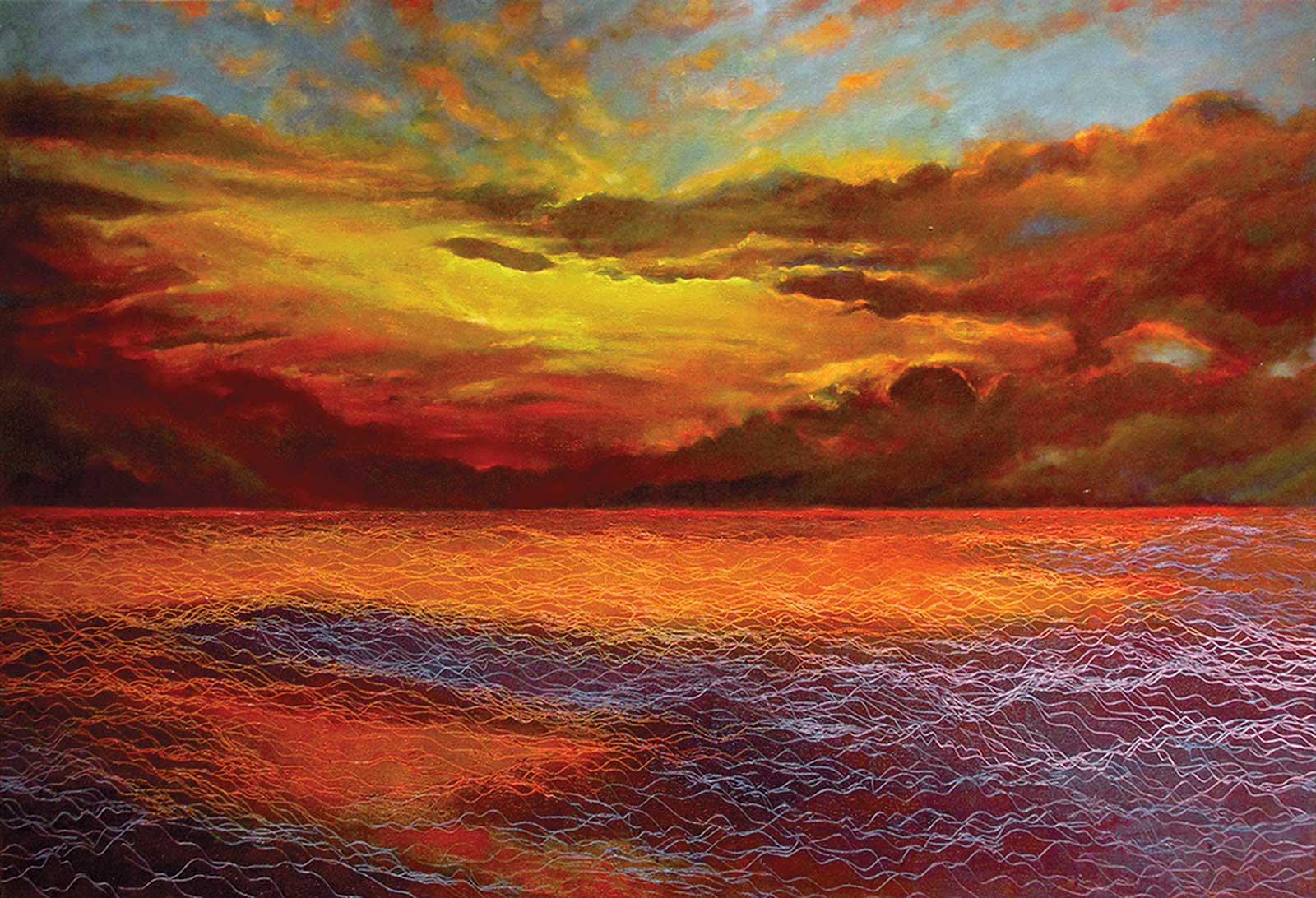 Olana, oil on linen. 117 x 63¾"
Her first large water painting measured 10 by 50 feet and arrived at the museum rolled up with the stretchers packed separately. We didn’t have a 50-foot wall so we tacked up the unstretched canvas and curved it around the corner to the adjacent wall. There was a feeling of being enveloped in the sea. Even when stretched and hung formally on a long well, the effect is overwhelming. Her incised lines, based in Chinese calligraphic theory, flow across the canvas like the water they depict, receding into an inviting distance. 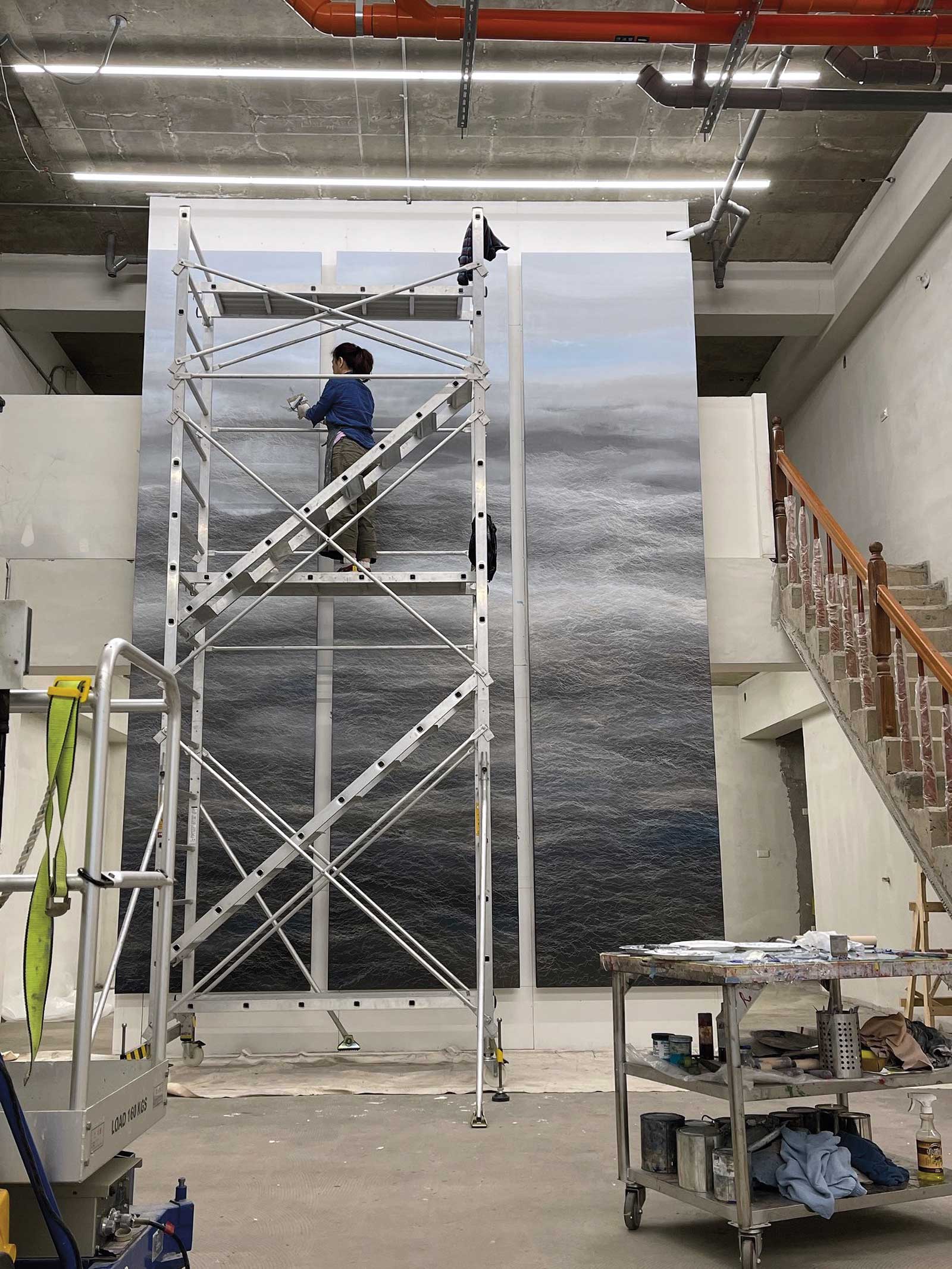 Wen on a scaffold working a 89 x 57" canvas.
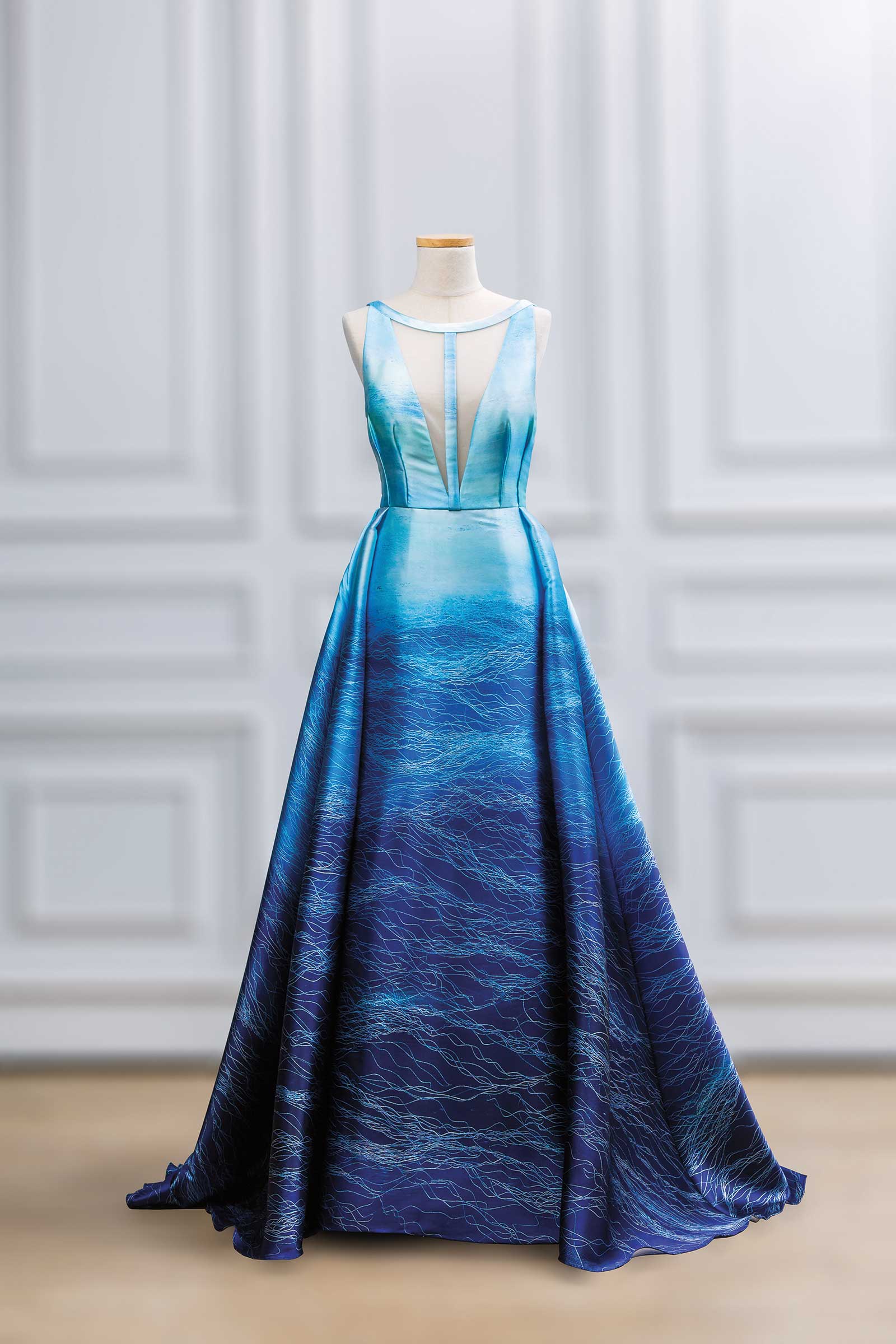 Wen has adapted her paintings for gowns, umbrellas, catamaran sails and other items.
Her father died shortly after she finished her water paintings. During the lengthy ritual of his Buddhist funeral, she watched the flames of the candles and the ceremonial burning of a symbolic house. “The fire created hot air and didn’t just rise vertically,” she observed, “but randomly swirled around the burning wood and around the amber colors. I discovered how to make fire paintings by turning my stylus 90 degrees to make my cursive lines vertical and to make them more random. I use a lot of reds, oranges and ash grays. There are no forms since fire is just air like water is just liquid.”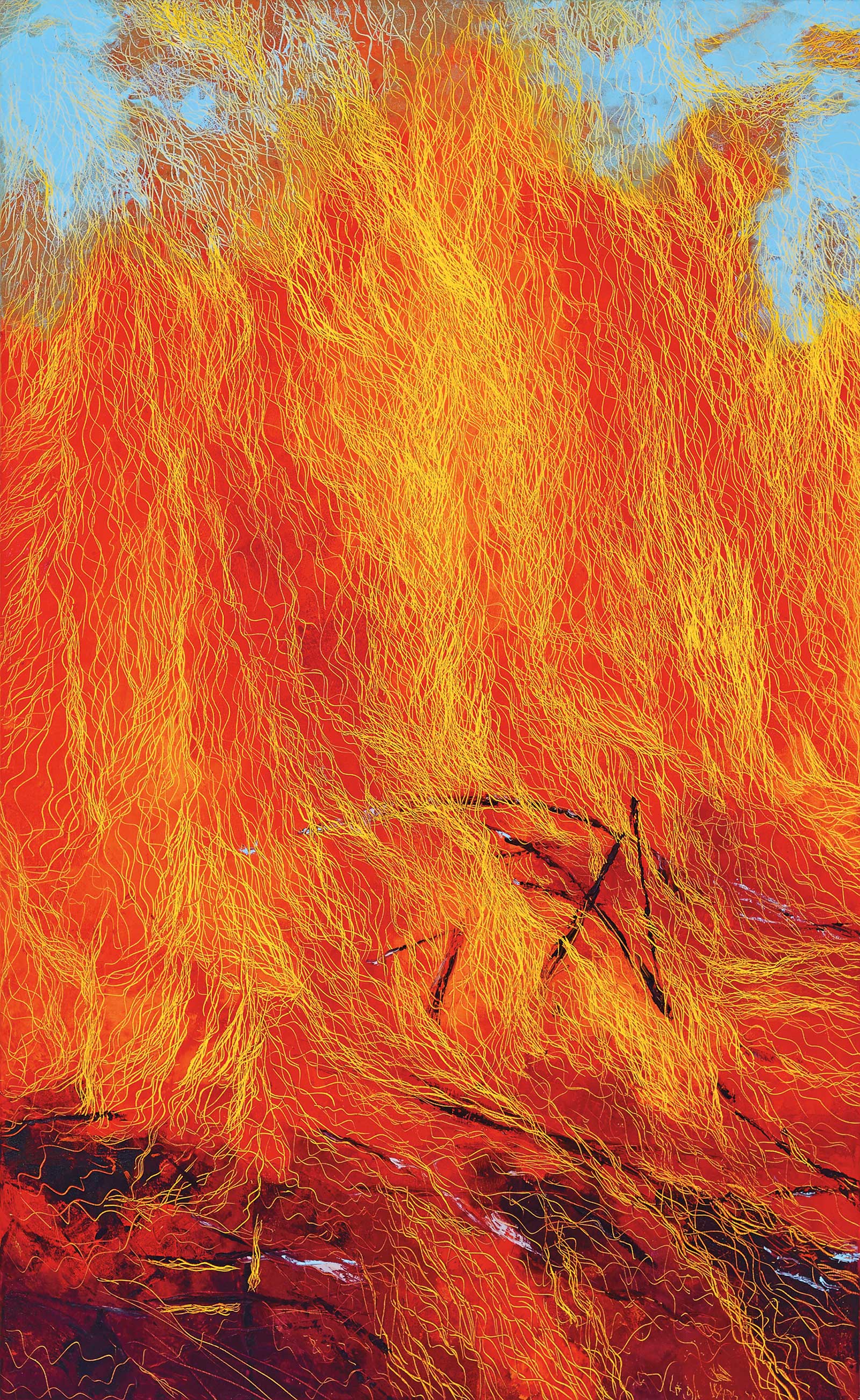 Splendid, oil on canvas, 51 x 31½"
To accomplish her large paintings and murals, Leigh uses scaffolds. Seven years ago she fell from a scaffold, fracturing her spine. She returned to Taiwan to recover. Her career flourished there, and a new series of paintings arrived.
“The flower paintings were an accidental creation,” she explains. “I was asked to present an exhibition for a flower expo and really did not want to paint in a traditional form. I was greatly inspired by my garden. That is my meditation patch. I usually do a walk through to see the plants and do some weeding before I start my painting days. I center myself before the chaos of the day begins. I began thinking of painting just flowers without leaves and thought about the nature of pollen transmission for flowers to extend new life. Then I started to think about female bodies. Being a mother, I was brought up in the traditional way and understand one of my jobs is bearing children. I started to think of female roles in society, particularly as artist and mother. I tried to direct my work towards more feminist ideas. In most every race, all women are secondary in the society with few exceptions. I wanted to think outside the square of paintings and decided to paint flowers in the shape of flowers, using a carved wooden form and canvas attached on top of it. I emphasized the stamens of the flower centers—their most important life extending part. Some could see them as extremely sensually provocative. Flowers relate more to the female than the male. So, I chose to express and focus on the importance of being a female artist.”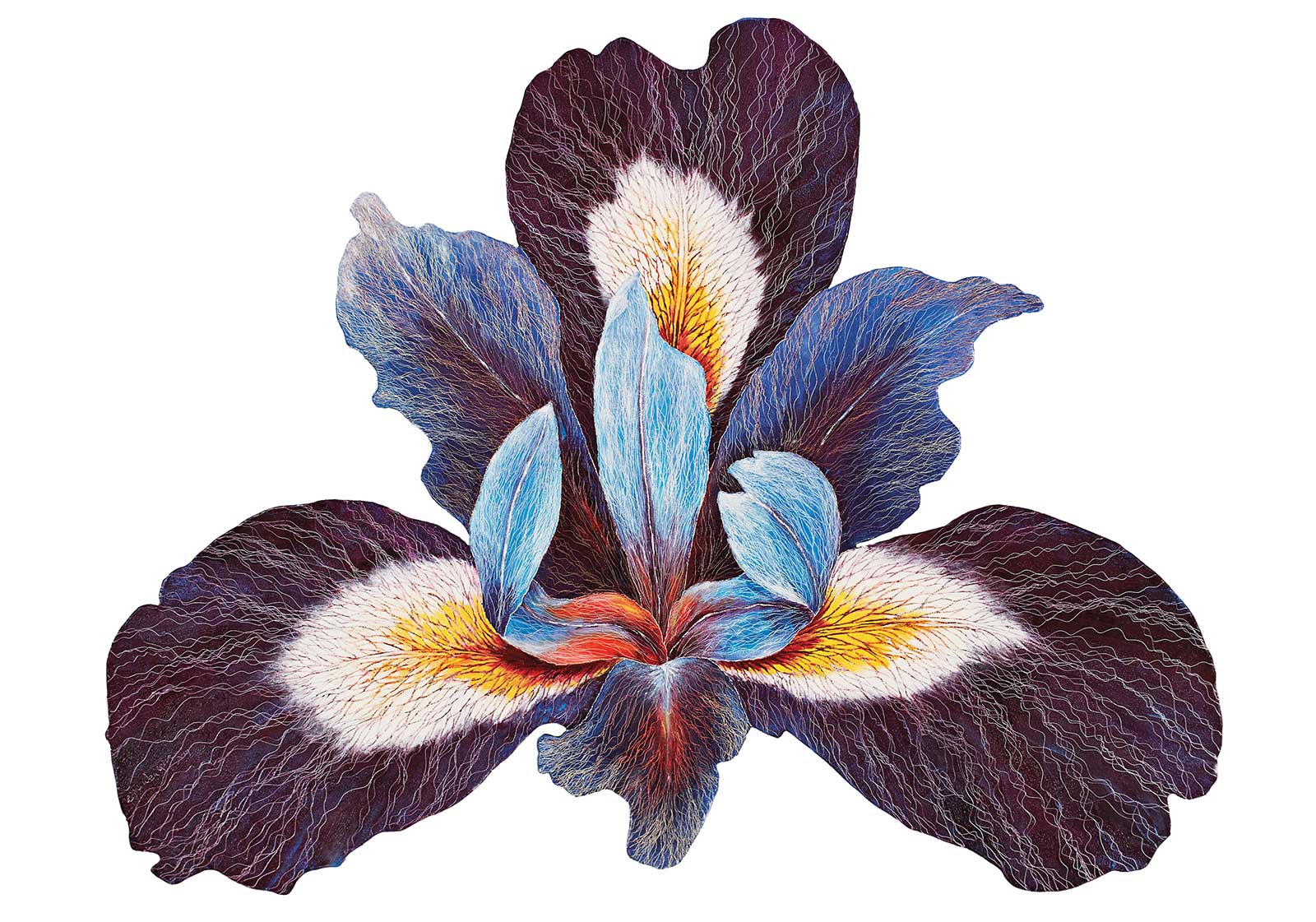 Siberian Iris II, oil on linen, 50 x 165"
When Leigh was living near Albany, she knew of my love of gardening and sent a care package of plants she had culled from her own garden. Recently she wrote, “Since the surgery in Taiwan and the pandemic, I have stayed here longer than I expected. I’m in the process of moving back to Westchester County. It is time to come home and start my garden again.”
Here, as an Asian American, she will again experience what she feels as “the ebb and flow of competing cultures…The ancient philosophies of my homeland, which teach self-discipline and selflessness, collide and mingle with Western notions of ego, alienation, and desire.”
She comments, however, “I am often awestruck by the power of the creator and am influenced by Eastern philosophies that pay respect to nature. I feel that humans are small in the face of nature, and one must learn to be selfless, compassionate, and giving.” —
Powered by Froala Editor