Joseph McGurl and I grew up about 15 miles and 15 years apart on the Atlantic Ocean south of Boston. He “could see the light from a lighthouse and boats passing by from my bedroom window.” I could see a tiny stretch of the ocean and, when the wind was right, hear the bell buoys at the entrance to the harbor warning of shallow water.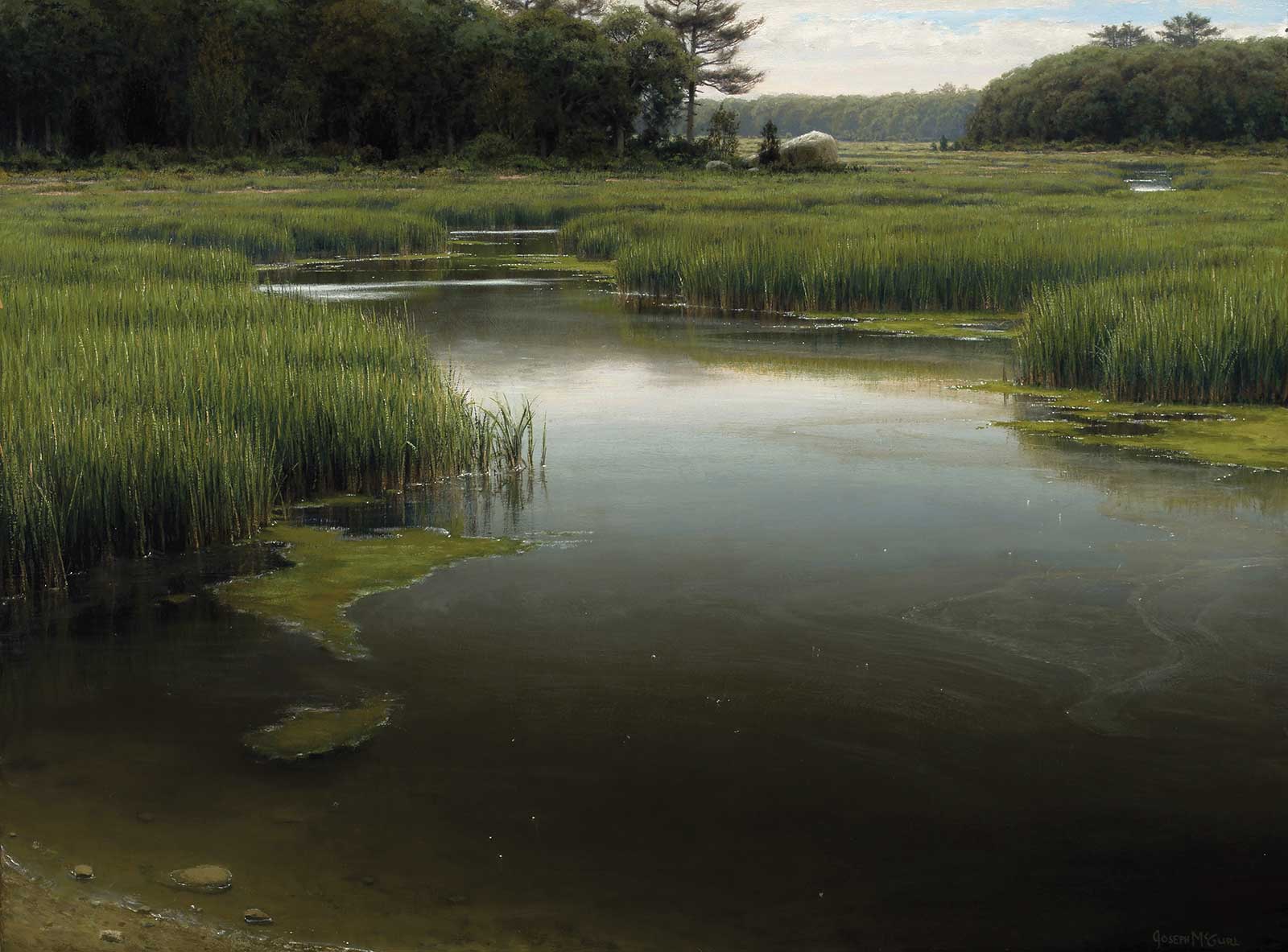 Creation in Time and Space (detail), 2015, oil on canvas, 30 x 40". Collection of the Art Renewal Center.
I did some sailing but was mostly a land lubber, hiking around the cliffs, walking the beaches and bicycling along the shore roads. His experience was more visceral. “Our lives revolved around the tides,” he recalls. “The tidal range was a challenge—low tide receded about 100 yards; we knew every rock and sandbar in the harbor. The tides determined where and when we would go and what we would do—swimming, waterskiing, sailing, fishing, exploring…We had lobster traps and ate lobster or fish all summer, constructed a home-built pier, had a revolving array of small boats and made our own moorings out of rebar, rocks and concrete. It was an intimate relationship to the environment.”
It was that intimacy and its effect on his paintings that I asked him to explore.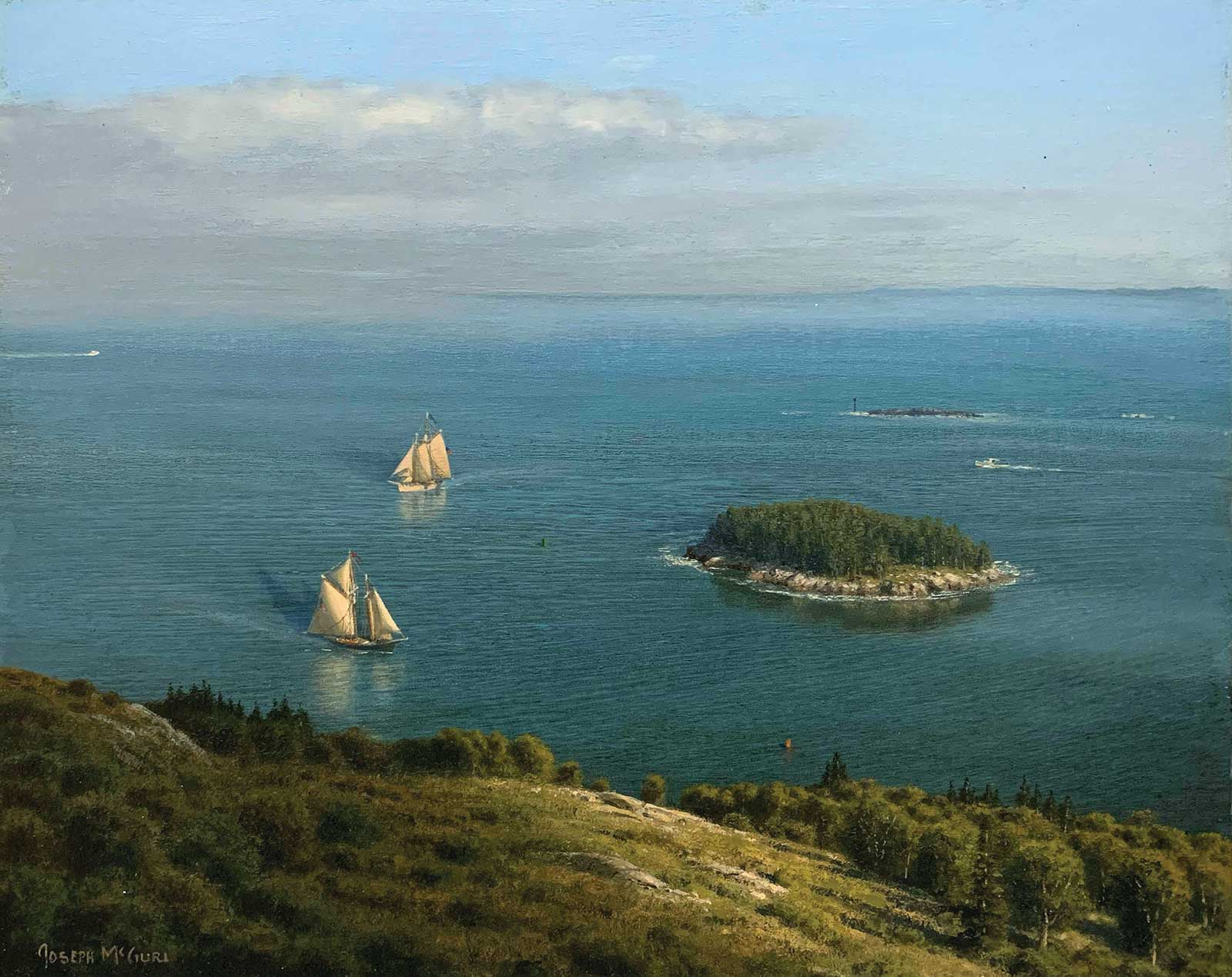 Fogbank from the Camden Hills, 2020, oil on canvas, 16 x 20". Courtesy Collins Galleries, Orleans, MA.
“Art and the ocean coalesced in my teens when marine subjects began to dominate my art-making. I was painting what I knew and loved. At the same time, I was going to the Museum of Fine Art in Boston for art classes starting at the age of 10. Walking to class, I passed the paintings of the Hudson River School and was fascinated by the way the artists portrayed the look and feel of nature so convincingly.
“Living near Boston, I was also aware of Thoreau, Emerson, Walden Pond and the Transcendentalist movement of the 19th century. Although I didn’t realize it at the time, the paintings I admired at the Museum of Fine Art were influenced by the Transcendentalists and were grouped together as Luminist paintings.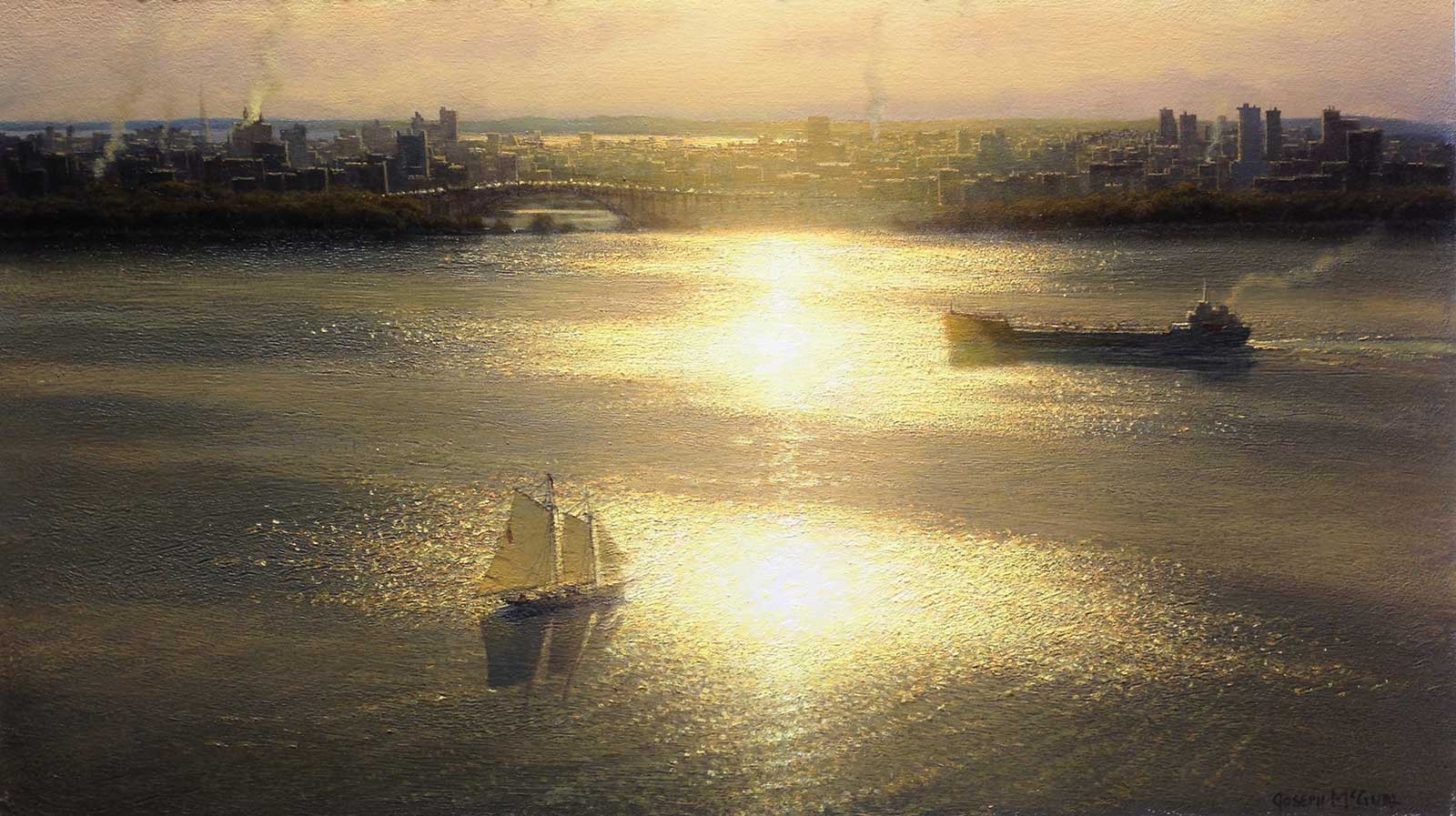 Light on the Hudson River, 2018, oil on panel, 18 x 28". Private Collection.
“Many of my paintings portray the ocean as calm and peaceful rather than turbulent and agitated. My art is meditative, and making art in the field or studio is a result of my philosophy. I believe there is an existence beyond this one and, much like the 19th century Transcendentalists including Thoreau and Emerson, I believe that spirituality can be seen in nature. The Luminist painters Sanford Gifford, Fitz Henry Lane, Martin Johnson Heade and others were also influenced by the Transcendentalists. This famous quote from Emerson provides a brief summary of transcendental philosophy: ‘Standing on bare ground—my head bathed in blithe air, and uplifted into infinite spaces—all mean egotism vanishes. I become a transparent eyeball; I am nothing; I see all; the currents of the Universal Being circulate through me; I am part or particle of God.’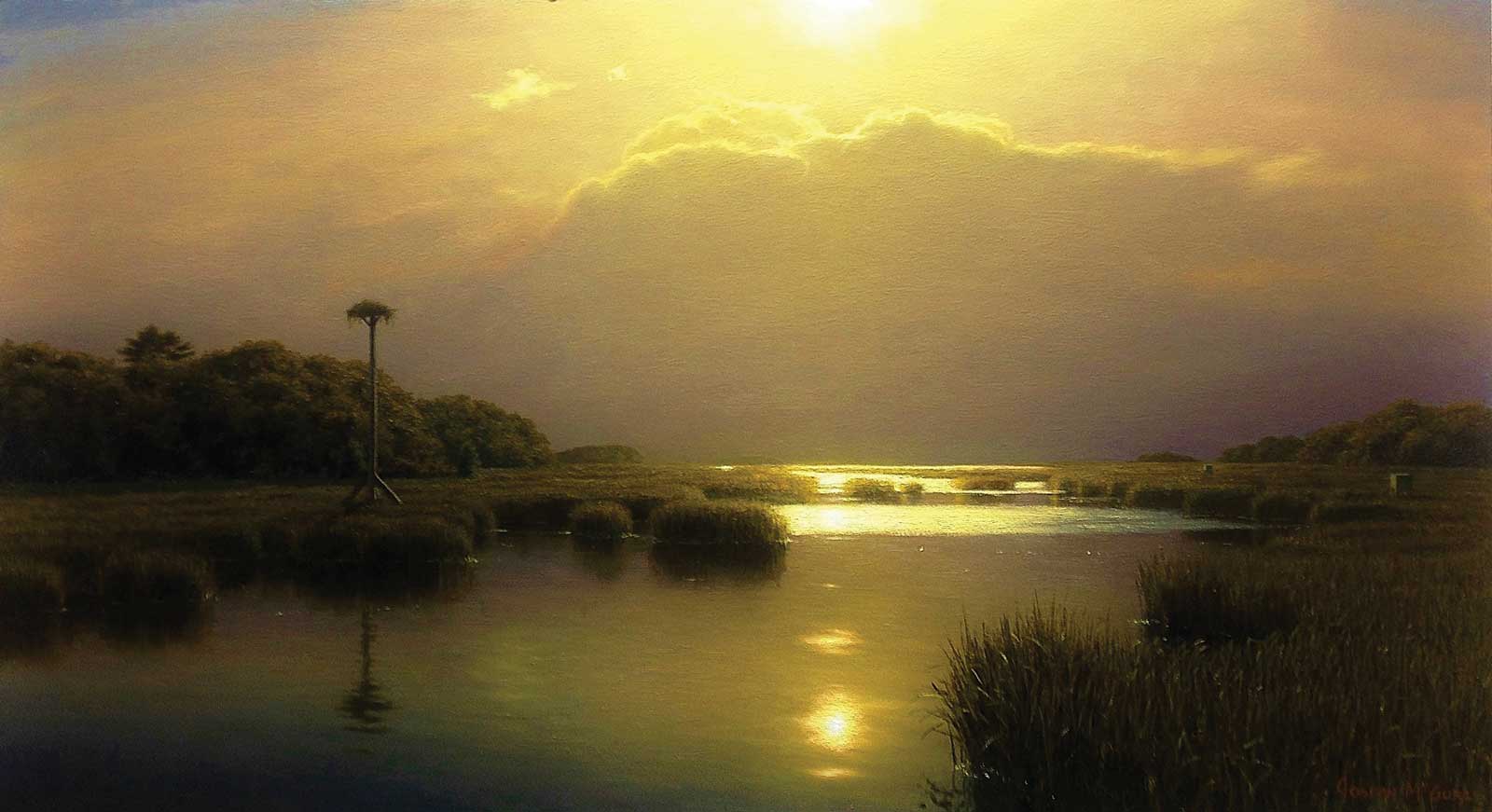 Transfiguration, oil on canvas, 24 x 36". Private Collection.
"Natural light is an important feature of Transcendental philosophy and Luminist paintings. They believed that light was symbolic of the divine. Coincidentally, the particle that gives us light, the photon, is also one of the most important particles that physicists use to understand the working of the universe. There is a connection between modern physics and Transcendentalist beliefs. According to the physicists, if we knew everything about nature, we may have the answer to the question of what is life. For instance, if we knew the history of a drop of water—what it is made of on the subatomic or quantum scale and where it has been since the beginning of time—we would also know where we came from. Because new matter cannot be created, all the particles that make up us and the water droplet came from the same source and have experienced the same history.”He resolved to be like Emerson’s "transparent eye-ball." "Heconnecting with, analyzing and dissecting our multidimensional world, almost as a philosopher and scientist would and then reassembling what I see and experience on canvas but in two dimensions rather than the many that exist in reality.”
Henri Poincaré (1854-1912) was a French mathematician, theoretical physicist, and a philosopher of science whose discoveries form the foundations of modern chaos theory. Joe'Is website contains a quote from Poincaré: “The scientist does not study nature because it is useful, he studies it because he delights in it, and he delights in it because it is beautiful.”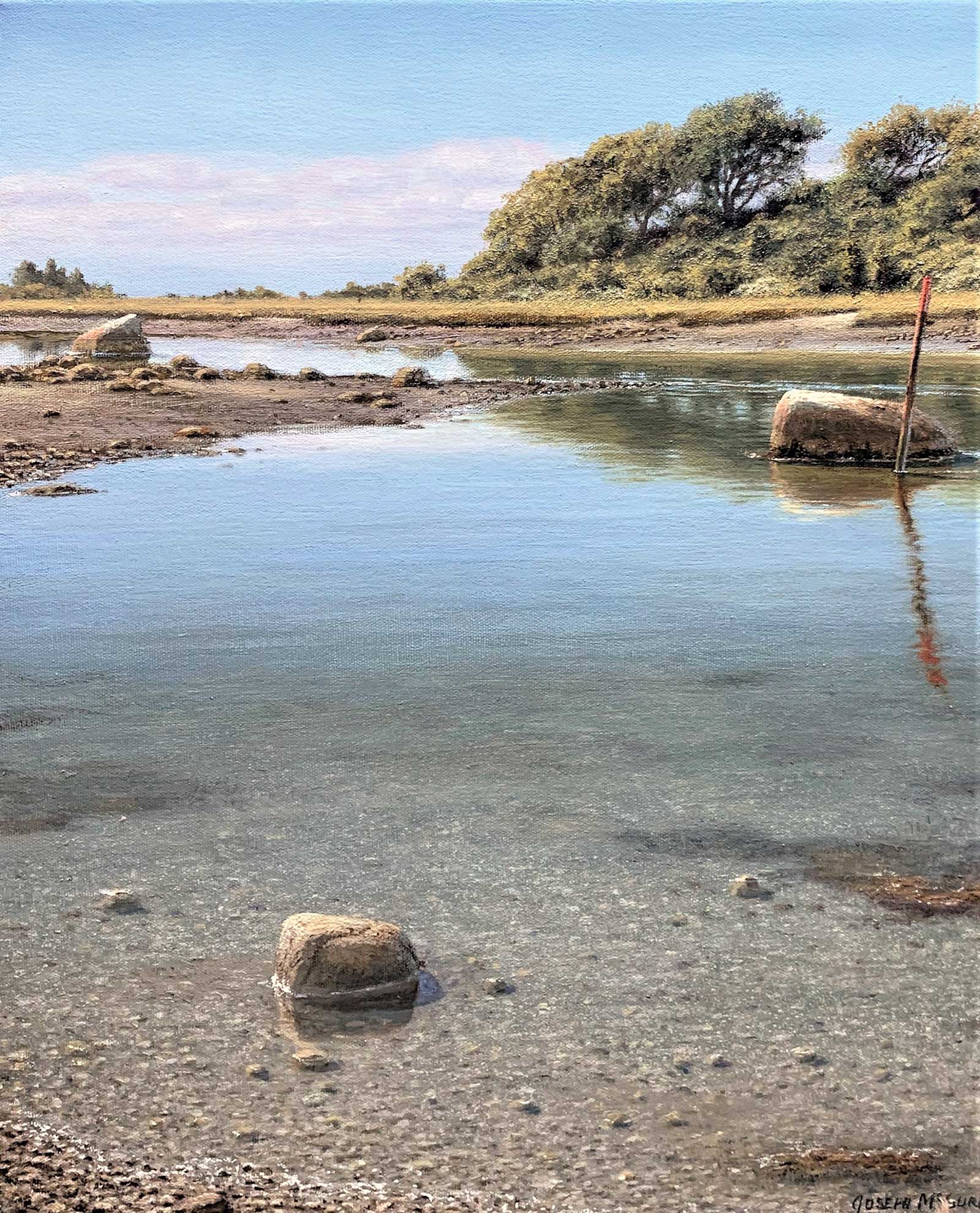 Incoming Tide, 2021, oil on canvas, 20 x 16". Courtesy Principle Gallery, Alexandria, VA.
Looking at just a few of Joe’s paintings, we can see life from the cellular to the cosmic. Creation in Time and Space depicts the salt marsh where the plants and algae turn photons into energy through photosynthesis. They are the nourishing base of the aquatic food chain. In Transfiguration, the sun and water create a phenomenon that recalls the transfiguration of Jesus in Matthew’s gospel: “and his face did shine as the sun, and his raiment was white as the light.”
He explains, “In general, the best way to paint the ocean is to spend countless hours watching and interacting with it so you understand it on several levels and in different situations. Even now when I’ve been studying the ocean for decades, I am still analyzing how to interpret it in paint. It is always different, so the technique that worked for one scenario may not work for another. Here are a couple of examples: The transition between water’s transparent and reflective qualities are intriguing. If you are standing in shallow water and look down, you can see your feet through the transparent water. As you look further away, you gradually see less of the seafloor and more of the greenish depth of the sea. Gradually, the blue sky is reflected more strongly on the surface of the sea as you move towards the horizon.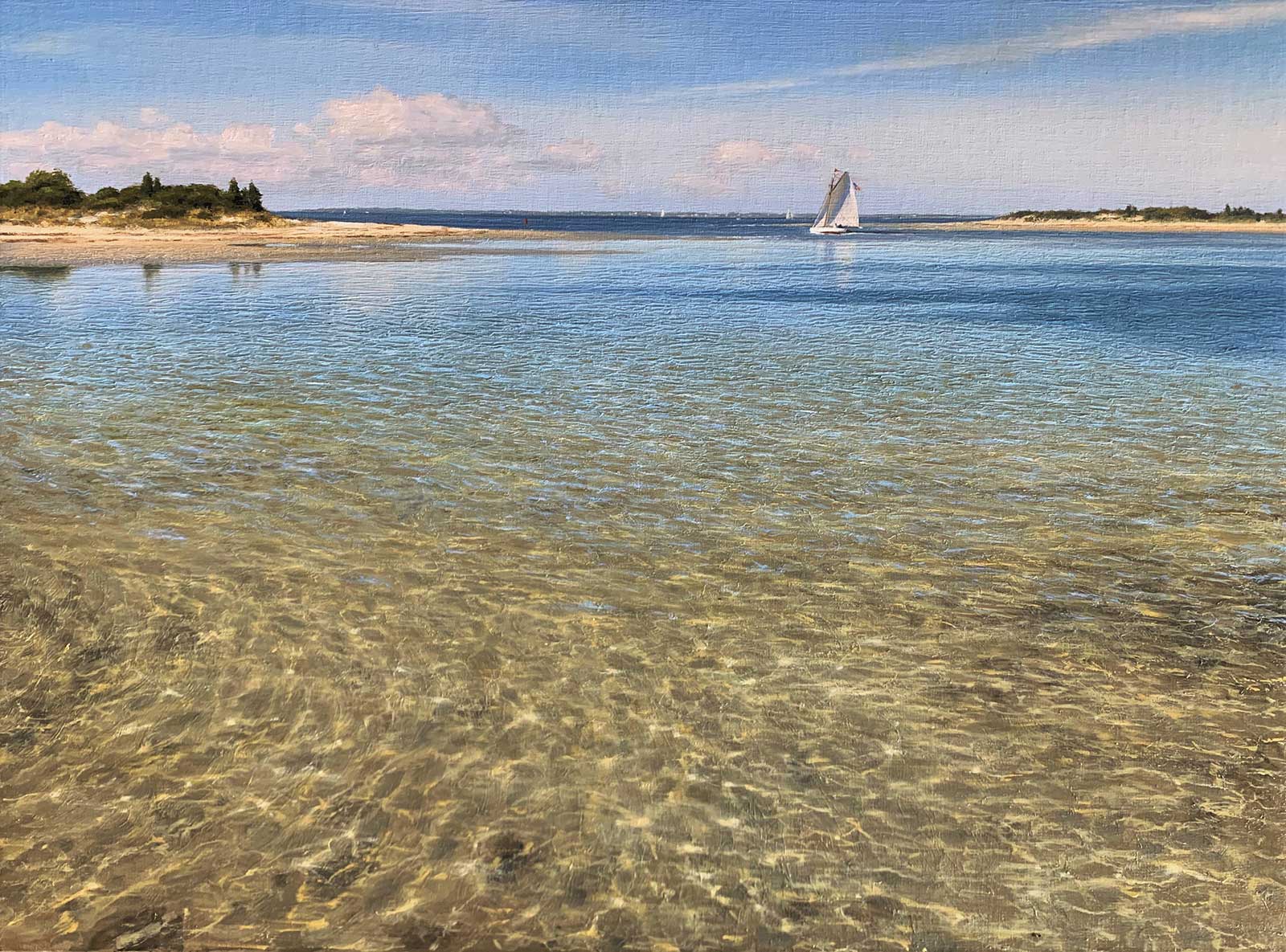 Shallow Water, 2020, oil on linen panel, 18 x 24". Private Collection.
“The following is a technique I’ve used to interpret this in paint: Begin by painting what you see on the seafloor near the shoreline. Then add a thin greenish glaze to that area to give it the appearance of shallow water. As the water gets deeper and further from your eye, add a deeper toned glaze until you can’t see the seafloor at all, just the depth of the sea. Gradually transition to an opaque sky color as the reflection of the sky overpowers the transparency of the sea near the horizon. This will give a realistic interpretation of the what we see when looking across the ocean.”
Incoming Tide captures what had been dry stones before the tide advances, transparent in the foreground and reflective in the distance.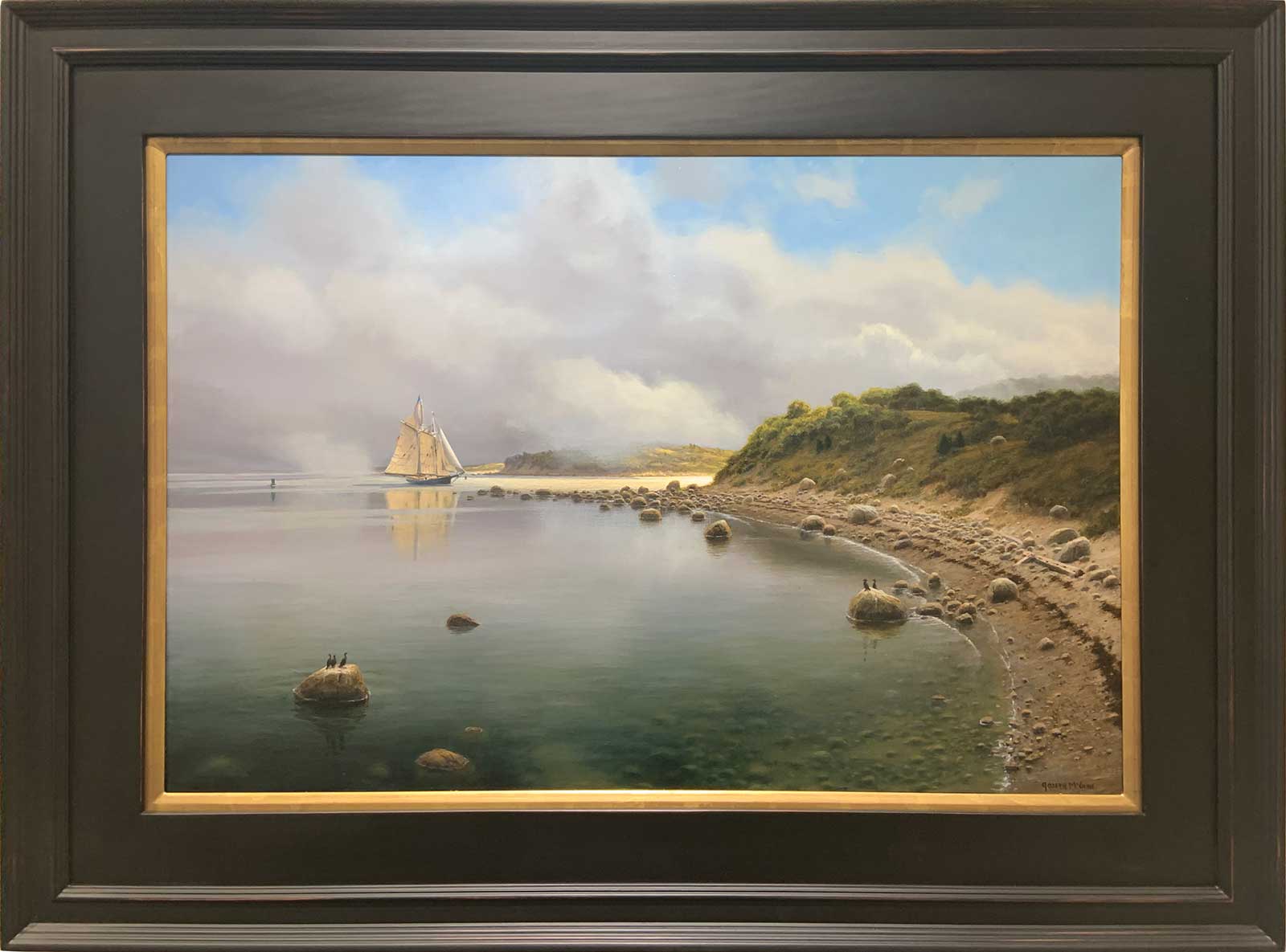 The Coastal Realm, 2021, oil on canvas, 24 x 36". Courtesy Cavalier Galleries, New York, NY; Greenwich, CT; Nantucket, MA; and Palm Beach, FL.
“Creating a sense of movement in the ocean is a challenge for all artists,” he continues. “Sometimes you will see paintings from photographs with incredible detail. But the water doesn’t ‘move.’ That wave will never break and the reflections are static. Years ago, I saw a Winslow Homer exhibition. In one room were his great seascapes. You could ‘hear’ the waves crashing on the rocky shoreline. They were the loudest paintings I ever saw. If you look at Homer’s waves, they don’t have much detail and often don’t really look like waves. It is the shape, color, value, brushstrokes and composition that all add up to creating the feeling of the energy of the sea, not the detail. Homer lived for years on the Maine coast and understood and connected with his subject, so he could paint what he felt rather than just what he saw. That’s what gave those paintings their power.
“There are many interpretations of the sea in the art world because it is such an intriguing and elusive subject. But it’s difficult to capture its true essence. It must be understood on many levels and with direct experience. Only then can the artist truly paint the sea.” —
Powered by Froala Editor