Echoes of Nature is an exhibit by Chinese and Chinese-American artists curated by Dr. Aihua Zhou Pearce that runs through July 30 at Studio Channel Islands gallery in Camarillo, California. The show, arranged in a spacious gallery that is something of a hidden secret in Ventura County, is a significant cultural event in the too-often overlooked story of Chinese immigration to the United States. The Pew Research Center calculates the United States is home to 5.5 million Chinese-Americans, whose families have prospered and become enthusiastic participants in the pursuit of the American Dream. Today, Chinese-Americans are typecast as nice, hardworking people, but are also ignored and treated with contempt, part of a long and shameful history of racist cruelty dating back to the 19th century. Exhibits of Chinese-American art are routinely bound by the tedious, traditional ropes of convention—refined ink paintings of misty landscapes and delicate calligraphy as defining features. Echoes of Nature helps to reshape the story of this “model minority” by offering art by Chinese-American artists who cut hard against the knots of stereotypes. The artists have very different approaches to their experiences of living and working in the United States.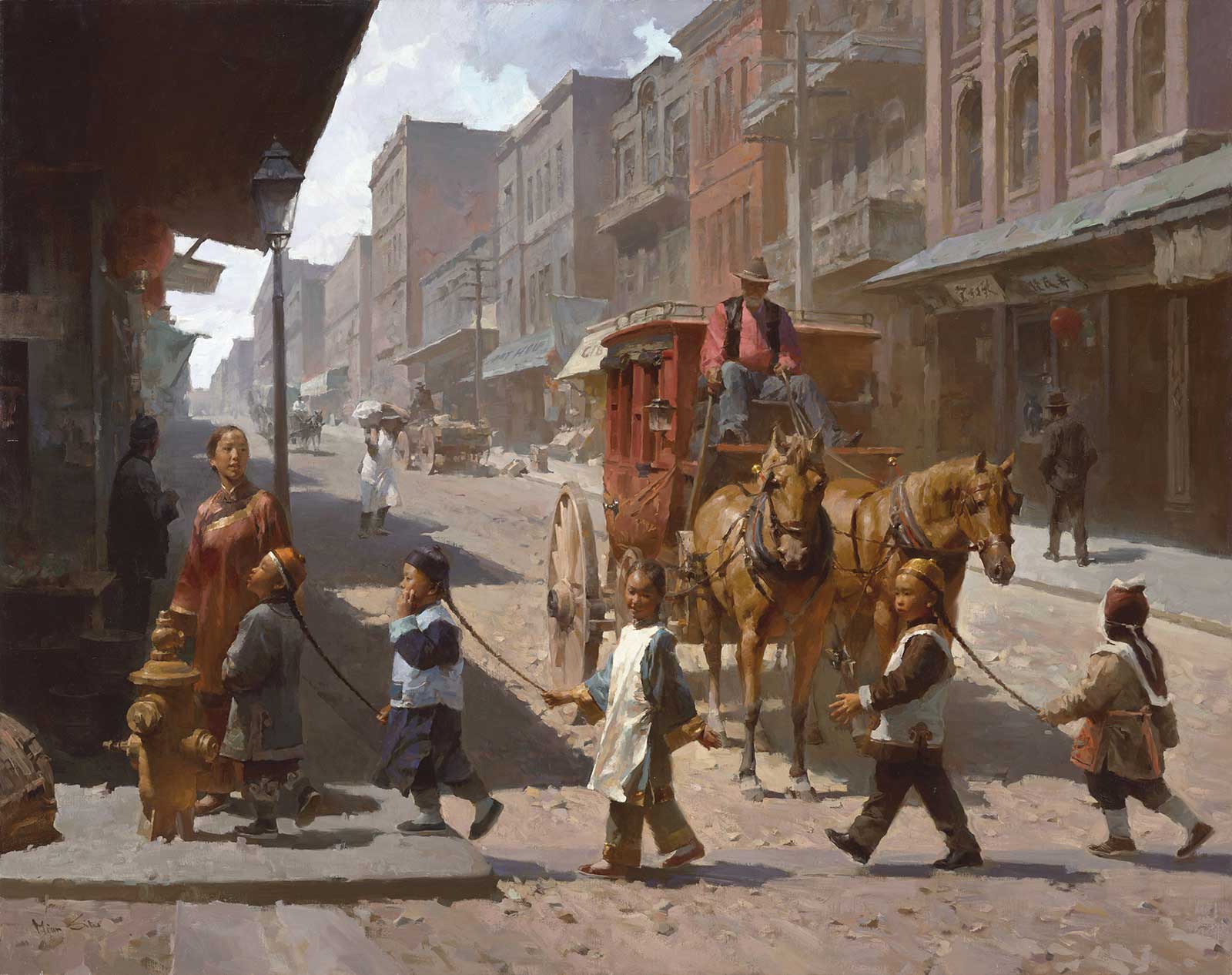 Mian Situ, The Overseer San Francisco 1905, oil, 38 x 48"
In the mid-19th century, a diaspora of Chinese settlers traveled from the far side of the Pacific and arrived in California to join the gold rush. Many mined, despite violence and bigotry, while others worked as builders of the Californian infrastructure, giving their lives to cut railroads through the rock of mountains, and breaking the earth as farm workers shaping the landscape of the new state. Mian Situ is unique as a history painter of this Chinese immigrant experience. His oils are immersed in the traditions of cowboy paintings, but they are a refreshing break from the expected narratives of the settling of the Wild West. Mian’s painting The Overseer shows a line of children crossing a street in San Francisco before a waiting stagecoach—the quintessential symbol of the pioneers. A large community of Chinese had settled in San Francisco, where they were forced by racist laws to live in the segregated ghetto now known as Chinatown. Paired off to cross safely, each child clutches the pigtail of the one before. The queue haircut had been required by the Qing Dynasty since 1644 as a sign of loyalty. Chinese immigrants were disproportionately men who sent much of the money they earned to their wives and children who remained in the old country, and sailed across the Pacific when they could return to visit. If they wanted to return to China to visit their families, they had to keep their queue or they would be refused entry as disloyal traitors. Mian’s romantic paintings of beautiful women wrapped in traditional costumes are equally remarkable and refreshing, balancing the excess of masculine subjects in Chinese painting while also using extremely skillful Western oil techniques.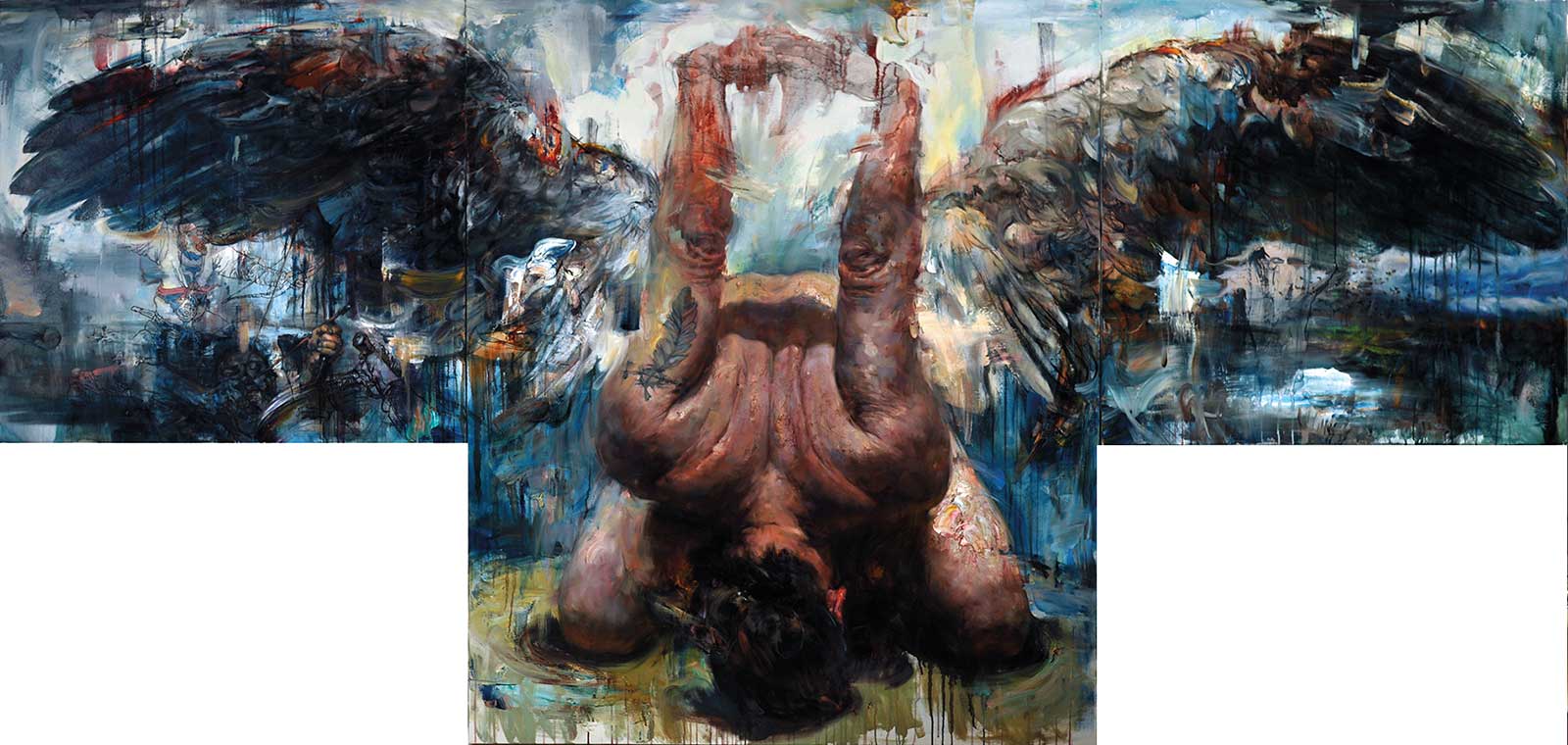 Victor Wang, The Wings (triptych), oil on canvas, 60 x 120"
 Liu Nan, Black Lives Matter, color and ink on Xuan paper, 54 x 27"
New Yorker Xu Weijin has sold paintings in China for over half a million U.S. dollars, but he is almost unknown in his adopted country, despite making his home on Long Island several years ago. By coming to America, he has dodged danger, for he painted dozens of huge proletarian portraits of men who work in harsh conditions in coal-mines, unflinching and powerful pictures of their coal-blacked faces, bandaged and bleeding. His studio is lined with monumental paintings of ordinary people who were participants in the cultural revolution—forgotten heroes that time and inattention has erased from history. By redressing that neglect his work dances on the edge of subversion. His new work, Portrait of Dr. Li Wenliang, exhibited here for the first time, memorializes the doctor who gave the first warning of the appearance of Covid-19, becoming a popular martyr after being sanctioned by the police for rumor-mongering, and later dying from the virus. It is a perfect example of Xu’s painting in his signature style. The script, making a radical break from the tradition of literati calligraphy and delicately positioned on the side of traditional ink paintings, is painted directly over the features of the face, telling the story of Li’s life and death.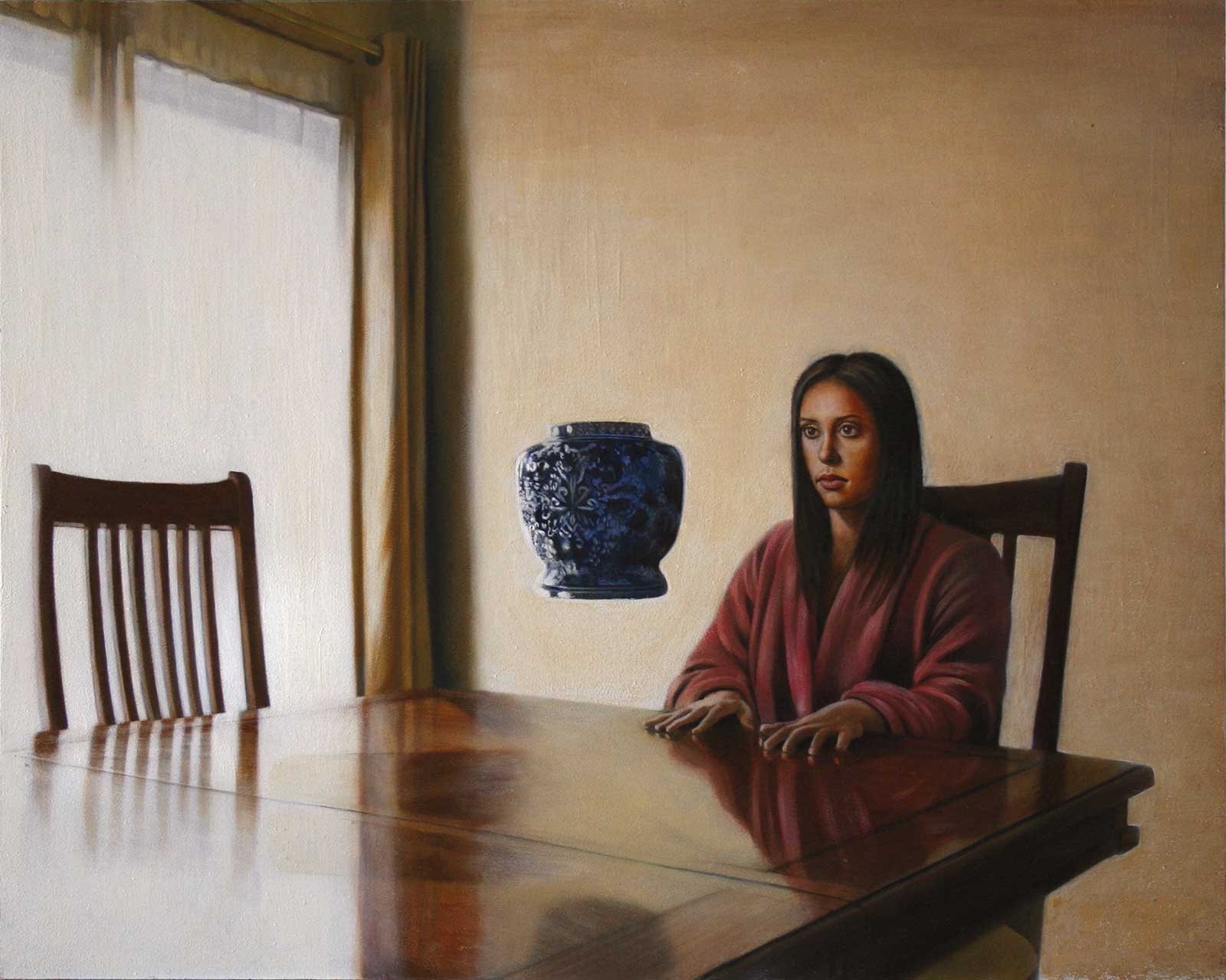 Aihua Zhou Pearce, The Woman with the Floating Vase, oil on canvas, 16 x 20"
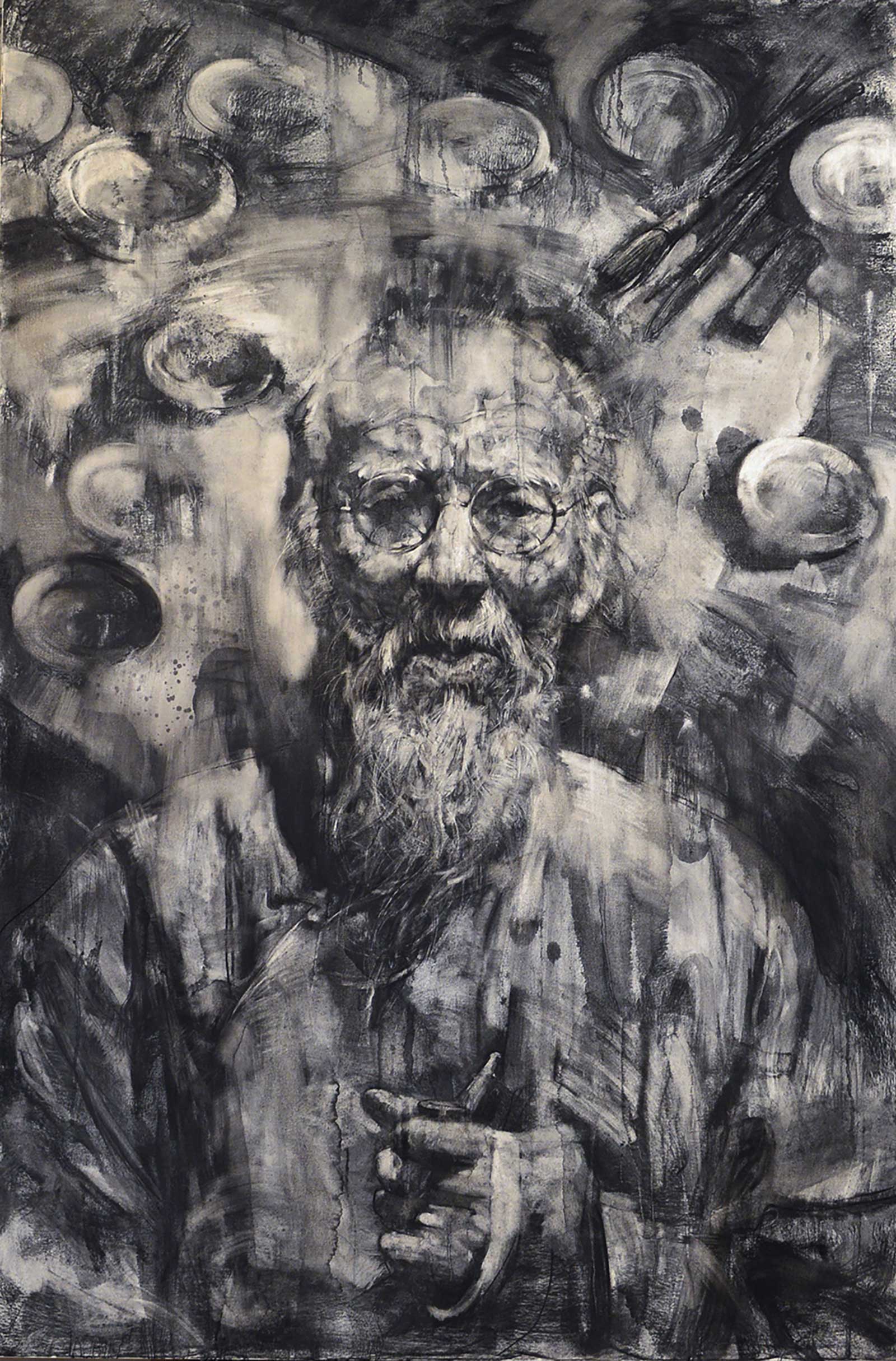 Victor Wang, The Heroes: Chinese Artist Qi Baishi, charcoal wash on canvas, 72 x 48"
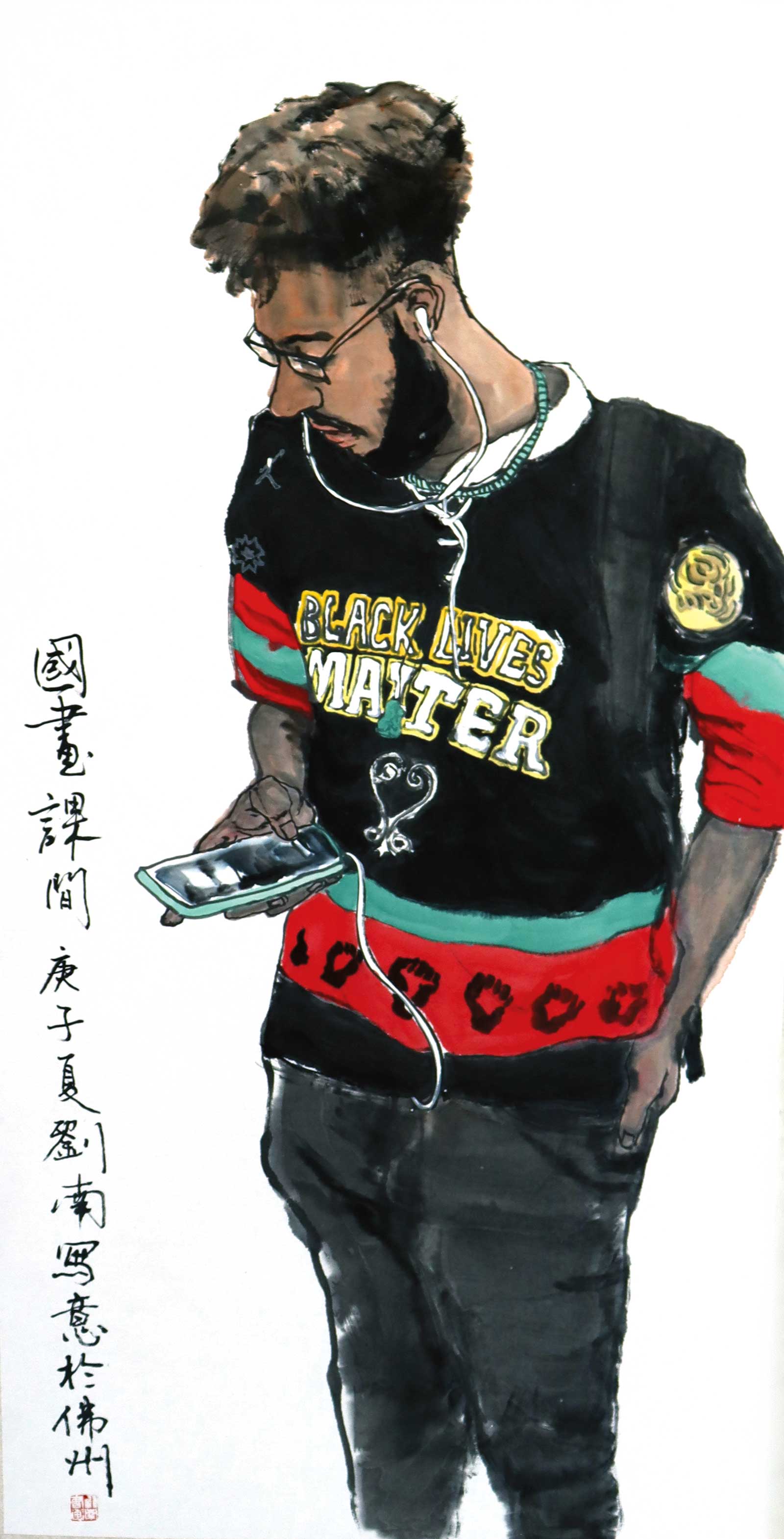
The show is a celebration of being American, while maintaining cultural identity. The paintings are the unexpected product of the immigrant experience, and not what we might expect of Chinese-American art. Contrasting with Xu, but still breaking stereotypes, Liu Nan makes ink paintings using masterly traditional techniques to craft portraits of young African-Americans. His figures wear Martin Luther King and Black Lives Matter T-shirts, and he paints the people he sees at Florida A&M University.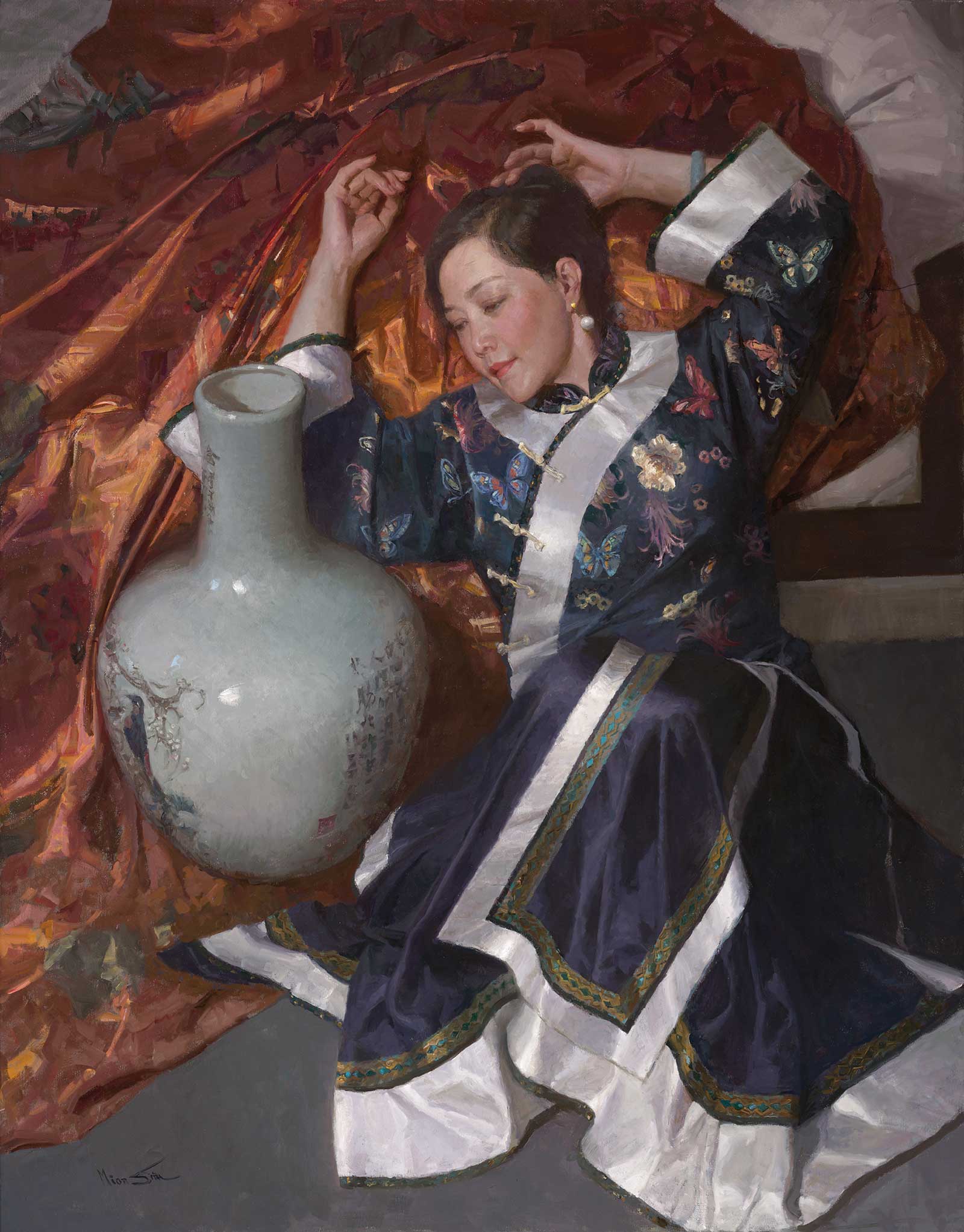 Mian Situ, Dream of Butterfly, oil, 46 x 36"
Yu Ji lives in Long Beach, California, where he is professor of art at the state university. He makes beautifully rendered drawings of American life, with a particular interest in social issues. Like Liu’s work, Yu’s paintings come from an unconventional perspective that provokes us to reimagine preconceived notions, especially surrounding social justice issues. His controversially titled drawing Human Life Matters deliberately imbalances the debate about race in the United States, and forces discussion about the appalling historical mistreatment of the Chinese-American population. There he is, wielding his mighty brush like a sword at the center of the composition, the axis of a dynamic mass of bodies swirling around him, gazing out at us as we gaze in at him, confronting us with the question. A light stars and stripes literally flogs the dark raised arm of a bearded man, eyes closed and caught in the pose of religious fervor.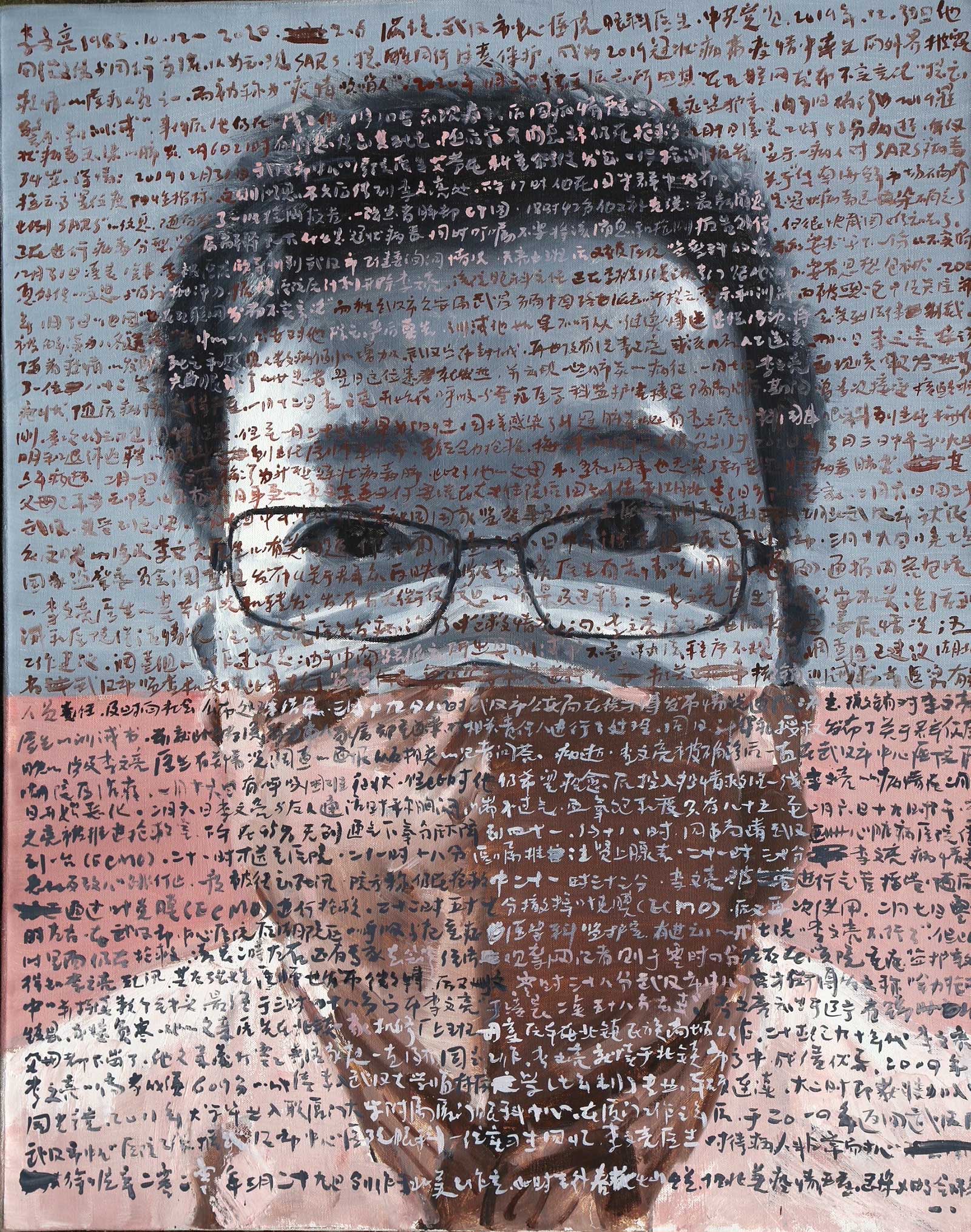 Xu Weixin, Portrait of Dr. Li Wenliang, oil on canvas, 39 x 31"
Victor Wang is a popular painter of deliciously sticky large-scale portraits. His work The Wings symbolizes the struggles for freedom experienced by Chinese immigrants in the United States—his dramatic and impressive impasto technique sculpts direct and sensual masses of paint into the form of a man, bent forward and winged within a liquid scene of loose, watery blues. The angel in The Wings is muscular and flexes his shoulder and back muscles. This was the pose of strung-up torture for Dachau inmates in the Nazi era, when that totalitarian government crushed voices of opposition, but Wang has turned it into a gesture of liberation. Strong and undaunted, but discrete, a feather is tattooed on the angel’s biceps. On the left of the triptych there are three figures concealed beneath the wing, a warrior archer from ancient China in the style of a traditional ink painting, a hunter firing a bow in Western figurative style and a hand gripping a knife. This is the voice of freedom. —
Echoes of Nature: Works by Contemporary Chinese Artists
When: June 4-July 30, 2022
Where: Studio Channel Islands, 2222 E. Ventura Boulevard, Camarillo, CA 93010
Information: (805) 383-1368, www.studiochannelislands.org
+++
Michael Pearce is a dynamic writer, curator, and critic. His wife Aihua Zhou Pearce is curator of Echoes of Nature. Pearce is an active and enthusiastic participant in the conversation about 21st century art and its roots, especially contemporary imaginative realism. He has published dozens of articles about art and artists, and is author of Art in the Age of Emergence. He is a champion of art that emerges from popular culture and shapes the spirit of the age. He is Professor of Art at California Lutheran University.
Powered by Froala Editor