Between the years 2006 and 2012, the city of Juárez, Mexico, just south of the border in El Paso, Texas, was considered the most violent and dangerous in the world. The election of Mexico President Felipe Calderón, and his declaration of war against escalating issues surrounding cartel activity and organized crime, culminated into a hotbed of turmoil and high murder rates. Such a disheartening time in history has undoubtedly affected thousands of lives, and artists like Alice Leora Briggs stepped up to bring awareness and attention to the many individuals engaged with or impacted by this horrific era.
Beginning June 24, EVOKE Contemporary will host an exhibition, book launch and signing of Briggs’ and Julián Cardona’s book, Abecedario de Juárez. The project, many years in the making, combines Briggs’ drawings and stories of victims gathered by Briggs and Cardona (now deceased), and a glossary of alphabetized slang terms that were born out of the widespread violence, which helps in understanding the chaos. 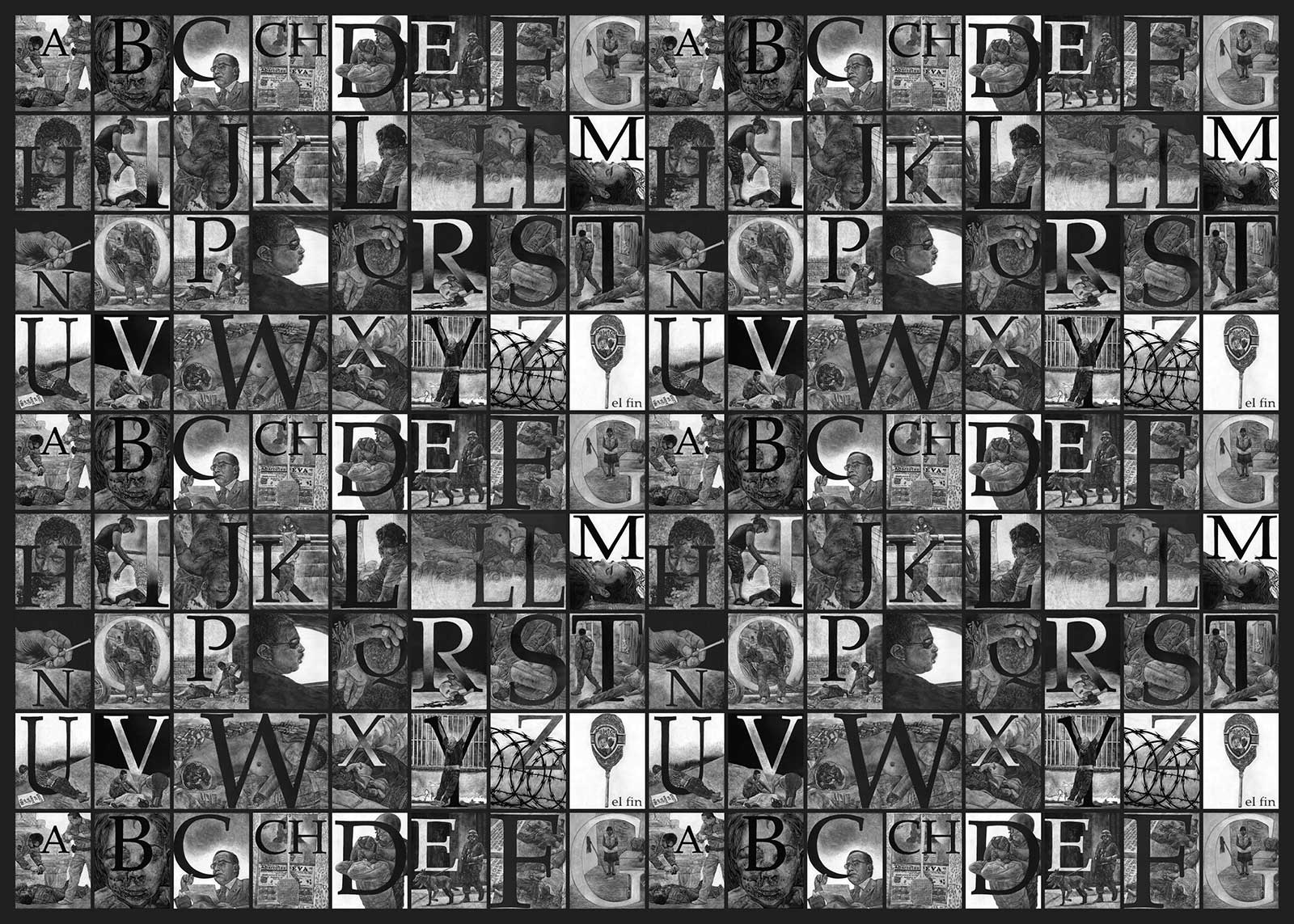 ABCedario de Juárez, sgraffito drawing on panel, 43 x 79." Courtesy Tia Collection, Santa Fe, NM.“I’ve been to Juárez many times,” Briggs explains. “I’ve been going there since 2007, when I lived in Texas only three minutes away from main bridge in El Paso. Like a lot of interesting things that happen to us in a lifetime, I didn’t go out looking for this. I met writer Charles Boden, who spent a great deal of time along the border and in Juárez. A lot of the information [in Abecedario de Juárez] came from this man who was my co-author on my previous book Dreamland: The Way Out of Juárez.”
Briggs and Cardona, who was actively photographing the violent evidence and conducting interviews, were introduced through Boden. “[During Julien’s interviews], sometimes there were discussions of people’s experiences that would be peppered with these slang terms,” Briggs remarks. “We would record those and do more research and how widely they might be used. The slang was in the newspaper, media reports and even by government officials.” 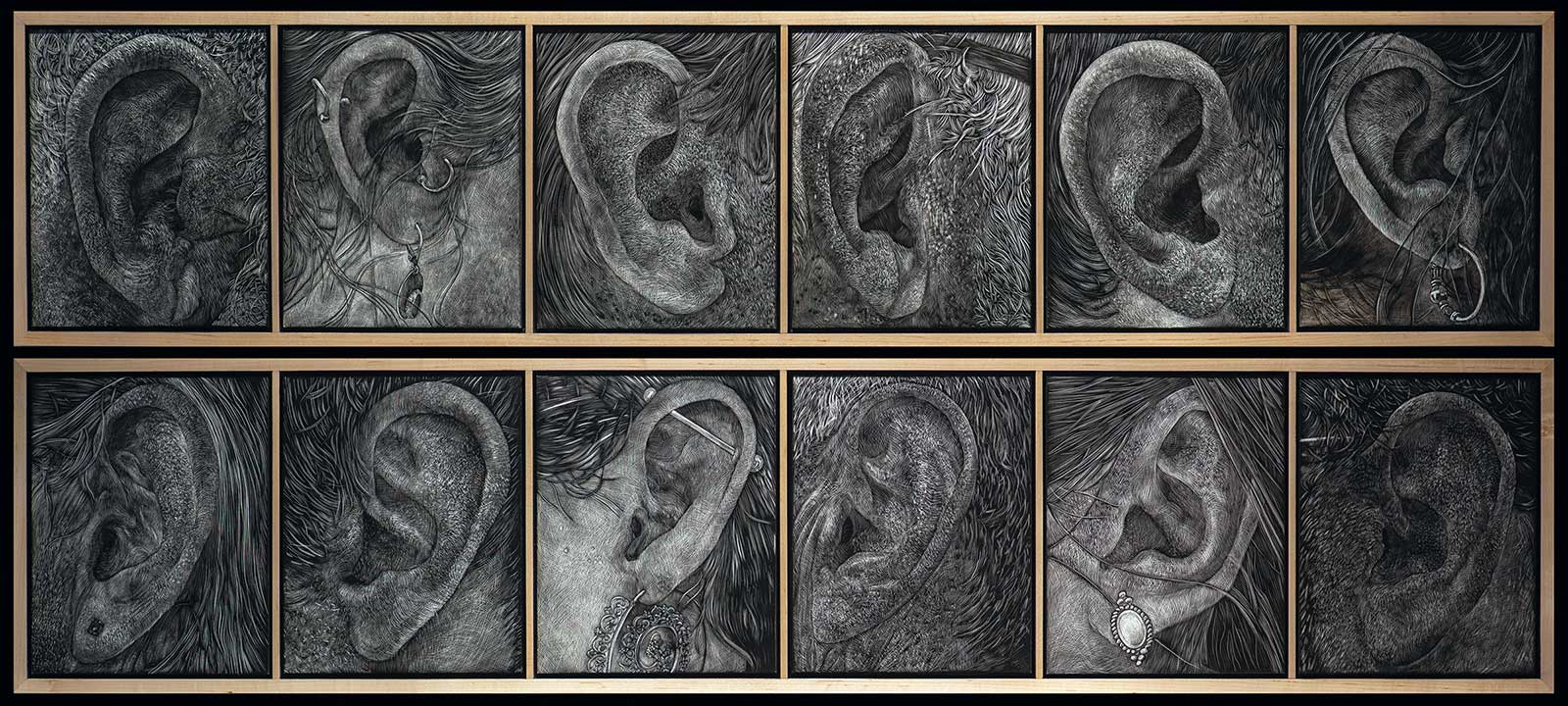 Las Orejas I and Las Orejas II (diptych), sgraffito drawing on panel, 11 x 50" each
Besides writing, Briggs offered up her artistic expertise to illustrate the book, with her pieces on view for the exhibition. “My work is sort of a requiem; remembering the dead, whether about Juárez or other horrific situations in the world,” she says. “[The alphabet and subsequent artwork] were partially inspired by Hans Holbein the Younger, a German-Swiss painter and printmaker. He created these sequences of woodblock prints in the 1500s and one was called the Dance of Death Alphabets. In some ways, my alphabet was an homage to Holbein as well as to Juárez.”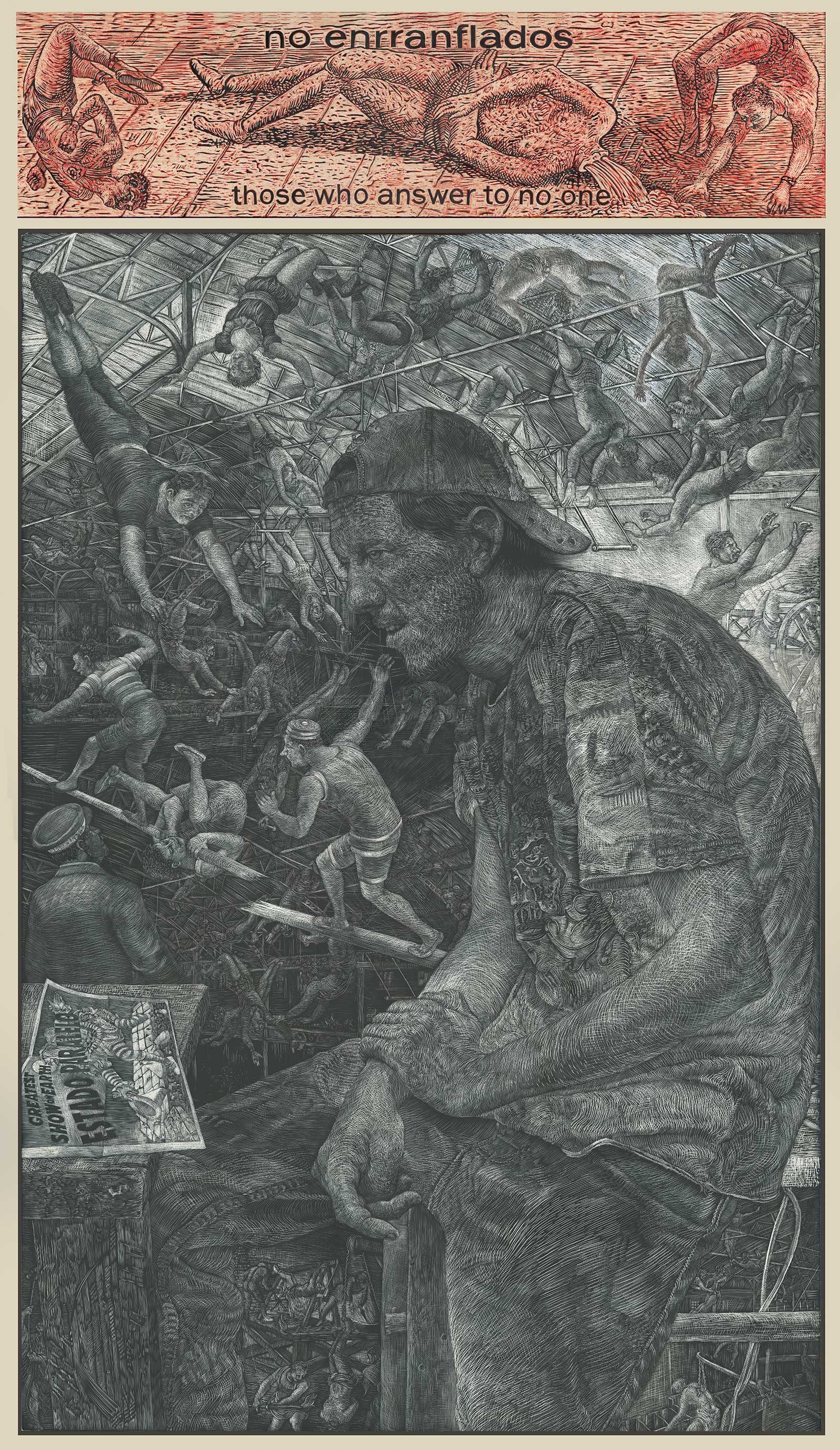 No Enrranflados (those who answer to no one), sgraffito drawing on panel and carved birch, 45 x 25"
Readers of the book and visitors to the exhibition will be privy to Briggs’ black-and-white sgraffito drawings, such as Las Orejas, meaning “the ear.” And the drawing depicts just that—a series of ears. “In Juárez,” says Briggs, “there were individuals who were not always formally employed by the government, and they would go to various gatherings and collect information about people who were involved in activities that were of interest. They were considered spies or state agents and would attend demonstrations and events [and report back].” They were the eyes and more importantly, the “ears.”
More violent scenes in works such as Necessary Tools, where Briggs has drawn Boden as the central figure at the head of an autopsy table. He’s shown examining a hog and surrounded by the very tools that Briggs witnessed at the Juárez morgue. The depiction of a pig or hog is a reference to the slang term used for policemen. In the background is a scene of an actual murder witnessed by a woman driving in broad daylight. In the middle of a busy intersection, a young man was pulled from his vehicle, a pig mask placed over his face, handcuffed and shot twice in the head. The men seen standing around the dead man are the forensic workers after the incident occurred. 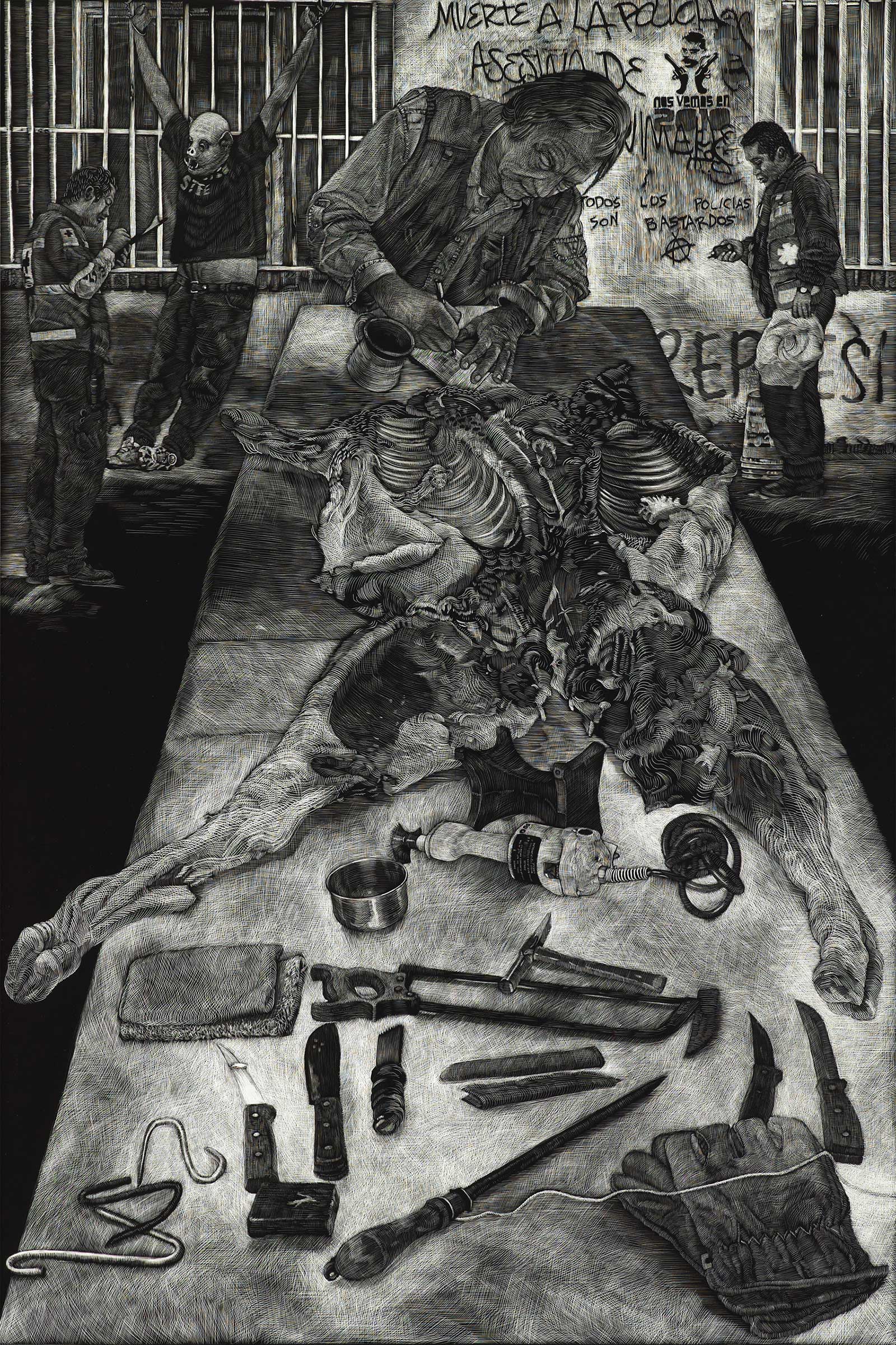 Necessary Tools, sgraffito drawing on panel, 36 x 24"
Briggs notes that this kind of situation was not unusual for that time. Juárez, along with other regions of Mexico, continue to have issues with cartels and other criminal activity, however, it is now considered a much safer place.
Visit EVOKE Contemporary between June 24 and July 23 to engage with the artwork and honor those impacted by the tragedy that befell Juárez, Mexico. —
EVOKE Contemporary 550 S. Guadalupe Street • Santa Fe, NM 87501 • (505) 995-9902 • www.evokecontemporary.com
Powered by Froala Editor