The idea of presenting previews of exhibitions rather than reviews held an intriguing allure when I was asked to contribute to the third issue of American Art Collector in my role as a museum director and curator. Offering collectors the opportunity to see something in the magazine and to purchase it from a gallery certainly beats their seeing something in a review only to learn they’d missed out on it.
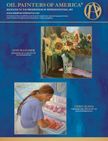
Now, as a full-time employee of the company, and as we’ve been preparing for the 200th issue, it’s been interesting to explore what’s changed in the past 16 years. Staff members have come and gone, each contributing to our success, and we have new publishers. Our founder and former publisher, Vincent Miller, has contributed to this issue.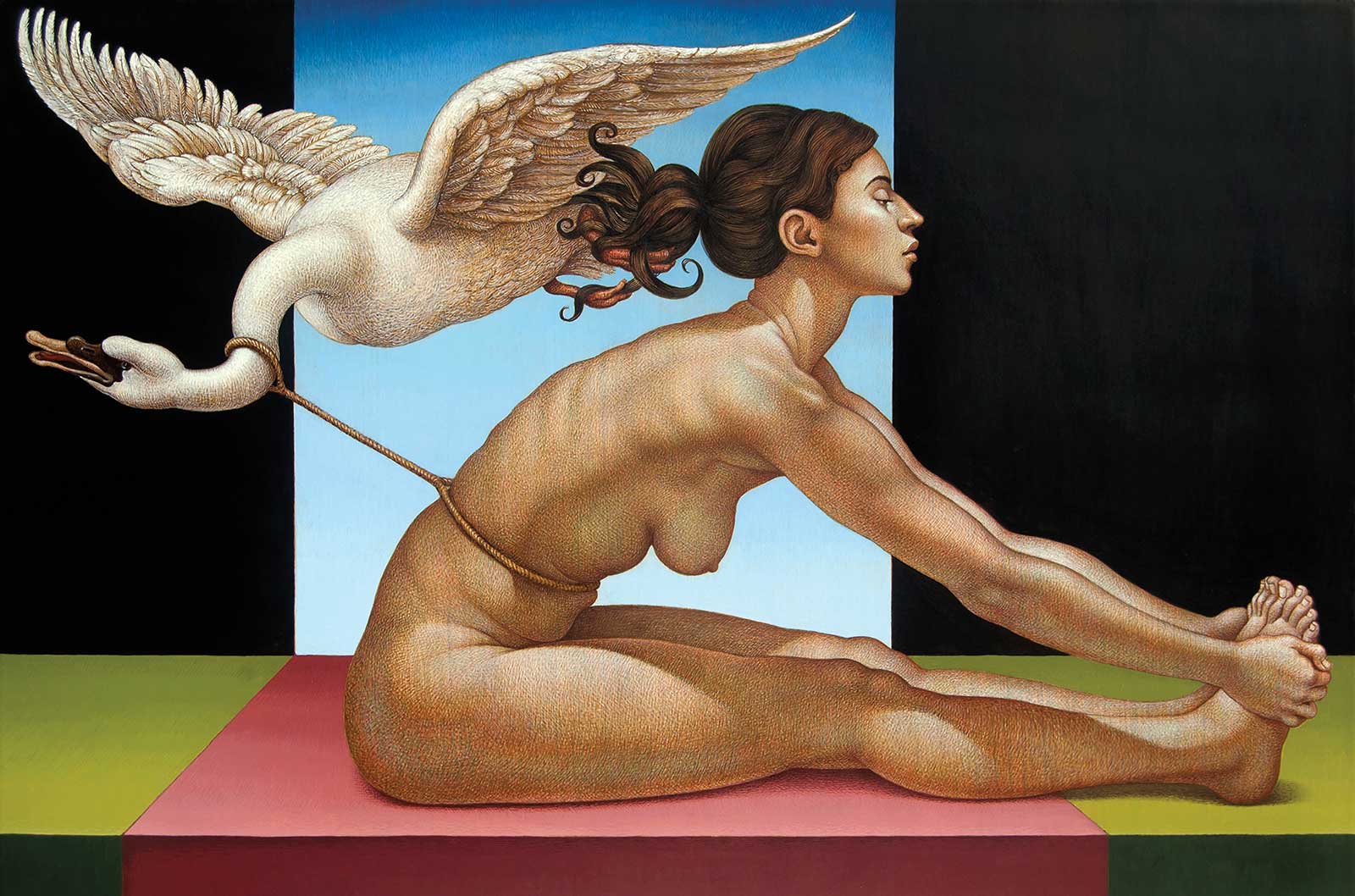 Michael Bergt, The Reach, 2015, egg tempera on panel, 24 x 36”. Courtesy the Artist and NüArt Gallery, Santa Fe, NM.
When I looked back at my first article, I began thinking about how we have broadened our perspective on what we include, how artists have changed and, in one instance, how a model has changed.
Suzanne Scherer and Pavel Ouporov often painted their young son, Nicolas, in their exquisite egg tempera paintings on poplar icon panels. They began Nicolai with Peacocks in 2004 when Nicolas was 2 years old and finished it several years later.
Nicolas is now an undergraduate at Columbia University “interested in mathematics, emerging tech, entrepreneurship, and the arts,” he says. “I have a long history in the performing arts and visual arts, working under institutions such as the Boston Ballet and YoungArts Foundation.
I believe that aspects of the arts are present in all fields and I hope to discover these intersections, pushing towards a more authentic, accessible world.”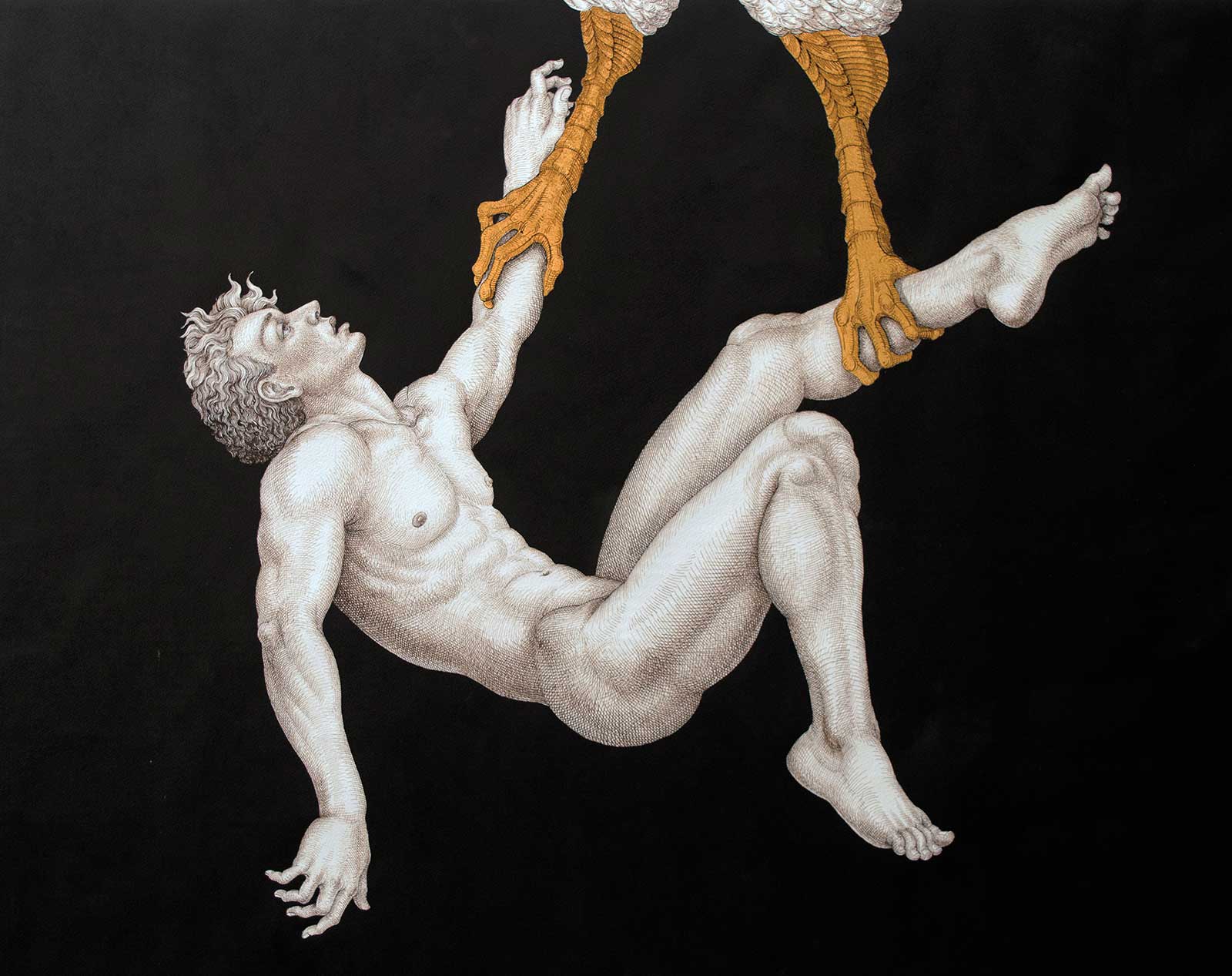 Michael Bergt, Ganymede, 2021, ink and gold leaf on paper, 30 x 40”. Private Collection.
The role of the model in figurative painting is often overlooked. In an artist statement, Nicolas reflected on being a model and a dancer, always being in front of the camera as an “object.” “I wanted so badly to take control of how my image was depicted, to grasp it from the hands of my parents and teachers. I wanted to be my own personality and reflect it somehow. This desire led me to the artform of photography.”
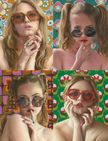
In photographic triptychs for a recent exhibition at the Box Gallery in West Palm Beach, Florida, he explored “improvisational pose as a method for capturing an ‘alternative’ portrait of a human being.” In the central image, dance movement was translated into mark-making when he covered his feet in pigment and executed dance moves on canvas.
Artists sometimes become pigeon-holed. Others continue to explore and to grow with the support of their galleries and their collectors.
Jeremiah D. Welsh is known for his exquisite, small-scale, low-relief, realist sculptures as well as his large-scale installations. Inspired by “the song of elk resonating through the forest” and having “felt the thrill of that impassioned bugling,” Jeremiah sculpted his bronze, Bugler on the Ridge, “as a symbol of the importance of each individual voice—and in acknowledgment of the personal courage required to speak forth clearly and with strength of purpose, the call of one’s convictions.”
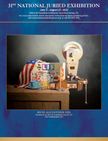
He had been inspired by aspects of modernism he saw in an Alexander Calder mobile as a young boy. “Later in life,” he explains, “I became fascinated by iconography’s flattening of organic form into geometric shape—as well as by Japanese block prints’ use of layering and shape separation. Both of these roots are now made manifest in my Modernist compositions.”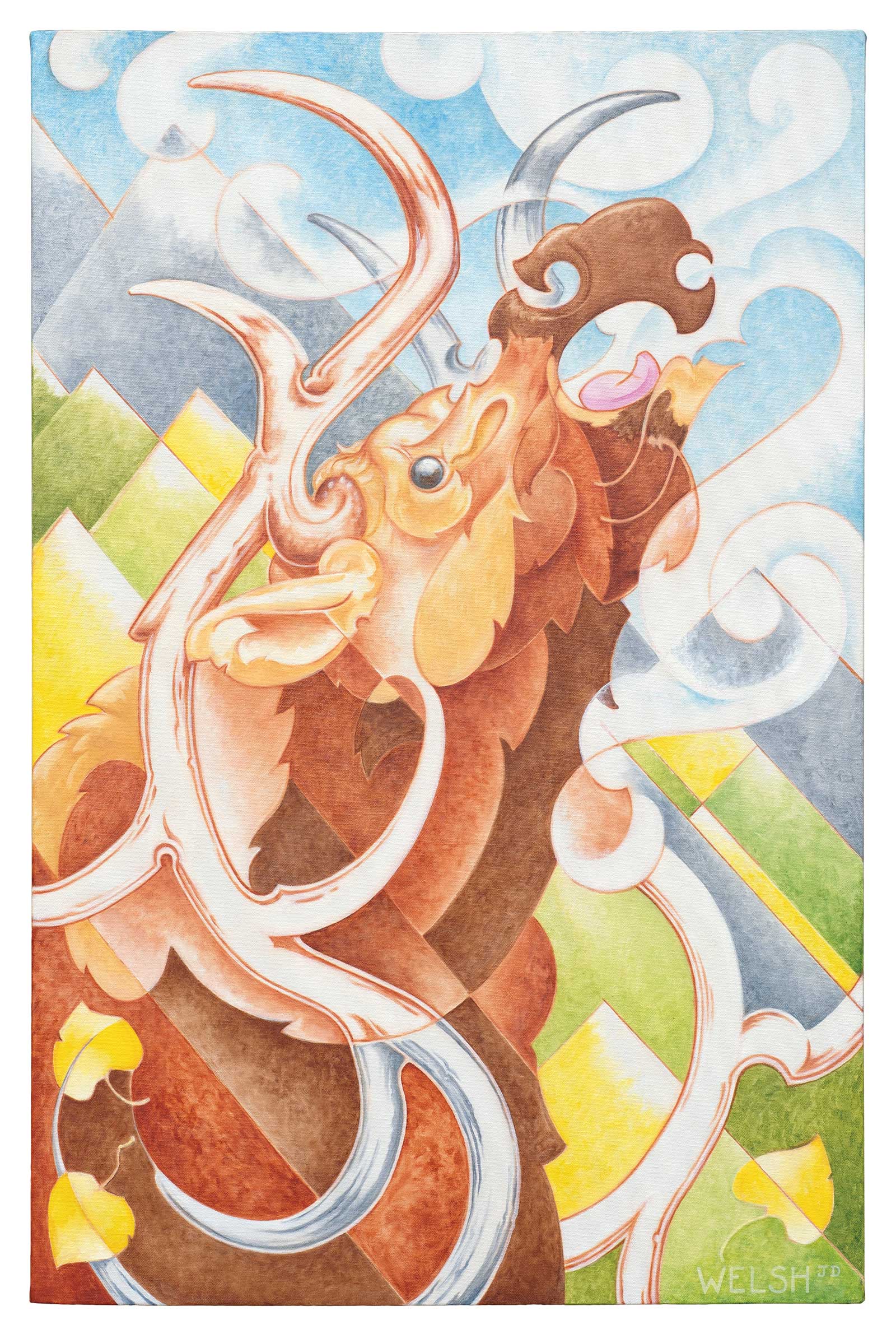 Jeremiah D. Welsh, Mountain Song, oil on canvas, 36 x 24 x 1½”. Courtesy the Artist and Wilford Gallery, Santa Fe, NM.
His oil on linen painting, Mountain Song, “draws upon both iconography and calligraphy, with structural elements inspired by Japanese woodblock printing, cubism and Art Deco. I completed the composition of Mountain Song as a modernist re-thinking of my realist piece, Bugler on the Ridge—and I am genuinely excited by the lyrical musicality that has resulted in the painted work.”
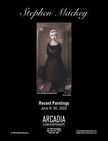
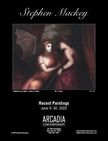
Among the previews in this issue is one on Stephen Mackey’s paintings at Arcadia Contemporary about which Mackey comments, “I have no special interest in randomness and the unconscious, Jung and Freud, etc.” He allows “the dream-like and the fantastic” to remain clothed in mystery.
Over the years it has been fascinating to talk with artists about their inspiration and their interest or lack of interest into delving into its depths.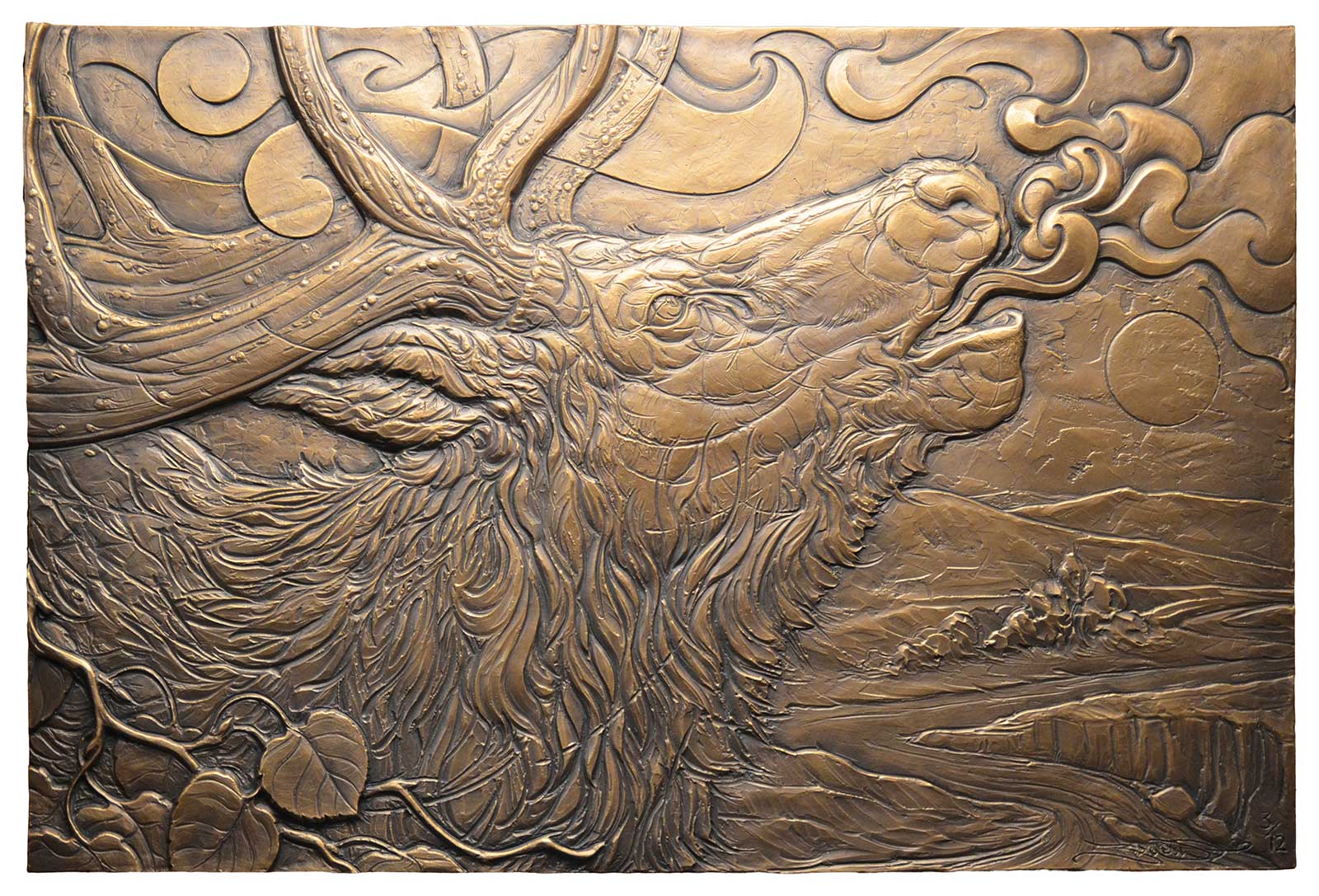 Jeremiah D. Welsh, Bugler on the Ridge, bronze, ed. 12 of 12, 12 x 18 x 7/8”. Courtesy the Artist and Wilford Gallery, Santa Fe, NM.
Myth has long been a rich source of inspiration for artists. Michael Bergt was in my first article for the magazine. He has studied myth, religious image-making, psychology, gender roles and many other topics—all of which bring richness to his egg tempera paintings, and his ink and colored pencil drawings.
Two pieces featured here personify myths. His egg tempera, The Reach (2015), represents the myth of Leda and the Swan in which the god Zeus is attracted by the beauty of Leda and, in the form of a swan, rapes her. In Ganymede, Zeus is overcome by beauty again, this time in the form of the youthful Ganymede whom Homer describes as “the loveliest born of the race of mortals.” Zeus assumes the form of an eagle, and abducts him to serve as cup bearer to the gods.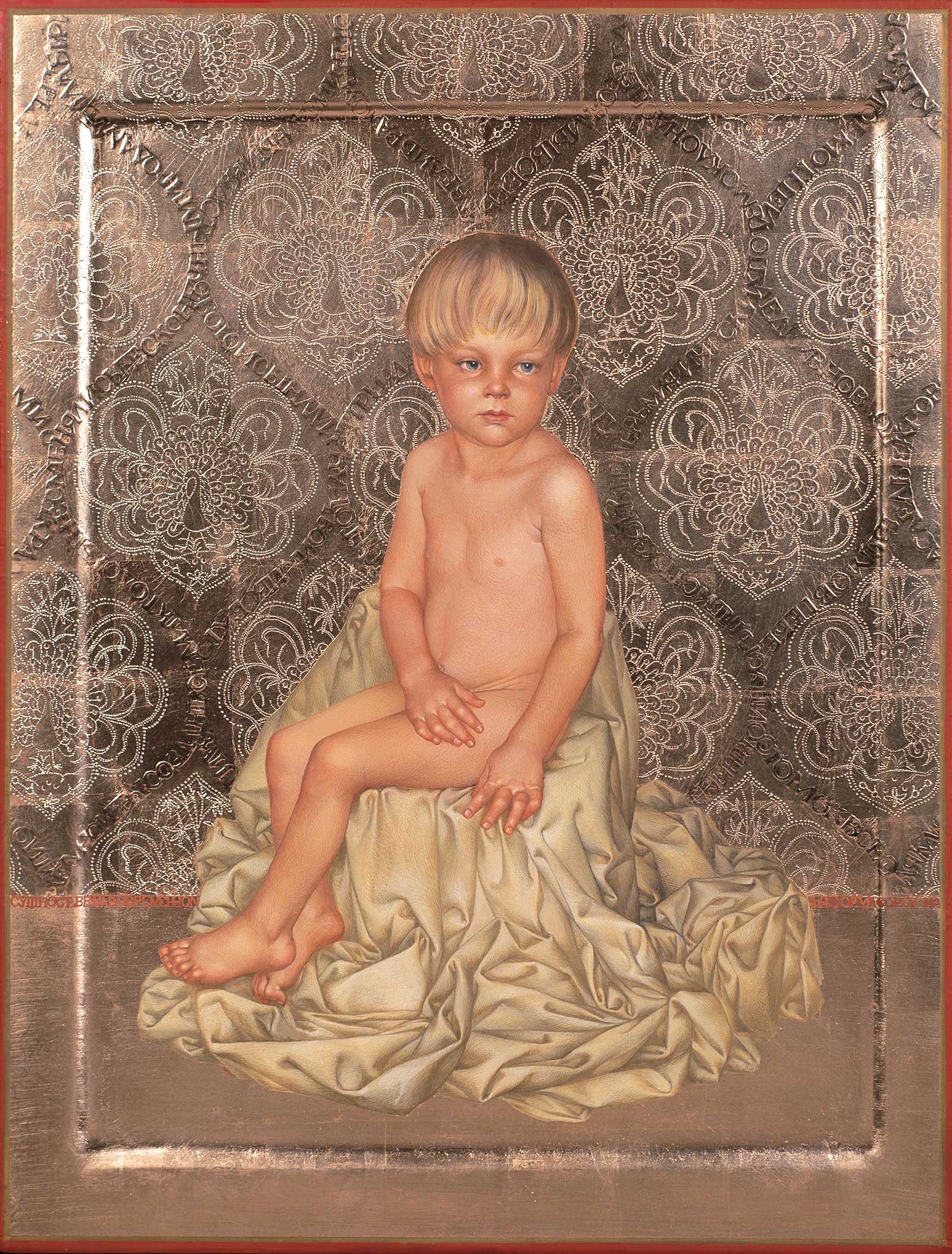 Scherer and Ouporov, Nicolai with Peacocks, egg tempera, gold leaf on poplar panel, 17 x 13”. Private Collection.
Bergt comments, “Six years separate The Reach and Ganymede, and yet there are many similarities. Both have encounters with a large bird that has the desire to abduct them. In mythology, we often see the gods expressing their ardor for mortals by assuming the form of an animal to seduce or abduct them. Metaphorically, this allows us to understand our own ‘primal’ drives that are not subject to the rules of God or of man. If we dare to see these narratives through a spiritual lens, then these mortals are visited by a spirit animal with a message of transformation, and our resistance is futile because our destiny is bigger than what we imagined. The ‘gifts’ of these unions are often gods of import themselves, as can be the fruits of our transformations. Our ‘shadow self’ might be the path for our realization of larger truths.”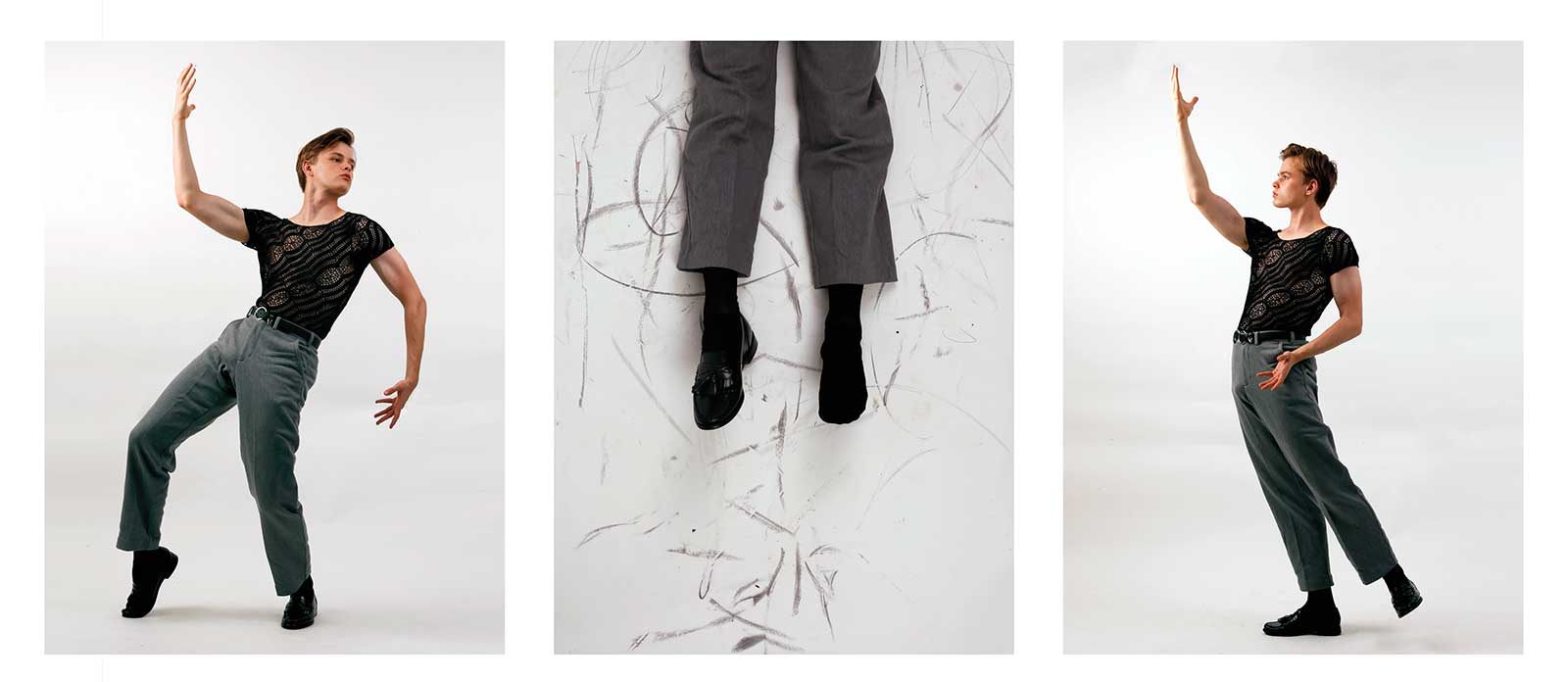 Nicolas Ouporov, Impulsive Gestures (triptych), 2022, C-print, 19¼ x 25½” each. Courtesy the Artist.
Ten years before joining the magazine I shared keynote duties with the great Jungian psychologist James Hillman at a conference, “Reviving the Spirit—The Challenge of Realism: Representational Painting after Modernism,” sponsored by the Newington-Cropsey Foundation. Jim was great. I was not. Nevertheless, I delved into his books, and am still struck by the title of one of the chapters in his book The Soul’s Code. The chapter, “Neither Nature nor Nurture—Something Else”, has, ever since, inspired me to seek out the “something else” in the art I’m privileged to write about in all of our magazines. —
Powered by Froala Editor