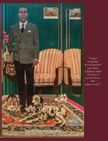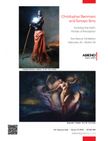
Recently, artist Sam Adoquei completed a stunning portrait commission of his close childhood friend Major Cornelius Boye Oddoye. The portrait is an intimate three-quarters life-size view of Major Oddoye dressed in his military fatigues with an ancient map surrounding him in the background. Adoquei and Oddoye grew up a couple of houses away from each other in Ghana. Major Oddoye went on to a military career and served in the Ghana Armed Forces but is now a diplomat posted to New York. Adoquei’s journey took him to Nigeria where he worked for a time as a commercial artist painting billboards and posters. He returned Ghana and graduated from the Ghanatta College of Fine Art. Afterward he furthered his studies in New York City, where he currently resides and established himself as a highly sought-after artist, teacher and author.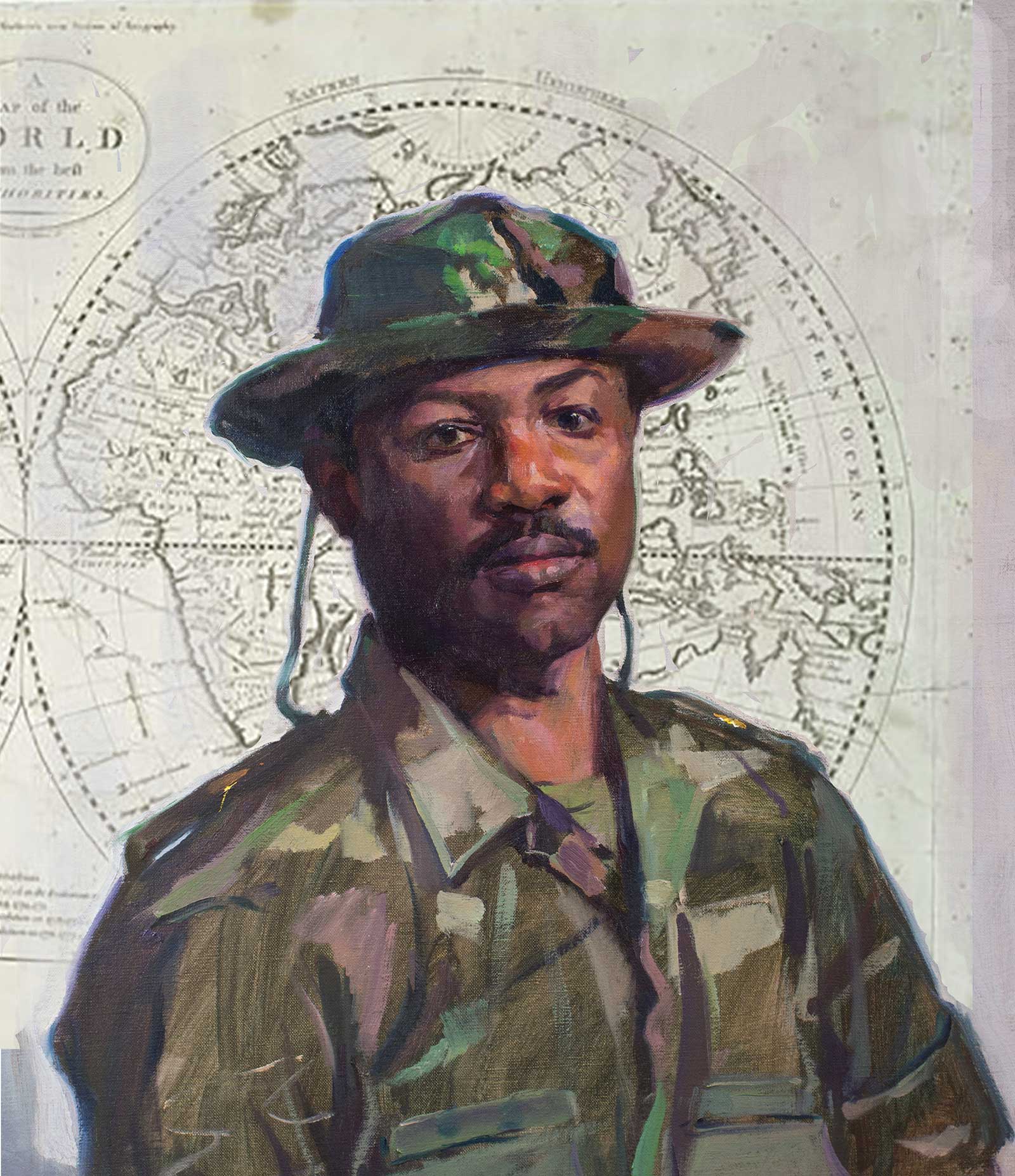 Major Cornelius Boye Oddoye, oil on linen, 24 x 20”The map in the background provides a unique element to the work, and according to Adoquei the idea would evolve over the course of the commission. “Originally, because of the many different places he has been assigned to, I used a globe on a table next to him,” says Adoquei. “After compositional sketches, I realized the result would become too cliché for my taste; and I feared props could weakened the power and strength of an officer. I wanted simple, sophisticated yet powerful.” He explains that his aim was to avoid another idealized “look at my shiny stuff” to achieve the painting he sought to create—one where “art, life and inspiration come together to create an invisible energy.”
Over the years Adoquei has completed portraits for institutions such as Princeton, Columbia, Yale, Vanderbilt University and the University of Pennsylvania, as well as for private collectors around the world. Currently, he is working on another private commission, and he is involved in The Skin Tones Project & Movement. The movement, as Adoquei explains, is about “celebrating the gift of evolution and differences in our beautiful skin tones.” The project stems from the idea that if politicians, scientists and religious leaders are doing their best to improve human relations, what can figurative artists contribute to these goals? It is a herculean task, but a task Adoquei knows to be worth pursuing knowing the success of it could be enlightening to all.
While researching for his recent book, A Short Story of Skin Tones in Art, Adoquei kept returning to the question of how to share the beauty of the world, especially when painting people, as a means of helping humanity? This is what inspired the Skin Tones Movement. “Whoever aspires to portraiture is a humanist disguised in an artistic spirit,” he says. Adoquei believes that portraiture can be a vehicle for abandoning prejudice and honoring human beauty in its many forms. —
Powered by Froala Editor