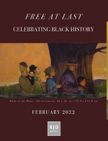
In celebration of Black History Month, RJD Gallery in Romeo, Michigan, will feature works by Alex Bostic, Stefanie Jackson, Ann Tanksley and Phillip Thomas in a new exhibition titled Free At Last.
“Freedom means many things to many people but perhaps its meaning is the most profound to people of color, like me,” says gallery director Joi Jackson Perle. “As a Black American descended from slaves, whenever I hear the word ‘freedom’ I find myself thinking of my ancestors and their ability to endure the cruelty of slavery, to celebrate the joy of Emancipation, and to continue the fight for civil rights and equality that continues today.”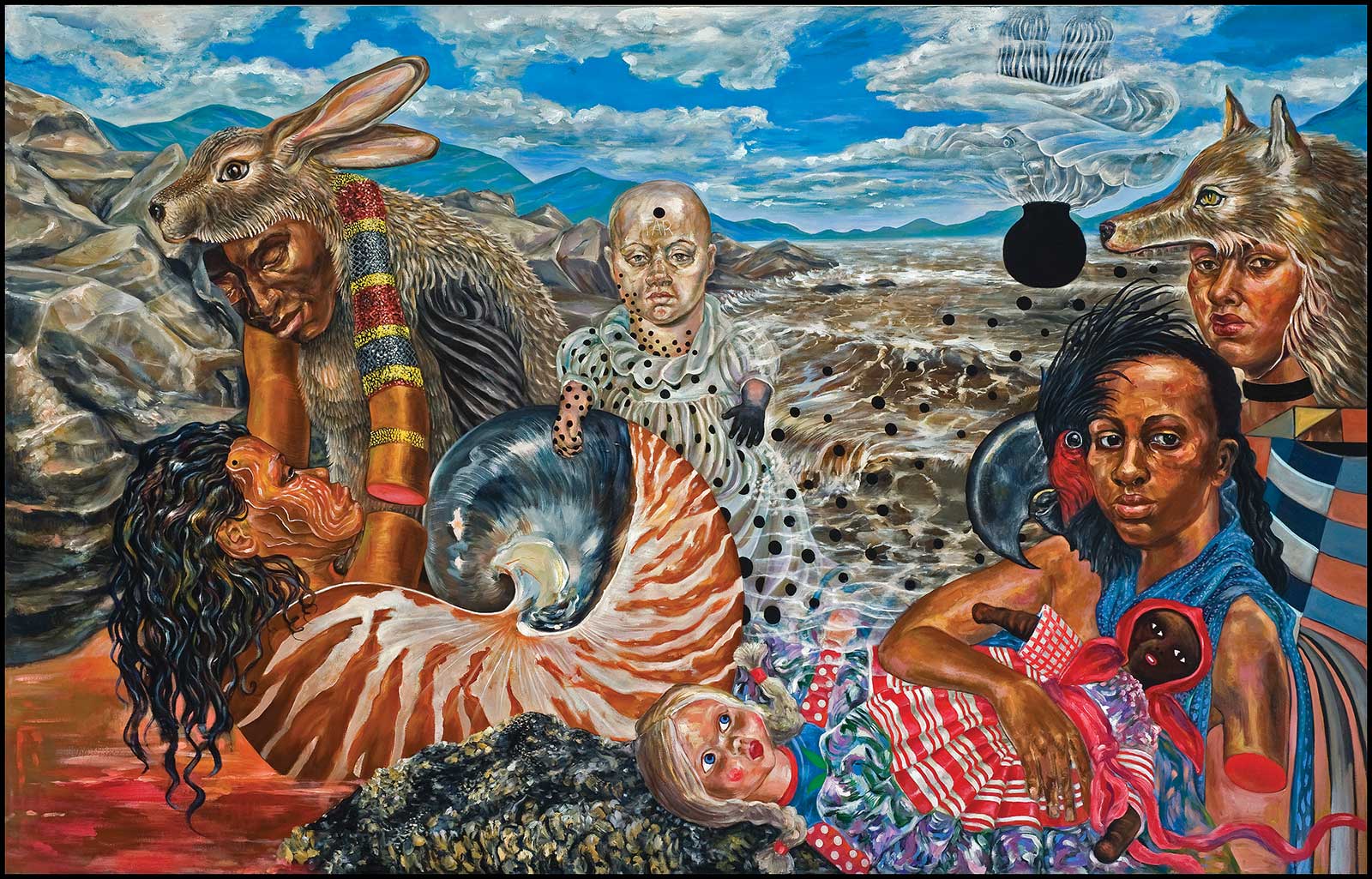 Stefanie Jackson, Tar Baby, oil on canvas, 48 x 60"
Jamaican artist Thomas based his painting If we must die on a 1919 poem by Claude McKay. The poem was published during a summer in which the Ku Klux Klan relentlessly terrorized Black communities, and it celebrates the resiliency of the victims.
Using toile fabric on canvas, Thomas’ imagery juxtaposes an idyllic garden party with a young Black man carrying a bayonetted rifle. “The figure also has the trappings of colonialism, presented in the judicial wig and his breast medals,” he explains. “Beyond these trappings is his intent on stripping himself of these mechanisms and a thrust toward self-governance, definition and determination. Upon further observation one can see the figure’s ‘hair,’ represented by camouflage fabric, is growing through the wig and, in time, will eventually engulf it.”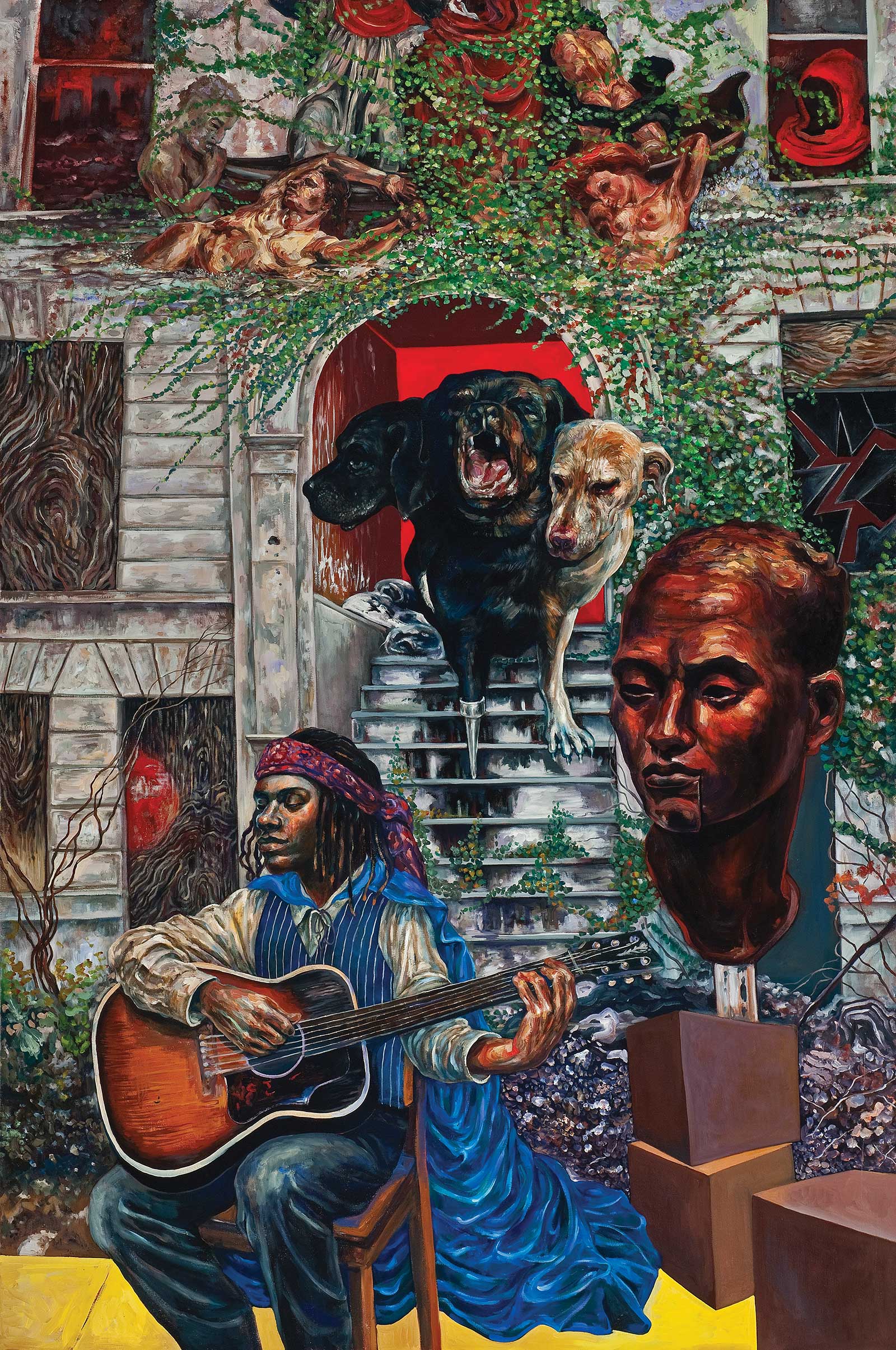 Stefanie Jackson, Ordinary Pain, oil on canvas, 60 x 48"
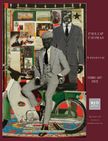
In “Road” Scholar, Thomas references the famed scholarship and confronts the program’s colonialist history and failings. The painting threads together historical texts and references to art history, like the 14th-century bronze heads from Ife and James Hakewill’s 18th- and 19th-century paintings of Jamaica.
“The figure on the bike is a representation of a specific type of Jamaican emigrant known as the ‘windrush’ emigrant,” Thomas explains. “The name ‘windrush’ comes from the name of the vessel that transported these people. This migration from the Caribbean to the United Kingdom was solicited by the British government to help rebuild England after the Second World War and many of these emigrants were veterans and other professionals that contributed to the war effort.”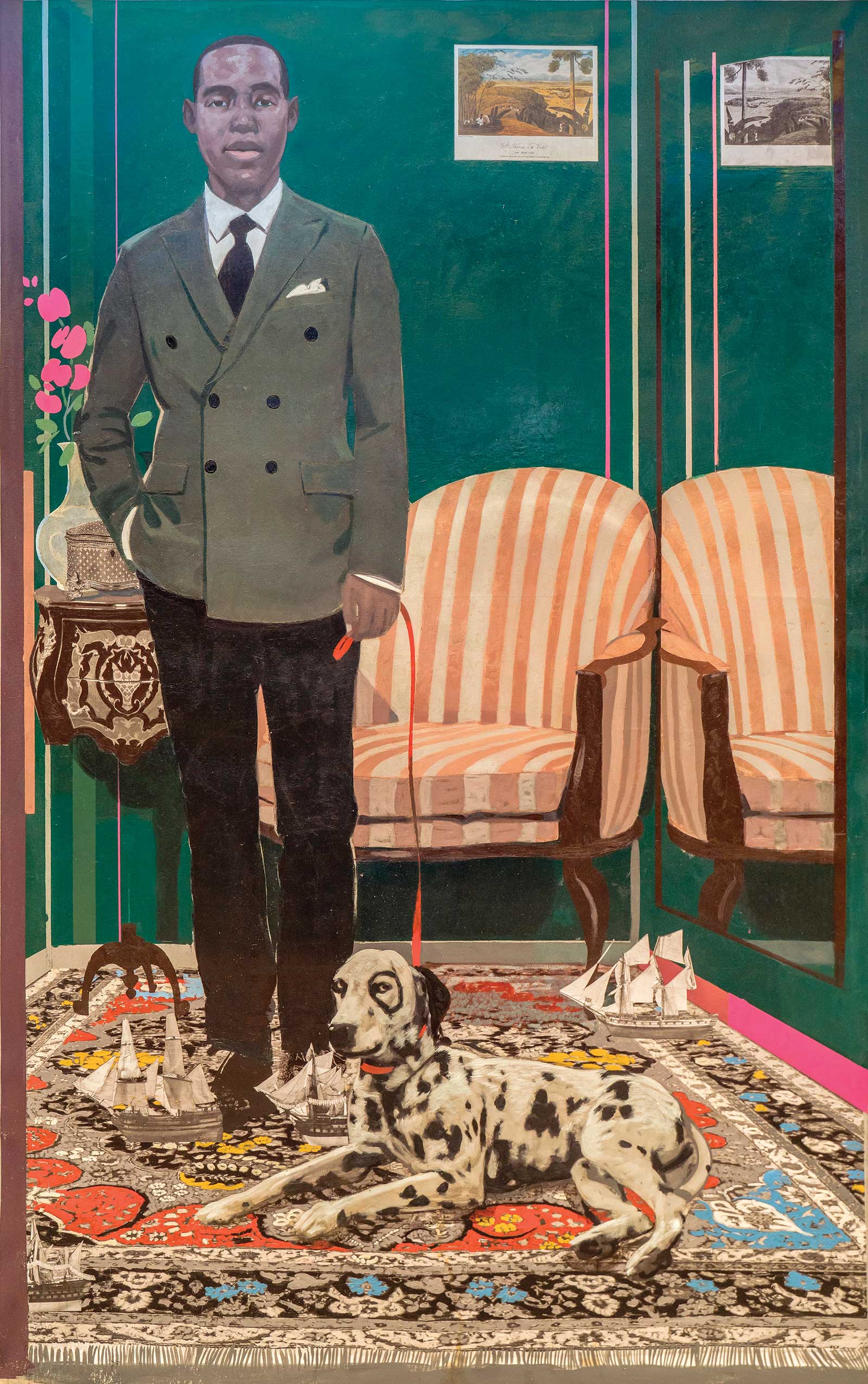 Phillip Thomas, Atlantic, mixed media on canvas, 86 x 53"
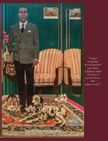
Another reference to Hakewill can be seen in Thomas’ Atlantic, with a painting of a man and a dog hanging on the wall in the background of the portrait.
“The viewer will notice on the rug two ships pointing in the same direction as though there was a hint of a much larger fleet that has traversed the ‘Atlantic’ over many centuries,” Thomas notes. The entire scene creates a push and pull between the subject’s individual psychology and the cultural influences of colonialism to create a dynamic visual narrative.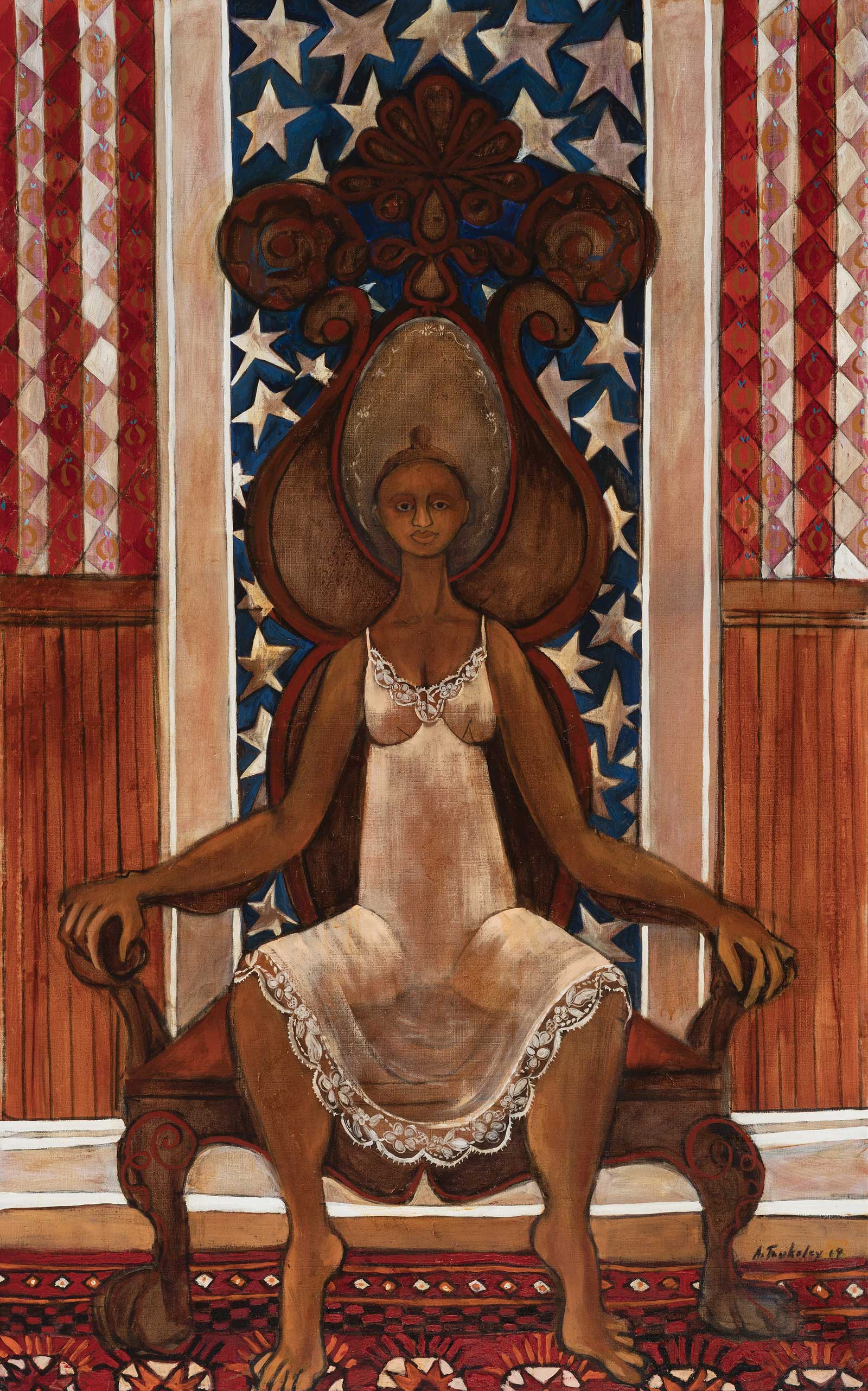 Ann Tanksley, The American Hotel, oil on linen canvas, 48 x 30"
Bostic’s Gathering imagines a family praying about freedom after receiving the news of the Emancipation Proclamation. “I looked at the stories and the words, and then I tried to approach it from a fine art point of view and still tell a compelling story,” he says.
Another painting from Bostic, titled Into the Light, features three generations of people who were enslaved—a grandmother, a mother and a son—looking up into the light, feeling hopeful about emancipation.
“I always want people to have an emotional response to each painting,” Bostic says. “My intention is for them to find a separate message about the painting within themselves and find something that they can relate to, either through their own personal history or through our shared history that creates a compelling story.”
Jackson’s Tar Baby takes inspiration from the folktale documented by the storyteller Joel Chandler Harris. Harris is famous for stories like Brer Rabbit, but Jackson points out that he took most of his tales from African American oral tradition.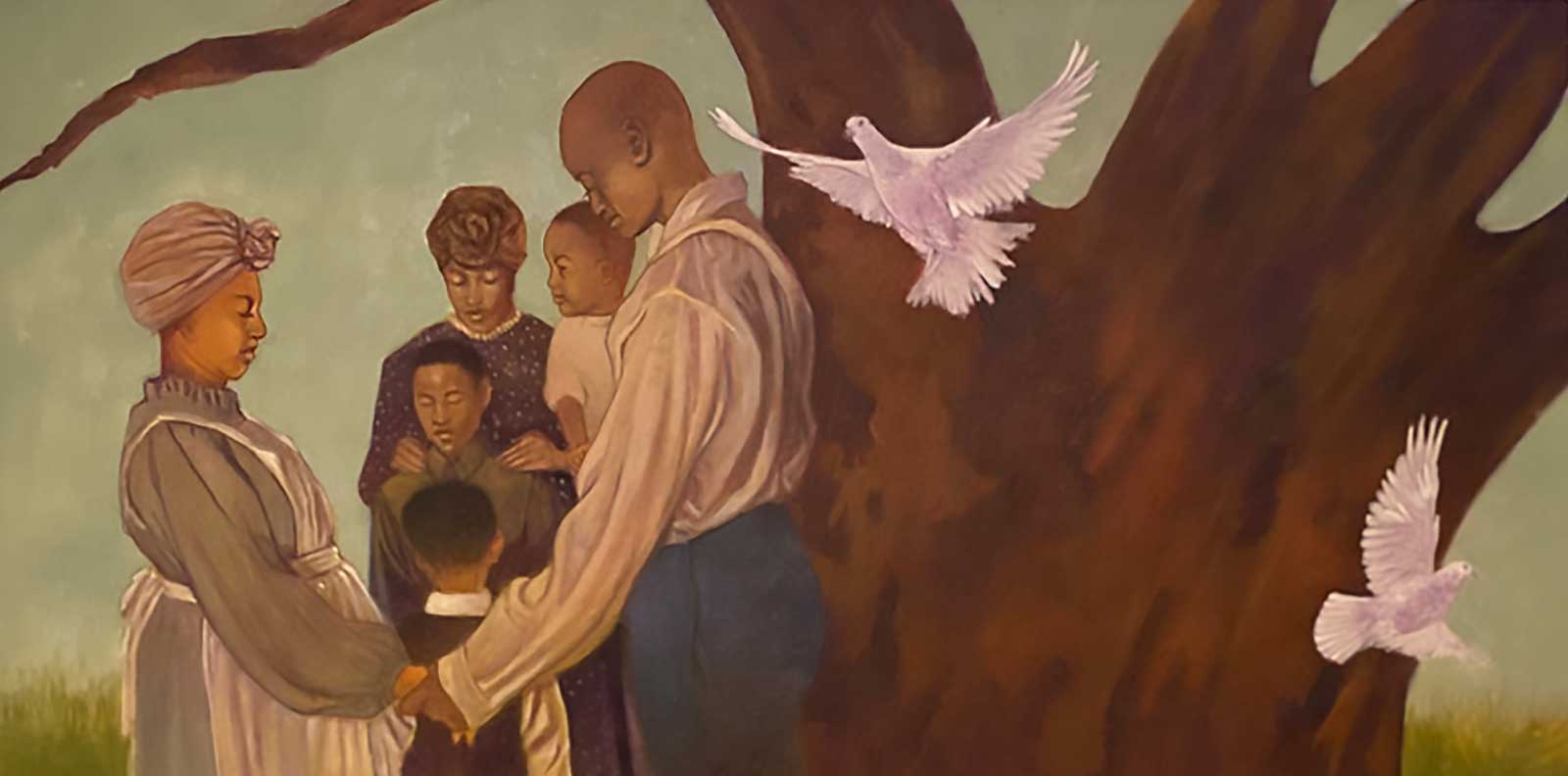 Alex Bostic, Gathering, oil on canvas, 22 x 44"
“I was driving from Athens, Georgia, to the coast and went through Eatonton, Georgia. There was a sign about it being the birthplace of Joel Harris,” Jackson explains. “But coincidentally, Eatonton was also the birthplace of Alice Walker, who wrote The Color Purple, and there was no distinction for it.”
The realization prompted Jackson to create a satirical painting about Harris’ works, reappropriating his characters. Jackson says, “I wanted to create a different impression of the original folktale. The original painting was called Tar Baby and the Tyranny of Expectancy, which relates to the stereotypes that the name ‘Tar Baby’ evokes.”
In another series of paintings, Jackson puts her own twist on the 1959 film Black Orpheus by Marcel Camus, which retells the myth of Orpheus and Eurydice. While Camus’ tale took place in Brazil, Jackson sets her paintings in her hometown of Detroit. In Ordinary Pain, Orpheus is singing to settle the three-headed dog Cerberus to gain entry to the underworld and save Eurydice.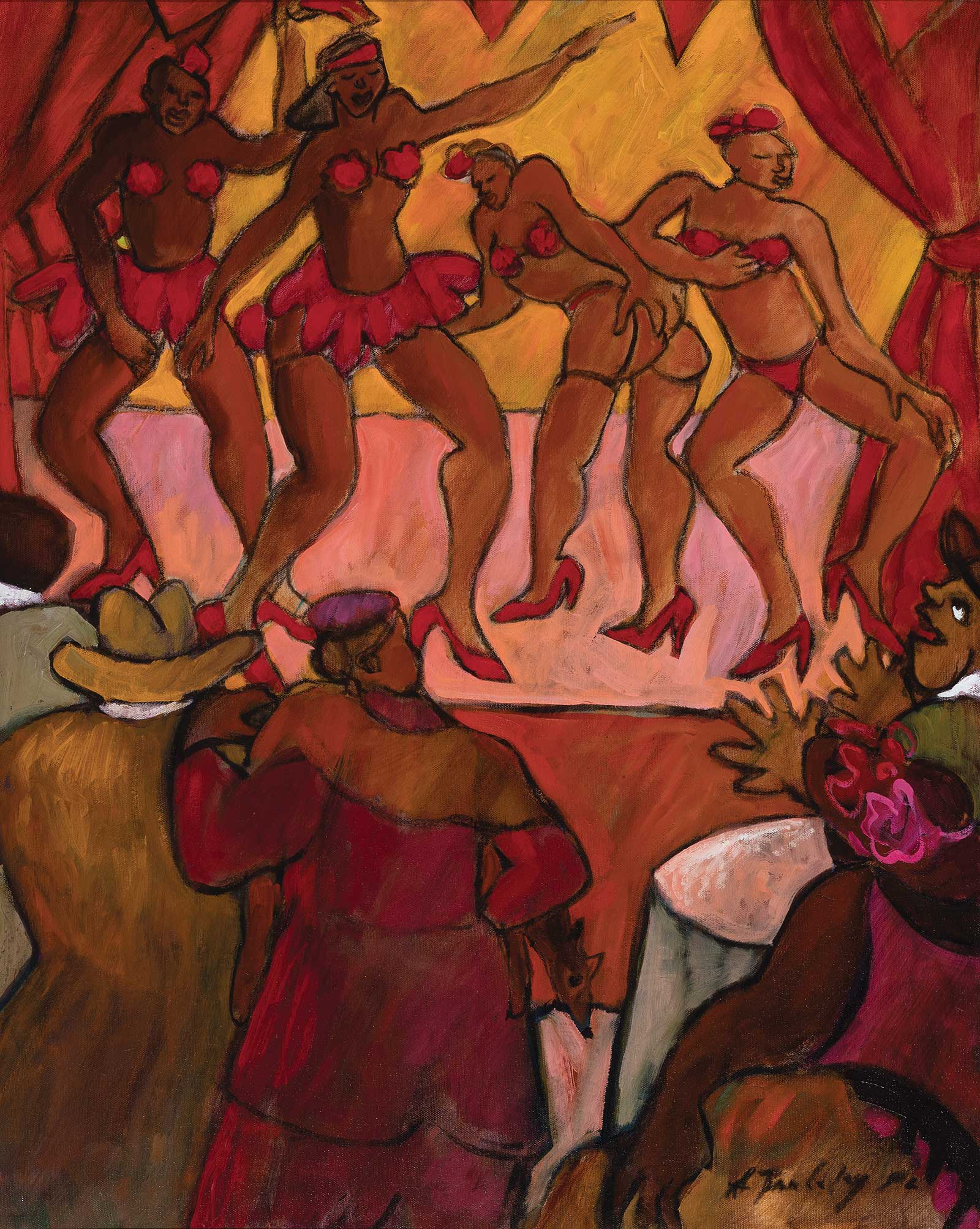 Ann Tanksley, The Foxes, oil on cotton canvas, 30 x 24"
“It’s a homage to Detroit. The whole scene portrays what the city represents to me, the Detroit that once was,” Jackson says. There are plenty of references to the city—abandoned buildings and a sculpture from the Detroit Institute of Arts. Even the title, Ordinary Pain, is taken from a song by Stevie Wonder, who is himself a Detroit native.
Tanksley’s The Foxes was also inspired by a film—1991’s A Rage in Harlem, based on a novel by Chester Himes and starring Forest Whitaker. “I enjoyed the film so much that I did several paintings based on it,” Tanksley says. In particular, the scenes that took place in nightclubs resonated with her, reminding her of her own experiences of going to the Apollo Theater and other New York clubs.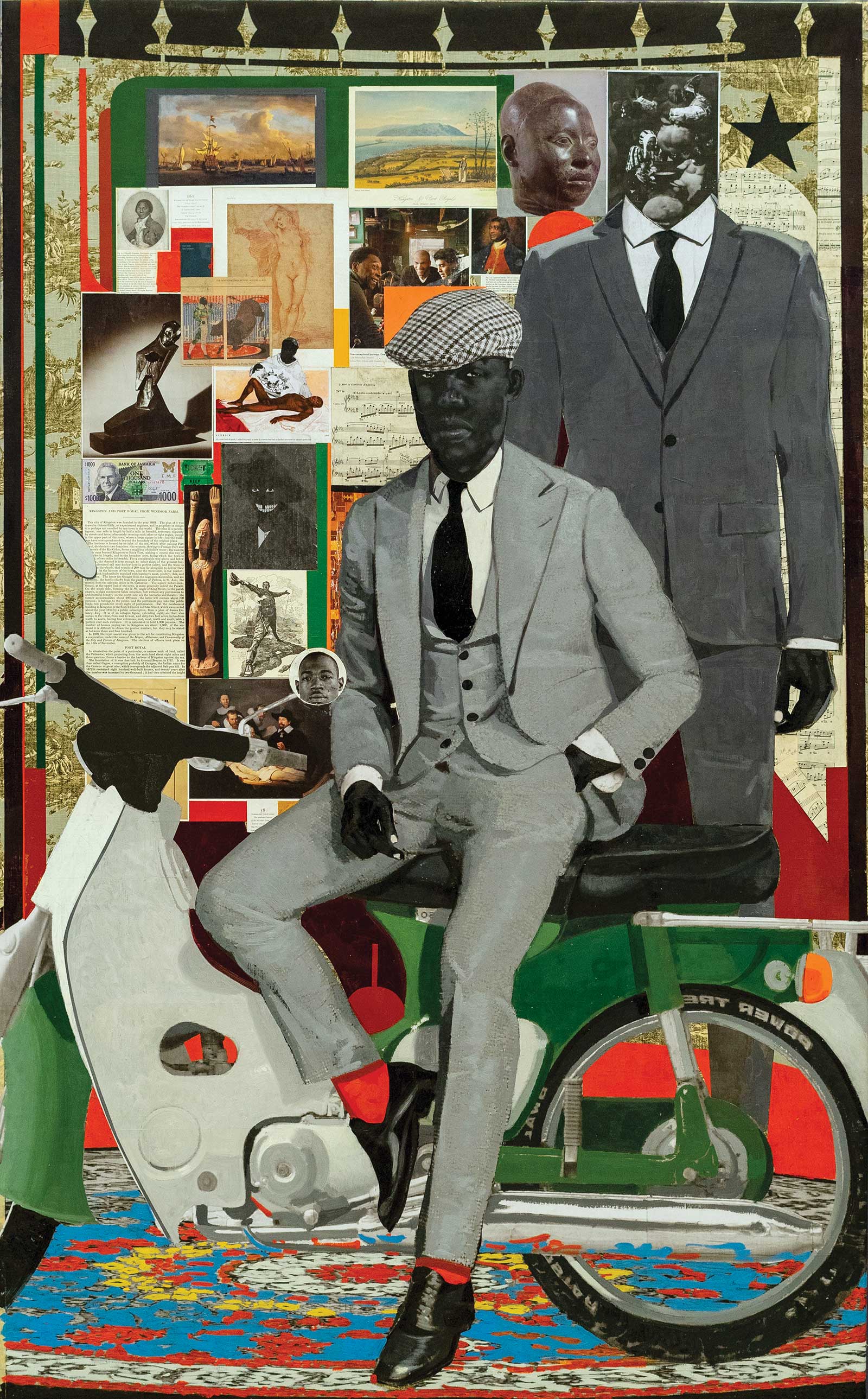 Phillip Thomas, “Road” Scholar, mixed media on canvas, 86 x 53"
“I love depicting the nightclubs. There’s so much dancing and fun and release,” she says. “One of the characters in the movie was wearing a fox fur around her neck, which is how the painting got its name.”
In another painting, Tanksley was inspired by the name of a small hotel on Main Street in Sag Harbor, New York—The American Hotel. She explains, “The building dated back to 1846 and has its own history, but I had no idea what the interior looked like. I imagined it must have been rather grand and ornate.”
Using her love of antique furniture, she imagined what the inside might look like. “I chose the furniture and the ornate rugs, and the woman seated in the chair became an imagined guest at the hotel,” Tanksley says. An American flag hangs on the wall in homage to the name of the hotel.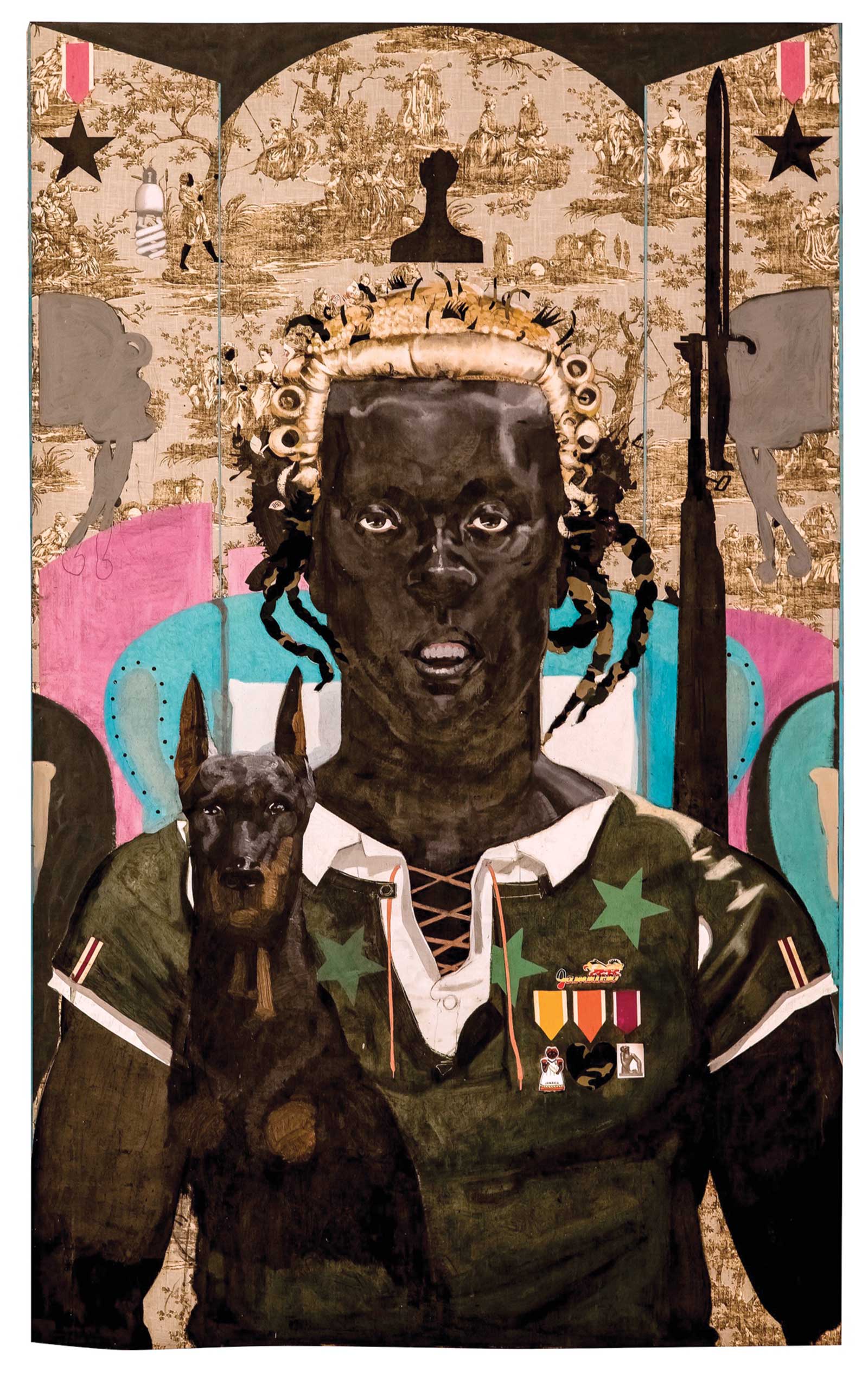 Phillip Thomas, If I must die, mixed media on canvas, 86 x 54"
RJD Gallery’s exhibition opens February 1 and remains on view through March 1. Perle says, “Free At Last is an examination of Black history told through the eyes of Black artists who present their unique and diverse narratives, that acknowledge the struggles and celebrate the triumphs of the Black experience in North America. The freedom to tell our story through art is in itself an expression of how far we have come, but also how far we still have to go.” —
Free At Last
When: February 1-March 1, 2022
Where: RJD Gallery, 227 N. Main Street, Romeo, MI 48065
Information: (586) 281-3613, www.rjdgallery.com
Powered by Froala Editor