Taylor Schultek is a discrete observer of the dark grid of the shadow city concealed beneath the surface of the boulevards, a broken and apocalyptic zone where indigents roam in darkness, and cryptic anarchy prevails. He crafts pictures of the underbelly of this liminal city, which resembles the cyber-punk dystopia of Mega-City One, of Bladerunner and of Diamond Dogs, a dehumanizing and wasted urban landscape of failed modernity, of a wrecked century of ancient concrete obscured under graffiti, and populated by desperate souls.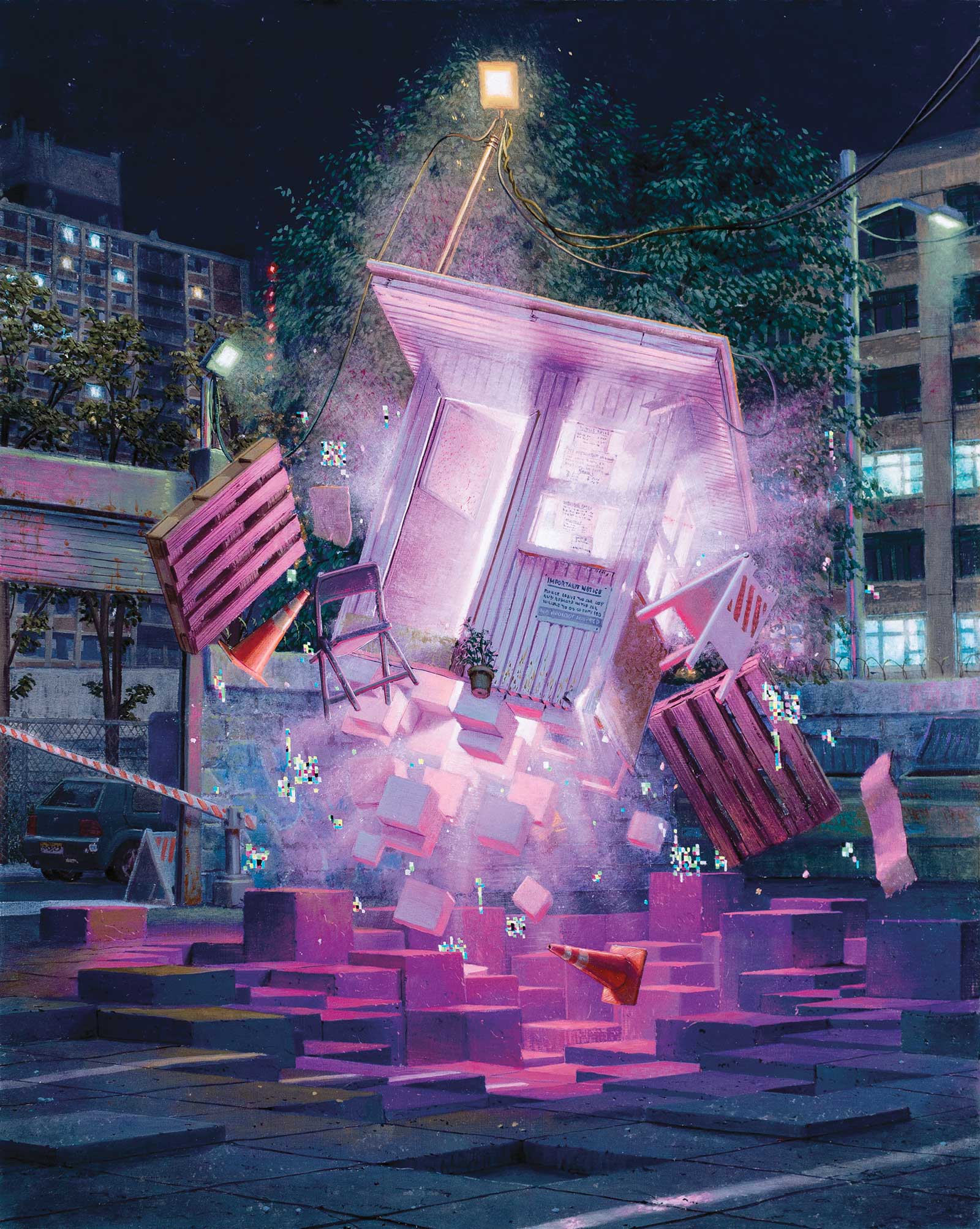 Temporal Rift, oil on birch panel, 20 x 16"
We might be tempted to file his imagery as science fiction, and Schultek says, “I had Jean-Pierre Roy as a teacher and he’s straight out of sci-fi movies, and he also turned me on to sci-fi novels like Neal Stephenson’s Snow Crash and Cryptonomicon, the cyber classics. Snow Crash is so good. There’s a computer virus that starts spreading into the real world, messing with people’s brains, using language as a way to hack into them. It came out in 1992. It takes place in a world where there’s a regular world and a metaverse, and the interplay between the two. And that’s where I’ve been leaning toward for the work.”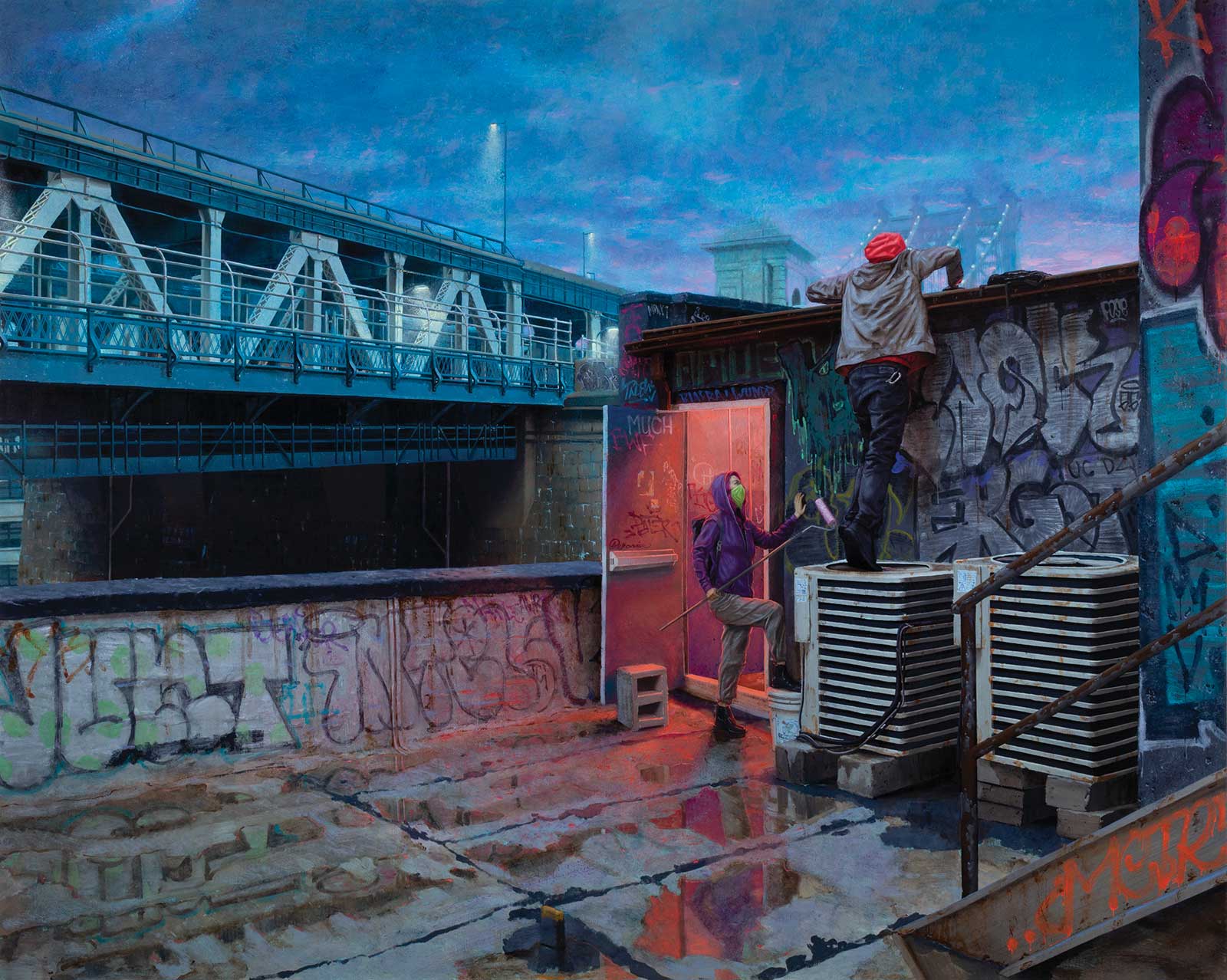 Contra, oil on birch panel, 48 x 60"
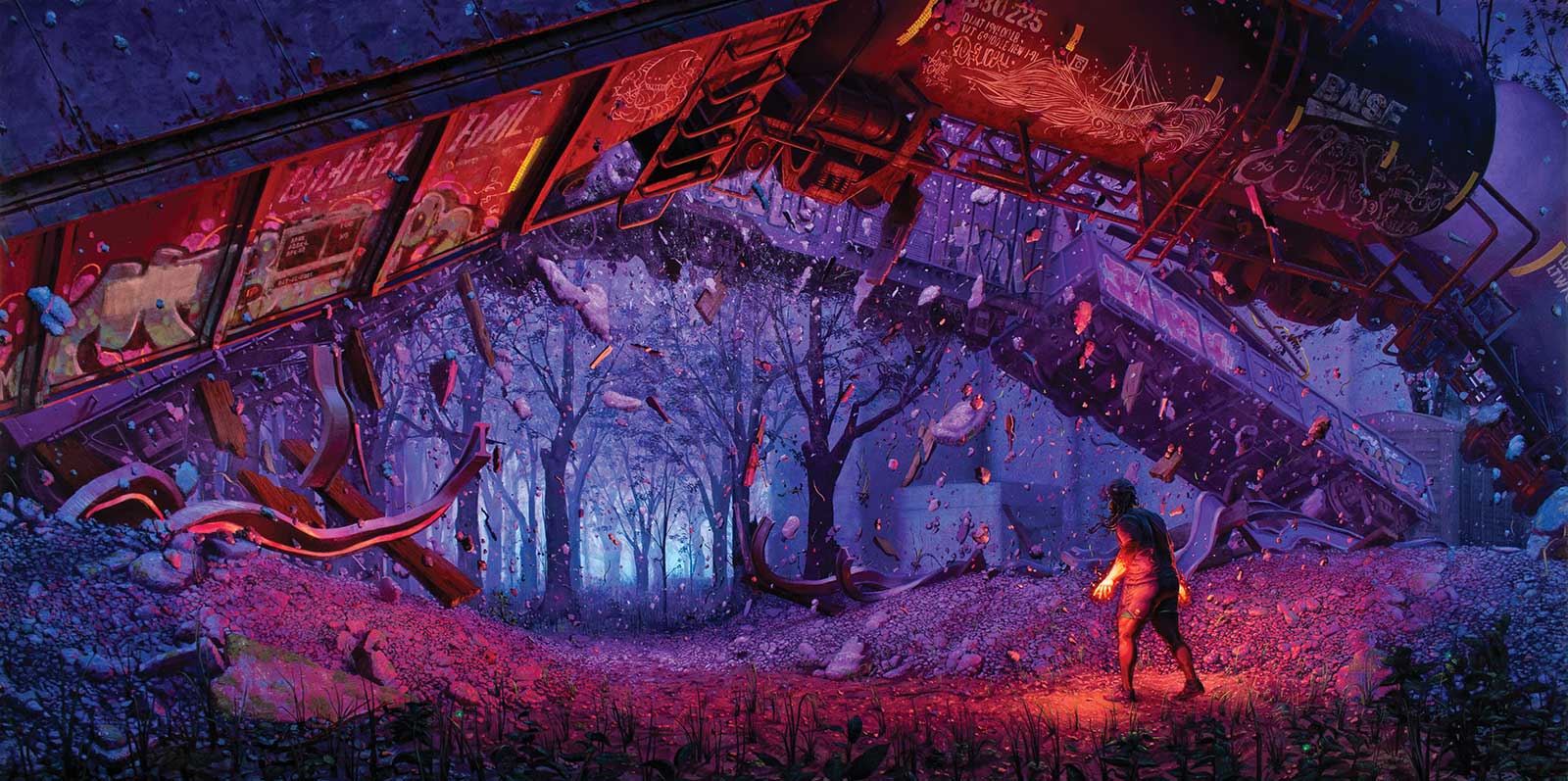 Super Lucid, oil, on Belgian linen, 60 x 120"
But his paintings are not a fantasy of our blighted future, for his crumbling city is already manifestly present in the creeping chaos and contempt of postmodern America, where addicts, those experiencing homelessness and the mad survive in the cemented shadows of mirrored and shining skyscrapers. They are scrubbed from our morning streets by rubber-gloved policemen and high-pressure water trucks. This future is present. The paintings are autobiographical.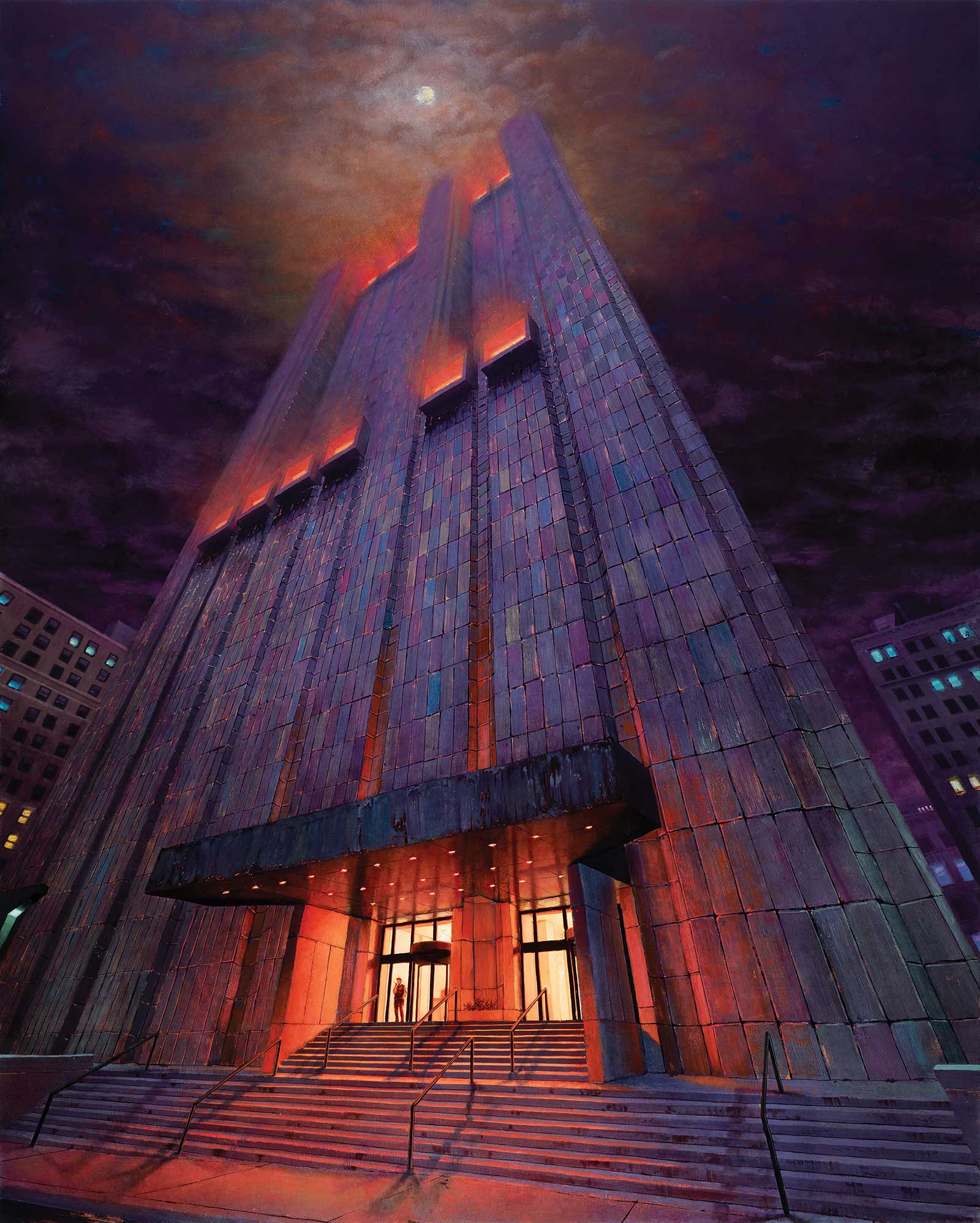 Titanpointe, oil on birch panel, 60 x 48"Schultek was a member of a graffiti crew in Minnesota, and he wandered through the dilapidated landscapes in the fringes of the city. The tags on the walls are his friends, and legendary names of the wall-painting community—he says, “It’s where it all started for me. I was 16 or something, I was making posters and album covers for my friends’ punk bands, and also doing graffiti on the side, it was just at that early point as graffiti started to be socially accepted. I met up with some friends from the internet on a site called Stencil Revolution, it was basically a resource for how to make stencils, how to make stickers, and we went on a good streak throughout the city, and it ended up landing me in galleries.”
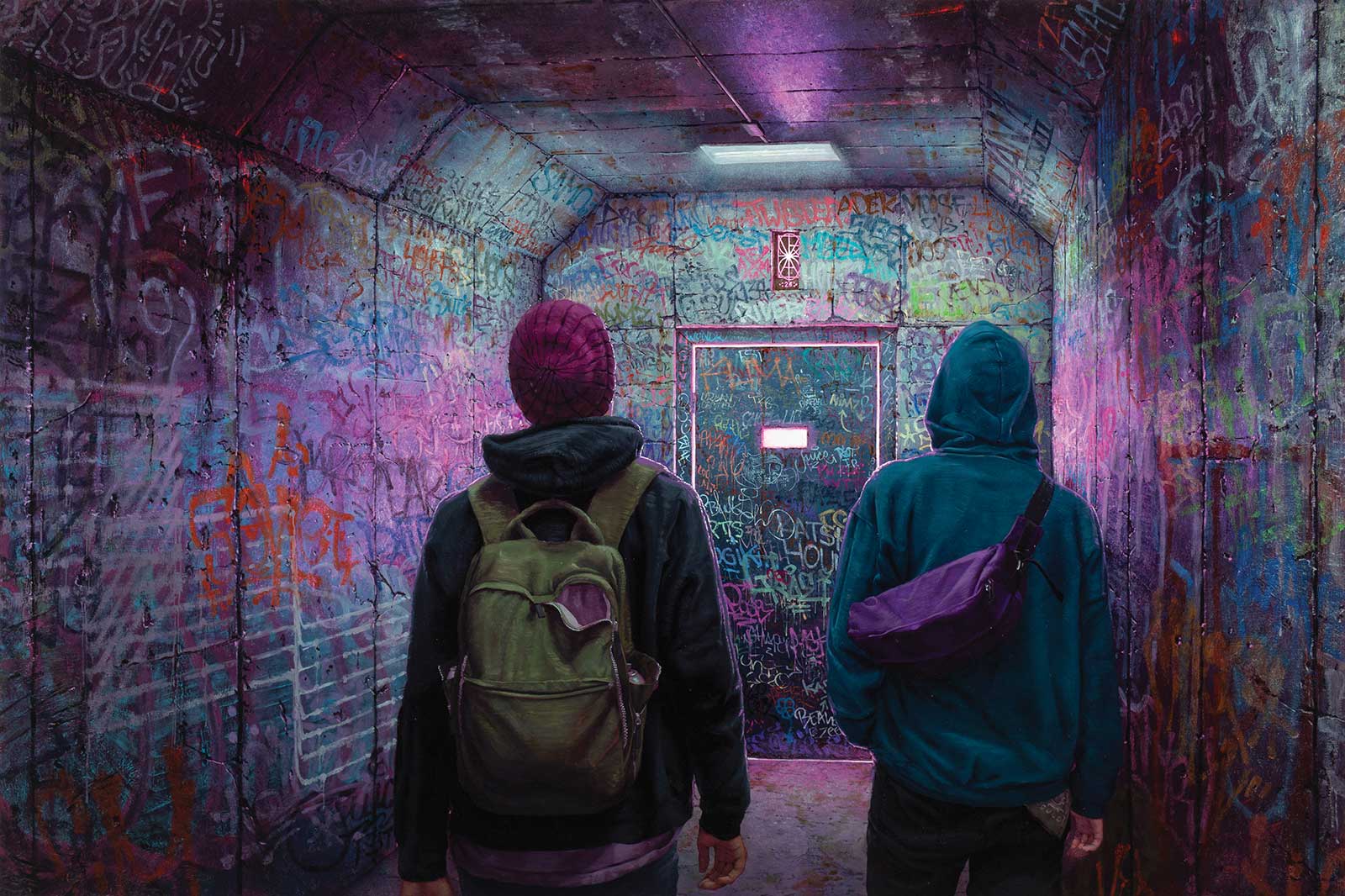 The Bomb Shelter, oil, 48 x 60"
With the air of the confessional, he discloses that he modeled as both men at the door of his Bomb Shelter. The clone Schulteks gaze at the hermetically sealed door of the shelter with its palimpsest of graffiti, and ask who dwells behind it. Watching the world through his eyes, we are the outsiders, dead to the bunker; obsolete. Surely, the steel protects the privileged people within from the dereliction of the landscape, but also preserves them from unwanted contact with undeserving outcasts. It reassures them of their security in defensive isolation. These are urban explorer clones, wandering through the lost underground of the city’s subterranean network of hissing tunnels to discover the catacomb of service shafts and concealed passageways which connects subways and sewers, water sumps and underground power substations.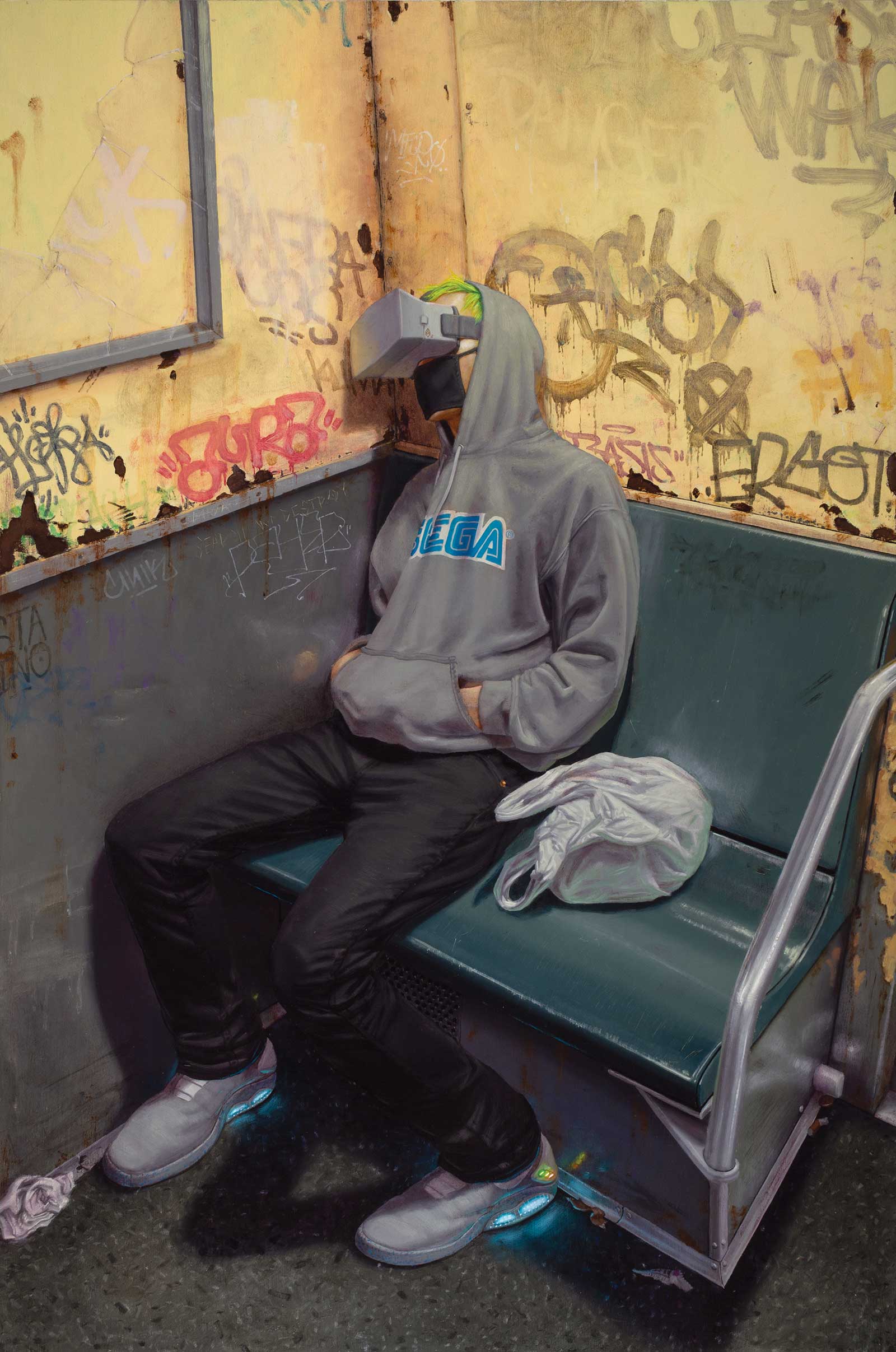 Flux Capacitor, oil on birch panel, 36 x 24"These are substantial paintings. A figure sprawled across a plastic subway seat, covid-masked and hoody-hooded, in a cocoon of utilitarian black and gray clothing, visored by an all-gray virtual-reality headset. The Flux Capacitor title is a reference to the classic 1985 science fiction movie Back to the Future—it is the neon-lit gadget which makes time travel possible. Oblivious to the real, the abandoned youth in the painting doesn’t witness the decaying metal or the penetrating spray of worn tags which are embedded into the antique and yellow paint of the underground carriage, smoke-stain glazed and unaffected by pressure washing, because he prefers his world electronically mediated and modified, as an artifice laid over squalor, an escapist simulation which is sensually superior to the real rotting city. It’s a brilliantly perceptive comment on synthetic cyberspace’s sensual dominance over reality; on our willing acceptance of the transient pleasures of the digital world as a spectacular panacea which distracts us from our ordinary surroundings. Divorced from civic control, our anxious people hope for just two things: bread and circuitry.
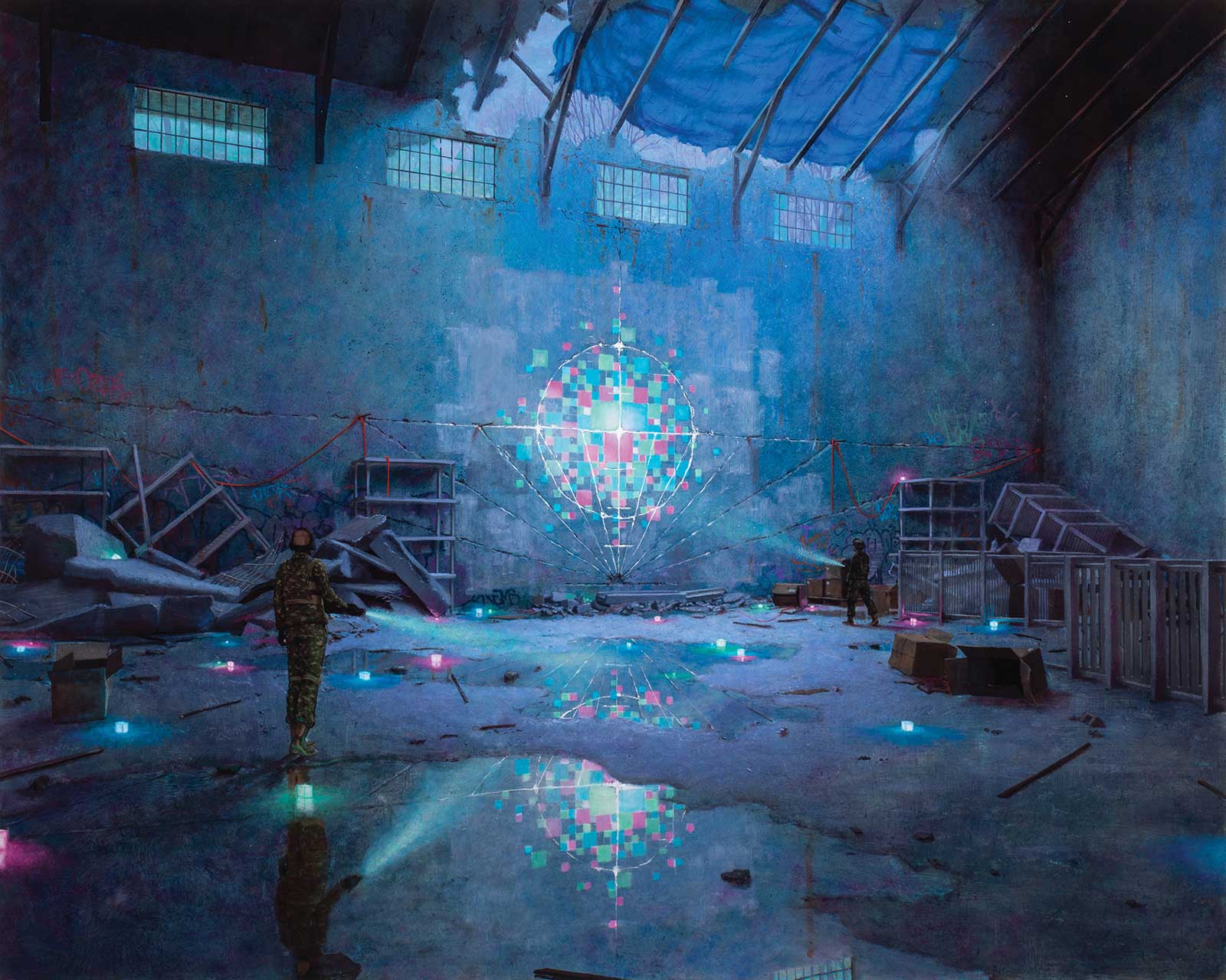 Ancestral Interface, oil on birch panel, 48 x 60"Schultek’s work takes us to the forsaken landscapes of colossal broken conduits and cracked slabs on the fringes of the wealthy world of rule, but a light appears within the wreck, cutting through hazy despair—a transcendent light that glows even within the mess and decrepitude of urban life. The light is in the distant matrix hovering in acidic purple haze at the drainage tunnel’s end. It radiates behind the uniquely clean scraped glass window of the steel door to the sepulchral shelter and in the enigmatic monogram above it. It is encoded in the pastel gridded flicker-screen of an arcade game hacked by unearthly and artificial intelligence, glowing with the sharp brightness of phthalocyanines, carbazoles and quinacridones, an outlandish and unnatural light burning against grays and browns. The light is a shining reminder that the outsiders who watch the privileged bunker are hungry for hope from the digital world. And there is power in infiltrating technology. Schultek says, “The most recent painting, Super Lucid, of the guy lifting the train, that’s someone who’s spent enough time in the digital world to manipulate space—that’s in the future—I’m still speculating.”
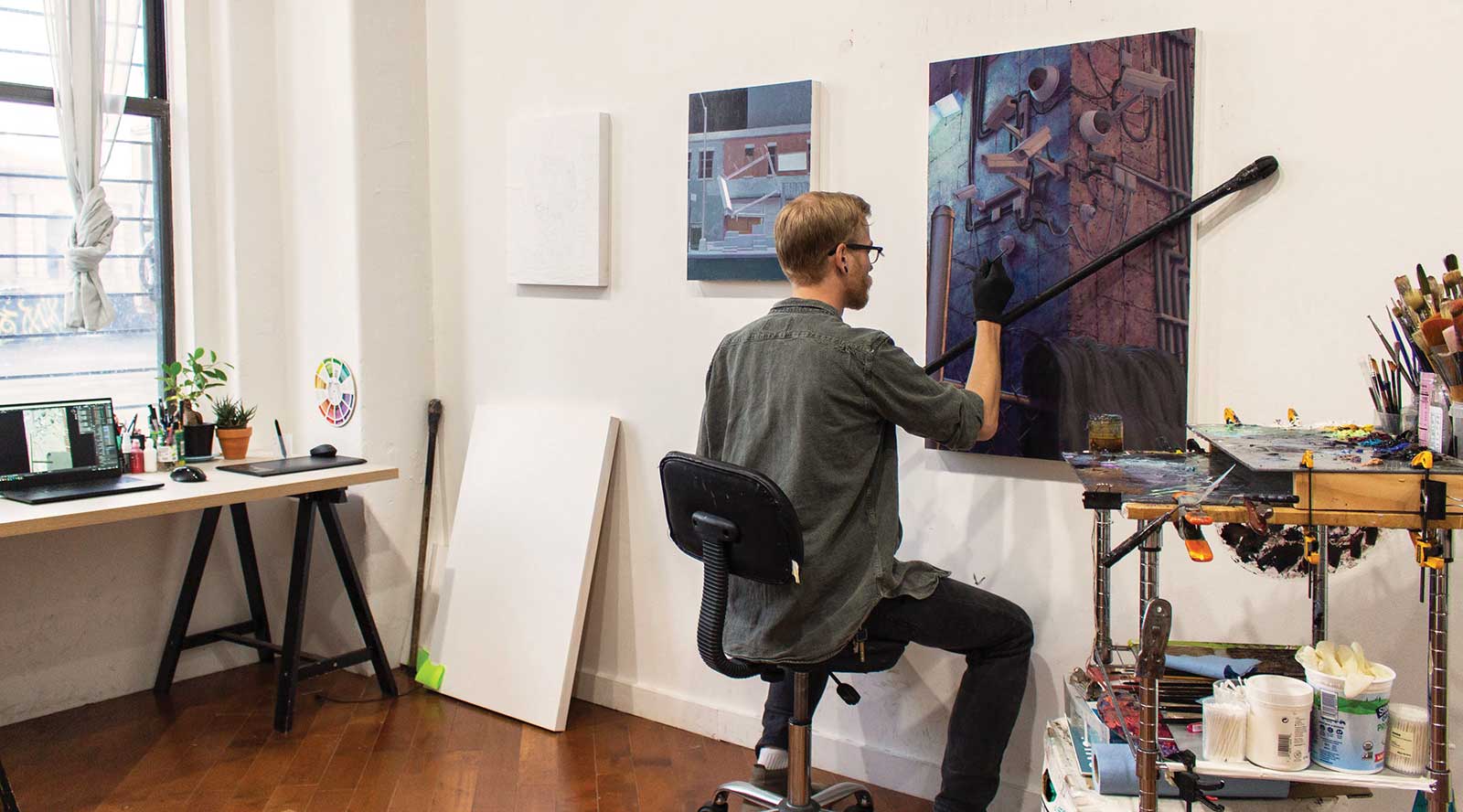 Taylor Schultek paints in his studio.In a shattered warehouse, camouflaged men stare at a neon-bright cryptogram deeply scored into the plaster of the rust-stained wall like a sorcerer’s ritual diagram for summoning demons, with radiant colors reflected in puddled water—scattered in the ruin, radiant cuboids shine in sharp pinks and blues. “I just finished reading an awesome book called TechGnosis, by Erik Davis," says Schultek. “He’s tying the spiritual movement to tech, Silicon Valley to the wellness spirituality of California, how communication and the languages of technology get adopted for different purposes, and as it grows, technology has different spiritual effects, too...” This Ancestral Interface is medieval natural magic turning techno. Overhead a ragged tarpaulin flaps above the smashed ceiling and unanswered questions float in the blue space—is artificial intelligence here to save us or slaughter us? Can technology solve our societal problems? Sensibly, Schultek offers no explanations, and we must unravel these problems for ourselves. New science is always magic to the uninitiated. —
Want to See More?
www.taylorschultek.com
Powered by Froala Editor