Stephen Towns was born in South Carolina and now lives and works in Baltimore. In 2016, he went to Ghana where he saw people who looked like him and could easily have been relatives. Often when people visit their ancestral homeland, they feel they have found their true home. Towns, however, says, “The experience made me realize how American I am. I came home to embrace my Americanism.”
His figurative paintings and story quilts explore the subject of race and its effects as well as the role of African Americans in shaping this country.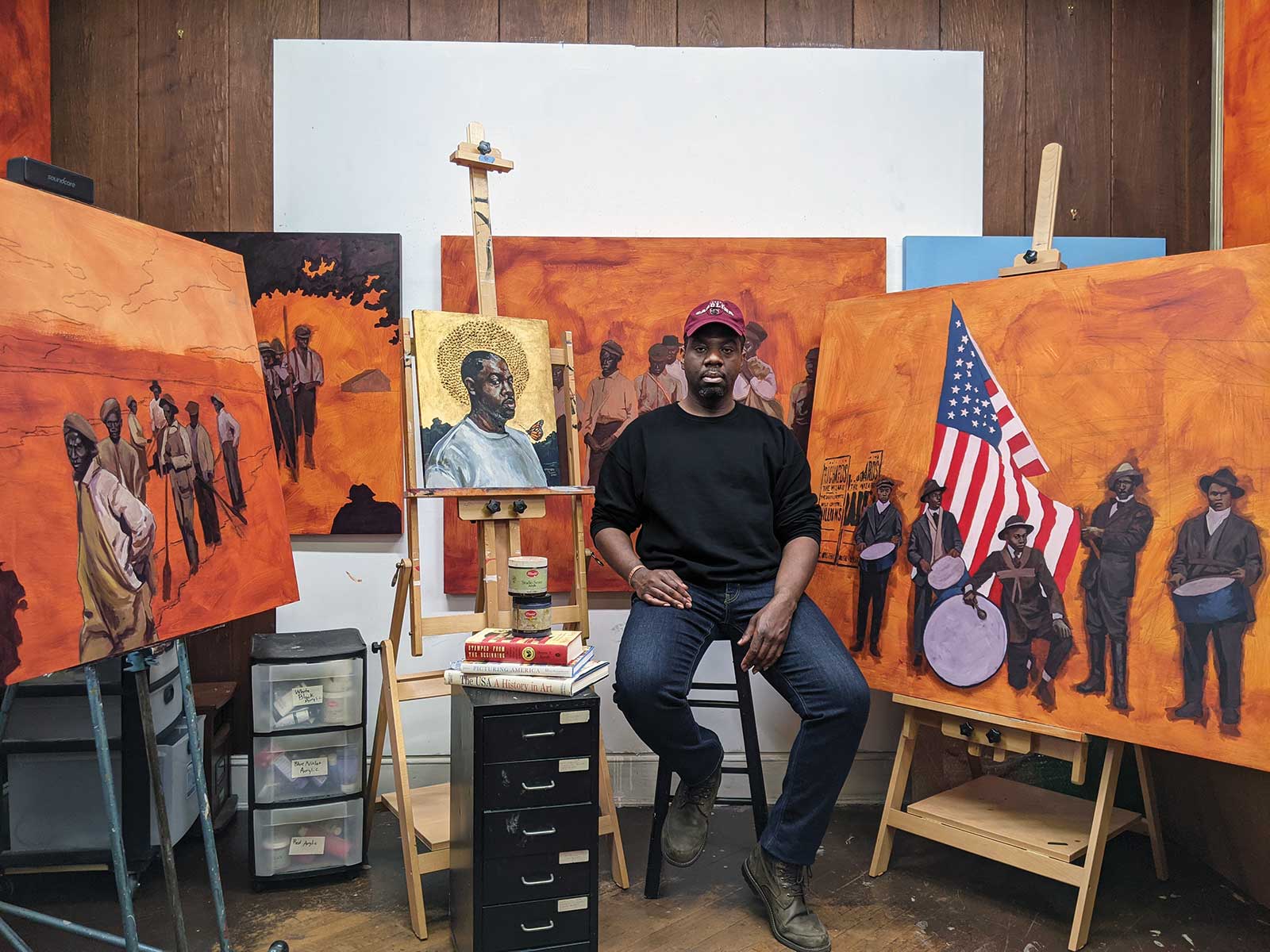 Stephen Towns in his studio. Photo by Jermaine Táron Bell.
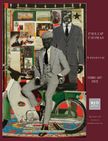
The Westmoreland Museum of American Art in Greensburg, Pennsylvania, will present an exhibition of his work, Stephen Towns: Declaration & Resistance, January 30 through May 8. After the Westmoreland Museum it will travel to the Boise Art Museum in Idaho, and Reynolda House Museum of American Art in Winston-Salem, North Carolina. The curator, art historian Kilolo Luckett, says, “Through his beautifully imposing quilts and mixed-media paintings, Stephen offers viewers sobering truths and tender stories of Black life that break away from dominant narratives that continue to plague society in the United States of America.”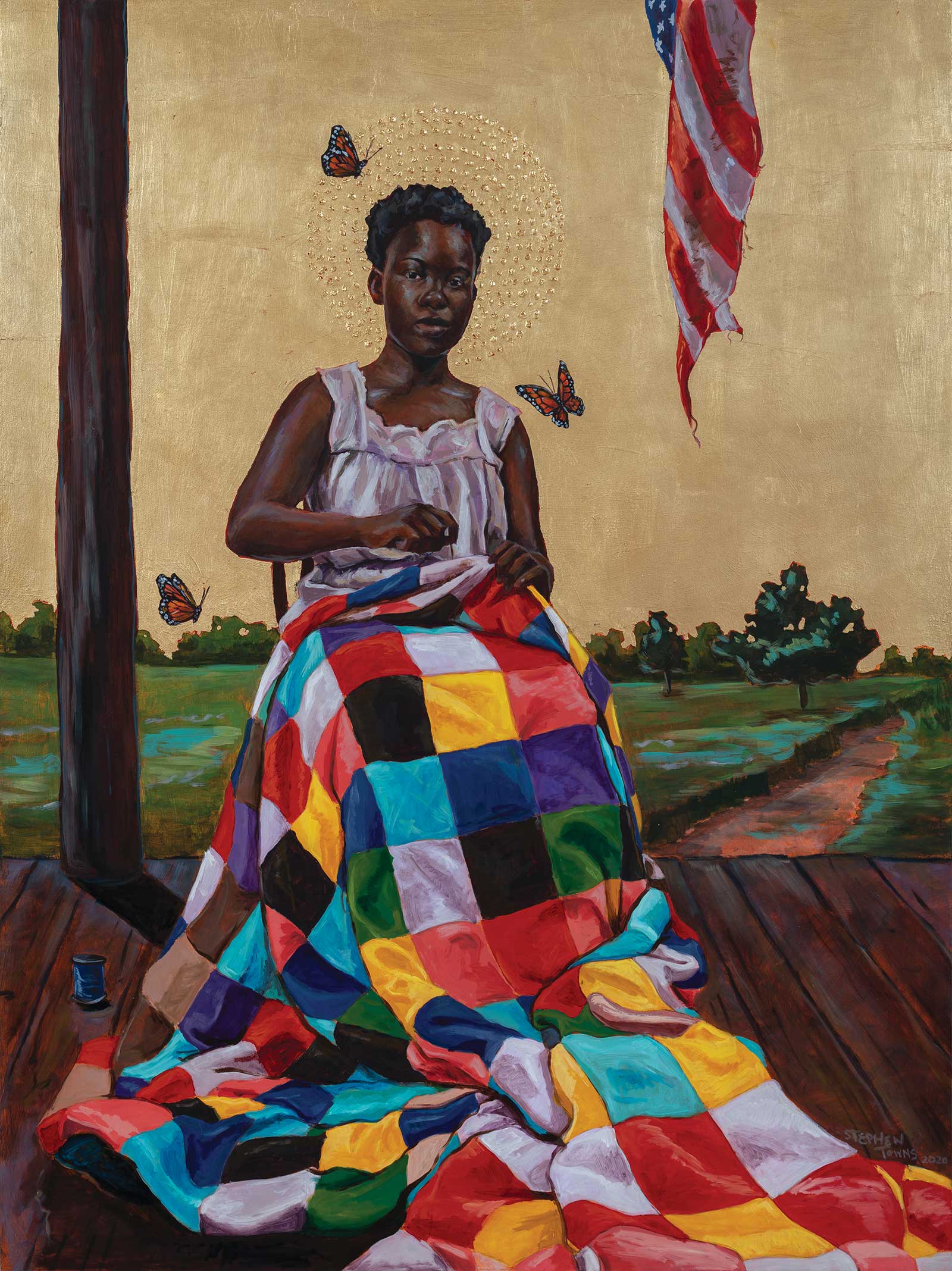 I am the Glory, acrylic, oil and metal leaf on panel, 48 x 36". Courtesy of the artist and De Buck Gallery.
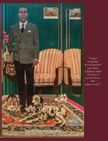
Towns explains, “Much of the work in Declaration & Resistance began when I was quarantining in the spring of 2020. When I returned to my studio, I reflected on how I had gained a deeper appreciation for essential workers risking their lives in the midst of a global health crisis. I come from a long line of laborers in Georgia and South Carolina. Prior to being a full-time artist, I also worked many laborious jobs. This show is a testament to my ancestors and also the coworkers I have befriended along the way.”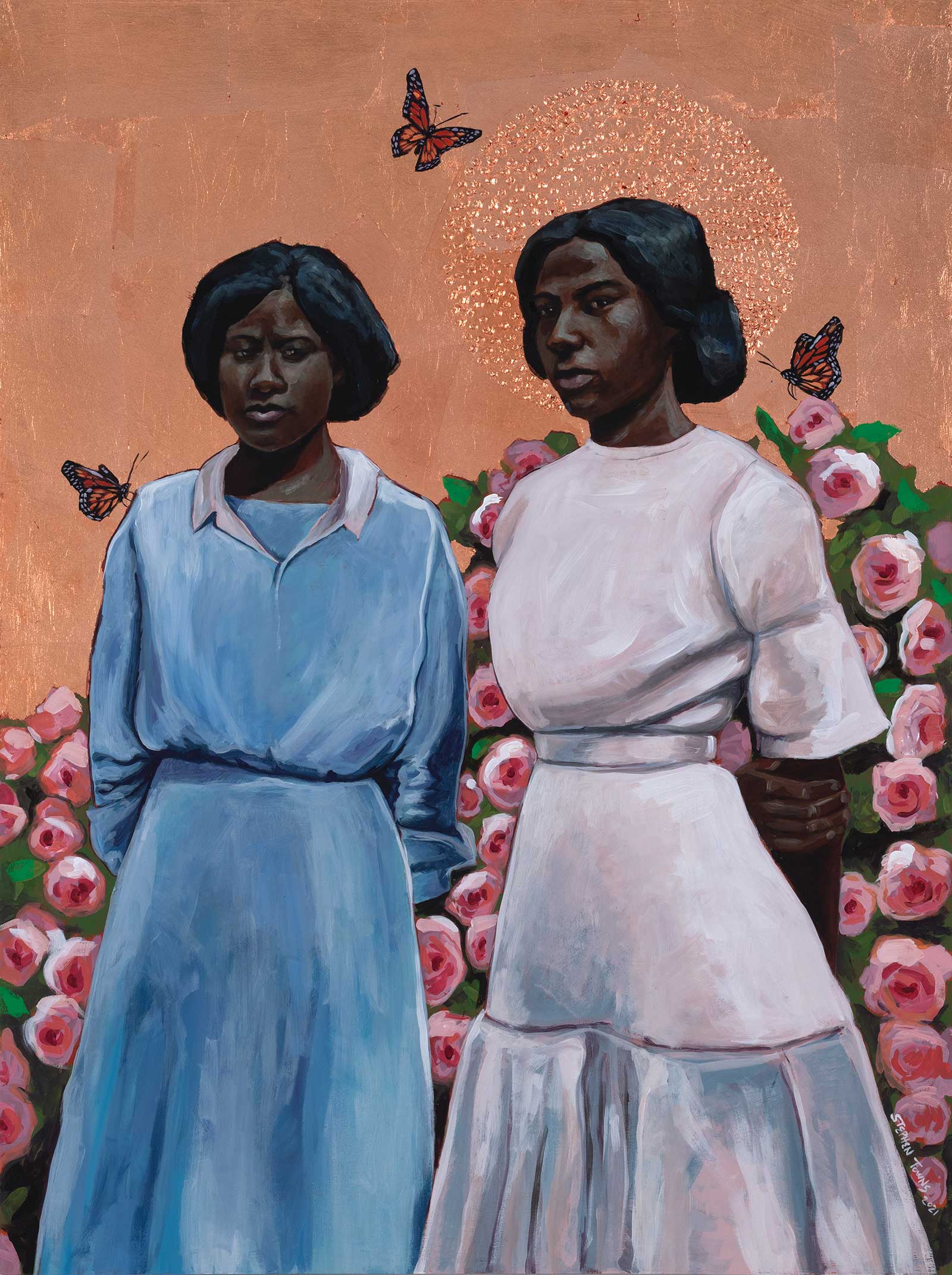 Two Roses, acrylic, oil and copper leaf on panel, 40 x 30"
He was laid off from a job at a medical university. Unemployed, he couch-surfed for two years and then became a program coordinator in the Office of Community Engagement at the Maryland Institute College of Art in Baltimore. Making art on the side, he delved into learning about the city and its peoples. He says, “I wanted to understand why things are the way they are and delved more into the history of slavery. When you look at history you read about people descended from royalty. I am descended from a long line of workers. We are royalty in our very being.”
He has created eight new quilts for the exhibition, one of which is Ona Judge and Her Family, a depiction of an enslaved person in the home of George and Martha Washington who escaped to live as a fugitive in New Hampshire.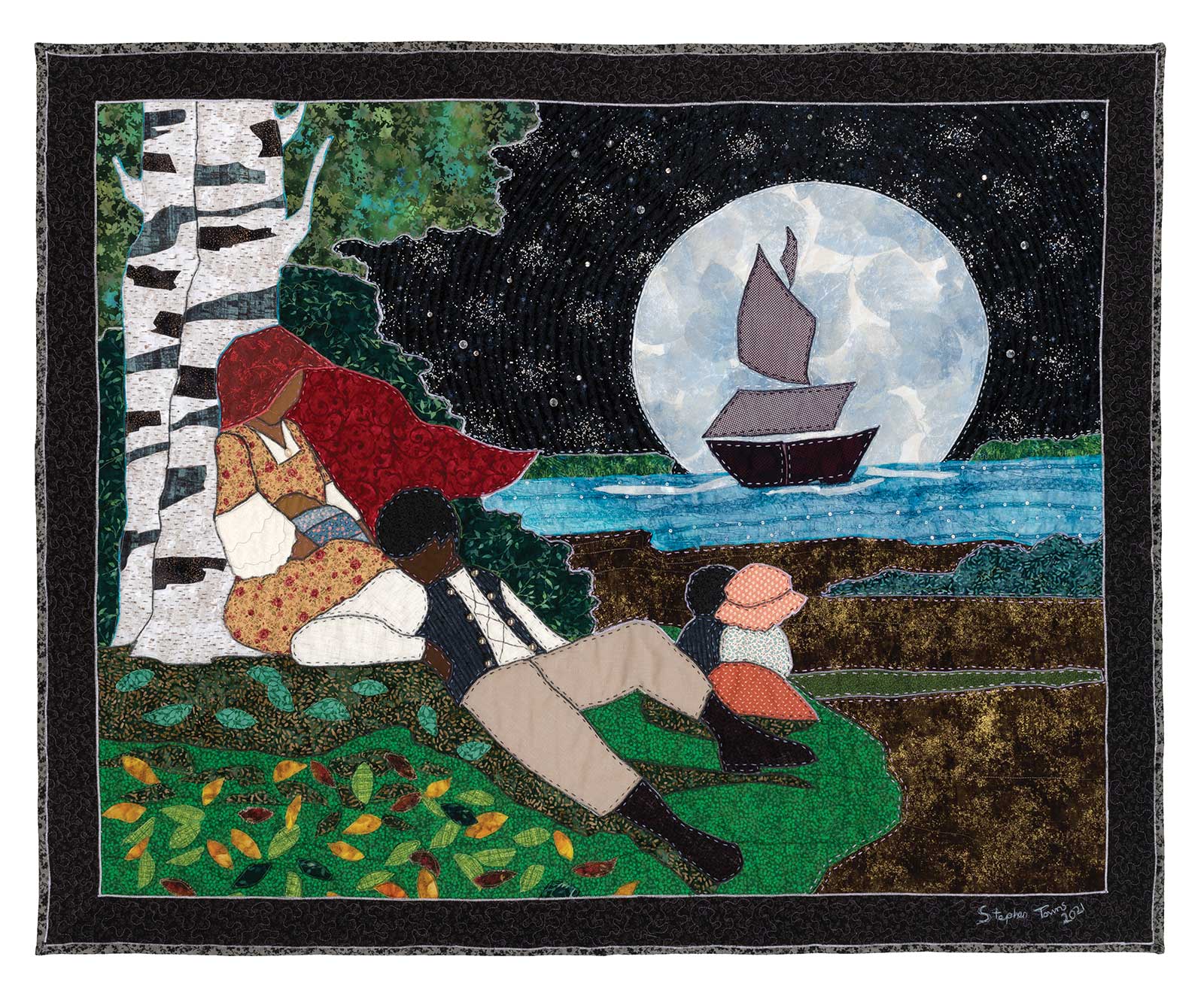 Ona Judge and Her Family, natural and synthetic fabric, polyester and cotton thread, crystal glass beads, metal and resin buttons, 43½ x 54½"
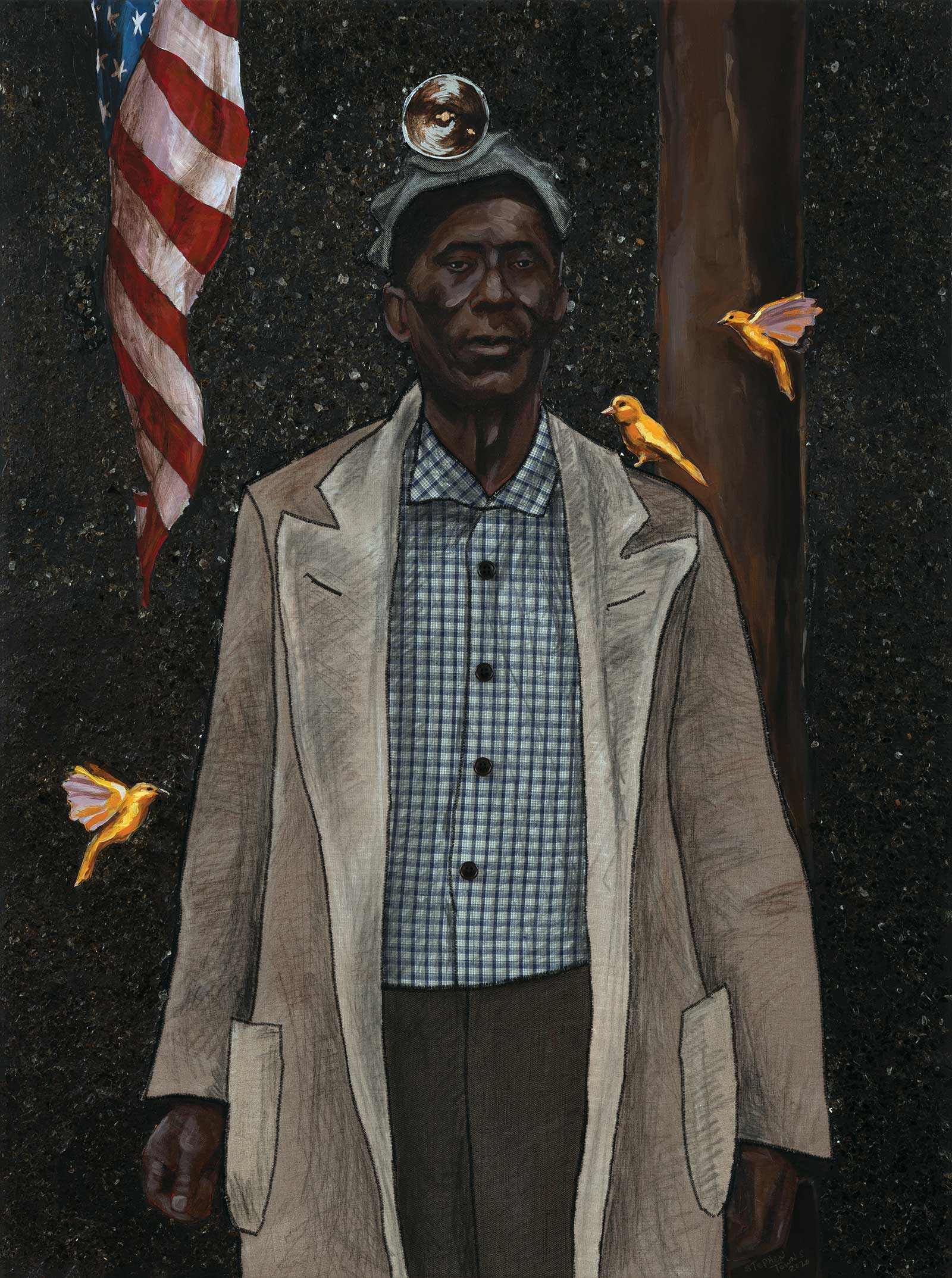 The Pioneer, oil, acrylic, fabric, buttons, Bristol paper, mica flakes, graphite, glitter and charcoal on panel, 40 x 30". The Westmoreland Museum of American Art, Gift of the William W. Jamison II and the Thomas Lynch Art Acquisition Fund, 2020.16.
“My mother was a quilter,” he says, “and I worked with fabric occasionally as a child. Working with fabric today, I have developed a deeper respect for the material and for the people who make the materials and work with them. I enjoy looking for the type of material I use in my quilts. It has patterns reminiscent of the late 1880s and early 1900s and is fairly difficult to find. Sometimes when I go into fabric stores I get a look like ‘What are you doing in here?’ I have images of my work on my phone and often begin conversations about fabric and quilting.”
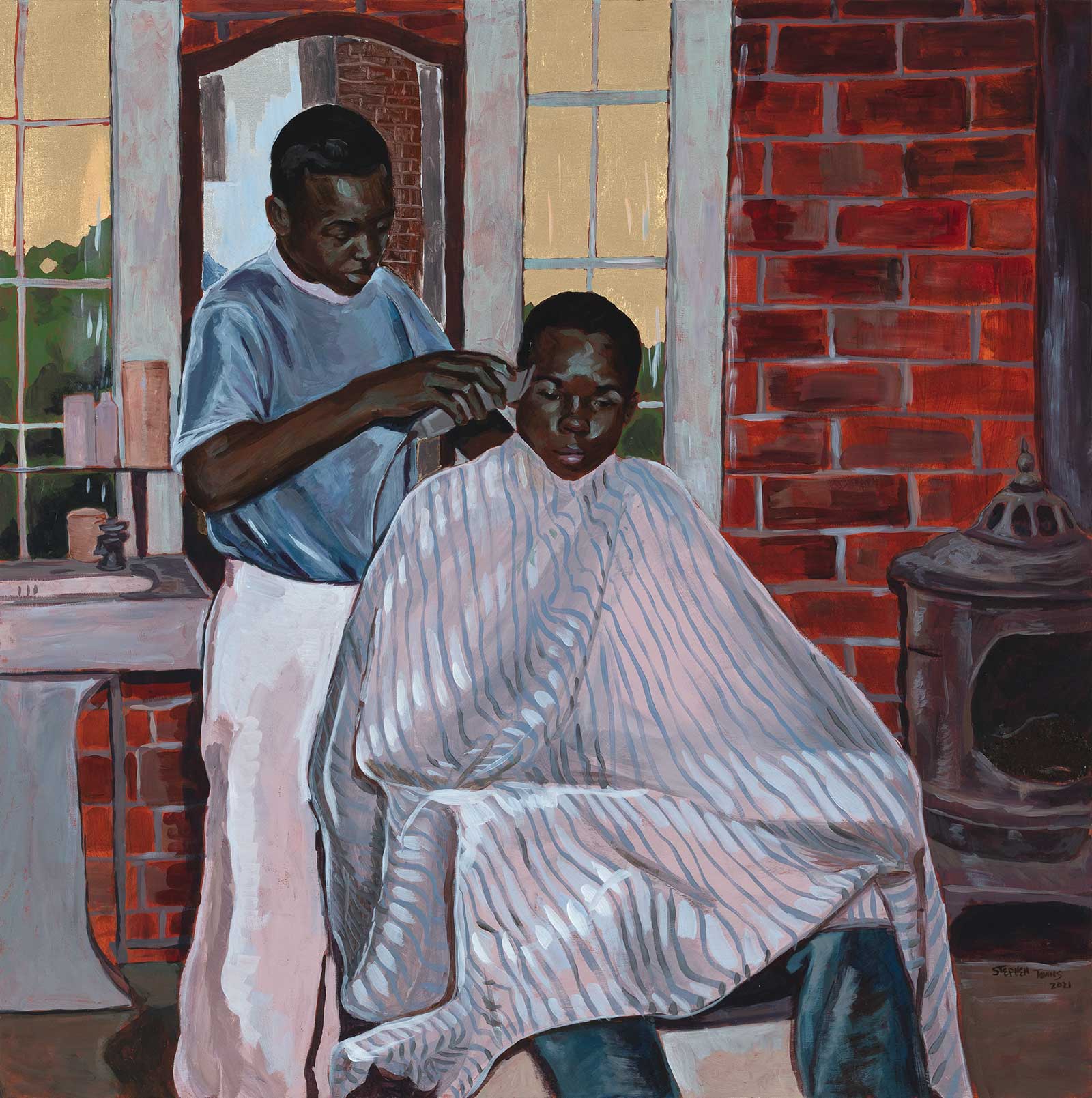 Shaping Up, acrylic, oil, metal leaf and silver leaf on panel, 36 x 36"His paintings of coal miners are complex constructions of, as the caption reads, “oil, acrylic, fabric, buttons, Bristol paper, mica flakes, graphite, glitter, charcoal on panel.” The images come from his research in archival materials. He notes, “Down in the coal mine the men are part of a collective. But out of the mine and washed up, they became separated into their various ethnicities.”
One of his paintings, I am the Glory, features a model who he photographed years ago and a colorful quilt that belonged to his husband’s aunt. The woman sits on her porch sewing her quilt with a gold nimbus behind her head and monarch butterflies fluttering around it. 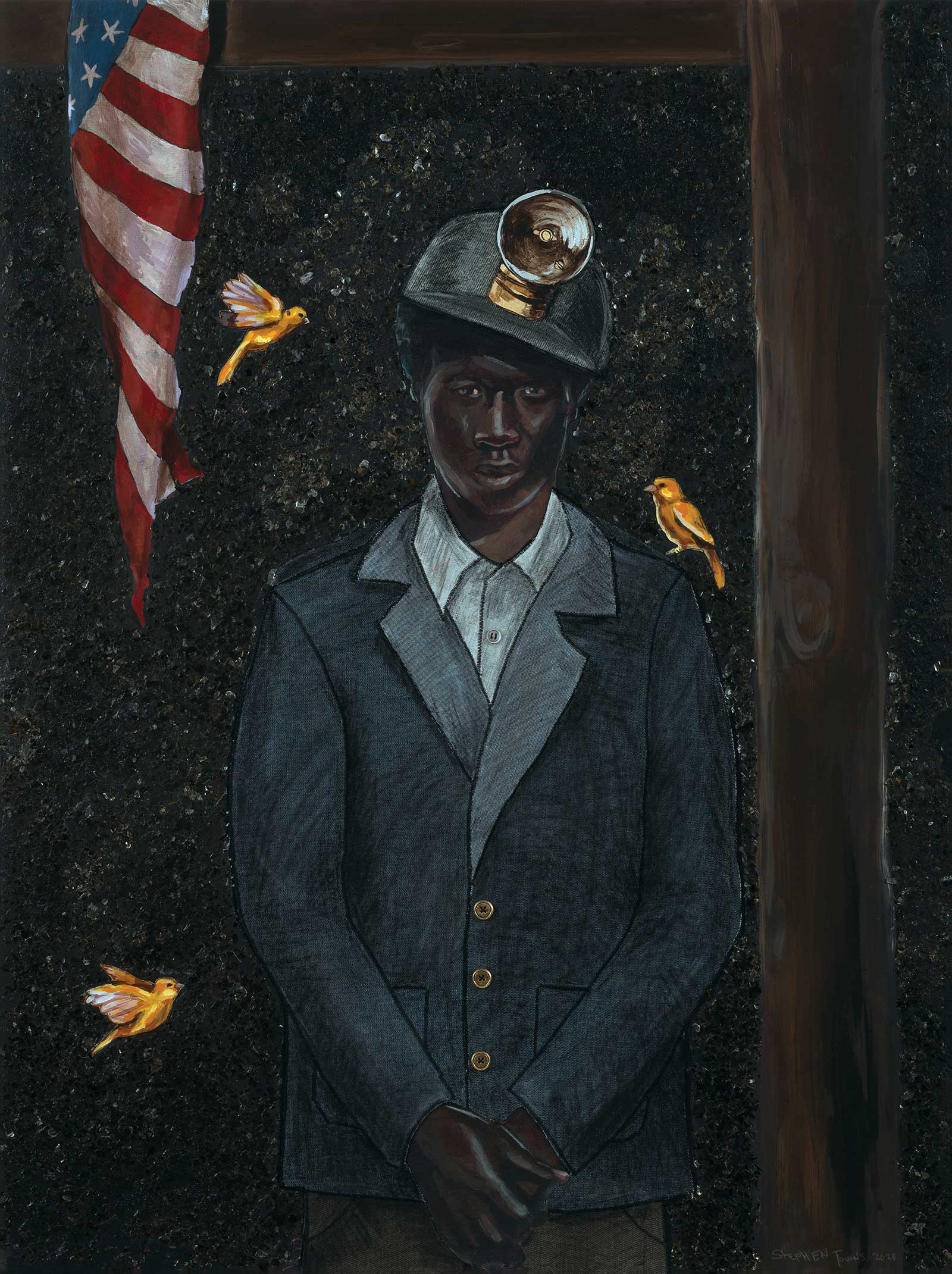 Built of Rich Earth, oil, acrylic, fabric, buttons, Bristol paper, mica flakes, graphite, glitter and charcoal on panel, 40 x 30"
Towns explains, “I grew up a Jehovah’s taught that God is above all things and about coming of the end times. I never thought I would see myself as 40 because the end times would come before that. In college, my professor was interested in Catholic iconography and Byzantine and medieval art. I’ve adopted metal leaf in my work, especially in the golden halos, to show my new perception of God as an all-encompassing reflective thing.
“The monarch butterfly represents spirituality,” he continues. “I refer to their beauty and their long migration. You can capture one and pluck off its wings, but you can’t stop the mass. They represent the migration and struggle of Black people in America.” —
Westmoreland Museum of American Art
221 N. Main Street • Greensburg, PA 15601
(724) 837-1500 • www.thewestmoreland.org
Powered by Froala Editor