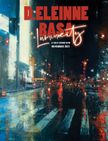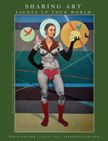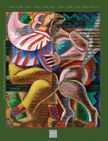
The Otherworld is an exhibit of visionary paintings by artists who imagine the world as another place, where alternatives to everyday reality are made manifest. There are many paths to this other world—chemical, religious and imaginative—and all are treated with equal respect in the exhibit, which seeks the common ground that lies between the psychedelic explorations of the Californian hippy movement, the visions born from contemporary spiritual inspiration and artistic imaginings of how the world might be re-created.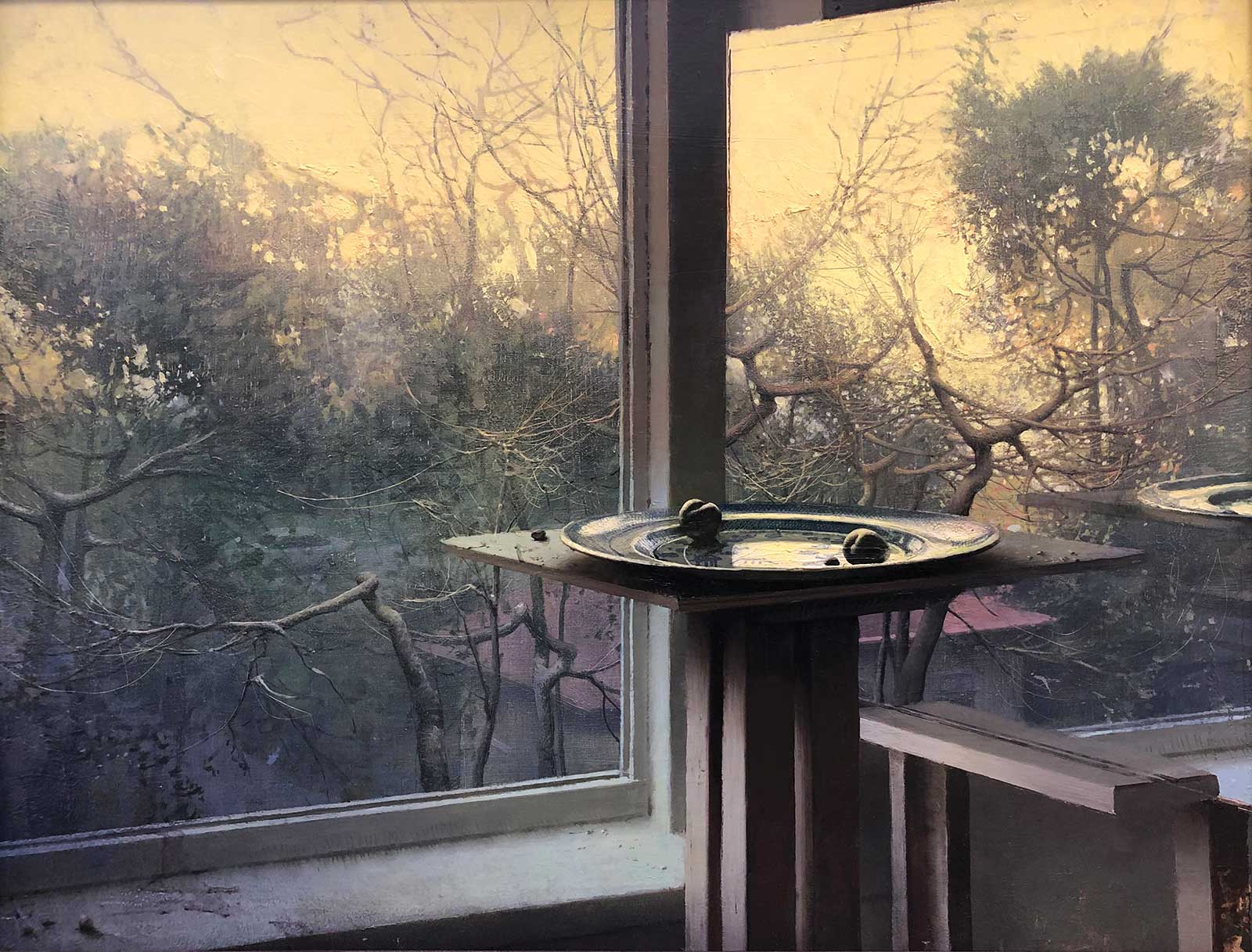 Daniel Sprick, Vapor and Dusk #2, oil on board, 20 x 26"
Surprisingly, the roots of Californian visionary art were first found in Germany among the members of the anti-authoritarian Wandervögel (Wandering Bird) youth movement, which flourished in the first two decades of the 20th century. Wandervögelers joined together on long rambles across the countryside, sleeping in barns or camping in tents, playing revived folk music and writing new songs in folkish style. Many of them became nudists, practiced the novel idea of sunbathing for health and ate a vegetarian diet. Although disinterested in materialism, the movement found an artistic voice in the transcendent work of Fidus, whose ecstatic drawings perfectly captured the mood of the movement.
Young German immigrants arriving in California in the 1930s brought with them the counter-cultural ideas the wandervögelers championed—these “nature boys” were deeply committed to the alternative lifestyle, which later became central to the new age hippy movement.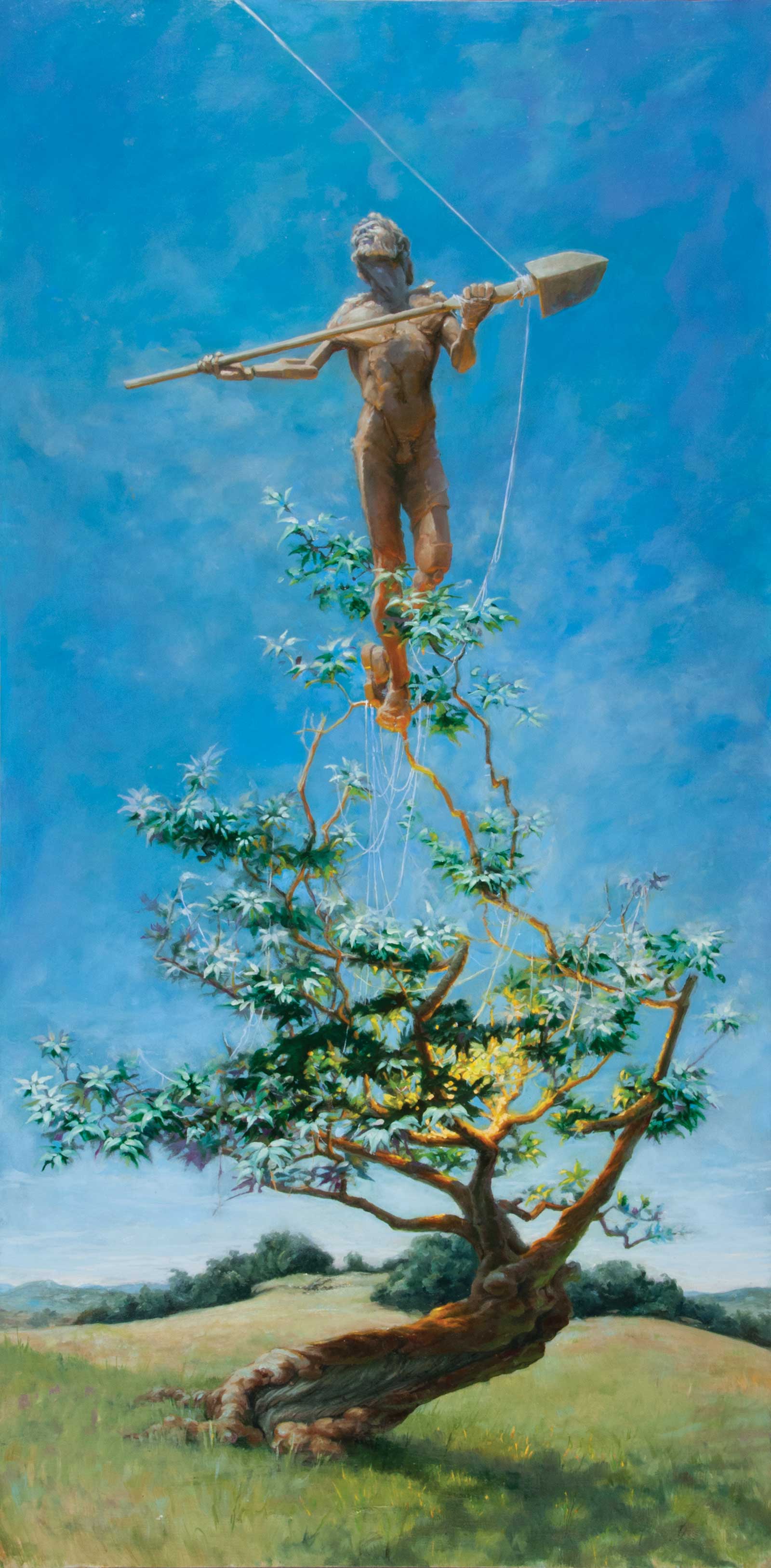 Guy Kinnear, Drawing Sun, oil on panel, 48 x 24"
The visionary aesthetic began a dramatic evolution when on April 16, 1943, a Swiss chemist named Albert Hoffman synthesized lysergic acid diethylamide, and accidentally absorbed a tiny amount of the chemical through his skin. The effects were dramatic. He closed his eyes and “perceived an uninterrupted stream of fantastic pictures, extraordinary shapes with intense, kaleidoscopic play of colors.” Impressed with the potential of the powerful substance, a few days later he ingested 250 micrograms in his laboratory. This time, the effects were so strong that he left work and rode his bicycle home where he relished the experience of the first LSD trip. When LSD met the nature boys of California, contemporary visionary art was born, and a new aesthetic took form.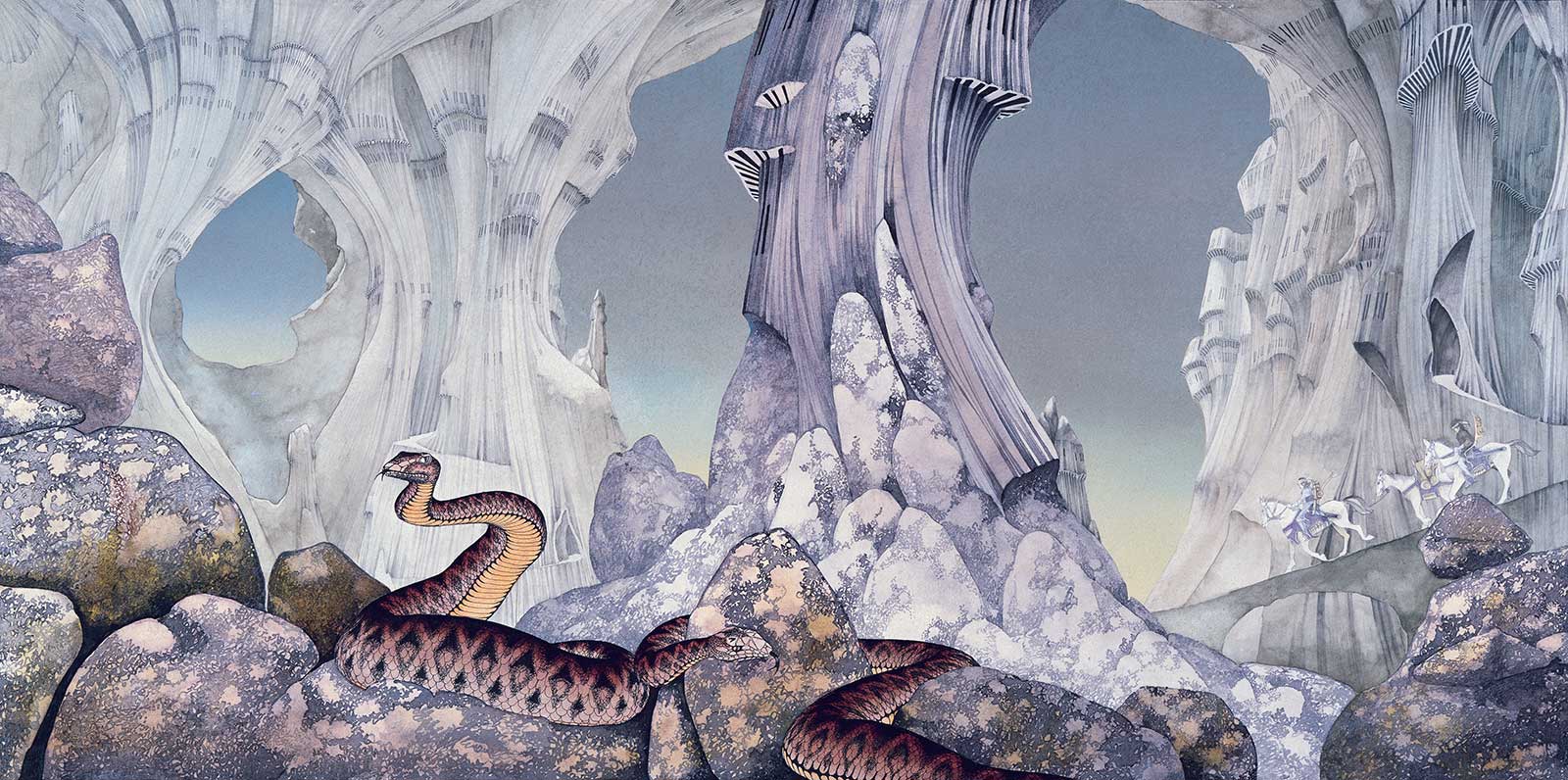 Roger Dean, Relayer, mixed-media and watercolor on board, 16 x 32"
Thomas Akawie, Cliff McReynolds, Bill Martin, Gage Taylor and Uriel Dana were among the original California visionary artists who first gained widespread fame in Walter Hopps’ essential book, Visions. Akawie’s work began with heavenly landscapes and evolved through abstraction into skies and seascapes in airbrushed acrylic. Taylor produced beautiful and ethereal paintings of woodlands and forests and collaborated in making early visionary work with Dana under the name Taylor Dana for 17 years. The contemporary art of California’s new age spirituality overlapped with mystical Christian themes in McReynolds’ work, which explored the outsider art of the hippy movement, Rosicrucianism, and psychedelic art of the 1970s, and used the iconography of Christian symbolism with remarkable freshness.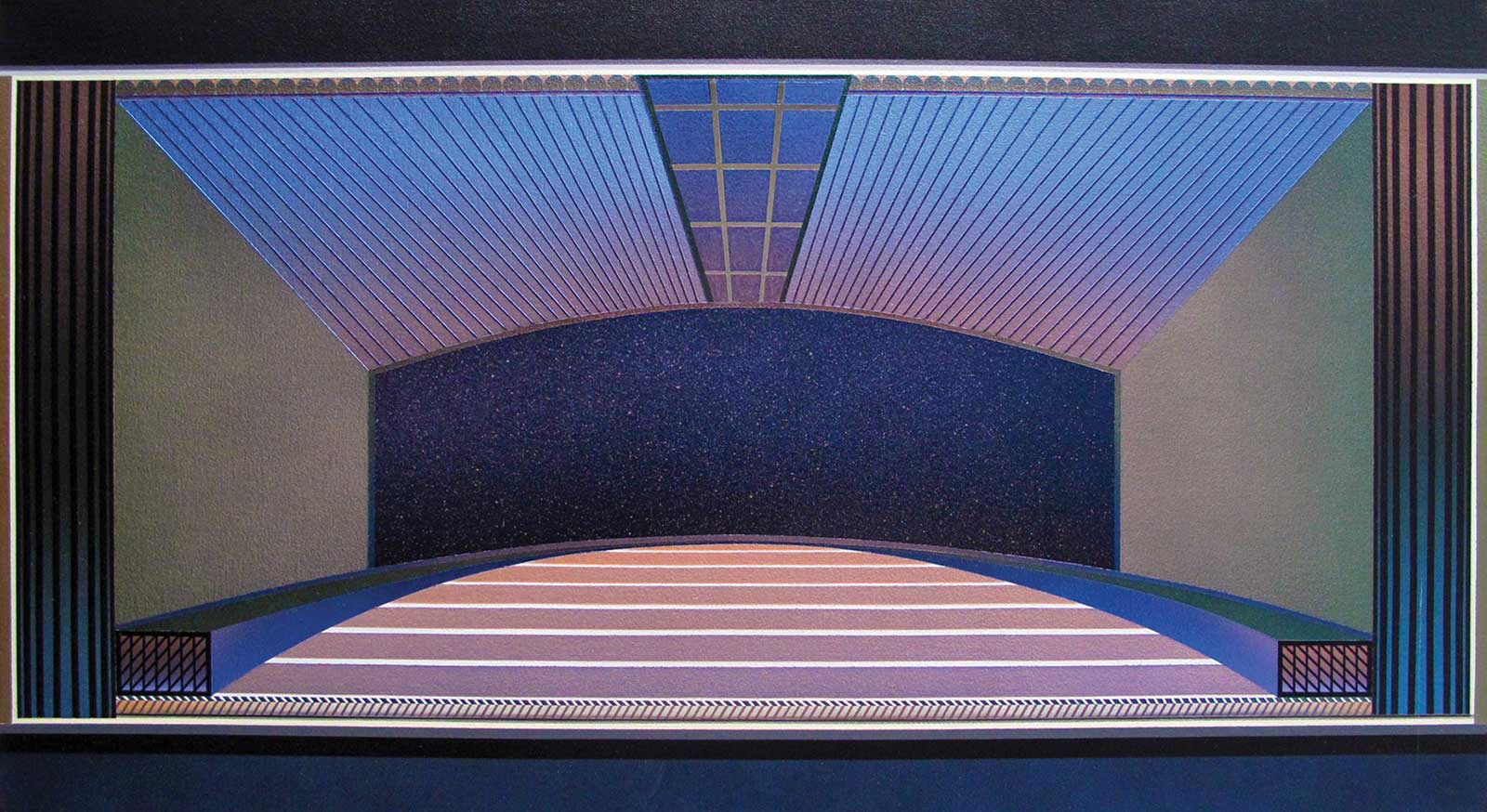 Thomas Akawie, Interior with Space Window, acrylic on canvas, 20¼ x 36½"
The visionary art of the 1960s took root in England, too, where artists like Roger Dean became popular figures of the British counterculture. Dean is the brilliant designer of iconic cover art for classic rockers Yes, producing fantastic images that are imprinted on the minds of millions of avid fans. His paintings capture the spirit of progressive rock especially in the coiled and predatory snakes and gracefully soaring rock formations of his extraordinary watercolor Relayer.
Since the psychedelic ’60s and stoned ’70s the subject matter of the visionaries has expanded, influenced by developments in technology and neuroscience. As the genre matured and became increasingly valuable, its paintings became increasingly sophisticated, and techniques expanded to include grisaille painting and Old Masters’ techniques; early airbrush work evolved into the sophisticated finishes of digital art. Mars-1 is the exemplar of the new wave of psychedelic painters—his Nuclear Mystics captures the new mood perfectly. His beautifully soft and romanticized work brings a new aesthetic to the genre—sophisticated and rendered with a restrained palette—his is a new species of visionary art, and he is its champion. Mars-1 and Alex Grey (of Tool cover art fame) have worked together to commemorate Hoffman’s historic experiment in a collaborative painting titled bicycle day.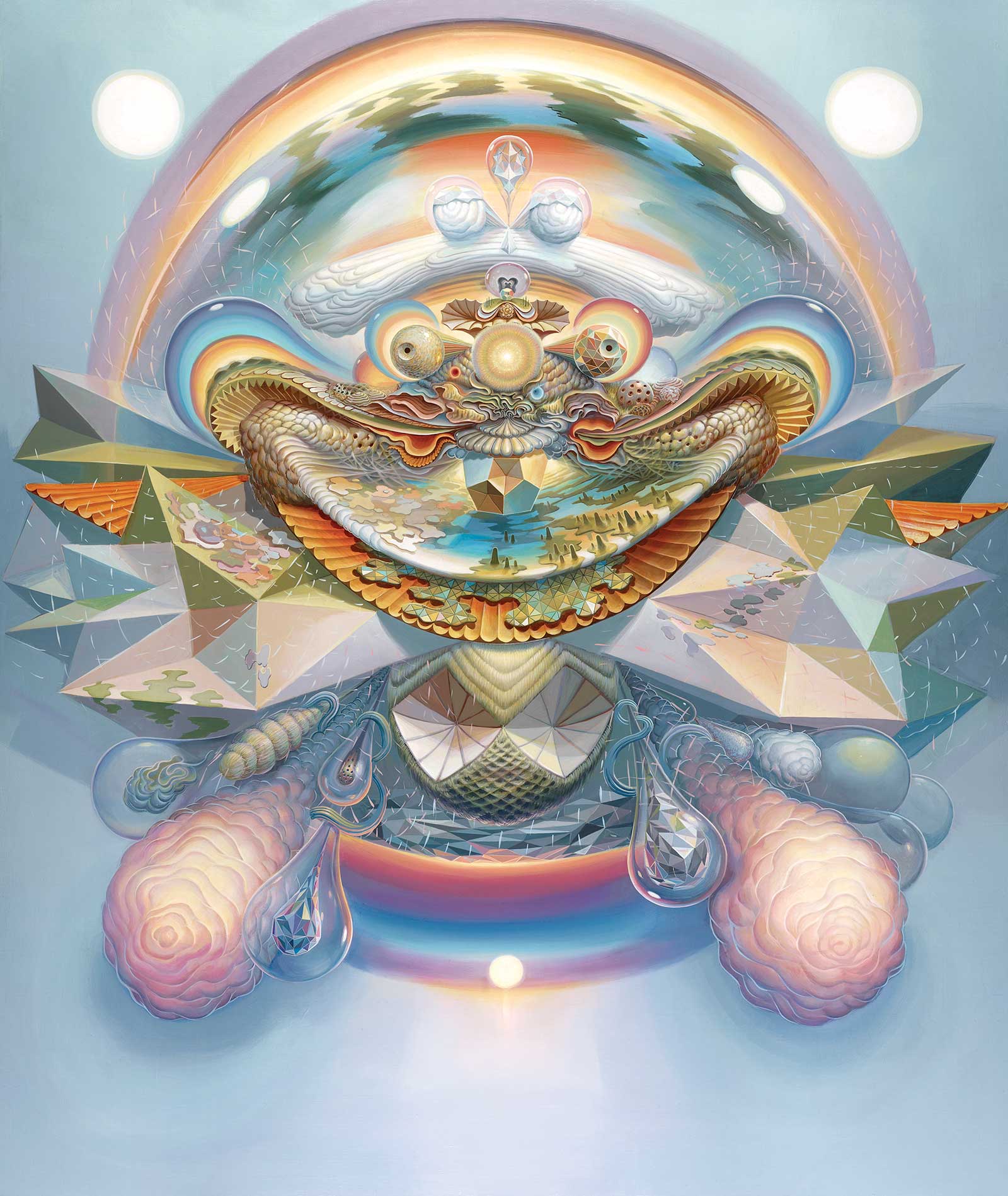 Mars-1, Nuclear Mystics, acrylic on panel, 72 x 60"
Although overlapping with psychedelic and religious visionary art, many artists are centrally focused on creating images of other worlds from their thoughts and daydreams. Theirs are secular fantasies. In Poland, Dawid Figielek has inherited the mysterious traditions of the artists of Northern European romanticism, and paints sublime images of monolithic pillars of light watched by diminutive figures within shrouded landscapes.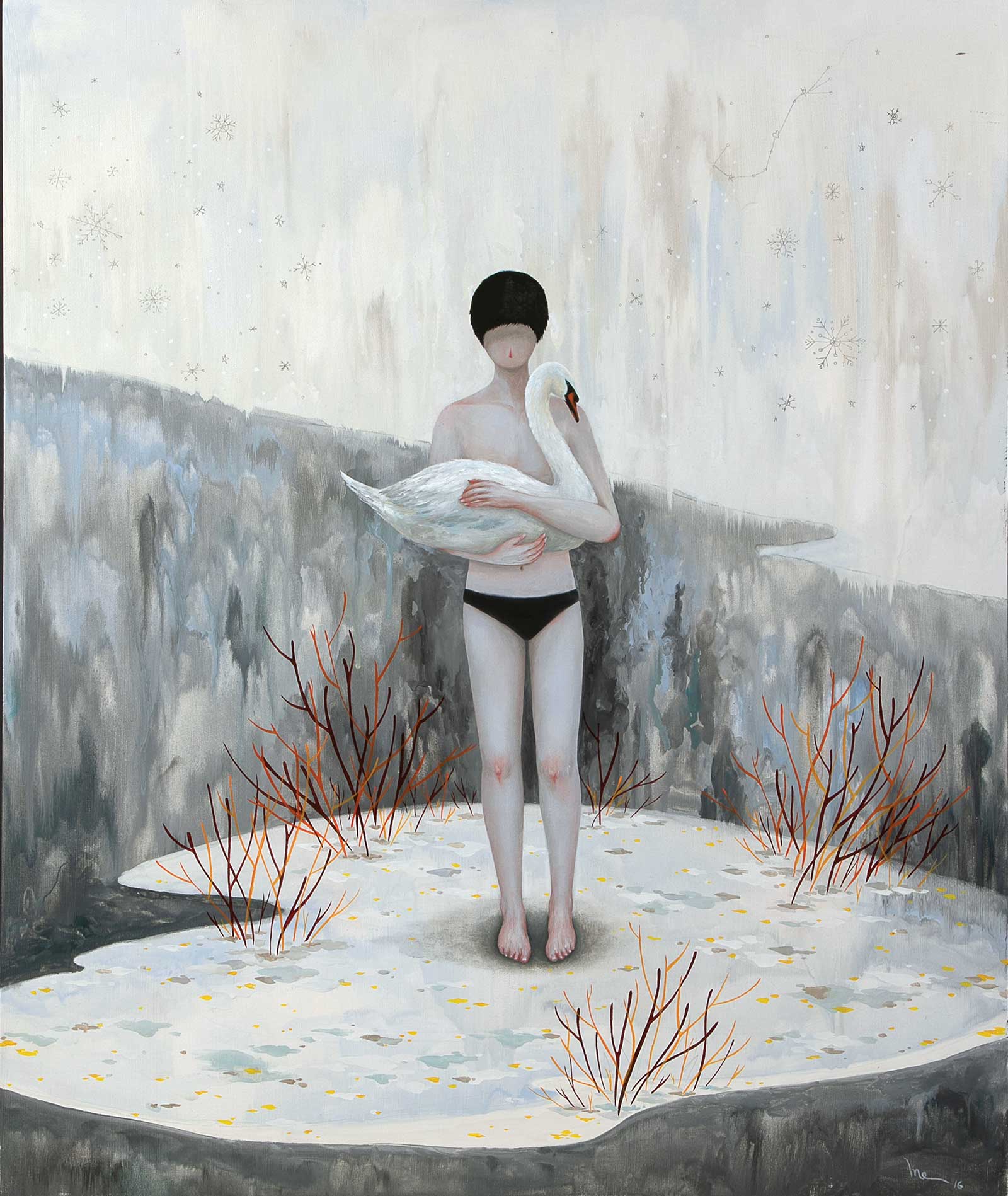 Mandy Cao, Untitled (Swan), oil on panel, 24 x 20"
Like Mars-1 the Irish artist Graham Toms has redefined the boundaries of the aesthetic. While Mars-1 has pushed forward into genial and gentle psychedelia, Toms has expanded the range of imaginative realism by creating a fantastic but coherent world of articulated creatures built upon the ancient logic of Acadian myths to give them a deep narrative structure, and imagined a world populated by strange biomechanical creatures, where DNA has mutated and created virulent forms which morph and overrun unfamiliar landscape. His Isle of the Dead emulates the great painting by Arnold Böcklin, where the serene island is the calm of death’s refuge, but in Toms’ version, the haven is set behind a writhing frame of insectoid and crawling creatures—it’s a world born of cyberpunk, of the intersection between digital and analogue, of dream and nightmare—and his aesthetic is new and unfamiliar, incorporating his own cartoon logic of structure, function and motion with solid painterly craftsmanship. Toms has achieved the artistic grail. He has a unique style, and knows what he is doing with it.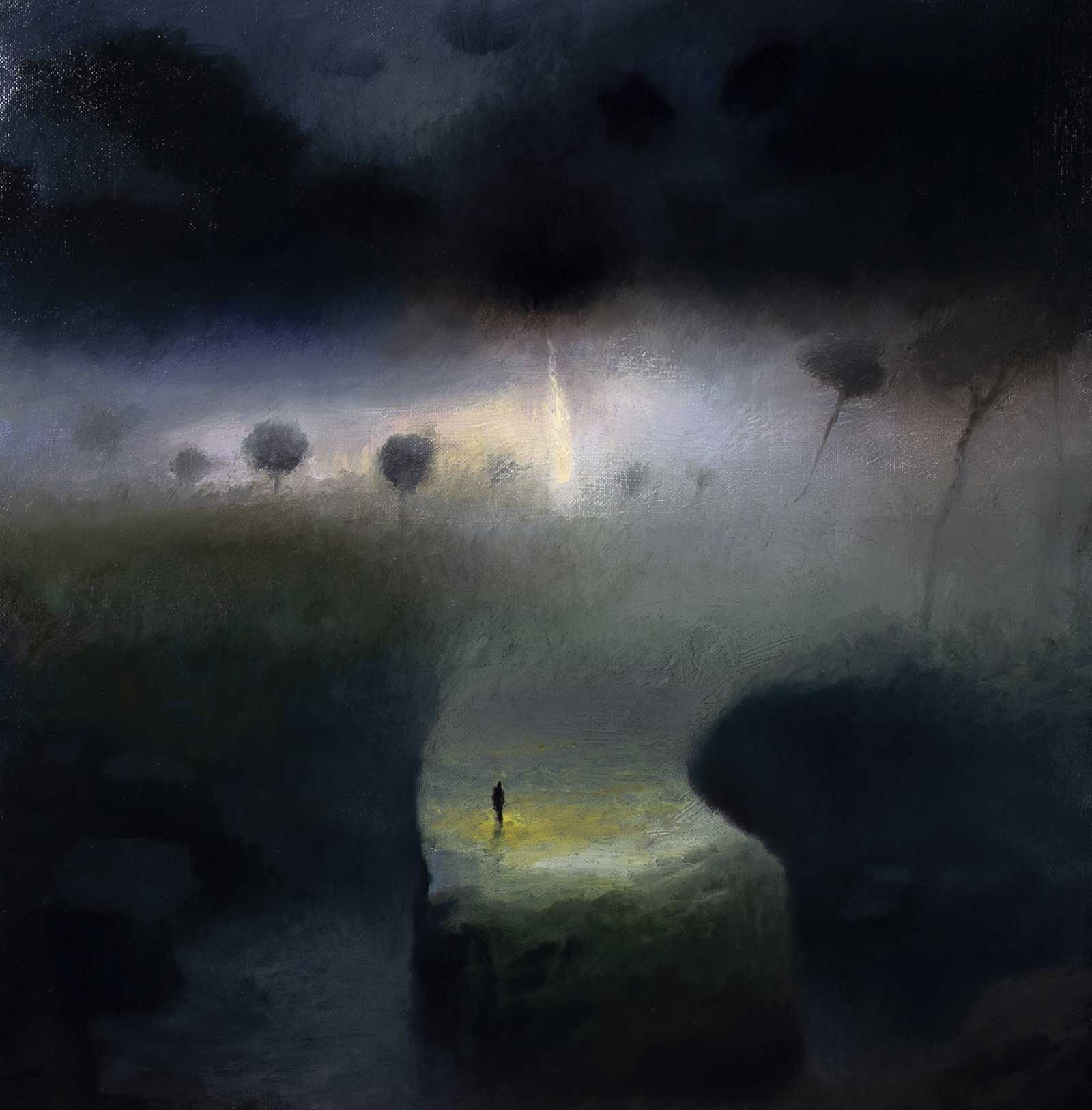 Dawid Figielek, Nocturne, oil on canvas, 19.68 x 19.68"
In Denver, the brilliant painter Daniel Sprick has refined his observational painting skills to such a high degree that his imagined landscapes are absolutely convincing, yet mystically lit and otherworldly. He has turned light inward, so that it glows from within the living land, which is made magical by his invention. Guy Kinnear’s strange paper and clay golems stride against dreaming landscapes, looming over the rising sun and the bloody moon. They are a combination of pragmatic craftsmanship and a surreal imagination—he sculpts his curious homunculi and paints them into the rolling hills which surround his off-grid home near Paso Robles. Another Californian, Mandy Cao, pauses between painterly modernist figuration and the wistfulness of contemporary imaginative realism. Internalizing and psychoanalytical, she focuses on the rites of passage of transformation from adolescent girl to young woman within a gently alien dreamscape.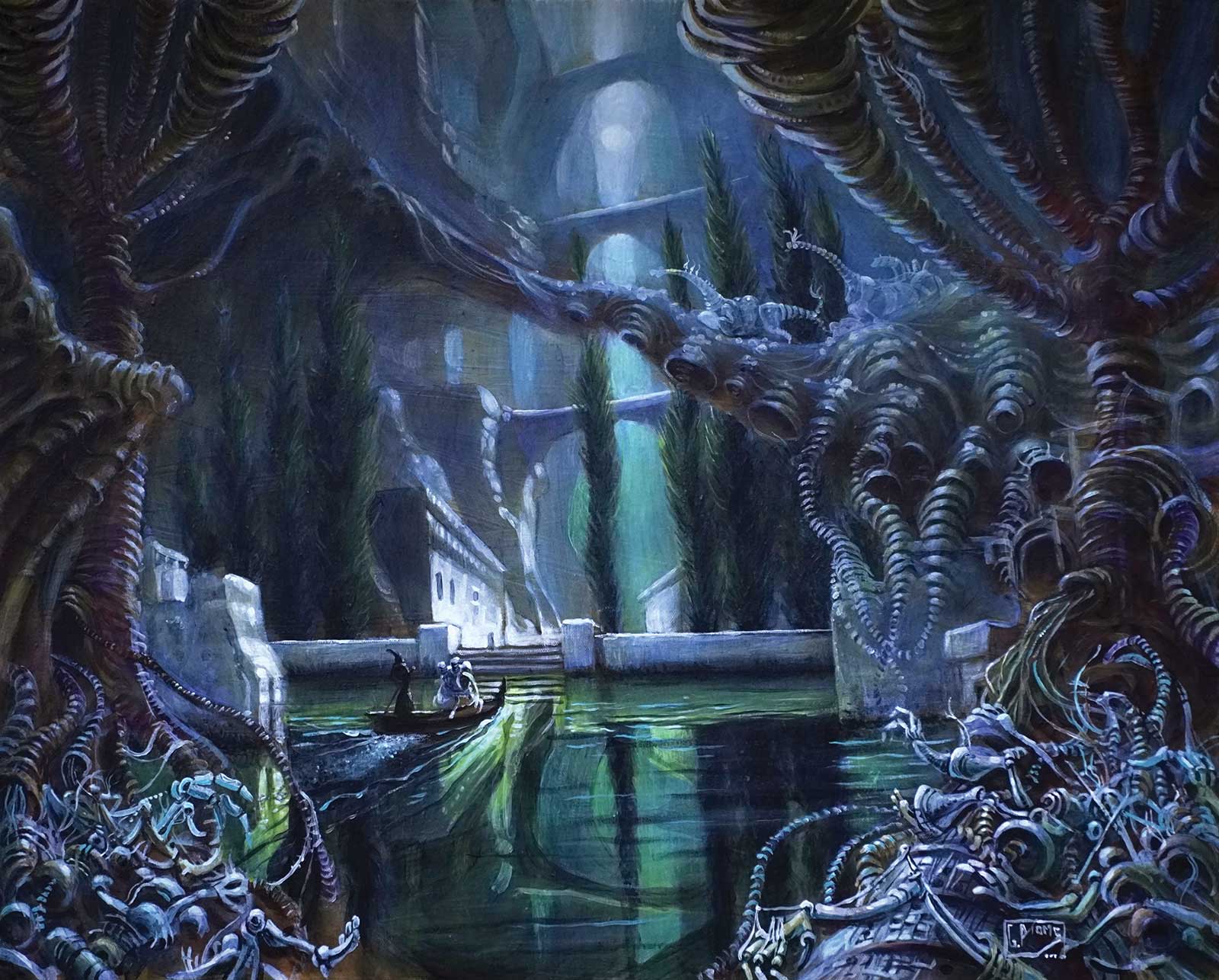 Graham Toms, Isle of the Dead, acrylic on canvas, 24 x 30"
Visionary art has become so popular that some of the artists who were approached for the show found it difficult to set aside work for it, either because their work is booked for four years into the future, or because they have no work left to show because of spectacular sales success. Four visionary paintings by Grey recently sold for a total of $1 million to an influential coder in Silicon Valley. Dean’s iconic idealized landscapes and Mars-1’s gentle psychedelia regularly sell for sums in six figures. While the artists of visionary art constantly reinvent and reshape the fantastic world of imagination, their collectors respond by creating a booming market for it. —
The Otherworld
When: November 12-February 4, 2022; December 2, 4-6 p.m., artists’ reception
Where: The William Rolland Gallery of Fine Art at California Lutheran University, 160 Overton Court, Thousand Oaks, CA 91360
Information: rollandgallery.callutheran.edu
+++
Michael Pearce, PhD, is a highly productive writer, curator and critic. He is an active and enthusiastic participant in the conversation about 21st-century art and its roots, especially contemporary representational art and imaginative realism. He has published dozens of articles about art and artists, and wrote a book about art and neuroscience titled Art in the Age of Emergence. He co-founded and chaired The Representational Art Conferences (TRAC), a series of major international conferences that addressed the issues and aesthetics of contemporary representational art. He is Professor of Art at California Lutheran University.
Powered by Froala Editor