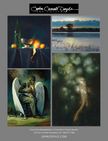
The characters in Alexandra Tyng’s paintings often appear out of time, interacting with people from the past or the future as well as their own past and future selves. In two of her most recent paintings, she explores “aspects of Aphrodite/Venus, the Greek/Roman goddess of love and beauty and Eros/Cupid, Aphrodite’s son and also the god of romantic love…I began by asking myself what these mythological figures would have been like as real people living today.”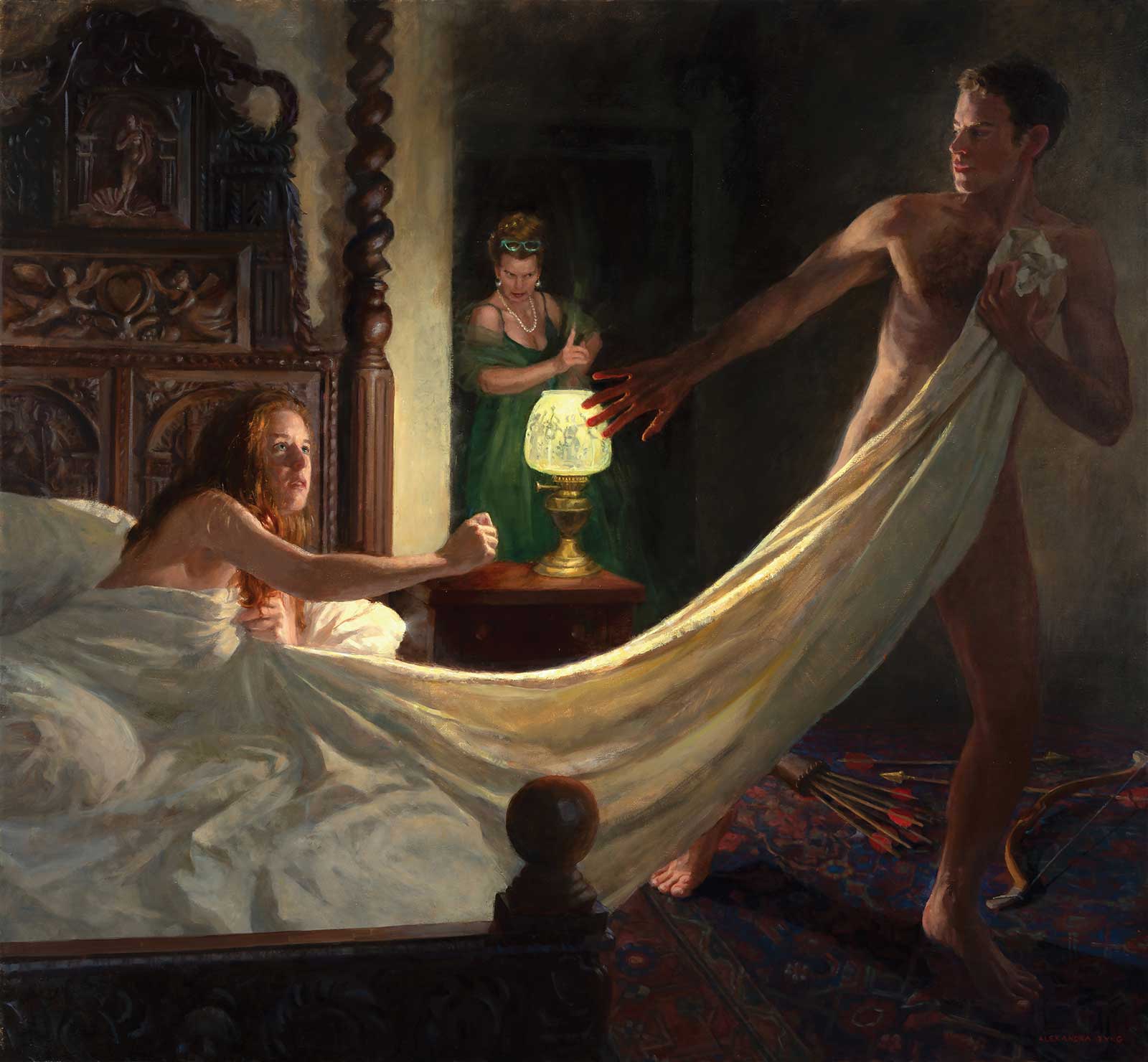 Defy the Gods, oil on linen, 48 x 52"
Carl Jung wrote about myths as expressions of a collective unconscious, ideas encoded in humans since their beginning. James Hillman, who was director of studies at the C.G. Jung Institute Zurich in Switzerland, wrote, “The plots that entangle our souls and draw forth our characters are the great myths. That is why we need a sense of myth and knowledge of different myths to gain insight into our epic struggles, our misalliances, and our tragedies. Myths show the imaginative structures inside our messes, and our human characters can locate themselves against the background of the characters of myth.”
In Defy the Gods, Tyng portrays the myth of Cupid and Psyche. Cupid’s mother, Venus, was jealous of Psyche’s beauty and commanded Cupid to cause her to fall in love with a monster. Cupid accidentally pricked himself with his own arrow and fell in love with her himself. They married but Cupid would only go to her in the darkness of night. One night she lit her lamp and discovered the handsome Cupid rather than a hideous monster. Cupid fled.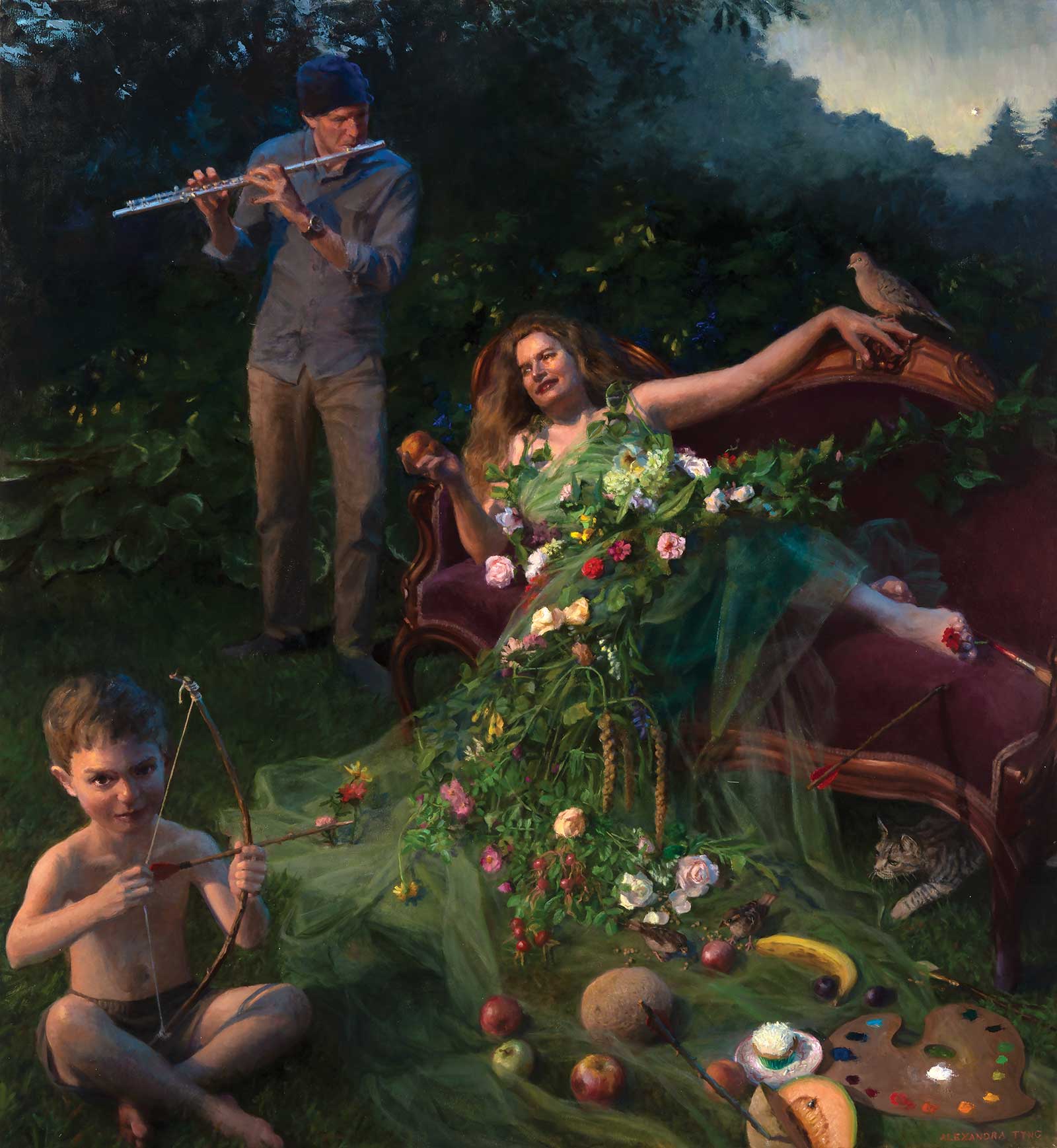 The Shadow of Abundance, oil on linen, 52 x 48"
Tyng muses, “What happens when Psyche turns on the lamp? She introduces consciousness to a relationship that has existed only in darkness. The honeymoon is over, the lovers must confront each other’s real selves and Eros is not ready for that. Aphrodite is in the role of the possessive and jealous mother, and she must also overcome that side of herself and let her son become a man.”
Her models were her artist friend Nancy Bea Miller (Venus), her daughter Becca (Psyche) who posed in person, and Becca’s friend, New York City Ballet dancer Russell Janzen, who was photographed in New York by Oliver Herring.
Tyng comments, “As a dancer, Russell was good at knowing where he was in space. He could imagine the entire thing.” As friends, Becca and Russell could imagine each other being there as they posed in different locations. When Becca saw the photographs of Russell, she instinctively adjusted her pose to respond more naturally to his.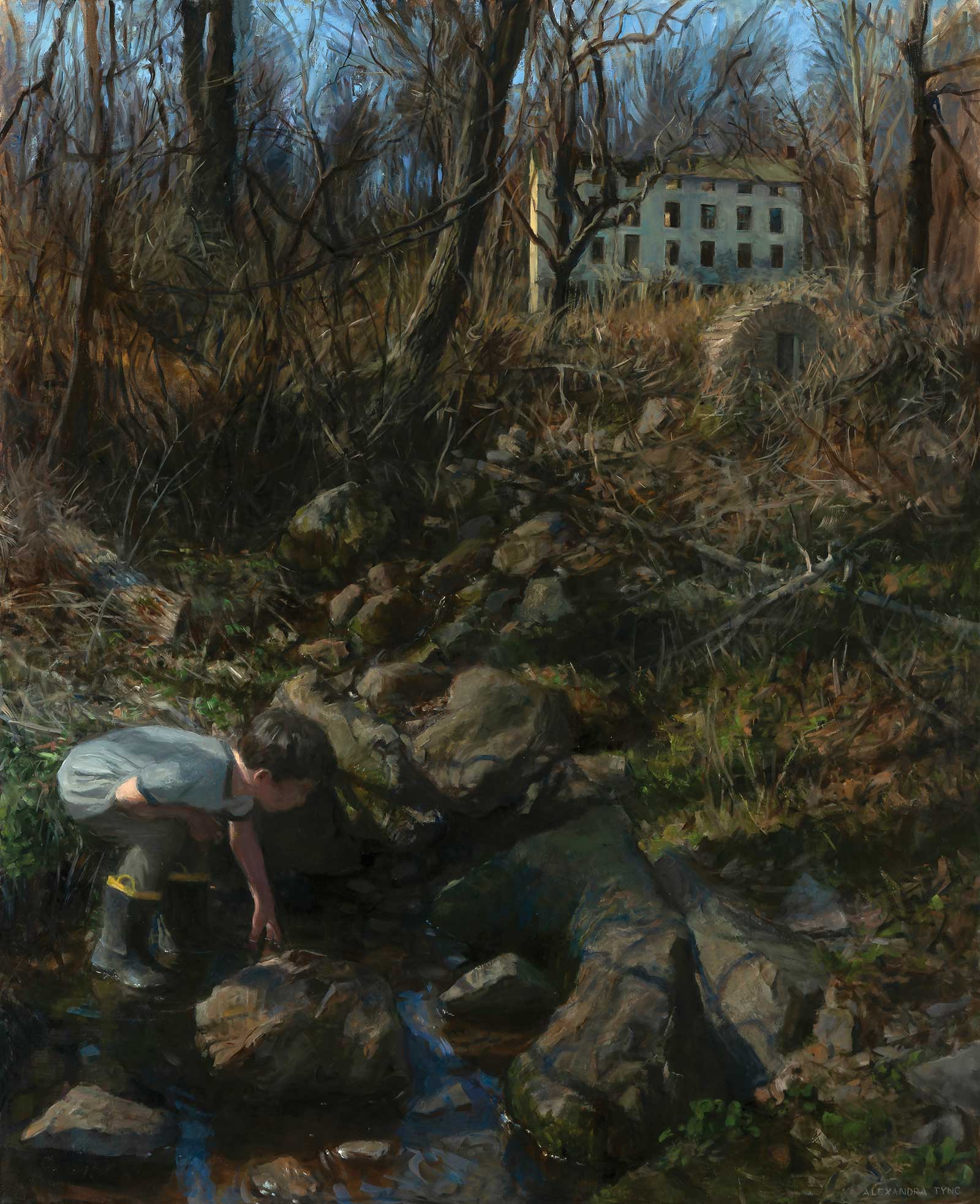 The Source, oil on linen, 54 x 44"
Always a master of light, Tyng makes it a character in her painting, emanating from the lamp, revealing the malevolent Venus (who also appears in a carving of Botticelli’s Venus on the headboard) emphasizing the eyes of Psyche who suddenly sees and outlining the fleeing Cupid, who clutches the translucent sheet that covers both their bodies yet still connects them.
In another mythological scene of Cupid and Venus, the light is more subtle and symbols are more concrete. In The Shadow of Abundance, Venus reclines in the light in a scene strewn with abundance. As the light decreases lower in the painting, her inattentiveness except for herself, shows “abundance going haywire” as Tyng notes. The sparrows, symbols of Venus, are threatened by a demon cat, a fly feasts on a melon and a knowing young Cupid lets his arrows fly erratically into the sofa and the melon. Venus “likes to be the center of attention,” the artist explains, “but she is unconscious of her not really doing her diligence as a mother.” Special Delivery, oil on linen, 18 x 29"
Tyng chose an academic field of study at Harvard rather than attending art school, which she knew “was focused on abstract and conceptual art. I had a feeling they would beat out of me what I really wanted to do,” which was to make figurative paintings. The paintings in the Harvard museums and the museums across the river in Boston were a rich source of instruction in the technique of painting. She also carries the creative genes of her parents, two exceptional architects, Anne Griswold Tyng and Louis Kahn.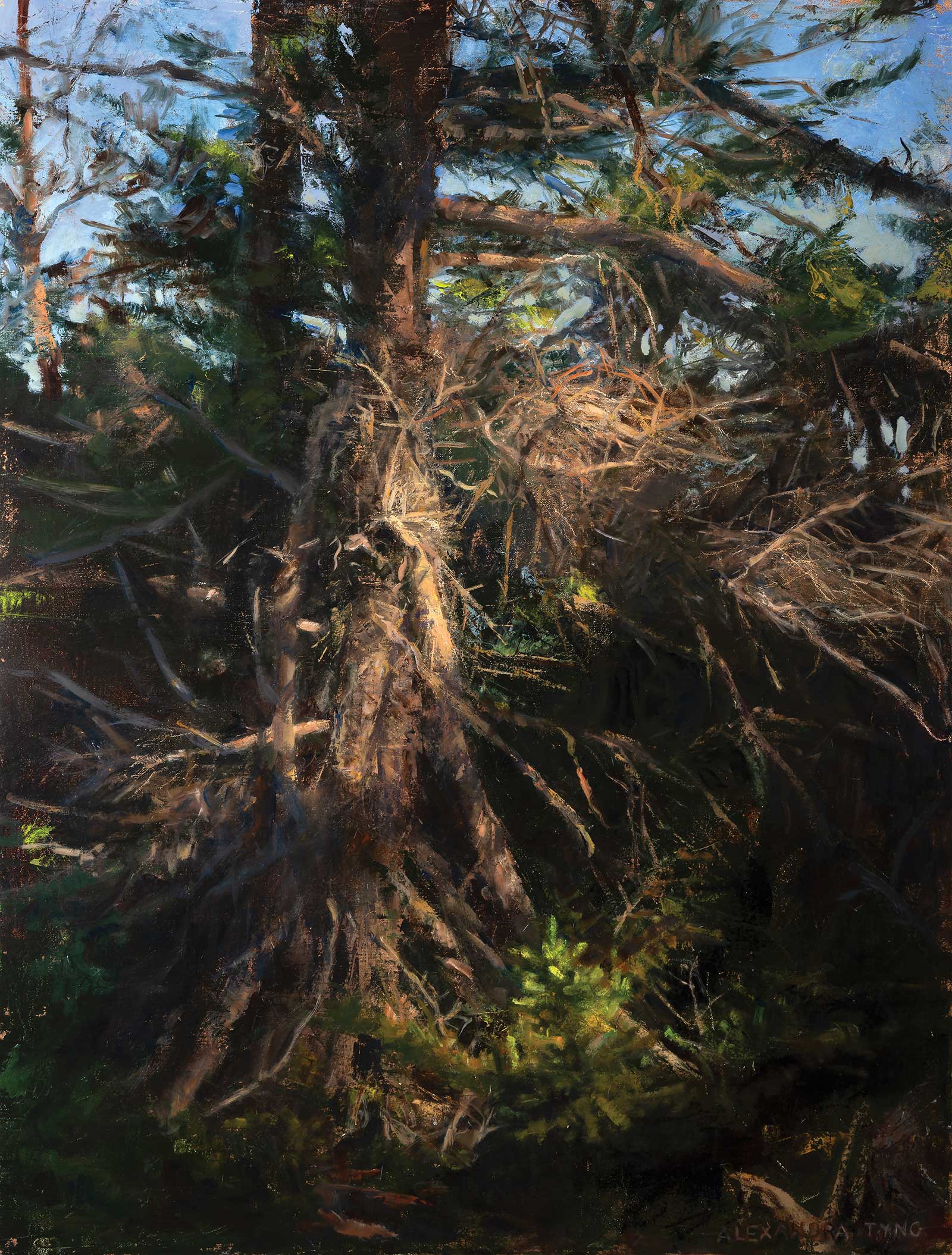 New Generation, oil on linen, 26 x 20"
She writes, “In my figurative paintings I create stories about human relationships that are partly from experience, partly from imagination. The characters in these stories are family members and friends. My symbolic language is drawn from objects, creatures and places of personal significance, and from archetypes in dreams, mythology, alchemy and fairy tales. In the process of creating these paintings I dig down beyond the initial idea, uncovering deeper levels of meaning until I am within reach of its essence.”
An exhibition of her recent paintings will be shown at Gross McCleaf Gallery in Philadelphia, December 1 through 24. —
Gross McCleaf Gallery
127 S. 16th Street • Philadelphia, PA 19102
(215) 665-8138 • www.grossmccleaf.com
Powered by Froala Editor