Charles Baudelaire thought 19th-century romanticism was a child of the north, where “dreams and fairytales are born of the mist,” but he didn’t know how the Southland sweats under a colorful haze of delusory fame and dazed illusions within the harsh and droughted deserts of contemporary California, or how the Hollywood fantasy factory fogs the world with a new conflicted spirit, self-absorbed and driven by celebrity, or how a fresh, tragic and hallucinatory kind of dystopian romanticism has been born from the hot smog, inspired by the acid imagination of Los Angeles’ hybrid culture. Painter Carl Dobsky lives in the heated heart of it in a hilly suburb tucked between Silverlake and Los Feliz, where he feels like an alienated spectator, uncomfortable with the world he inhabits and observes. “I don’t feel at home here,” he says, but the dry, dusty city is his inspiration, and he is its black mirror, an individualist rock ’n’ roller who loves psychedelia as much as Henri Magritte, admires Iron Maiden’s Eddie as much as M.C. Escher, Salvador Dalí as much as Roger Dean. He paints with the realism of Gustav Courbet and the vision of Odd Nerdrum.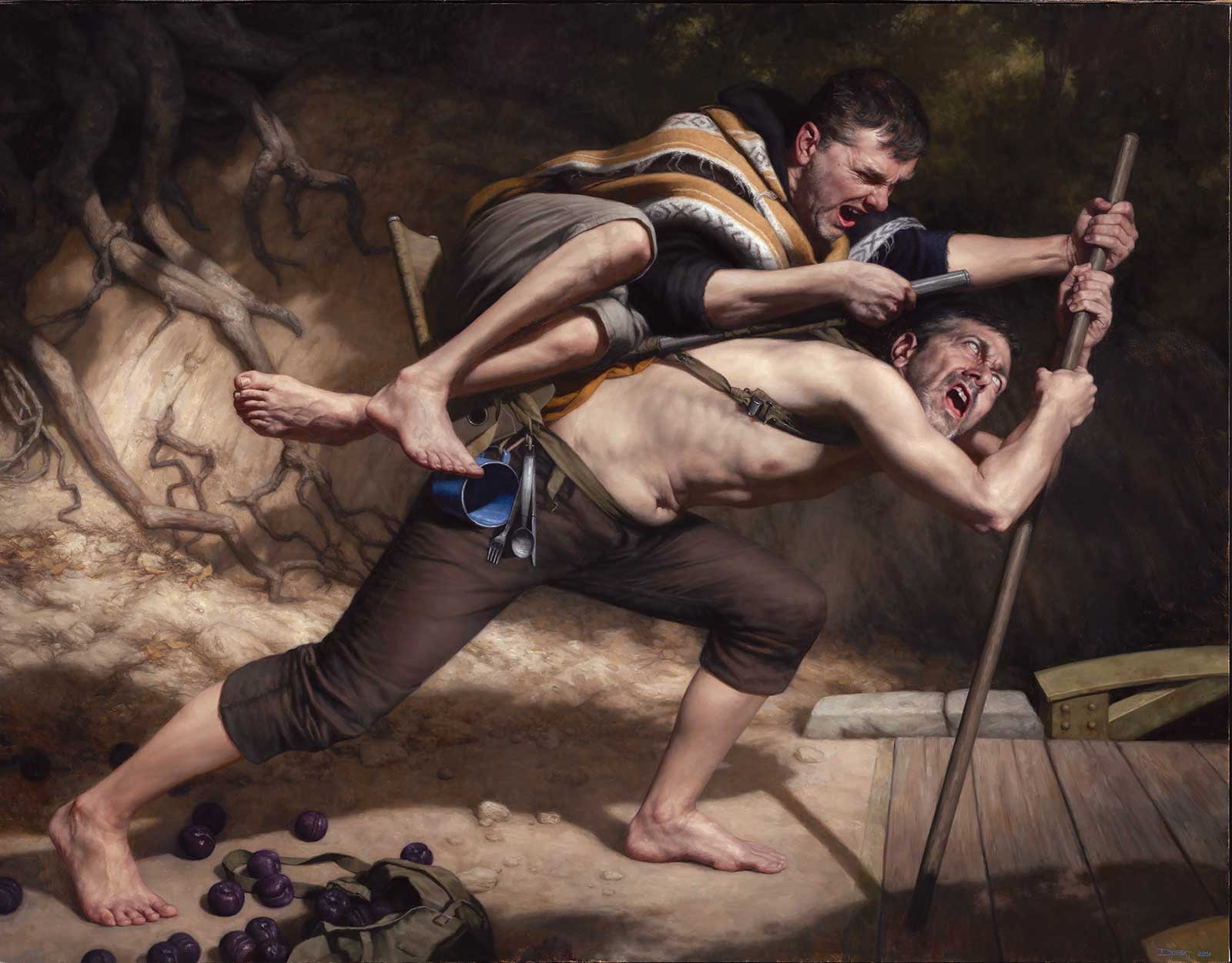 Argument of Blind Man and Lame Man, oil on linen, 56 x 72"
The secret magic of imagination often hides in plain sight, tucked into ordinary places, and in Dobsky’s temporary COVID-studio inside his bungalow, the spectacular canvases that lean against the walls bear huge images that make comedians of our senses. We talk among pictures of hyenas pushing between restaurant diners, party guests cackling as orange hillsides burn, bald and foolish doppelgangers digging in their own graves and beating each other with shovels. These idiosyncratic pictures are grown in a mind enlivened by the primal seed of imagination, inspired by the rich earth of fertile and creative chaos of the millenarian city. Angelenos working to make their own future are witnesses to the birth of first world shanty towns on freeway embankments, while the city heaves and contracts and fake-famous celebrities cruise in limos behind black windows. In the hills, millionaires in mansions overlook apocalyptic opioid slums. We have seen naked men run screaming among tourist crowds clutching cellphones filming wildfires flooding down mountainsides and rolling over neighborhoods; we have seen the oily rainbow clouds of rocket fuel hanging in the yellow sky, the diffused trails of missile tests aimed at the desert. This is the heartland of imaginative realism, where fabulous fantasy lives in symmetry with the surreal city. Dobsky lives blocks from the Philosophical Research Society, guarded by a syncretic Egyptian statue bearing a tablet inscribed with “Thou Art That” from the Sama Veda, and housing the occult library of Manly Hall; a walk away from Frank Lloyd Wright’s Mayan temple, the Ellis house; and a short drive from the faux château Magic Castle, home to the greatest magicians on earth.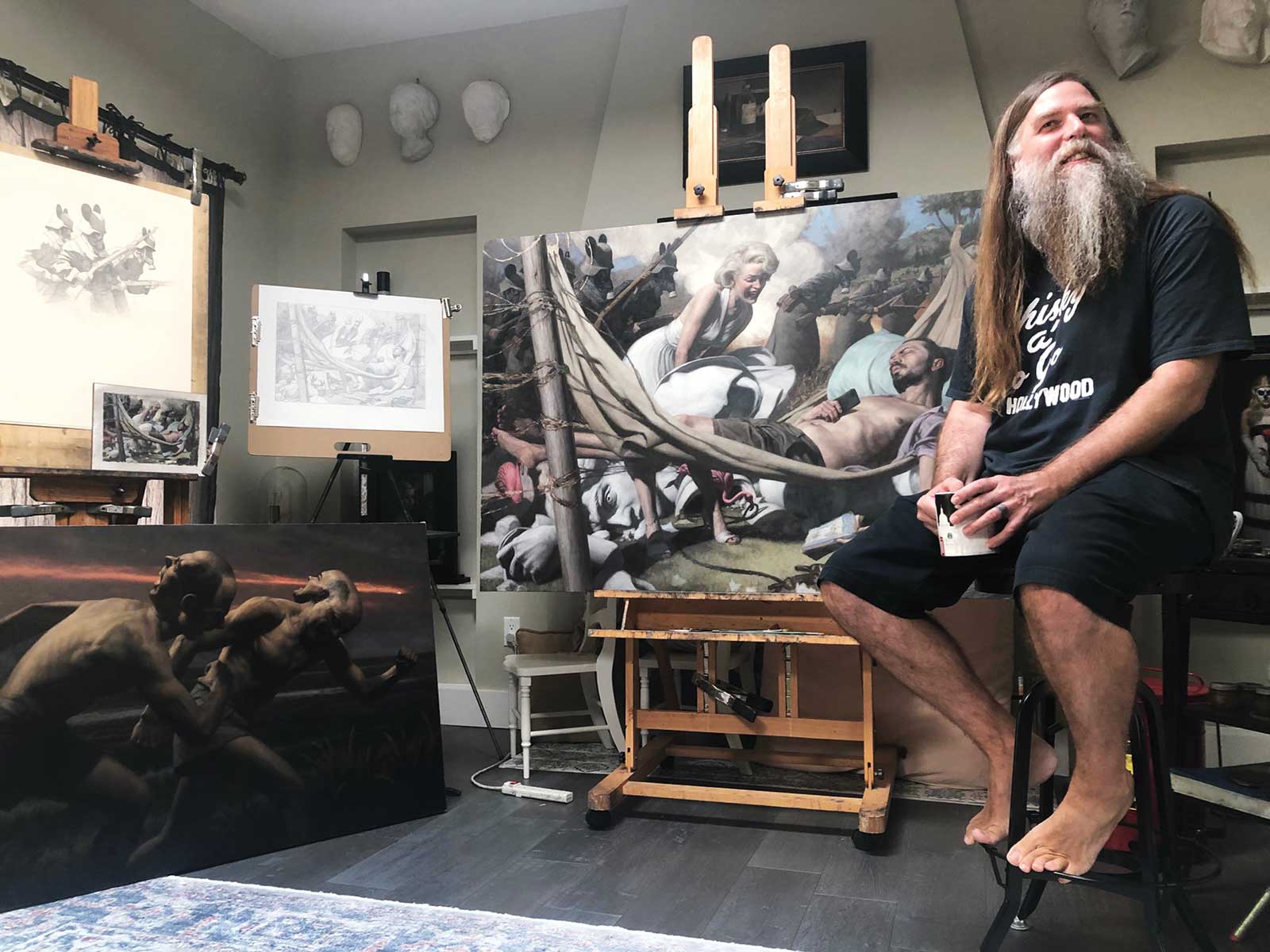 Carl Dobsky in his temporary studio in Los Angeles.
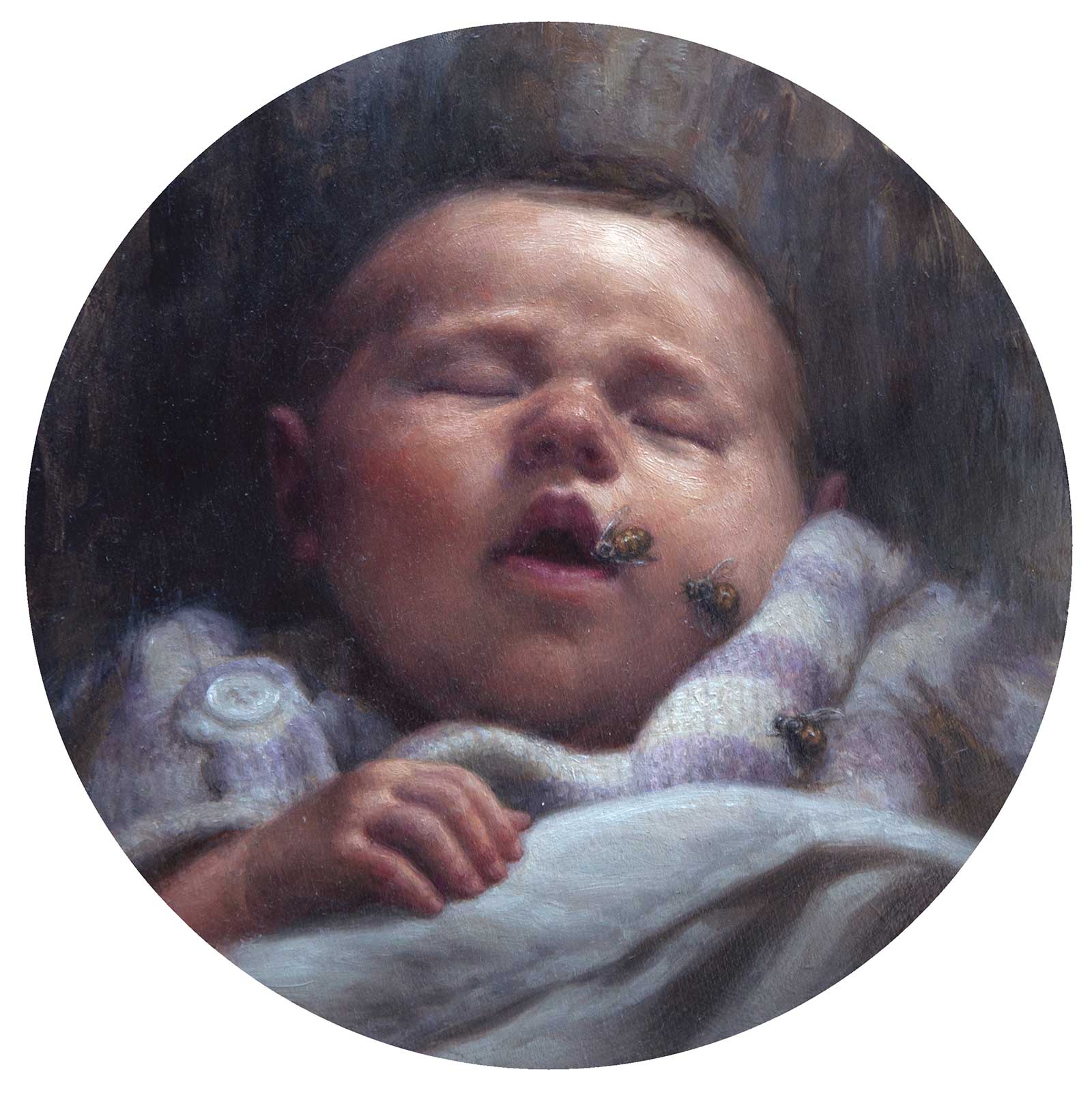 Words of Honey, oil on linen
“This is a new piece,” he says, pointing to a painting beside the easel’s foot of two-faced male figures running headlong. “I have a memory that I had gone to a little archaeological museum and there was a myth of some really old native culture, and there had been these two-headed beings that were having a competition that had to do with the sun. Is it a false memory? Did I have a dream? The sun could be seen as the figure of truth, or illumination, or god, some sort of overarching principle…they’re competing against it, which is an impossible task. Their animosity toward each other is futile as well. I wanted to touch something primal in people. I like the prehistoric story, the ancient myth, even though I don’t know where it comes from.”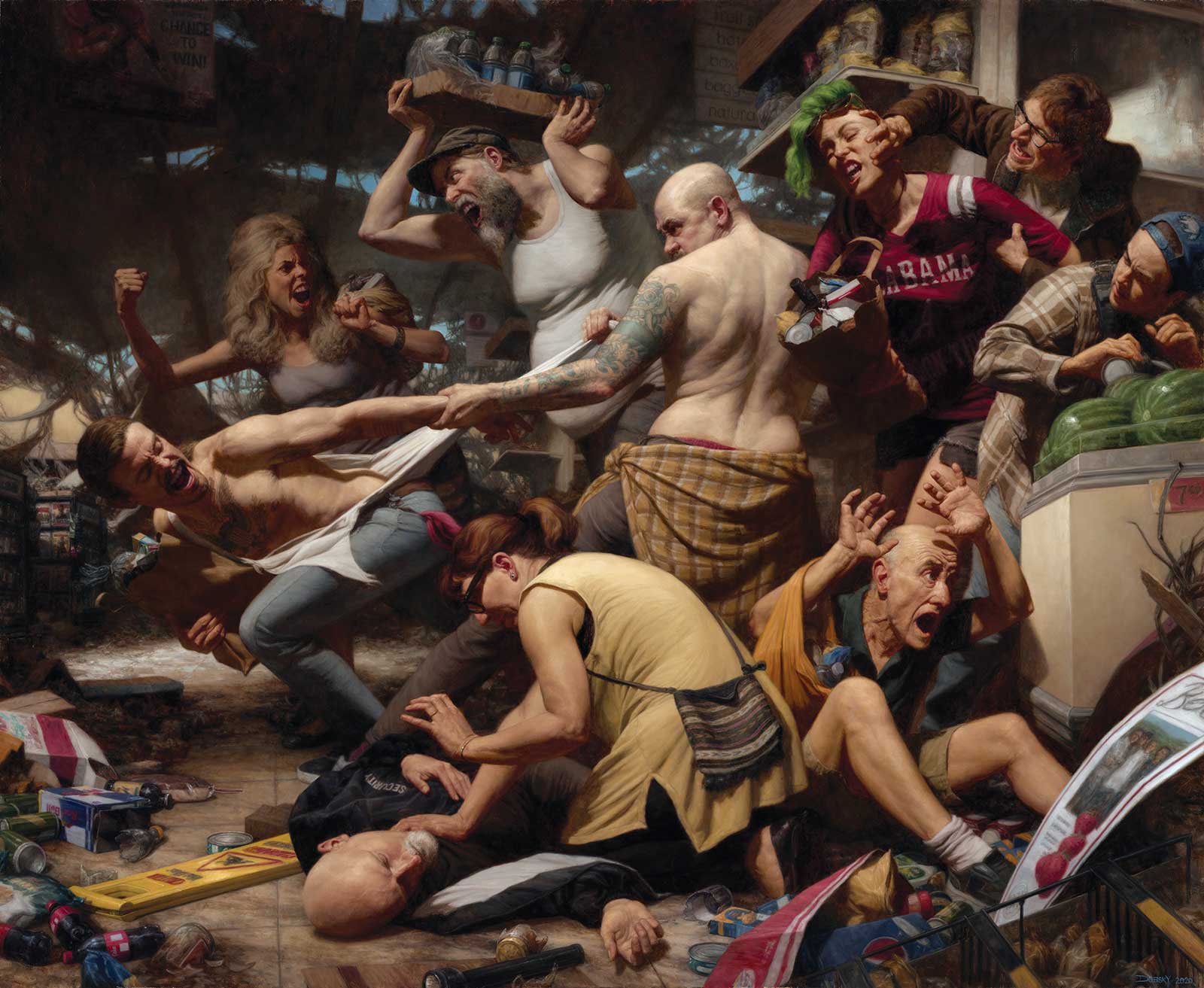 Taken By Storm, oil on linen, 72 x 96"
Above it on the easel shelf is a cryptic vision of a man sleeping in a hammock, stretched over barbed wire from the trenches, clutching a cellphone and paperback in hand. He is dreaming, and Marilyn Monroe leans over him, while German soldiers advance behind her armored in helmets with Mickey Mouse ears. The painting is unfinished, and parts of it reveal Dobsky’s technique, a sketched-in rough layer of loose work, then a second layer of refinement, both done in color. Barbed wire is loosely brushed in umber tones, Michelangelo’s David is in fragments in the mud. It is a snapshot of the illogic of postmodern life, a mélange of imagery pulled from the contemporary spectacle.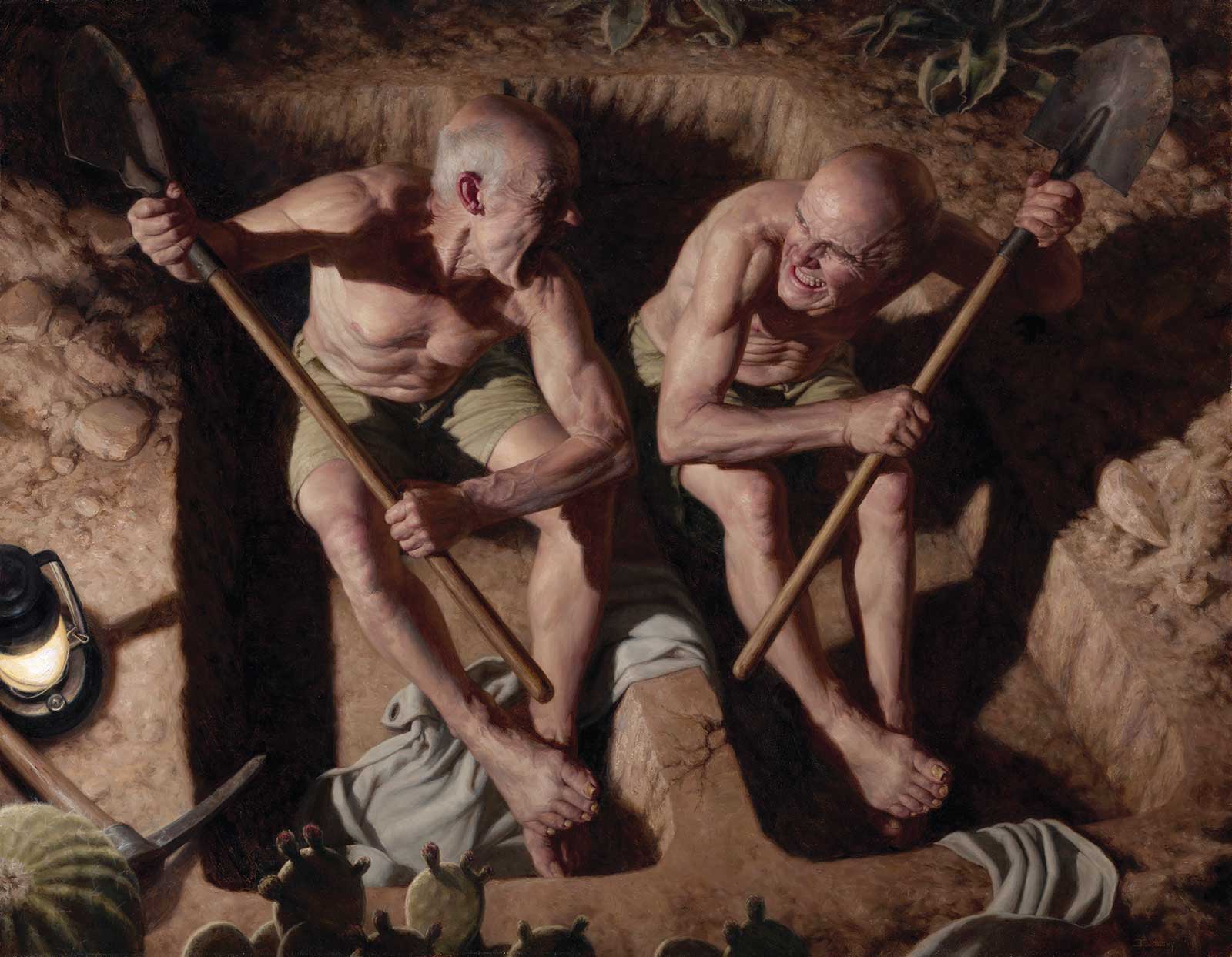 Gravediggers, oil on linen, 42 x 54"
Dobsky was born to paint the post-science age of 21st-century America and the “you do you” self. Even with the help of the entheogenic city, drawing down the lightning is not easy—the seeds of imagination must be fed with the devotion of craftsmanship to bring them into the human sphere. Dobsky understands both the need, and the commitment. Thousands of hours of work have prepared his path: a BFA at Ringling College, an MFA at the New York Academy, private classes with Jacob Collins, work as a concept illustrator in San Francisco and recently as an inspiring teacher. The relentless commercialism of professional illustration was repellent, concept art was for too young an audience, and the pursuit of beauty was not enough.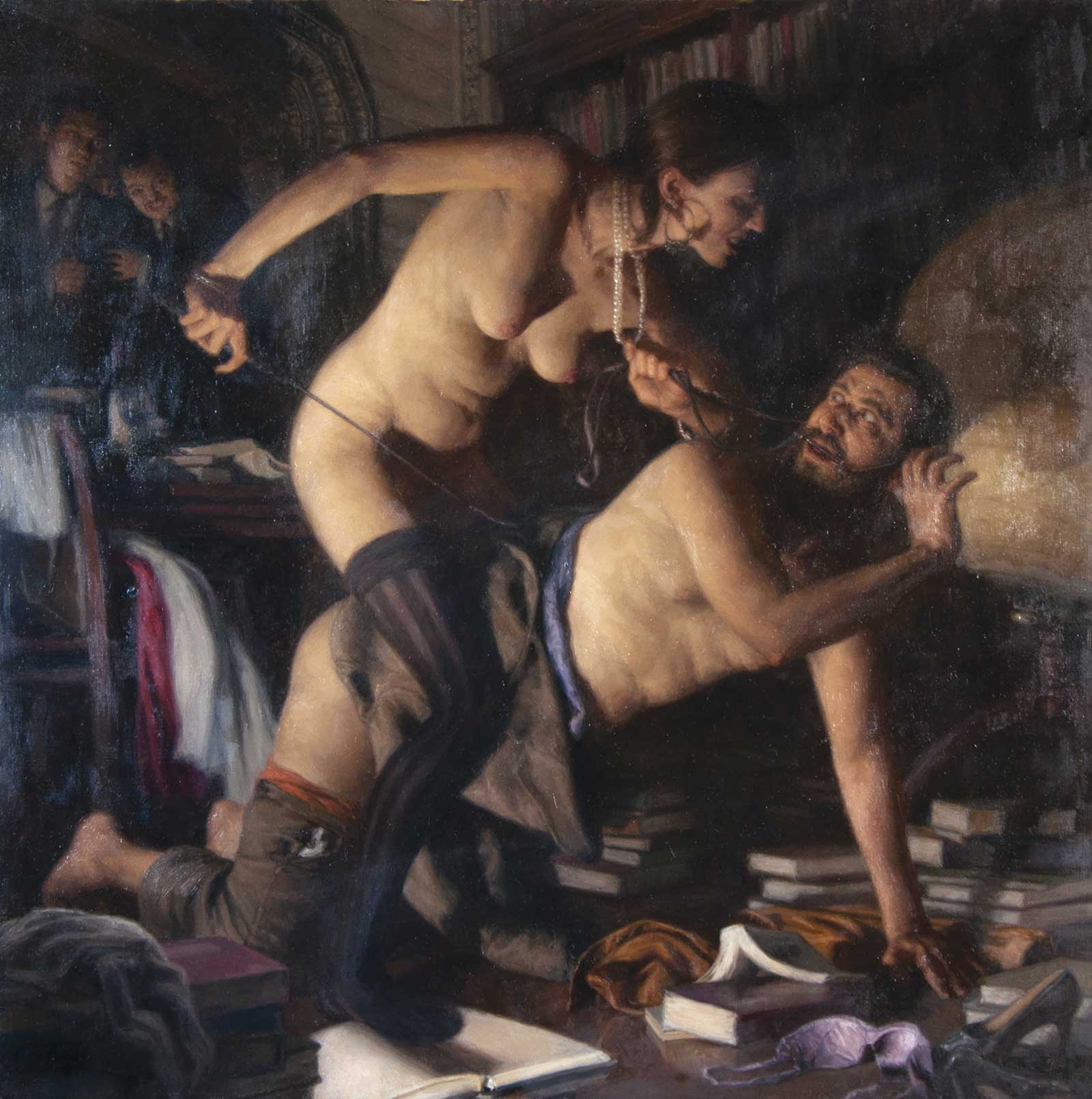 Phyllis and Aristotle, oil on linen, 18 x 18"
“I’m attracted to beauty,” he says, “but who isn’t? Capturing beauty is only one idea among many ideas. There’s a lot more going on than just painting pictures of what you see in front of you. I find my head space is often occupied by things I’m revolted by, or disturbed by, that bother me…it’s not just positive things that affect me, and often the things I don’t like very much turn out to be the seed or the germ for coming up with an idea. I’m trying to make sense of this stuff somehow. Sometimes I’m just trying to vent.”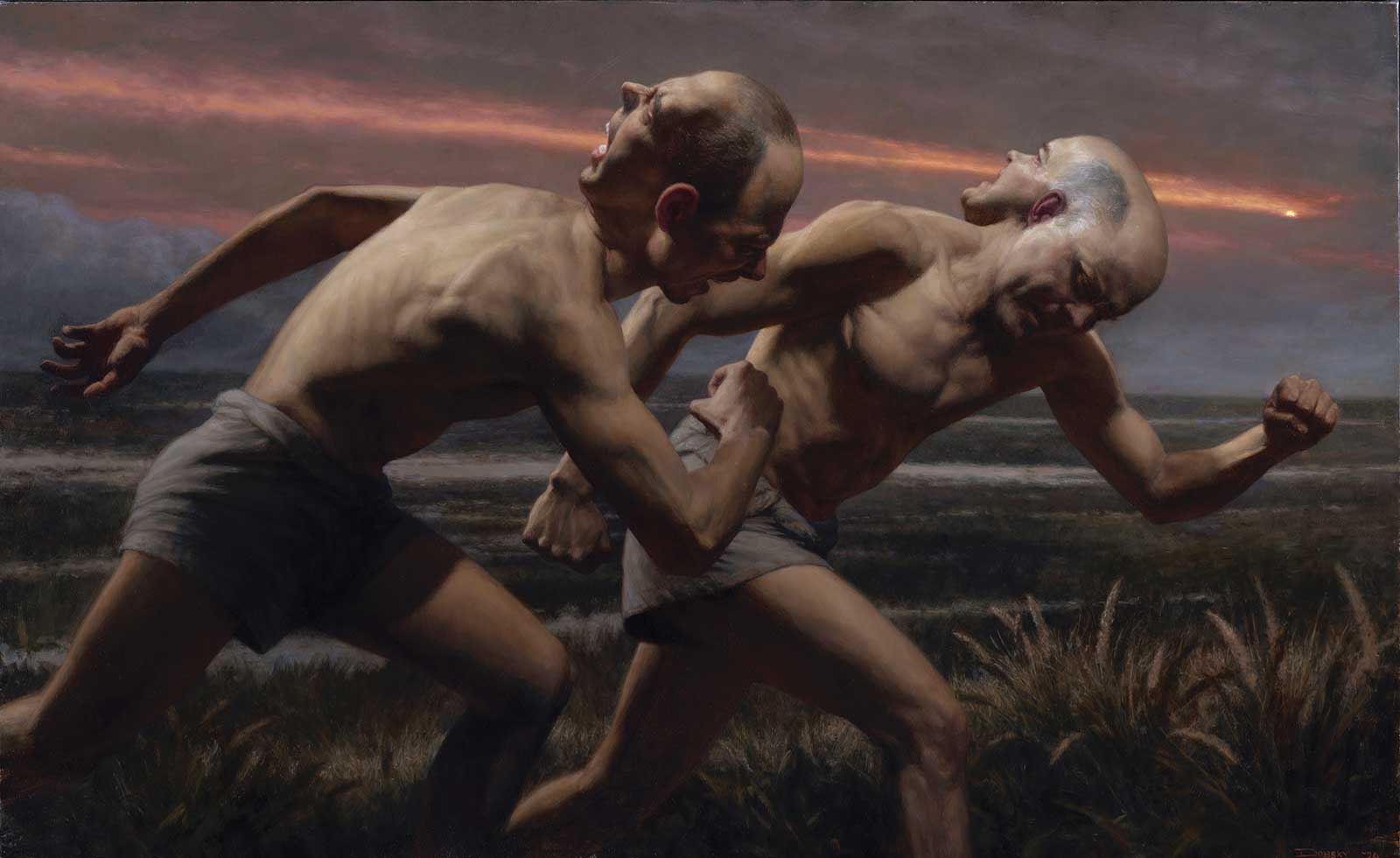 Race of Two-Faced Men, oil on linen, 32 x 52"
Dobsky’s paintings don’t spring into the world ex nihilo, and the seed of his inspiration is nurtured by the long discipline of his practice. He makes graphite sketches of the idea, guided by his training, and produces color studies before moving to the crafting of the work, which can take months of focused labor, and have a commensurate price point. (He sells his studies and drawings at prices new collectors can afford.) These paintings won’t match the couch, and only advanced and fearless collectors will find space for them, because they will dominate a gallery, not just a wall. They belong in museums, because they represent the zeitgeist—not just of Los Angeles—but of all the conflicted generalities of the contemporary society of the spectacle: the dark soul of self-centered materialism, the violent collision of luxury and narcissistic greed, the madness of indifferent consumerism in the face of the rising flood, the hypocrisy of the political struggle. These are inspired images describing the romanticism of our 21st-century present, and Dobsky’s paintings tell its dystopian and hallucinatory story to the future.
Want to See More?
www.carldobsky.net
Craig Krull Galley
(310) 828-6410
+++
Michael Pearce, PhD, is a highly productive writer, curator and critic. He is an active and enthusiastic participant in the conversation about 21st-century art and its roots, especially contemporary representational art and imaginative realism. He has published dozens of articles about art and artists, and wrote a book about art and neuroscience titled Art in the Age of Emergence. He co-founded and chaired The Representational Art Conferences (TRAC), a series of major international conferences that addressed the issues and aesthetics of contemporary representational art. He is Professor of Art at California Lutheran University.
Powered by Froala Editor