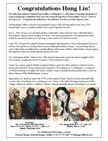
Hung Liu was born in China in 1948 in the regime of Mao Zedong. In 1966, having endured many hardships under the regime, she witnessed the beginning of the Cultural Revolution when she was about to graduate from high school.
She recalls, “Suddenly, overnight, the revolution had started. I saw these Red Guards, who had been very modest, even shy girls, friendly and sensitive, who studied hard, and who respected their teachers, transformed into demons. They used a belt to beat people and even set up a detention center at school.” The Red Guards were to purge Chinese society of Western influences.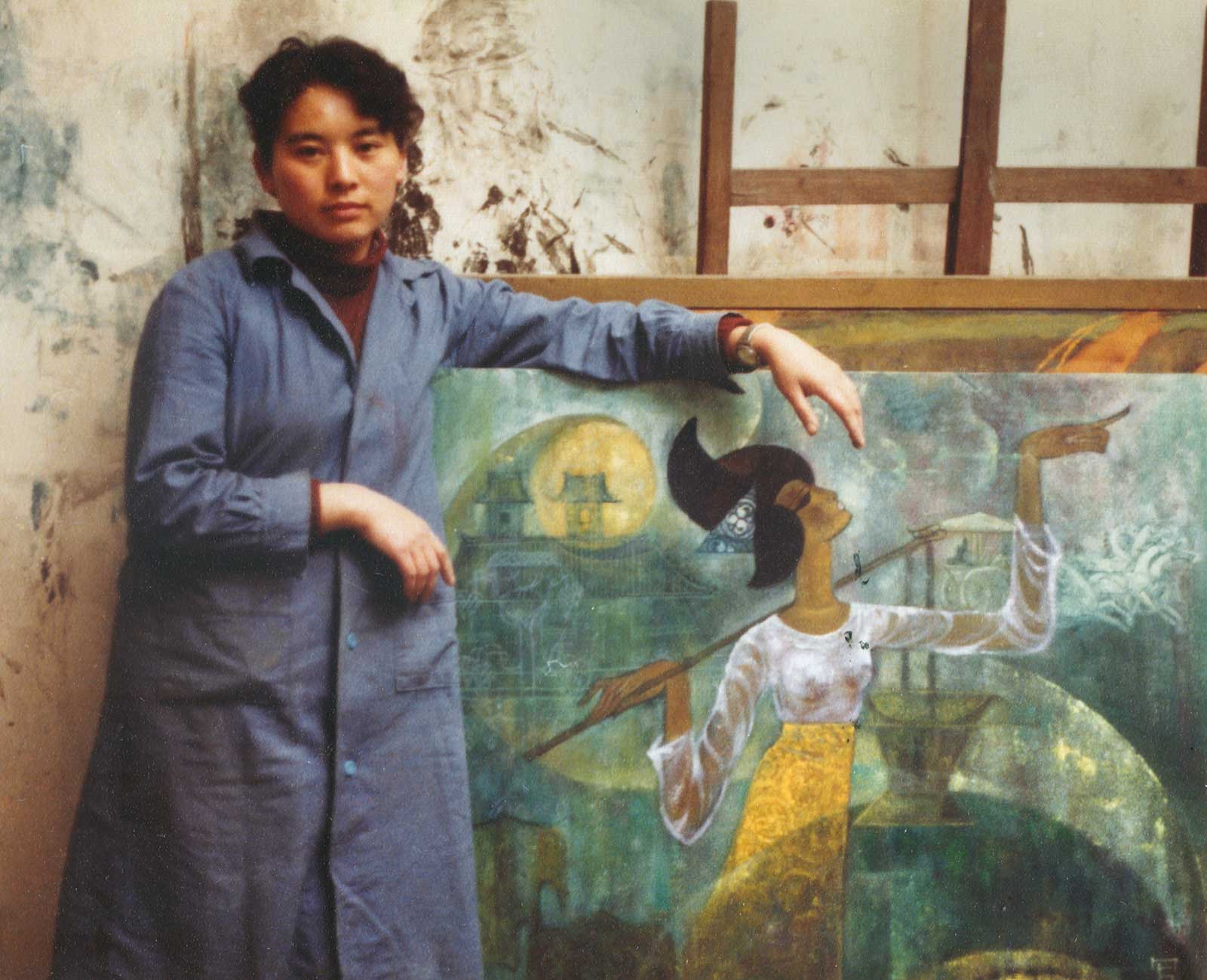 Hung Liu as a graduate student, Central Academy of Fine Arts, Beijing, China. Reproduction after the original 1980 photograph. Courtesy of Hung Liu and Jeff Kelley.
Two years later, she was sent to work among the peasants in the countryside in Mao Zedong’s “re-education” program. She worked in the fields seven days a week for four years. She filled sketchbooks with drawings of her co-workers and had also smuggled a camera in with her.
When schools began to reopen, she studied art, eventually applying and being accepted at the University of California, San Diego in 1981. The Chinese government refused her bid for a passport, however. In 1984 she was granted a passport, left for the United States and began her graduate studies at UCSD.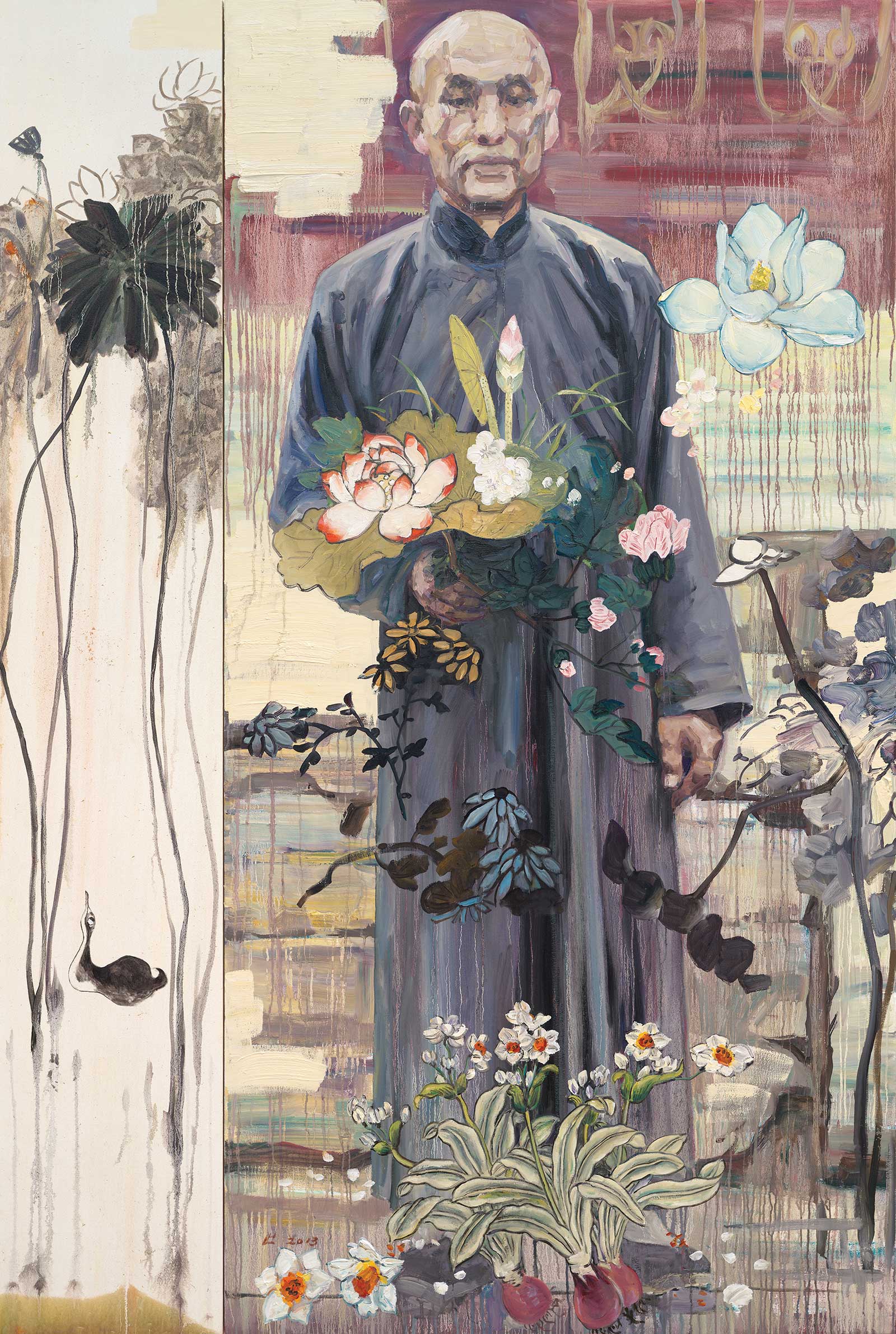 The Botanist, 2013, oil on canvas. San Francisco Museum of Modern Art, gift of Lorrie and Richard Greene and Accessions Committee Fund purchase. © Hung Liu.
The National Portrait Gallery in Washington, D.C., will honor her with the exhibition Hung Liu: Portraits of Promised Lands, August 27 through May 30, 2022. The museum states, “Having lived through wars, political revolutions, exile and displacement, Liu presents a complex, multifaceted picture of an Asian Pacific American experience. This is the first time the Portrait Gallery will honor an Asian American woman with a solo exhibition.” The exhibition will include more than 50 paintings, photographs and drawings.
Her earlier paintings were a reaction against the socialist realism she had been taught in China. She combined historic and contemporary imagery from Western and Asian culture, mixing linseed oil with her paints and allowing it to drip, suggesting the haziness of memory.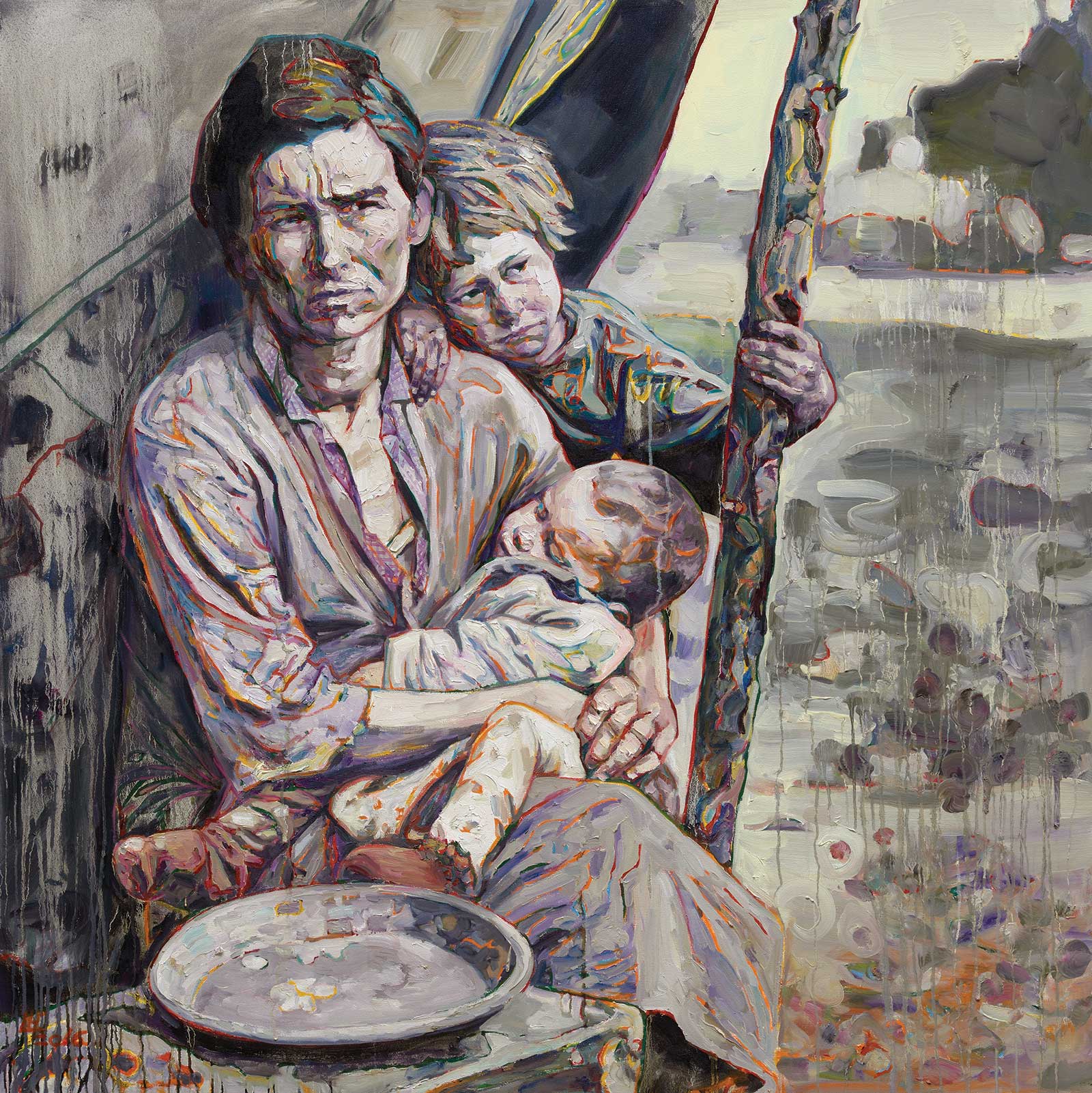 Migrant Mother: Mealtime, 2016, oil on canvas. Collection of Michael Klein. © Hung Liu.
In her essay for the catalog to the exhibition, Lucy R. Lippard writes, “Most of Liu’s paintings are layered, a form of collage. The dripping paint that is her trademark (it has been interpreted as tears) acts as a veil between past and present, persuading the viewer to look through it to an unfamiliar reality.”
Among the paintings in the exhibition are her responses to the photographs of Dorothea Lange. Lange was hired by the Farm Services Administration to document the hardships of the Great Depression. She revolutionized documentary photography and humanized the effects of the Depression.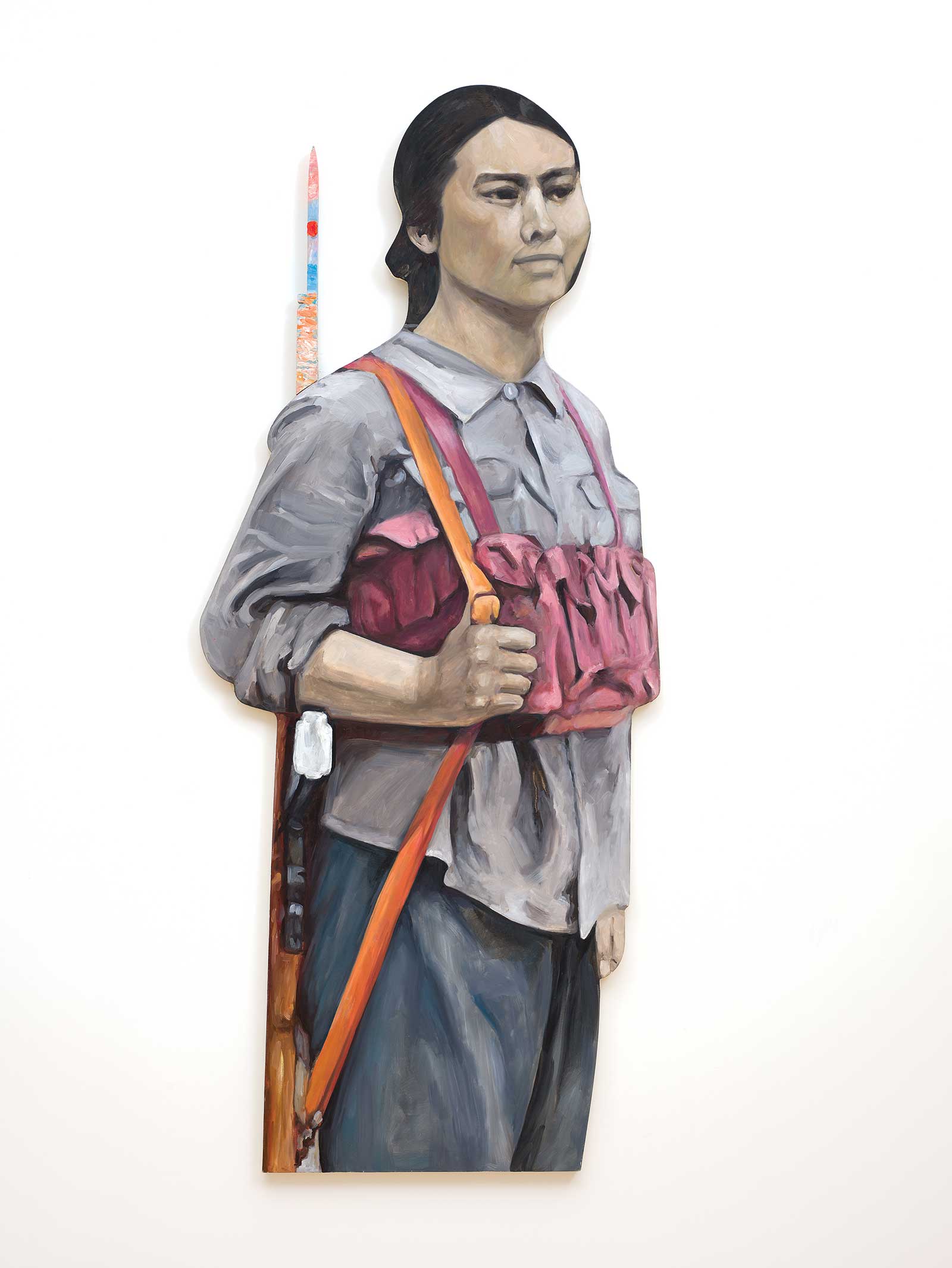 Avant-Garde, 1993, oil on shaped canvas, oil on wood. San Francisco Museum of Modern Art, gift of Hung Liu and Jeff Kelley. Photo by Katherine Du Tiel. © Hung Liu.
“Over the past decade,” Liu explains, “I’ve become increasingly aware of the presence of Dorothea Lange’s photographs in America’s memory of itself during the Dustbowl and Great Depression. Maybe six or seven years ago I realized that Lange’s archive resides at the Oakland Museum of California (my hometown). The museum allowed me to begin researching Lange’s work and life more deeply. Of course, her images of common Americans fleeing natural and economic crisis spoke to me one at a time, as have the Chinese subjects I’ve been painting most of my life. Chinese peasants and American peasants aren’t so different in terms of their fundamental humanity. So, since I have always based my paintings on historical photographs, I began to focus on commonplace American subjects through the photographs of Dorothea Lange. By turning her photographic subjects into contemporary paintings, I came into closer contact with American stories of poverty, migration, survival and—of course—courage and hope. I’ve learned that Lange also displayed the courage necessary to travel the country, seek out her subjects and represent them for history. Despite having had polio as a child, she lugged heavy camera equipment wherever she sought out people to photograph. She inspires me.”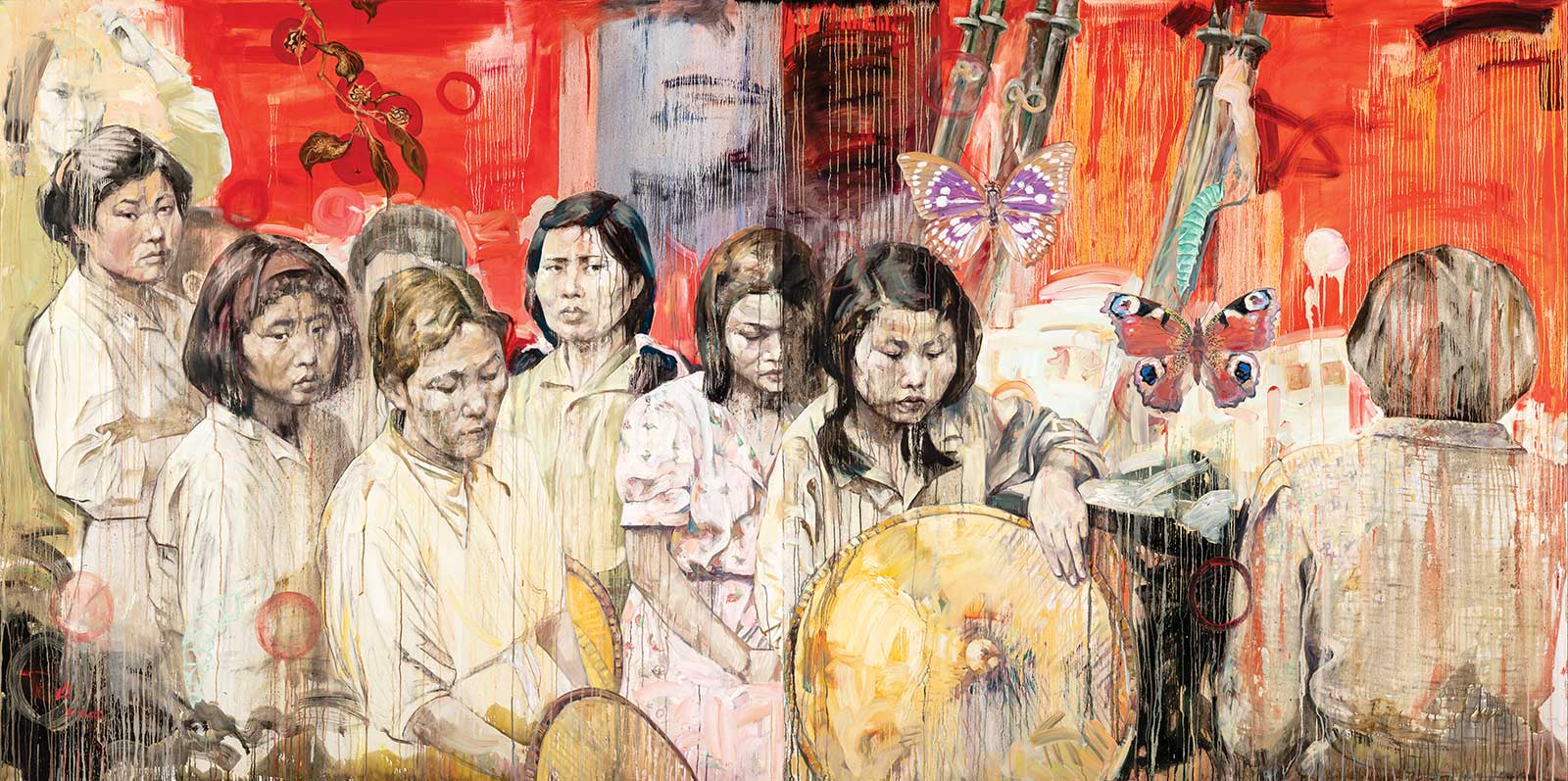 Strange Fruit: Comfort Women, 2001, oil on canvas. Karen and Robert Duncan Collection. © Hung Liu.
Lange’s most recognized photograph is Migrant Mother, 1936. She had come across 32-year-old Florence Owens Thompson and her seven children in a camp of field workers and recalled, “I saw and approached the hungry and desperate mother, as if drawn by a magnet. I do not remember how I explained my presence or my camera to her, but I do remember she asked me no questions. I made five exposures, working closer and closer from the same direction.” Lange also explained, “I had to get my camera to register the things about those people that were more important than how poor they were—their pride, their strength, their spirit.”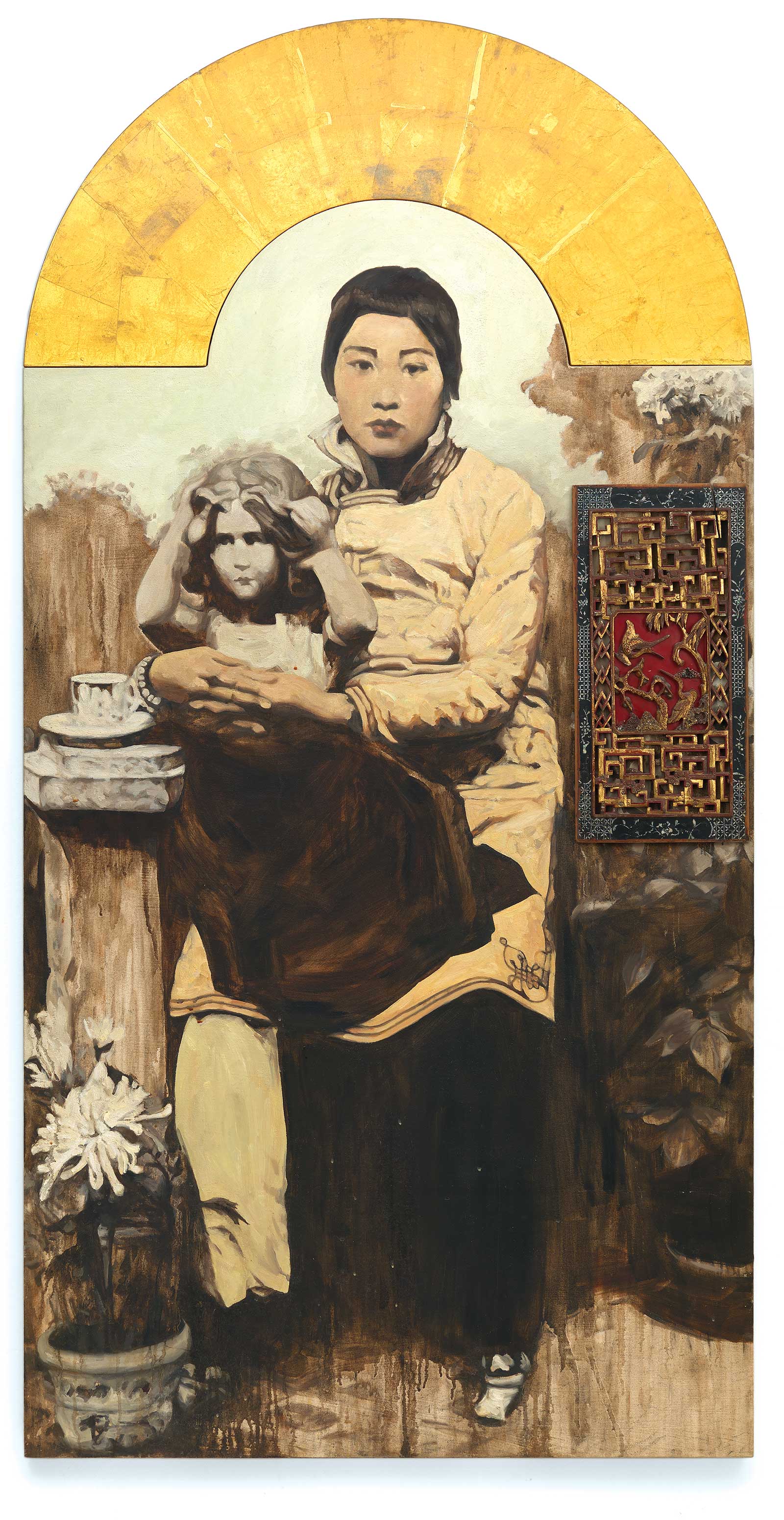 Madonna, 1992, oil on canvas, gold leaf, wood and antique architectural panel. Estate of Esther S. Weissman. © Hung Liu.
One of the photos in the series appears in Liu’s show as Migrant Mother: Mealtime, 2016, a 60-by-60-inch oil painting. The vintage photograph is moving in its black-and-white starkness. The image is transformed by Liu in her colorful enlargement. I ask her about the unusual color and she replies, “Since roughly 1990 I have been turning old photographs into new paintings. This means of course I’ve been transforming black-and-white images into fields and surfaces of color. We tend to think of history as black and white—or at least my generation does. The risk of changing them into color is that you lose contact with their sense of the past. Nearly all of my subjects lived before my time, although since the invention of photography. That means there is a kind of natural distance between us, which I try to close as a painter. The brushstrokes, small and big, are direct responses to what I see in the photographs, which is often not much since old photographs can be grainy and blurry. Color existed of course when those photographs were taken, but the only way we can imagine its palette is by painting through our own memories of similar settings and moments in time. This means that the color in my paintings of the last 25 years have been filtered through my experience of growing up in revolutionary China, having worked as a peasant in the countryside during the Cultural Revolution, and having fled war and left home. Perhaps what is ‘unusual’ about the color in my Dorothea Lange paintings is simply that they are American subjects painted by a Chinese artist, and that they are also painted with an earthiness we associate with poverty and peasantry. The intimacy I feel for Lange’s subjects is grounded in hue.”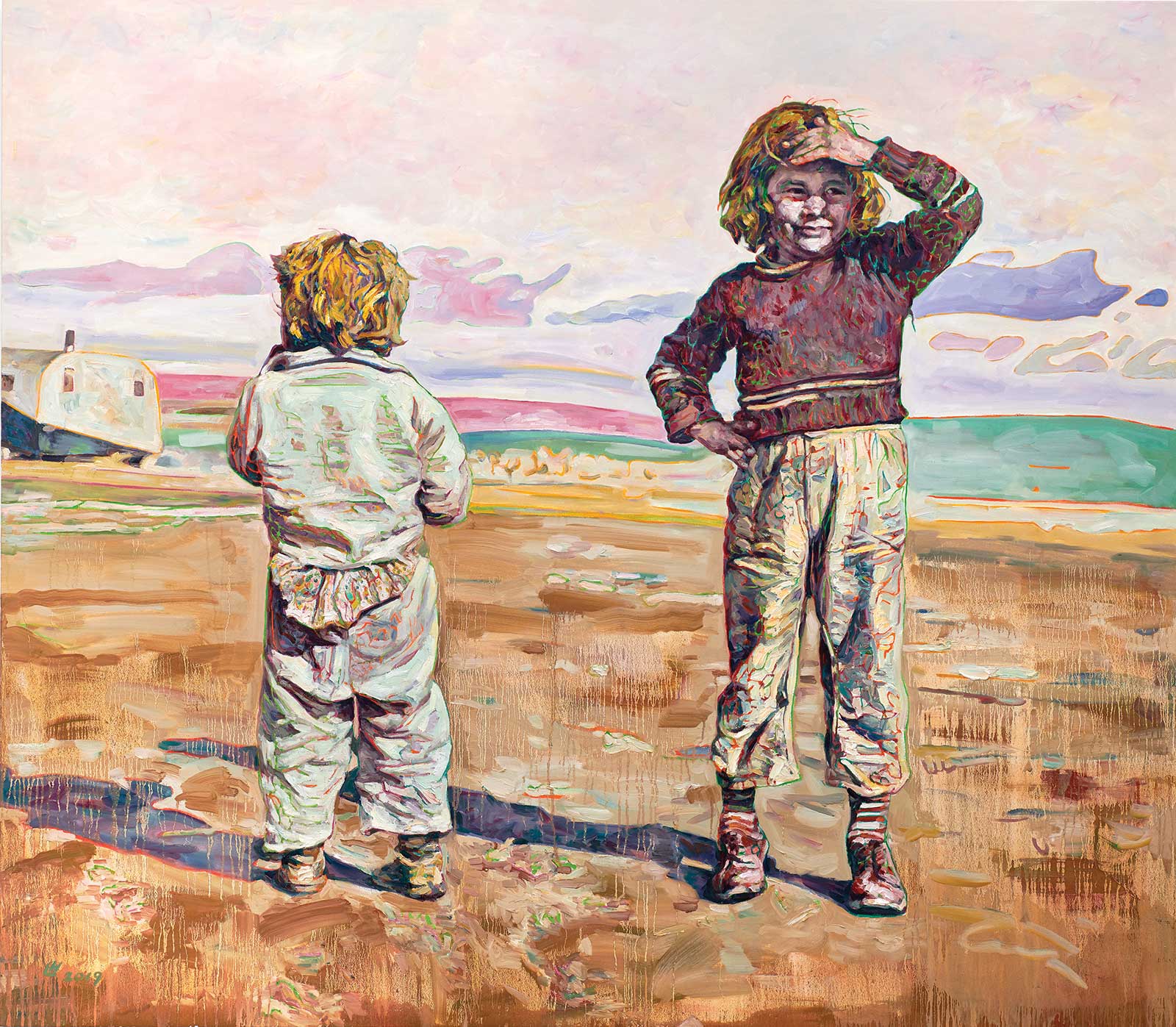 Catchers, 2019, oil on canvas. Collection of Tim and Donna Jones, San Francisco. © Hung Liu.
She honors people from her own past in numerous works. The Botanist, 2013, portrays her grandfather, Liu Weihua, and is based on a photograph he had commissioned. The painting measures a commanding 96 by 54 inches. In the 1920s photograph, Liu Weihua stands in front of a temple in Qianshan holding flowers in his hand.
I ask Liu about the abundance of flowers in her painting. She says, “The flowers in The Botanist are taken mostly from traditional Chinese painting and refer to the fact that my grandfather was a trained botanist. The flowers on the left panel are from the Ching dynasty artist Bada Shanren (1626-1705) and throughout the painting there are numerous lotus plants and seeds which signify peace and serenity since my grandfather spent his life researching the temples and monasteries of Qianshan, a religious mountain in Northeast China. There is also one magnolia plant at the top of the painting, which comes from a tree outside the door of my studio in Oakland—my gift to my grandfather.” —
Hung Liu: Portraits of Promised Lands
When: August 27-May 30, 2022
Where: National Portrait Gallery, 8th and G Streets Northwest, Washington, D.C. 20001
Information: www.npg.si.edu
Powered by Froala Editor