Line, shape, color, value, texture, form and space are the seven major principles of design and when expertly handled by an artist the result is a strong and balanced composition. A powerful arrangement of these components can draw viewers in to seek a closer look, then carefully move their eye through all the elements of the work, before bringing their eyes back to rest on the focal point. The following works of art, which were selected from this year’s International Portrait Competition winners, were created by five incredible women artists from around the world in Ukraine, United States, Russia, United Kingdom and Canada—each of whom have successfully incorporated these principles to captivate viewers and effectively communicate the inspiration behind their award-winning works.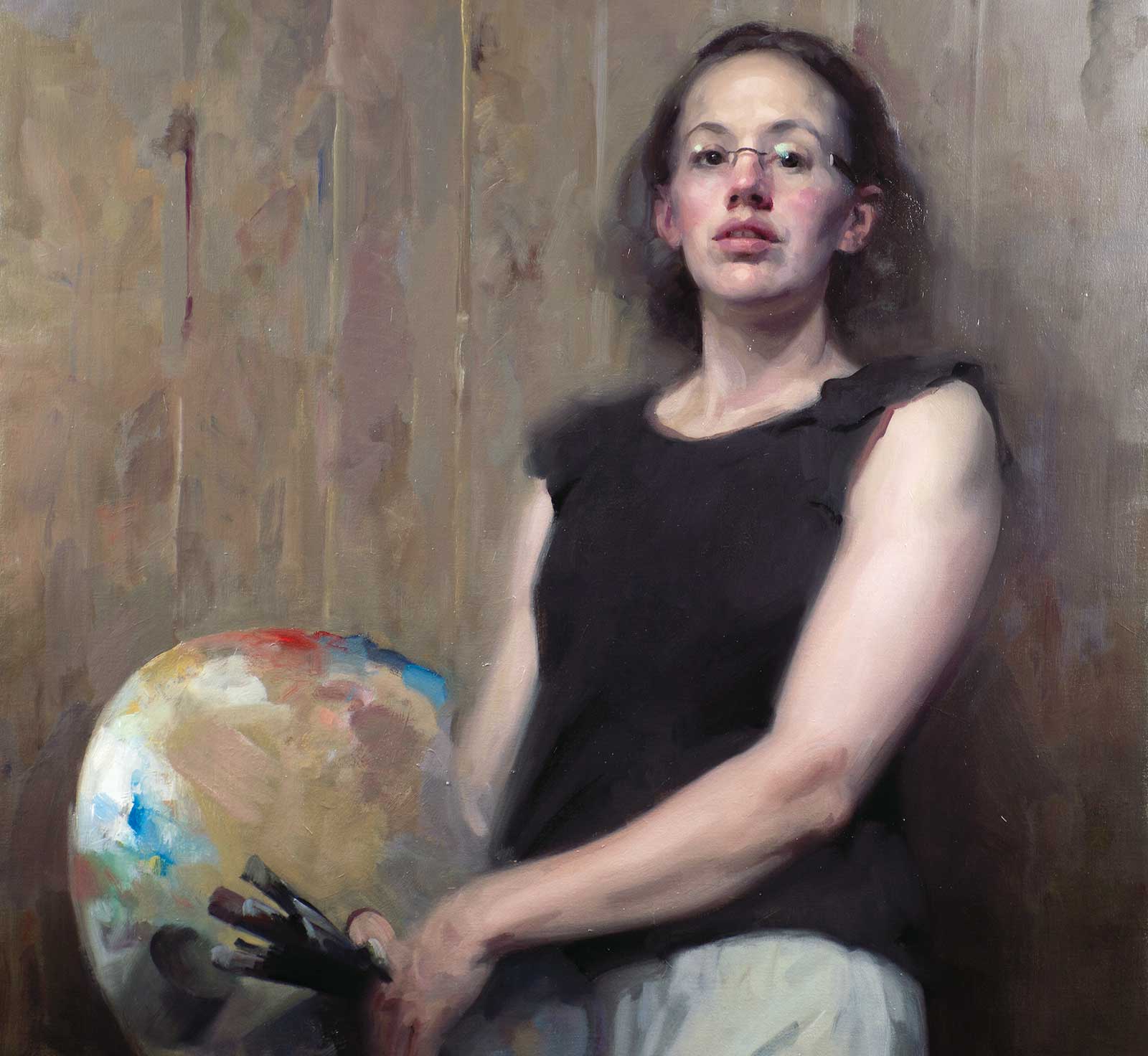 Frances Bell, Self, oil, 34 x 36"
The first artist, Olga Krimon, was born and educated in Russia, graduated with honors and continued to develop her painting skills in America through self-study, drawing classes and workshops. When she graduated art school in the 1990s, she realized that the Soviet Perestroika was not the right time for her to become and artist and survive. Instead, she went on to study languages, which brought her to the United States. After a long corporate career in IT consulting, she did not feel happy or fulfilled—for that, she turned to art. Krimon says, “It became a necessity, a way to survive, a way to express what I felt and how I felt. I needed it daily, I worked nights and weekends to get ahead. And I realized that I couldn’t change who I was, no matter how hard I tried. I led dual corporate and art careers for years until I finally had the courage to become who
I dreamt of becoming, who I really was all along. I couldn’t be without it, even though it’s a much more difficult path than a corporate career. It makes me so grateful and so fulfilled to do what I do.”
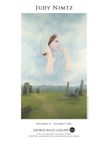
Krimon’s painting Before They Fly was inspired by the model’s pose. The model, Ava, leaned forward slightly and the artist could see a counterbalance of diagonals starting to take shape. She wanted the viewer to look at her face first, then move the gaze down through her hands, and to follow the curve of her dress through the curve of the crane. She made the decision to paint the bird and girl’s dress the same value and color scheme, so they sit so closely that the bird becomes an extension of the girl, as if they are one. Krimon explains, “The bird is also a guard. A parent, maybe. While Ava initially held on to the edge of the bench, I changed that to the tree branch, and I added the feathers and other elements that further emphasized the idea of a nest, of a comfortable space where she grows up to then fly away. The white bird was also a symbol of purity and innocence. It all started to tie together. I left the background very simple—with a lot of my initial underpainting wash coming through it. It gives the feeling of warmth and comfort that I wanted to have.”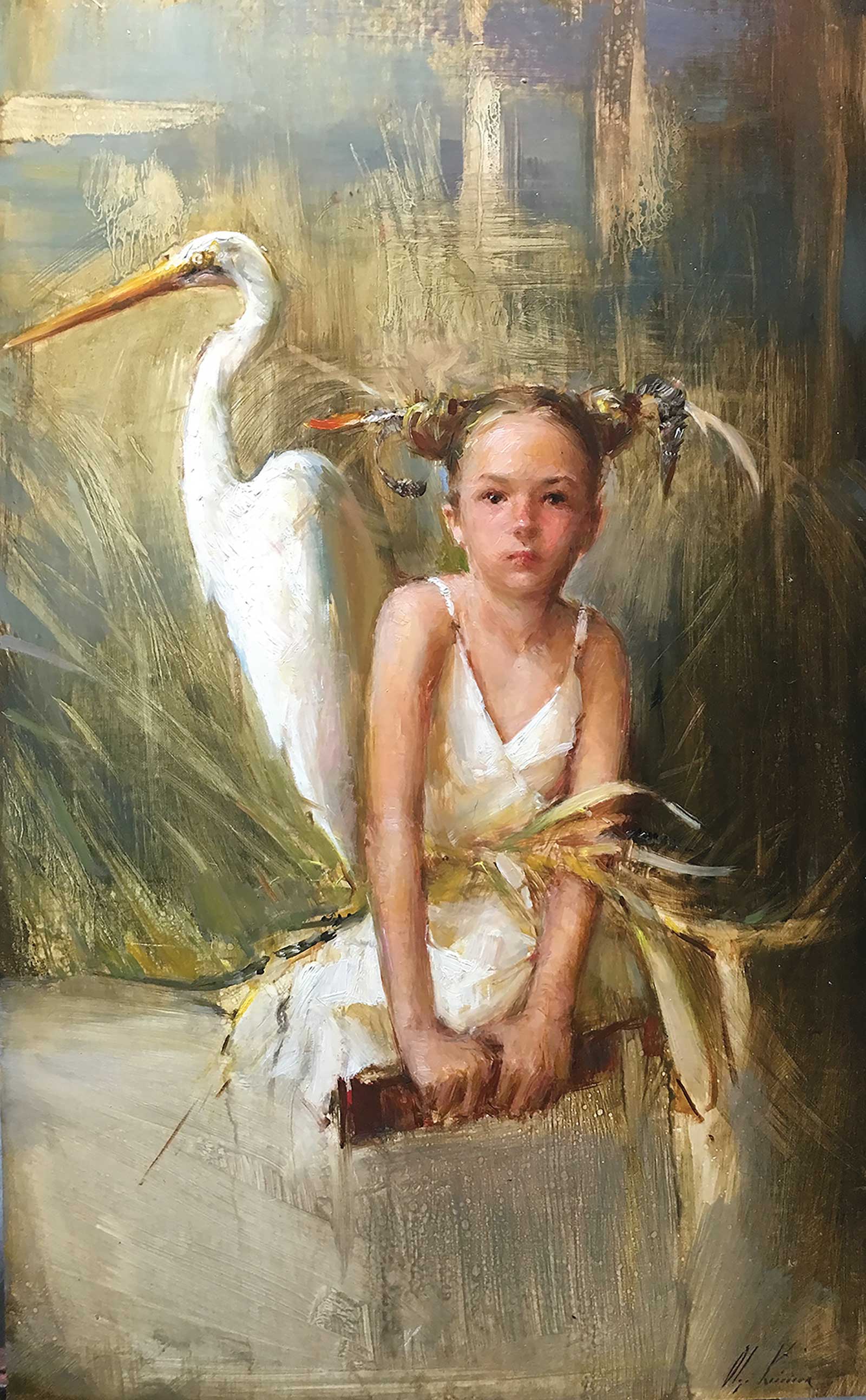 Olga Krimon, Before They Fly, oil, 25 x 15"
This year’s Draper Grand Prize winner Annie Murphy-Robinson’s passion for art started at an incredibly early age, saving her hard-earned allowance for art lessons. Her mother taught her how to draw animals, but it was portraits that she longed to create, and so she begged her mom to buy her “how to draw” books and spent her elementary school years learning how to draw people. During her teenage years, her family moved first to Tucson, Arizona, then to Phoenix, interrupting her trajectory of a possible career in the arts. In her adolescence, she struggled with substance abuse, eventually running away from home and dropping out of high school. She joined the Army at 17 and later continued her college education where she majored in art with a concentration in painting.
While trying to figure out who she was and how her art fit into the world, Murphy-Robinson enrolled in graduate school and during this time she found her way back to original love, drawing people. Almost all of her work is of her two daughters. On this, she says, “My work is about that space of youth where magic unfolds, defining identity through experimentation, the clothing, the gaze and the pose among other things.” She continues, “At the emotional level, my focus is to convey truth and honesty, and for me, the only absolute truth I know is of myself and my children. This truth is filtered through a lens of my own experience, often being bittersweet and questioning.” 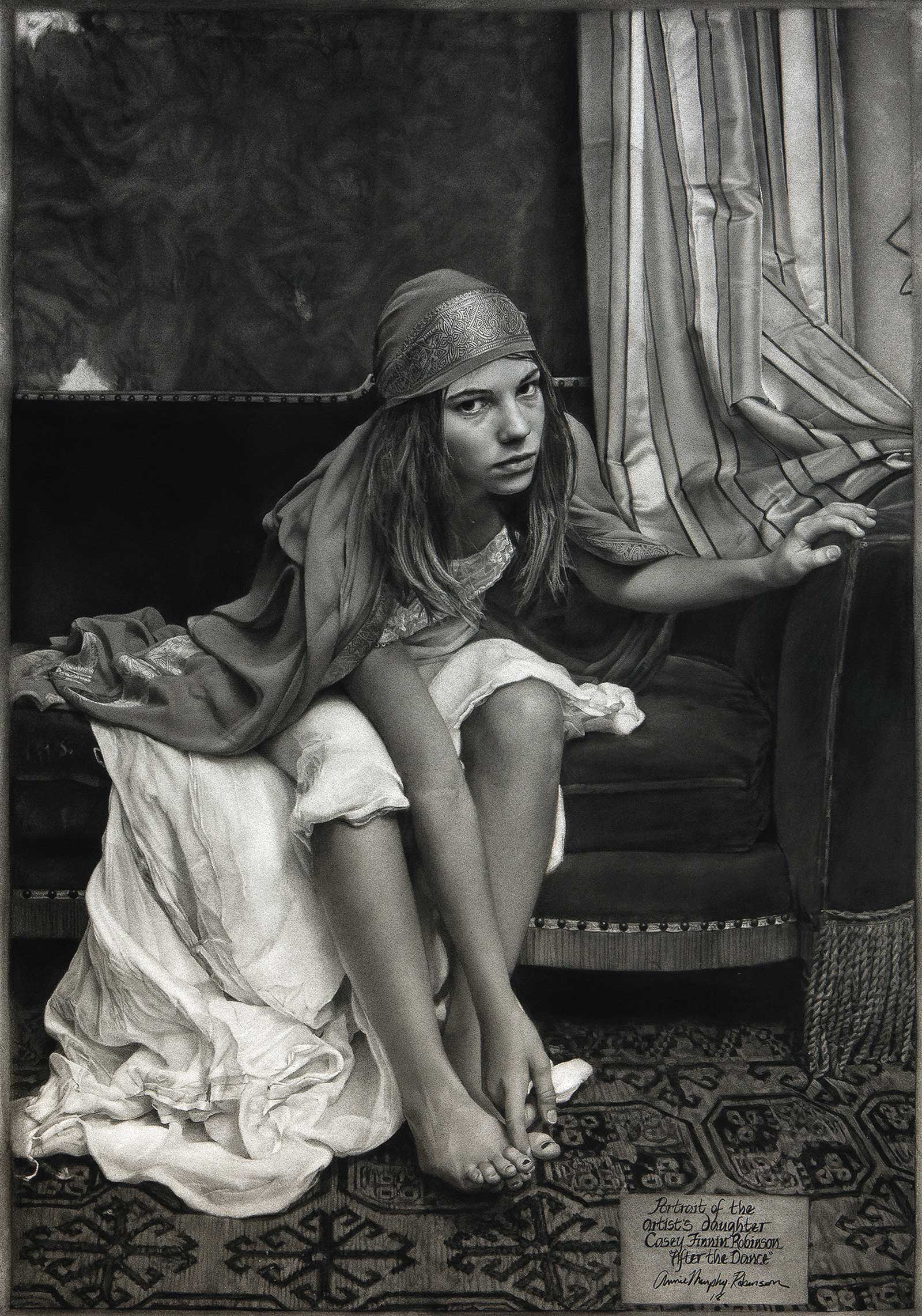 Annie Murphy-Robinson, Casey After The Dance, charcoal on paper, 60 x 42"
Her Grand Prize-winning work, Casey After the Dance, is a portrait of her daughter in a time set in the distant past. The artist says, “I am inspired by the plight of women, especially in a historical context. The toughness and adaptability of this fictional woman is apparent, the smile is gone, the dance is over and she is tired. It felt more authentic to capture the moment after, the moment when no one is looking.”
Another work that features her daughter, titled Casey Adapt, is about the adaption we have to do as humans in order to live a civilized life. This drawing symbolizes a pull to return to our feral roots, and embodies our wild nature, symbolized by the coyote fur. Murphy-Robinson’s journey led her to draw what she knows, what she loves. She describes that connection to her work: “I validate my life and experiences—good, bad and indifferent—through my art. We all have a voice; we all have experiences that with regular practice will show up in our work. My advice is don’t wait for a good idea, don’t second-guess yourself, do the work and it will come.”
Artist Olena Babak grew up in Ukraine and studied art in several schools and ateliers in both the United States and her home country. Receiving an education that was diverse with an international viewpoint has allowed her to develop her own artistic style and voice. Babak initially started her art career as a graphic designer and she says, “After working as a graphic artist and trying a few different things I went back to studying art. I had a chance to paint with and learn from some wonderful teachers at the University of Maine as well as at a private art atelier in North Carolina. I have been a full-time artist painting and drawing things that inspire me since we moved back to Maine in 2011. I’m grateful to have had the ability to be able to pursue my passion.”
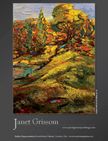
In her charcoal and pastel drawing Apple Orchard, she intentionally combines high levels of finish with more suggestive marks. Describing her process, she says, “I feel that not everything needs to be developed to the same level, and by allowing your eye some places to wander it creates a story and a bit of mystery. I believe that a simple line or brushstroke can convey as much information as a highly rendered form but the combination of the two ultimately can create a visually interesting story.”
Babak’s process includes creating a small thumbnail sketch to find just the right balance of shape. She feels it’s important to be able to have the energy of the artwork and the mood from the very first marks on paper, as it sets the tone for everything to follow. Babak explains her process further, “I apply the most color to the place where a viewer’s attention is supposed to be directed. The very last marks are made in the background, and I hope they become supporting elements for the main subject. Often a work will be almost finished and will need just a few well thought out marks to complete. Those marks could take me a few (or more) weeks to decide on. I like the background to be very free feeling allowing a person to visually enter the world that I’m creating on paper.”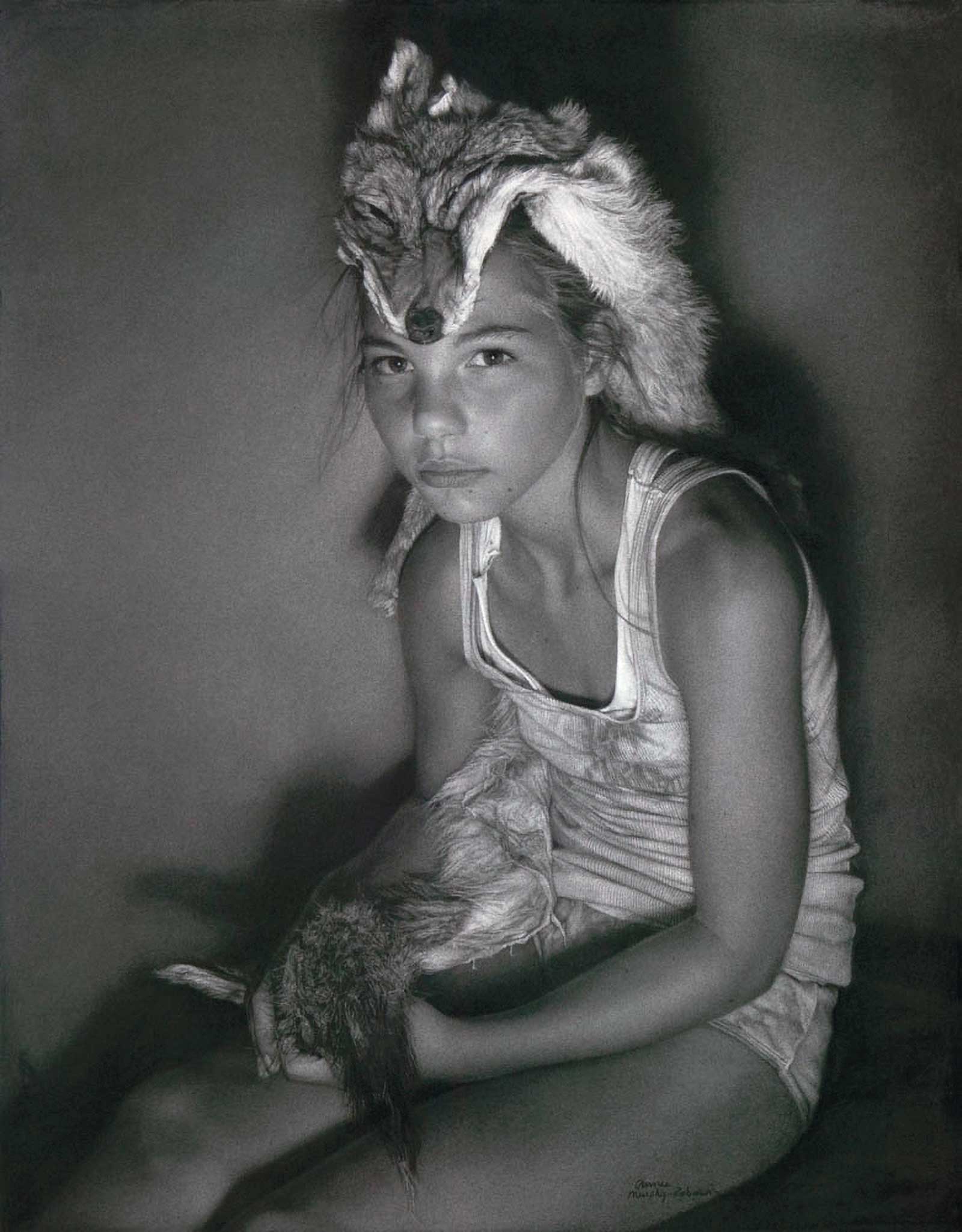 Annie Murphy-Robinson, Casey Adapt, charcoal on paper, 42 x 32"
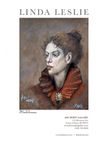
Sculptor Louise Weir graduated with a Bachelor of Fine Arts from York University in Toronto, Canada, as well as a master’s in art therapy. For a time, Weir worked with young adults as an art therapist and after raising her four children, she returned to sculpture. Her first project involved employing marginalized individuals and homeless people as models. These “Portraits in Recovery” as she calls them are classically styled sculptures of living persons of no particular distinction in the public realm, yet she found humanity revealed in the portraits equal to any important historical or contemporary figure.
Her model for the sculpture Claudia in a Scarf was a student in her daughter’s theatre arts high school. She first noticed her features that seemed contemporary in nature yet echoed those of a medieval Madonna. Weir describes her, saying, “Claudia is one of those people who I was just drawn to sculpt. She has lovely large eyes, a long straight nose and an oval face, very striking, like a medieval Madonna. Happily, she agreed to sit for me. I began working on a portrait of her, looking directly forward, with her hair up off of her neck. I worked on the shoulders and chest until I achieved a pleasing composition.”
After, Weir was inspired to continue working on this first portrait. She says, “There is something of theater in a good sculpture. Unlike painting, which invites you into a world, sculpture steps into the space with you. So, when I finished the first portrait and undertook to create Claudia with a Scarf, I decided to tilt the neck and change her gaze to something more introspective. This allows the viewer to gaze at the work without being ‘observed’ by the portrait. The scarf created a sense of history and drama and elongated the form.” By making these changes and using several key design principles, Weir achieved a much stronger composition in her work. 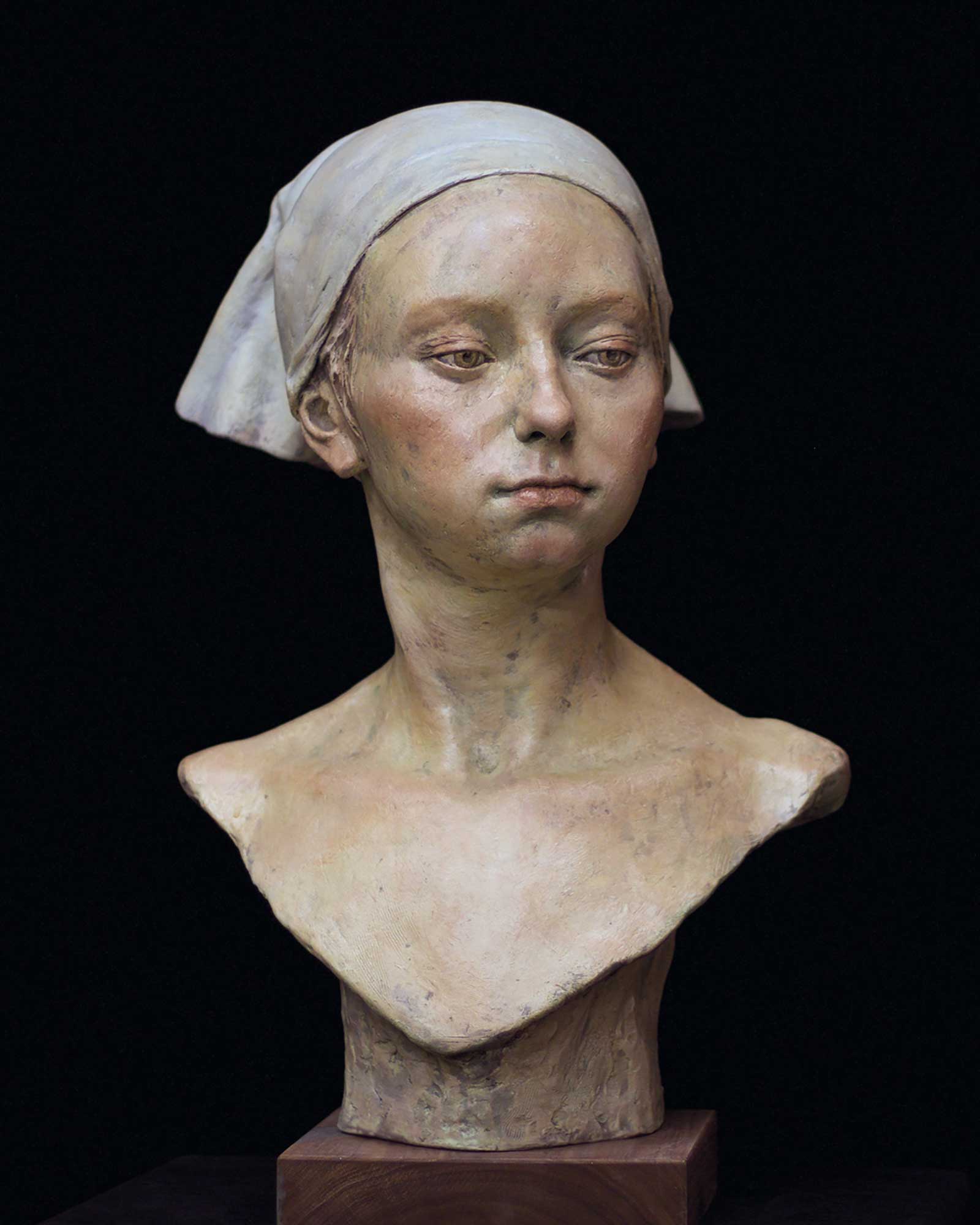 Louise Weir, Claudia with a Scarf, plaster with oil paint, 20½ x 14½ x 14½"
Frances Bell was born and educated in England and at age 18 went to Florence to study at Charles H. Cecil Studios. After teaching in Florence for several summers, she put all her efforts towards a full-time career in commissioned work. Bell says, “My professional life, and broader themes, range across both portraiture and landscape and much in between. Portraiture is still slightly more of a priority over other genres, but the variety of subject matter deepens and broadens each interest. I’m a member of the Royal Society of Portrait Painters in the United Kingdom and enjoy participating in the exiting and rich portrait-based conversation in progress today.”
Bell frequently works from life and has not always felt the allure of a self-portrait as the set up can seem arduous and contrived. But with this self-portrait, she describes her inspiration, “My process was informed by the original germ of an idea—the heavy leaning quality I wanted to portray. I felt I wanted to be propped up on the wall, slightly from below as far as viewers were concerned, in the repose of considering the activity of painting. So given those aims I had to place the mirror below me, and then flick my eye upward to the canvas. I placed the mirror between me and my canvas and moved backward and forward between the pose and the painting. It was by no means a pure sight-size, but I’ve learned to adapt and slacken the method when needs must.” In addition, Bell uses multiple lights and atmospheres to calibrate the ambience of the finished work, creating an effortless value plan that creates depth and interest.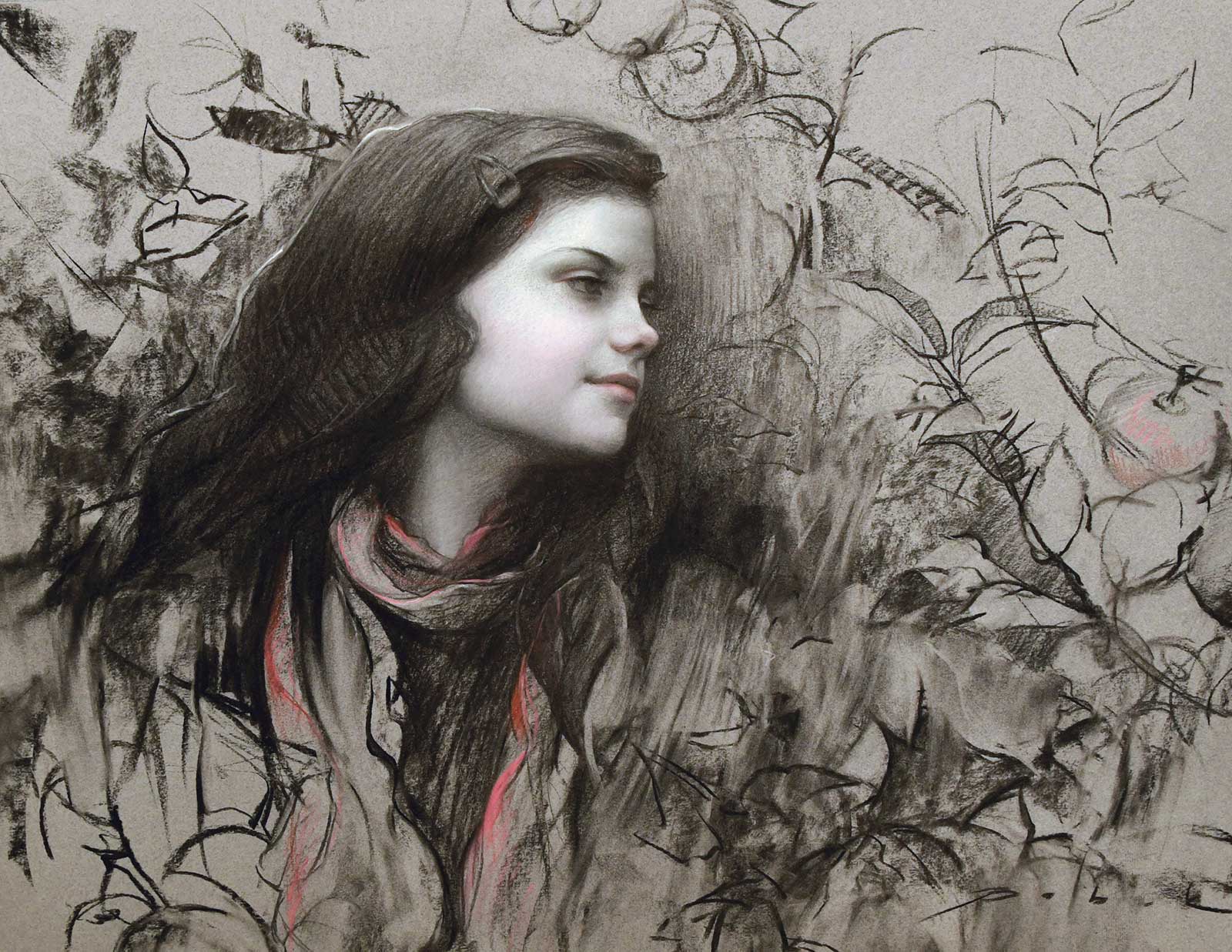 Olena Babak, In the Apple Orchard, charcoal and pastel, 19 x 25"
Line, shape, color, value, texture, form and space. Seven simple principles that are anything but simple to master. Yet each of these five artists, in their various medias and styles, have achieved just that—a mastery of compositional arrangement. Spread across the world, yet all working toward a similar purpose, that is part of the universal beauty of art. —
Christine Egnoski is the Executive Director for the Portrait Society of America and has served in that position since the founding of the organization in February of 1998. In addition to writing for International Artist magazine she also provides occasional articles for American Art Collector. Passionate about portraiture, she can be reached at info@portraitsociety.org.
Powered by Froala Editor