In his poem Abt Vogler, Robert Browning (1812-1889) writes in the voice of Georg Joseph Vogler (1749-1814), a German organist and theorist who meditates late in life on the meaning of that life. One line of the poem reads, “On the earth the broken arcs; in the heaven a perfect round,” suggesting the hope of fulfilment or surcease of sorrow in the next life.
Koo Schadler incorporates the words from the poem in her egg tempera, In the Heaven Diptych II (Apples and Acorns), 2020. She celebrates the second part in gilded letters and hides the first part in chiseled stone disappearing in shadow. The ephemeral appears in the butterflies and rainbow as well as in the plucked apple whose leaves are already beginning to wither. The apple has been burdened with symbolism through the ages from being a symbol of the universe because of its perfect round shape and, along with its association with knowledge, the fall of mankind in the Garden of Eden. The acorns suggest the coming of the mighty oak which will produce more acorns and more oaks, but one of them has been bitten into.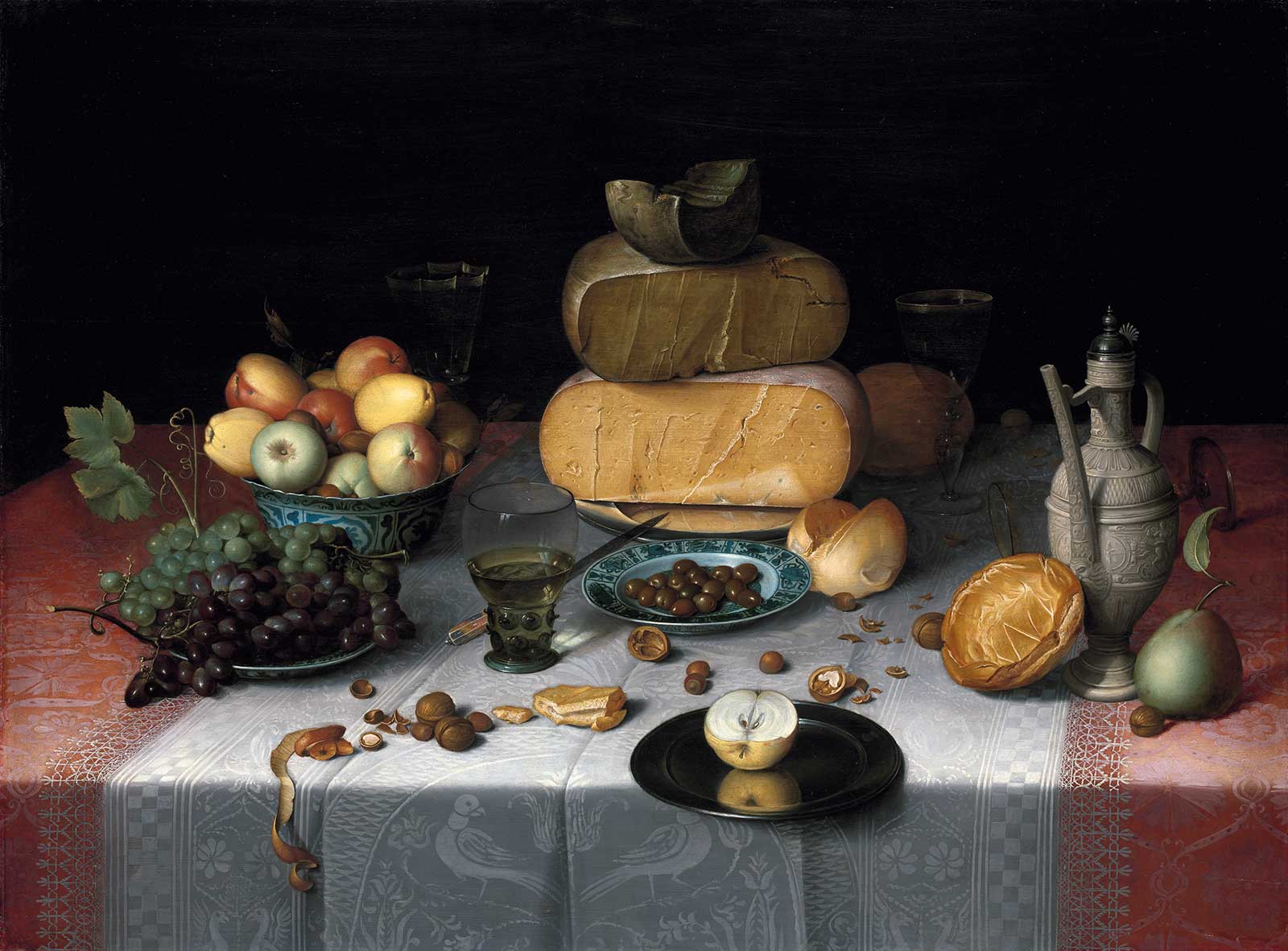 Floris Claesz van Dijck (1575-1651), Still Life with Cheese, ca. 1615, oil on panel, 32½ x 44". Collection of Rijksmuseum, Amsterdam, Netherland.
Schadler’s luminous egg tempera is built up of “layers of thick and thin paint, glazes and scumbles, fine round and wide flat brushes, sponges, splatters, stencils, rubber stamps, fingers and more,” she explains. She uses her contemporary approach to egg tempera to express timeless ideas.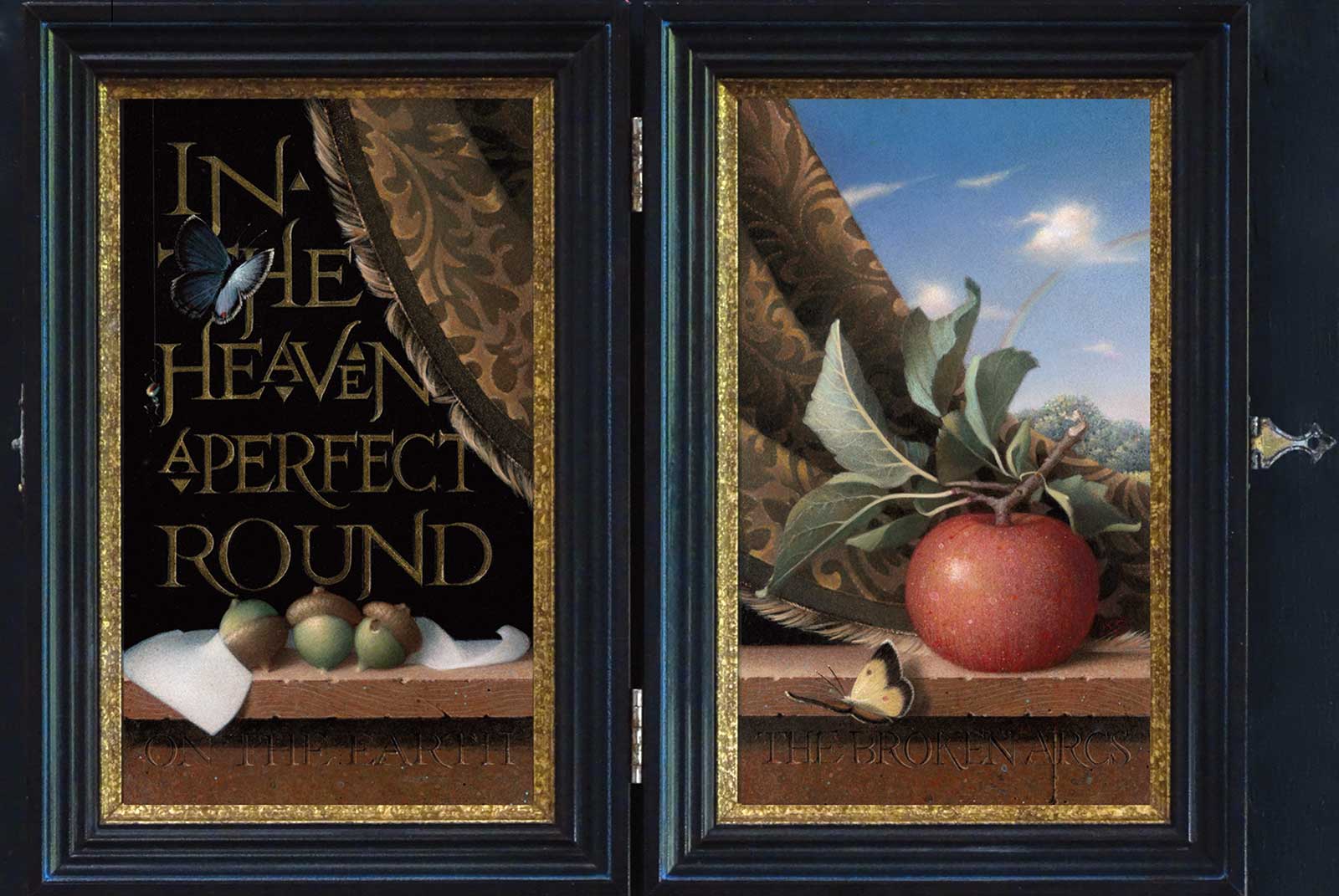 Arden Gallery, In the Heaven Diptych II (Apples and Acorns), egg tempera on true gesso and MDF panel, shellac and wax, 9¾ x 13 x 1", by Koo Schadler.
In Dutch still lifes of the 17th century, the abundance of produce and elegant tableware often symbolized the transience of life and each piece of fruit, cheese, nuts and wildlife symbolized something specific. Floris Claesz van Dijck (1575-1651) painted Still Life with Cheese, around 1615. He looks down on the setting from a high vantage point to allow each item to be seen but allows the scene to recede into shadow from the brightly lit foreground. The creases in the finely painted damask tablecloth recede in perspective to create depth. An apple peel, nut shells and knife marks on the cheese bring the ideal into the everyday. We have become jaded looking at high-resolution digital imagery, seldom actually seeing art in the flesh. Paintings such as this were astounding to the 17th-century Dutch who admired the artists’ skill and understood the symbolism.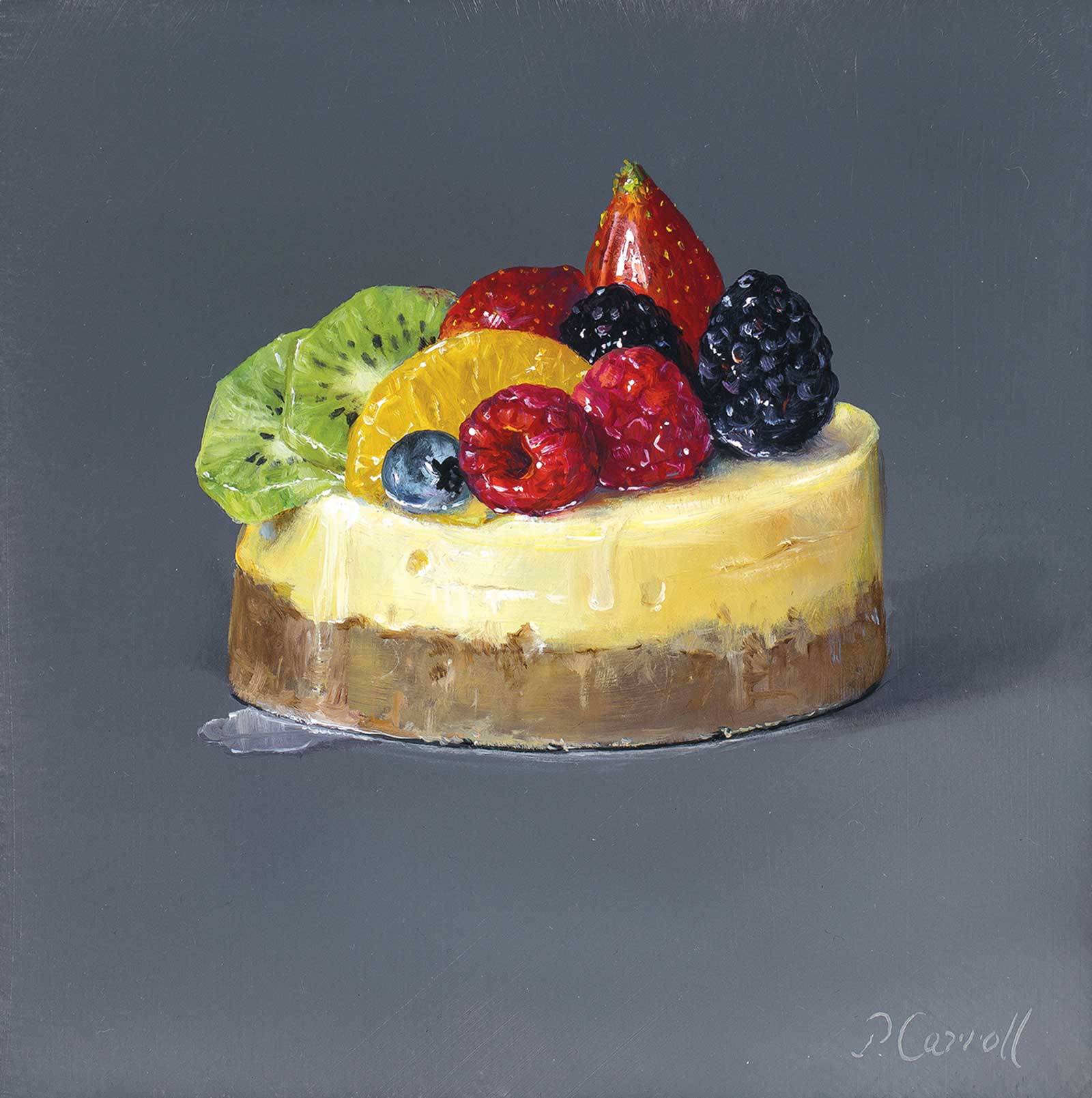 Winfield Gallery, Cheesecake, oil on panel, 6 x 6", by Pamela Carroll.
Pamela Carroll’s still lifes are influenced both by Dutch and Spanish masters and her contemporary peers and highlight the beauty in everyday objects. She assembles her still lifes drawing from the abundant produce of the Monterey Peninsula where she lives as well as utilitarian objects and whimsical toys she finds in antique shops. She approaches her subjects with seriousness being careful to capture their textures and colors in subtle lighting. She also approaches her subjects with humor as in Cheesecake, 2021. The shimmering dessert sits isolated on a table, an object of veneration and potential delight. The fruit, while perfect, don’t behave perfectly as the fruit in van Dijk’s painting. They ooze, as fruit do, creating a puddle of moisture next to the cake.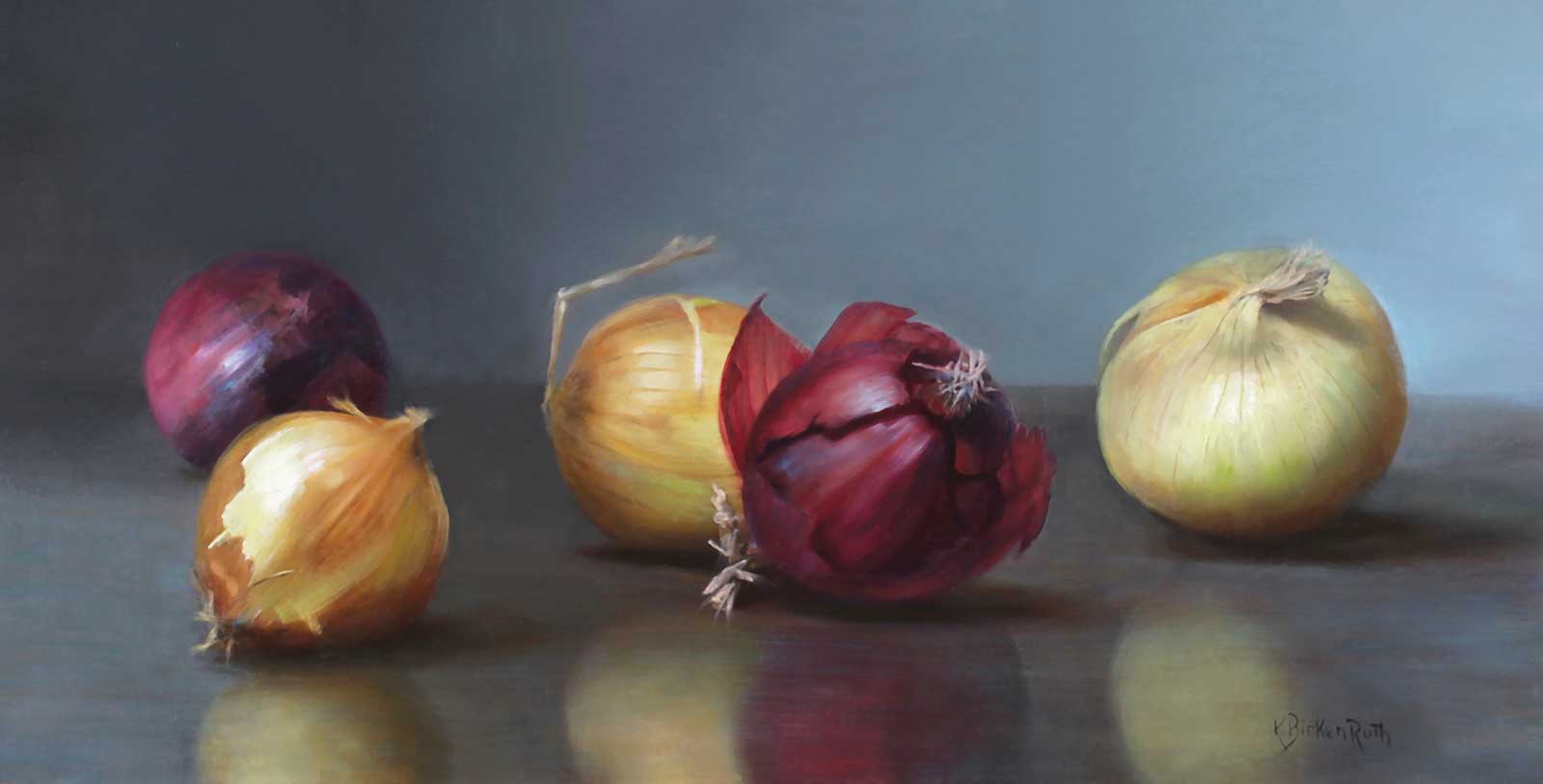 Susan Powell Fine Art, Red and Yellow Onions, oil, 10 x 20", by Kelly Birkenruth.
This special feature on the art of food features everything from dining rooms ready for patrons to enjoy their feasts to the beautiful and bountiful items that nourish.
Susan Powell Fine Art in Madison, Connecticut, represents a number of artists who incorporate food into their artwork including Larry Preston and Kelly Birkenruth.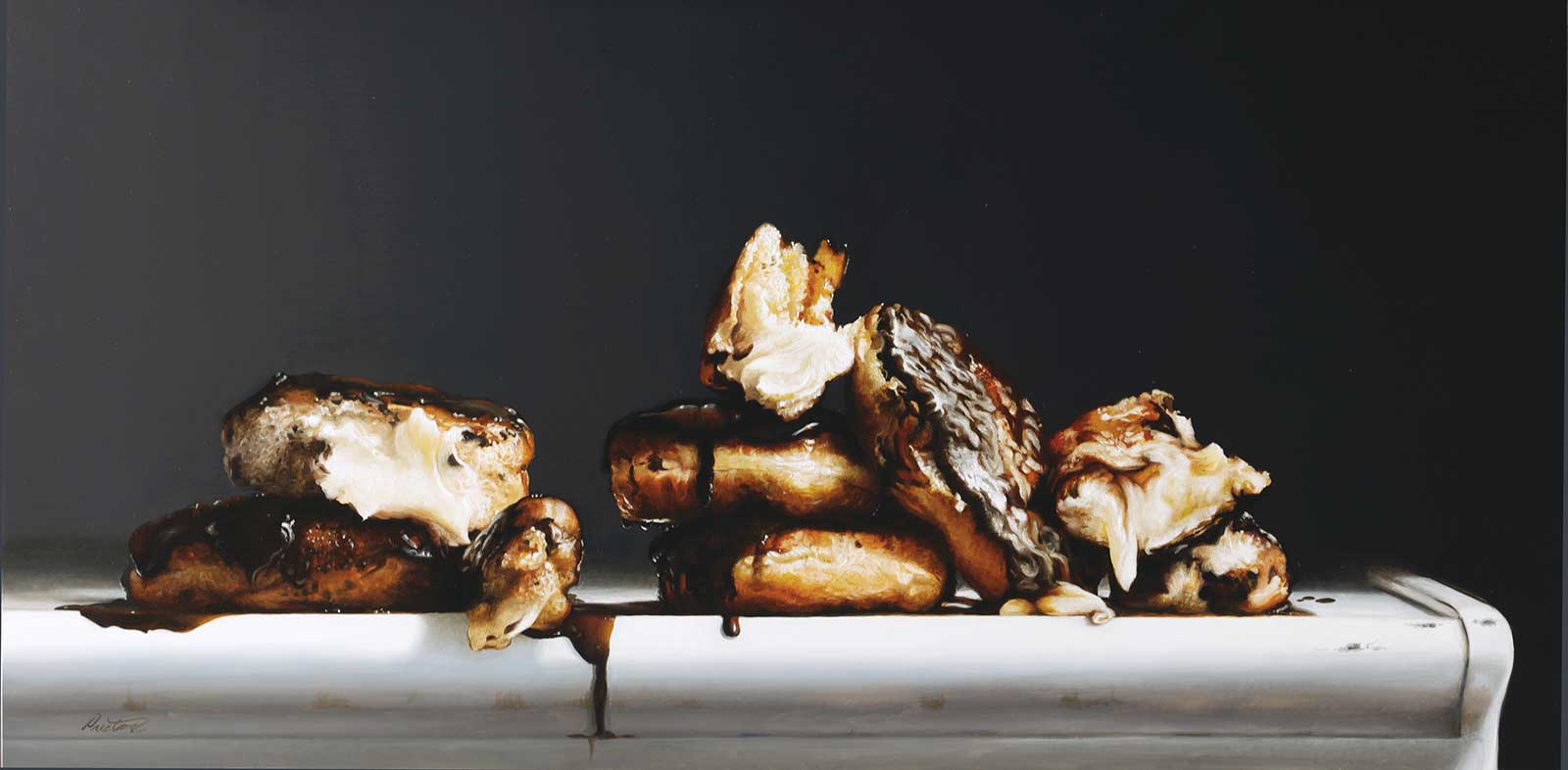 Susan Powell Fine Art, Boston Cream, oil on panel, 18 x 36", by Larry Preston
“Larry Preston’s whimsical Boston Cream is a fresh take on the classic still life. Larry is inspired by 17th-century Dutch and Flemish paintings and paints simple, everyday objects that he finds beautiful and too often overlooked. The contrast in light and shadow creates drama in the delectable creamy donuts with dripping chocolate and adds to the realism of this non-traditional still life,” says gallery owner Susan Powell. “Kelly Birkenruth explores beauty in the everyday cooking staple of Red and Yellow Onions. Her riveting, simplified composition of five onions has an alluring color harmony with wonderful nuances of subtle colors in the thin, papery skins. Kelly tilts some of the onions to create interest and imply movement.”
Describing her own painting, Birkenruth says, “While painting onions I am always amazed at the juxtaposition of their weight contrasted with their translucent, fragile skin. I also included their reflection on the tabletop to add interest and round out the composition.”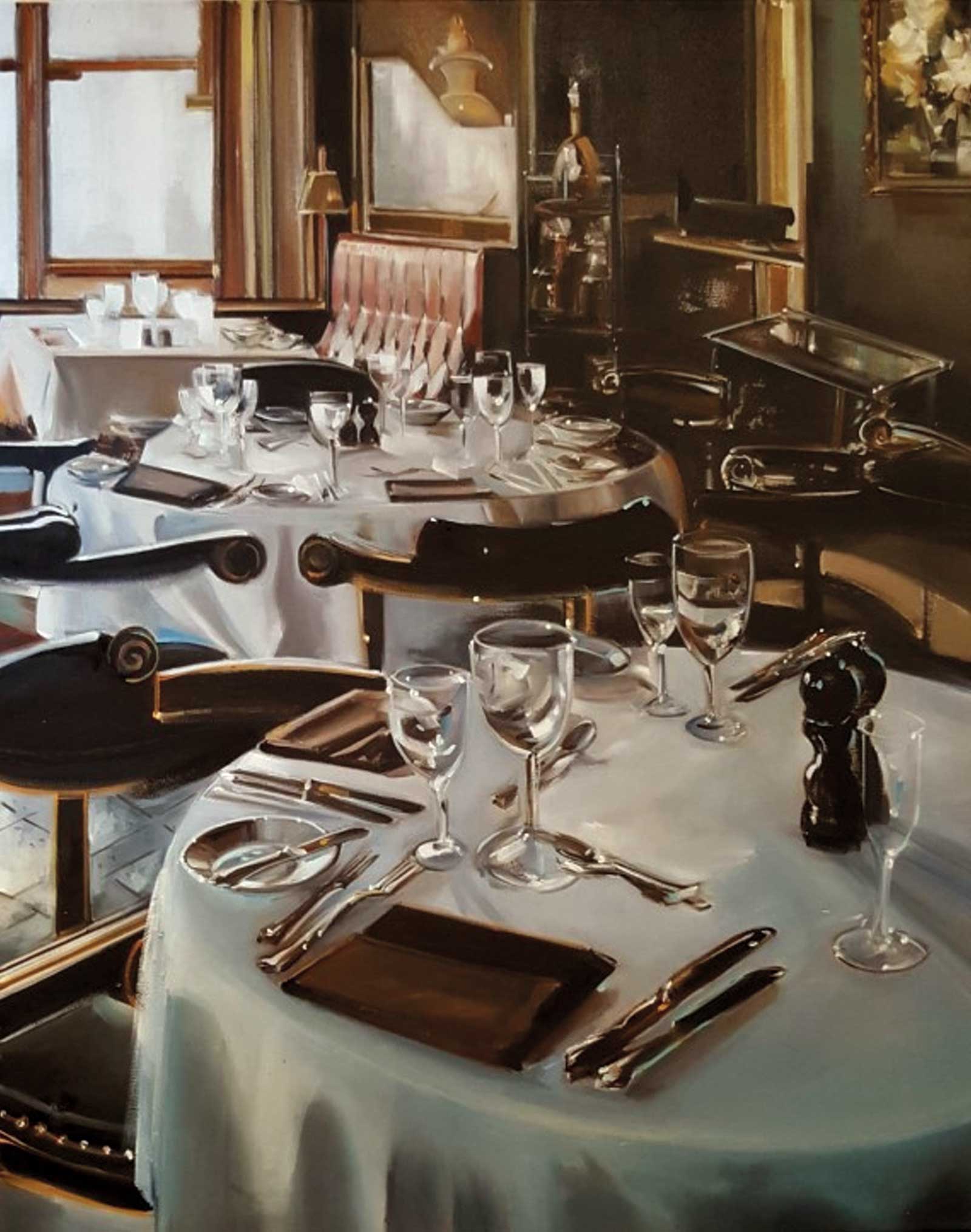 Thalia Stratton, Lunch at the Grand Bertagne, oil, 30 x 24"
Thalia Stratton has become recognized for her paintings featuring the interiors of restaurants around the world. The pieces are the epitome of the dining experience, showing the fresh linens, centerpieces and dinnerware. She says, “Every year I travel back to Greece, the country of my parents’ birth and my spiritual home. I visit my extended family and my many friends and enjoy the beauty of Athens and the neighboring islands. And, as part of each of my annual Athenian sojourns, I visit and eat at the Grand Bretagne Hotel,” says Stratton.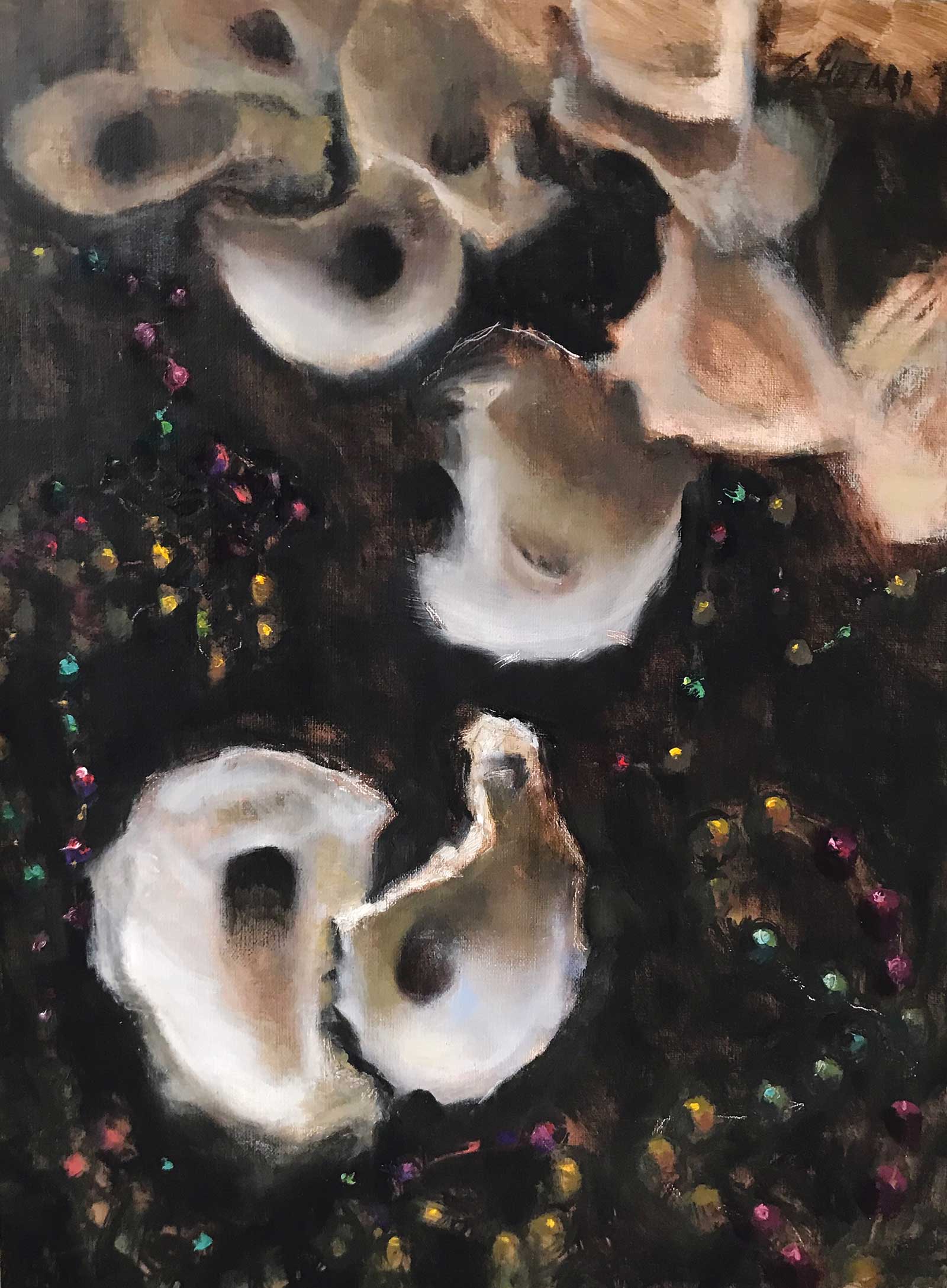 Susan Hotard, Shell We Dance, oil on linen panel, 16 x 12"
Her painting Lunch at the Grand Bretagne is one in a series of paintings that continues her graduate thesis dedicated to “The Art of Dining.” Stratton adds, “In Greece, as in much of Europe, especially in the Southern Europe, dining is really an art, the art of enjoying oneself and one’s family and friends in a celebration of what life has to offer.”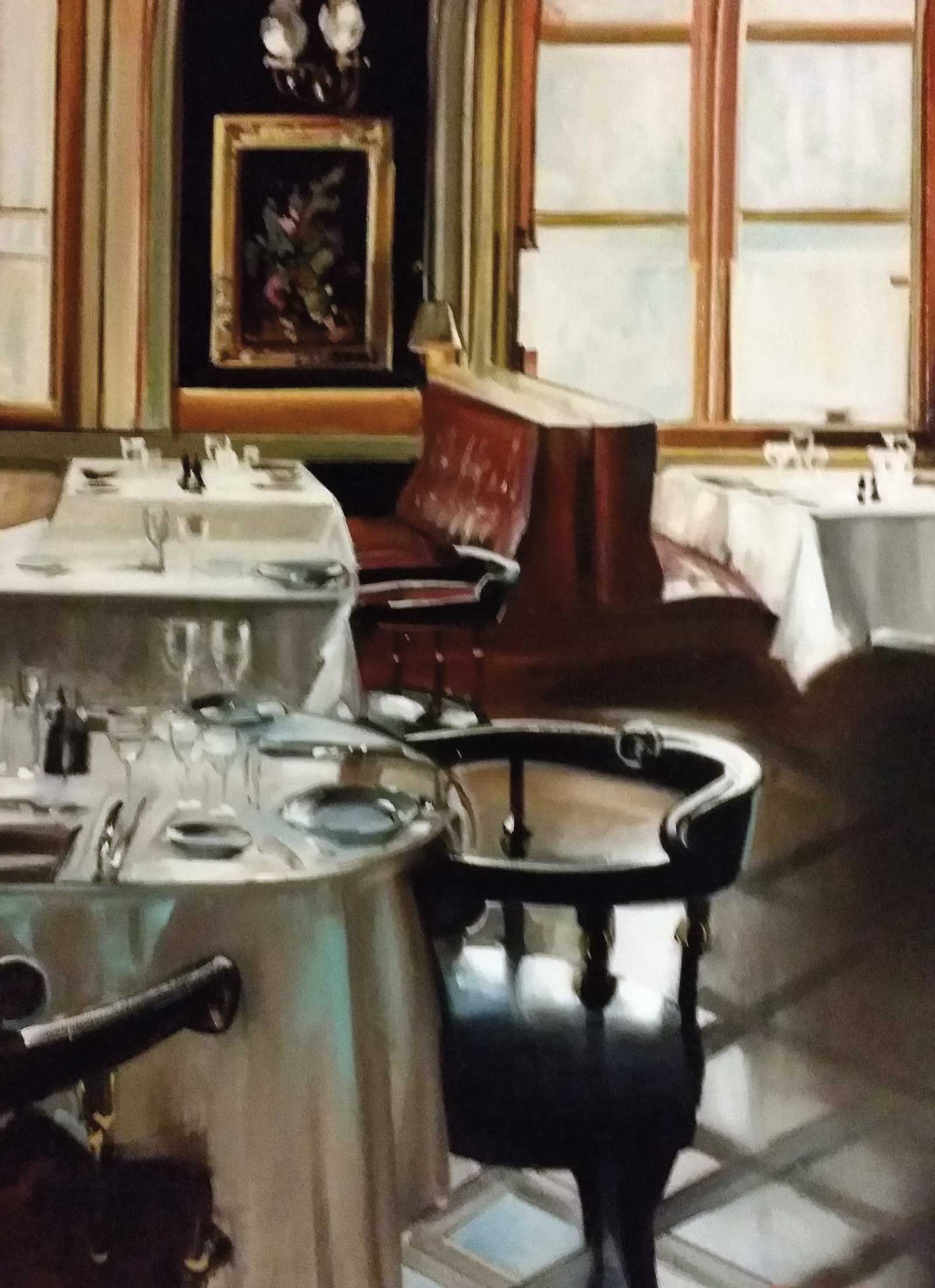 Thalia Stratton, The Grill Room II, oil, 30 x 24"
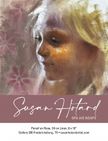
Painter Susan Hotard is known for her figurative work and still lifes. One of her newest works is Shall We Dance. As Hotard explains, it “was composed using carnival beads collected from Mardi Gras parades and oyster shells left from enjoyable restaurant meals. The tri-colored beads of purple, gold and green, mimic the movement of the shells in the way they both undulate and shimmer. I picture the pair of shells dancing cheek to cheek amongst the detritus of age-old New Orleans celebrations. Laissez le bon temps rouler! (Let the good times roll!)” —
Featured Artists & Galleries
Arden Gallery
129 Newbury Street, Boston, MA 02116
617) 247-0610
www.ardengallery.com
Susan Hotard
susan@susanhotardartist.com
www.susanhotardartist.com
Susan Powell Fine Art
679 Boston Post Road, Madison, CT 06443
(203) 318-0616
susanpowellfineart@gmail.com
www.susanpowellfineart.com
Thalia Stratton
(415) 971-5521, fashimag@pacbell.net
www.thaliastratton.com
Winfield Gallery
Dolores between Ocean & 7th
Carmel-By-The-Sea, CA 93923
(831) 624-3369
www.winfieldgallery.com
Powered by Froala Editor