“I grew up in a small town in Illinois,” Richard Estes says. “I never went any place. We moved to Chicago when I was 15 and I saw all these fabulous things—skyscrapers, art museums. When I was 18, I went to Europe and traveled for three months by myself. When you’re alone, you have the freedom to do exactly what you want, but it’s sort of lonesome. I prefer traveling with somebody else. I always enjoy sharing things. I travel mostly for art and architecture, concerts and opera in the great European opera houses.” In the U.S., he travels between his two homes, an apartment in New York City and a house on Mount Desert Island in Maine.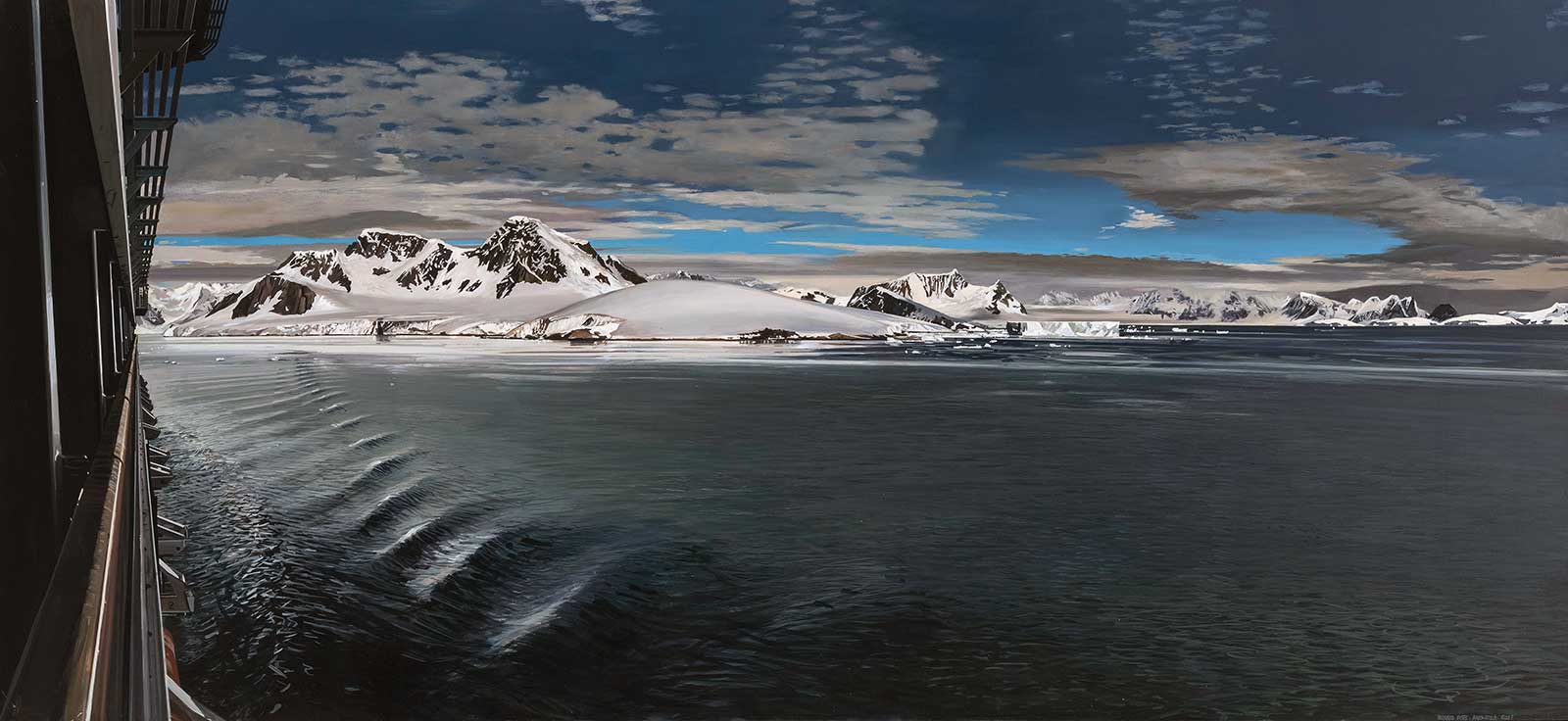 Antarctica II, 2007, oil on panel, 263⁄8 x 57"
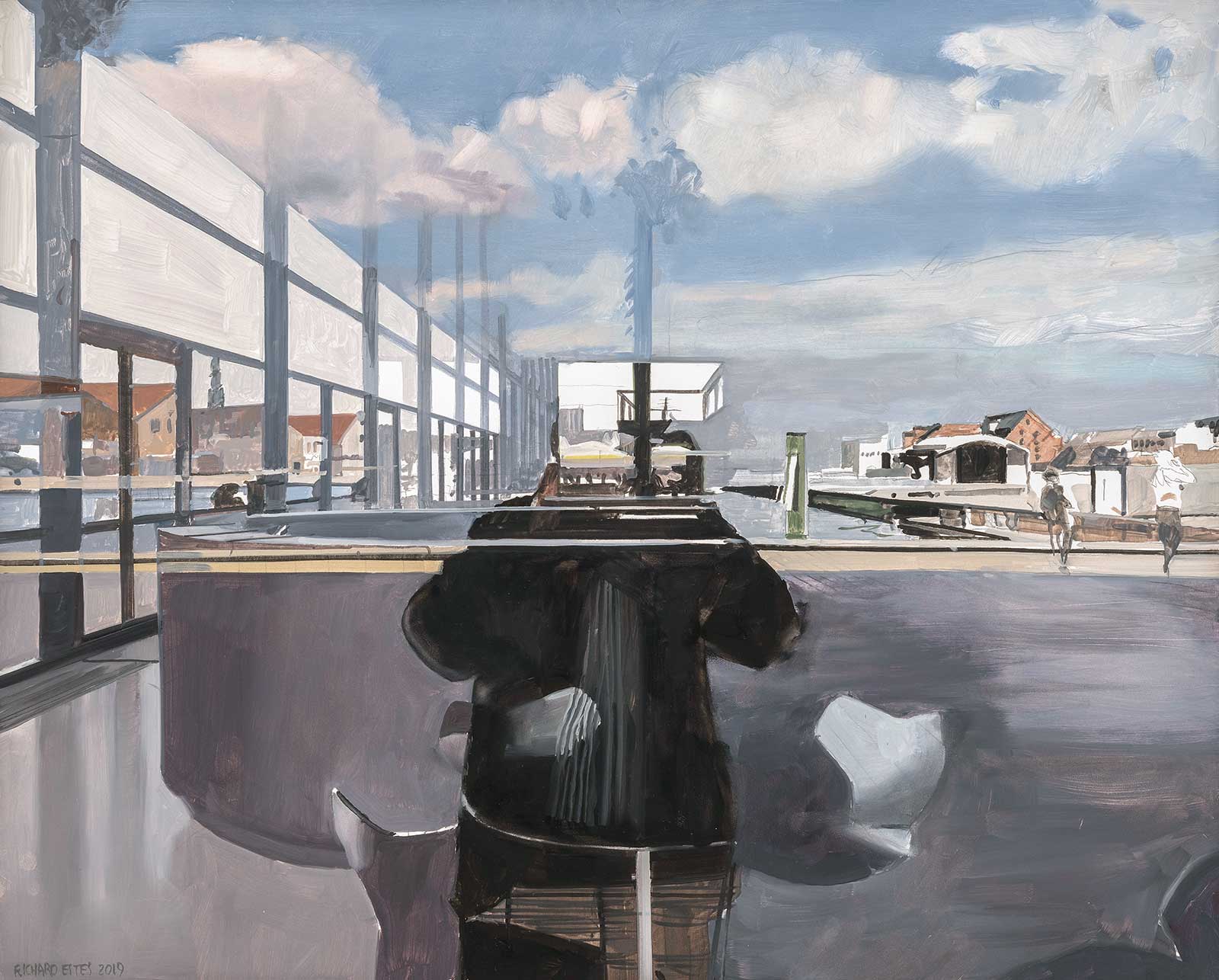 Self Portrait in Copenhagen, 2019, oil on panel, 16 x 20"
The cultural experiences of his trip to Europe led him to study art. Photography and drawing had been part of his youth and he had thought he might study architecture. He enrolled in the School of the Art Institute of Chicago in 1952. He says of the experience, “I think one of the best things about being a student there was, for example, trying to do a figure painting and then going up into the galleries to see the way El Greco or Degas did it. You can really put your work in the proper perspective that way, and learn from the paintings.”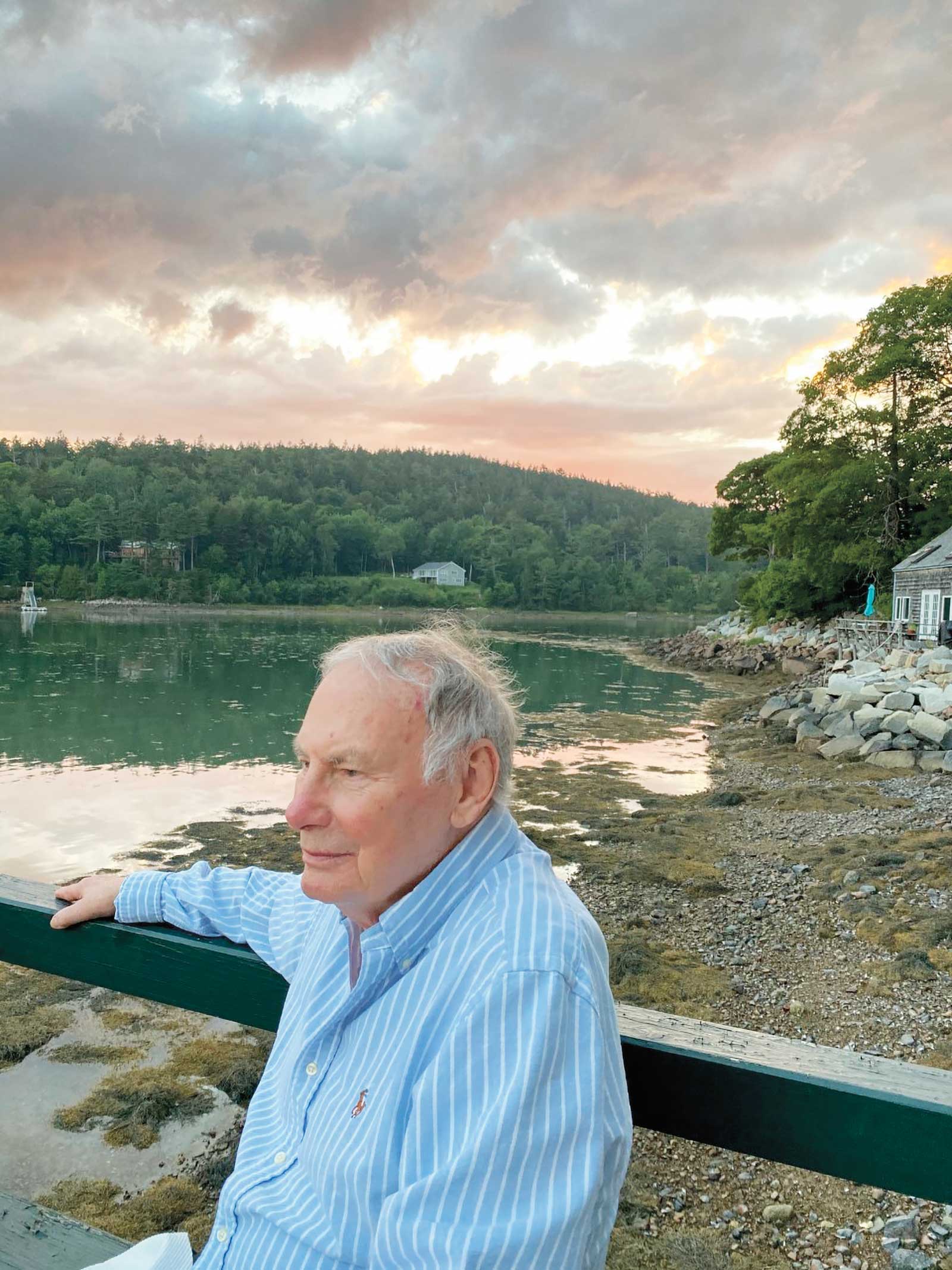 Richard Estes in Maine, summer 2020. Photo courtesy Dario Espinoza.
Recently, he went to see the exhibition Goya’s Graphic Imagination at the Metropolitan Museum of Art in New York. Nearly 70 years after his experience of paintings at the Art Institute, he continues to revel at being in the presence of original works by the masters. “We see the artist’s work in reproduction,” he says, “but there’s something in the actual object that’s unique, you see the technique. The artist’s touch is like handwriting.”
Estes particularly admires the Dresden paintings of Bernardo Bellotto (ca. 1721-1780), who was the nephew and student of Canaletto (1697-1768). “They’re travel paintings,” Estes explains. “It’s fascinating to see what things looked like in the 18th century and how they’ve changed. Canaletto’s paintings of Venice are almost too accurate, almost as if they were traced. He may have used an optical device.”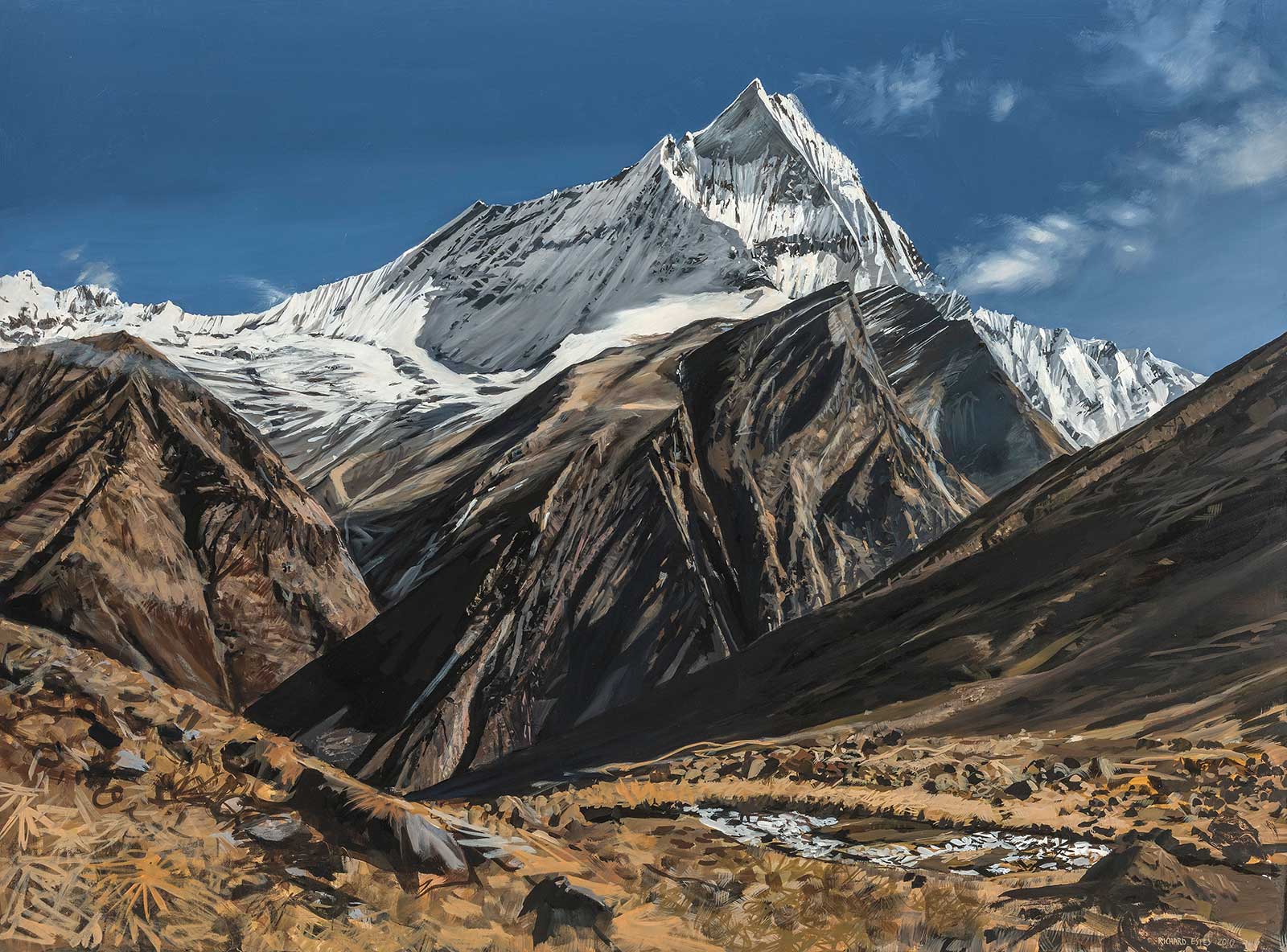 View in Nepal, 2010, oil on canvas, 32 x 43"
Menconi + Schoelkopf in New York, will hold its first exhibition of Estes’ works, Voyages, June 14 through July 30, focusing on his travel paintings.
“Voyages delves deeply into Estes’ canon,” the gallery notes, “offering a riveting and intimate look at some of Estes’ most impassioned work with pieces created from his own world travels, some even capturing him in transit itself. During a period when we share an unsatisfied longing for travel, the photorealism of these paintings captures small, personal moments of the artist’s adventures—touching down at an airport in Germany, approaching Antarctica by sea, stepping aboard the L train, and memorizing the landscapes of Hiroshima, Barcelona, the Pont Neuf and Central Park.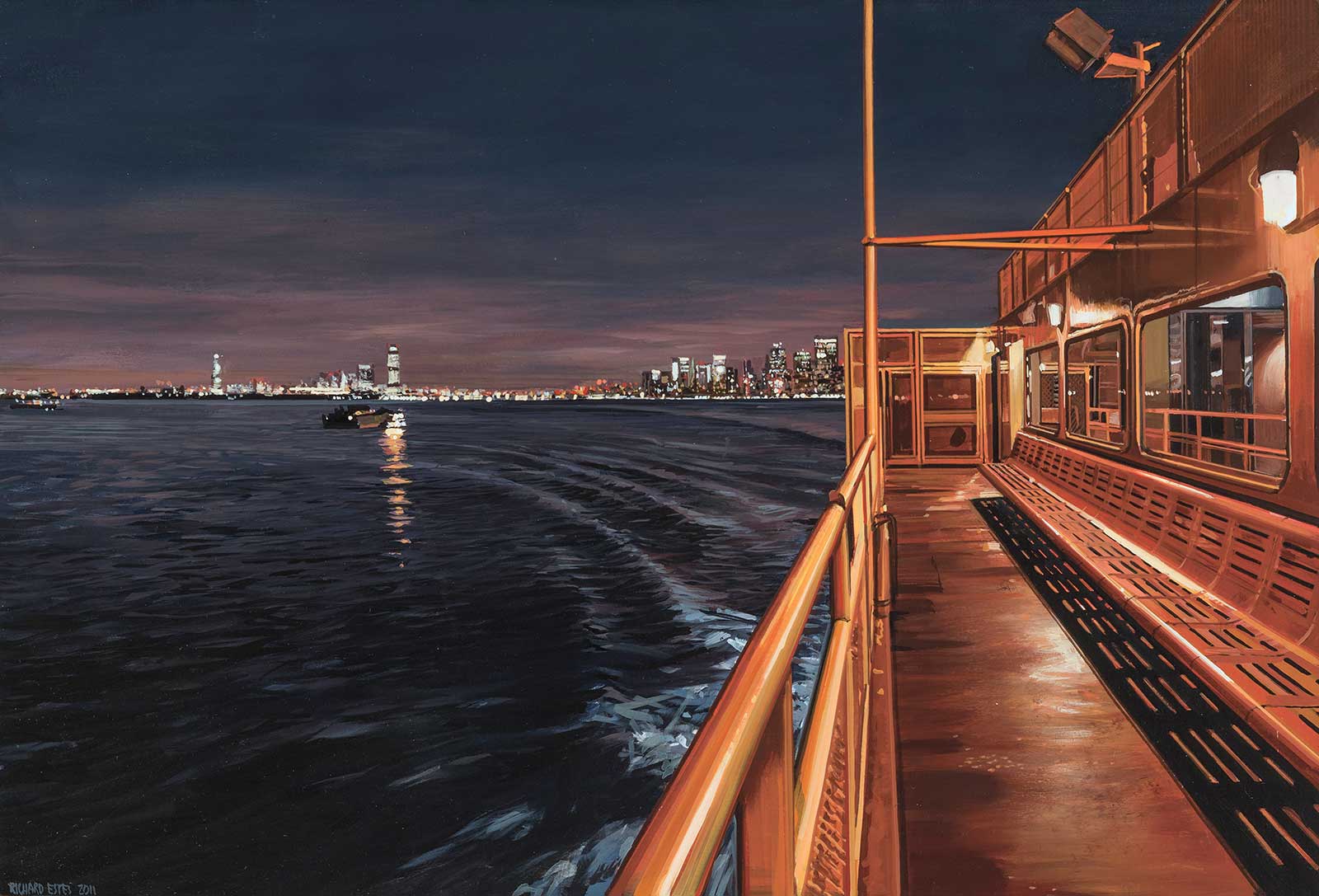 Staten Island Ferry Arriving with a Distant View of Manhattan and New Jersey, 2011, oil on panel, 127⁄8 x 187⁄8"
“Richard Estes is the standard-bearer of photorealist painting and its most devoted and accomplished practitioner,” the gallery continues. “His work is defined by a profound commitment to the fidelity and quotidian truths of his depictions. Of equal importance is his unique creative process in which repeated observations coalesce into an image in his mind. The painting of that image represents a vision within his subjective reality. Over the last half-century, the rare integrity of his process has unveiled a true understanding of the world around us, even as our cities, our landscapes and our rituals change—slowly and steadily, then all at once. As the pendulum swings back from abstraction and realism recaptures the imagination, Richard Estes is secured as one of the leading painters of the 20th century.”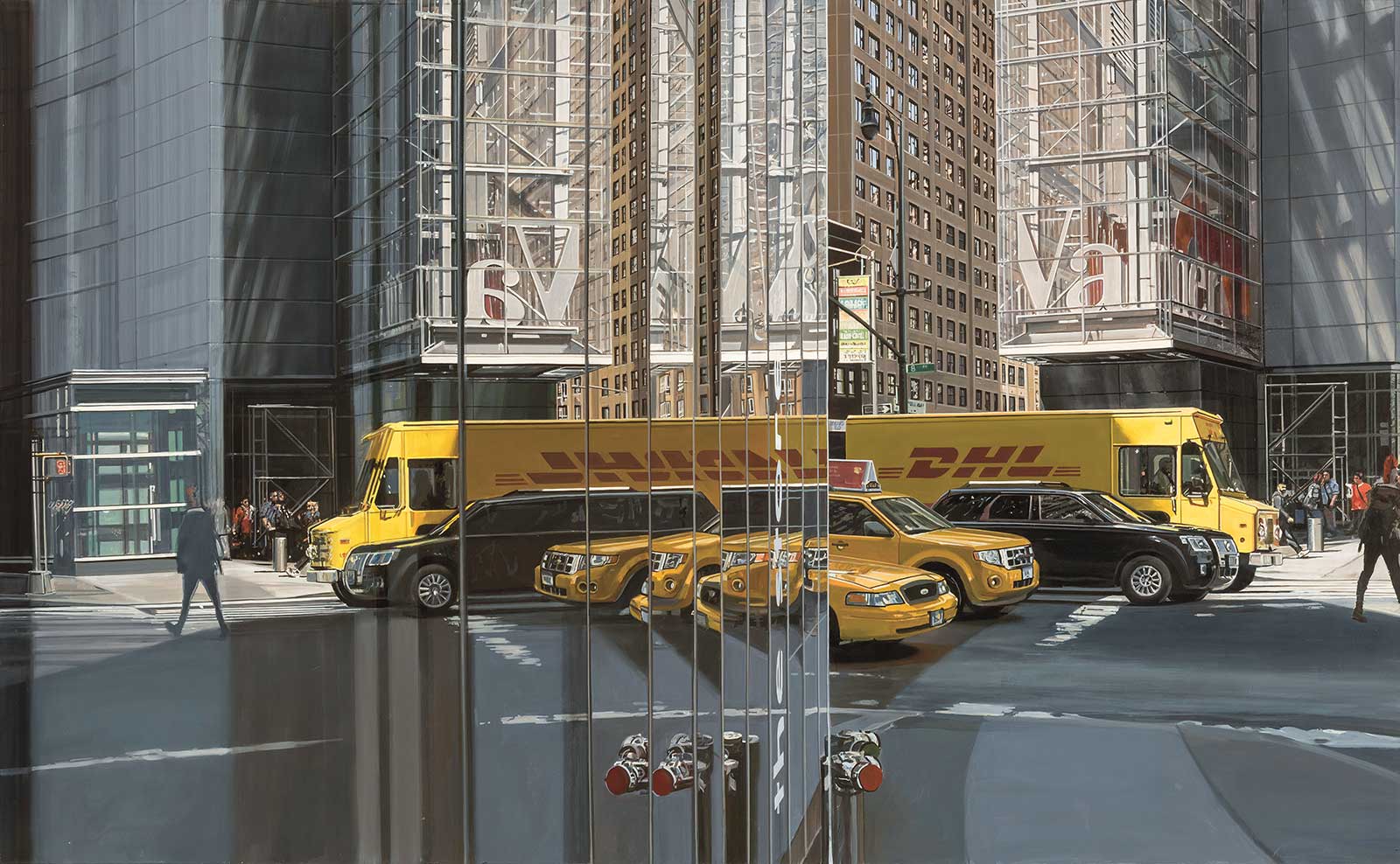 Express, 2020, oil on canvas, 37 x 55"
His Self Portrait in Copenhagen, 2019, recalls his iconic paintings of New York from the ’70s, rich with reflections, complex perspective and subtle color. “Sometimes I change the perspective,” he explains. “We tend to see things with our brain. What you really see is an area the size of a coin. The brain fills in the space around. With deep perspective, things that are far away get too small, so I enlarge them.
“I’m a very realistic painter,” he continues. “A painting can never be like a photograph, which is a mechanical process. Paint is a muddy thing, linseed oil with different kinds of dirt. You can see the brushstrokes.”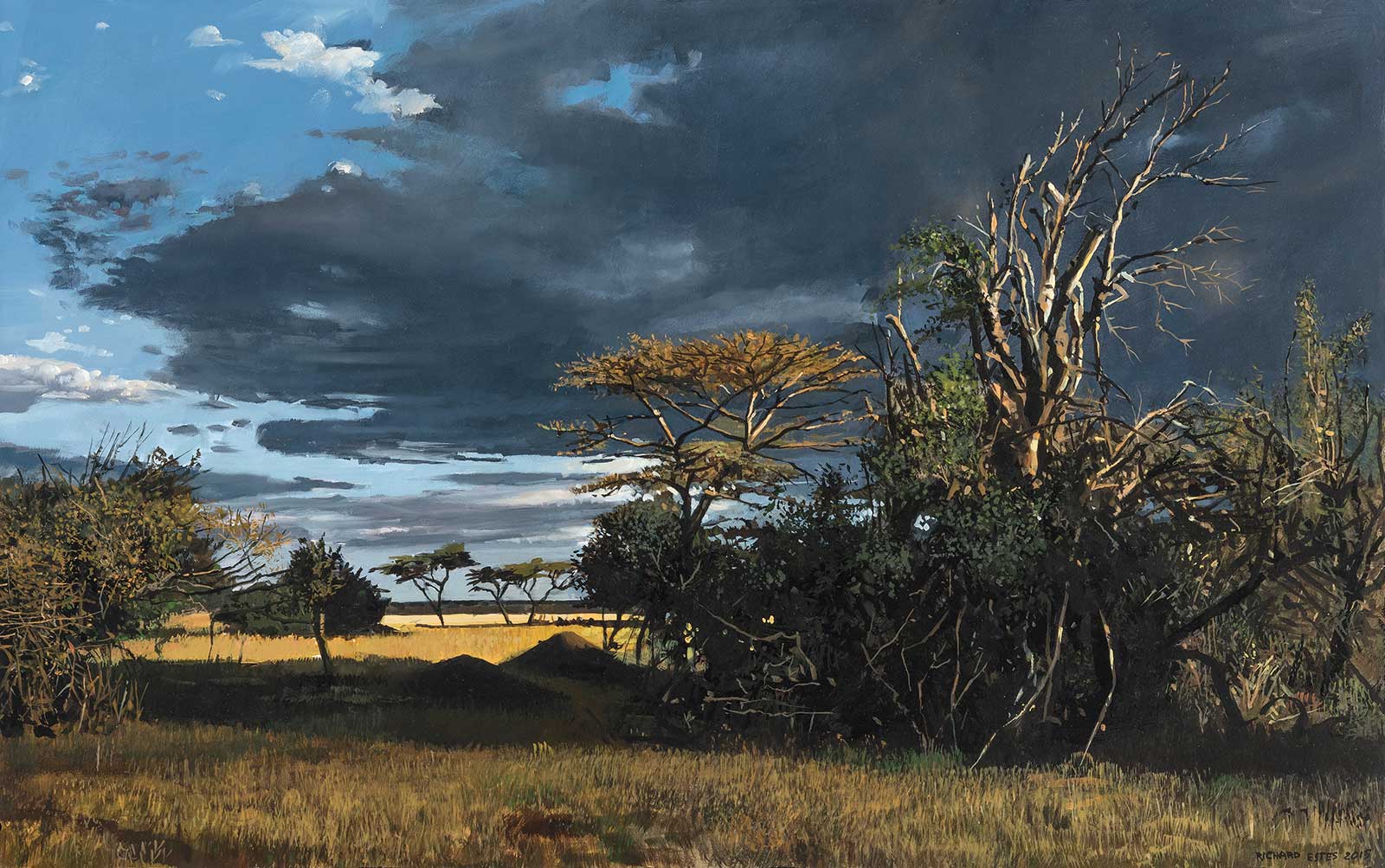 Serengeti, 2015, oil on panel, 13¾ x 21 7⁄8"
In his panoramic Antarctica II, 2007, the wake of the ship is painted in hash marks that coalesce into the convincing reflection of light off the water. The theme of boat/wake/destination, with the eye traveling along the length of the hull, occurs often in his recent work. He says, “Initially, I was in a boat riding along and saw that view and thought it would make an interesting painting. Maybe I am looking for it now. I keep trying to make a painting better than the one before. I always want to make a better one. I’m never happy with anything once I’ve finished it. I just stop painting. At some point it begins getting worse rather than better. A year later I might think it’s not so bad.”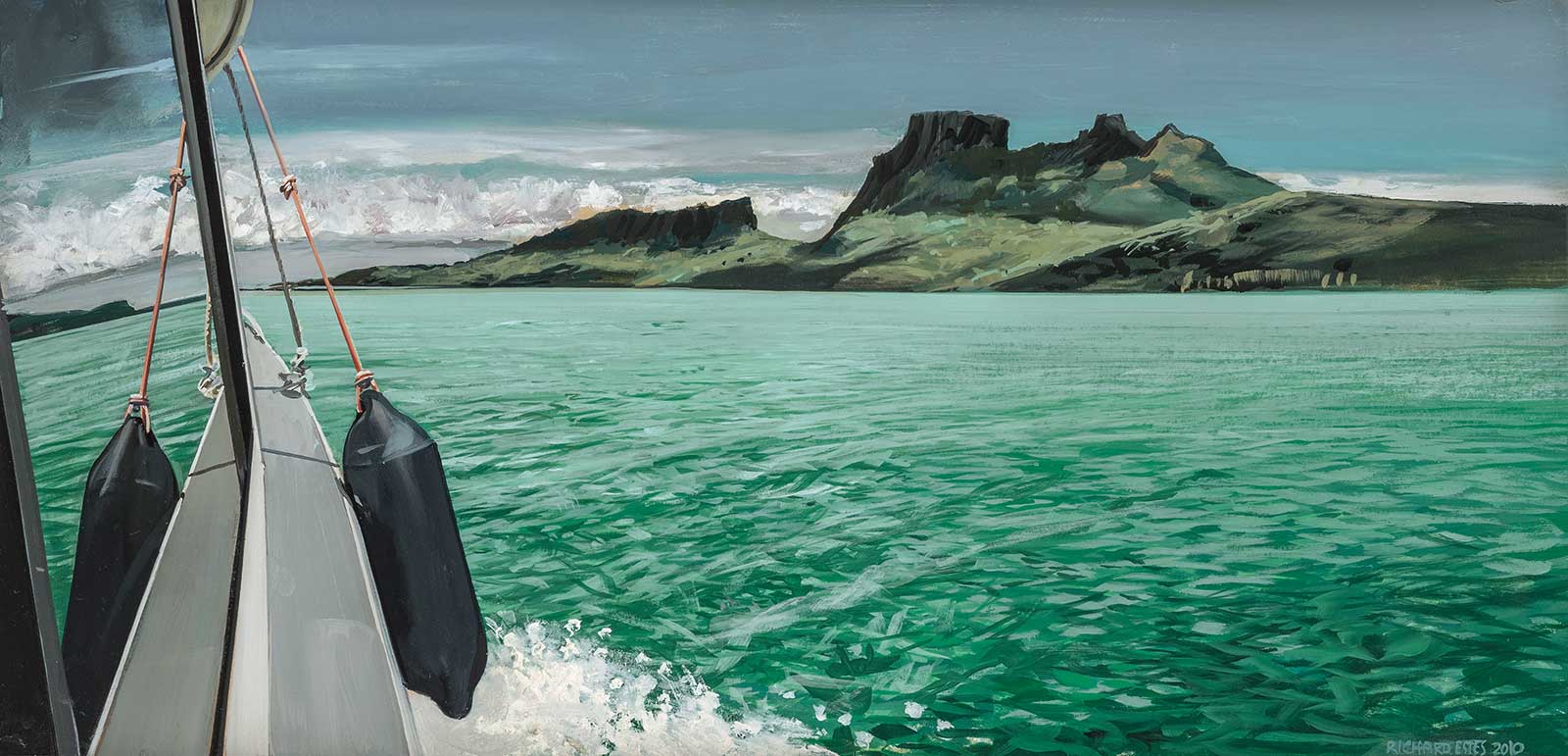 Tahiti, 2010, oil on panel, 9 x 18½"
Once armed with a Hasselblad camera, Estes now carries his iPhone and iPad to capture what interests him in his travels. Commenting on his use of photography, he has written, “A photograph is just values. It doesn’t have line. When you use a photograph, you are using the values, but you are adding line and space and movement, coming from your own experience. That’s why although I work from photographs, I like the subject to be things I’m really familiar with. I don’t think I could use someone else’s photographs of some place I’ve never been to and make a painting.”
Estes photographs from his experience but then assembles the photographs to create another experience. It’s not important that the painting be the Seagram Building, for instance. He does a pencil drawing from his collage and begins to balance the colors and values as he applies the paint. “If you’re putting black on a white surface,” he explains, “it doesn’t have to be black. If you put it on a darker ground, it’s not dark anymore. It’s relative.”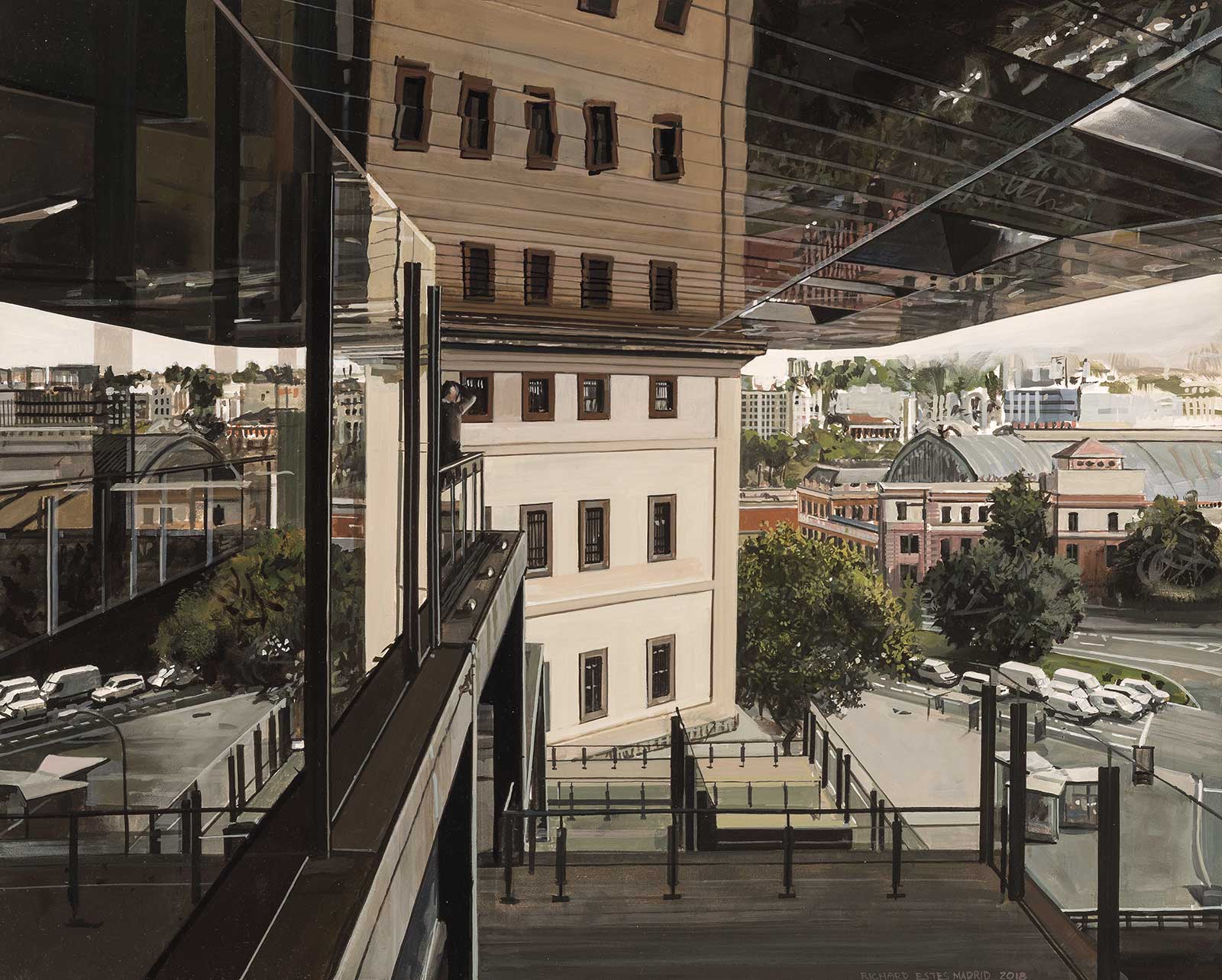 Madrid, 2018, oil on panel, 16 x 20"
In his View in Nepal, 2010, the white of the mountains looms behind the dark foreground, the distance emphasized by the rapidly painted vegetation and rocks and the more finely rendered summit.
He is still pursuing the painting “better than the one before.” He recently said, “There’s one I’m working on now. I really thought it was hopeless. But I’m refining it.” –
Richard Estes: Voyages
When: June 14-July 30, 2021
Where: Menconi + Schoelkopf, 22 E. 80th Street, New York, NY 10075
Information: (212) 879-8815, www.msfineart.com
Powered by Froala Editor