
From the tales of Robinson Crusoe, widely thought to have been drawn from the stories of actual castaways, to the disaster of the HMS Victory that claimed more than 1,000 lives on the English Channel in 1744, to the RMS Titanic itself—shipwrecks have embedded themselves deep into the psyche of humankind. The subject has captivated us for centuries. Remains of formidable vessels lost to the depths of the sea for eternity, castaways struggling for survival on deserted islands, and the romanticized stories of the marine giants that get tangled up in humanity’s story (think Moby-Dick or the kraken). But the insurmountable disaster of a shipwreck is not felt by humans alone.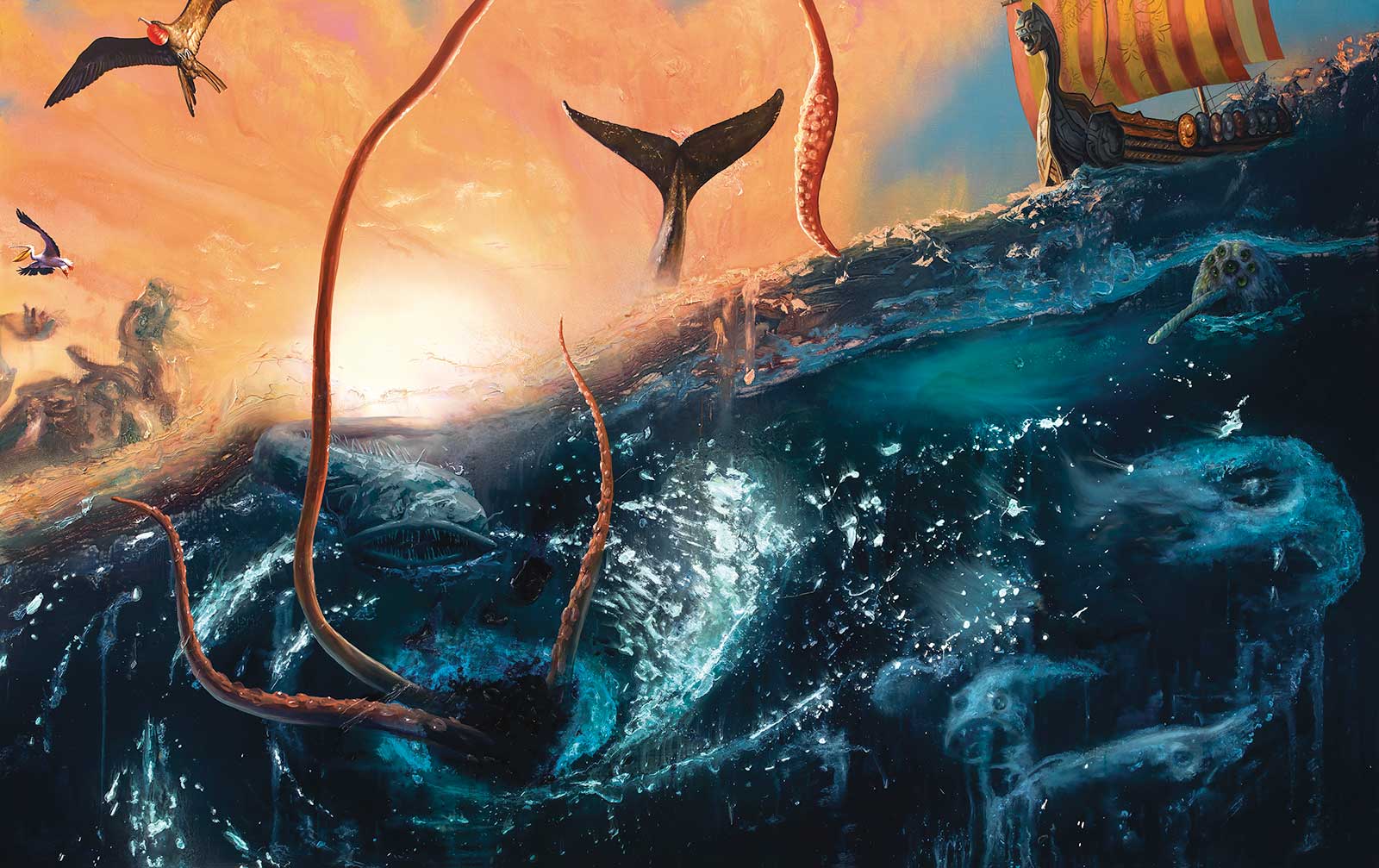 Alexis Rockman, Maelstrom, oil on wood, 68 x 108". Courtesy the artist and Sperone Westwater Gallery.
“I started thinking about the history of shipwrecks and how they epitomize the vast hopes of the world. They are a kind of kitschy or disgraced genre. There’s this sort of ‘gentleman’ fill-in-the-blank kind of drama to them...I thought it would be interesting to play with that,” says artist Alexis Rockman. A painter for more than 30 years, Rockman is well-known in the art world, and known just as well for his monumental projects that capture some snapshot in our history as it relates to environmentalism, to the impact we have on our planet and the other living creatures that inhabit it. In 2004, his Manifest Destiny series hypothesized what the Brooklyn waterfront might look like in several centuries after climate change has caused a catastrophic rise in sea level, and the Great Lakes Cycle, from around 2017, featured five large-scale paintings and six watercolors that each examined the history and ecology of the Great Lakes, from the Ice Age to present and beyond.
Continuing his thoughts on his current project, Shipwrecks, Rockman adds, “All of the terrible things that have happened ecologically, because of humans, have been because of ships…[the transportation of] diseases, invasive species, weapons.”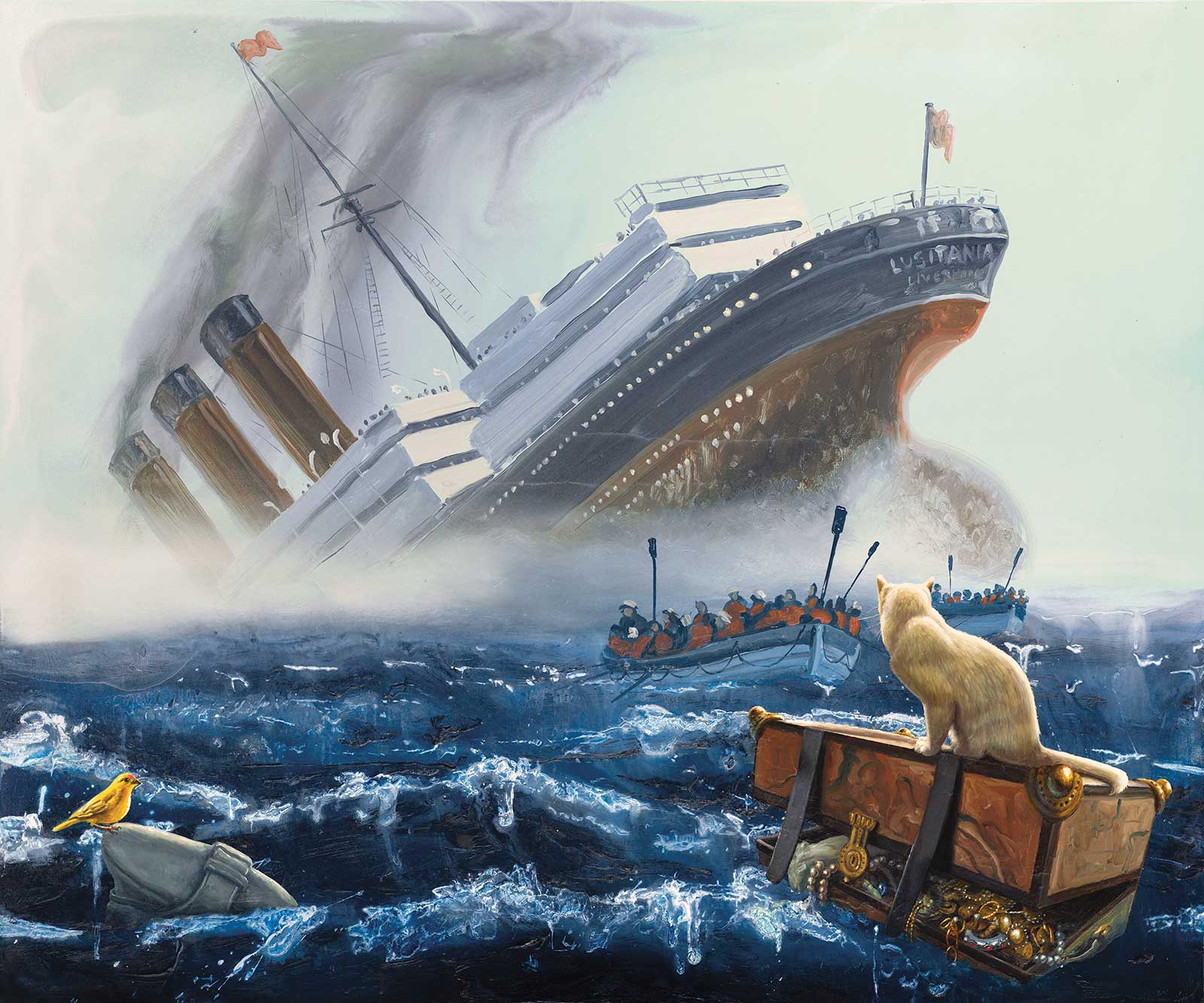 Lusitania, oil on wood, 40 x 48". Courtesy Jonathan O’Hara.
A traveling exhibition of this latest series will begin at the Peabody Essex Museum in Salem, Massachusetts, from March 6 to May 31. The exhibition will move to the Guild Hall of East Hampton in New York this summer, Rockman says, with possibilities for future locations still being worked out.
“Five years ago, I started thinking about Alfred Russel Wallace coming back from Brazil collecting specimens from the Amazon to study,” Rockman says. Wallace was a British naturalist and biologist, among other titles, known for his independent theory of evolution through natural selection. (His paper on the subject was jointly published with some of Charles Darwin’s writings.) “He came home with this scientific ticket to credibility,” Rockman continues, “but then his ship caught fire.” The story culminated in his oil The Sinking of the Brig Helen, the catalyst that sparked the rest of his shipwreck paintings. “[Wallace] talks about having a pet monkey,” he adds. The painting depicts a smoldering ship in the background, while remnants of Wallace’s treasures, now lost items riddling the ocean with litter, float in the foreground. Indeed, a monkey perches on a barrel bobbing along amongst the debris.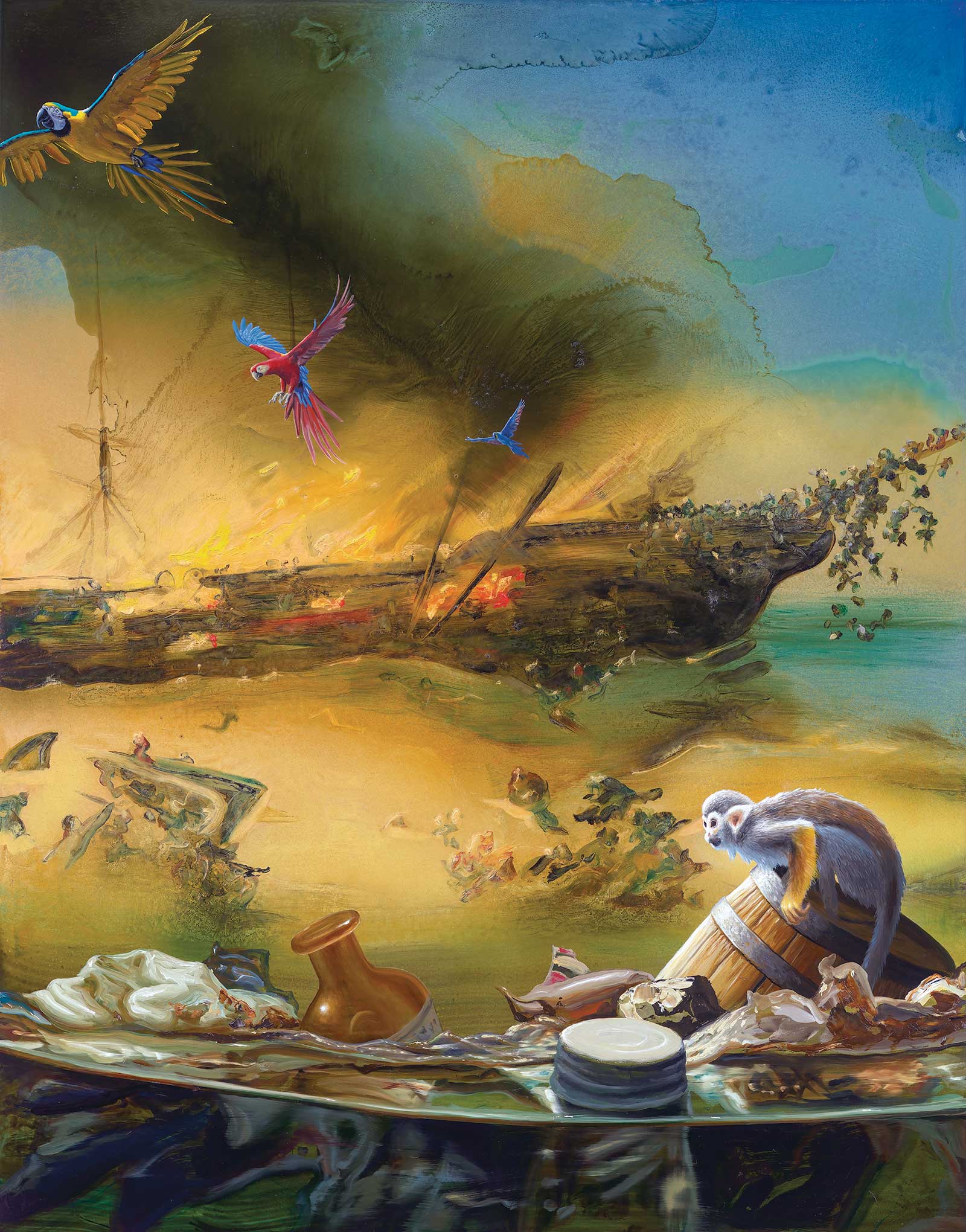 The Sinking of the Brig Helen, oil on Dibond, 56 x 44". Courtesy David Roth and Heifara Rutgers.
Maelstrom is a tremendous piece. Sea monsters emerge from the depths of our darkest dreams in a spiral of chaotic, rushing waters, with the star of the show being larger-than-life tentacles bursting high into the air. “It’s really a modest inventory of some sea monsters from Northern Europe. Most of human history is not an [accurate] eyewitness observation of ecology, it’s someone telling a story about a monster they saw,” says Rockman. We know them well—the kraken, the Loch Ness monster, the Hydra. He adds, “[The painting channels] the 16th century when artists were embracing science but still didn’t have enough information to be accurate, so much of it ends up being about language and telling a story.”
Rockman explains that in Lusitania, the story of the British ocean liner sunk by a German U-boat during World War I, he wanted to play with the concept of societal classes. “I love this idea that there are all these moments of what happens on a boat...Not unlike the Titanic, there’s this idea of class,” he says. “You have money and lavish items from rich people, but then you have [seemingly smaller treasures], like people’s pets, which you usually don’t think about...I love thinking about the protagonists in a scenario like that, the ones who are never considered.”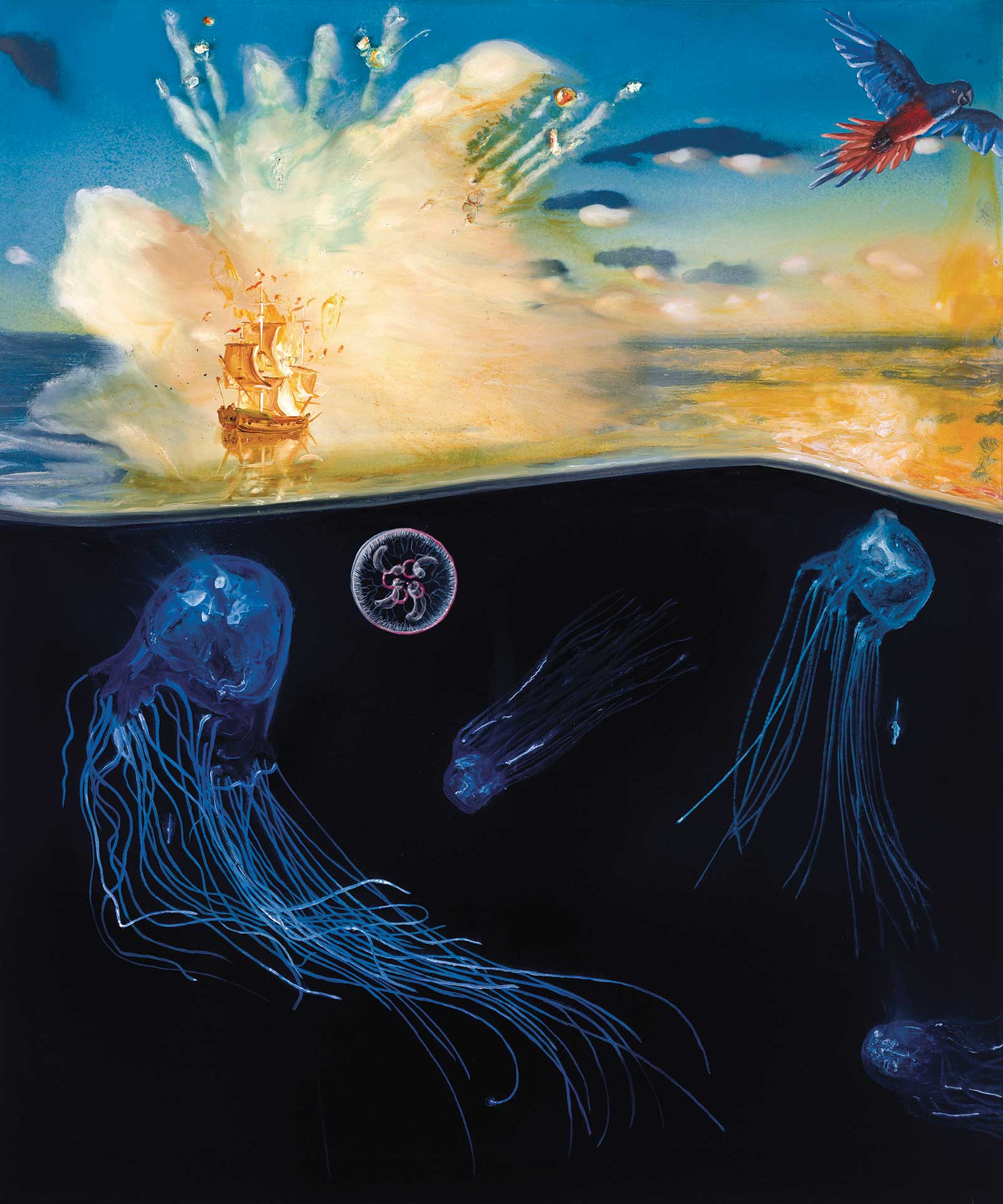 Luxborough Galley, oil on wood, 48 x 40". Courtesy the artist and Sperone Westwater, New York.
A particularly gut-wrenching piece in the series is Luxborough Galley, an England-bound ship that left Jamaica in 1727 bearing slaves, rum and sugar. It burst into flames when a keg of rum in the spirit room exploded. “It was a horrible endeavor,” says the artist. In Rockman’s painting, the devastation is part of the backdrop and at the forefront we’re given a prominent view of a bloom of giant jellyfish, luminescent against the black of the ocean, and utterly in their own world. “Meanwhile under the water, the jellyfish have their own problems,” says Rockman. “Two universes.”
In The Lifeboat of the HMS Erebus, polar bears scramble onto a lifeboat amid violent waters, part of the story of the HMS Erebus and HMS Terror, a British voyage in which Captain Sir John Franklin set out to explore the Canadian Arctic and complete a crossing of the Northwest Passage. Both ships became icebound, and after more than a year, were abandoned by the crew, ultimately claiming the life of Franklin and some two dozen others. Rockman’s oil shows not the perspective of the men, but of the polar bears inhabiting the lands the crew sought to explore.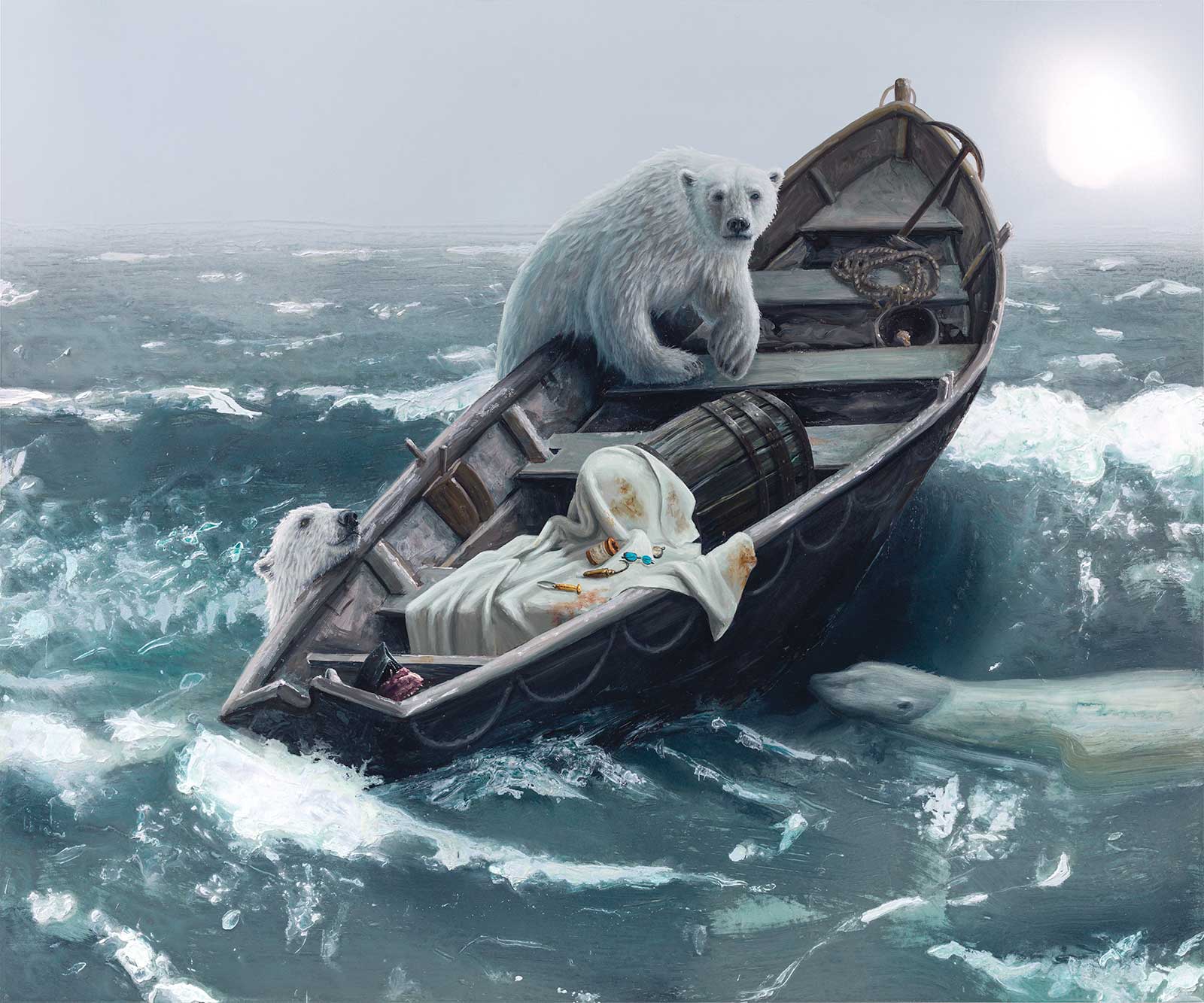 The Lifeboat of the HMS Erebus, oil on wood, 40 x 48". Courtesy Baldwin Gallery, Aspen, CO.Ten oil paintings along with several watercolors will be displayed in the Peabody Essex Museum’s East India Marine Hall. A number of other paintings are included in the Shipwrecks project and will be hanging in future exhibitions like the one at Guild Hall this summer.
“I’m not an expert on maritime history,” he says, “but I have to believe it’s going to be interesting to other people...I’m a pretty knowledgeable naturalist, but one of the points of doing these projects, to me, is continuously filling holes in
my education.” —
Alexis Rockman: Shipwrecks
When: March 6-May 31, 2021
Where: Peabody Essex Museum, East India Square, 161 Essex Street, Salem, MA 01970
Information: (978) 745-9500, www.pem.org
Powered by Froala Editor