
The historian and activist Rebecca Solnit writes, “It had come to me not in a sudden epiphany but with a gradual sureness, a sense of meaning like a sense of place. When you give yourself to places, they give you yourself back; the more one comes to know them, the more one seeds them with the invisible crop of memories and associations that will be waiting for you when you come back…”
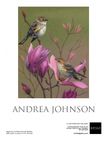
Andrea Johnson has given herself to places from Cape Cod to Japan and now lives above the fertile Salinas Valley in California, where she was brought up. Her mother, an abstract painter, was her teacher in junior high. “She was hard on me,” she confesses. “I excelled under that, but I never thought I’d be an artist. I relate visually to everything and have a strong desire to record it.”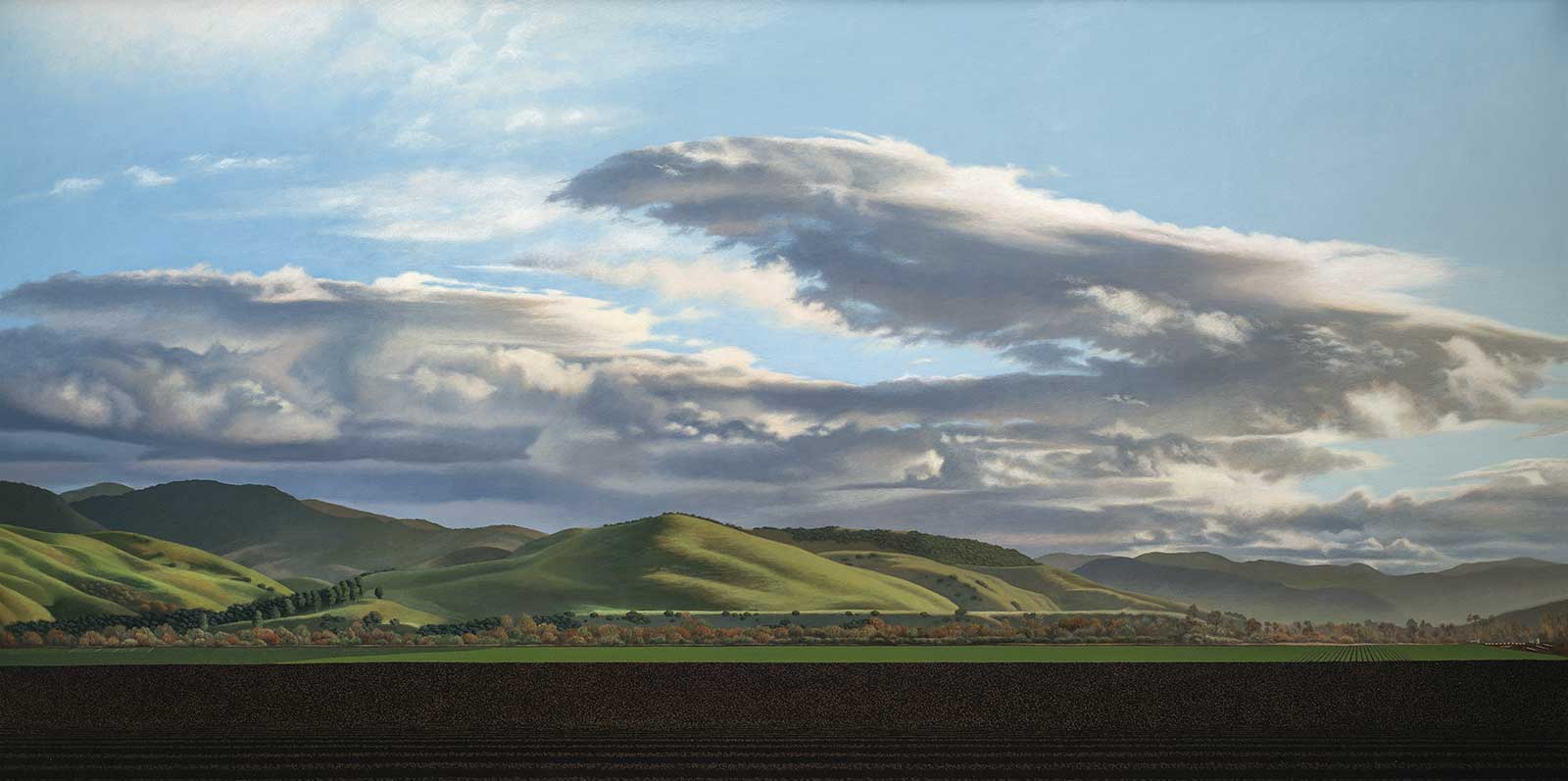 Sunset, Fort Ord Hills, acrylic on canvas, 36 x 72"
Her routine during the pandemic is simple—a horseback ride or a hike in the morning several times a week and back to the studio where she works from 11:30 a.m. to around 5 p.m. She feeds her horse and then joins her husband for dinner. Chris Winfield is a geometric abstract artist and owner of the Winfield Gallery in nearby Carmel-by-the-Sea. “We’re good at critiquing each other,” she says, “but we could never share a studio. We have very different sensibilities. I’m very solitary and like peace and quiet. Chris has rock going all the time.”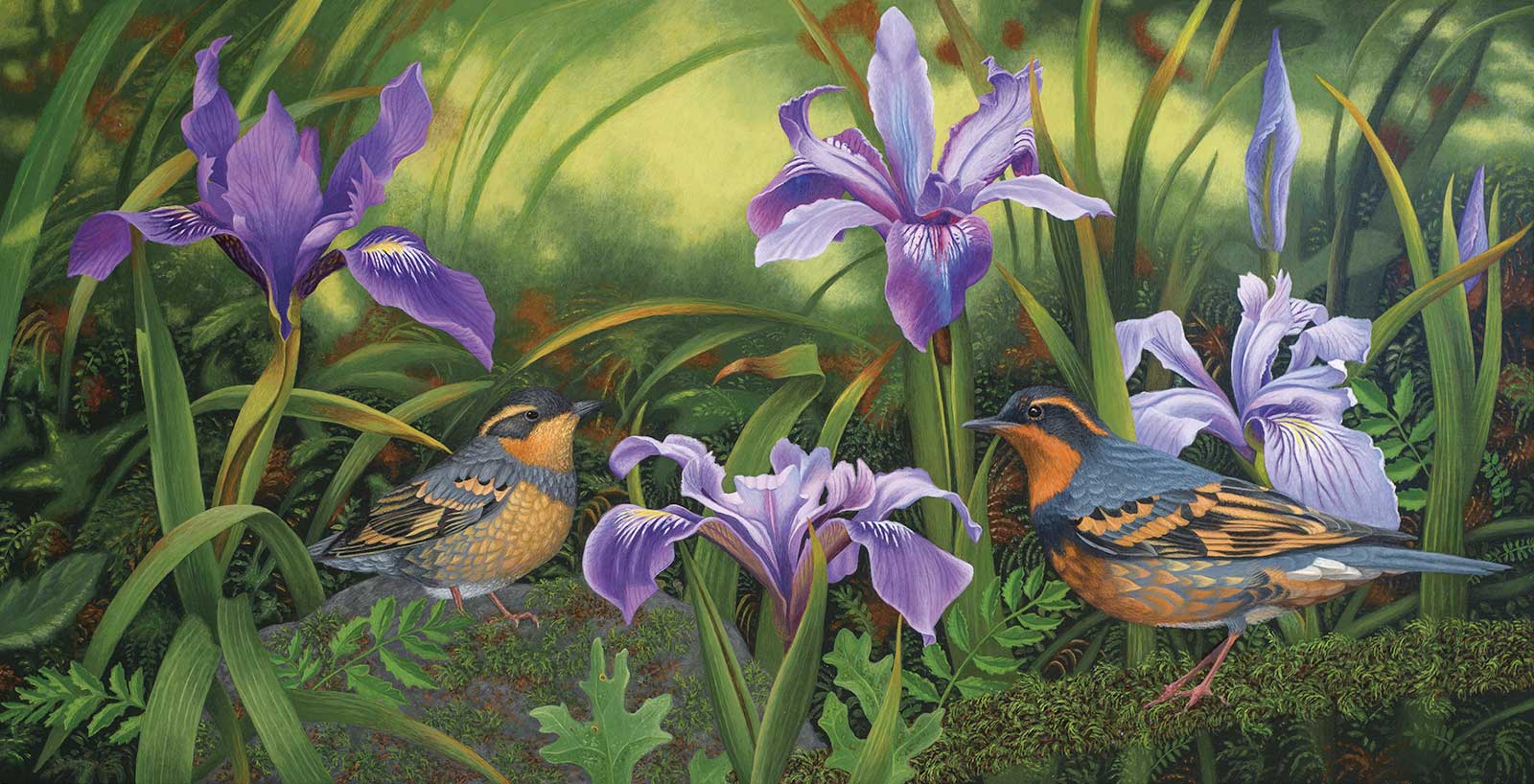 Varied Thrush and Iris, acrylic on canvas, 11¼ x 22¼". Private collection.
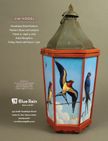
Her time in Japan influenced her early paintings. “I used to do patterns,” she explains. Her painting Waxwing and Grapes, carries on the pattern tradition. “I’m not interested in scientific illustration,” she admits. “I started with birds because I didn’t know how to do landscapes. I make a bird look the way it needs to look to make the painting work. The painting has to be believable, not accurate. The composition works if you stay drawn into the painting. I also didn’t know in the beginning how to make the birds three-dimensional, so they were flat, based on my love of Japanese screens.”
Describing the circular composition of Bat and Full Moon, she explains how she adjusted the wing of the bat so it would be within the picture plane and not lead the eye out of the frame. The moon is from one of her photos. “I grew the magnolias and brought them in to a dark room and illuminated them from behind. I’m trying to grow a lot of the flowers I use in the paintings.”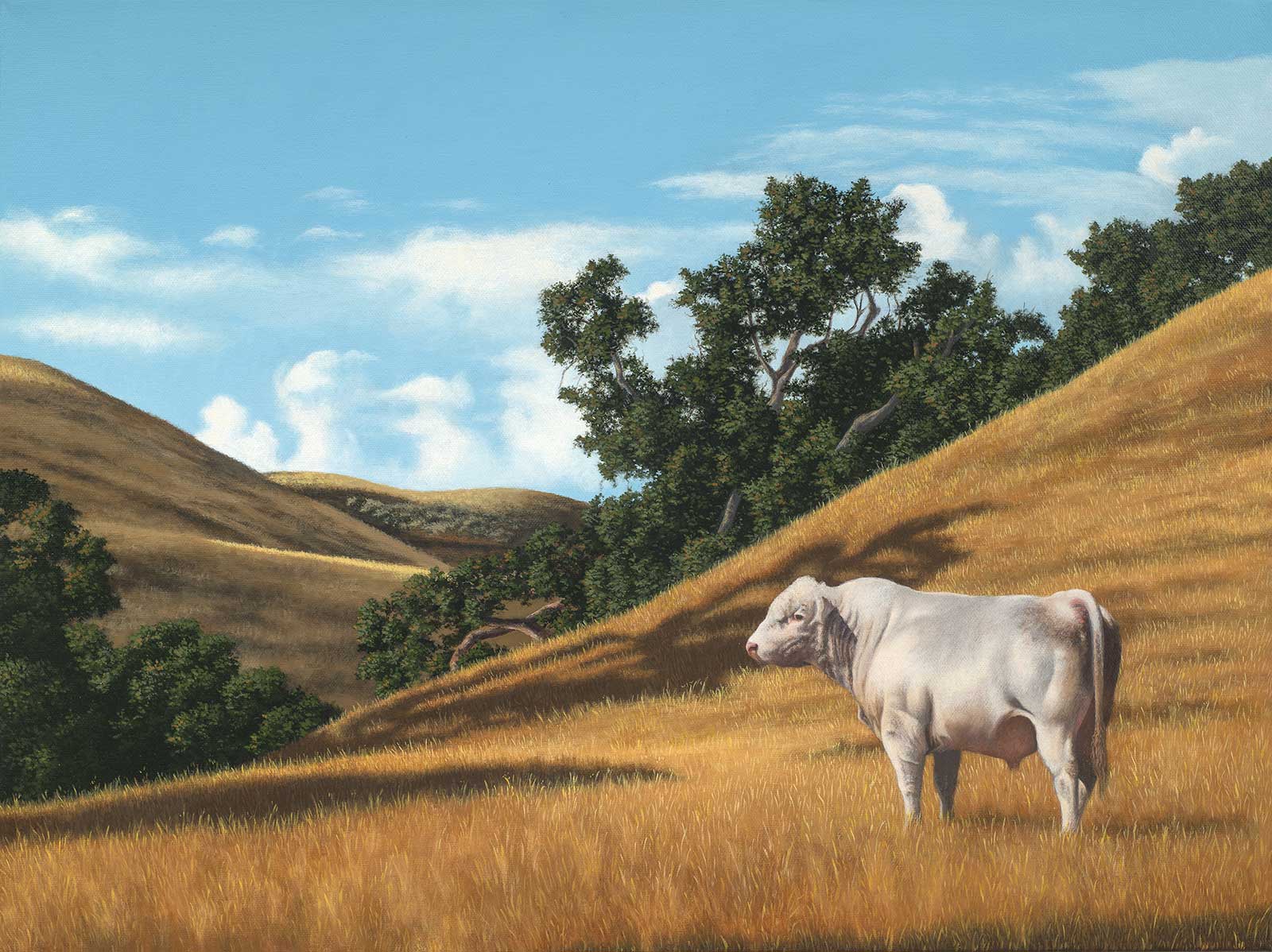 Bull in Corral de Tierra, acrylic on canvas, 30 x 40"
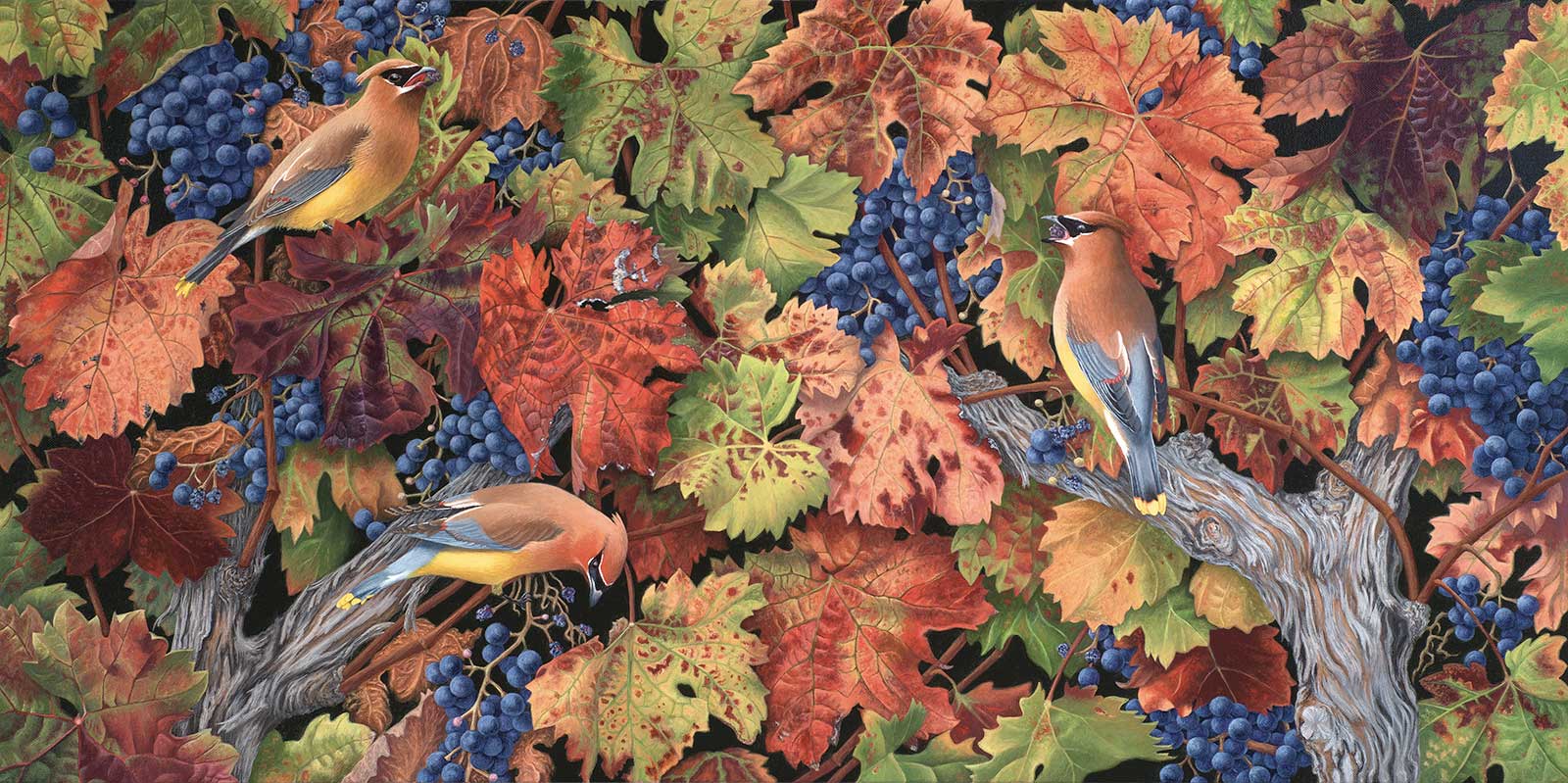 Waxwings and Grapes, acrylic on canvas, 18 x 36". Private collection.
When I ask her about the potentially gruesome scene, she says, “The bat is coming in to get the frog. That’s the truth of what’s out there. Maybe the frog will jump away.”
Johnson paints what she sees every day. The hill in Bull in Corral de Tierra, for instance, is behind her studio. She had photographed the bull on her drives around the countryside. “I paint the hills early or late in the day when there are shadows to give them form. Ordinarily they’d be green, but in the drought, they’re always brown,” she explains. “I started looking at the clouds in Salinas Valley that come in and seem to be stuck there. I don’t see those clouds from my house but late in the day I start to look at the sky and if I think there might be clouds, I take my camera and go out. I like the geometric lines of the fields against the soft clouds. It’s so flat, there’s a huge vista.”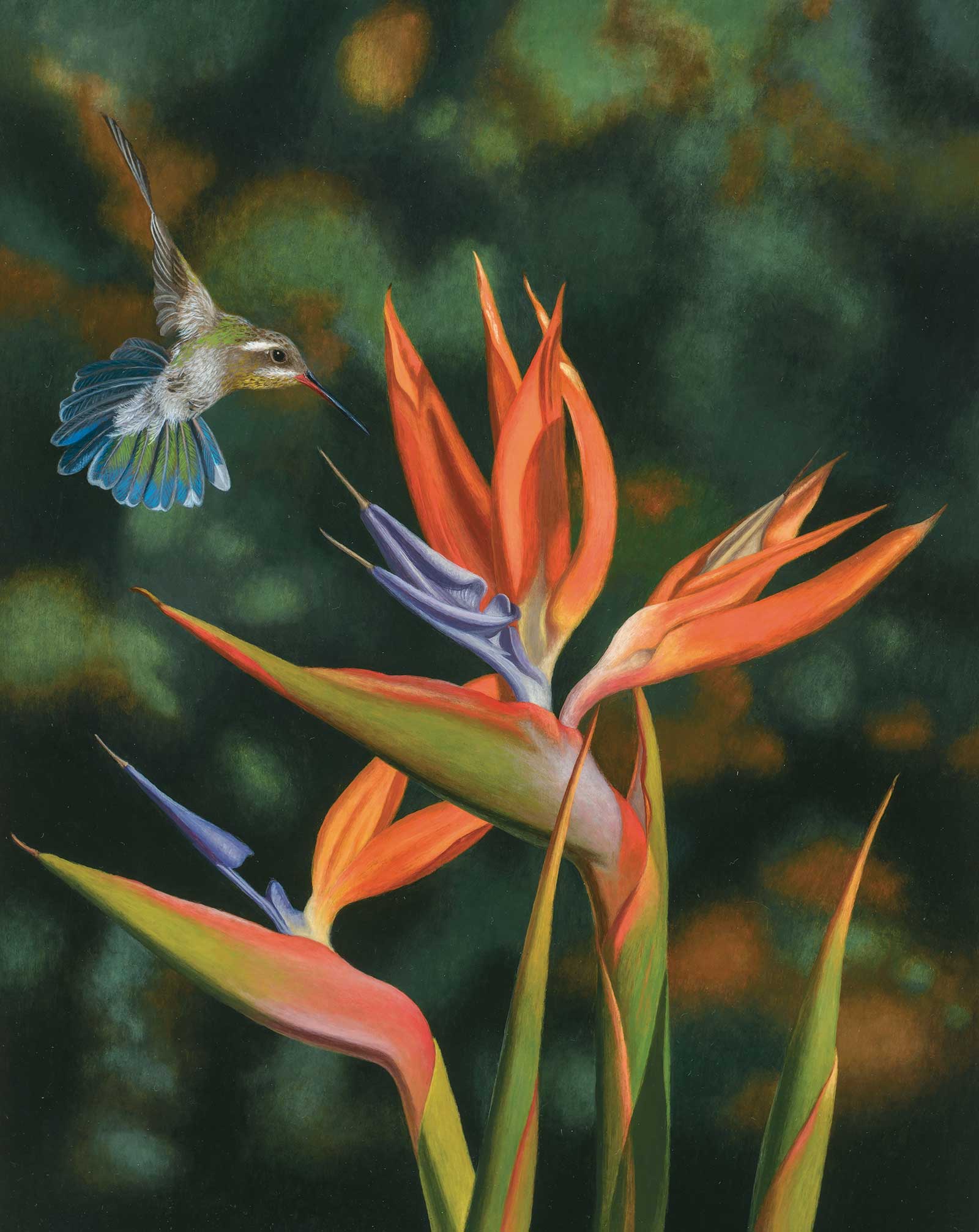 Hummingbird and Bird of Paradise, acrylic on panel, 14 x 11"
She continues, “It is the light that gives this landscape its form…shadows rounding the foothills or creating sharp linear patterns across the fields. These shapes and patterns change with the time of day and the inconstant cloud cover overhead. Land to sky…this is the relationship that I am captivated by, and it is my intent to crystallize these moments in my paintings of the Salinas Valley.
“When I started doing landscapes, I talked to David Ligare about how to create three-dimensional space,” Johnson explains. “I use acrylics with a lot of medium, so the paint is very thin. To get a cloud to look like a cloud and not a solid thing in the sky and to make it luminous, I build up a lot of layers just as the cloud is made up of layers, so you’re looking through them. Sometimes there are 15 layers of paint.”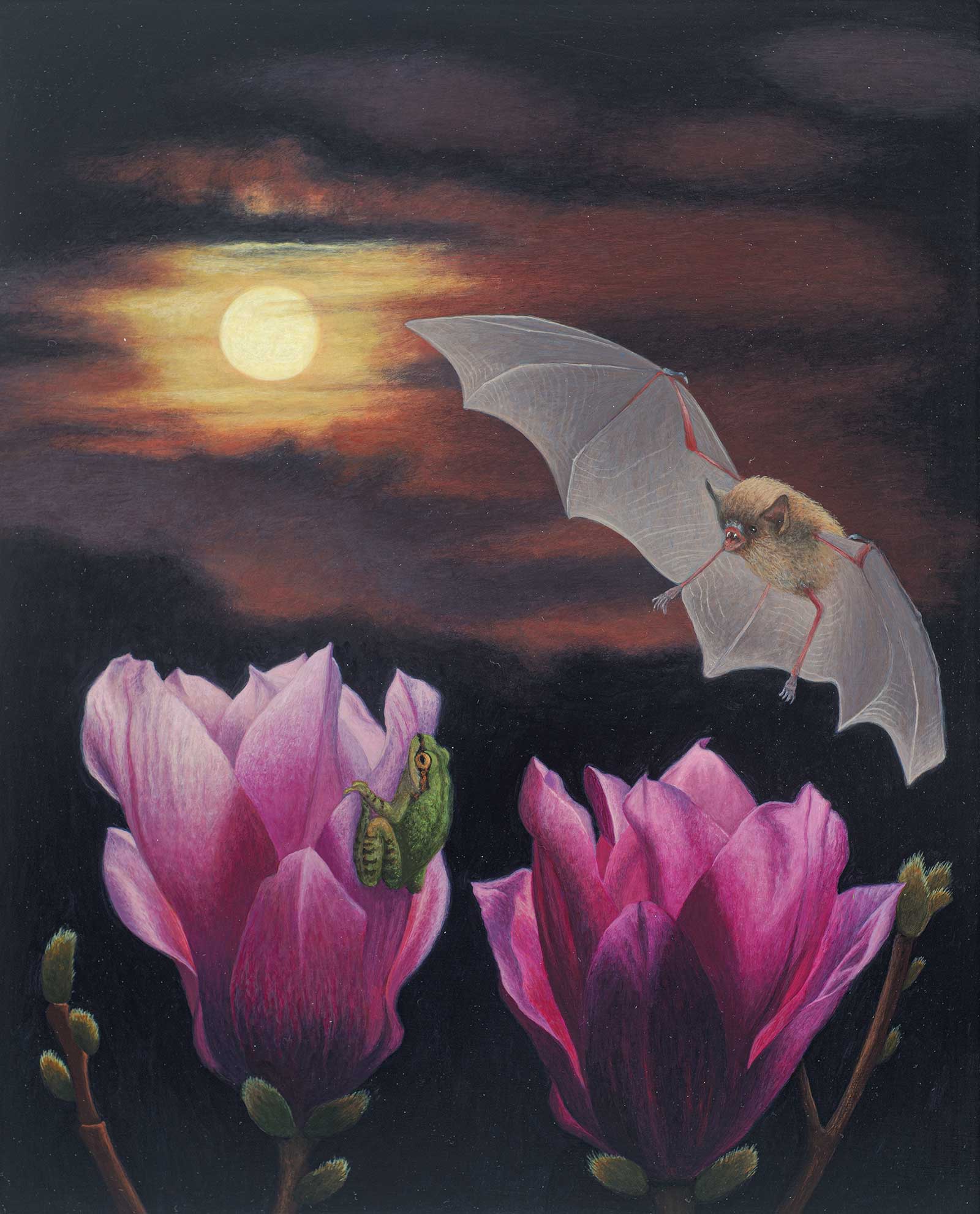 Bat and Full Moon, acrylic on panel, 14 x 11"
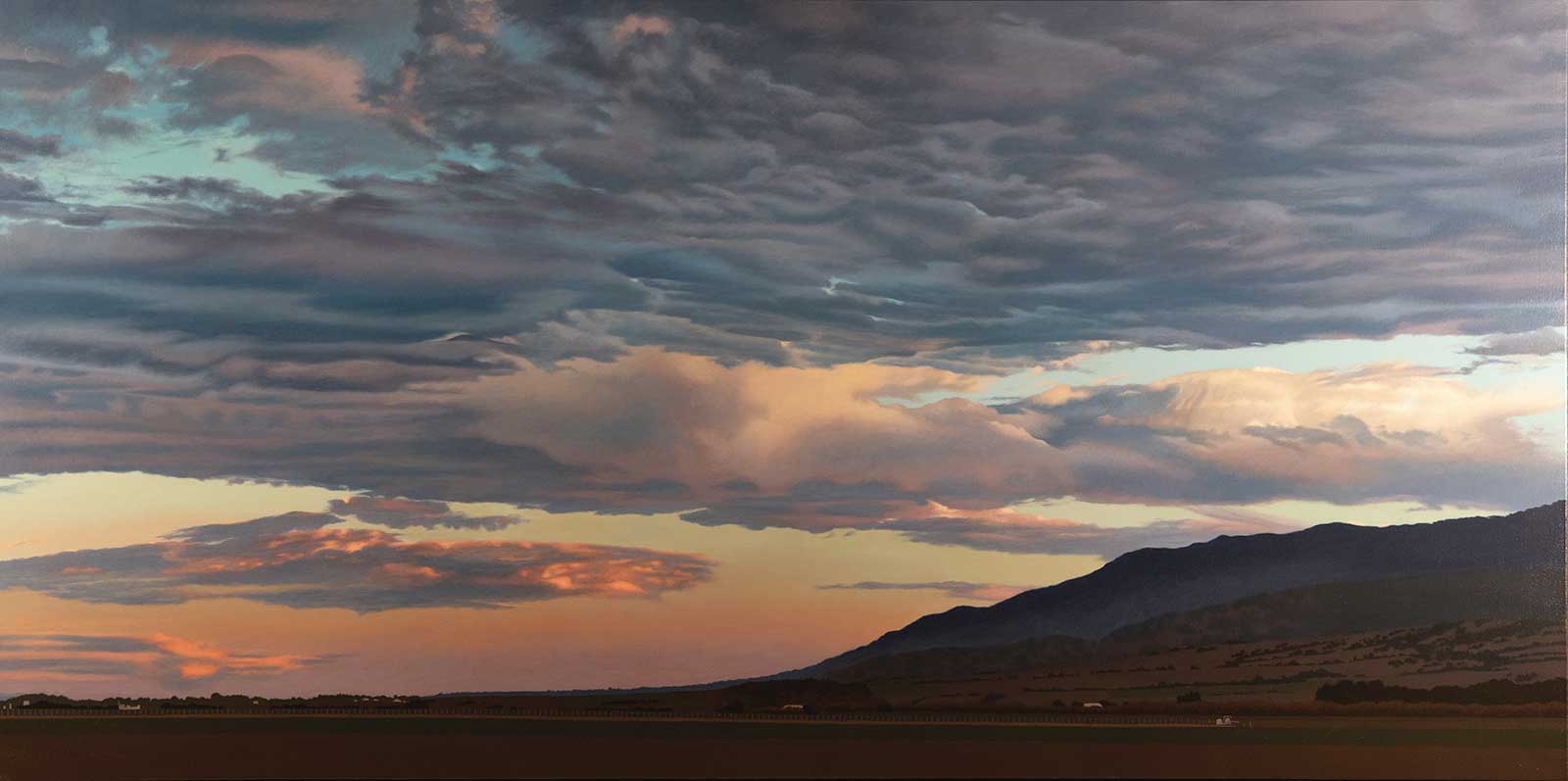 Nightfall Salinas, acrylic on canvas, 36 x 72"
The artist is partial to Sunset Fort Ord Hills. “It’s peaceful and I want to enter that scene,” she shares. “Actually, I live back there. The painting is more atmospheric and there’s not much color in the sky. Sometimes you can get carried away with the eye catching brilliant colors of the sunset.”
Johnson says, “Painting is the hardest thing I’ve ever done. It requires all my focus and energy. It’s a solitary life. People say, ‘It must be so much fun to do what you do.’ I love what I do and I can’t think of doing anything else. But it’s work and I’m very serious about it. I have a strict schedule of painting five to six hours a day. It’s a job. I am not a natural virtuoso painter. I have to really work hard to get it to come out right. After I’ve finished a large painting that takes a month to a month and a half, I can’t wait to work on something small.”
She has photographs she’s taken in the past that she will rediscover and decide to paint. Among them are shots of Point Lobos. “One day I’ll tackle the ocean,” she muses. —
Powered by Froala Editor