
The poet Mary Oliver wrote: Instructions for living a life: Pay attention. Be astonished. Tell about it.
Jon Redmond rides his bicycle around the countryside and along the streets of North Philadelphia, returns to his studio and records his impressions. “Creating a painting is like creating a poem,” he says. Mary Oliver and writers of haiku choose from among the world of words available to express the essence of their idea, words that have “the most power and resonance,” Redmond observes.
He selects the details in a scene that are “necessary to how I want the painting to feel. Sometimes I’ll get rid of the information in shadows which inhabit the sense of ‘shadow.’ Shadows are the lack of light.”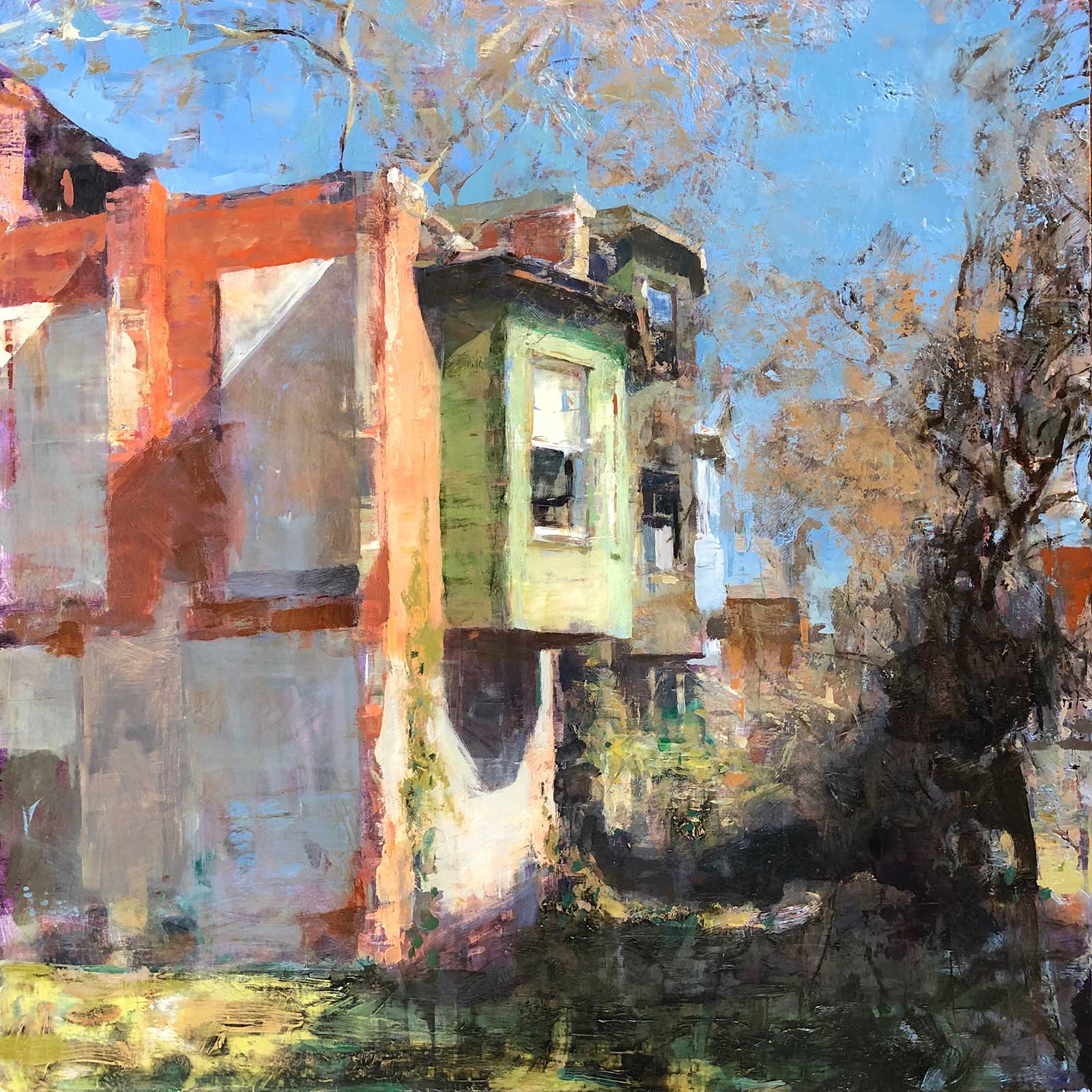 Back Bay, oil on board, 24 x 24"
Light is his primary inspiration. “Most of my paintings are about light,” he explains, “how light makes you feel.” Whether it is bright sunlight on a brick wall, animating objects on a table in his studio or filtering through a forest, light is palpable, a subject itself no matter what it illuminates.
The characteristic brick row houses of the mid-Atlantic, stretching for blocks or punctuating streetscapes, are a constant inspiration. He sees the beauty in their everydayness and in the evidence of their having sheltered generations of families that have sometimes left their mark or have simply moved on.
In Curb Cut, a simple, boxy structure is brightly sunlit with the shadow of a neighboring house cast along its walls. Redmond was attracted by the shape of the new curb cut, barely visible in the shadow. The cut is an accommodation to a contemporary consideration of handicaps. The house itself shows signs of adaptation over the years—an air conditioner juts from a second floor window and aluminum awnings shade another window and the front stoop. “I don’t like to be too nostalgic,” he explains. “Little details like the air conditioner talk about how old, beautiful buildings have been lived in and changed, morphed over time.”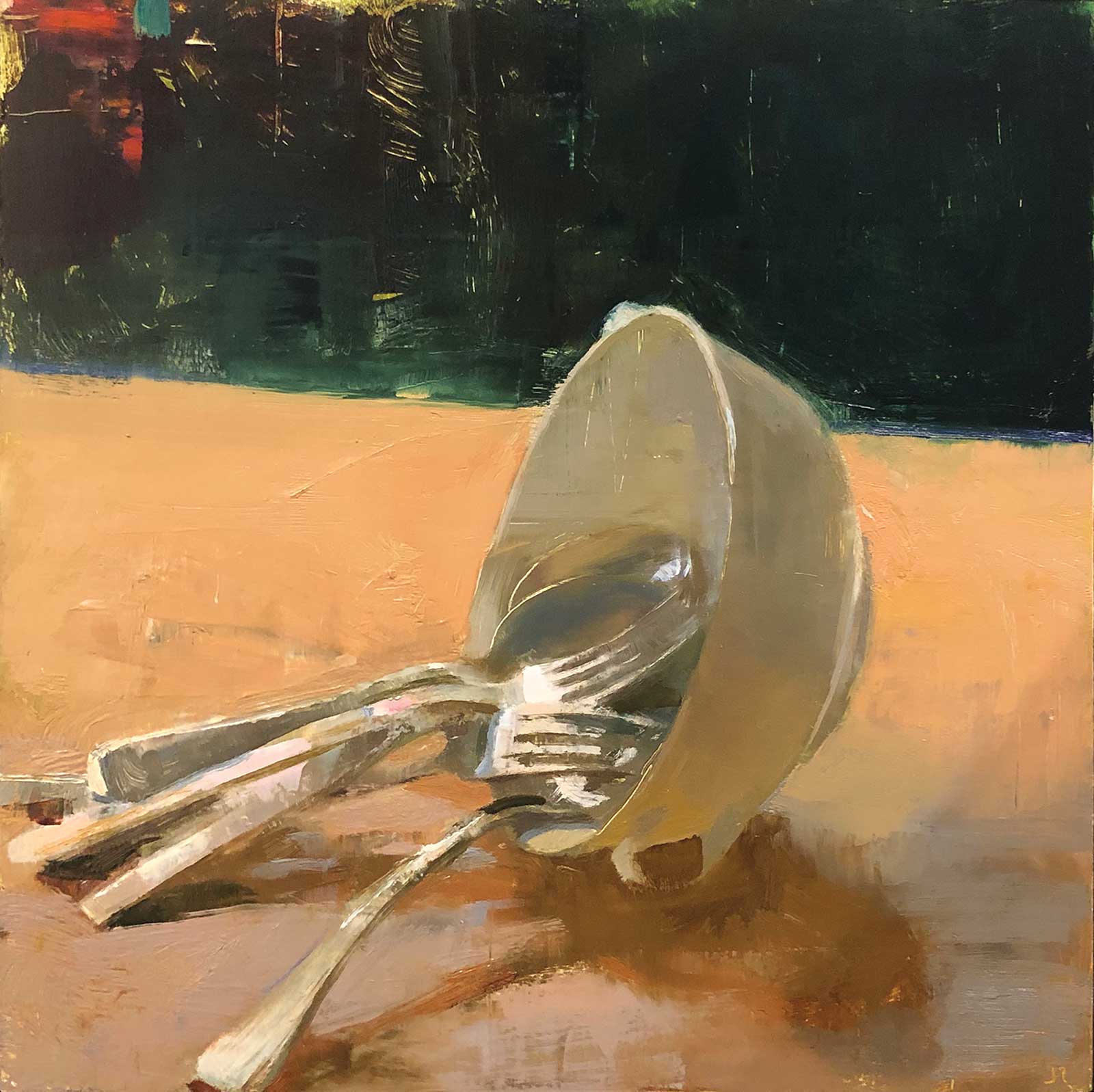 Silverware and Bowl, oil on board, 10 x 10"
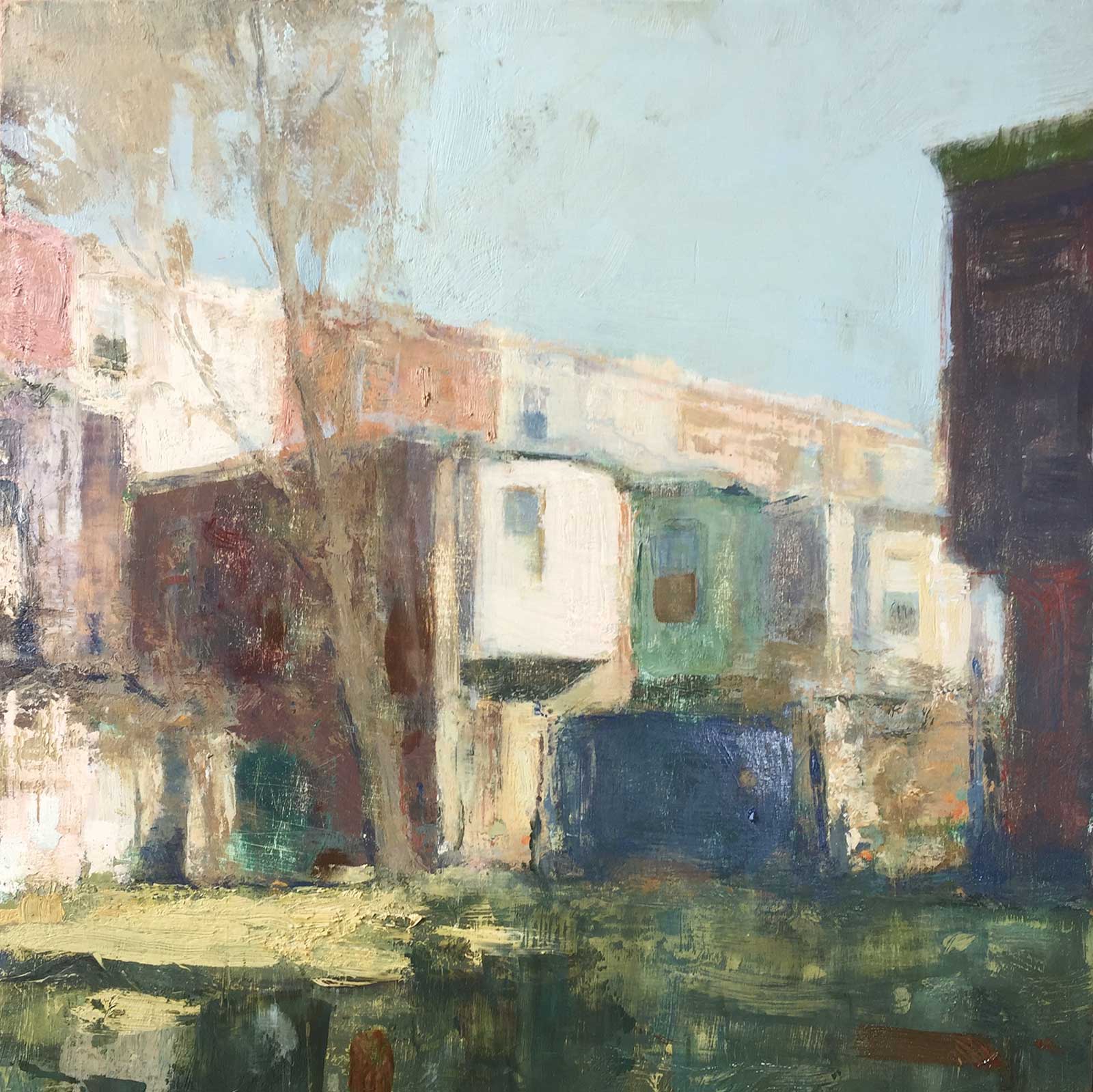 Rear Bays, oil on board, 10 x 10"
Redmond used to paint alla prima in the field, applying wet paint into wet paint, capturing the immediacy of the experience. Today he paints in the studio from photo references and memory, maintaining the same immediacy. “There are many distractions painting on site,” he says. “Often the best view is from the middle of a busy intersection, or a truck pulls up and blocks a building.”
Although he is known for his city row house paintings, he says, “I approach each painting anew. I have themes, not a formula. Each painting has its own momentum.” Painting in the studio he has more options. His alla prima paintings were finished when he lifted his brush. “Now I may lay in an area and then scrape it down and repaint,” he explains. “The surface of the paintings is becoming more interesting, nuanced and varied.”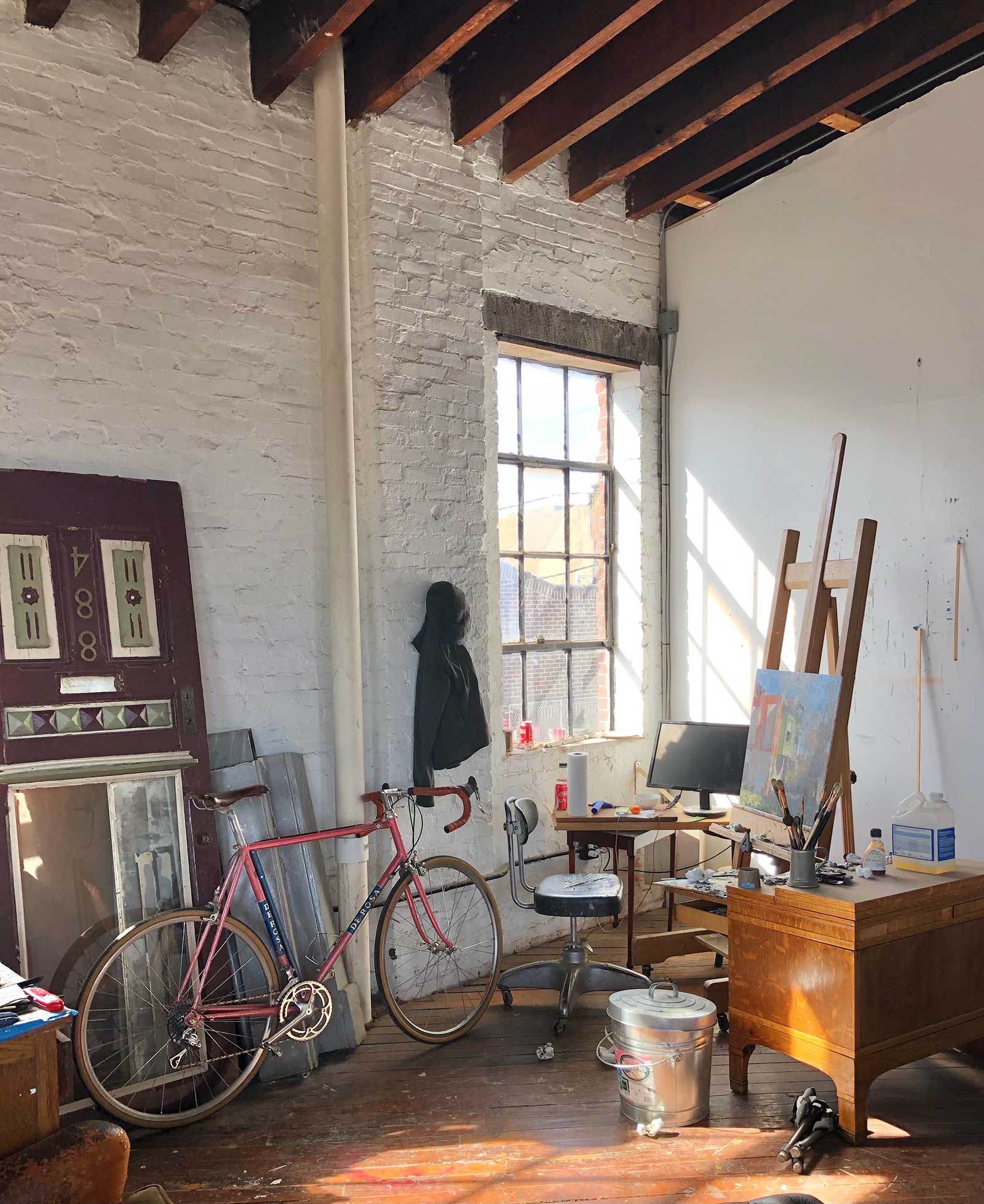 Jon Redmond rides his bicycle through the countryside and streets of North Philadelphia gathering inspiration for his paintings.
Another of his row house paintings is Three Bays. The subjects are in shadow, in contrast to the brightly lit row in the distance. The windows and doors on the shadowed porches reflect the buildings that are opposite. “They didn’t really look like that,” he admits. “I’m always looking and noticing those kind of things—punctuations of light within the shadows. I enhance or subdue them, searching for the feeling of the space.
“I’m fascinated by the bay being like a still life, like an object sitting on a surface,” he continues. “They catch the light so interestingly as they project out from this larger mass and throw shadows that break up the space.”
Traditional still lifes of objects on a table are also part of his output. They are everyday things just like his row houses. Redmond says, “I love taking objects and plunking them right in front of me, looking at them and thinking about how to make an interesting painting out of those elements. The light inspires me. The paintings are studies of value and the contrast of the surfaces of the objects. In Silverware and Bowl, I put the forks and spoons into the bowl, which then tipped over. I liked how it looked. I don’t need to paint the exact thing. Sometimes there may have been a lot more silver but the initial idea didn’t come together well, so I begin to take stuff out.”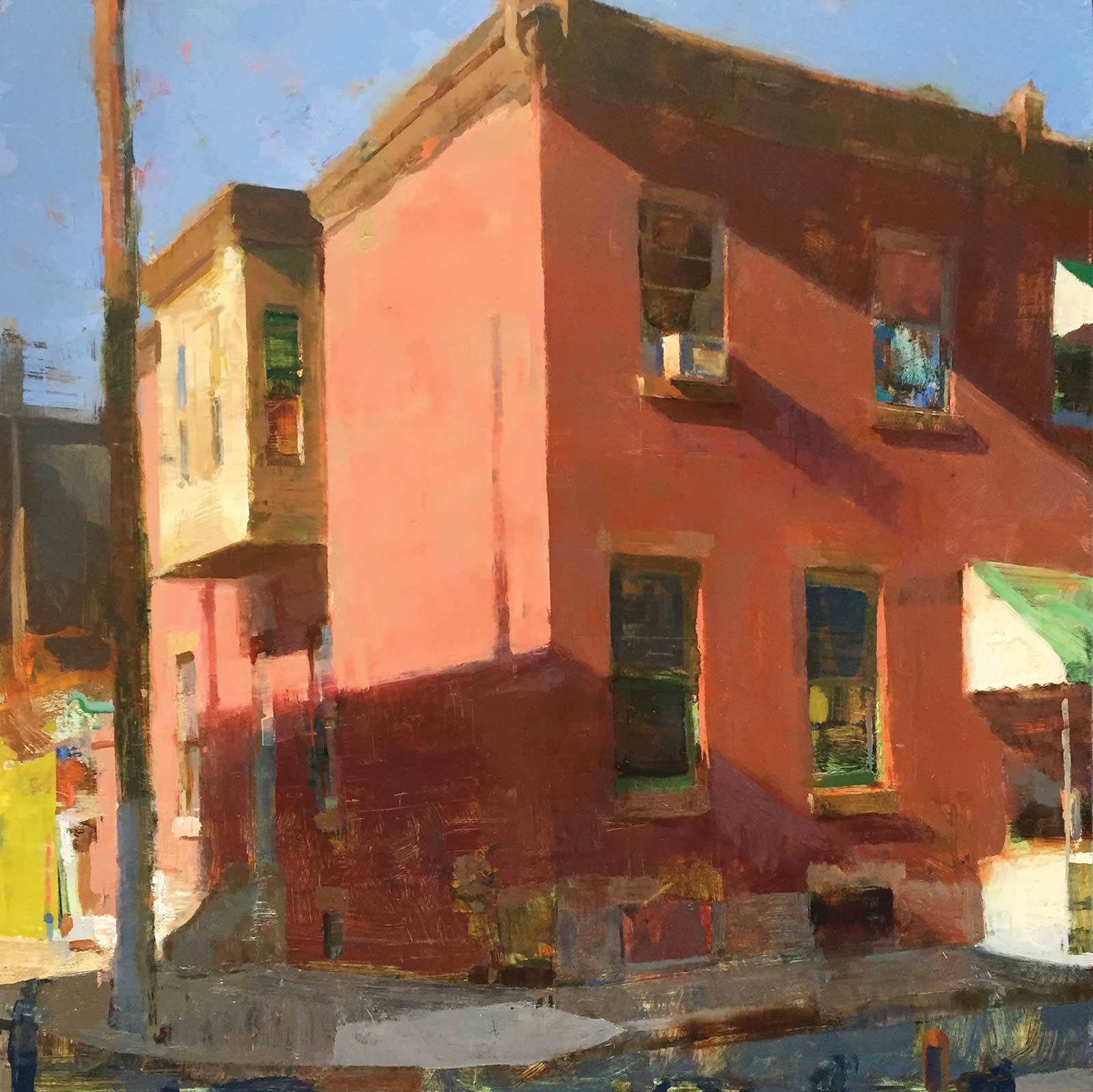 Curb Cut, oil on board, 24 x 24"
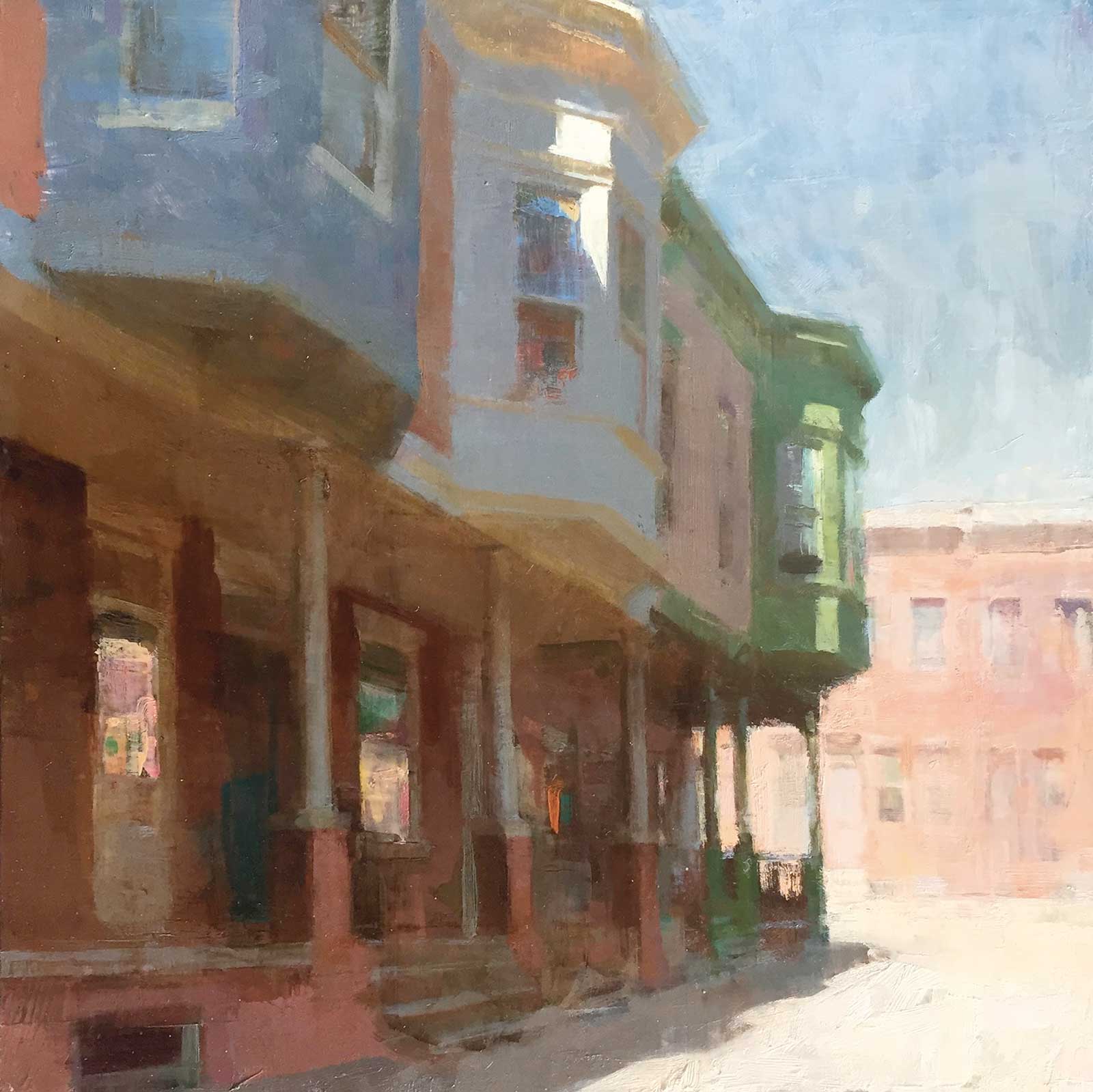 Three Bays, oil on board, 17½ x 17½"
The bucolic landscape around his home on the eastern side of the Berkshires in Massachusetts, is also a constant source of information—and exercise. When we finished our conversation, he was planning to go snowshoeing in a fresh 15-inch snowfall.
Stone Wall in the Woods was painted in the late fall. “When the leaves start falling,” he says, “the forest floor gets a warm orangey pink carpet. The round stones contrast with the geometrical, linear trees, which contrast with the negative space around them. The wall is like a stream flowing through the space.”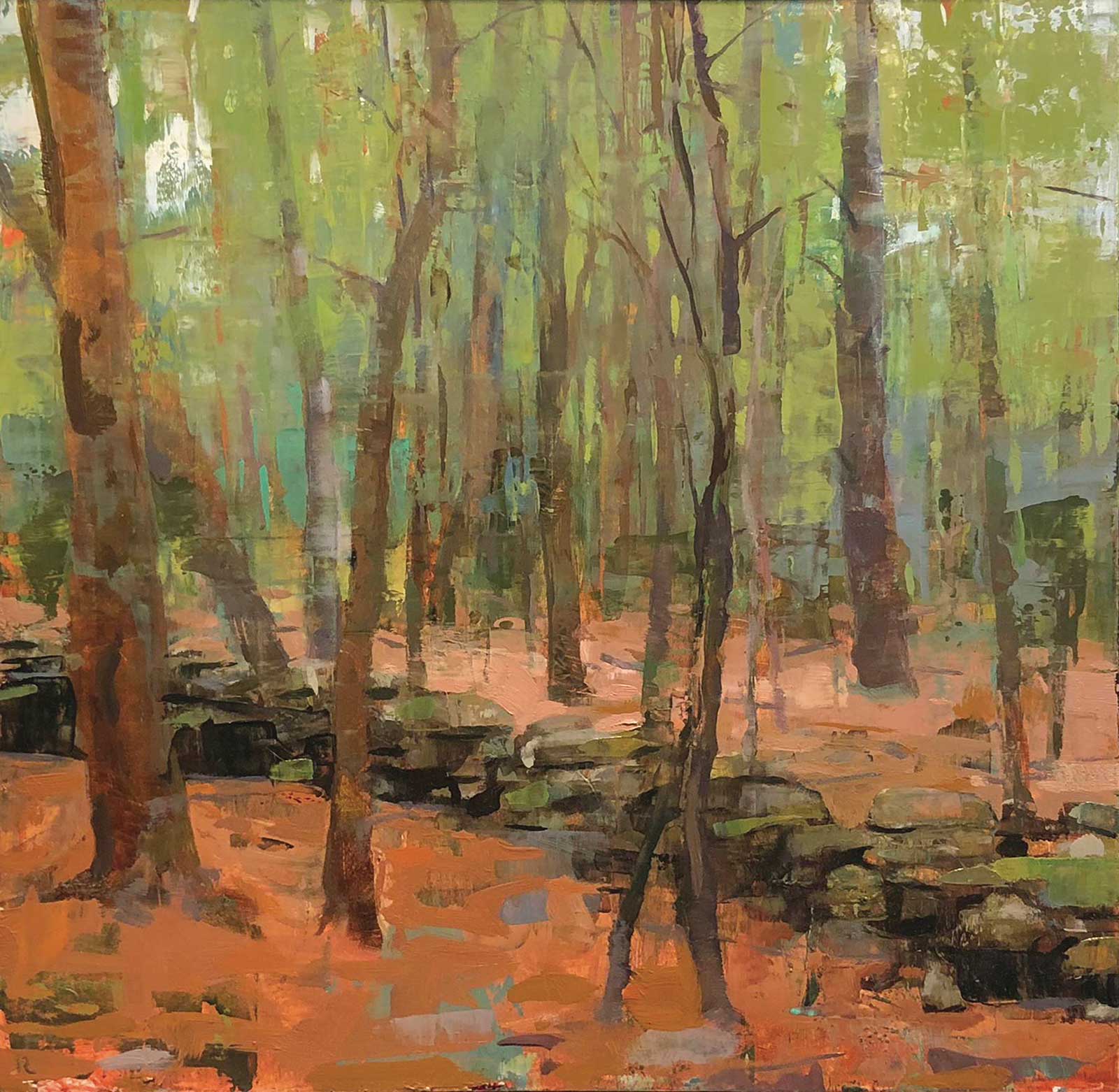 Stone Wall in the Woods, oil on board, 14 x 14"
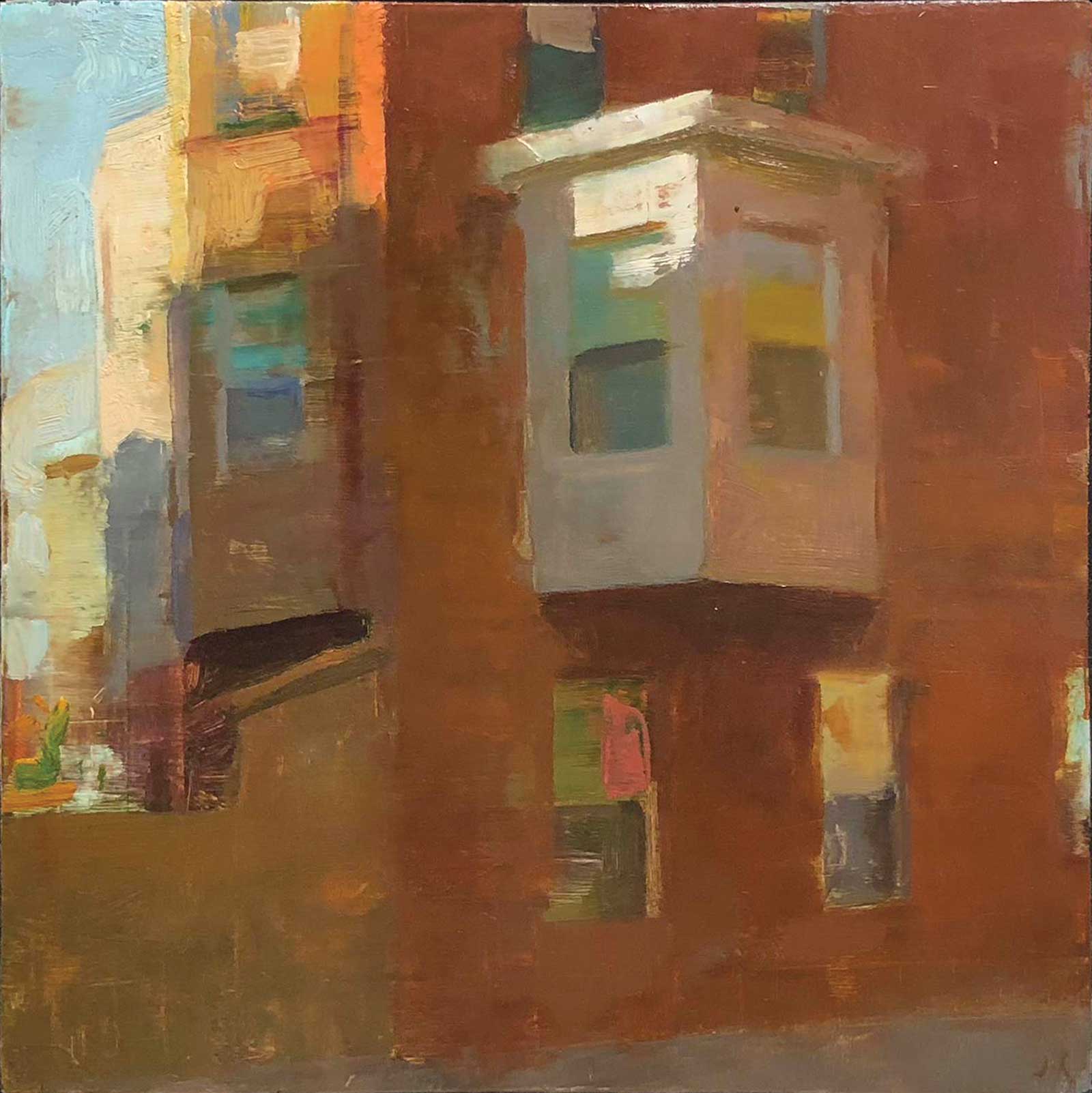 White Bay, oil on board, 10 x 10" Artwork images courtesy Somerville Manning Gallery, Greenville, DE.
Robert Frost, who, with Mary Oliver, is one of Redmond’s favorite poets, wrote, “Poetry is when an emotion has found its thought and the thought has found words.”
Redmond’s response to a scene, light animating a brick building or a teacup, percolates while he uses another part of his brain to work on his old farmhouse, snowshoe or to play the banjo. It then finds its way to oil paint on board—a visual poem of a moment to which he paid attention and was astonished. —
Powered by Froala Editor