The Egyptians depicted funerary paintings of food in the 15th century BCE. The tradition of still life painting reached a height in the Dutch Golden Age between 1575 and 1675, with extraordinarily realistic, dramatic and heavily symbolic paintings of abundance. Among them, vanitas paintings contained a skull alluding to the ephemeral nature of it all.
The tradition of still lifes continues today unburdened of universally accepted symbolism and open to the visceral inspiration of artists that resonates on a more personal level with the viewer.
Frank Oriti first came to fame painting portraits of his peers who had left their native Cleveland and “returned to places we attempted to escape.” He has moved “beyond portraits and figure paintings in the last five years, painting denim, leather jackets and sneakers that have all made me realize how I look and how I study things when I go about painting them. Making sure they are centrally placed, being able to control soft and hard edges, and the overall form that these objects take are all worthy of close inspection during the painting process.”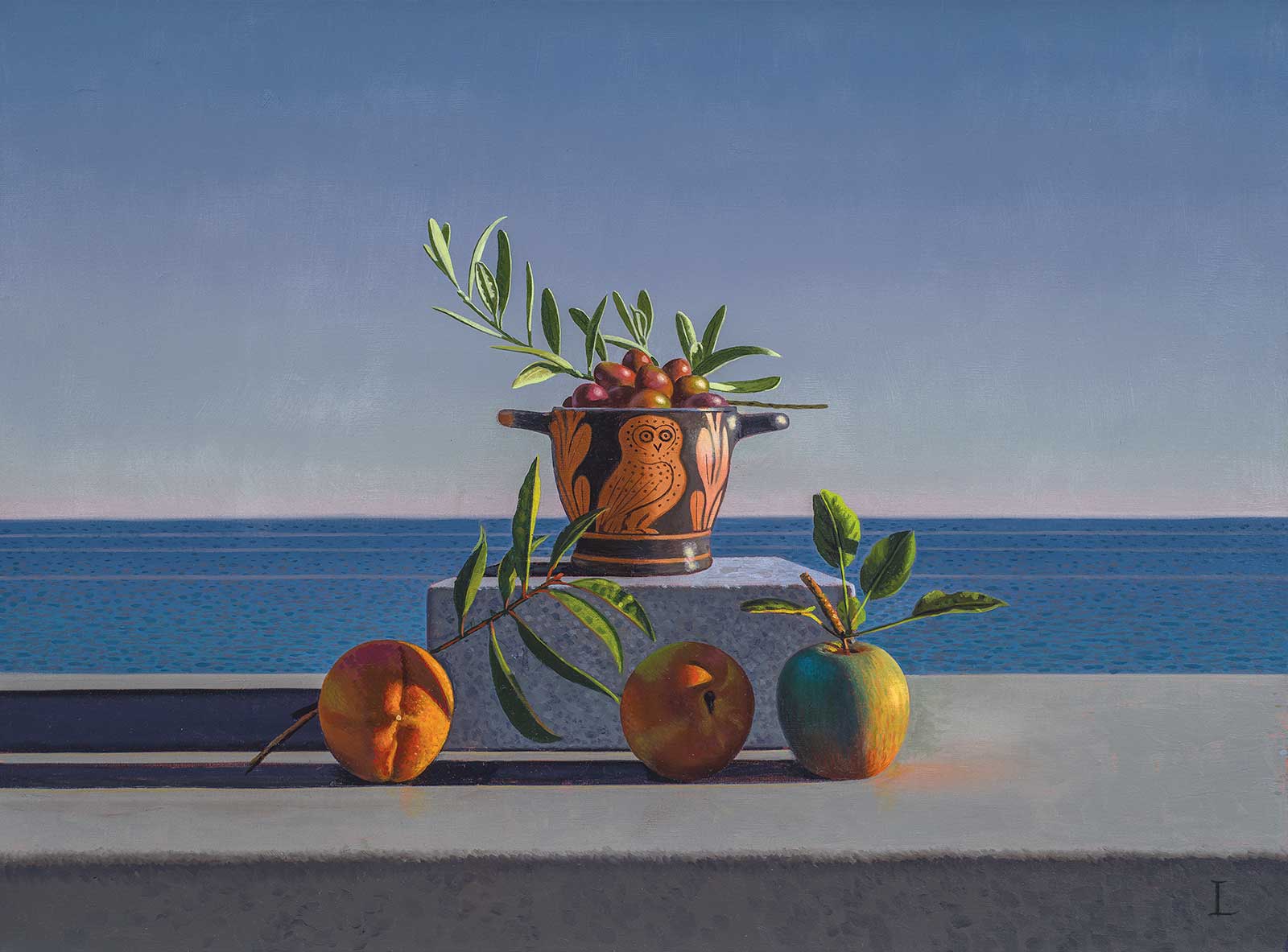 Winfield Gallery, Still Life with Peaches, Olives and Apple (detail), oil on canvas, 18 x 24", by David Ligare.
Banned features one red and black, iconic Air Jordan, front and center with no context and no modulating shadows. He paints the materials themselves, commenting, “I wanted full attention on the object so that the viewer has to confront the material and all of the rips and tears and faded details. Painting sneakers has opened things up in regards to painting with a wider range of color as well as teaching myself to paint new and interesting materials.” He reaches a high level of verisimilitude in ways that Golden Age painters would be comfortable with and others they never thought of. Oriti explains, “Depending on what specific material I am painting—sometimes I build the form with thick paint and scratch into it. Sometimes I work in very thin layers of glaze. Other times I put paint down, partially wipe it away, and then paint back into it—whatever it takes to bring these objects to life.”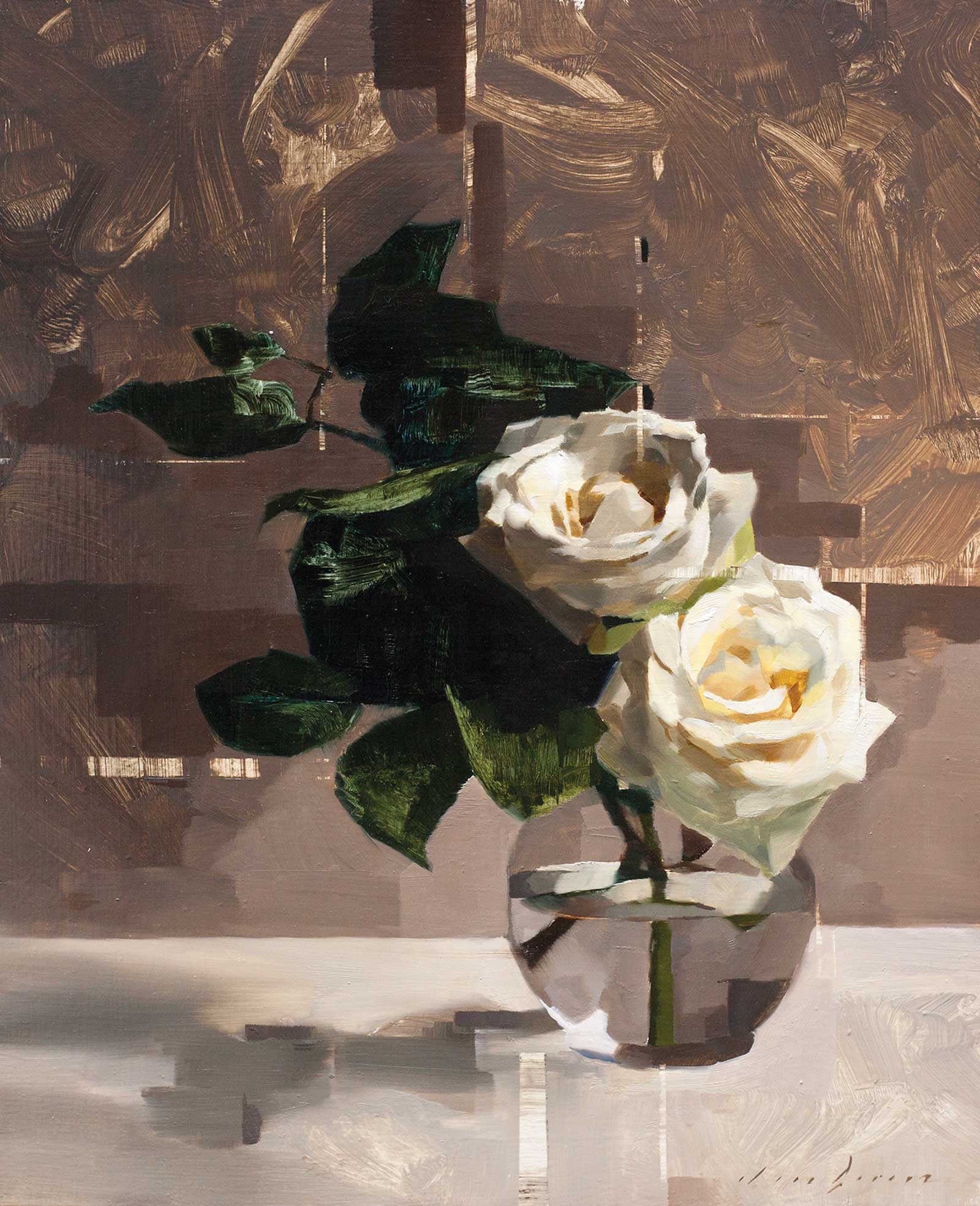 Abend Gallery, Roses and Shade, oil on panel, 13.78 x 11.22", by Jon Doran
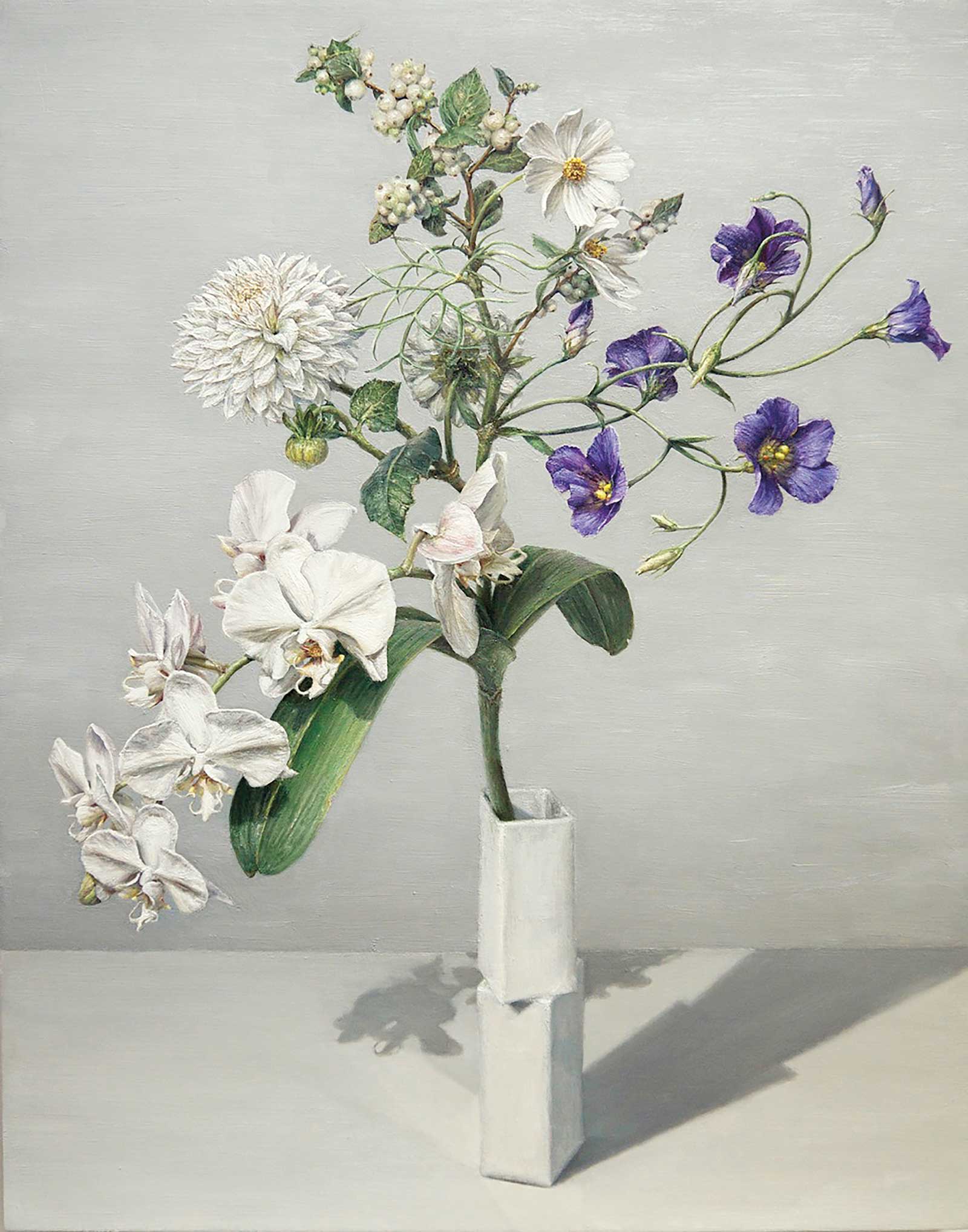 MARC STRAUS Gallery, The Von Humboldt, oil on wood panel, 28 x 22", by Clive Smith
Jon Doran brings traditional still life into a world in which we see differently. We became accustomed to depth of field through photography and now experience the digital breaking up of images into pixels. Doran paints lush, painterly, representational still lifes that challenge our perception.
“Hopefully,” he explains, “viewers find themselves bouncing between engaging with the subject, the cup or floral arrangement, for example, and the actual substance of paint, the streaks, dashes and marks. Almost like breaking the fourth wall, I hope to coax the eye into believing the play of light on form, but then call it out and show that it’s just paint on a surface."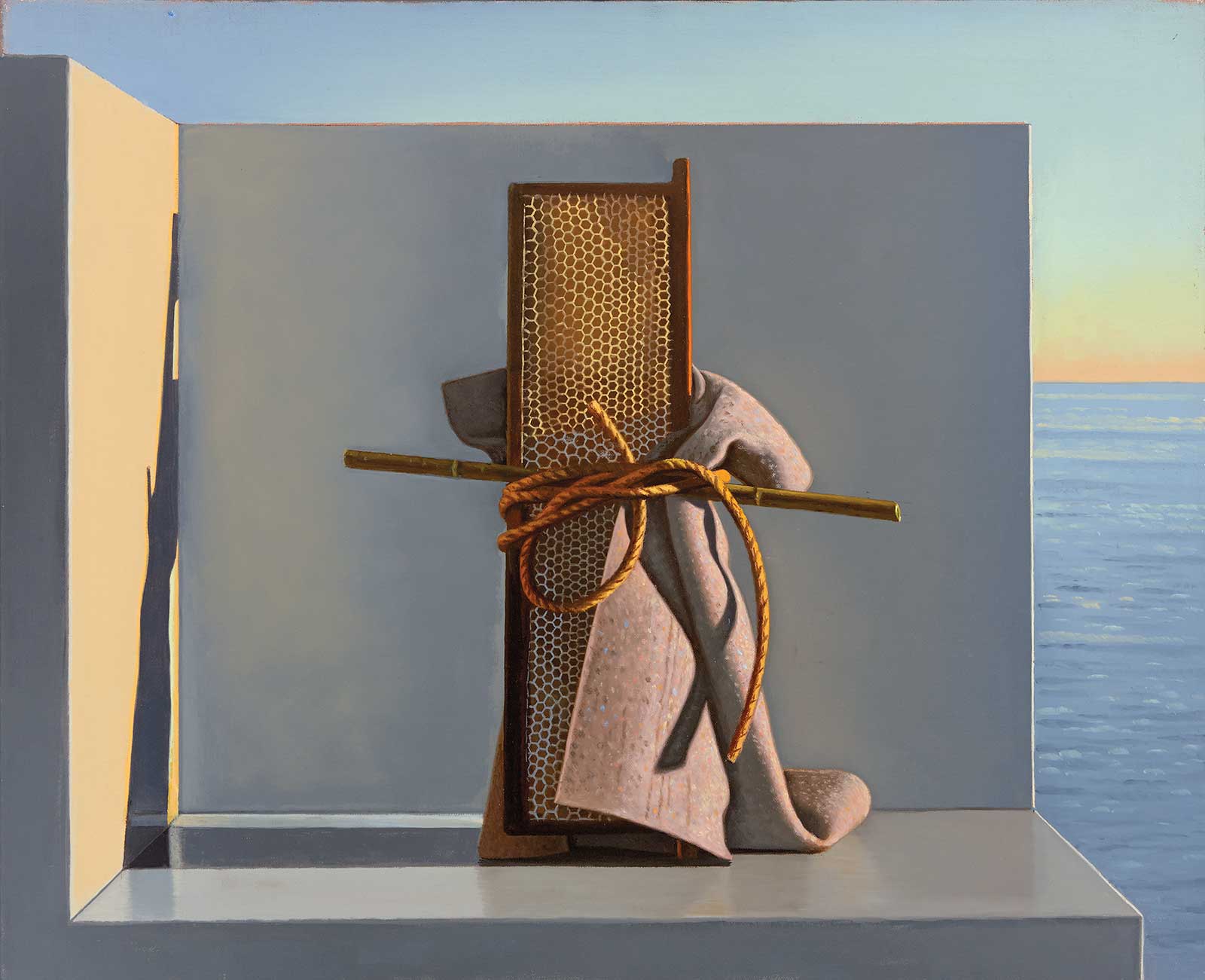 Winfield Gallery, Still Life with Honeycomb, oil on canvas, 18 x 22", by David Ligare
Roses and Shade delights with its soft petals and glossy leaves. Doran interrupts the calmness of the composition with a streak extending vertically from beneath the vase up through the stems and shadows of the roses and off into the background. It becomes part of the composition but exists on the surface not within his illusion of depth.
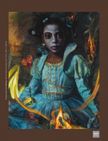
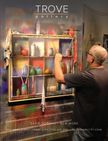
Clive Smith won the prestigious BP Portrait Award at London’s National Portrait Gallery in 1999. At the time, I acquired one of his portraits for the collection of the Arnot Art Museum. Since that time, he has reinvented himself several times, commenting more often on species extinction, consumer culture and, at one point, imagining himself “a biotech florist.” He comments on the unreality of the Golden Age still lifes in which plants appeared to be in bloom at the same time although they never were in nature. In The Von Humboldt, sweet peas, orchids and chrysanthemums bloom off the same stem. The setting at first appears to be a shelf against a wall but the shadows fall off into a nebulous space that echoes the mysterious and threatening shadows of the earlier Dutch still lifes.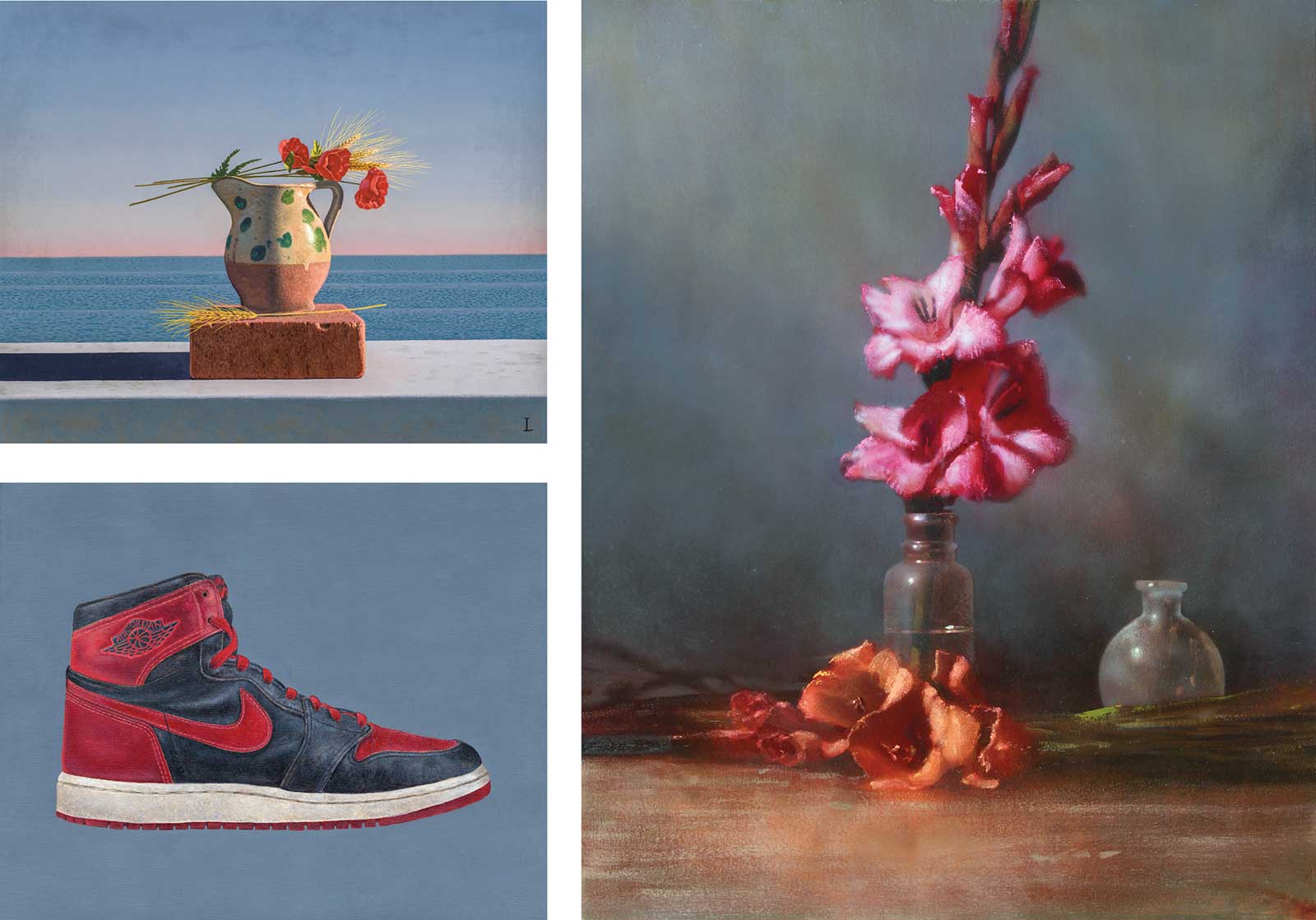 Clockwise from top left: Winfield Gallery, Still Life with Pitcher, Poppies and Wheat, oil on canvas, 18 x 22", by David Ligare; TROVE Gallery, Tower II, oil on canvas, 40 x 32", by David Dornan; RJD Gallery, Banned, oil on canvas, 16 x 20", by Frank Oriti
Contemporary artists from around the globe continue the tradition of still life painting by often looking back at the techniques of past masters, but painting for today. Their styles and subjects vary and provide wide appeal to collectors of all types.
California-based Winfield Gallery represents the work of modern-day still life master David Ligare. His artwork is an investigation into still life meanings and history, with Greco/Roman imagery, literature and philosophy being the crux. It allows him to show opposites, such as a rock and leaf or candles and a sponge, “because the essence of classicism is the balance of opposites,” he explains.
“Then, after seeing shrines in Nepal with chickens pecking at the offerings I remembered seeing similar images in still lifes from Pompeii and Herculaneum, I made a study and discovered that there was indeed a type of offering called Aparchai in Greek and Primitiae in Latin left on shrines,” says Ligare. “These were what are called ‘fruit-first offerings’ left in thanks for successful harvest or other endeavors.” His first exhibition of these paintings was in London in 2005.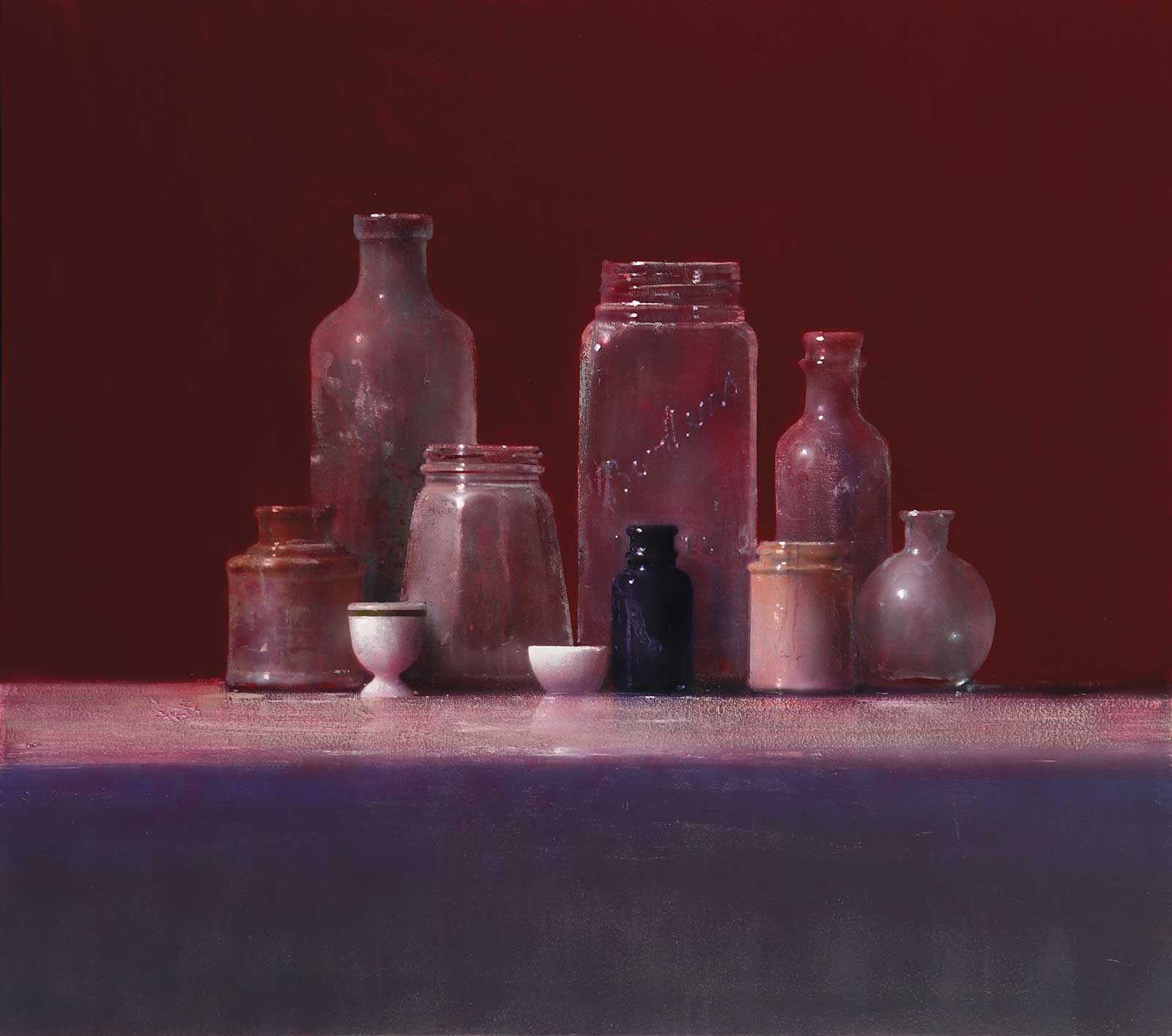 TROVE Gallery, Old Friends, oil on canvas, 40 x 45", by David Dornan.
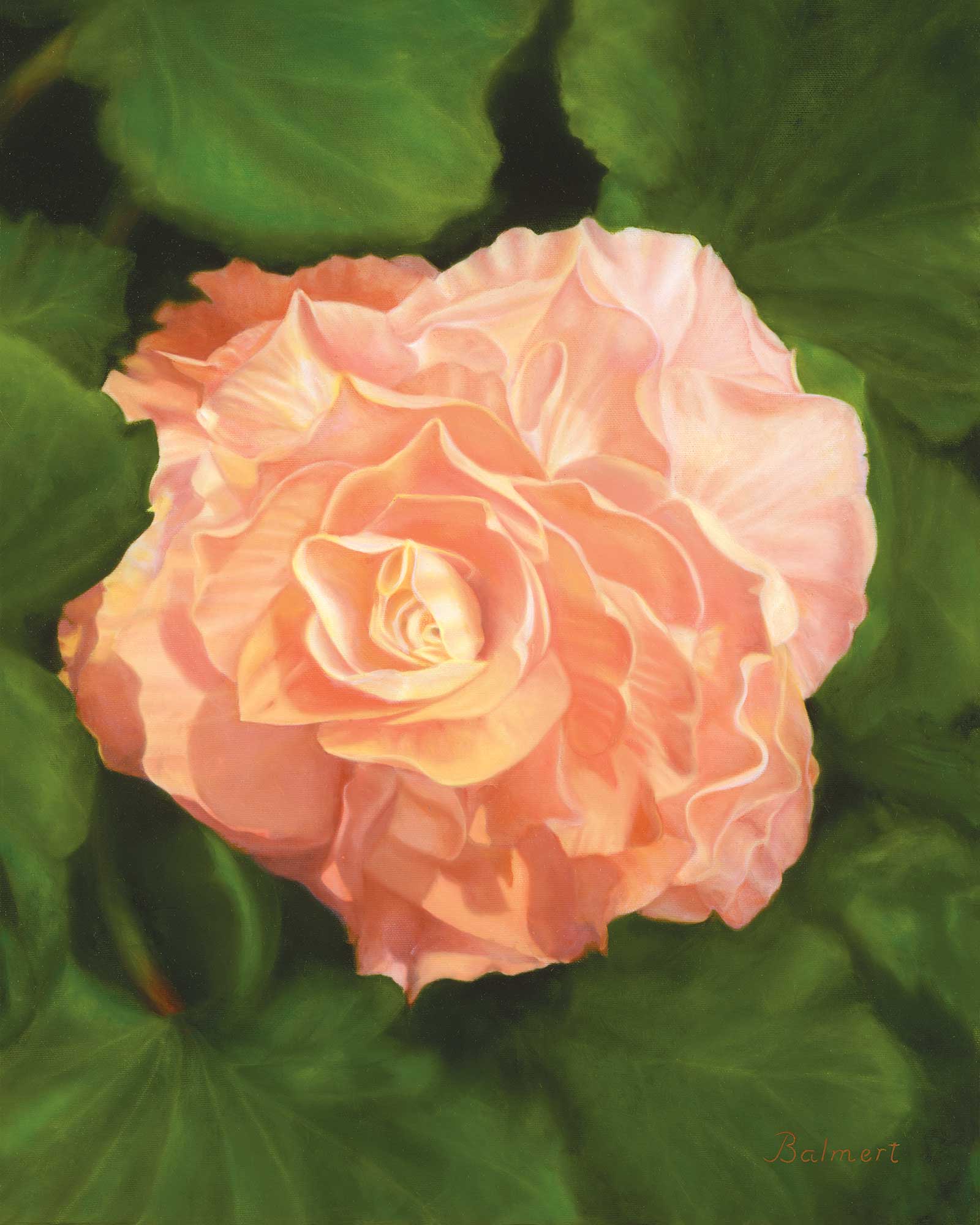 Nancy Balmert, Beautiful Begonia, oil, 20 x 16"Ligare’s artwork explores these modern and historic ideas, but the “true impetus, for me, has been seeing the objects illuminated by the late afternoon sunshine. Sunshine and its philosophical meaning have been the unifying element in all of my work.”
TROVE Gallery in Park City, Utah, announces brand-new works of art by David Dornan for 2021. Among the offerings are his still life paintings that depict commonplace objects in monumental sizes. As an artist who is always developing his process, Dornan’s latest works will revisit familiar subjects but with a twist. “I am trying to see old friends in new ways,” Dornan explains.
For the last 10 years, Dornan has been experimenting and adjusting his process to push his artwork to new levels and to keep painting fresh. This includes using stencils he cuts outs to shield parts of the work while blasting others with energy and color, creating a sense of freedom in the work. And he also plays with the oil paints themselves, having figured out a way to make oil paint behave like charcoal, for instance.
Dornan adds, “I continually want to reinvent the process. That’s what’s changed for me more than the objects. I’m very interested in taking objects that people would throw away or toss out and give them a stage that makes them fixed in time.”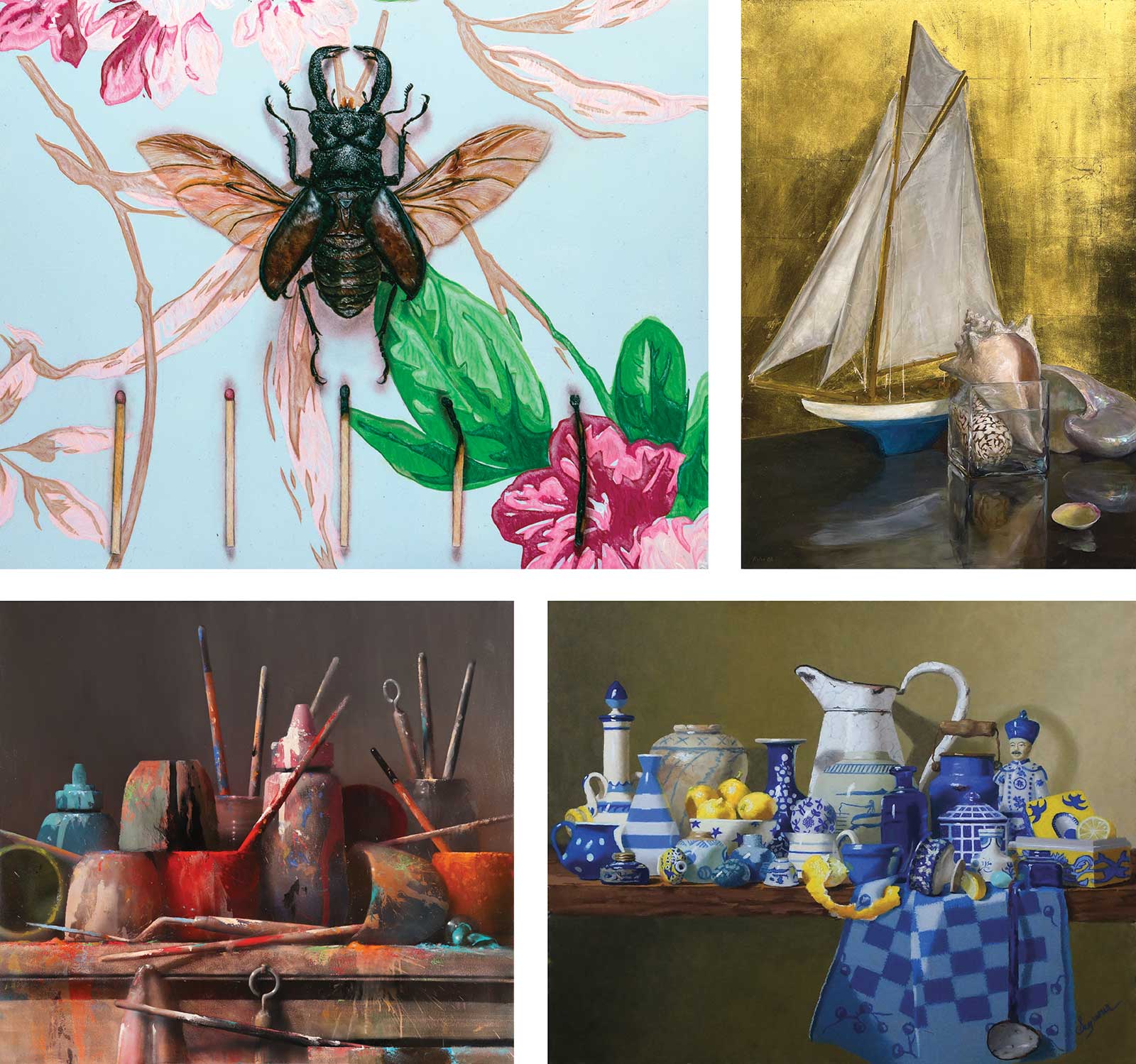 Clockwise from top left: Gallery Victor Armendariz, The King Beetle, oil and acrylic on aluminum, 8 x 10", by Matthew Cook; Gallery Victor Armendariz, Still Life with Sail Boat, oil on panel with gold leaf, 24 x 18", by Helen Oh; Claudia Seymour, Robin’s Egg, soft pastel on Art board, 16 x 20"; TROVE Gallery, Nestle II, oil on canvas, 45 x 50", by David Dornan.
At Chicago-based Gallery Victor Armendariz, collectors will find an assortment of contemporary still life works by artists such as Matthew Cook, Bruno Surdo and Helen Oh.
The story of the King Beetle in Cook’s painting of the same name “comes from a parable told by Bawa Muhaiyaddeen to illustrate different religions to his students. Here the King Beetle is seen with five matchsticks in varying degrees of consumption. These represent the fire that the King Beetle sends his disciples out to investigate. Each one comes back with deeper and deeper burns yet no more understanding of the fire. The King Beetle then decides to investigate and is consumed by the flames, thus sacrificing himself, represented by the final matchstick.”
Oh’s painting Still Life with Sailboat, depicting a model sailboat and seashells on a reflective tabletop, “evokes warm summer days and walks across the beach. The individually applied squares of gold leaf bring a glow of sun’s warmth to the painting.”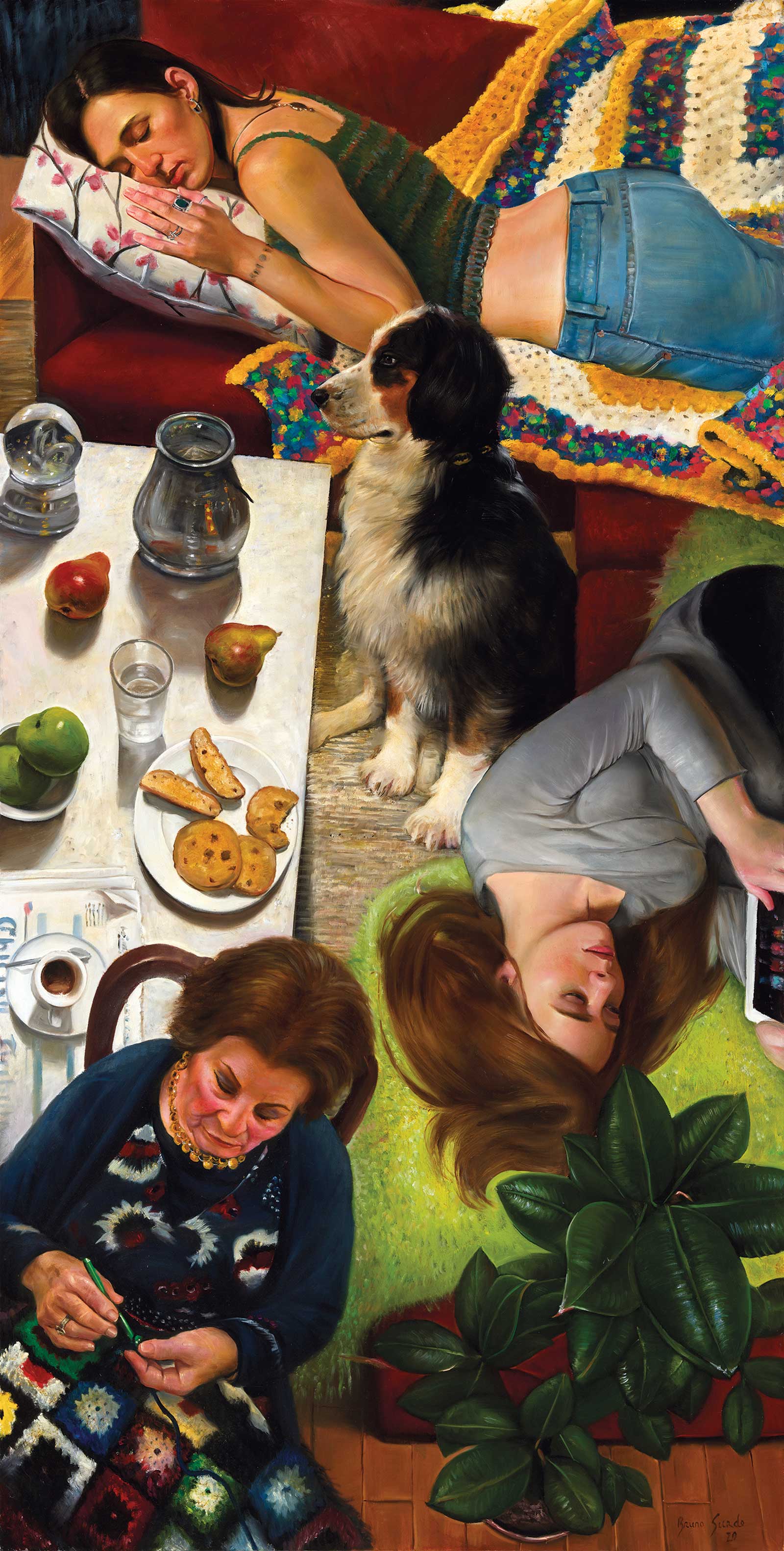 Gallery Victor Armendariz, Inner Bliss, oil on panel, 72 x 36", by Bruno Surdo.
Surdo blends figurative and still life in the painting Inner Bliss. “Sometimes all that we need is to kick back and enjoy the peace that comes with just being close to one another. In Bruno Surdo’s piece titled Inner Bliss, we can understand this mood completely,” the gallery shares. “Each individual is doing what they love best, be it sleeping, crocheting, relaxing but collectively, they are still all together.”
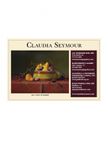
Wilton, Connecticut-based artist Claudia Seymour is almost exclusively a still life and floral painter. “I’m inspired by the beauty of the world around us—fruits, vegetables and flowers—and by the beauty that man has made in the form of textiles, antiques and ceramics,” she says. “I collect all manner of things that might find their way into my painting compositions, but I’m always after an appreciation of beauty, in the hope that the viewer will sense the loveliness of the objects I have arranged to paint.”
In her artwork, Krista Schoening “explores the history of still life, using the past as a mirror through which we can understand our present moment. Using historical art as a starting point. I ask myself why I feel a certain way about it, and what these feelings suggest about me as a contemporary person in the 21st century.”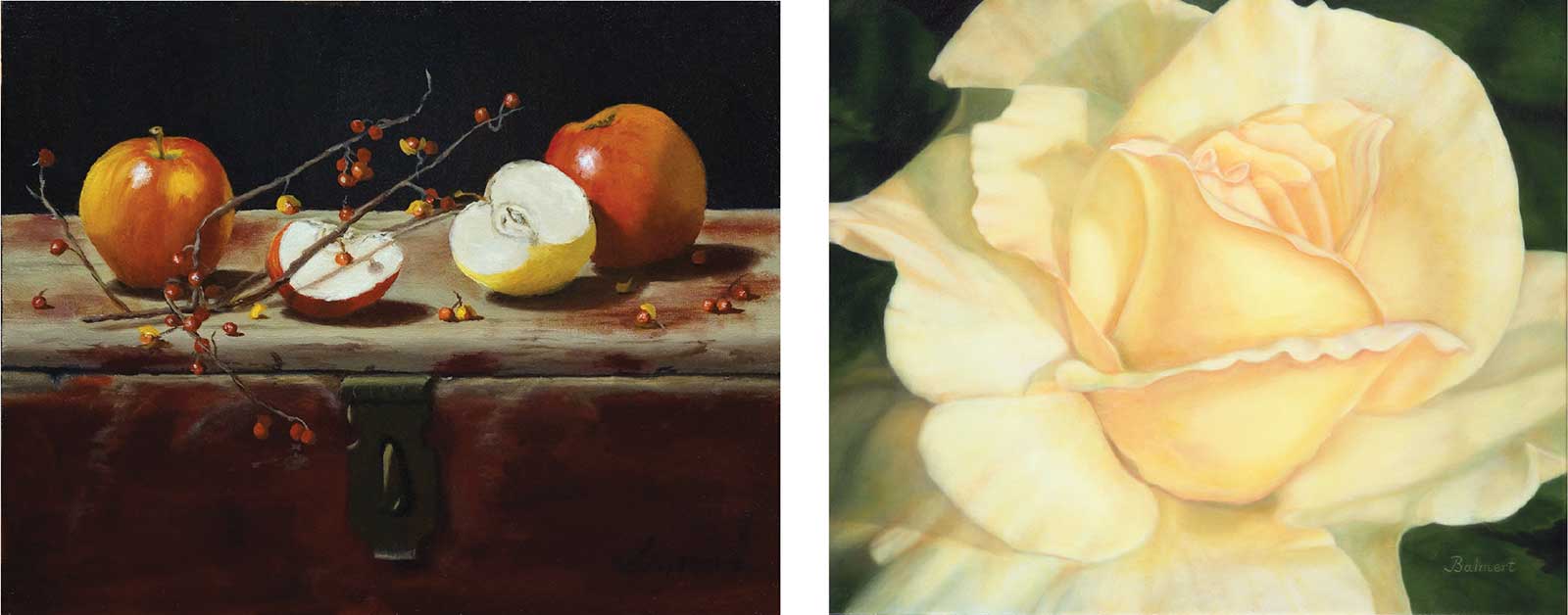 Left to right: Claudia Seymour, Bittersweet with Apples, oil on linen/panel, 8 x 10"; Nancy Balmert, Midas Touch Rose, oil on canvas, 20 x 24"
The artist, whose artwork can be found at Shift Gallery in Seattle, furthers, “My recent quilted pieces are inspired by both my love for the work of historical European painters, including Anne Vallayer-Coster, and also by my sense of disquiet at the connections between 21st-century crises and the intellectual and political legacy of the early modern era (in the case of this work, the time just before the French Revolution). In the acts of painting a master copy, cutting it and sewing it into a new configuration, I work through my ambivalence. My grandmother first taught me to quilt when I was a teenager, and to her quilts were a way of repurposing materials by recycling them into new configurations. This history (both personal and art historical) along with the quilt’s traditional association with women’s labor, inspired me to first take scissors to my canvas.”
This past September curators Francesco Saverio Russo and Salvatore Russo presented floral artist Nancy Balmert with Artist of the Year 2020 at Sciortino Museum in Monreale, Italy. She also was selected by the curators to be one of 30 artists in the book Artisti 2020. Balmert, who is represented by Amsterdam Whitney International Fine Art in New York City, is known for her large-scale florals that show the texture and hues of each bloom she paints.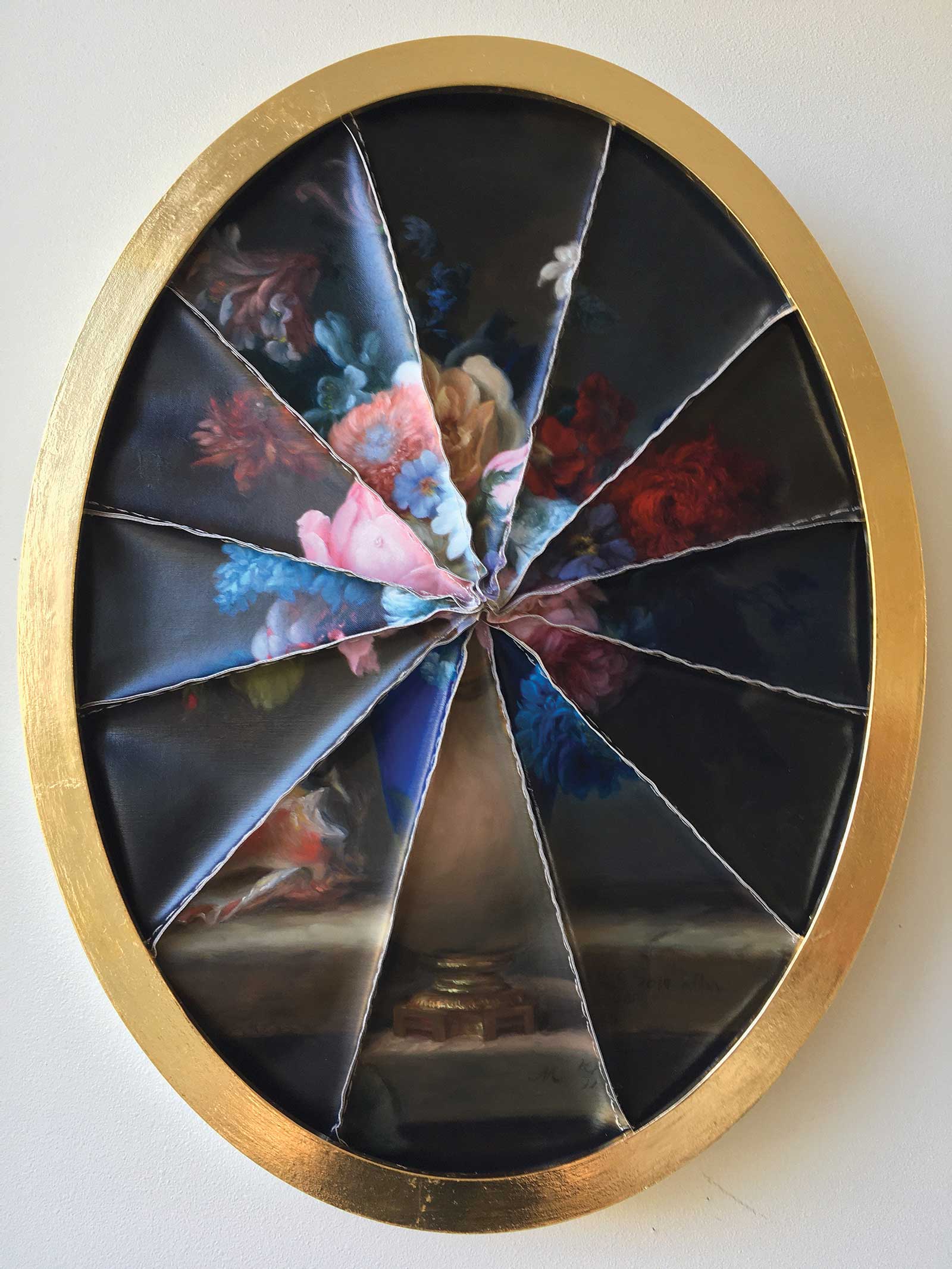 Krista Schoening, Quilted Bouquet after Anne Vallayer-Coster, oil on linen, hand sewn, 21 x 16"
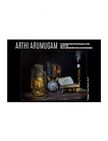
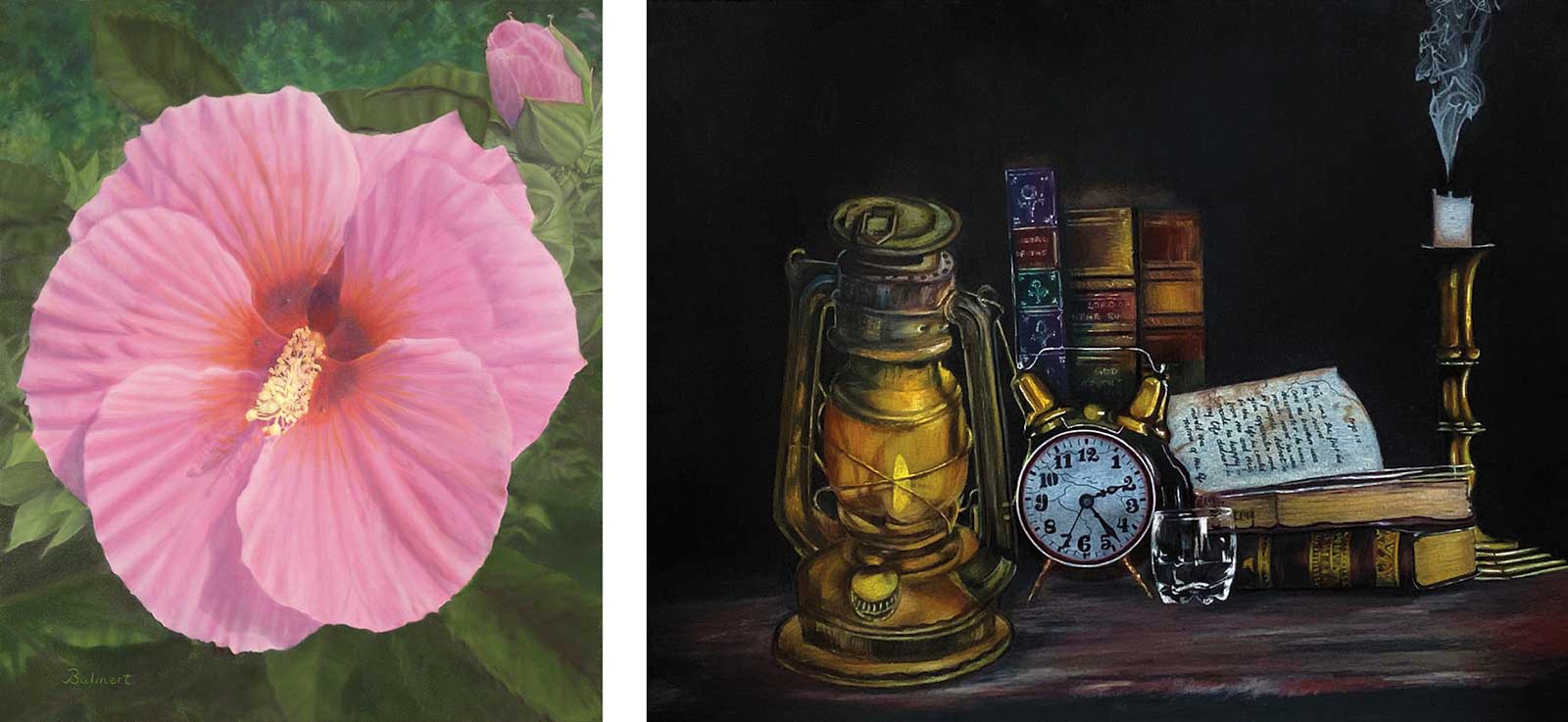 Left to right: Nancy Balmert, Hibiscus at Notre Dame, oil on canvas, 24 x 20"; Arthi Arumugam, Vintage, colored pencil, 11 x 14"
Ruthie Tucker, art curator and critic at the Amsterdam Whitney International Fine Art, recently wrote, “Intimately connected to nature, Nancy Balmert perfectly captures its picturesque soul, translating its ravishing details, allowing the soul of the flower to bloom in full essence. Bringing the natural scene to life with an explosion of vibrancy and warmth, one can feel as if one were strolling in the garden, inhaling the scent of the roses and feeling the warmth of the sun’s rays beaming down upon them.”
Arthi Arumugam composes her still lifes from real-life objects as well as those that come from her imagination. Her colored pencil drawing Vintage reimagined her contemporary study table as a 19th-century vintage book table. She added in her ideas of an antique lamp, a candle lamp, books and an alarm clock to round out the composition. The textures, reflections and translucency of the candle lamp and other objects in the painting create unique effects. She also added a bronze glow in the alarm clock’s bell and in the books as well as added smoke coming from the candle to set the mood and tone of the painting. —
Featured Artists & Galleries
Abend Gallery
1261 Delaware Street, Suite 2
Denver, CO 80204, (303) 355-0950
www.abendgallery.com
Arthi Arumugam
Richardson, TX, (918) 876-7787
sachinbala1046.wixsite.com/arthiarumugam
Claudia Seymour
Wilton, CT
claudiaseymour@aol.com
www.claudiaseymour.com
Gallery Victor Armendariz
300 W. Superior Street, Chicago, IL 60654
(312) 722-6447
www.galleryvictor.com
Krista Schoening
info@kristaschoening.com
www.kristaschoening.com
MARC STRAUS Gallery
299 Grand Street, New York, NY 10002
(212) 510-7646
www.marcstraus.com
Nancy Balmert
www.nancybalmert.com
RJD Gallery
2385 Main Street, Bridgehampton, NY 11932
(631) 725-1161
www.rjdgallery.com
TROVE Gallery
804 Main Street, Park City, UT 84060
(435) 655-3803, www.troveparkcity.com
Winfield Gallery
Dolores between Ocean & 7th
Carmel-by-the-Sea, CA 93921
(831) 624-3369
www.winfieldgallery.com
Powered by Froala Editor