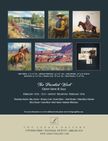
When William Michael Harnett’s Trompe l’Oeil painting The Old Violin was first exhibited at the Cincinnati Industrial Exposition in 1886, the local paper reported, “A painting has been added to the Art Gallery, which has created a furore…Visitors need no guide-post; they will find it by following the crowd.” It was also reported that a guard was stationed by the painting to keep people from trying to pluck the objects off it. Harnett (1848-1892) said, “As a rule, new things do not paint well. I want my models to have the mellowing effect of age.”
A well-used violin hangs by a string from a rusty nail. The presence of several new nails suggests that the old door is still in use and the strings of the violin show traces of rosin as if it is ready to be picked up and played again. (Rosin creates friction between the strings and the hair of the bow that hangs nearby.) The painting is more than a tour de force in tricking the eye according to the National Gallery. It references “relationships between illusion and reality, between old and new, and between the momentary and the enduring. At the heart of such meanings is the transience of time, which the artist illustrated by showing signs of wear and age throughout the painting.”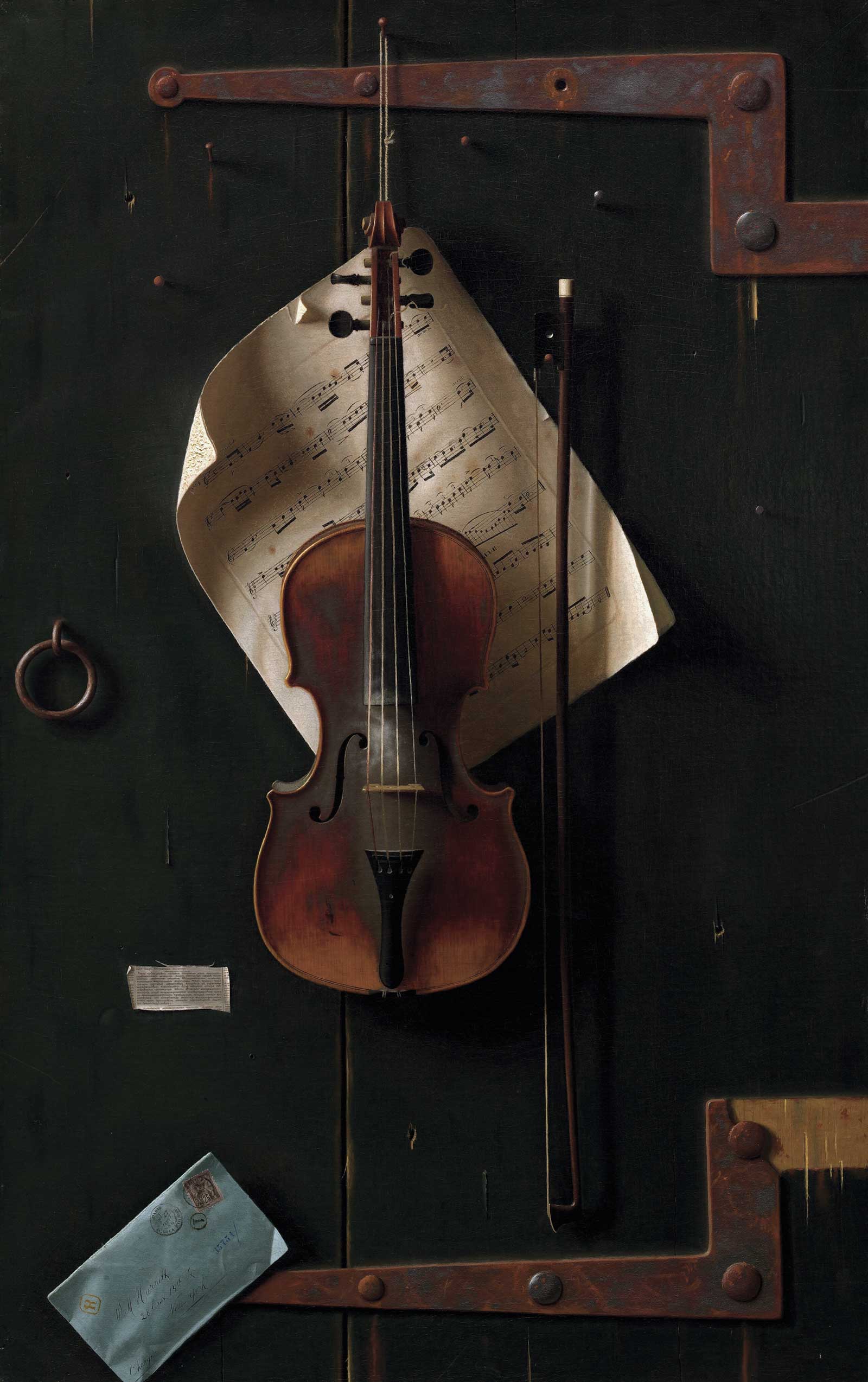 William Michael Harnett (1848-1892), The Old Violin, 1886, oil on canvas, 38 x 23 5/8". National Gallery of Art, Washington, D.C. Gift of Mr. and Mrs. Richard Mellon Scaife in honor of Paul Mellon.
Eric Conklin paints with traditional oils on canvas, mixing the paint himself, but diverts from tradition with some obvious as well as subtle visual humor. In Ben’s String Cabinet, objects hang from a string pinned to the cabinet door, including spectacles more visible by their shadow. Conklin gives away his painting technique in the unfinished lower right portion of the painting indicating he may paint by numbers. The humor continues in the seemingly unrelated objects hanging on the door—a key on a string that forms the shape of a kite and Ben Franklin peering out from a hundred dollar bill—a nod to Franklin’s exploration of electricity and lightning and his early advocacy of paper money.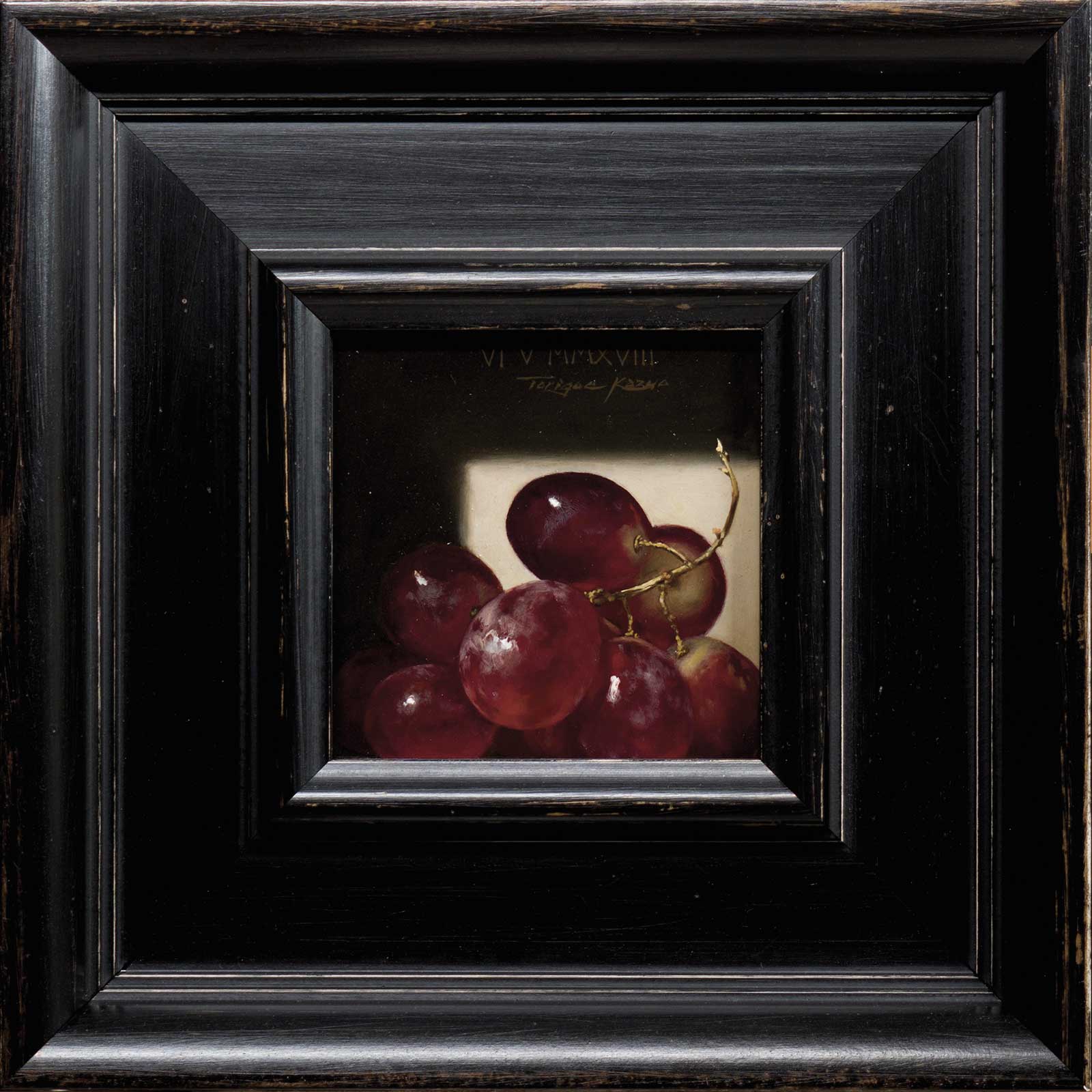 Kazuo Torigoe, VI V MMXVIII, oil on copper, 4.33 x 4.33"
John Whalley’s old objects are from his vast collection of lovingly made and lovingly used objects from books to plumb lines. I don’t usually think of monkey wrenches as being poignant, but Grandfather elicits that response. The warmly rusted Stillson wrench with its wooden handle was manufactured by the Oswego Tool Co. It dwarfs the smaller wrench, well-used as well, but cared for and rust free. They may not be related, but they form a bond when Whalley puts them together. He says, “I seem to find, to discover, the beautiful in unexpected, sometimes odd places, and attempt to share, through my artwork, these discoveries with the receptive viewer.” Just as Harnett’s violin is ready to be taken down and played, the utilitarian wrenches have years of life in them despite their scars.
Lee Alban takes Trompe l’Oeil outside adding another level of trickery. Taped onto a scene in the desert Southwest is a vintage photograph of a teepee in the same setting. He says, “All of the paintings in this series [Spirits of the American West] have titles which are Native American sayings. The concept of the series is to pay homage to the Native Americans who once lived in the areas depicted in my landscapes.
I used Trompe l’Oeil paintings of vintage photographs as a unique way to ‘return’ the original inhabitants to their lands. As an additional homage, I researched Native American sayings to use as titles. I titled this painting, May the Warm Winds of Heaven Blow Softly Upon Your House, because of the teepee.”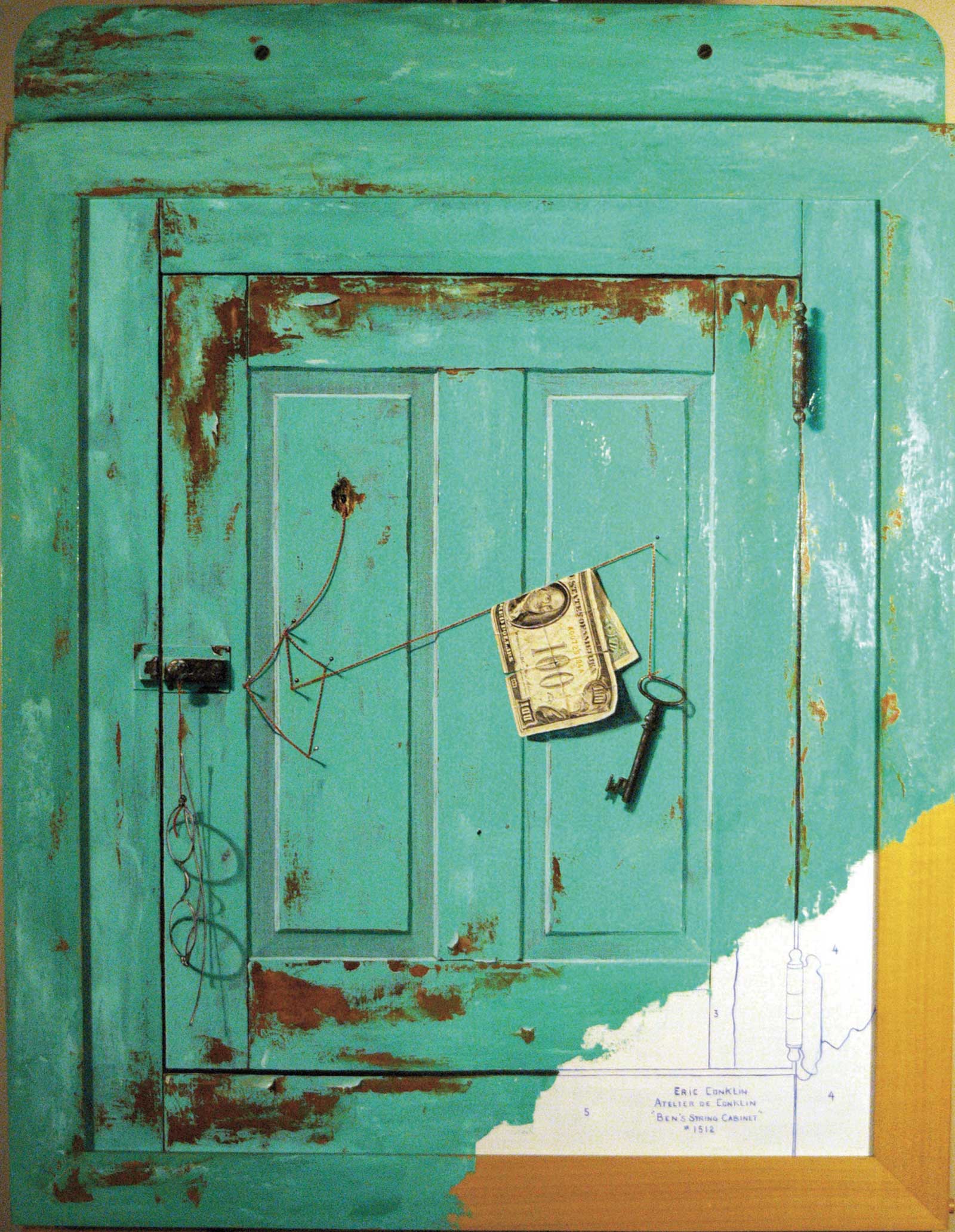 Eric L. Conklin, Ben’s String Cabinet, oil, 30½ x 23". Courtesy McBride Gallery, Annapolis, MD.
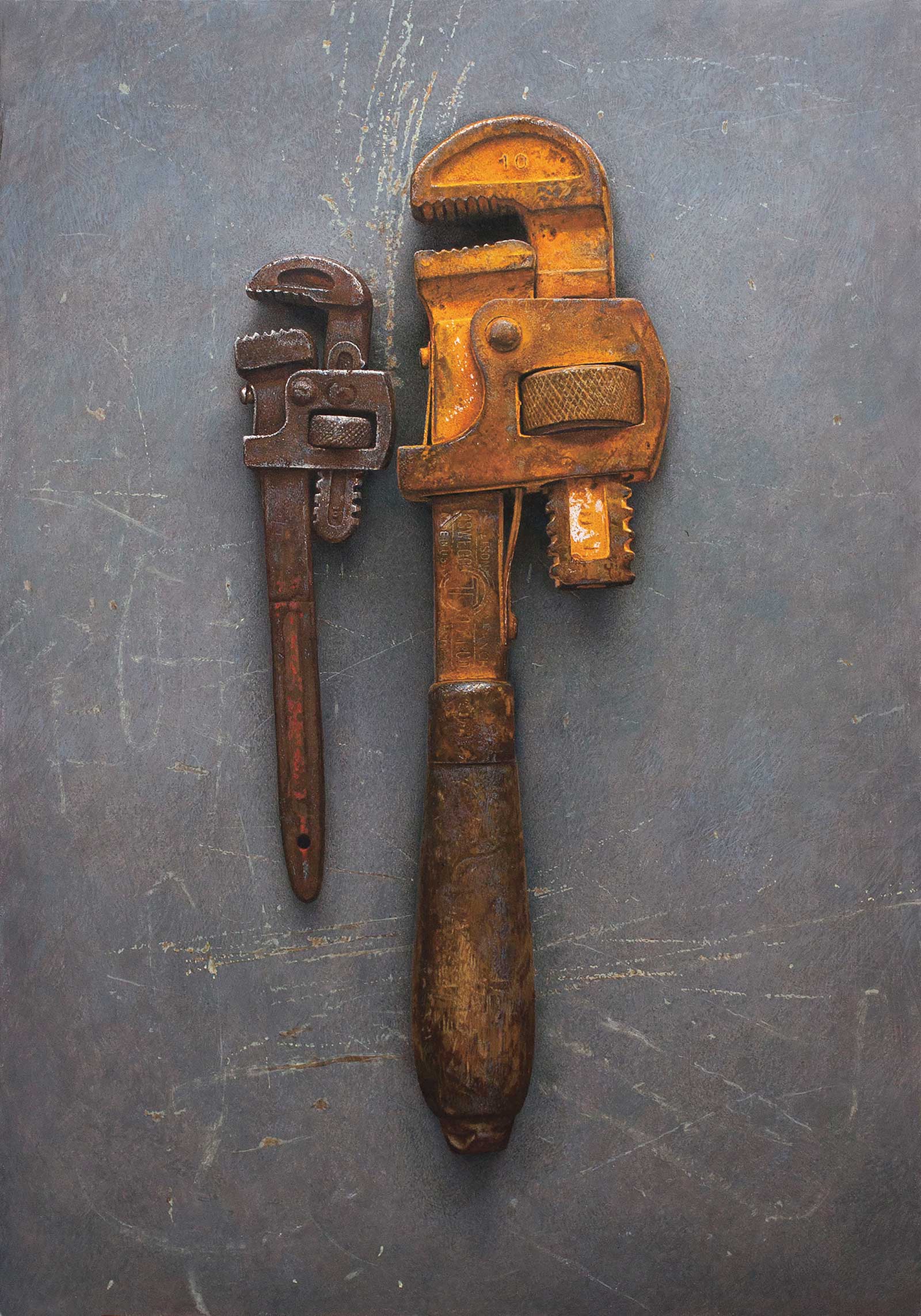 John Whalley, Grandfather, egg tempera on panel, 30 x 21". Courtesy Greenhut Gallery, Portland, ME.
Kazuo Torigoe paints on copper plates in the manner of European painters of the 16th and 17th centuries. He views his work as homage to both the traditional materials he uses and to the history of Trompe l’Oeil. The plates resist environmental degradation, are stable and portable. Torigoe often grinds precious materials such as malachite and lapis lazuli to make the pigments for his paints.
He often paints an illusion of part of the frame with articles seemingly extending out of the frame. In VI V MMXVIII, which is less than 5 inches square, he creates a “shadow box” with the painted shadow of the frame projecting onto the back wall of the “box,” as he says, “in order to create a connection with the space.”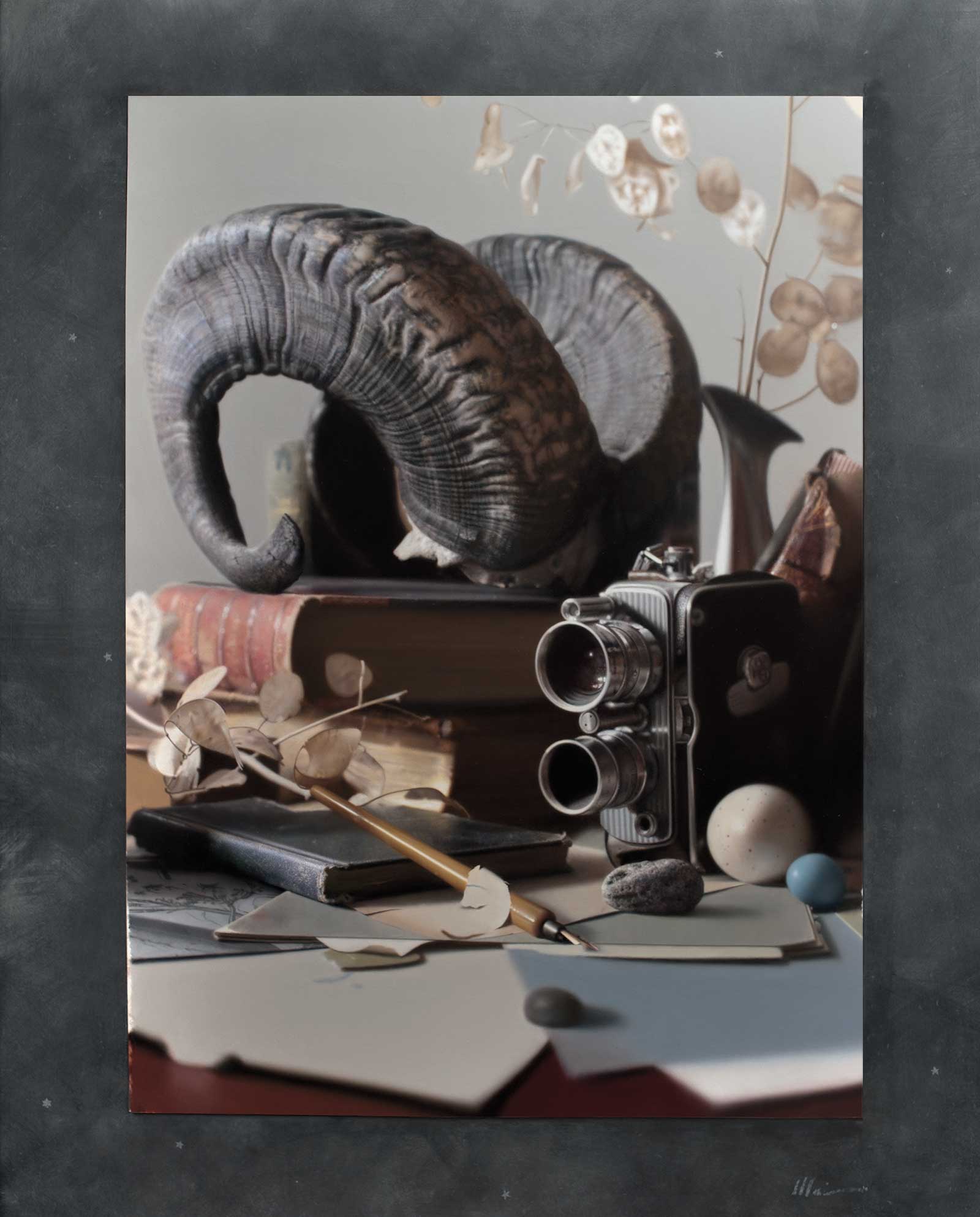 Anthony Waichulis, Natura, oil, 30 x 24". Courtesy Gallery 1261, Denver, CO.
Anthony Waichulis, seemingly at the top of his career, humbly acknowledges the past, learning and the future. “My desire to learn and grow as an effective representational Trompe l’Oeil painter remains unfettered. I aspire to honor those I follow and strive to give benefit to those who may one day follow me.” A student of the science of visual perception, he acknowledges that “patterns of light trigger neural activity” that, in our brain, form an image.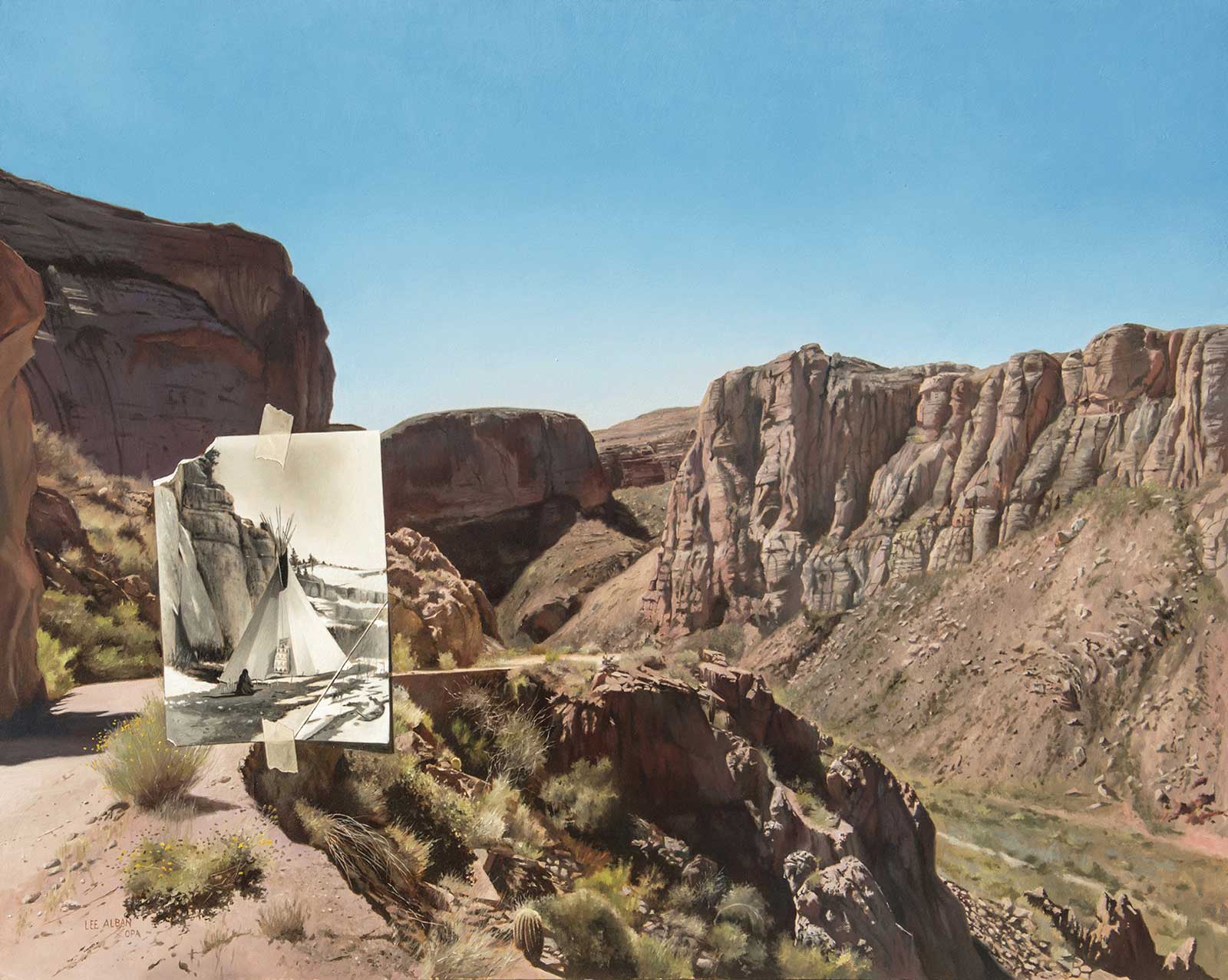 Lee Alban, May the Warm Winds of Heaven Blow Softly Upon Your House, oil, 24 x 30"
In Natura, he plays with our visual perception. In a Trompe l’Oeil painting we expect extraordinary detail from foreground to background. Here he paints how we actually see. When we focus on an object, everything else is relatively out of focus, a phenomenon photographers manipulate by adjusting depth of field in their cameras. The focal plane is roughly at the lenses of the camera. The ram horns and seed pods of the money plant are out of focus as is the edge of the paper in the foreground. It’s as if he is deliberately singing out of tune. When the viewer realizes the depth of focus is shallow he searches for something in focus which, for me, was the seed pod on the far left, all the while marveling at the painter’s skill. —
Powered by Froala Editor